The Hidden Cost of Organizational Silos
Source of Image: Elevate GTM Solutions
The Hidden Cost of Organizational Silos
Most organizations do not deliberately create silos. They form gradually as companies grow, teams specialize, and new systems are introduced. Sales builds its own customer view, marketing develops its own segmentation logic, product tracks usage differently, and finance maintains separate reporting structures. Over time, each function becomes optimized for its own performance rather than the performance of the organization as a whole. What begins as specialization slowly turns into separation, and once it happens, it becomes part of how the company operates.
The Real Cost Is Economic, Not Technical
Silos are often treated as a data or systems issue, but their real impact is economic. When information is fragmented, execution slows and effort multiplies. Teams duplicate work, leadership spends time reconciling conflicting narratives, and investment decisions become harder to align. Research from McKinsey has shown that companies often lose substantial value not because they lack data or strategy, but because those elements are not connected across functions. The loss rarely appears in one place. Instead, it spreads quietly across productivity, growth, and operational clarity.
Silos Quietly Slow Decision Making
One of the least visible effects of silos is decision latency. When each team works from a slightly different version of reality, decisions require negotiation before action. Meetings become about alignment rather than progress. Deloitte has pointed out that many organizations struggle to translate insight into action because information sits in separate systems and ownership is fragmented. The issue is rarely lack of data. It is the friction involved in turning that data into coordinated decisions.
They Also Distort Priorities Across the Business
Silos do not just slow decisions. They shape them. Each function naturally optimizes for its own goals and timelines. Marketing may prioritize growth, finance may focus on efficiency, product may emphasize innovation, and sales may push short-term revenue. Each decision may be reasonable on its own, yet misaligned when combined. BCG has noted that fragmented operating models often lead to inconsistent execution because teams interpret priorities differently. Over time, this creates drift between what leadership intends and what the organization actually does.
Why Silos Persist Despite Heavy Investment in Tools
Most organizations attempt to solve silos by adding new platforms or dashboards. Yet technology alone rarely fixes structural misalignment. Gartner research consistently shows that organizational design, incentives, and decision frameworks play a larger role in performance than tools themselves. Silos persist because they are embedded in workflows and reporting lines. Teams are rewarded for optimizing their own outcomes, not for strengthening the system as a whole. Integration becomes an initiative rather than a natural way of working.
Breaking Silos Requires Shared Context, Not Just Shared Data
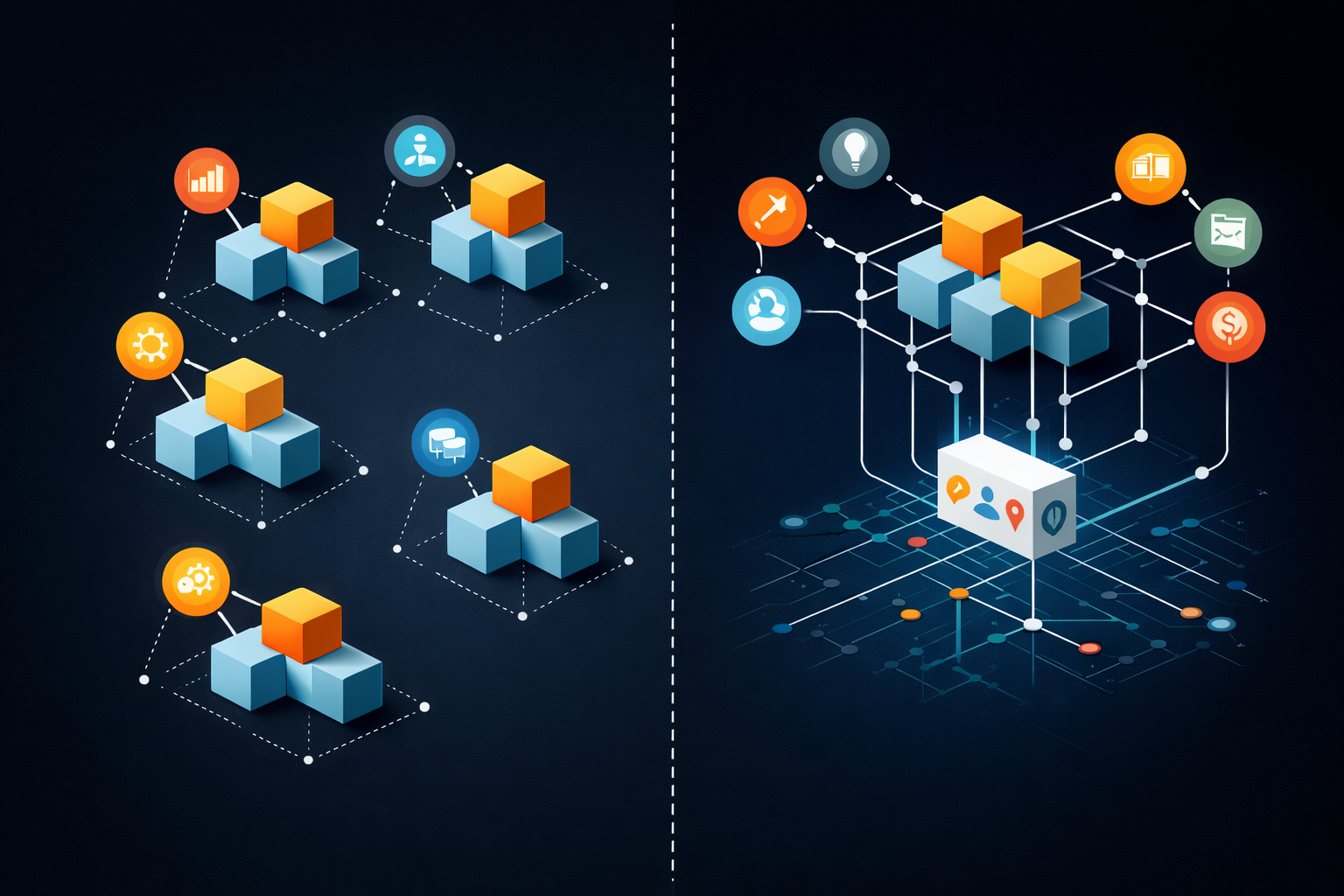
Companies that successfully reduce silos rarely do it by simply connecting systems. They create shared operating context across teams. Instead of separate dashboards, they align around common decision frameworks. Instead of fragmented narratives, they build a shared understanding of priorities, trade-offs, and goals. When context is shared, collaboration becomes faster, decisions become clearer, and execution becomes more consistent. The shift is not just technological. It is organizational. It moves the company from isolated functions to coordinated systems.
From Fragmented Functions to Coordinated Systems
Breaking silos is not about forcing teams into identical processes. It is about creating an operating layer where context, priorities, and decisions remain connected as conditions change. Organizations that move in this direction tend to respond earlier to market shifts and maintain alignment as they scale.
This philosophy is also what shaped Elevate GTM Solutions. The platform is designed to help organizations move beyond fragmented planning and toward a coordinated, context-aware operating model where strategy, execution, and adaptation stay connected as the business evolves.
In the end, the real competitive advantage is not better tools or more reports. It is the ability to move as one organization instead of many disconnected parts.