
Competitive Intelligence: Knowing the Battlefield Before You Fight On It
No go to market strategy exists in a vacuum. Every prospect a sales team talks to is also, in some form, talking to alternatives, whether that means a direct competitor, an adjacent tool trying to expand into the same space, or simply the option of doing nothing and sticking with the status quo. Competitive intelligence is the discipline of understanding that landscape clearly enough to make sharper decisions about positioning, pricing, product investment, and sales strategy, rather than guessing at what competitors are doing based on outdated impressions or secondhand rumor.
This guide covers the full scope of competitive intelligence inside a go to market program, starting with the broader competitive landscape, narrowing down to specific competitor profiles and product analysis, and finishing with benchmarking, opportunity assessment, and a clear set of recommendations leadership can act on.
Good competitive intelligence work sits at the intersection of research discipline and practical usefulness. A beautifully detailed competitor profile that never makes it into a sales rep's hands during a live deal provides little real value, just as a quick, superficial glance at a competitor's homepage rarely uncovers the genuine strategic insight a business actually needs. The strongest competitive intelligence programs strike a careful balance, thorough enough to be genuinely reliable, but structured and accessible enough that the people who need it most, whether in sales, marketing, or product, can actually put it to use in the moments that matter.
Competitive Landscape Overview
Before analyzing any single competitor in depth, it helps to step back and understand the shape of the competitive landscape as a whole.
Market Structure
Market structure describes how many competitors exist, how concentrated the market is around a small number of dominant players, and how much differentiation currently exists between the available options. A fragmented market with many similar competitors calls for a very different competitive approach than a concentrated market dominated by one or two entrenched leaders.
Understanding structure also means recognizing how the market has changed over recent years, since consolidation through mergers and acquisitions, or a wave of new entrants following a technology shift, can quickly reshape what used to be a stable, well understood competitive environment into something considerably more dynamic.
A useful discipline is revisiting the market structure assessment at least twice a year, since categories can shift from fragmented to concentrated, or the reverse, more quickly than most teams expect. A market that felt stable and predictable eighteen months ago may already look considerably different today, particularly in fast moving technology categories where new entrants and consolidation both happen at a rapid pace.
Building a simple visual map of the market structure, showing relative size and position of major players, often communicates this landscape far more quickly to a broader internal audience than a purely written description, particularly when sharing findings with teams outside of product marketing who may not follow competitive dynamics as closely on a day to day basis.
Competitive Ecosystem
The competitive ecosystem extends beyond direct product competitors to include technology partners, channel resellers, and industry influencers who shape how buyers discover and evaluate options. Understanding this broader ecosystem helps a company recognize indirect competitive pressure that would not show up in a simple list of rival products.
| Ecosystem Layer | Role | Competitive Relevance |
|---|---|---|
| Direct Competitors | Compete for the same buyer and budget | Primary focus of most competitive analysis |
| Technology Partners | Provide infrastructure or integration | Can favor one competitor through preferred partnerships |
| Channel Resellers | Influence which products reach buyers | Shape which options buyers even consider |
| Industry Analysts | Publish comparative rankings and reports | Heavily influence enterprise buyer shortlists |
Mapping the full ecosystem, rather than focusing exclusively on direct product competitors, often reveals leverage points a company can use to its own advantage. Building a stronger relationship with an influential technology partner or securing a favorable analyst mention, for example, can meaningfully shift competitive dynamics even without any change to the underlying product itself.
Market Leaders
Market leaders are the companies buyers most commonly compare everyone else against, often because of scale, brand recognition, or first mover advantage within the category. Understanding what makes a leader dominant, whether that is genuine product superiority, distribution advantage, or simply longer market tenure, clarifies what it would actually take to challenge that position.
It is worth separating a leader's genuine product strength from advantages that stem purely from incumbency, such as brand familiarity built over many years or deeply entrenched customer relationships that would be costly for a buyer to switch away from. A leader whose dominance rests mostly on incumbency rather than a superior product may actually be more vulnerable to a sharply differentiated challenger than their market position would initially suggest.
Emerging Challengers
Emerging challengers are newer entrants gaining traction quickly, often by targeting a specific underserved segment or introducing a meaningfully different approach that resonates with a growing part of the market. These companies deserve close attention even when they remain smaller than established leaders, since today's small challenger is sometimes tomorrow's dominant player.
Tracking emerging challengers requires looking beyond simple size metrics toward growth rate and the specific reasons customers are choosing them over more established alternatives. A small challenger growing quickly because it has found a genuinely underserved niche represents a very different kind of threat than one growing slowly through generic marketing spend without a clear differentiated angle.
Competitive Dynamics
Competitive dynamics capture how the overall competitive environment behaves over time, including how quickly competitors respond to each other's moves, how aggressively pricing shifts in response to new entrants, and how much the market rewards innovation versus rewarding scale and brand trust. Understanding these dynamics helps a company anticipate how competitors are likely to react to its own strategic moves before making them.
Some markets reward fast followers who watch a category leader innovate and then quickly replicate successful moves, while other markets reward genuine first movers who capture disproportionate advantage simply by being first to market with a new capability. Understanding which pattern applies in a given category helps a company decide how much to prioritize speed versus polish when planning its own competitive moves.
Competitor Identification & Classification
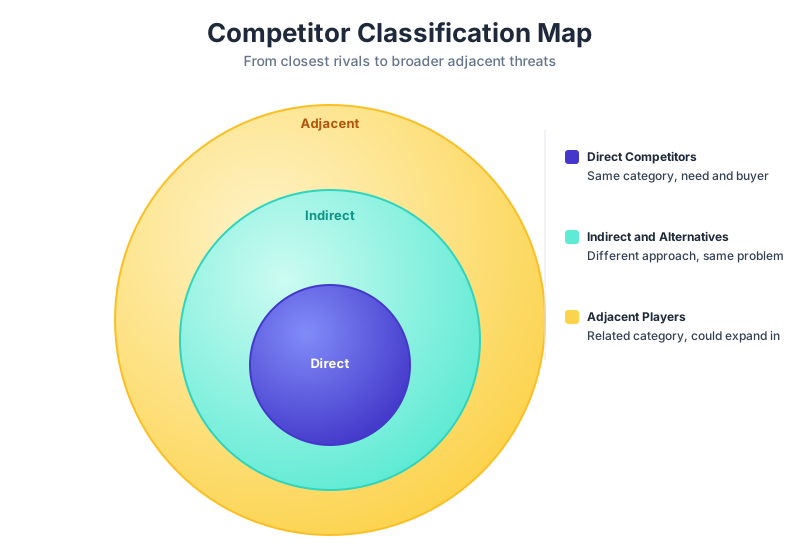
A clear, consistent system for identifying and classifying competitors keeps competitive intelligence work organized and prevents important alternatives from being overlooked.
Direct Competitors
Direct competitors offer a highly similar product addressing the same core need for the same target buyer. These competitors typically show up most frequently in sales deals and deserve the deepest, most detailed ongoing analysis, since they represent the most immediate competitive pressure a go to market team faces.
Sales teams are often the best early source for identifying which direct competitors actually matter in practice, since they encounter real competitive deals far more often than a marketing or strategy team working purely from external research. Building a simple, consistent process for sales reps to log which competitors show up in their deals, and how often the company wins or loses against each one, produces a far more accurate picture of direct competition than assumptions made from a distance.
Indirect Competitors
Indirect competitors solve the same underlying problem through a meaningfully different approach or product category. A company selling project management software, for example, might treat a general purpose spreadsheet tool as an indirect competitor, since some buyers genuinely choose that alternative even though it is not a direct category match.
Indirect competitors are often underestimated precisely because they do not look like obvious rivals on paper. Yet in many categories, a meaningful share of lost deals actually go to an indirect alternative rather than a direct competitor, particularly among smaller or less sophisticated buyers who have not yet recognized the value of a more specialized, dedicated solution.
| Competitor Type | Definition | Analysis Priority |
|---|---|---|
| Direct Competitors | Same category, same core need, same buyer | Highest, deep ongoing tracking |
| Indirect Competitors | Different category, same underlying problem | Medium, periodic review |
| Alternative Solutions | Manual processes or in house built tools | Medium, especially in early stage markets |
| Emerging Competitors | New entrants with growing traction | Medium to high depending on growth rate |
Alternative Solutions
Alternative solutions include manual processes, spreadsheets, or internally built tools that some buyers use instead of purchasing a dedicated product at all. In many categories, particularly newer or less mature ones, this kind of internal status quo represents the single largest competitive obstacle, even though it never appears on a traditional competitor list.
Winning against this kind of alternative usually requires a different sales approach than competing against another vendor, since the conversation is less about feature comparison and more about justifying the value of change itself. Messaging that clearly articulates the hidden cost of the current manual approach, such as time lost or errors introduced through manual processes, tends to be more persuasive here than a direct feature comparison would be.
Emerging Competitors
Emerging competitors are newer companies that have not yet reached significant scale but show signs of rapid growth or a genuinely differentiated approach worth monitoring closely. Tracking these companies early, before they become a serious competitive threat, gives a go to market team more time to prepare a response if the emerging player does eventually gain significant traction.
Adjacent Market Players
Adjacent market players operate in a related category and could expand into direct competition given the right strategic move, such as a company selling one part of a broader workflow deciding to build out adjacent capability that would put it in direct competition. Watching adjacent players closely, particularly ones with significant funding or a track record of aggressive expansion, helps a company anticipate competitive threats before they fully materialize.
A useful signal for spotting adjacent players likely to expand into direct competition is watching their public messaging and hiring patterns for hints of ambition beyond their current core category. A company that begins hiring specifically for a capability outside its historical core offering, or that starts publishing content addressing a broader set of problems than its current product solves, is often signaling an expansion move well before the product itself actually ships.
Competitor Company Profiles
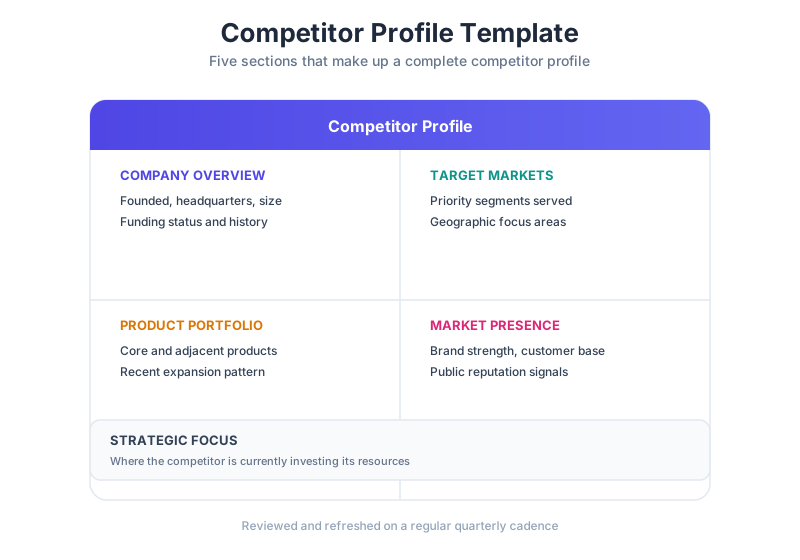
Once competitors are identified and classified, building detailed profiles for the most important ones gives a go to market team a genuinely useful working reference.
Company Overview
A company overview captures the basic facts about a competitor, including founding history, headquarters location, company size, and funding status. This foundational information helps contextualize everything else in the profile, since a well funded, established competitor requires a different competitive response than a small, resource constrained challenger.
Funding status in particular deserves close attention, since a competitor that has recently raised significant capital often shifts its behavior noticeably, whether through more aggressive hiring, expanded marketing spend, or a willingness to compete more aggressively on price in the short term to capture market share quickly. Watching funding announcements across the competitive set provides an early signal of upcoming shifts in competitive intensity.
Target Markets
Understanding a competitor's target markets clarifies where direct competitive overlap actually exists versus where the two companies are pursuing meaningfully different segments despite appearing similar on the surface. Some competitors that look threatening at first glance turn out to focus on a different segment entirely, reducing the urgency of a direct competitive response.
Reviewing a competitor's customer case studies, testimonials, and public customer logos provides a reasonably reliable proxy for understanding their actual target market focus, often revealing a clearer picture than their own marketing language, which sometimes describes a broader target audience than the one they are genuinely winning business from in practice.
| Profile Section | Key Questions | Why It Matters |
|---|---|---|
| Company Overview | Size, funding, history | Signals resources and stability |
| Target Markets | Which segments and geographies | Clarifies actual overlap |
| Product Portfolio | What they sell beyond the core product | Reveals expansion patterns |
| Market Presence | Brand strength, customer base size | Signals competitive intensity |
| Strategic Focus | Where they are investing right now | Predicts future competitive moves |
Product Portfolio
A competitor's product portfolio reveals not just their current offering, but their broader strategic direction, since companies often expand into adjacent products that hint at where they intend to compete next. Watching portfolio expansion over time gives useful early warning of a competitor's evolving strategic ambitions.
Tracking portfolio changes over several years, rather than just the current snapshot, often reveals a clearer pattern than looking at any single product launch in isolation. A competitor that has steadily expanded from a narrow starting point into a much broader platform over time is signaling a different long term ambition than one that has stayed narrowly focused on its original core offering throughout its history.
Market Presence
Market presence covers how visible and established a competitor is within its target market, including brand recognition, customer base size, and public reputation. A competitor with strong market presence, even without dramatically superior product capability, can still win deals purely on the strength of buyer familiarity and trust built over time.
Strategic Focus
Strategic focus identifies where a competitor is currently investing its resources, whether that is a specific product area, a new geography, or a particular customer segment. This information, often available through public statements, job postings, and product release patterns, provides valuable insight into where competitive pressure is likely to intensify in the near future.
Job postings in particular offer an underused but genuinely revealing source of intelligence, since the specific roles a competitor is hiring for often reveal strategic priorities well before any public announcement. A sudden wave of hiring for a specific new market or product area is frequently one of the earliest available signals of a competitor's next major strategic move.
Competitive Product Analysis
Beyond company level profiles, a detailed look at the actual product itself reveals where genuine competitive advantage or vulnerability exists.
Feature Comparison
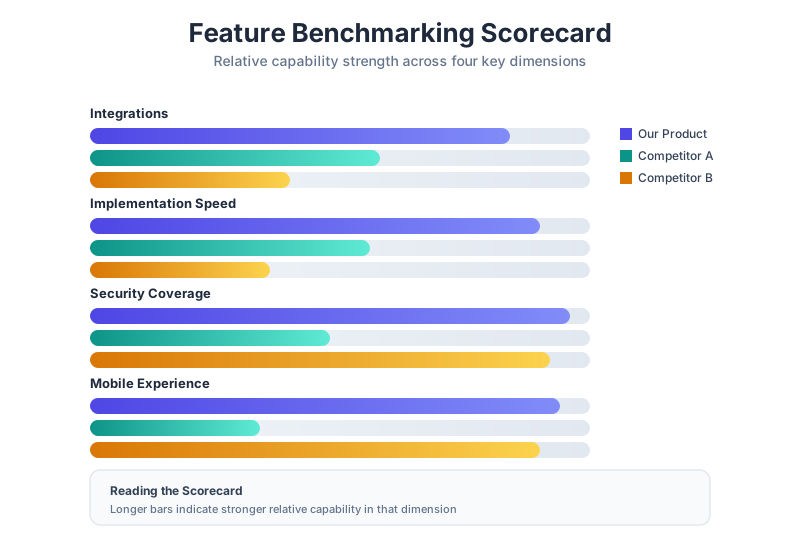
Feature comparison lays out how competing products stack up across specific capabilities, giving sales and marketing teams a clear, factual reference for competitive conversations. This comparison should be updated regularly, since competitors continue shipping new capability and an outdated comparison can mislead a sales team into overselling or underselling a competitive advantage that no longer reflects current reality.
Building this comparison from direct hands on product testing, rather than relying purely on competitor marketing claims, produces a far more trustworthy reference. Marketing pages sometimes describe a capability more generously than the actual product delivers, and a sales team caught making a comparison claim based on inaccurate information risks damaging credibility with a prospect who discovers the discrepancy during their own evaluation.
| Capability | Our Product | Competitor A | Competitor B |
|---|---|---|---|
| Native Integrations | 150 plus | 90 plus | 60 plus |
| Implementation Time | Two weeks average | Four weeks average | Six weeks average |
| Security Certifications | Full enterprise suite | Partial coverage | Full enterprise suite |
| Mobile Experience | Full feature parity | Limited mobile support | Full feature parity |
Capability Assessment
Capability assessment goes beyond a simple feature checklist to evaluate how well each competitor actually executes on the capabilities they offer, since two products can claim the same feature on paper while delivering dramatically different real world quality and reliability.
Customer reviews and win loss interview feedback are particularly valuable for this deeper assessment, since they reveal how a capability actually performs in practice rather than how it is described in a demo or marketing page. A capability that looks identical on a feature checklist can turn out to be considerably more reliable, faster, or easier to use in one competitor's implementation than another's.
Product Strengths
Understanding a competitor's genuine product strengths, rather than dismissing them reflexively, is essential for building an honest, credible competitive strategy. Sales teams that acknowledge a competitor's real strengths while clearly articulating why the tradeoff still favors their own product tend to be far more persuasive than teams that pretend a strong competitor has no redeeming qualities at all.
Internal bias toward downplaying competitor strengths is a common and understandable tendency, but it ultimately weakens competitive readiness. A sales team walking into a deal underestimating a genuinely strong competitor capability is far more likely to be caught off guard mid conversation than one that has honestly acknowledged that strength in advance and prepared a thoughtful response to it.
Product Weaknesses
Product weaknesses represent genuine gaps or shortcomings in a competitor's offering, whether that is missing functionality, known reliability issues, or a consistently reported pain point in customer reviews. These weaknesses, when accurately documented, become valuable talking points during competitive sales conversations, provided they are presented factually rather than through exaggeration.
Innovation Comparison
Innovation comparison tracks how quickly each competitor ships new capability and how meaningfully those updates address genuine customer needs versus representing minor, incremental changes. A competitor with a rapid pace of substantive innovation deserves closer ongoing monitoring than one whose release notes consist mostly of small bug fixes and minor adjustments.
Reviewing release notes and product changelogs over an extended period, rather than just the most recent update, reveals a more accurate picture of a competitor's genuine innovation pace. Some competitors publish frequent but minor updates that create an impression of rapid progress without delivering much substantive new value, while others ship less frequently but with far more meaningful capability each time.
Competitive Positioning Analysis
Beyond the product itself, understanding how competitors position themselves in the market reveals valuable strategic insight into their broader approach.
Market Positioning
Market positioning analysis examines how each competitor describes itself, what category it claims to belong to, and what core promise it makes to prospective customers. Comparing these positioning statements side by side often reveals whether competitors are converging on similar language or genuinely differentiating from one another.
This comparison exercise is often more revealing when done by collecting the actual homepage headlines and core messaging from each competitor verbatim, laid out side by side, rather than paraphrasing from memory. Seeing the exact language competitors use often reveals a surprising degree of similarity that can be easy to miss when each competitor is reviewed individually rather than compared directly at the same time.
Value Propositions
Analyzing competitor value propositions clarifies what each rival claims as its central reason to buy, helping identify where a company's own value proposition genuinely stands apart versus where multiple players in the market are making strikingly similar claims that risk sounding interchangeable to a prospect comparing several options.
| Competitor | Stated Value Proposition | Positioning Angle |
|---|---|---|
| Competitor A | Fastest implementation in the category | Speed and simplicity |
| Competitor B | Most comprehensive enterprise feature set | Depth and completeness |
| Competitor C | Lowest total cost of ownership | Price and efficiency |
| Our Product | Fastest path to measurable business outcomes | Speed and business impact |
Identifying where several competitors are making nearly identical value proposition claims reveals an opportunity, since a market where every player claims to be the fastest or most comprehensive option has effectively diluted that claim entirely. A company willing to stake out a genuinely different value proposition angle in a crowded field of similar sounding claims often earns disproportionate attention simply by standing out from the noise.
Brand Perception
Brand perception captures how the broader market actually views each competitor, which can differ meaningfully from how that competitor describes itself in its own marketing. Reviewing customer reviews, social media sentiment, and analyst commentary provides a more objective read on brand perception than relying purely on a competitor's own carefully curated messaging.
A useful method for gauging brand perception more systematically is tracking the specific adjectives and phrases that show up repeatedly in independent reviews and social commentary about each competitor, rather than relying on a single impression. Patterns that appear consistently across many independent sources carry far more weight than an isolated comment, and tracking this over time also reveals whether a competitor's perception is improving or declining.
Differentiation Strategies
Differentiation strategies examine the specific approach each competitor uses to stand apart, whether that is leading with price, technical depth, ease of use, or customer service quality. Understanding these strategies helps identify whether the broader market is converging toward a specific differentiation angle that a company should either compete on directly or deliberately avoid in favor of a less contested angle.
Category Ownership
Category ownership considers which competitor, if any, has successfully become the default reference point buyers compare every other option against. A competitor that has achieved genuine category ownership enjoys a significant structural advantage that requires a sustained, deliberate strategy to challenge rather than a single clever marketing campaign.
Challenging an established category owner directly on their own terms rarely succeeds. A more effective approach often involves redefining the category itself around a dimension where the incumbent is genuinely weaker, effectively changing the basis of comparison rather than trying to win a fight the incumbent has already structurally won through years of accumulated brand association.
Competitive Strategy Assessment
Beyond product and positioning, understanding a competitor's broader go to market strategy reveals how they actually operate and where they are likely headed next.
Go-to-Market Strategies
Go to market strategy assessment examines how each competitor actually reaches and converts customers, whether through a self serve product led motion, a traditional field sales approach, or a hybrid combining both. Understanding this helps predict how a competitor is likely to respond to shifts in buyer behavior or new entrants disrupting the established sales model.
A competitor built around an expensive field sales motion, for example, often struggles to respond quickly if a self serve challenger begins winning smaller deals at a fraction of the acquisition cost, since shifting an entire go to market motion requires significant organizational change that cannot happen overnight. Recognizing this kind of structural rigidity in a competitor's model can reveal where a more agile approach might succeed even against a much larger, better funded rival.
Pricing Approach
Pricing approach analysis compares how competitors structure and communicate their pricing, including whether they use transparent published pricing, a custom quote model, or a freemium entry point designed to drive broad top of funnel adoption before converting to paid plans.
| Competitor | Pricing Model | Transparency |
|---|---|---|
| Competitor A | Per seat subscription | Published pricing tiers |
| Competitor B | Usage based | Custom quote required |
| Competitor C | Freemium with paid upgrade | Partially published |
| Our Product | Tiered subscription | Published pricing tiers |
Pricing transparency itself often becomes a competitive differentiator in categories where most established players hide pricing behind a custom quote process. A company willing to publish clear, straightforward pricing in a category where competitors do not can capture meaningful attention from buyers frustrated by the friction of an opaque sales process elsewhere.
Distribution Strategy
Distribution strategy examines how competitors actually get their product in front of buyers, whether through direct sales, channel partnerships, marketplace listings, or organic and paid digital marketing. A competitor with a strong distribution advantage, such as a deep partner network, can sometimes outcompete a superior product simply through sheer reach and availability.
Distribution advantages tend to compound over time, since a competitor with strong existing channel relationships often finds it easier to add new partners than a company starting from scratch, particularly in industries where trusted partner relationships take years to build. Recognizing when a competitor holds this kind of compounding distribution advantage helps set realistic expectations for how quickly a company can close the gap through its own channel investment.
Partnership Ecosystem
Partnership ecosystem analysis looks at the technology integrations, reseller relationships, and strategic alliances a competitor has built, since a strong partnership ecosystem can create meaningful switching costs and distribution advantages that are difficult for a smaller competitor to quickly replicate.
Growth Initiatives
Growth initiative tracking monitors publicly visible signals of where a competitor is investing to grow, such as new hiring patterns, geographic expansion announcements, or newly launched product lines. These signals, gathered consistently over time, help anticipate where competitive pressure is likely to intensify well before it becomes fully visible in the market.
Building a simple, recurring tracking process, such as a quarterly review of competitor press releases, hiring pages, and product announcements, keeps this intelligence current without requiring a dedicated full time analyst. Even a lightweight, consistent process applied regularly tends to surface meaningful signals that a one time deep dive review would likely miss entirely.
Competitive Benchmarking
Bringing together everything gathered so far, benchmarking creates a structured, side by side comparison that makes competitive strengths and weaknesses immediately clear.
SWOT Comparison
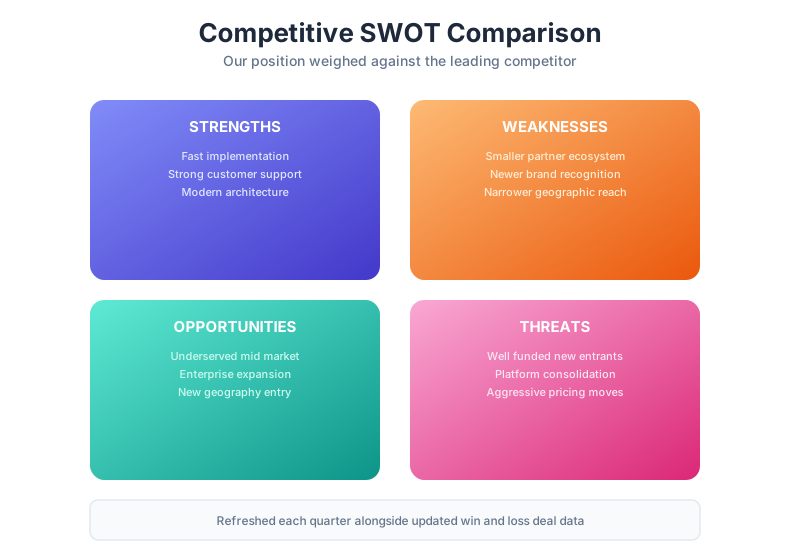
A SWOT comparison lays out strengths, weaknesses, opportunities, and threats for each major competitor alongside the company's own position, creating a clear, structured view of relative competitive standing rather than a scattered collection of individual observations.
| Dimension | Our Position | Leading Competitor |
|---|---|---|
| Strengths | Fast implementation, strong support | Broad feature depth, brand recognition |
| Weaknesses | Smaller partner ecosystem | Slower release cadence |
| Opportunities | Underserved mid market segment | Enterprise expansion |
| Threats | Well funded new entrants | Platform consolidation trend |
Building this comparison honestly, including areas where a competitor genuinely outperforms the company, produces a far more useful strategic tool than a version skewed to make the company look uniformly stronger. The value of a SWOT comparison comes precisely from its honesty, since strategic decisions based on an overly flattering self assessment tend to underestimate real risk.
Feature Benchmarking
Feature benchmarking extends the earlier feature comparison into a more systematic, regularly updated scorecard, ideally validated against real customer feedback rather than relying purely on competitor marketing claims about their own capability.
Assigning a consistent scoring methodology across every competitor, rather than describing each one in loosely comparable prose, makes this benchmarking far more useful for spotting genuine gaps and strengths at a glance. A simple numeric or tiered scoring system, applied consistently, also makes it easier to track how the competitive landscape shifts over successive review cycles.
Customer Experience Comparison
Customer experience comparison evaluates the full experience of working with each competitor, from initial sales interaction through onboarding, ongoing support, and renewal conversations. This dimension often gets less attention than feature comparison, despite frequently being the deciding factor in competitive deals within mature, feature commoditized categories.
Mystery shopping a competitor's own sales process, where feasible and ethical, or closely reviewing publicly available customer feedback about their onboarding and support experience, often reveals meaningful differences that a purely feature focused analysis would completely miss. Many buyers ultimately choose based on the overall experience of working with a vendor as much as the specific feature set on offer.
Technology Maturity
Technology maturity assessment looks at the underlying architecture and technical foundation each competitor has built, since a modern, scalable architecture provides a durable advantage that is difficult for a competitor running on legacy infrastructure to quickly match, regardless of how their current feature list compares.
Market Performance Indicators
Market performance indicators, such as estimated market share, customer growth rate, and publicly available funding or revenue signals, provide a broader quantitative view of how each competitor is actually performing in the market, beyond the more qualitative product and positioning analysis covered elsewhere.
These indicators are often harder to obtain with precision for private companies, but reasonable estimates can be built from indirect signals such as employee headcount growth, job posting volume, and customer review volume over time. Tracking these proxies consistently across the competitive set, even without perfectly precise figures, still provides a useful directional sense of which competitors are genuinely gaining momentum.
Competitive Opportunities & Risks
Bringing the analysis together, this section identifies where genuine opportunity exists to win against competitors, and where real risk requires a deliberate response.
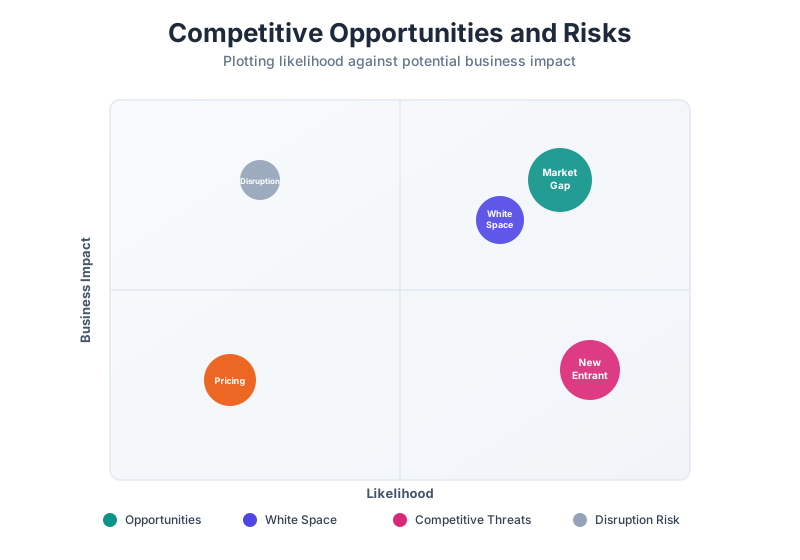
Market Gaps
Market gaps are needs that no current competitor addresses particularly well, representing a genuine opportunity to win business through superior fit rather than through direct feature for feature competition. These gaps often become visible through consistent patterns in customer reviews and lost deal feedback across multiple competitors.
Cross referencing common complaints across several competitors, rather than reviewing each one in isolation, often reveals a shared blind spot the entire category has missed, representing a more durable opportunity than a gap specific to just one rival that others may have already addressed.
White-Space Opportunities
White space opportunities extend beyond simple market gaps to identify entirely new angles of positioning or product capability that no competitor has claimed, offering a chance to build a durable, differentiated advantage before the broader market catches up.
Identifying genuine white space requires looking slightly beyond the current competitive set toward adjacent categories or emerging buyer needs that have not yet become mainstream expectations within the category. The clearest white space opportunities often exist at the intersection of two trends that have not yet fully converged, giving an alert company the chance to claim that intersection before it becomes an obvious, contested space.
Competitive Threats
Competitive threats identify specific moves by rivals that could meaningfully hurt the business, whether that is an aggressive pricing move, a new capability that closes a previous product gap, or a well funded competitor entering a previously uncontested segment.
| Risk Type | Example Signal | Recommended Response |
|---|---|---|
| Pricing Threat | Competitor drops prices sharply | Reinforce value based messaging |
| Capability Threat | Competitor closes a known gap | Accelerate roadmap in adjacent area |
| New Entrant Threat | Well funded startup enters segment | Strengthen customer retention efforts |
| Consolidation Threat | Competitors merge or get acquired | Reassess partnership and channel strategy |
Prioritizing these threats by both likelihood and potential impact, rather than treating every possible threat with equal urgency, keeps the response planning focused on what genuinely matters most. A low likelihood, low impact threat deserves periodic monitoring rather than the same intensive planning effort given to a high likelihood, high impact scenario.
Disruption Risks
Disruption risks consider bigger, more structural threats, such as a new technology paradigm that could make the current product category less relevant, or a shift in buyer behavior that favors an entirely different purchasing model than the one the market currently relies on.
Strategic Advantages
Strategic advantages summarize where the company holds a genuine, durable edge over the competitive field, whether that is technology, customer relationships, brand trust, or organizational capability that would be difficult for any competitor to quickly replicate.
Distinguishing between advantages that are genuinely structural and those that are more temporary or easily copied helps set realistic expectations about how long a given edge will last. A structural advantage rooted in proprietary technology or a uniquely skilled team tends to hold up far longer than an advantage based purely on being first to market with a feature competitors can eventually replicate.
Competitive Recommendations
All of the analysis above should translate into a clear, actionable set of recommendations for how the business should respond to its competitive environment.
Differentiation Opportunities
Differentiation opportunity recommendations identify where the company should invest to build sharper, more defensible separation from competitors, drawing directly from the market gaps and white space analysis completed earlier.
These recommendations carry the most weight when paired with a clear rationale explaining why the identified gap or white space represents a genuine, durable opportunity rather than a superficial observation likely to close quickly once competitors notice it themselves.
Competitive Response Strategies
Competitive response strategy recommendations outline how the business should react to specific competitive threats identified earlier, whether that means adjusting pricing, accelerating a roadmap item, or strengthening messaging around an area where a competitor has recently gained ground.
Response strategies work best when they distinguish between threats requiring an immediate, direct reaction and those better addressed through a longer term strategic shift. Reacting to every competitive move with urgency tends to produce a scattered, reactive strategy, while thoughtfully sequencing responses based on genuine severity keeps the overall competitive strategy coherent and sustainable.
Strategic Priorities
Strategic priority recommendations connect competitive intelligence findings back to broader business priorities, ensuring the most significant competitive risks and opportunities receive proportionate attention rather than being addressed reactively as they arise.
Investment Recommendations
Investment recommendations translate competitive analysis into specific guidance on where to direct product, marketing, and sales resources, based on where competitive pressure is most acute or where the clearest differentiation opportunity exists.
Presenting investment recommendations alongside a rough estimate of expected competitive impact helps leadership weigh these requests against other business priorities more effectively, rather than evaluating competitive investment requests in isolation without a clear sense of the relative stakes involved.
Long-term Competitive Roadmap
A long term competitive roadmap lays out how the company intends to build and defend competitive advantage over a multi year horizon, rather than reacting only to the current competitive snapshot, ensuring today's decisions support a durable position rather than a short lived tactical win.
Revisiting this roadmap on a regular cadence, ideally aligned with broader annual and quarterly planning cycles, keeps the long term competitive strategy connected to the reality of an evolving market rather than becoming a static document written once and rarely revisited as conditions change around it.
Executive Competitive Summary
The executive summary condenses the full competitive intelligence analysis into a format leadership can review quickly without losing the substance behind the findings.
Key Competitors
This section names the small number of competitors that matter most right now, prioritized by how much direct competitive pressure they actually represent rather than an exhaustive list of every company operating anywhere near the category.
Keeping this list short and genuinely prioritized, rather than exhaustive, makes the executive summary far more useful as a quick reference. A leadership team scanning this section should immediately understand which two or three competitors deserve the most ongoing attention, without needing to sift through a long list where the truly important rivals are buried among many less relevant mentions.
Competitive Strengths & Weaknesses
A concise summary of where the company stands strong against the competitive field, and where real vulnerabilities remain, gives leadership a clear, honest picture to inform strategic planning discussions.
Presenting this honestly, including genuine weaknesses rather than only favorable strengths, ultimately serves leadership better than an overly optimistic summary. Strategic decisions made without a clear eyed view of real vulnerabilities tend to be less resilient than those grounded in an accurate, if occasionally uncomfortable, assessment of where the company genuinely stands relative to its competitive field.
Strategic Risks
Strategic risk summary highlights the most significant competitive threats identified during the analysis, paired with a brief note on the recommended response, so leadership understands both the risk and the plan already in motion to address it.
Pairing each named risk with a brief note on the confidence level behind it, distinguishing between a well confirmed threat and a more speculative early signal, helps leadership calibrate how urgently to act on each item rather than treating every listed risk with equal certainty and urgency.
Competitive Advantages
Competitive advantage summary restates the company's most durable strengths clearly, giving leadership and new team members a quick reference for why the company is positioned to win despite whatever competitive pressure currently exists.
This section works best as a source of genuine confidence grounded in evidence, rather than generic reassurance. Backing each stated advantage with a specific proof point, such as a retention statistic or a concrete customer outcome, gives the summary real substance rather than reading as an unsupported assertion of strength.
Executive Recommendations
The summary should close with a short, clear set of recommendations for leadership, whether that is approving investment in a specific differentiation area, prioritizing a competitive response to a specific threat, or committing to a long term roadmap designed to build lasting competitive advantage rather than only addressing today's immediate pressures.
As with other parts of this summary, framing each recommendation alongside its expected impact and rough resourcing requirement helps leadership weigh competitive investment fairly against other demands on the business, rather than evaluating it in isolation without a clear sense of relative priority.
Competitive intelligence, like every other part of go to market strategy, requires ongoing attention rather than a single analysis performed once and filed away. The strongest companies build a continuous rhythm of competitive tracking, revisiting their analysis regularly as competitors evolve, new entrants appear, and the broader market continues to shift around them. Treating this work as a living practice, owned collaboratively across product, marketing, and sales rather than a one time research project, keeps a company's competitive posture sharp and genuinely responsive to a landscape that never holds still for long.
Contents