
Product Positioning: Defining Why Customers Should Choose You
Positioning is the mental shortcut a customer uses to understand why a product exists, who it is for, and why it deserves attention over every other option competing for the same budget. Get positioning right and every other part of go to market work becomes easier, from writing marketing copy to training a sales team to answering a tough question in a competitive deal. Get it wrong, and even a genuinely great product can struggle to gain traction, because customers simply do not understand why they should care.
This guide walks through the full scope of product positioning inside a go to market program, starting with the strategic context that shapes positioning decisions, moving through value proposition and differentiation, and finishing with a clear set of recommendations and an executive summary leadership can act on.
Positioning Overview
Before crafting specific messaging, a team needs to agree on what positioning is meant to accomplish and how it fits into the broader strategic picture.
Positioning Objective
Every positioning exercise should start with a clear objective, since positioning built without a specific goal in mind tends to drift into generic, forgettable language that could apply to almost any product in the category. Common objectives include establishing category leadership, differentiating against a specific dominant competitor, or repositioning after a product pivot that has changed who the ideal customer really is.
Writing the objective down explicitly, and referring back to it throughout the positioning process, keeps the work anchored to a specific business outcome rather than becoming an open ended brainstorming exercise about what sounds impressive. A positioning objective focused on displacing a specific entrenched competitor, for example, will produce very different language than one focused on educating a market that does not yet understand the category at all.
It also helps to distinguish between an objective that is primarily defensive, such as protecting existing market share against new entrants, and one that is primarily offensive, such as breaking into a new segment or geography. Defensive positioning tends to emphasize proof, track record, and trust, while offensive positioning often needs to lead harder with a bold, differentiated claim in order to earn attention from an audience that has never considered the company before. Mixing these two modes without acknowledging the difference often produces positioning that satisfies neither goal particularly well.
Strategic Context
Strategic context captures the broader business situation positioning needs to operate within, including current company stage, competitive pressure, and any recent changes to the product or target market that make old positioning obsolete. A company launching its first product into a brand new category faces a completely different positioning challenge than an established player defending market share against a wave of new entrants.
Understanding this context also means being honest about constraints, such as limited marketing budget, a small sales team, or a product that is still missing capabilities competitors already offer. Positioning that ignores these constraints and promises more than the company can currently deliver tends to create expectation gaps that hurt customer satisfaction and retention down the line.
Strategic context should also account for how much the company's own story has changed recently. A product that has pivoted its core use case, expanded into a new market, or shifted its pricing model often carries old positioning language that no longer accurately reflects what the company actually does today. Auditing existing marketing materials, sales decks, and website copy against the current strategic reality is a useful first step before writing anything new, since it often reveals just how much drift has accumulated between what the company says and what it now actually delivers.
Target Market Alignment
Positioning only works when it aligns tightly with the target market and segmentation work already done earlier in the go to market process. A positioning statement built for enterprise buyers will fall flat with small business buyers, even if the underlying product capability is identical, simply because the two audiences care about very different outcomes and speak in different language.
This alignment work is often where positioning projects quietly go wrong. A team might craft genuinely compelling language in isolation, only to discover later that it does not actually match how the priority segments identified during market segmentation talk about their own problems, or that it inadvertently speaks more to a lower priority segment than the one the business has decided to focus on. Checking alignment early, before investing heavily in content and campaign development built around new language, saves considerable rework later.
| Alignment Check | Question to Ask | Why It Matters |
|---|---|---|
| Segment Fit | Does this resonate with our priority tier segments | Prevents positioning built for the wrong audience |
| Persona Fit | Does this speak to economic and technical buyers | Ensures messaging works across the buying committee |
| Need Fit | Does this map to validated pain points | Avoids positioning around problems customers do not have |
| Channel Fit | Can this message work across sales and marketing channels | Ensures consistency everywhere a customer encounters it |
Running new positioning language past this alignment checklist before finalizing it catches misalignment early, when it is still cheap to fix, rather than after a full campaign or sales enablement rollout has already been built around language that does not quite fit the intended audience. Teams that skip this step often discover the misalignment only after noticing weak engagement metrics or confused feedback from the sales team much later.
Positioning Principles
A short set of guiding principles keeps positioning work consistent as different teams contribute messaging over time. Strong principles might include always leading with customer outcomes rather than product features, staying specific rather than vague, and avoiding language so broad it could describe a dozen other products in the same category. These principles act as a quality filter that any new positioning language should pass before it gets published anywhere customers will see it.
Documenting these principles in a shared, easily accessible location, rather than keeping them as tribal knowledge held by a handful of senior marketers, helps new hires and cross functional partners write on brand copy more quickly. Reviewing the principles periodically, especially after a significant product change or new competitive entrant reshapes the landscape, keeps them relevant rather than becoming an outdated artifact nobody actually references anymore.
Value Proposition
With the strategic groundwork in place, the next step is articulating exactly what value the product delivers and why that value matters to the customer.
Core Value Proposition
The core value proposition is a single, clear statement of the primary value a customer receives, written in language a prospect would actually use themselves rather than internal product terminology. A strong core value proposition answers one direct question: why would a busy person stop what they are doing and pay attention to this.
Testing the core value proposition with actual prospects, rather than relying purely on internal opinion, reveals whether the language actually lands the way the team intends. A value proposition that sounds compelling in an internal meeting sometimes falls completely flat with real prospects who do not share the same context or vocabulary the internal team has built up over months of working on the product.
A simple way to test a candidate value proposition is reading it aloud to someone outside the company who fits the target profile and watching for genuine reaction rather than polite nodding. If that person needs to ask a clarifying question before understanding what the product actually does, the value proposition likely needs to be simplified further before it is ready to appear on a homepage or in an opening sales pitch.
Business Value
Business value translates the core value proposition into terms a budget holder cares about, such as cost savings, revenue growth, risk reduction, or efficiency gains. This is the layer of the value proposition most relevant to the economic buyer, who typically needs to justify the purchase in financial terms to their own leadership.
| Value Category | Example Business Value | Primary Audience |
|---|---|---|
| Cost Reduction | Lower operational overhead per transaction | Finance, economic buyer |
| Revenue Growth | Faster time to close, higher conversion rates | Sales leadership |
| Risk Reduction | Fewer compliance violations, improved security | Legal, technical buyer |
| Efficiency Gains | Reduced manual work, faster cycle times | Operations, end users |
Framing business value in the specific financial language a company's finance team already uses internally, whether that is payback period, total cost of ownership, or return on investment, makes it far easier for an economic buyer to build their own internal business case using the vendor's materials directly. Vendors that force a buyer to translate generic value claims into their own company's specific financial framework are adding unnecessary friction to an already complex approval process.
Customer Outcomes
Customer outcomes describe the tangible result a customer experiences after adopting the product, framed around their world rather than the product itself. Rather than describing what the product does, this layer describes what changes for the customer once they are using it well, such as faster reporting cycles, happier end customers, or fewer emergency fire drills at the end of each quarter.
Collecting customer outcome stories directly from existing customers, in their own words wherever possible, tends to produce far more resonant messaging than outcomes imagined internally by a product or marketing team. Customers often describe outcomes in ways that surprise the internal team entirely, highlighting a benefit that was never the primary intended use case but has become genuinely important to how they experience the product day to day.
Quantifiable Benefits
Wherever possible, value propositions should be backed by specific, quantifiable numbers rather than vague claims. A statement claiming a solution saves time is far less persuasive than one stating it saves an average of six hours per week per user, especially when that number is backed by real customer data rather than an internal estimate nobody can verify.
Collecting these quantifiable benefits requires ongoing collaboration with customer success and analytics teams, pulling real usage and outcome data from existing customers rather than guessing at plausible sounding figures. Numbers pulled directly from customer results carry far more credibility in sales conversations than projections based on assumptions.
It is worth being conservative with these figures rather than reaching for the single most impressive number available from one exceptional customer. Using a realistic average or median figure, and being transparent about how it was calculated, protects credibility during a sales process where a sharp prospect may ask directly how a specific number was derived. A defensible, slightly more modest number will hold up better under scrutiny than an eye catching figure that falls apart the moment someone asks a follow up question.
Value Pillars
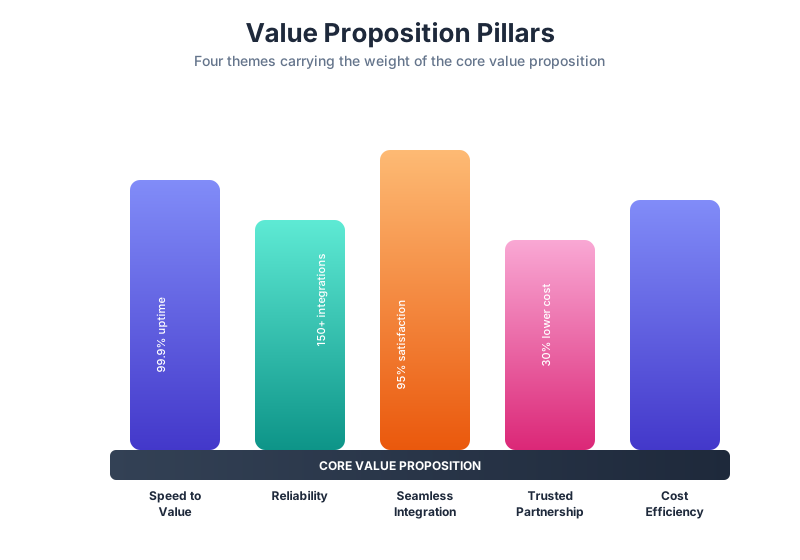
Value pillars organize the full value proposition into three or four memorable themes that support the core message, each backed by its own proof points and evidence. Breaking value into distinct pillars makes it easier for sales and marketing teams to build content and messaging that reinforces the same core themes consistently across every channel and touchpoint.
Choosing pillars that map cleanly onto the different buyer roles within a typical buying committee often produces the most effective structure, since it gives sales reps a natural way to shift emphasis depending on who they are speaking with in a given conversation, without needing to invent entirely new messaging on the spot for each stakeholder.
Positioning Framework
With value proposition work complete, the next step is assembling a formal positioning framework that ties everything together into language the whole organization can use consistently.
Positioning Statement
A positioning statement is a structured, internal facing summary that captures the essence of how a product should be positioned, typically following a format along these lines: for a specific target customer who has a specific need, this product is a specific category that delivers a specific key benefit, unlike a specific alternative.
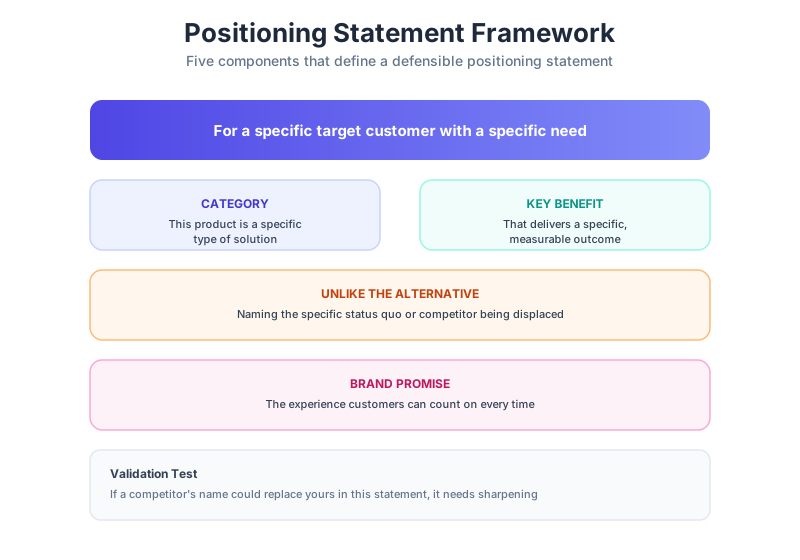
This structured format forces discipline, since every blank in the template needs a specific, defensible answer rather than a vague generality. A positioning statement that could apply equally well to three different competitors has not actually done the work of differentiating anything, and revisiting each component honestly often reveals where the underlying positioning work still needs more sharpening.
It is worth remembering that a positioning statement built in this structured format is typically an internal tool rather than something published word for word on a website or in a sales deck. Its purpose is to align internal teams on a shared, precise understanding of the positioning, which can then be translated into more natural, varied language across different external facing materials without losing the underlying strategic clarity the structured statement provides.
Category Definition
Category definition determines what mental bucket customers place a product into when they first encounter it, which shapes their expectations, their comparison set, and even their willingness to pay. Choosing to fit into an existing well understood category makes buyer education easier but risks getting compared directly against every established player already dominating that space. Choosing to define a new category offers more room for differentiation but requires significant investment in market education before buyers understand why the new category even matters.
Companies with limited marketing budget often benefit more from positioning within an existing, well understood category rather than attempting to create an entirely new one, since category creation typically requires years of sustained content, thought leadership, and public relations investment before it takes hold in the broader market's vocabulary. A smaller company attempting category creation without that sustained investment often ends up with confused prospects who simply default back to comparing the product against the nearest existing category anyway.
Target Customer
The target customer section of the positioning framework should tie directly back to the ideal customer profile work done during segmentation, restating in positioning specific language exactly who the product is built for and, just as importantly, who it is not built for. Being explicit about who a product is not for feels counterintuitive to some teams, but it actually sharpens positioning considerably by removing the temptation to write vague, everyone friendly messaging.
Some of the strongest positioning work in any category comes from companies willing to explicitly say who their product is a poor fit for, since this kind of honesty builds credibility with the audience the product genuinely serves well. Prospects who read a clear statement of who a product is not built for, and recognize themselves as exactly who it is built for instead, tend to convert with far more confidence than prospects courted with vague, universally applicable claims.
Primary Need Addressed
Every strong positioning framework centers on a single primary need, even when the product technically solves several different problems. Trying to lead with every capability at once dilutes the message and makes it harder for a prospect to quickly understand what the product is really for. Secondary needs and capabilities can still be communicated, but they should support the primary need rather than compete with it for the customer's attention.
Identifying the true primary need often requires looking past what the product team is most proud of building and instead examining what actually drives the majority of new customer acquisition today. Sometimes the feature an engineering team considers most innovative is not actually the reason customers are buying, and positioning built around internal pride rather than external buying behavior tends to underperform positioning grounded in what is genuinely driving conversion.
Brand Promise
The brand promise captures the emotional and experiential commitment a company makes to its customers, beyond just the functional value proposition. This might include commitments around reliability, transparency, partnership, or a specific kind of customer experience that customers should expect every time they interact with the company, not just within the product itself but across support, billing, and every other touchpoint.
A brand promise only holds real value when it is consistently kept, which means every team across the organization, not just marketing, needs to understand and honor it. A company that promises transparency in its marketing but hides pricing behind lengthy sales conversations, or promises partnership but provides slow, impersonal support, quickly erodes the credibility of its own positioning through lived customer experience that contradicts the stated promise.
Unique Value Proposition (UVP)
Beyond the general value proposition, a company needs a sharper, more specific articulation of what makes it genuinely unique compared to every available alternative.
Key Differentiators
Key differentiators are the specific, defensible reasons a customer should choose this product over any alternative, including doing nothing at all. Strong differentiators are difficult for competitors to quickly copy, whether because they are rooted in proprietary technology, unique data, or a fundamentally different approach to solving the underlying problem.
| Differentiator Type | Example | Defensibility |
|---|---|---|
| Proprietary Technology | Unique algorithm or architecture | High, hard to replicate quickly |
| Data Advantage | Exclusive dataset improving accuracy | High, compounds over time |
| Business Model | Pricing or delivery model competitors avoid | Medium, can be copied eventually |
| Brand and Trust | Category leadership, strong reputation | Medium, builds slowly over years |
Ranking differentiators by defensibility, rather than treating them all as equally important, helps a team decide where to invest further and which claims deserve the most prominent placement in outward facing materials. A differentiator that competitors could replicate within a single product release cycle deserves far less prominence than one rooted in years of accumulated data or proprietary technology that would take a competitor considerable time and investment to match.
Competitive Advantages
Competitive advantages describe the broader organizational strengths that support the product's differentiators, such as a larger customer base generating network effects, a more experienced team in a specific vertical, or superior distribution through established partnerships. These advantages often matter as much as the product itself in a buyer's final decision, particularly in categories where products look similar on the surface.
Organizational advantages are sometimes overlooked in positioning work because they feel less tangible than a specific product feature, yet buyers frequently weigh them heavily, especially for larger, higher stakes purchases where a vendor's long term stability and track record carry real weight in the final decision.
Innovation Strengths
Innovation strengths highlight where a company is meaningfully ahead of the market in terms of new capability development, research investment, or willingness to solve problems competitors have not yet addressed. Communicating innovation strengths credibly requires backing claims with concrete examples of shipped capability, rather than vague promises about a roadmap that may never fully materialize.
Publishing a regular cadence of product updates and capability announcements, rather than a single large launch followed by silence, helps reinforce an innovation narrative over time. Buyers evaluating a longer term partnership pay close attention to this pattern, since a vendor with a visible track record of continuous improvement signals lower long term risk than one whose most impressive capability was announced years ago and has seen little visible progress since.
Exclusive Capabilities
Exclusive capabilities are specific features or functions that genuinely do not exist anywhere else in the market, whether due to patents, proprietary partnerships, or simply being first to build something well. These capabilities deserve prominent placement in positioning materials, since they represent the clearest, least debatable form of differentiation available.
It is worth periodically auditing whether claimed exclusive capabilities remain genuinely exclusive, since competitors do eventually catch up on features that are not protected by patents or truly proprietary technology. Positioning that continues to claim exclusivity for a capability competitors have since matched risks damaging credibility once a sophisticated buyer discovers the claim is no longer accurate.
Customer Value Delivered
Ultimately, every unique value proposition claim needs to tie back to value the customer actually experiences, rather than being interesting purely from a technical or competitive standpoint. A differentiator that excites engineers internally but does not translate into a customer benefit a buyer actually cares about will not move the needle in a sales conversation, no matter how genuinely impressive it is.
A useful discipline when reviewing any proposed differentiator is asking directly what the customer gets out of it, in their own terms, before including it in outward facing positioning materials. If the honest answer is that the differentiator mostly matters to internal stakeholders or reflects technical pride rather than customer benefit, it likely belongs in internal documentation rather than customer facing messaging.
Product Differentiation
Differentiation extends beyond a short list of bullet points into a fuller picture of how a product stands apart across every dimension a customer might evaluate.
Functional Differentiation
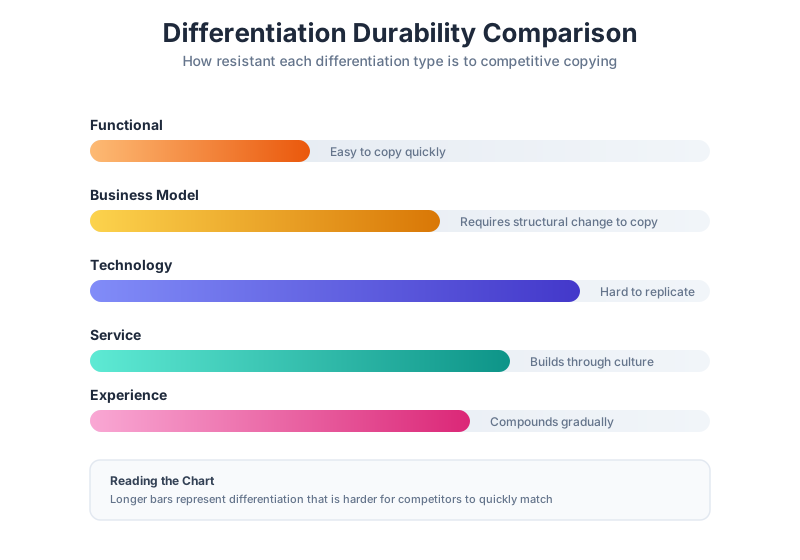
Functional differentiation covers the specific features and capabilities that set a product apart, such as faster performance, broader integration support, or a more complete feature set within a specific workflow. This is often the easiest form of differentiation to communicate, but also the easiest for competitors to eventually match, making it important to pair functional claims with other, more durable forms of differentiation.
Business Differentiation
Business differentiation includes pricing models, packaging structures, and commercial terms that set a product apart from alternatives, such as usage based pricing in a market dominated by seat based licensing, or a more flexible contract structure that removes friction competitors still impose on their customers.
Business model differentiation is often underused compared to functional differentiation, despite frequently being harder for competitors to copy quickly, since changing a pricing or packaging model can require significant internal restructuring, renegotiation with existing customers, and sometimes a shift in how the entire sales organization operates. A company willing to make this kind of structural change can create a genuinely durable advantage that purely feature based differentiation rarely achieves.
Technology Differentiation
Technology differentiation covers the underlying architecture, infrastructure, or technical approach that distinguishes a product, such as a more modern cloud native architecture compared to a competitor still running on legacy infrastructure, or a fundamentally different technical approach that delivers meaningfully better results.
Technology differentiation resonates most strongly with technical buyers who understand the underlying implications, but it needs to be translated carefully for other audiences within the buying committee who may not appreciate why a particular architectural choice matters. Pairing technical differentiation with a clear, plain language explanation of what it means practically for the end result, such as faster processing or fewer outages, ensures the advantage lands with the whole buying committee rather than only the most technical stakeholder in the room.
| Differentiation Type | Focus Area | Durability Over Time |
|---|---|---|
| Functional | Features and capabilities | Lower, easier to copy |
| Business | Pricing and commercial terms | Medium |
| Technology | Architecture and infrastructure | Higher, harder to replicate |
| Service | Support and implementation | Medium to high |
| Experience | Overall usability and design | Medium |
Service Differentiation
Service differentiation covers the quality and structure of support, onboarding, and account management a customer receives throughout their relationship with a company. In markets where core product capability has become relatively commoditized, service differentiation often becomes the deciding factor in a competitive deal, since customers increasingly weigh the experience of working with a vendor as heavily as the product itself.
Experience Differentiation
Experience differentiation captures the overall feel of using a product day to day, including design quality, ease of onboarding, and the small details that make a product genuinely pleasant to use versus merely functional. This layer of differentiation is often underestimated, yet it strongly influences word of mouth referrals and organic growth, since users naturally talk about products that feel good to use.
Both service and experience differentiation compound over time in ways that are harder for competitors to observe and replicate than a feature list, since they depend on accumulated organizational habits, hiring choices, and design culture rather than a single identifiable capability a competitor could simply build in a following release. This makes them particularly valuable forms of differentiation to invest in for companies playing a longer term competitive game.
Positioning Pillars
Positioning pillars translate the value proposition and differentiation work into a structured set of themes that anchor all outward facing messaging.
Strategic Pillars
Strategic pillars represent the three or four core themes a company wants to be known for, chosen deliberately based on what matters most to the target customer and where the company has genuine strength to back up the claim. Limiting the number of pillars keeps messaging focused, since trying to lead with too many themes at once tends to dilute all of them.
Choosing pillars is often as much about deciding what to leave out as what to include. A company may have five or six genuinely strong areas worth talking about, but forcing a choice down to the three or four most important themes produces sharper, more memorable messaging than trying to represent every strength equally. The remaining strengths do not disappear entirely, they simply move into a supporting role rather than competing for top level attention.
Product Strengths
Each strategic pillar should be supported by specific product strengths that make the pillar credible, tying abstract themes back to concrete capabilities a prospect can actually see and evaluate during a demo or trial.
Customer Benefits
Alongside product strengths, each pillar needs a clear customer benefit statement, translating the underlying capability into language that describes what changes for the customer, rather than simply listing what the product technically does.
Proof Points
Proof points are the specific evidence, such as customer testimonials, case study results, or third party benchmarks, that back up each pillar with credibility beyond the company's own claims about itself. A pillar without proof points reads as marketing spin, while a pillar backed by concrete, verifiable evidence builds genuine trust with skeptical buyers.
Gathering proof points is an ongoing responsibility rather than a one time project, since fresh evidence keeps positioning feeling current rather than relying on the same one or two case studies referenced for years after they were first collected. Building a habit of regularly capturing new results from recent customers ensures each pillar always has recent, relevant evidence available rather than aging proof points that a sharp prospect might question the continued relevance of.
| Pillar | Product Strength | Proof Point |
|---|---|---|
| Speed to Value | Fast implementation, guided onboarding | Average go live time of two weeks |
| Enterprise Reliability | High uptime, robust infrastructure | 99.9 percent uptime over trailing year |
| Seamless Integration | Broad native integration library | Over 150 supported integrations |
| Trusted Partnership | Dedicated customer success model | 95 percent customer satisfaction score |
Supporting Capabilities
Supporting capabilities round out each pillar with secondary features and functions that reinforce the core message without competing with it for attention. These capabilities are often mentioned in supporting content such as documentation or feature pages, rather than featured prominently in top level messaging where the core pillars need to remain the clear focus.
Positioning Validation
Before finalizing positioning, it needs to be tested against reality rather than assumed to be correct simply because it sounds good internally.
Market Relevance
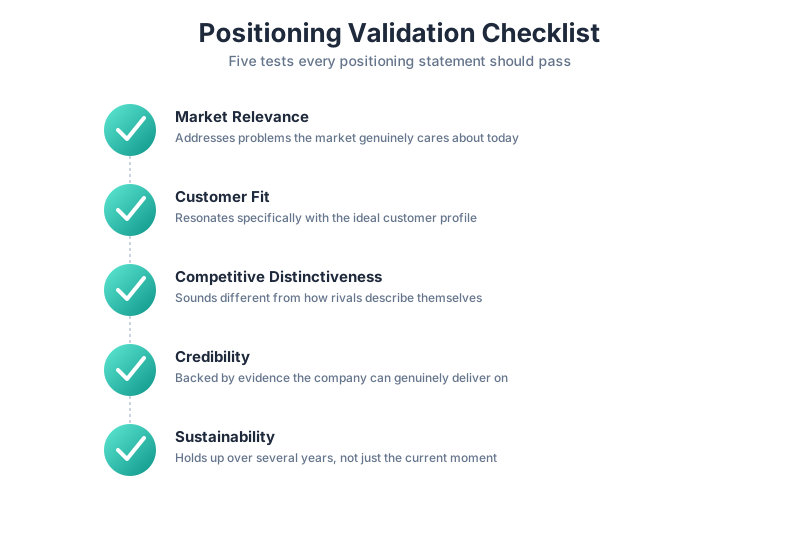
Market relevance checks whether the positioning actually addresses problems the target market genuinely cares about right now, rather than problems that were relevant several years ago or that only a small subset of the market actually experiences. Validating relevance requires direct conversations with current prospects and customers, rather than relying solely on internal assumptions about what matters.
Customer Fit
Customer fit validation tests whether the positioning resonates specifically with the ideal customer profile defined during segmentation, rather than a broader, more generic audience. Positioning that tests well with a wide range of people but does not particularly excite the actual target customer has likely been diluted too far in an attempt to appeal to everyone.
A useful validation method is running the positioning past a handful of customers who represent the primary ICP directly, asking not just whether they understand it, but whether it genuinely made them more excited about the product than the language they had encountered before. Polite agreement is a much weaker signal than visible enthusiasm, and it is worth distinguishing carefully between the two when gathering this kind of feedback.
Competitive Distinctiveness
Competitive distinctiveness checks whether the positioning actually sounds different from how competitors describe themselves, rather than using the same generic language every player in the category tends to reach for. A useful exercise here is removing the company name from a positioning statement and a competitor's equivalent statement, then seeing whether an outside observer can reliably tell which is which.
Credibility Assessment
Credibility assessment evaluates whether the company can genuinely back up its positioning claims with real evidence, rather than making promises the product or team cannot currently deliver on. Overpromising in positioning creates a painful gap between expectation and reality that shows up in poor onboarding experiences, frustrated customers, and negative reviews down the line.
Involving customer facing teams such as support and customer success in reviewing new positioning language before it launches is a useful safeguard, since these teams often have the clearest, most honest view of where the product genuinely delivers versus where the gap between marketing claims and lived customer experience tends to show up most painfully.
Sustainability of Positioning
Sustainability of positioning considers whether the current positioning will still hold up over the next several years, or whether it depends on a competitive or market advantage likely to erode quickly. Positioning built entirely around being the newest or cheapest option in a category, for example, tends to be far less sustainable than positioning built around a durable structural advantage.
A useful question to ask when assessing sustainability is what would need to happen for this positioning to stop being true. If the honest answer is simply that a competitor releases a similar feature or matches a price point, the positioning is likely built on a fragile foundation that will require frequent rework. Positioning grounded in structural advantages, such as proprietary data, deep vertical expertise, or a genuinely different business model, tends to remain valid for much longer without needing constant revision.
Positioning Opportunities
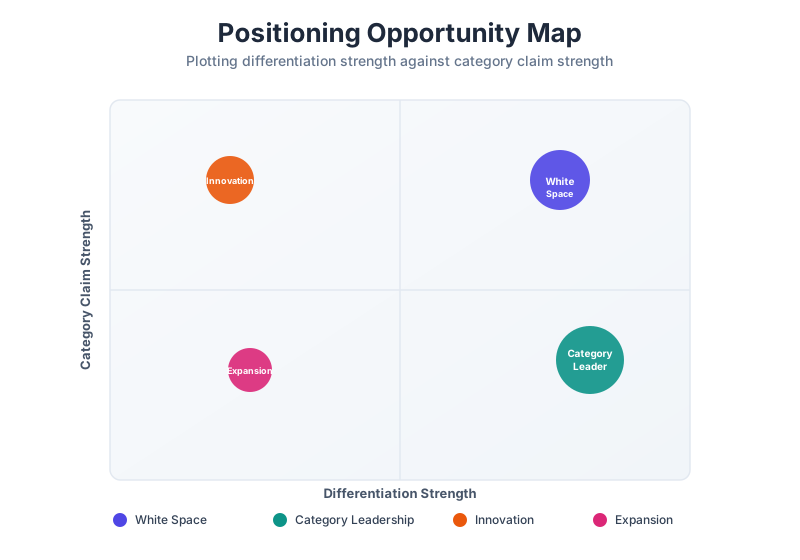
Beyond defending and validating current positioning, it is worth exploring where genuinely new positioning opportunities might exist.
White Space Positioning
White space positioning identifies angles or themes that no competitor has meaningfully claimed yet, offering a company the chance to become closely associated with an important idea before anyone else stakes a claim to it. These opportunities often emerge from shifts in buyer priorities that competitors have been slow to notice or respond to in their own messaging.
Spotting white space positioning opportunities often requires paying close attention to what buyers are asking about in sales calls and support conversations that competitors are not yet addressing prominently in their own marketing. A theme that keeps surfacing organically in customer conversations, but that no competitor has built explicit messaging around, often represents a genuine opening worth claiming before someone else notices it first.
Category Leadership Opportunities
Category leadership opportunities involve positioning a company not just as a strong option within an existing category, but as the defining example of what that category should look like. Companies that successfully claim category leadership often benefit from being the default reference point buyers compare everyone else against, which carries significant long term positioning advantage.
Claiming category leadership convincingly usually requires more than confident language alone. It typically demands sustained investment in original research, thought leadership content, and public visibility that gradually establishes the company as the voice that defines how the broader market talks about the category, rather than simply asserting leadership without the supporting evidence to back it up.
Expansion Opportunities
Expansion opportunities in positioning consider how current positioning could extend to support new products, new segments, or new use cases without diluting the core message that already resonates with existing customers. Successful expansion usually builds on the existing positioning foundation rather than abandoning it entirely in favor of something disconnected from what the brand has already established.
Innovation Positioning
Innovation positioning highlights a company's ongoing investment in solving new problems or improving existing solutions, appealing particularly to buyers who want a long term partner rather than a vendor who might stagnate after an initial sale. This form of positioning works best when backed by a visible pattern of shipped innovation over time, rather than a single announcement that is never followed up on.
Buyers evaluating a multi year vendor relationship often weigh innovation positioning heavily, since they are effectively betting on a company's ability to keep improving alongside their own evolving needs. Demonstrating this through a consistent track record, rather than a single flagship feature launch, builds far more confidence that the partnership will continue delivering value well beyond the initial purchase.
Future Positioning Evolution
Future positioning evolution considers how current positioning might need to shift as the market, competitive landscape, and customer needs continue to change. Building this forward looking view into the positioning process helps a company avoid becoming attached to language that made sense at launch but no longer reflects where the market or the product itself has moved.
Setting a regular cadence, such as an annual or semi annual positioning review, keeps this evolution intentional rather than reactive. Companies that only revisit positioning after noticing declining performance or a jarring competitive moment often find themselves scrambling to catch up, while those with a scheduled review process can evolve their positioning gradually and deliberately as conditions shift.
Positioning Recommendations
All of the analysis above should culminate in a clear, actionable set of recommendations that guide how positioning gets refined and applied going forward.
Positioning Refinement
Positioning refinement recommendations specify exactly what language, themes, or emphasis should change based on the validation work completed earlier, rather than leaving the team to guess at what needs improvement. Specific, concrete recommendations are far more useful than a general sense that positioning needs to feel sharper.
Differentiation Improvements
Differentiation improvement recommendations identify where the current positioning relies too heavily on functional claims competitors can easily match, and where the company should invest to build more durable, harder to copy differentiation over time, whether through technology investment, service model changes, or brand building.
These recommendations work best when tied to a realistic timeline and owner, since differentiation improvements, particularly those involving structural changes like a new pricing model or a deeper vertical specialization, often take considerably longer to implement than a simple messaging update. Being explicit about which improvements are quick wins versus longer term investments helps leadership sequence the work appropriately.
Strategic Priorities
Strategic priorities translate positioning work into a short list of what the business should focus on to make the positioning increasingly true over time, whether that means product investment, service model changes, or brand and content investment needed to establish category leadership.
Go Forward Positioning Guidance
Go forward positioning guidance gives practical direction to marketing, sales, and product teams on how to apply the refined positioning consistently across every channel and customer touchpoint, including specific language to use and language to retire because it no longer reflects where the positioning has evolved.
Providing clear examples alongside this guidance, showing exactly how the refined positioning should sound in a sales conversation, on a website, or in a piece of content, makes the guidance far easier for teams across the organization to actually apply consistently, compared to abstract principles alone that leave too much room for individual interpretation.
Success Factors
Success factors identify what needs to be true for the new or refined positioning to actually succeed, such as sales team training, updated marketing materials, or product capability that needs to ship before certain positioning claims can be made honestly and confidently in the market.
Listing these success factors explicitly, and assigning clear ownership for each one, prevents a common failure mode where updated positioning language gets approved and published but never actually reaches the sales team through proper training, or where a marketing campaign launches around a claim that product has not yet fully delivered on. Treating positioning as a cross functional rollout, rather than purely a marketing deliverable, considerably improves the odds that the new positioning actually takes hold consistently across the organization.
Executive Positioning Summary
The executive summary condenses the full positioning framework into a format leadership and new team members can absorb quickly without digging through the entire document.
Positioning Statement
This section presents the finalized positioning statement clearly and prominently, since it represents the single most important reference point for how the company should be described across every customer facing interaction going forward.
Core Value Proposition
A concise restatement of the core value proposition gives leadership a quick reference for the primary reason customers choose the product, without needing to revisit the full value proposition analysis in detail.
Key Differentiators
The summary should list the small number of differentiators that matter most, prioritized by how durable and defensible they are, rather than an exhaustive list of every minor feature advantage the product happens to have at the moment.
Strategic Advantages
Strategic advantages connect positioning back to the broader competitive and market context, explaining why the company is well positioned to win given current market conditions, competitive intensity, and its own particular strengths. This section gives leadership a clear line of sight from the detailed positioning work all the way up to the broader competitive story investors, board members, and new executives need to understand quickly.
Executive Recommendations
The summary should close with a short, clear set of recommendations for leadership, whether that is approving investment in a specific differentiation area, greenlighting updated marketing materials, or committing to a category leadership positioning strategy that will require sustained investment over multiple years to fully realize.
Positioning, like every other part of go to market strategy, is never finished once and forgotten. The strongest companies revisit their positioning regularly, testing it against new competitive moves, evolving customer needs, and the product's own continued development, refining the language as the underlying truth about the product and the market continues to change. Treating positioning as a living asset, owned collaboratively across marketing, sales, and product rather than a single document written once and filed away, keeps a company's story sharp and credible even as everything around it continues to shift.
Contents