
Pricing Strategy: Turning Value Into a Number Customers Will Pay
Pricing sits at the exact intersection of everything else in a go to market plan. It reflects the value a product delivers, it shapes how customers perceive quality and positioning, and it directly determines revenue and growth. Get pricing wrong and even a genuinely strong product can struggle, either by leaving significant revenue on the table with prices set too low, or by creating unnecessary friction and lost deals with prices set too high relative to perceived value. Pricing is never purely a finance exercise or purely a marketing exercise, it requires input from both, along with product and sales, to get right.
This guide covers the full scope of pricing strategy inside a go to market program, starting with overall pricing objectives, moving through pricing model design, value based and competitive analysis, packaging, economics, and finishing with scenario planning, recommendations, and an executive summary leadership can act on.
Pricing decisions tend to attract opinions from every corner of a business, since nearly everyone has a stake in the outcome. Sales wants pricing flexible enough to close deals quickly, finance wants pricing disciplined enough to protect margin, product wants pricing that reflects the effort behind new capability, and marketing wants pricing that supports the broader brand story. A good pricing process does not try to please every stakeholder equally, it builds a clear, evidence based framework that can weigh these competing interests thoughtfully and produce a defensible decision everyone can understand, even when it does not perfectly match what each individual team might have chosen on its own.
Pricing Strategy Overview
Before designing a specific pricing model, a team needs to agree on what the pricing strategy is meant to accomplish and how it connects to broader business goals.
Pricing Objectives
Pricing objectives clarify what the pricing strategy needs to prioritize, whether that is maximizing revenue growth, capturing market share quickly, protecting margin, or supporting a premium brand position. Different objectives can point toward meaningfully different pricing decisions, so being explicit about which objective matters most avoids a pricing strategy that tries to accomplish everything at once and ends up serving no single goal particularly well.
A company prioritizing rapid market share growth, for example, might accept lower initial margins in exchange for more aggressive, accessible pricing that removes friction for new customers, while a company prioritizing margin protection might hold firmer on price even at the cost of losing some price sensitive deals. Neither approach is inherently correct, but each requires a different set of supporting decisions throughout the rest of the pricing strategy.
Writing down the specific pricing objective, and referring back to it whenever a new pricing question arises, keeps decisions consistent over time. Without this anchor, pricing decisions can drift inconsistently as different stakeholders push for changes based on their own immediate priorities, whether that is a sales leader wanting more discounting flexibility to close deals faster or a finance leader wanting firmer margin protection.
Strategic Pricing Approach
Strategic pricing approach describes the overall philosophy guiding pricing decisions, whether that is cost based pricing built up from internal cost structure, competitive pricing anchored to what rivals charge, or value based pricing anchored to the actual outcomes a customer receives. Most mature go to market teams eventually converge on value based pricing as the primary anchor, using cost and competitive data as supporting inputs rather than the primary driver.
Cost based pricing, while simple to calculate, often leaves significant value on the table when a product delivers outcomes far exceeding its cost to build and deliver. Competitive pricing, while useful as a sanity check, can trap a company into matching a market norm that may not reflect the genuine differentiated value a specific product delivers. Value based pricing requires more upfront research to get right, but tends to produce a more defensible, sustainable price point over time.
Pricing Principles
Pricing principles are the guiding rules that keep pricing decisions consistent over time, such as always pricing according to value delivered rather than cost to serve, maintaining transparent published pricing wherever possible, or avoiding frequent price changes that could erode customer trust. These principles act as a reference point whenever a new pricing decision needs to be made, keeping decisions consistent even as different people across the organization weigh in over time.
| Pricing Principle | Description | Why It Matters |
|---|---|---|
| Value Alignment | Price should reflect value delivered | Keeps pricing defensible and sustainable |
| Simplicity | Pricing should be easy to understand | Reduces friction and sales cycle length |
| Consistency | Similar customers should see similar pricing | Builds trust and reduces internal complexity |
| Flexibility | Pricing should accommodate different needs | Expands addressable market without discounting core value |
These principles work best when documented explicitly and shared broadly across sales, marketing, and finance, rather than existing as unstated assumptions that different teams interpret differently. A shared, written set of principles gives everyone a consistent reference point when a new pricing question arises, reducing the likelihood of inconsistent, ad hoc decisions made under deal pressure.
Business Goals Alignment
Business goals alignment ensures pricing strategy connects directly to the company's broader strategic priorities, whether that is entering a new market segment, defending against a specific competitive threat, or supporting a shift toward larger enterprise deals. Pricing decisions made in isolation from these broader goals often create friction with other parts of the go to market strategy, such as a low price point that undermines a premium positioning strategy established elsewhere.
Involving pricing decision makers directly in broader go to market planning discussions, rather than treating pricing as a separate, downstream exercise handled later, helps catch this kind of misalignment early. A pricing team working from outdated strategic priorities can easily produce a technically sound pricing model that nonetheless works against where the broader business is actually trying to go.
Pricing Model & Structure
With overall strategy defined, the next step is choosing the specific pricing model and structure that will actually be used to charge customers.
Pricing Model
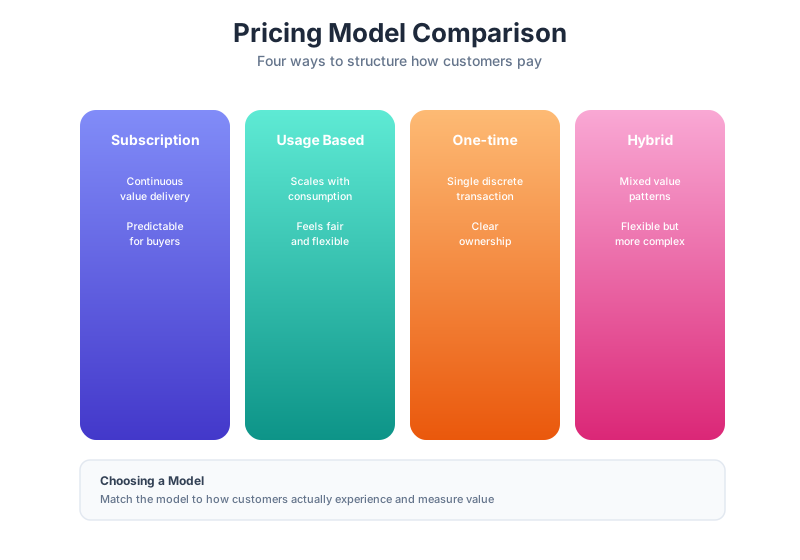
Choosing between subscription, usage based, one time, or hybrid pricing models depends heavily on how customers derive and experience value from the product. Subscription pricing works well when value is delivered continuously over time, usage based pricing works well when value scales directly with how much a customer actually uses the product, and one time pricing suits products where value is delivered in a single, discrete transaction.
| Pricing Model | Best Fit | Customer Perception |
|---|---|---|
| Subscription | Continuous value delivery | Predictable, easy to budget |
| Usage Based | Value scales with consumption | Fair, pay for what you use |
| One-time | Single discrete transaction | Clear ownership, no ongoing commitment |
| Hybrid | Mixed value delivery patterns | Flexible, but can feel complex |
Many companies eventually adopt a hybrid model as they mature, combining a subscription base with usage based components for specific high variability features. This approach captures the predictability benefits of subscription pricing while still allowing pricing to scale fairly with genuinely variable usage, though it requires careful design to avoid feeling overly complex or unpredictable to the customer trying to estimate their own costs in advance.
Pricing Architecture
Pricing architecture defines the underlying structure that determines how price actually scales, whether that is based on number of users, volume of usage, feature access, or some combination of these factors. A well designed architecture should scale naturally with the value a customer receives, so that price increases feel proportionate to increasing value rather than arbitrary or punitive.
Testing a proposed pricing architecture against real customer usage data before finalizing it helps avoid unpleasant surprises after launch. Modeling how the new architecture would have priced existing customers, compared to what they currently pay, often reveals unintended consequences, such as a small number of customers facing a dramatic price increase that could trigger churn, well before the new structure actually goes live.
Packaging Strategy
Packaging strategy determines how product capability gets bundled into specific purchasable offerings, balancing the goal of giving customers meaningful choice against the risk of creating so many options that the decision itself becomes a source of friction. Most successful packaging strategies settle on a small number of clearly differentiated tiers rather than an overwhelming menu of granular options.
Research on decision making consistently shows that too many options can reduce conversion rather than improve it, since prospects faced with an overwhelming number of choices sometimes disengage entirely rather than work through a complex decision. Limiting the core packaging structure to three or four clearly differentiated tiers, supplemented by targeted add-ons for specific needs, tends to strike a better balance than an expansive menu of granular options.
Billing Options
Billing options cover the practical mechanics of how customers actually pay, including billing frequency, payment methods, and currency support. Offering flexibility here, such as both monthly and annual billing with a meaningful discount for annual commitment, can meaningfully improve both conversion and retention without requiring any change to the core pricing model itself.
Contract Structure
Contract structure covers the terms surrounding a purchase beyond the price itself, including contract length, renewal terms, and cancellation policies. Simpler, more transparent contract terms tend to reduce friction during the sales process, particularly for smaller deals where a lengthy negotiation over contract terms can be disproportionately costly relative to the deal size itself.
Standardizing contract terms for smaller deals, while reserving more customized terms for larger enterprise agreements where the added negotiation effort is proportionate to the deal size, helps a sales team move faster on the volume of smaller transactions while still accommodating the genuine customization needs of larger accounts.
Making standard contract terms easily accessible, ideally reviewable by a prospect before they ever speak with a sales rep, further reduces friction, since many buyers appreciate the ability to review terms internally with their own legal or procurement team early rather than waiting until late in the sales process to discover potential dealbreakers.
Value-Based Pricing Analysis
Value based pricing anchors price to the actual value a customer receives, rather than internal cost structure or purely competitive positioning.
Customer Perceived Value
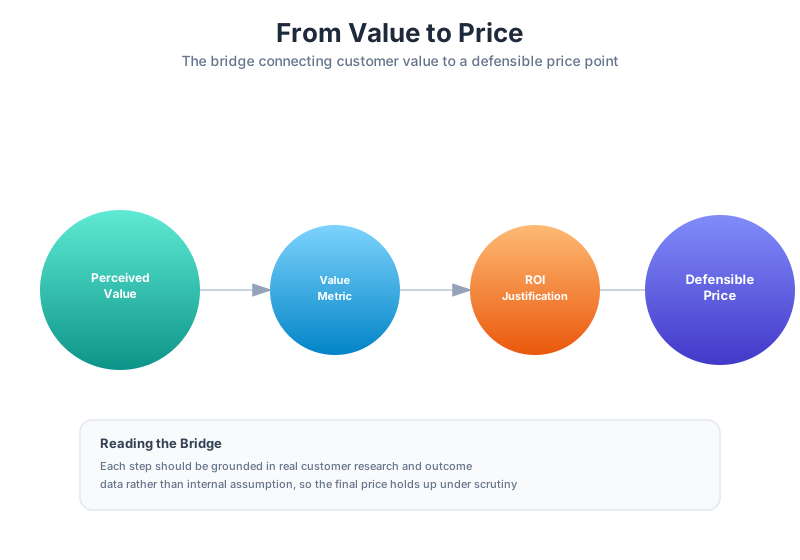
Customer perceived value captures how much value a customer genuinely believes they receive from a product, which does not always match the value a company internally believes it delivers. Understanding this perception gap, through direct customer research rather than internal assumption, is essential before setting a price anchored to value.
Structured pricing research methods, such as asking customers directly what price would feel too expensive, too cheap to trust, and reasonably priced, can reveal a surprisingly clear picture of perceived value across a target segment. This kind of direct research consistently produces more reliable pricing signals than internal guesswork, since a product team's own sense of value delivered is naturally biased by how much effort went into building it, which has little bearing on what a customer actually perceives.
Value Metrics
A value metric is the specific unit pricing scales against, such as number of users, volume of transactions processed, or amount of data stored. Choosing a value metric that aligns closely with how customers actually experience and measure value makes pricing feel fair and easy to understand, while a poorly chosen value metric can create friction even when the underlying price point is reasonable.
| Value Metric Type | Example | Alignment Strength |
|---|---|---|
| Per Seat | Charge per named user | Strong for collaboration tools |
| Per Transaction | Charge per processed transaction | Strong for payment or workflow tools |
| Per Outcome | Charge based on result achieved | Strong alignment, harder to measure |
| Flat Fee | Single fixed price regardless of use | Simple, weaker value alignment |
Selecting the right value metric often matters more to long term pricing success than the specific price point itself, since a poorly aligned metric creates ongoing friction and resentment even at a reasonable overall price, while a well aligned metric makes even a premium price feel fair because customers can directly see the connection between what they pay and what they get.
ROI Justification
ROI justification quantifies the return a customer receives relative to what they pay, giving an economic buyer a clear, defensible basis for approving the purchase internally. Strong ROI justification uses real customer outcome data rather than optimistic internal projections, since a skeptical buyer will often ask directly how a stated return was calculated.
Building a simple, transparent ROI calculator that a prospect can adjust with their own numbers, rather than presenting only a single generic figure, tends to build considerably more trust and produces a more personalized business case the buyer can confidently take to their own internal stakeholders for approval.
Business Impact
Business impact analysis connects pricing directly to the broader business outcomes a customer experiences, such as revenue growth, cost reduction, or risk mitigation. Framing price relative to this broader impact, rather than as an isolated cost line item, helps a budget holder see the purchase as an investment rather than a pure expense.
Pricing Rationale
Pricing rationale documents the reasoning behind a specific price point, connecting it back to customer value, market position, and business goals. Having this rationale clearly documented internally makes it far easier to defend pricing decisions consistently across sales conversations, rather than leaving individual reps to justify price on the fly without a shared, coherent explanation.
This documentation also proves valuable whenever pricing eventually needs to change, since a clearly recorded rationale for the original price point makes it much easier to evaluate whether a proposed change is genuinely justified by new information, or simply a reaction to short term pressure such as a single lost deal or an aggressive competitor discount.
Competitive Pricing Analysis
Beyond internal value based reasoning, pricing decisions need to account for how competitors price and how that shapes buyer expectations.
Competitor Pricing Benchmarks
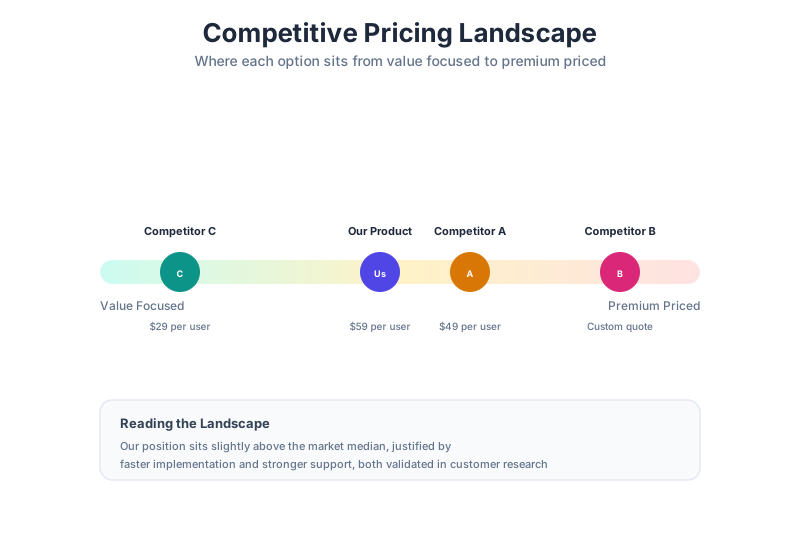
Competitor pricing benchmarks provide a clear, factual reference for how the broader market prices similar solutions, helping avoid a price point so far outside market norms that it creates unnecessary friction or suspicion, in either direction, among prospects actively comparing several options.
| Competitor | Entry Price Point | Pricing Model |
|---|---|---|
| Competitor A | $49 per user per month | Per seat subscription |
| Competitor B | Custom quote | Usage based |
| Competitor C | $29 per user per month | Per seat with freemium tier |
| Our Product | $59 per user per month | Per seat subscription |
Building this benchmark from actual published pricing pages, sales conversations, and where possible direct customer feedback about what competitors quoted them, rather than relying on outdated or secondhand information, keeps the comparison genuinely useful. Competitor pricing shifts more often than many teams expect, and a benchmark reviewed only once a year can quickly become a misleading reference for current sales conversations.
Market Pricing Landscape
Market pricing landscape analysis looks beyond individual competitor price points to understand broader pricing norms and expectations within the category, such as whether the market generally favors transparent published pricing or custom quotes, and whether free trials or freemium tiers have become a standard expectation buyers now assume.
Buyer expectations shaped by the broader market landscape can matter as much as the actual price point itself. A prospect entering a sales conversation already expecting a free trial, because that is now standard practice across the category, may react negatively to a vendor who does not offer one, regardless of how that vendor's actual price compares to competitors.
Premium vs Value Positioning
Deciding between premium and value positioning shapes how a company frames its price relative to competitors. Premium positioning justifies a higher price point through superior quality, service, or brand, while value positioning competes more directly on price and efficiency. This decision should align closely with the broader positioning work established earlier in the go to market strategy.
Attempting to occupy both premium and value positioning simultaneously tends to confuse the market and dilute both messages. A company should generally choose one lane deliberately and commit to the supporting decisions that make that positioning credible, whether that means investing heavily in service quality to justify a premium price, or ruthlessly controlling costs to sustain a genuinely competitive value price without sacrificing margin.
Price Differentiation
Price differentiation considers whether pricing itself can serve as a meaningful competitive differentiator, such as a notably simpler, more transparent pricing structure in a category where competitors rely heavily on opaque custom quotes. In categories where products otherwise look similar, pricing structure and transparency can become a genuine point of differentiation on its own.
Competitive Pricing Insights
Competitive pricing insights synthesize the broader analysis into specific, actionable takeaways, such as identifying a pricing gap in the market that the company could occupy, or recognizing that competitors are converging toward a specific price point that creates pressure to justify any meaningful deviation from that range.
These insights should feed directly into the pricing recommendations covered later, rather than existing purely as background research. A gap identified here, such as a segment currently underserved by existing competitor pricing structures, represents a concrete opportunity worth acting on rather than simply noting for future reference.
Pricing Tiers & Packaging
Translating pricing strategy into specific, purchasable packages requires careful design to balance simplicity, choice, and revenue optimization.
Product Editions
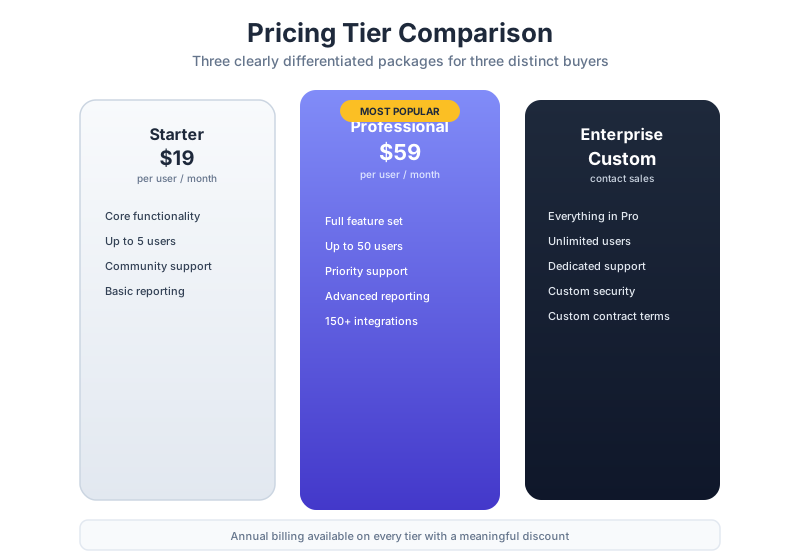
Product editions define the specific named packages a customer can choose from, typically ranging from a basic entry level tier through a mid tier most customers eventually land on, up to a premium or enterprise tier for the most sophisticated buyers. Each edition should have a clear, distinct value proposition that makes the intended target customer for that tier immediately obvious.
Naming each edition thoughtfully, rather than defaulting to generic labels, can meaningfully influence how prospects perceive and self select into tiers. Descriptive names that hint at the intended customer or use case, rather than purely numeric or generic labels, help prospects more quickly identify which tier genuinely fits their own situation without needing to read through detailed feature lists first.
Feature Allocation
Feature allocation determines which specific capabilities appear in each tier, requiring careful balance between giving lower tiers enough value to be genuinely useful and reserving enough differentiated value in higher tiers to create a clear incentive to upgrade as a customer's needs grow.
| Tier | Target Customer | Key Features Included |
|---|---|---|
| Starter | Small teams, basic needs | Core functionality, limited users |
| Professional | Growing teams, standard needs | Full feature set, moderate user limits |
| Enterprise | Large organizations, complex needs | Advanced security, dedicated support, custom limits |
Deciding which specific features belong in which tier deserves careful analysis of actual usage data rather than intuition alone. Features that nearly every customer uses regardless of company size or sophistication generally belong in every tier, while features that only a smaller, more advanced segment of customers actually need can serve as meaningful upgrade incentives reserved for higher tiers.
Tier Comparison
A clear tier comparison, typically presented as a simple table on a pricing page, helps prospects quickly understand what differentiates each option without needing to read dense paragraphs of description. This comparison should highlight the handful of features that matter most for tier decision making, rather than listing every minor capability difference across the entire product.
Testing the actual pricing page comparison table with real prospects, rather than assuming internal logic will be equally clear to an outside buyer, often reveals confusion points worth addressing before launch. What feels obvious to a team that has lived with the pricing structure for months can be genuinely unclear to a first time visitor trying to make a quick decision.
Add-ons and Upgrades
Add-ons and upgrades allow customers to purchase specific additional capability without needing to jump to an entirely higher tier, giving pricing more flexibility to capture value from customers with specific needs that do not fit neatly into the standard tier structure.
Enterprise Offerings
Enterprise offerings typically move away from standardized tier pricing toward custom quotes tailored to a specific large customer's needs, since enterprise buyers often require specific security, support, and contractual terms that do not fit a one size fits all packaging structure. Even within a custom quote model, maintaining a consistent internal pricing framework helps ensure fairness and consistency across different enterprise deals.
Even with custom quoting, providing a rough indicative price range publicly, rather than requiring every prospect to fill out a form and wait for a sales conversation just to get a general sense of cost, tends to reduce friction and filter out prospects who are clearly outside the intended budget range before they invest time in a sales conversation that was never going to close.
Pricing Economics
Beyond what customers pay, pricing strategy needs to account for the underlying economics that determine whether a given price point actually supports a healthy, sustainable business.
Revenue Potential
Revenue potential analysis estimates how much total revenue a given pricing strategy could generate across the target market, factoring in expected adoption rates, tier distribution, and average deal size within each customer segment.
Building this analysis with a range of adoption assumptions, rather than a single fixed estimate, produces a more realistic view of revenue potential. Actual tier distribution often differs meaningfully from initial assumptions, and modeling a conservative, moderate, and optimistic adoption scenario side by side gives leadership a clearer sense of the range of plausible outcomes rather than a single number that may create a false sense of precision.
Profitability Analysis
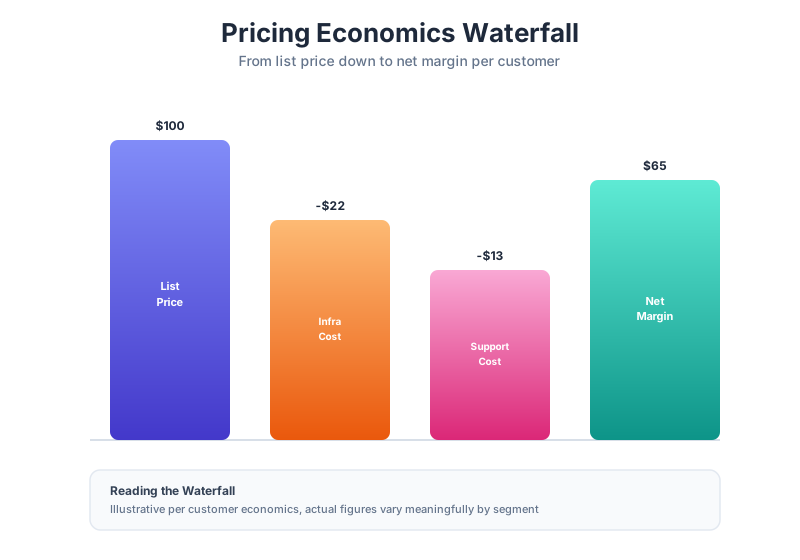
Profitability analysis examines how much of that revenue actually converts into profit after accounting for cost to serve, including infrastructure, support, and any direct costs associated with delivering the product to each customer. A pricing strategy that generates strong top line revenue but thin margins may not actually support healthy long term business growth.
| Pricing Scenario | Estimated Revenue Impact | Margin Impact |
|---|---|---|
| Current Pricing | Baseline | Baseline |
| Ten Percent Price Increase | Higher revenue per customer | Improved margin, some conversion risk |
| Simplified Tier Structure | Potentially higher conversion | Neutral to slightly positive margin |
| Usage Based Add-on | New incremental revenue stream | Strong margin, aligned to cost |
Profitability analysis works best when broken down by customer segment rather than viewed only in aggregate, since blended margin figures can mask meaningful differences between highly profitable and marginally profitable customer groups. A segment that looks attractive purely on revenue volume might actually be dragging down overall margin once true cost to serve is properly accounted for.
Cost Considerations
Cost considerations ensure pricing accounts for the true cost of delivering and supporting the product, including infrastructure costs that may scale with usage, customer support costs, and any variable costs tied to specific customer segments or usage patterns.
Many companies underestimate the true cost to serve certain customer segments, particularly smaller accounts that require disproportionate support attention relative to their revenue contribution. Accurately capturing these costs, rather than assuming cost to serve scales neatly with deal size, often reveals that pricing needs adjustment for specific segments to remain genuinely profitable rather than simply appearing so on a top line basis.
Margin Analysis
Margin analysis compares pricing against cost to serve across different customer segments and tiers, often revealing that certain segments are considerably more profitable than others even at similar price points, information that can meaningfully inform where sales and marketing investment should be prioritized.
Customer Lifetime Value Impact
Customer lifetime value impact considers how pricing decisions affect not just initial deal size, but long term retention, expansion revenue, and overall customer relationship value over time. A slightly lower initial price point that meaningfully improves retention and expansion can sometimes produce better long term economics than a higher initial price that increases early churn.
Modeling lifetime value across different pricing scenarios, rather than evaluating pricing purely on initial deal economics, often shifts the conclusion meaningfully. A pricing change that looks unfavorable when measured only by first year revenue can look considerably more attractive once its effect on multi year retention and expansion is properly factored into the analysis.
Pricing Risks & Opportunities
Pricing decisions carry both risk and opportunity that deserve explicit consideration before finalizing a strategy.
Price Sensitivity
Price sensitivity analysis examines how much demand changes in response to price changes, varying considerably across different customer segments. Smaller, more budget constrained customers typically show higher price sensitivity than larger enterprise customers, for whom price is often a smaller factor relative to the overall value and risk considerations involved in the purchase decision.
Measuring price sensitivity directly, through controlled experiments such as testing slightly different price points with different prospect groups, provides far more reliable data than assuming sensitivity based on internal intuition alone. Even a modest, carefully designed test can reveal whether a segment truly is as price sensitive as assumed, or whether that assumption has simply never been properly validated.
Adoption Barriers
Adoption barriers related to pricing include friction points such as a confusing pricing page, an intimidating custom quote process for smaller deals, or a price point that creates hesitation even when the underlying value proposition is genuinely strong. Identifying and removing these barriers can meaningfully improve conversion without requiring any change to the actual price itself.
Reviewing session recordings or analytics data on how prospects actually interact with a pricing page often reveals specific friction points, such as visitors repeatedly hovering over a particular tier without converting, or abandoning the page entirely at a specific point in the comparison table. These behavioral signals often point to concrete, fixable issues rather than requiring a fundamental pricing change.
| Risk or Opportunity | Description | Recommended Action |
|---|---|---|
| High Price Sensitivity | Smaller segments hesitant on price | Introduce lower entry tier or trial |
| Upsell Opportunity | Customers outgrowing current tier | Proactive expansion outreach |
| Discount Overuse | Sales team discounting too frequently | Tighten discount approval guidelines |
| Competitive Price Pressure | Rivals undercutting on price | Reinforce value based messaging |
Upsell Opportunities
Upsell opportunities exist wherever customers are likely to outgrow their current tier or usage level over time, representing a valuable, relatively low cost source of expansion revenue compared to acquiring entirely new customers. Proactively identifying and reaching out to these customers, rather than waiting for them to request an upgrade themselves, tends to capture this opportunity more reliably.
Building simple usage based alerts, such as automatically flagging accounts approaching a tier limit, gives customer success and sales teams a practical, data driven way to time upsell outreach at exactly the moment it feels most natural and relevant to the customer, rather than reaching out based purely on a generic renewal calendar schedule.
Expansion Pricing
Expansion pricing strategy considers how pricing should scale as an existing customer grows, whether through additional users, increased usage, or upgraded tiers. A well designed expansion pricing structure makes growth feel natural and fair to the customer, rather than creating a jarring cost increase that feels disconnected from the additional value being received.
Market Risks
Market risks related to pricing include broader economic pressure that could reduce customer budgets, a shift in market norms toward lower price points, or a well funded competitor entering with aggressive, unsustainable pricing designed purely to capture market share quickly.
Preparing a considered response to aggressive competitive pricing in advance, rather than reacting hastily in the moment, helps avoid an emotional, poorly thought out price cut that damages margin without genuinely addressing the underlying competitive threat. Often the better response involves reinforcing differentiated value rather than matching an aggressive price that may not be sustainable for the competitor offering it either.
Pricing Scenarios & Forecasts
Rather than committing to a single fixed view of future pricing, building out multiple scenarios helps a business prepare for different possible outcomes.
Best-Case Scenario
The best case scenario models pricing performance under favorable conditions, such as strong demand, minimal price sensitivity, and successful upsell execution, giving leadership a sense of the upper bound of what current pricing strategy could achieve under ideal circumstances.
Base-Case Scenario
The base case scenario represents the most realistic expected outcome, grounded in current conversion rates, typical customer behavior, and reasonable assumptions about market conditions. This scenario should serve as the primary planning reference for budget and revenue targets.
Distinguishing clearly between the best case and base case scenarios, rather than presenting only an optimistic view, helps set realistic expectations across the organization. Sales and finance teams that plan against an overly optimistic scenario often find themselves scrambling to explain a shortfall later, when a more grounded base case would have set expectations appropriately from the start.
Growth Pricing Strategy
Growth pricing strategy considers how pricing might need to evolve to support more aggressive growth targets, whether through more accessible entry pricing to expand top of funnel volume, or through more effective expansion pricing to grow revenue from the existing customer base more efficiently.
Companies pursuing aggressive growth targets sometimes need to accept a temporary reduction in average deal economics in exchange for significantly higher volume, provided the underlying unit economics still remain healthy over the customer lifetime. Modeling this tradeoff explicitly, rather than pursuing growth and margin goals without acknowledging the tension between them, produces a more coherent overall pricing strategy.
Regional Pricing Considerations
Regional pricing considerations account for meaningful differences in purchasing power, competitive intensity, and market norms across different geographies. A single global price point rarely optimizes revenue across every region equally, and thoughtful regional pricing adjustments can meaningfully improve both conversion and fairness across diverse markets.
| Region | Pricing Adjustment | Rationale |
|---|---|---|
| North America | Standard pricing | Primary reference market |
| Western Europe | Standard to slightly adjusted | Similar purchasing power |
| Emerging Markets | Reduced entry pricing | Lower purchasing power, price sensitivity |
| Enterprise Global | Custom quote regardless of region | Value based, not geography based |
Regional pricing adjustments should be implemented thoughtfully, since customers increasingly compare prices across regions through public forums and social media, and a poorly explained regional difference can create perceived unfairness among customers in higher priced regions who discover the discrepancy. Clear, defensible reasoning grounded in genuine purchasing power differences helps manage this risk.
Future Pricing Evolution
Future pricing evolution considers how pricing strategy might need to shift over a longer time horizon, as the product matures, the competitive landscape changes, and the company's own strategic priorities evolve. Building this forward looking view prevents pricing from becoming rigidly attached to assumptions that made sense at an earlier stage but no longer reflect current reality.
Setting a regular, scheduled cadence for revisiting pricing strategy, rather than only reacting when a problem becomes obvious, keeps this evolution deliberate and proactive. Many companies find that pricing goes years without meaningful review simply because there is never an urgent, forcing reason to revisit it, even as the underlying market and product have changed considerably in the meantime.
Pricing Recommendations
All of the analysis above should culminate in a clear, actionable set of pricing recommendations.
Recommended Pricing Model
The recommended pricing model section states clearly which model and architecture the business should adopt going forward, along with the core reasoning drawn from the value based and competitive analysis completed earlier.
This recommendation should be specific enough to actually implement, rather than a general directional statement. Naming the exact pricing model, value metric, and tier structure, along with the reasoning connecting each choice back to the evidence gathered earlier, gives the team a clear, actionable starting point rather than an abstract concept requiring further translation before it can be built.
Pricing Optimization Opportunities
Pricing optimization opportunities identify specific, near term adjustments that could improve revenue or conversion without requiring a complete pricing overhaul, such as adjusting a specific tier boundary or introducing a new add-on to capture currently unaddressed value.
These smaller, incremental opportunities are often easier to implement and test quickly compared to a full pricing model change, making them a useful place to start building organizational confidence and momentum before tackling larger, more structural pricing decisions.
Packaging Improvements
Packaging improvement recommendations identify where the current tier structure creates confusion, leaves value on the table, or fails to clearly differentiate between options, drawing on both internal data and direct customer feedback about the packaging experience.
Discount Strategy Guidance
Discount strategy guidance establishes clear rules for when and how much discounting is appropriate, preventing the common problem of inconsistent, ad hoc discounting that erodes both margin and the perceived value of published pricing over time.
A well structured discount approval process, with clear thresholds requiring escalating levels of approval for larger discounts, helps maintain pricing discipline across a growing sales team, rather than leaving discounting decisions purely to individual rep judgment under deal pressure at the end of a quarter.
Strategic Pricing Roadmap
A strategic pricing roadmap lays out how pricing strategy should evolve over the coming years, connecting near term recommendations to the longer term future pricing evolution discussed earlier, ensuring pricing decisions made today support where the business intends to be positioned down the road.
Sequencing this roadmap thoughtfully, rather than attempting every recommended change at once, tends to produce better outcomes. Introducing one meaningful pricing or packaging change at a time, measuring its impact, and then building on that learning before the next change keeps the business from confusing its own data by changing too many variables simultaneously.
Executive Pricing Summary
The executive summary condenses the full pricing analysis into a format leadership can review quickly without needing to revisit every underlying section in detail.
Recommended Pricing Strategy
This section clearly restates the overall recommended pricing strategy and the core reasoning behind it, giving leadership a quick, confident reference point for the direction being proposed.
Pricing Model
A concise restatement of the recommended pricing model and packaging structure gives leadership and new team members quick access to the practical mechanics of how the business intends to charge customers going forward.
Keeping this restatement focused purely on the model and structure itself, rather than repeating the full underlying rationale already covered earlier in the document, respects the purpose of an executive summary as a fast, high level reference rather than a full restatement of the entire analysis.
Key Pricing Insights
Key pricing insights highlight the two or three most important findings from the full analysis, stated plainly and backed by the strongest available data, rather than an exhaustive restatement of every section covered earlier.
Prioritizing insights that directly challenge an existing assumption, or that reveal a previously unrecognized opportunity, tends to be more valuable to leadership than insights that simply confirm what the organization already believed. The most useful executive summaries surface genuinely new information rather than restating the obvious.
Revenue Opportunities
Revenue opportunity summary highlights where pricing strategy creates the clearest path to additional revenue, whether through improved conversion, expansion revenue, or a specific packaging change expected to meaningfully move the needle.
Quantifying these opportunities with a rough estimated dollar impact, even when the estimate carries some uncertainty, gives leadership a more concrete basis for prioritization than a purely qualitative description of where opportunity might exist.
Executive Recommendations
The summary should close with a short, clear set of recommendations for leadership, whether that is approving a specific pricing change, committing to a packaging redesign, or greenlighting further research into a pricing question that remains genuinely uncertain.
As with the recommendations covered earlier in the document, pairing each executive recommendation with a rough sense of expected impact and implementation effort helps leadership weigh pricing initiatives fairly against other competing business priorities, rather than evaluating pricing requests in isolation without a clear sense of relative importance.
Pricing, like every other part of go to market strategy, benefits from ongoing attention rather than a single decision made once and left untouched indefinitely. The strongest companies revisit pricing regularly, testing assumptions against real conversion and retention data, and adjusting deliberately as the product, competitive landscape, and customer base continue to evolve over time. Treating pricing as a continuously managed discipline, rather than a decision made once at launch and forgotten, keeps a business genuinely aligned with the value it delivers as that value itself continues to grow and change.