
Customer Acquisition: Building a Repeatable Path to New Customers
Every business eventually faces the same core question: how do we consistently and predictably bring in new customers without reinventing the approach every quarter. Customer acquisition strategy answers that question by defining which channels a company invests in, how demand actually gets generated and captured, and how a prospect moves from first hearing about a product to becoming a paying customer. Done well, acquisition strategy turns unpredictable, one off wins into a repeatable growth engine the whole business can plan around.
This guide covers the full scope of customer acquisition inside a go to market program, starting with overall objectives, moving through acquisition models, demand generation, channels, and funnel design, and finishing with performance measurement, recommendations, and an executive summary leadership can act on.
Acquisition strategy tends to attract more experimentation and shifting opinion than almost any other part of a go to market plan, since new channels and tactics constantly emerge, and it is easy to chase whatever appears to be working well for other companies at a given moment. The strongest acquisition strategies resist this temptation to chase every new trend, instead building a disciplined, evidence based approach grounded in a clear understanding of where the company's own specific customers actually spend their attention and how they genuinely prefer to evaluate and buy.
Customer Acquisition Overview
Before choosing specific channels or tactics, a team needs a clear, shared understanding of what acquisition strategy is meant to accomplish.
Acquisition Objectives
Acquisition objectives define what the strategy needs to prioritize, whether that is rapid new customer volume, higher quality enterprise deals, or efficient, low cost growth within a specific segment. Different objectives point toward meaningfully different channel and campaign choices, so clarity here early prevents a scattered approach that tries to optimize for volume, quality, and efficiency all at once without a clear sense of which matters most right now.
A company prioritizing rapid volume growth might lean heavily into paid channels and broad top of funnel content, while a company prioritizing quality enterprise deals might invest more heavily in account based marketing and outbound sales development. Being explicit about the primary objective keeps every subsequent decision, from channel selection to budget allocation, pointed in a consistent direction.
Objectives often shift as a company matures, moving from a pure focus on volume during early growth stages toward a greater emphasis on efficiency and deal quality once the business reaches a certain scale. Revisiting acquisition objectives regularly, rather than assuming the original priorities set at launch still apply, keeps the strategy aligned with where the business actually stands today.
Growth Goals
Growth goals translate acquisition objectives into specific, measurable targets, such as a target number of new customers, a specific revenue growth rate, or a defined market share gain within a priority segment. These targets should connect directly to the broader business plan, rather than being set independently by a marketing or growth team without reference to what the rest of the business actually needs.
Setting growth goals collaboratively with finance and sales leadership, rather than in isolation, ensures the targets reflect genuine business capacity, such as whether the sales team can actually handle the pipeline volume a given growth goal would generate, or whether current infrastructure can support the customer volume being targeted.
Target Acquisition Strategy
Target acquisition strategy identifies which specific customer segments and channels deserve the most focused investment, drawing directly from the segmentation and ideal customer profile work established earlier in the go to market plan. Acquisition efforts spread evenly across every possible segment tend to underperform a more focused strategy concentrated on the highest priority segments identified through earlier research.
| Strategic Focus Area | Primary Question | Why It Matters |
|---|---|---|
| Segment Priority | Which customers are we acquiring first | Focuses budget on highest value targets |
| Channel Priority | Which channels reach them most effectively | Prevents wasted spend on low fit channels |
| Motion Priority | Self serve, sales assisted or hybrid | Shapes team structure and tooling needs |
| Efficiency Target | What CAC and payback period is acceptable | Keeps growth sustainable and fundable |
Focusing acquisition effort deliberately on the highest priority segments, even when it means passing on lower fit opportunities that present themselves, requires discipline that can be genuinely difficult to maintain when short term volume pressure tempts a team toward chasing any available lead regardless of fit. Holding this discipline consistently tends to produce stronger long term results than a broader, less targeted approach.
Success Metrics
Success metrics define how acquisition performance will actually be measured, typically including customer acquisition cost, conversion rates at each funnel stage, and payback period. Establishing these metrics upfront, before campaigns launch, ensures the team can evaluate performance objectively rather than retrofitting success criteria after results are already in.
Choosing metrics that genuinely reflect business health, rather than vanity metrics that look impressive but do not connect to real revenue outcomes, keeps the team focused on what actually matters. A large volume of website traffic or social media followers means little if it does not eventually translate into qualified pipeline and closed revenue.
Building a simple, shared dashboard that surfaces these core metrics consistently across marketing, sales, and leadership helps keep everyone anchored to the same definition of success, rather than different teams tracking slightly different numbers and arriving at conflicting conclusions about how the strategy is actually performing.
Customer Acquisition Model
With overall objectives set, the next step is choosing which acquisition models the business will rely on to actually bring in new customers.
Inbound Strategy
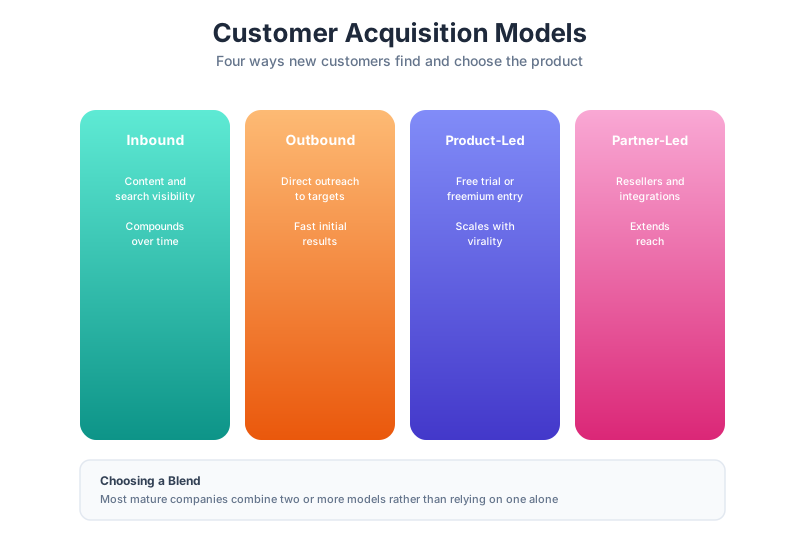
Inbound strategy attracts prospects through content, search visibility, and other channels where the prospect actively seeks out information, rather than being directly targeted through outbound outreach. This approach tends to build a durable, compounding asset over time, since well built content and search presence continue generating demand long after the initial investment.
The main tradeoff with inbound strategy is patience. Content and search visibility typically take months to build meaningful momentum, which can be a difficult sell for a team under pressure to show immediate results. Companies that stick with a disciplined inbound investment despite slow early progress often find that the channel eventually becomes one of the most cost efficient sources of new pipeline, once enough content and authority have accumulated.
Outbound Strategy
Outbound strategy proactively reaches out to specific target prospects through channels such as cold email, cold calling, or targeted advertising, rather than waiting for prospects to initiate contact. This approach tends to produce faster, more predictable short term results than inbound, though it typically requires more ongoing investment to sustain volume.
Outbound performance depends heavily on the quality of targeting and personalization behind each outreach effort. Generic, mass outreach tends to produce diminishing returns and can damage sender reputation over time, while highly targeted, well researched outreach to a carefully selected list of prospects tends to sustain much stronger response rates, even at lower volume.
| Acquisition Model | Speed to Results | Long Term Durability |
|---|---|---|
| Inbound | Slower to build momentum | High, compounds over time |
| Outbound | Faster initial results | Requires ongoing investment |
| Product-Led Growth | Moderate, depends on product virality | High, once flywheel is established |
| Partner-Led Growth | Slower to establish, faster once mature | High, built on lasting relationships |
Product-Led Growth
Product-led growth relies on the product itself as the primary driver of acquisition, typically through free trials, freemium tiers, or viral sharing mechanics built directly into the product experience. This model works particularly well for products with fast time to value and natural collaboration or sharing built into how the product gets used.
Successfully executing a product-led growth motion requires the product itself to deliver value quickly enough that a prospect experiences a genuine aha moment before they lose patience during a free trial or freemium experience. Companies attempting this model without first ensuring a genuinely fast, frictionless path to value often see disappointing conversion, regardless of how much traffic they drive toward the free experience.
Partner-Led Growth
Partner-led growth relies on external partners, such as resellers, technology integrations, or referral relationships, to drive new customer acquisition. This model can extend reach considerably beyond what a company could achieve through its own direct efforts alone, though it requires sustained investment in partner enablement and relationship management to work well.
Partners perform best when the relationship is genuinely mutually beneficial, rather than one sided in favor of the company seeking the partnership. Investing in clear partner enablement materials, responsive support, and a fair revenue sharing structure tends to produce far more active, engaged partners than a relationship where the partner feels like an afterthought.
Hybrid Acquisition Approach
Most mature companies eventually rely on a hybrid approach, blending inbound, outbound, product-led, and partner-led elements rather than relying on a single model exclusively. Understanding which combination best fits the specific product, market, and buyer behavior is more important than assuming any single model represents a universal best practice across every situation.
The right blend often shifts over a company's lifecycle, with earlier stage companies frequently relying more heavily on outbound and founder led sales to establish initial traction, before gradually building out inbound and product-led motions that become more efficient once there is enough brand recognition and customer proof to support them.
Deciding on the right blend also depends heavily on average deal size and sales cycle length. Products with larger deal sizes and longer, more considered buying processes tend to lean more heavily on outbound and partner-led motions that support a higher touch sales process, while products with smaller deal sizes and faster buying decisions often find inbound and product-led approaches considerably more efficient at scale.
Demand Generation Strategy
Demand generation strategy determines how a company builds awareness and captures interest before a prospect ever reaches a direct sales conversation.
Brand Awareness
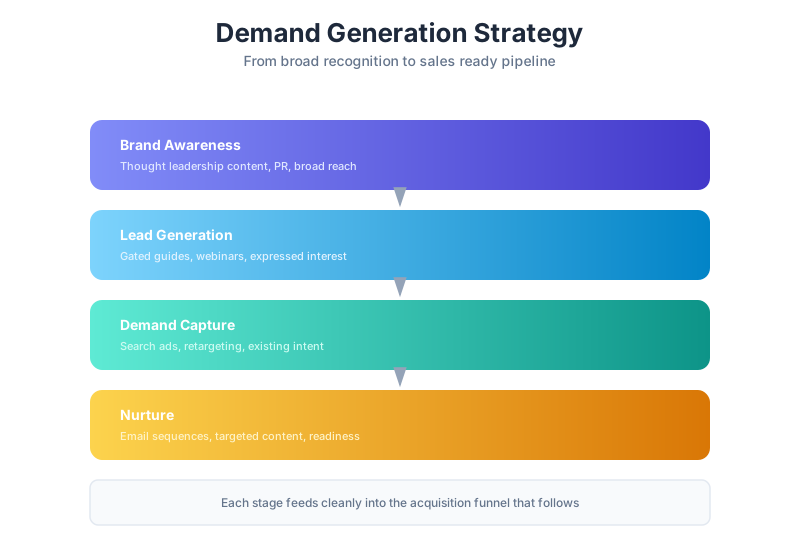
Brand awareness efforts build broad recognition and familiarity within a target market, even among prospects not yet actively looking for a solution. While harder to measure directly than more immediate demand capture tactics, strong brand awareness meaningfully improves the effectiveness of every other acquisition channel, since prospects respond more readily to a company they already recognize.
Measuring brand awareness impact indirectly, such as tracking branded search volume or comparing conversion rates for prospects who have previously encountered the brand versus those encountering it for the first time, helps demonstrate the value of awareness investment even without a perfectly direct attribution path back to revenue.
Lead Generation
Lead generation captures contact information and expressed interest from prospects, typically through gated content, webinars, or other offers that provide value in exchange for a prospect's willingness to share their information. Effective lead generation balances genuinely valuable content against an appropriately low friction exchange, since overly aggressive gating can suppress volume without meaningfully improving lead quality.
Testing different levels of gating friction, from fully open content through a simple email capture to a more detailed form, often reveals the actual tradeoff between volume and quality for a specific audience and content type, rather than relying on an assumption about what level of friction is appropriate.
| Demand Generation Stage | Primary Goal | Example Tactic |
|---|---|---|
| Brand Awareness | Build broad recognition | Thought leadership content, PR |
| Lead Generation | Capture expressed interest | Gated guides, webinars |
| Demand Capture | Convert existing intent | Search ads, retargeting |
| Nurture | Move leads toward readiness | Email sequences, targeted content |
Demand Capture
Demand capture focuses on prospects who already have some level of existing intent or awareness, converting that intent into a concrete lead or opportunity through tactics such as search advertising or retargeting. This differs from broader demand generation in that it targets prospects already further along in recognizing their need, rather than building awareness from scratch.
Demand capture tactics generally show a more direct, measurable return than broader awareness building, since they target prospects closer to a decision, making this an efficient place to start for teams with limited budget looking to establish an initial acquisition motion before investing more heavily in longer term demand generation.
Campaign Priorities
Campaign priorities determine which specific demand generation initiatives receive the most focused investment during a given period, based on where the acquisition strategy has identified the greatest opportunity or need. Without clear prioritization, marketing teams often spread effort too thin across many simultaneous campaigns rather than concentrating resources behind the highest impact initiatives.
Marketing Funnel Strategy
Marketing funnel strategy connects demand generation activities to the broader acquisition funnel, ensuring that awareness and lead generation efforts feed cleanly into the consideration and conversion stages covered later in the framework, rather than existing as disconnected activities that generate volume without a clear path to actual revenue.
Mapping each demand generation activity explicitly to the funnel stage it supports helps identify gaps, such as strong top of funnel content but a noticeable shortage of the more detailed, comparison focused content needed to support prospects further along in their evaluation process.
Acquisition Channels
Beyond the broader demand generation strategy, specific channels represent the actual mechanisms through which prospects are reached.
Organic Channels
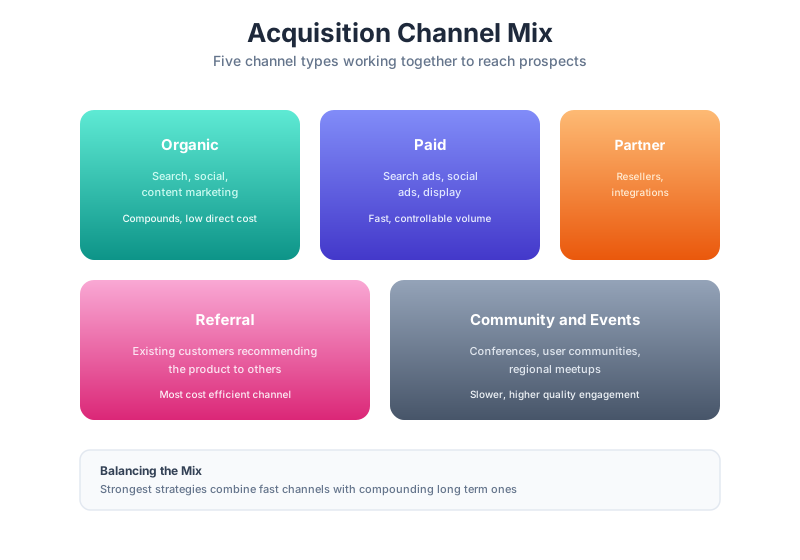
Organic channels include search engine visibility, organic social media, and content marketing, all of which build a compounding asset over time without direct ongoing media spend. These channels typically take longer to build momentum but offer strong long term efficiency once established.
Investing consistently in organic channels over an extended period, rather than treating them as a short term tactic to abandon if results are not immediate, tends to produce the strongest long term payoff. Search visibility in particular often takes six months or more to show meaningful traction, and teams that give up too early miss out on the compounding value that builds after that initial period.
Paid Channels
Paid channels include search advertising, social media advertising, and display advertising, offering faster, more controllable volume than organic channels in exchange for ongoing spend. Paid channels work particularly well for testing new messaging or targeting quickly, since results are visible much faster than the slower build required for organic channels.
Because paid channels require ongoing spend to sustain volume, they work best when paired with a clear understanding of acceptable acquisition cost and payback period, ensuring the channel remains genuinely profitable rather than simply generating volume at a cost that undermines the broader business economics.
| Channel Type | Typical Time to Results | Cost Structure |
|---|---|---|
| Organic | Months to build momentum | Primarily time and content investment |
| Paid | Days to weeks | Ongoing media spend |
| Partner | Weeks to months to establish | Revenue share or referral fee |
| Referral | Ongoing, tied to customer satisfaction | Low direct cost, requires strong product |
Partner Channels
Partner channels rely on external relationships, such as resellers, technology integration partners, or agencies, to reach prospects a company could not efficiently reach on its own. Building strong partner channels requires sustained investment in enablement and relationship management, but can meaningfully extend reach once established.
Successful partner channel programs typically designate a clear internal owner responsible for partner relationships, rather than treating partner management as a part time responsibility spread across an already busy team. Dedicated ownership tends to produce more consistent partner engagement and a more reliable flow of partner sourced opportunities.
Referral Channels
Referral channels rely on existing customers actively recommending a product to others, typically the most cost efficient acquisition channel available since it requires little direct spend and benefits from the built in trust of a personal recommendation. Building a structured referral program, rather than relying purely on organic word of mouth, helps capture this opportunity more consistently.
A well designed referral program makes the act of referring genuinely easy and rewarding for the existing customer, rather than requiring significant effort or offering an incentive too small to motivate action. Timing referral requests around a moment when a customer has just experienced clear value, such as right after achieving a meaningful result, tends to produce stronger response rates than a generic, poorly timed ask.
Community & Events
Community and events channels build relationships and awareness through in person or virtual gatherings, whether that is an industry conference, a company hosted user community, or a smaller regional meetup. These channels often produce a slower but higher quality form of acquisition, since attendees typically engage more deeply than through a purely digital touchpoint.
Building an owned community, such as a dedicated online forum or user group, offers a particularly durable long term asset, since it creates a space where prospects and customers interact directly with each other, generating organic advocacy and peer validation that a company could not easily manufacture through its own marketing alone.
Customer Acquisition Funnel
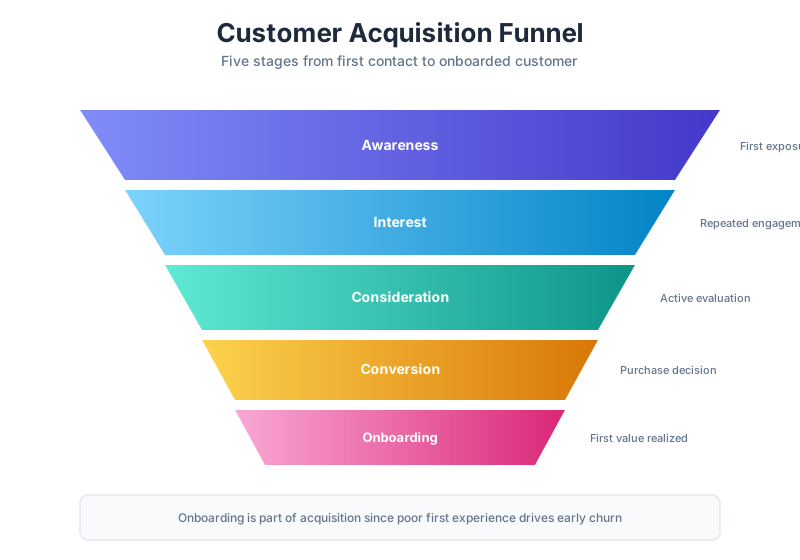
The acquisition funnel maps the stages a prospect moves through from first awareness to becoming an active customer.
Awareness
The awareness stage introduces a prospect to a company or product for the first time, typically through demand generation activities such as content, advertising, or word of mouth. Success at this stage is measured by reach and recognition rather than direct conversion, since most prospects encountering a brand for the first time are not yet ready to buy.
Setting realistic expectations for awareness stage metrics matters considerably, since holding this stage to the same conversion standard as later, more qualified funnel stages leads to premature judgments about whether an awareness campaign is actually working. Reach, impressions, and brand recall are more appropriate measures here than immediate lead generation.
Interest
The interest stage captures prospects who have moved beyond simple awareness to actively engaging further, such as visiting a website multiple times, following social channels, or signing up for an email newsletter. This stage represents an early signal of genuine curiosity worth nurturing toward deeper consideration.
Tracking specific behavioral signals at this stage, such as return visits or content engagement depth, helps distinguish prospects genuinely warming up from those who encountered the brand once and moved on without further interest. This distinction helps prioritize nurture efforts toward the prospects most likely to eventually convert.
| Funnel Stage | Key Signal | Typical Content or Action |
|---|---|---|
| Awareness | First exposure to brand or product | Content, ads, word of mouth |
| Interest | Repeated engagement | Newsletter signup, content downloads |
| Consideration | Active evaluation | Product demos, comparison content |
| Conversion | Purchase decision | Trial, sales conversation, checkout |
| Onboarding | First value realization | Guided setup, welcome sequences |
Consideration
The consideration stage involves a prospect actively evaluating whether a specific product meets their needs, often comparing it directly against alternatives. Content and sales engagement at this stage should provide the detailed information a prospect needs to move confidently toward a decision, rather than continuing to rely on broader awareness level messaging.
This is often the stage where sales and marketing need the closest coordination, since a prospect moving into active evaluation frequently benefits from a more personal touchpoint alongside the self serve content they are already consuming independently. Handoff processes that clearly define when and how sales should engage a prospect showing consideration stage behavior help prevent both premature outreach and missed opportunities to engage at the right moment.
Conversion
The conversion stage represents the actual purchase decision, whether that happens through a self serve checkout flow or a more traditional sales negotiation. Removing unnecessary friction at this stage, such as a confusing checkout process or an overly lengthy contract negotiation for smaller deals, can meaningfully improve conversion rates without requiring any change to the underlying offer.
Analyzing where prospects most commonly drop off during the conversion stage, whether that is abandoning a checkout flow at a specific step or stalling during contract negotiation, often reveals specific, fixable friction points rather than requiring a fundamental change to pricing or positioning.
Customer Onboarding
Customer onboarding, while technically occurring after the acquisition transaction itself, plays a critical role in the broader acquisition strategy, since a poor onboarding experience can undermine the value of an otherwise successful acquisition effort by leading to early churn before the customer ever experiences genuine value.
Treating onboarding as an extension of the acquisition funnel, rather than a separate handoff to a different team with no connection back to acquisition strategy, helps ensure the promises made during marketing and sales are actually delivered on during the customer's first experience with the product.
Acquisition Programs & Campaigns
Translating strategy into specific, executable initiatives requires a structured approach to campaign planning.
Campaign Strategy
Campaign strategy defines the specific initiatives a team will execute over a given period, each tied to a clear objective, target audience, and expected outcome. Well structured campaigns connect directly back to the broader acquisition objectives established earlier, rather than existing as disconnected, one off marketing activities.
Documenting a clear campaign brief before launch, covering objective, audience, channel mix, and success criteria, keeps execution focused and makes it much easier to evaluate afterward whether the campaign actually achieved what it set out to do, rather than judging success against vague or shifting expectations after the fact.
Channel Mix
Channel mix determines which specific combination of channels a given campaign will use, balancing reach, cost, and expected conversion quality across the available options. Most effective campaigns use multiple complementary channels working together, rather than relying on a single channel in isolation.
| Campaign Type | Primary Channel Mix | Typical Objective |
|---|---|---|
| Brand Campaign | Content, social, PR | Build awareness and recognition |
| Lead Generation Campaign | Paid search, gated content | Capture qualified leads |
| ABM Campaign | Targeted ads, direct outreach | Engage specific named accounts |
| Product Launch Campaign | Email, social, PR, paid | Drive awareness of new capability |
Sequencing channels thoughtfully within a single campaign, such as building initial awareness through content and social before layering in paid retargeting to capture prospects who have already shown some engagement, tends to produce a more efficient overall channel mix than launching every channel simultaneously without any sequencing logic.
Content Initiatives
Content initiatives cover the specific pieces of content a team creates to support demand generation and funnel progression, from top of funnel educational content through bottom of funnel comparison and case study material. Planning content initiatives around the funnel stages they support ensures a balanced content library rather than an oversupply of one stage and a gap elsewhere.
Auditing existing content against the funnel stages it supports periodically reveals these kinds of gaps clearly, often showing an abundance of broad, top of funnel blog content alongside a surprising shortage of the detailed comparison or case study content prospects need during active evaluation.
ABM Initiatives
Account based marketing initiatives focus acquisition effort on a specific, named list of high value target accounts, coordinating marketing and sales activity closely around those accounts rather than pursuing a broader, less targeted approach. This model works particularly well for companies targeting a relatively small number of large, high value enterprise accounts.
Successful ABM programs require genuine coordination between marketing and sales, with both teams working from the same target account list and reinforcing consistent messaging across every touchpoint a target account encounters, rather than marketing and sales pursuing separate, uncoordinated efforts toward the same accounts.
Growth Experiments
Growth experiments test new channels, messages, or tactics on a smaller scale before committing significant budget, allowing a team to validate an idea's potential quickly and cheaply before scaling it into a full campaign. Building a consistent, disciplined experimentation process helps a team continuously discover new opportunities rather than relying solely on channels that have always worked in the past.
Maintaining a running log of past experiments, including ones that did not work, prevents a team from repeating the same failed idea years later simply because institutional memory of the earlier attempt has faded. This log also helps new team members quickly get up to speed on what has already been tried and learned.
Acquisition Performance Framework
Measuring acquisition performance rigorously ensures the strategy can be evaluated and improved based on real data rather than assumption.
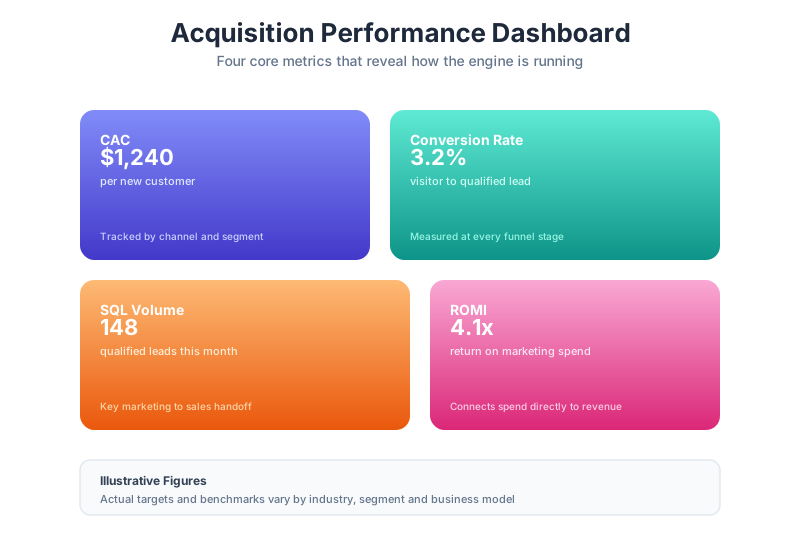
CAC (Customer Acquisition Cost)
Customer acquisition cost measures the total cost of acquiring a new customer, including marketing spend, sales costs, and any other directly attributable expenses, divided by the number of new customers acquired within a given period. Tracking CAC by channel and segment, rather than only as a blended average, reveals meaningfully different efficiency across different parts of the acquisition strategy.
Comparing CAC against customer lifetime value, rather than looking at acquisition cost in isolation, provides the more meaningful measure of whether acquisition spend is genuinely sustainable. A high CAC can still represent a healthy investment if the resulting customer generates enough long term value to comfortably exceed that initial cost within a reasonable payback period.
Conversion Rates
Conversion rates measure the percentage of prospects moving from one funnel stage to the next, providing a granular view of exactly where the acquisition funnel performs well and where it leaks the most potential customers. Improving a weak conversion point partway through the funnel often produces a larger overall impact than adding more volume at the very top of the funnel.
Segmenting conversion rate analysis by channel and campaign, rather than only viewing an overall blended conversion rate, often reveals that certain sources produce prospects who convert considerably better than others, information that should directly inform where future acquisition investment gets prioritized.
| Metric | Definition | Why It Matters |
|---|---|---|
| CAC | Total acquisition cost per new customer | Measures overall efficiency |
| Conversion Rate | Percentage moving between funnel stages | Identifies funnel bottlenecks |
| SQL Volume | Sales qualified leads generated | Measures pipeline contribution |
| ROMI | Return on marketing investment | Connects spend directly to revenue |
Pipeline Contribution
Pipeline contribution measures how much of the overall sales pipeline originates from specific acquisition channels or campaigns, helping clarify which efforts are genuinely driving revenue opportunity rather than simply generating activity metrics that do not translate into real business impact.
This metric works best when tracked using consistent attribution rules applied across the entire marketing and sales organization, since inconsistent attribution methodology between teams can create confusing, contradictory pipeline contribution figures that undermine confidence in the data altogether.
Sales Qualified Leads (SQLs)
Sales qualified leads represent prospects that have been vetted and deemed ready for direct sales engagement, serving as a key handoff point between marketing and sales. Tracking SQL volume and quality over time helps identify whether marketing is generating enough qualified opportunity to support sales team capacity and revenue targets.
Return on Marketing Investment (ROMI)
Return on marketing investment connects marketing spend directly to resulting revenue, providing the clearest measure of whether acquisition investment is genuinely paying off. Calculating ROMI accurately requires reasonably reliable attribution data connecting specific marketing activities to closed revenue, which can be genuinely challenging in longer, multi touch sales cycles.
Even an imperfect ROMI calculation, clearly documented with its underlying assumptions, tends to be more useful for decision making than avoiding the metric entirely due to attribution difficulty. Being transparent about the limitations of the calculation, rather than presenting an imprecise figure with false confidence, keeps the metric genuinely useful for guiding investment decisions.
Growth Opportunities & Risks
Beyond current performance, it is worth identifying where the greatest opportunities for improvement exist, along with the risks that could undermine acquisition performance.
High-Impact Opportunities
High impact opportunities identify the specific changes most likely to meaningfully improve acquisition performance, whether that is a currently underinvested channel showing early promise, or a funnel stage with a particularly weak conversion rate that improvement efforts could meaningfully strengthen.
Ranking opportunities by expected impact relative to required effort, rather than pursuing whichever opportunity happens to be top of mind, helps a team prioritize the initiatives most likely to move the needle first, rather than spreading limited resources across too many ideas simultaneously.
Market Expansion
Market expansion opportunities consider whether acquisition strategy should extend into new segments or geographies not currently being pursued, drawing on the broader market research and segmentation work covered earlier in the go to market strategy.
Testing a new segment or geography on a smaller, contained scale before committing significant resources helps validate genuine demand and appropriate channel fit before scaling investment, reducing the risk of a costly expansion effort into a market that ultimately proves less receptive than initially expected.
| Opportunity or Risk | Description | Recommended Response |
|---|---|---|
| Underinvested Channel | Early signal in a channel with limited spend | Test increased investment |
| Funnel Bottleneck | Weak conversion at a specific stage | Targeted conversion rate optimization |
| Channel Saturation | Diminishing returns in current channel mix | Diversify into new channels |
| Rising CAC | Acquisition cost trending upward | Review channel mix and messaging |
Channel Optimization
Channel optimization considers how existing channels could perform better through refined targeting, improved messaging, or better creative, rather than necessarily requiring investment in entirely new channels. Small, incremental improvements to existing channel performance often produce a better return than chasing an entirely new, unproven channel.
Running structured tests on specific elements within an already working channel, such as testing different messaging angles or audience targeting parameters within an existing paid campaign, tends to produce reliable, incremental efficiency gains that compound meaningfully over time.
Acquisition Bottlenecks
Acquisition bottlenecks identify specific constraints limiting growth, whether that is a funnel stage with unusually weak conversion, insufficient sales capacity to handle current lead volume, or a content gap preventing prospects from moving smoothly toward a decision.
Growth Risks
Growth risks include broader threats to acquisition performance, such as rising costs in a previously efficient paid channel, a platform policy change affecting organic reach, or increasing competitive intensity making previously effective messaging less distinctive.
Diversifying across multiple channels, rather than depending heavily on a single source of acquisition, provides meaningful protection against these kinds of risks. A business overly reliant on one paid channel or one social platform faces considerably more disruption if that specific channel suddenly becomes more expensive or less effective than a business with a more balanced channel portfolio.
Customer Acquisition Recommendations
All of the analysis above should translate into clear, actionable recommendations guiding where to focus acquisition investment going forward.
Priority Acquisition Channels
Priority channel recommendations identify which specific channels deserve the most focused investment based on the performance and opportunity analysis completed earlier, rather than spreading budget evenly across every available option regardless of demonstrated effectiveness.
These recommendations should clearly state the reasoning behind each prioritization choice, connecting back to specific performance data rather than presenting the priority list as an unsupported assertion. A clear evidence trail makes the recommendations far easier to defend when budget decisions are being reviewed by finance or leadership.
Campaign Recommendations
Campaign recommendations outline the specific initiatives that should be prioritized in the near term, connecting directly back to the highest priority channels and segments identified elsewhere in the strategy.
Budget Allocation Guidance
Budget allocation guidance translates channel and campaign priorities into specific spending recommendations, ensuring the largest share of budget flows toward the channels and campaigns demonstrating the strongest return.
Presenting budget allocation as a clear breakdown by channel and expected outcome, rather than a single lump sum figure, gives leadership a much clearer basis for evaluating and approving the proposed spending plan, and makes it easier to track actual performance against the original plan once campaigns are underway.
Scaling Strategy
Scaling strategy addresses how acquisition efforts should grow over time as the business matures, whether that means gradually shifting investment from paid channels toward organic and referral channels as they mature, or expanding into new channels once current ones show signs of diminishing returns.
Building this scaling plan with specific triggers for when to expand, rather than an open ended aspiration to grow eventually, gives the team clear guidance on when it makes sense to increase investment in a given channel or introduce an entirely new one to the mix.
90-Day Acquisition Roadmap
A ninety day acquisition roadmap translates the broader strategy into a specific, near term action plan, giving the team a clear sequence of initiatives to execute immediately rather than a purely conceptual strategy that never quite translates into concrete next steps.
Breaking the roadmap into clear thirty day increments, each with specific deliverables and owners, keeps the plan accountable and gives the team natural checkpoints to review progress and adjust course if early results diverge meaningfully from what was expected.
Executive Acquisition Summary
The executive summary condenses the full acquisition strategy into a format leadership can review quickly without needing to revisit every underlying section in detail.
Recommended Acquisition Strategy
This section clearly restates the overall recommended acquisition approach and the core reasoning behind it, giving leadership a quick, confident reference point for the direction being proposed.
Priority Channels
A concise restatement of the priority channels gives leadership and new team members quick access to where the business intends to focus its acquisition investment going forward.
Keeping this restatement genuinely brief, focused on the top two or three priority channels rather than every channel discussed in the full analysis, respects the purpose of an executive summary as a fast reference rather than a complete restatement of the underlying strategy document.
Expected Growth Outcomes
Expected growth outcomes translate the acquisition strategy into a clear, quantified sense of what results leadership should expect, whether that is a specific new customer target, a revenue growth rate, or an expected efficiency improvement in acquisition cost.
Presenting these expected outcomes alongside a base case and a more conservative scenario, rather than a single optimistic figure, sets more realistic expectations and protects the credibility of the acquisition team if results land closer to the conservative end of the range.
Key Performance Metrics
Key performance metrics restate the small number of metrics leadership should track most closely to gauge whether the acquisition strategy is performing as expected, giving a quick reference point for ongoing performance reviews.
Limiting this list to the handful of metrics that genuinely matter most, rather than an exhaustive dashboard of every available data point, keeps leadership review conversations focused on what actually drives decisions rather than getting lost in secondary details better suited to an operational review.
Executive Recommendations
The summary should close with a short, clear set of recommendations for leadership, whether that is approving a specific budget allocation, prioritizing a particular channel investment, or committing to the ninety day roadmap outlined earlier in the strategy.
Framing each recommendation with a clear expected impact and resourcing requirement helps leadership weigh acquisition investment fairly against other competing business priorities, rather than evaluating the request in isolation without a clear sense of relative importance and urgency.
Customer acquisition, like every other part of go to market strategy, requires ongoing attention rather than a single strategy set once and left unchanged. The strongest companies continuously test, measure, and refine their acquisition approach, adjusting channel mix and campaign investment as market conditions, competitive intensity, and customer behavior continue to evolve over time. Treating acquisition as a discipline of continuous learning, rather than a fixed plan executed once and revisited only when results disappoint, keeps a business genuinely responsive to a market that never stays still for long.
Contents