
Sales Enablement: Giving Sales Teams What They Need to Win
A brilliant go to market strategy can still lose deals in the field if the sales team lacks the training, messaging, and tools to represent it effectively. Sales enablement closes that gap, ensuring every rep, regardless of tenure or individual skill, has consistent access to the knowledge, content, and coaching needed to have a genuinely good conversation with a prospect at any stage of the buying journey. Done well, enablement turns individual sales talent into a repeatable, scalable system rather than leaving outcomes dependent on a handful of naturally gifted reps.
This guide covers the full scope of sales enablement inside a go to market program, starting with readiness assessment, moving through sales process, messaging, assets, training, and objection handling, and finishing with performance measurement, recommendations, and an executive summary leadership can act on.
Enablement often gets treated as an afterthought, a collection of documents produced once around a launch and rarely revisited afterward. That approach fundamentally misunderstands what enablement actually needs to be. The market shifts, competitors ship new capability, the product itself continues to evolve, and new reps join the team needing to absorb everything more experienced colleagues have learned gradually over months or years. Treating enablement as a living, continuously maintained system, rather than a static set of onboarding materials, is what separates sales organizations that consistently perform well from those that rely too heavily on the instincts of a handful of naturally talented individual reps.
Sales Enablement Overview
Before building specific enablement programs, a team needs a clear, shared understanding of what enablement is meant to accomplish and how it connects to the broader business.
Enablement Objectives
Enablement objectives clarify what the enablement function needs to prioritize, whether that is reducing new hire ramp time, improving win rates against a specific competitor, or supporting a major new product launch that requires the sales team to learn an entirely new value proposition. Being explicit about which objective matters most keeps enablement investment focused on solving the problems that genuinely matter most right now.
A sales team struggling with long ramp times for new hires might prioritize a stronger onboarding program, while a team losing competitive deals might prioritize sharper battlecards and competitive training instead. Naming the specific problem enablement is meant to solve keeps the resulting programs practical and targeted rather than a generic collection of best practices applied without clear purpose.
Gathering direct input from reps and sales managers about where they experience the most friction today, rather than assuming enablement leadership already has full visibility into the problem, often surfaces a more accurate and specific picture of where investment should be prioritized first.
Sales Strategy Alignment
Sales strategy alignment ensures enablement programs directly support the broader sales strategy, including target segments, deal size expectations, and the specific sales motion the organization relies on, whether that is a high touch enterprise approach or a faster, more transactional model.
This alignment matters more than it might initially seem, since enablement content built without a clear connection to the actual sales strategy tends to feel generic and disconnected from what reps are genuinely trying to accomplish in their day to day work. A battlecard built for enterprise deals provides little value to a team primarily closing smaller, faster transactional deals, and content designed generically for both often satisfies neither audience particularly well.
| Alignment Area | Key Question | Why It Matters |
|---|---|---|
| Target Segment | Does enablement address our priority buyer | Prevents generic content misaligned with real deals |
| Sales Motion | Does content fit self serve, inside, or field sales | Ensures format matches how reps actually sell |
| Deal Complexity | Does training match typical deal sophistication | Avoids oversimplifying or overcomplicating guidance |
| Growth Stage | Does enablement reflect current company maturity | Keeps programs realistic for team size and experience |
Reviewing this alignment periodically matters because sales strategy itself evolves over time, and enablement programs built for an earlier stage of the business can quietly become misaligned with a sales motion that has since shifted toward larger deals, new segments, or a different buying process entirely.
Business Goals
Business goals connect enablement work back to the broader company objectives it ultimately needs to support, such as a specific revenue target, an expansion into a new market segment, or a strategic shift toward larger, more complex enterprise deals that require a different selling approach than the business has relied on previously.
Making these business goals visible and understood by the enablement team specifically, rather than assuming enablement priorities will naturally track broader company direction without explicit communication, helps ensure enablement investment consistently supports what the business actually needs most.
Success Criteria
Success criteria define how enablement effectiveness will actually be measured, typically including metrics such as new hire ramp time, win rate improvement, and content utilization rates. Establishing these criteria upfront ensures enablement investment can be evaluated against real outcomes rather than good intentions or activity volume alone.
Choosing criteria that connect clearly to genuine business impact, rather than purely activity based measures such as number of training sessions delivered, keeps the enablement function accountable to results that actually matter to the broader sales organization and company leadership.
Sales Readiness Assessment
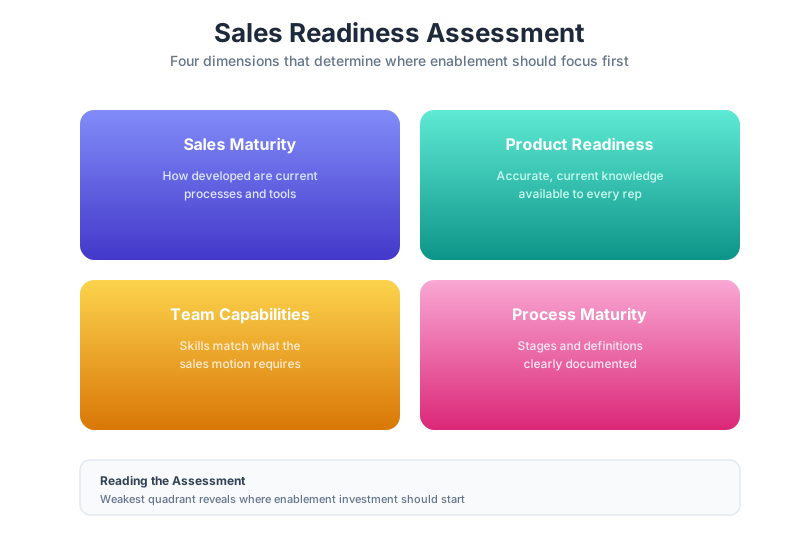
Before building new enablement programs, it helps to honestly assess where the sales organization currently stands.
Sales Maturity
Sales maturity assessment evaluates how developed the sales organization's processes, tools, and skills currently are, recognizing that a small, early stage sales team requires a very different enablement approach than a large, established organization with well developed existing infrastructure.
An honest maturity assessment sometimes reveals that a sales team has grown quickly without corresponding investment in process and tooling, meaning enablement work may need to address foundational gaps before more advanced programs, such as sophisticated coaching frameworks, can genuinely take hold.
Product Readiness
Product readiness, from a sales enablement perspective, considers whether the sales team has access to accurate, current product knowledge and whether the product itself is mature enough to support confident, consistent selling without reps needing to caveat every claim due to genuine uncertainty about capability.
Establishing a reliable, fast feedback loop between product and sales ensures reps learn about new capability and limitations promptly, rather than discovering gaps in their own knowledge awkwardly in the middle of a live customer conversation.
| Readiness Dimension | Key Question | Typical Gap Without Investment |
|---|---|---|
| Sales Maturity | How developed are current processes and tools | Inconsistent execution across reps |
| Product Readiness | Do reps have accurate, current knowledge | Outdated or inconsistent claims in deals |
| Team Capabilities | Do reps have the skills the sales motion requires | Mismatch between hiring and actual selling needs |
| Process Maturity | Are stages and definitions clearly documented | Unpredictable pipeline and forecasting |
Team Capabilities
Team capabilities assessment evaluates the actual skills present across the sales organization, including discovery skills, negotiation ability, and comfort handling technical or executive level conversations, identifying where the team's current skill set may not fully match what the sales motion actually requires.
Conducting this assessment through a combination of manager observation, call recording review, and direct rep self assessment tends to produce a more complete and accurate picture than relying on any single perspective alone, since each source reveals different blind spots the others might miss.
Process Maturity
Process maturity assessment evaluates how clearly the sales process itself has been documented and how consistently reps actually follow it, since even strong individual selling skill cannot fully compensate for a poorly defined, inconsistently applied underlying process.
A useful test of genuine process maturity is asking several different reps to describe the current stage definitions in their own words and comparing the answers, since meaningful divergence reveals that the documented process exists mostly on paper rather than in genuine shared practice.
Enablement Gaps
Enablement gaps identify the specific areas where current support falls short of what the sales team genuinely needs, whether that is missing competitive content, inadequate onboarding, or a lack of consistent coaching, drawing directly from the maturity and capability assessment completed above.
Prioritizing these gaps by their likely impact on revenue, rather than addressing them in whatever order feels most urgent day to day, ensures the most consequential gaps receive attention first even when a smaller, more visible gap might otherwise attract more immediate internal pressure to fix.
Revisiting this gap analysis on a regular cadence, rather than treating it as a one time diagnostic, keeps enablement priorities current as the sales team grows, the product evolves, and the competitive landscape continues to shift in ways that can quietly open new gaps even after earlier ones have been successfully closed.
Sales Process & Methodology
A clear, well understood sales process gives every rep a consistent framework for moving deals forward.
Sales Process Overview
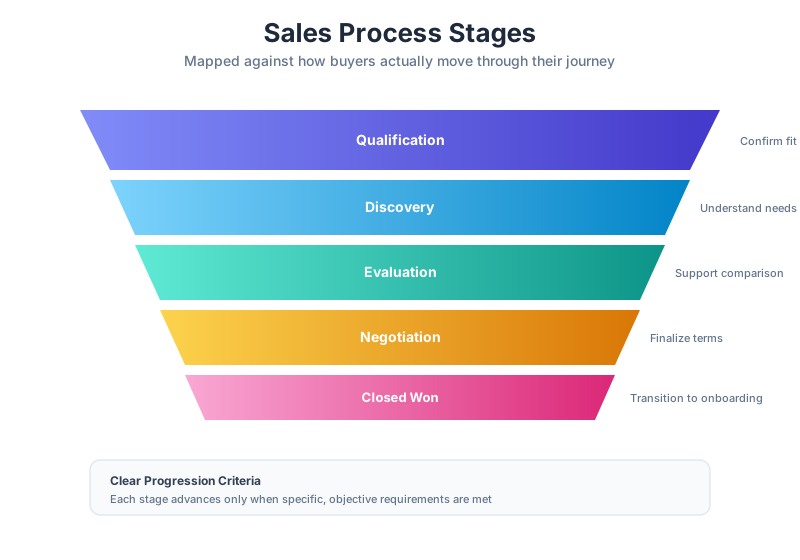
Sales process overview documents the specific stages a deal moves through from initial qualification to closed business, giving every rep and sales leader a shared, consistent language for describing where a given opportunity actually stands.
Keeping the number of stages manageable, typically between four and seven, tends to strike a good balance between granularity and usability, since an overly detailed process becomes cumbersome to maintain accurately while too few stages fail to provide meaningful visibility into pipeline progression.
Reviewing the sales process periodically against actual closed deal data, rather than treating the originally documented stages as permanently fixed, helps catch situations where real deals no longer genuinely follow the process as written, a common and often unnoticed form of drift in growing sales organizations.
Buyer Journey Alignment
Buyer journey alignment ensures the internal sales process genuinely maps to how buyers actually make purchasing decisions, rather than reflecting purely internal administrative convenience that does not correspond to the buyer's real experience of evaluating and choosing a solution.
Reviewing win and loss interview data periodically helps confirm the internal process still reflects genuine buyer behavior, since buyer expectations and typical evaluation patterns can shift over time in ways an unreviewed, static internal process might fail to keep pace with.
| Sales Stage | Buyer Journey Stage | Primary Rep Activity |
|---|---|---|
| Qualification | Awareness to Consideration | Confirm fit and genuine need |
| Discovery | Consideration | Understand requirements and priorities |
| Evaluation | Evaluation | Support comparison and technical validation |
| Negotiation | Purchase | Finalize terms and remove final friction |
| Closed Won | Purchase Complete | Transition to onboarding |
Sales Methodology
Sales methodology provides the underlying philosophy and specific techniques reps use to guide conversations, such as a consultative, needs based approach or a more structured, framework driven methodology, giving the team a consistent approach rather than each rep improvising their own style entirely independently.
Choosing a single methodology and investing in genuine, sustained training around it tends to produce better results than casually introducing multiple competing frameworks over time, since reps benefit from deep fluency in one consistent approach rather than a shallow, confusing mix of several different methodologies.
Opportunity Management
Opportunity management establishes clear rules for how deals get tracked, qualified, and prioritized within the sales pipeline, ensuring consistent data quality that supports accurate forecasting and helps sales leaders identify where coaching attention is most needed.
Enforcing consistent data entry standards, even when it feels like an administrative burden to individual reps, pays off considerably at the aggregate level, since clean, reliable pipeline data is what makes forecasting and performance analysis genuinely trustworthy rather than a rough approximation.
Deal Progression Framework
A deal progression framework defines the specific criteria a deal must meet to advance from one stage to the next, preventing the common problem of deals sitting indefinitely in an early stage or advancing prematurely without genuinely meeting the requirements that stage represents.
Making these criteria specific and objective, rather than a vague sense of "things are going well," gives reps and managers a shared, unambiguous basis for stage progression conversations, reducing the natural optimism bias that can otherwise inflate pipeline health reporting.
Sales Messaging & Value Selling
Beyond process, reps need the messaging and selling skills to communicate value convincingly throughout a sales conversation.
Value Proposition
Value proposition training ensures every rep can articulate the core value proposition clearly and confidently, connecting directly back to the broader positioning and messaging work established elsewhere in the go to market strategy, rather than each rep developing their own inconsistent version of the pitch.
Testing reps directly, such as asking them to deliver the core value proposition unprompted during a coaching session, reveals whether training has genuinely landed or whether reps are still relying on notes and inconsistent improvisation during actual customer conversations.
Discovery Framework
A discovery framework gives reps a structured approach to understanding a prospect's specific situation, priorities, and pain points, ensuring the rest of the sales conversation builds on genuine understanding rather than a generic pitch delivered regardless of the buyer's actual context.
A strong discovery framework balances structure with genuine curiosity, giving reps a consistent set of areas to explore while still leaving room for authentic, responsive conversation rather than a rigid, checklist style interrogation that feels impersonal to the prospect.
The best discovery conversations often feel less like an interrogation and more like a genuinely useful consultation, where the prospect walks away having gained clarity about their own situation regardless of whether they ultimately decide to purchase, a quality that is difficult to achieve through rigid scripting alone.
| Value Selling Element | Purpose | Applied At Stage |
|---|---|---|
| Value Proposition | Clear articulation of core value | Throughout, especially early |
| Discovery Framework | Uncover genuine needs and priorities | Discovery |
| Outcome Messaging | Connect capability to business results | Evaluation |
| Executive Framework | Communicate at strategic level | Negotiation, exec conversations |
Business Outcome Messaging
Business outcome messaging training equips reps to connect specific product capabilities to the business results a prospect actually cares about, moving conversations beyond feature descriptions toward the tangible impact a purchase decision could deliver.
Practicing this translation explicitly during training, working through several real capabilities and their corresponding business outcomes together as a group, helps reps build the habit of thinking in outcome terms rather than defaulting back to familiar, comfortable feature language during live conversations.
Differentiation Strategy
Differentiation strategy training ensures reps can clearly and confidently articulate why a prospect should choose this solution over available alternatives, drawing directly from the competitive intelligence and positioning work established elsewhere in the broader go to market strategy.
Role playing common competitive scenarios during training, rather than only reviewing written battlecards passively, builds genuine confidence and fluency that translates far more reliably into live deal performance than written reference material alone.
Executive Conversation Framework
An executive conversation framework prepares reps to engage confidently with senior stakeholders, who typically care more about strategic business impact than technical detail, requiring a different conversational approach than a discussion with a more hands on, technical buyer.
Many reps, particularly earlier in their careers, feel genuinely intimidated by executive conversations, and dedicated coaching specifically addressing this discomfort, rather than assuming general sales training automatically prepares reps for this specific scenario, meaningfully improves confidence and performance in these higher stakes conversations.
Sales Assets & Enablement Content
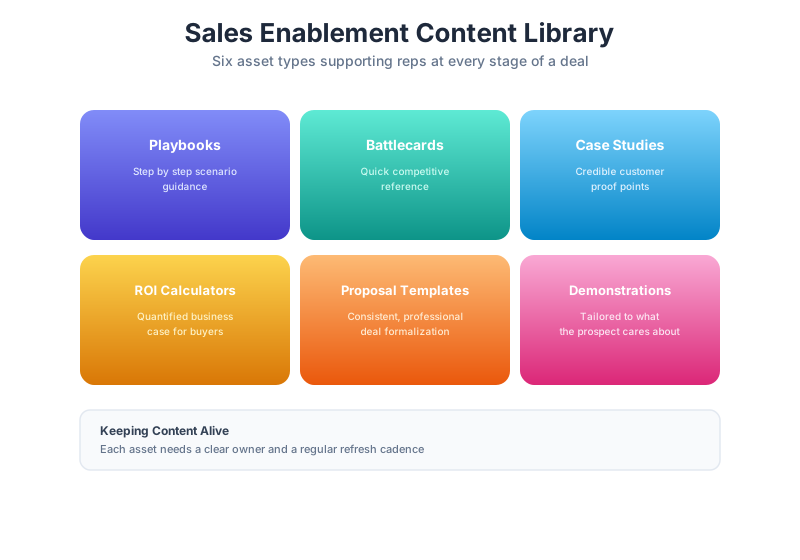
Reps need a well organized library of practical content to support conversations at every stage of a deal.
Sales Playbooks
Sales playbooks provide step by step guidance for specific selling scenarios, such as how to approach a particular target segment or how to navigate a common deal pattern, giving reps a practical reference rather than requiring them to reconstruct an effective approach from scratch each time.
Building playbooks around genuinely common, recurring scenarios that reps actually encounter, rather than attempting to cover every conceivable situation exhaustively, keeps the playbook library focused and genuinely useful rather than overwhelming and rarely consulted.
Battlecards
Battlecards give reps quick, structured reference material for competitive situations, summarizing key differentiators, common objections, and recommended responses for each significant competitor the sales team regularly encounters.
Keeping battlecards genuinely concise, ideally reviewable in under a minute during a live deal, respects the reality that reps need this information quickly in the moment rather than during a dedicated study session, which means resisting the temptation to cram every possible detail onto a single reference document.
Assigning a clear owner responsible for keeping each battlecard current, and setting an explicit review cadence rather than relying on someone noticing content has become outdated, prevents this valuable but perishable content from quietly drifting out of sync with the actual competitive landscape.
| Asset Type | Primary Use Case | Update Frequency |
|---|---|---|
| Sales Playbooks | Guidance for specific selling scenarios | Quarterly or after major strategy shifts |
| Battlecards | Quick competitive reference during live deals | Whenever competitive landscape shifts |
| Case Studies | Proof points for evaluation stage conversations | Ongoing, as new stories become available |
| ROI Calculators | Quantified business case for economic buyers | Annually or after major pricing changes |
Case Studies
Case studies provide concrete, credible proof that the product delivers real results for genuine customers, giving reps powerful supporting evidence to reinforce claims made earlier in a sales conversation with specific, relatable examples.
Organizing case studies by segment, use case, and industry, rather than as an undifferentiated list, helps reps quickly find the specific story most likely to resonate with whatever prospect they happen to be speaking with at a given moment.
ROI Calculators
ROI calculators give reps and prospects a structured way to quantify expected financial return, supporting the kind of concrete business case an economic buyer often needs to secure internal budget approval.
Making the underlying assumptions behind an ROI calculator transparent and adjustable, rather than presenting only a fixed final number, allows a prospect to test the calculation against their own specific situation, which builds considerably more trust than a number presented without visible reasoning behind it.
Proposal Templates
Proposal templates give reps a consistent, professional starting point for formalizing a deal, reducing the time spent on administrative document creation while ensuring every proposal reflects current pricing, terms, and messaging accurately.
Keeping proposal templates current as pricing and packaging evolve prevents the awkward and potentially costly situation of a rep unknowingly sending a prospect outdated terms that no longer reflect actual current offerings.
Product Demonstrations
Product demonstration guidance ensures reps can deliver a consistent, compelling demo experience tailored to what a specific prospect cares about most, rather than running through an identical, generic demo script regardless of the audience's actual priorities.
Training reps to ask a few targeted questions before beginning a demo, then adapting the flow based on those answers, produces a noticeably more engaging and relevant experience than a rigidly scripted walkthrough that treats every prospect identically regardless of their specific interests.
Sales Training & Coaching
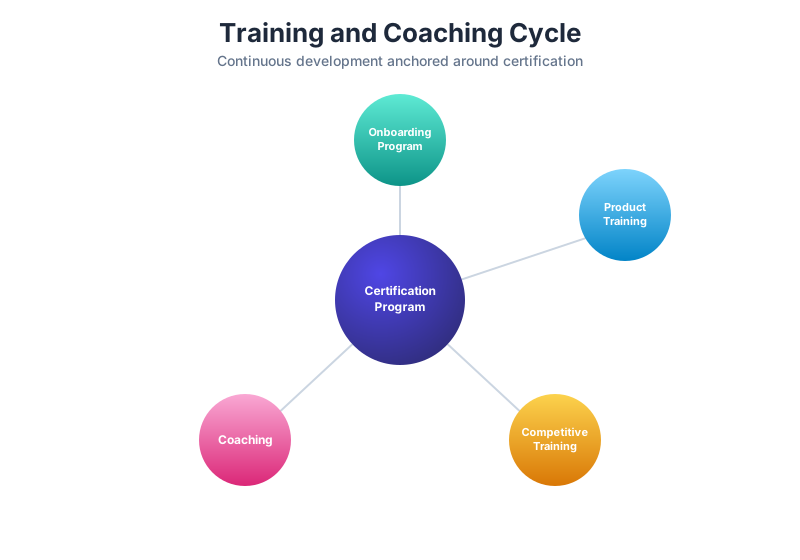
Ongoing training and coaching keep the sales team's skills and knowledge current as the product, market, and competitive landscape continue to evolve.
Onboarding Program
An onboarding program gives new sales hires a structured path to full productivity, covering product knowledge, sales process, and messaging in a sequenced way that avoids overwhelming a new hire with everything at once during their first days.
Building in early opportunities for new hires to practice, such as shadowing calls and role playing common scenarios before handling live deals independently, tends to shorten genuine ramp time far more effectively than a purely lecture and document based onboarding approach.
Assigning an experienced peer mentor alongside the formal onboarding curriculum gives new hires an approachable resource for the many smaller, informal questions that arise day to day, questions that might otherwise go unasked if the only available resource is a formal manager or a static document library.
Product Training
Product training ensures reps maintain accurate, current knowledge of what the product actually does, particularly important as new capabilities ship regularly and existing reps need ongoing updates rather than relying solely on knowledge from their original onboarding.
Tying product training sessions directly to the product release cadence, rather than scheduling them independently on an arbitrary calendar, ensures reps learn about new capability close to when it actually becomes available to sell rather than well before or well after the fact.
| Training Type | Audience | Typical Cadence |
|---|---|---|
| Onboarding Program | New hires | Structured first 30 to 90 days |
| Product Training | All reps | Ongoing, tied to release cadence |
| Competitive Training | All reps | Quarterly or as landscape shifts |
| Coaching | Individual reps | Weekly or bi-weekly one on one |
Competitive Training
Competitive training keeps reps current on how the competitive landscape is evolving, ensuring battlecards and talking points reflect genuinely current competitor capability rather than outdated information that could mislead a rep during a live competitive deal.
Involving reps directly in gathering competitive intelligence, such as sharing what they hear from prospects about competitor moves, creates a valuable feedback loop that keeps competitive training grounded in real, current field experience rather than relying solely on periodic formal research.
Objection Handling
Objection handling training equips reps with practiced, confident responses to the most common concerns prospects raise, moving beyond simply providing a written reference document toward genuine skill built through repeated practice and role play.
Rotating through realistic objection scenarios during regular team meetings, rather than treating objection handling training as a single onboarding event, keeps these skills sharp and gives newer reps repeated exposure to how more experienced colleagues handle difficult moments in a live conversation.
Coaching Framework
A coaching framework establishes a consistent approach for sales managers to develop their reps' skills over time, typically combining deal specific coaching on live opportunities with broader skill development coaching focused on longer term growth areas.
Training sales managers themselves on how to coach effectively, rather than assuming strong individual sales skill automatically translates into strong coaching ability, addresses a common gap, since these are genuinely different skill sets that do not automatically transfer from one to the other.
Certification Program
A certification program establishes clear checkpoints confirming reps have genuinely absorbed key training content, rather than assuming completion of a training session automatically translates into real, applied competency in actual customer conversations.
Designing certification around practical demonstration, such as a recorded mock sales conversation reviewed against a clear rubric, tends to validate genuine competency far more reliably than a simple written quiz that only confirms factual recall rather than applied skill.
Tying certification to specific milestones in a rep's tenure, rather than treating it as an optional, occasional exercise, helps ensure every rep reaches a consistent baseline of demonstrated competency before being expected to handle certain deal types or conversations independently.
Objection Handling & Competitive Selling
Handling objections and competitive pressure confidently often determines whether a well qualified deal actually closes.
Common Objections
Common objection documentation captures the specific concerns prospects raise most frequently, whether related to price, risk, or capability gaps, giving reps a shared, well tested set of responses rather than each individually improvising an answer in the moment.
Gathering this documentation from real, recorded sales conversations rather than hypothetical brainstorming ensures the objections addressed genuinely reflect what prospects actually say, rather than what the internal team assumes prospects might be thinking.
Updating this documentation on a regular cadence, rather than treating it as a one time exercise completed early in a product's life, keeps it relevant as customer concerns naturally shift alongside changes in the competitive landscape, pricing, and the product itself.
Competitive Responses
Competitive response guidance gives reps clear, confident talking points for addressing specific competitors directly, ideally acknowledging genuine competitor strengths honestly while clearly articulating why the tradeoff still favors the company's own solution.
Reps who acknowledge a competitor's real strength before pivoting to their own differentiation tend to come across as more credible and trustworthy than those who dismiss a competitor entirely, since prospects doing serious research can usually tell when a rep is being less than fully honest about the competitive landscape.
| Objection Category | Example Concern | Response Approach |
|---|---|---|
| Price | This costs more than expected | Reframe around value and total return |
| Risk | We are hesitant to switch vendors | Highlight migration support and proof points |
| Capability Gap | This is missing something we need | Clarify roadmap or workaround honestly |
| Timing | We are not ready to decide now | Understand root cause, offer appropriate next step |
Risk Mitigation
Risk mitigation guidance helps reps address a prospect's underlying concern about the safety of making a purchase decision, whether that involves highlighting security certifications, customer references, or contractual protections that reduce perceived risk.
Identifying the specific type of risk a prospect is genuinely worried about, whether that is technical risk, financial risk, or personal career risk in recommending the wrong vendor, allows a rep to address the real underlying concern rather than offering generic reassurance that misses what is actually driving the hesitation.
Proof Points
Proof points give reps specific, credible evidence to support claims made during a sales conversation, whether that is a customer statistic, a third party benchmark, or a relevant case study that makes an otherwise abstract claim concrete and believable.
Organizing proof points so reps can quickly find the most relevant example for a specific claim or objection, rather than searching through a large, unstructured library under time pressure during a live call, ensures this valuable evidence actually gets used consistently rather than sitting unused.
Sales Conversation Guidance
Sales conversation guidance brings objection handling, competitive positioning, and proof points together into practical advice for how a conversation should actually flow, helping reps navigate a live discussion smoothly rather than mechanically reciting disconnected talking points.
Emphasizing genuine listening and adaptive response over rigid script adherence in this guidance helps reps sound natural and responsive rather than robotic, since prospects generally notice and respond negatively to a conversation that feels overly scripted and impersonal.
Sales Performance Framework
Measuring enablement impact requires connecting enablement activity to genuine sales performance outcomes.
Sales KPIs
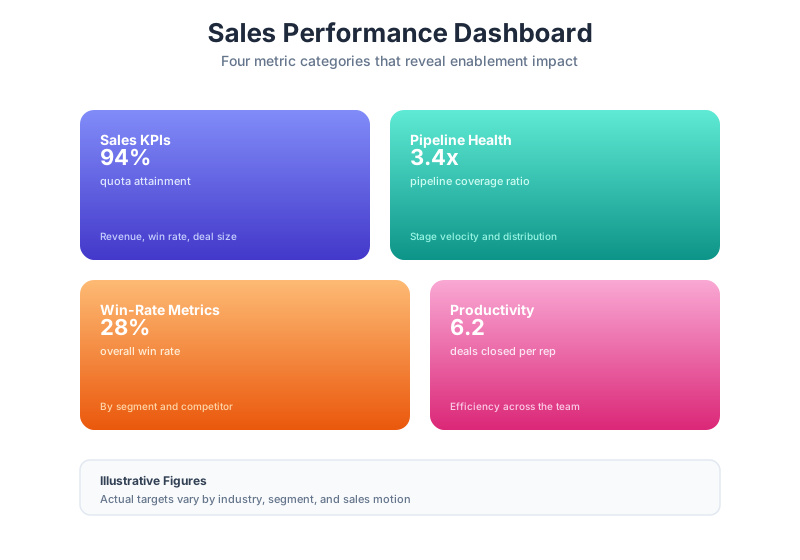
Sales key performance indicators define the top level metrics used to evaluate overall sales performance, typically including revenue attainment, win rate, and average deal size, giving leadership a consistent view of how the sales organization is performing.
Reviewing these KPIs alongside enablement activity data, rather than in isolation, helps reveal genuine correlations between specific enablement investments and performance shifts, though establishing clear causation rather than mere correlation often requires more careful analysis over a longer time horizon.
Segmenting these KPIs by rep tenure, territory, and deal type, rather than only reviewing them in aggregate, often surfaces meaningful variation that a single blended number would otherwise obscure, revealing specific pockets of the sales organization that may need more targeted enablement attention than others.
Pipeline Health
Pipeline health metrics evaluate the quality and volume of the sales pipeline, including stage distribution and velocity, helping identify whether the sales organization has enough genuinely qualified opportunity to hit its targets going forward.
Watching for unusual patterns, such as a large concentration of deals stuck in a specific stage for far longer than typical, often points directly to a specific enablement gap, whether that is a missing piece of content or a skill gap affecting how reps handle that particular stage of the sales process.
| Metric Category | Example Metric | Primary Insight |
|---|---|---|
| Sales KPIs | Quota attainment | Overall sales performance |
| Pipeline Health | Stage velocity and distribution | Forecast reliability and bottlenecks |
| Win-Rate Metrics | Win rate by segment and competitor | Where the team wins and struggles |
| Sales Productivity | Deals closed per rep | Individual and team efficiency |
Win-Rate Metrics
Win rate metrics track how often qualified opportunities actually convert into closed business, broken down by segment, competitor, and deal size to reveal specific patterns worth addressing through targeted enablement investment.
A win rate that looks acceptable in aggregate can sometimes mask a significant weakness against one particular competitor or within one specific segment, and only the more granular breakdown reveals where targeted enablement investment would actually make the most difference.
Sales Productivity
Sales productivity metrics evaluate how efficiently the sales organization converts effort into results, such as deals closed per rep or average sales cycle length, helping identify whether enablement investment is genuinely improving overall team efficiency.
Comparing productivity metrics between newer and more tenured reps often reveals exactly how much of a gap onboarding and ongoing enablement need to close, giving a concrete, measurable target for how quickly new hires should be expected to approach full productivity.
Enablement Effectiveness
Enablement effectiveness metrics connect specific enablement programs directly to sales performance improvement, such as comparing win rates or ramp times before and after a new training program, providing the clearest evidence of whether enablement investment is actually paying off.
Building this kind of before and after comparison into the initial design of any new enablement program, rather than trying to reconstruct it retroactively, makes it considerably easier to demonstrate genuine impact and secure continued investment in the programs that prove genuinely effective.
Sales Enablement Recommendations
All of the analysis above should translate into clear, actionable recommendations for improving enablement going forward.
Priority Enablement Initiatives
Priority enablement initiative recommendations identify the specific, highest impact programs worth building first, based on the readiness gaps and performance data reviewed earlier, rather than attempting to build every possible enablement program simultaneously.
Sequencing initiatives so early efforts build credibility and visible momentum tends to work better than starting with the most ambitious, resource intensive program, since demonstrated early wins help build organizational support for more substantial enablement investment later.
Content Recommendations
Content recommendations identify which specific sales assets need to be created or updated most urgently, whether that is refreshed battlecards addressing a recently gained competitor advantage or a new case study supporting a currently underrepresented segment.
Prioritizing content gaps that reps have flagged directly through their own feedback, rather than relying purely on assumptions about what content matters most, tends to produce a more genuinely useful content roadmap that addresses real friction reps encounter in live deals.
Coaching Improvements
Coaching improvement recommendations identify specific changes to how sales managers develop their teams, such as introducing a more structured coaching cadence or providing managers with better tools to track and act on individual rep development needs.
Equipping managers with a simple, consistent coaching template, rather than leaving coaching approach entirely to individual manager preference, tends to produce more consistent development outcomes across the sales organization regardless of which specific manager a given rep happens to report to.
Technology Recommendations
Technology recommendations identify tools or platform investments that could improve how enablement content gets delivered, tracked, and utilized, ensuring reps can actually find and apply the resources built for them rather than valuable content going unused due to poor accessibility.
Evaluating technology based on genuine adoption likelihood, not just feature completeness, matters considerably here, since even a powerful platform delivers little value if reps find it cumbersome enough that they quietly avoid using it in favor of their own informal workarounds.
90-Day Enablement Roadmap
A ninety day enablement roadmap translates the broader recommendations into a specific, near term action plan, giving the organization a clear, manageable sequence of initial steps rather than an overwhelming, all encompassing enablement transformation attempted all at once.
Breaking this roadmap into clear phases with specific deliverables and named owners keeps the plan accountable, giving the organization natural checkpoints to assess progress and adjust course if early implementation reveals the original plan needs refinement.
Executive Sales Enablement Summary
The executive summary condenses the full enablement plan into a format leadership can review quickly without needing to revisit every underlying section in detail.
Enablement Priorities
This section restates the highest priority enablement initiatives clearly, giving leadership a quick reference point for where enablement investment is being focused and why.
Keeping this restatement focused on the top two or three priorities, rather than an exhaustive list of every initiative discussed throughout the full plan, respects the purpose of an executive summary as a fast, high level reference point.
Critical Success Factors
Critical success factor summary identifies what needs to be true for the enablement plan to actually succeed, such as sustained sales leadership support, adequate resourcing, or genuine rep engagement with new training and content.
Being explicit about these prerequisites helps leadership understand what active support and participation from them specifically the plan actually depends on, rather than assuming success rests purely on the enablement team's own effort in isolation.
Expected Business Impact
Expected business impact translates the enablement plan into a clear, quantified sense of what results leadership should expect, whether that is improved win rates, faster ramp times, or increased average deal size.
Presenting these expectations as a realistic range rather than a single fixed target sets more appropriate expectations across the organization and avoids an all or nothing framing that may not fully account for genuine variability in how quickly enablement improvements typically translate into measurable results.
Key Recommendations
Key recommendation summary highlights the small number of decisions leadership needs to make to move the plan forward, connecting directly back to the priority initiatives and resourcing needs identified earlier.
Framing each recommendation alongside its expected impact and required resourcing helps leadership weigh enablement investment fairly against other competing business priorities, rather than evaluating each request in isolation without a clear sense of relative importance.
Executive Next Steps
The summary should close with a short, clear set of next steps for leadership, whether that is approving the ninety day roadmap, committing budget to a specific enablement technology, or personally reinforcing the importance of enablement participation across the sales organization.
Pairing each next step with a clear sense of what specifically is being asked of leadership, whether that is a decision, a budget commitment, or visible personal reinforcement, helps ensure the summary translates into genuine action rather than passive acknowledgment.
Sales enablement, like every other part of go to market strategy, is never truly finished. The strongest organizations treat enablement as an ongoing discipline that evolves alongside the product, the market, and the sales team itself, recognizing that yesterday's effective training and content inevitably need refreshing as conditions continue to change. Treating enablement as a continuously managed function, rather than a project completed once and set aside, keeps a sales organization genuinely equipped to perform well even as the business around it continues to grow and shift.
Contents