
Define GTM Context
Before Strategy
Capture structured inputs, signals, and triggers so every go-to-market motion starts with clarity.

Build GTM strategy on real signals, not assumptions
GTM Context captures structured triggers, signals, and inputs that define why a GTM motion exists and how teams need to respond.
- • Identify triggers across KPI shifts, launches, and market changes
- • Capture signals from CRM, product, RevOps, and market data
- • Define urgency, timelines, and GTM velocity
- • Align context across markets, products, and segments
Teams start with clarity grounded in real market conditions, aligning on demand, urgency, and context before strategy is created.
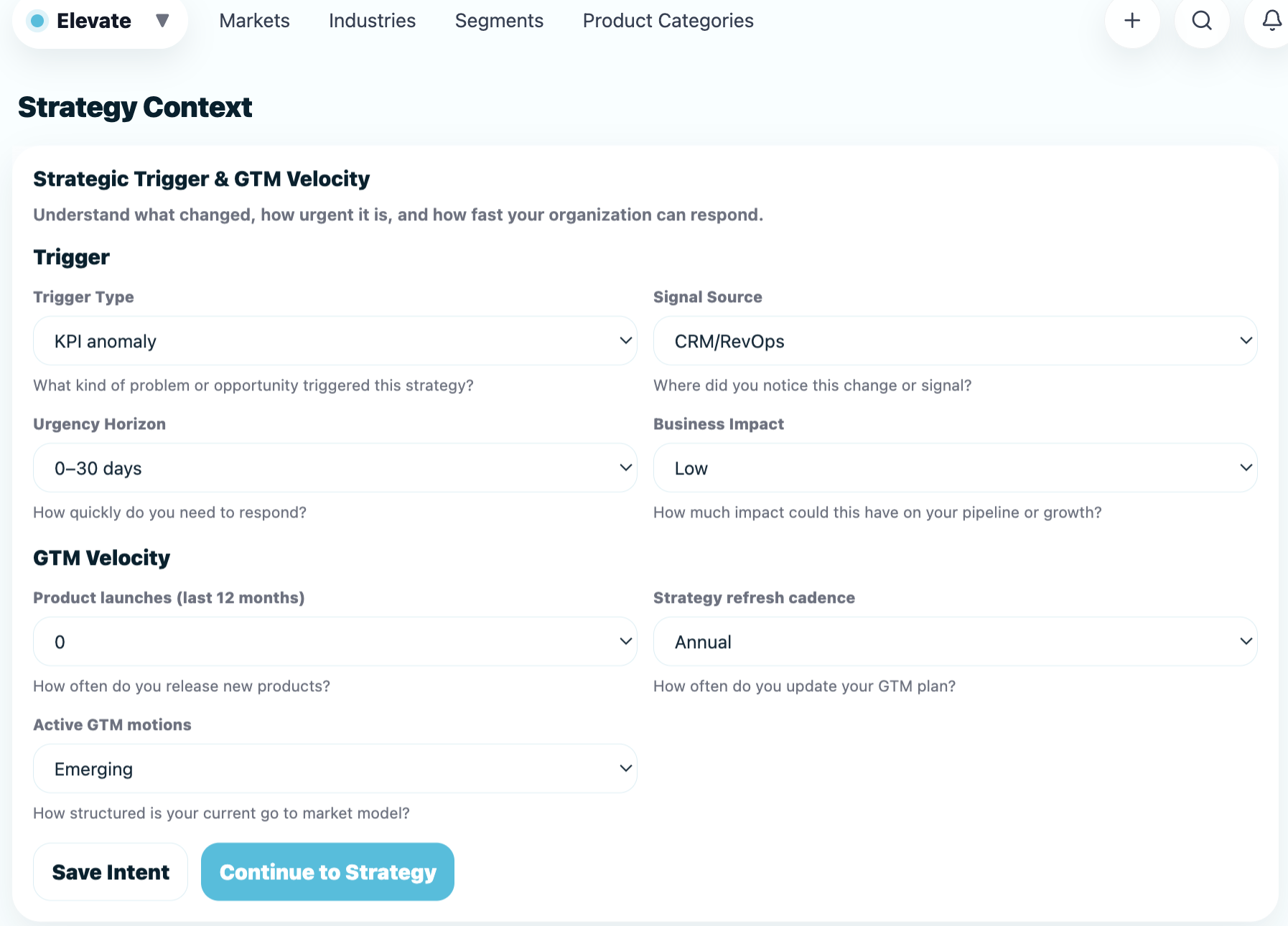

Turn signals into structured GTM inputs
Signals are automatically structured into a unified GTM context, giving teams a consistent view of what’s happening and how to respond.
- • Normalize signals into a single GTM context layer
- • Connect triggers, signals, and market inputs together
- • Structure inputs across markets, products, and segments
- • Create a shared context used across all GTM workflows
Drive faster, aligned GTM decisions
With structured GTM context, teams eliminate ambiguity and align faster across strategy, execution, and reporting.
- • Reduce back-and-forth across teams
- • Align decisions across sales, marketing, and product
- • Improve speed and quality of GTM execution


Create a shared GTM language across teams
GTM Context creates a shared structure across marketing, sales, and product teams, ensuring everyone operates from the same inputs.
- • Align teams on one GTM view
- • Standardize signals and triggers
- • Reduce misalignment across functions
Core Capabilities
Trigger Identification
Detect KPI changes and market shifts
Signal Mapping
Aggregate CRM, product, and market signals
Context Structuring
Define market, segment, and product context
Urgency Modeling
Set response timelines and velocity
Impact Prioritization
Understand what matters most to your pipeline and growth
Motion Classification
Identify GTM motion stage
Explore GTM Context Use Cases
Start with the right GTM context based on your business objective.
Define the right market, ICP, and positioning before launch to maximize early adoption.
Launch a new product
→Understand regional demand signals and buyer behavior before expansion.
Enter a new market
→Identify new segments and growth opportunities within your product portfolio.
Expand existing product
→Diagnose where GTM is breaking across strategy and execution.
Fix GTM performance
→Align messaging and proof points to increase conversion.
Improve win rates
→Ensure sales, marketing, and product operate from the same GTM context.
Align cross-functional teams
→