
Launch and Execute: Turning Strategy Into a Real World Moment
All the strategy work in the world means little if the actual launch falls flat. Launch and execution is where positioning, messaging, pricing, and channel decisions all come together into a single coordinated moment, or more often a coordinated sequence of moments, when a product actually reaches the market. Getting this right requires more than a good plan, it requires genuine readiness across every function, a realistic timeline, and the discipline to follow through consistently in the weeks after launch day rather than treating the launch date itself as the finish line.
This guide covers the full scope of launch and execution inside a go to market program, starting with launch strategy and readiness assessment, moving through the launch plan, timeline, cross-functional execution, and enablement, and finishing with risk management, success metrics, a ninety day roadmap, and an executive summary leadership can act on.
Launches carry a distinct kind of pressure compared to most other go to market work, since they compress months or years of strategic preparation into a defined window with a hard, public deadline. That compression tends to expose weaknesses that a slower, less visible initiative might quietly absorb without consequence. A messaging gap that would go unnoticed in ordinary daily operations becomes glaringly obvious the moment it appears simultaneously across a press release, a sales deck, and a customer email. This is precisely why the discipline of readiness assessment and cross functional coordination covered throughout this guide matters so much specifically for launches, even when the underlying go to market fundamentals are otherwise sound.
Launch Strategy Overview
Before building a detailed launch plan, a team needs a clear, shared understanding of what the launch is meant to accomplish and what assumptions the plan rests on.
Launch Objectives
Launch objectives clarify what the launch needs to prioritize, whether that is maximizing initial awareness, driving a specific volume of qualified pipeline, or successfully establishing a new product category in the market. Being explicit about which objective matters most shapes nearly every downstream decision, from how much budget goes toward paid awareness versus sales enablement, to how success will ultimately be measured.
A launch prioritizing broad awareness might invest heavily in public relations and content, while a launch prioritizing immediate pipeline might invest more heavily in direct outreach and account based marketing. Naming the primary objective early prevents a launch plan that tries to accomplish everything at once without a clear sense of what matters most.
Revisiting the stated objective throughout the planning process, rather than setting it once and moving on, helps catch moments where a specific tactical decision quietly drifts away from what the launch was originally meant to prioritize, which happens more often than most teams expect once planning gets underway.
It also helps to distinguish between the launch objective and the broader product objective. A product might exist to serve a long term strategic purpose spanning years, while the specific launch moment itself might be optimized for a narrower, more immediate goal such as generating early customer proof points rather than immediately maximizing revenue.
GTM Launch Strategy
GTM launch strategy defines the overall approach the launch will take, connecting directly back to the broader positioning, messaging, and channel decisions already established elsewhere in the go to market plan. A coherent launch strategy ensures the launch itself reinforces and builds on that existing strategic foundation rather than introducing an entirely disconnected new narrative.
Treating the launch as one expression of an already established strategy, rather than an opportunity to reinvent positioning and messaging from scratch, keeps the broader go to market story consistent and avoids confusing customers who have already encountered the company's existing positioning elsewhere.
This does not mean launch messaging should be identical to every other piece of existing content, since a launch genuinely benefits from fresh, exciting framing appropriate to the moment. The key distinction is that this fresh framing should still clearly connect back to the same underlying positioning and value proposition rather than introducing a fundamentally different story that leaves customers wondering which version of the company's message is actually accurate.
| Launch Strategy Element | Key Question | Connects To |
|---|---|---|
| Positioning Alignment | Does the launch reinforce existing positioning | Product positioning strategy |
| Messaging Consistency | Does launch messaging match established themes | Product messaging framework |
| Channel Selection | Which channels will carry the launch | Distribution and acquisition strategy |
| Audience Priority | Which segments does the launch target first | Market segmentation and ICP |
Success Criteria
Success criteria define how the launch will actually be evaluated, typically including specific targets for awareness, pipeline generation, and early adoption within a defined window after launch. Establishing these criteria before launch, rather than after, ensures the team can judge success objectively against a real benchmark rather than a vague sense of how things went.
Setting these targets at a level informed by realistic benchmarks from previous launches or comparable industry data, rather than purely aspirational numbers, keeps the evaluation grounded and prevents a genuinely solid launch from being unfairly judged against an unrealistic bar set without a defensible basis.
Launch Assumptions
Launch assumptions document the specific conditions the plan depends on being true, such as expected market receptiveness, competitor behavior, or internal capacity to support demand. Writing these assumptions down explicitly makes it much easier to diagnose what went wrong if the launch underperforms, since a team can check which specific assumption failed to hold rather than searching blindly for an explanation.
Reviewing these assumptions collaboratively across functions before finalizing the launch plan often reveals that different teams have been quietly operating from different, sometimes contradictory assumptions, a misalignment far better caught during planning than discovered mid launch.
Launch Readiness Assessment
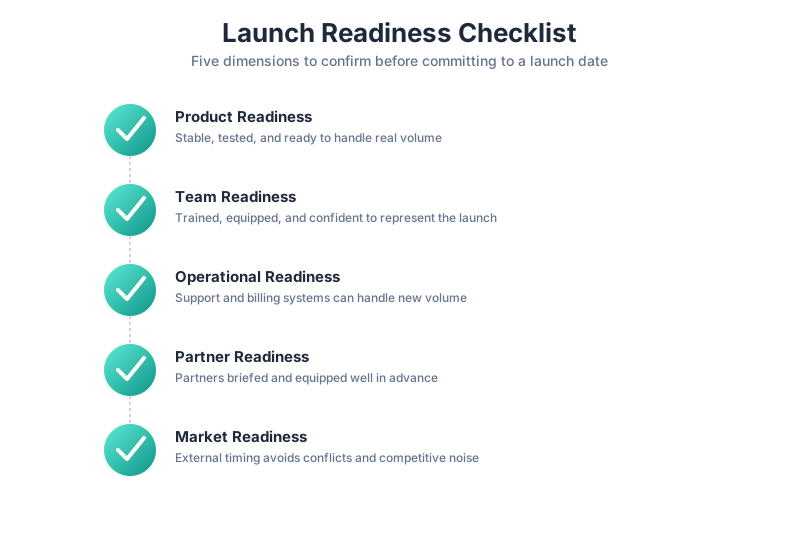
Before committing to a launch date, every function involved needs to honestly assess whether it is actually prepared.
Product Readiness
Product readiness assessment confirms the product itself is stable, tested, and genuinely ready for real customers to use, including verifying that critical bugs have been resolved and that the product can handle the anticipated volume of new interest without performance problems undermining the customer's first experience.
Running a realistic load test that approximates expected launch volume, rather than assuming existing infrastructure will simply handle whatever demand materializes, catches capacity issues while there is still time to address them rather than during the actual launch when the stakes are considerably higher.
It is also worth distinguishing between a product that is technically feature complete and one that is genuinely ready for a real customer's first experience, since these are not always the same thing. A feature can work correctly in isolation while still producing a confusing or frustrating experience for a new user encountering it for the first time without the benefit of deep internal familiarity with the product.
Team Readiness
Team readiness assessment confirms every internal team involved in supporting the launch, from sales to customer success to support, has received adequate training and has access to the materials needed to do their part effectively once the launch goes live.
Testing team readiness directly, such as through a mock customer conversation or a quick knowledge check, provides a more reliable signal than simply confirming that training materials were distributed, since distribution alone does not guarantee genuine comprehension or confidence.
| Readiness Area | Key Question | Owner |
|---|---|---|
| Product Readiness | Is the product stable and tested at scale | Product and Engineering |
| Team Readiness | Are internal teams trained and equipped | Enablement and Functional Leaders |
| Operational Readiness | Can support and billing handle new volume | Operations |
| Partner Readiness | Are partners briefed and equipped | Partnerships |
| Market Readiness | Does external timing make sense | Marketing and Leadership |
Operational Readiness
Operational readiness assessment confirms that supporting systems, such as billing, customer support infrastructure, and order processing, can genuinely handle the anticipated volume and complexity that a successful launch will generate, preventing a scenario where strong initial demand overwhelms operational capacity and damages the customer experience.
Walking through the full customer journey end to end, from initial signup through billing and first product use, often surfaces operational gaps that would not be obvious from reviewing each system in isolation, since problems frequently emerge specifically at the handoff points between systems.
Partner Readiness
Partner readiness assessment confirms that any partners expected to support the launch, whether through co-marketing, technical integration, or reselling, have been properly briefed and equipped well in advance, since an unprepared partner can undermine an otherwise well executed launch in the specific segments or geographies they serve.
Building partner readiness into the same overall timeline used for internal teams, rather than treating partner communication as an afterthought handled separately and later, helps ensure partners are not the weak link in an otherwise well coordinated launch effort.
Market Readiness
Market readiness assessment considers whether external conditions genuinely support launching now, including competitive activity, broader economic conditions, and whether the timing avoids conflicting with other major industry events or internal company announcements that could dilute attention.
Scanning the competitive and industry calendar in the weeks surrounding a planned launch date helps avoid the disappointing scenario of launching directly into a crowded news cycle where a major competitor announcement or unrelated industry event absorbs the attention the launch was counting on.
Go-to-Market Launch Plan
With readiness confirmed, the next step is defining the specific approach the launch itself will take.
Launch Approach
Launch approach defines the overall style and scale of the launch, whether that is a high profile, public launch designed to generate maximum attention, or a quieter, more controlled rollout designed to manage risk and gather feedback before wider visibility. Neither approach is universally correct, and the right choice depends on the specific objectives and risk tolerance established earlier.
Matching the approach to the actual confidence level in the offering matters considerably here. A high profile launch invites more scrutiny and higher stakes if something goes wrong, making it best suited to offerings that have already been thoroughly validated, while a quieter approach gives more room to learn and adjust before a larger audience forms a first impression.
Launch Model
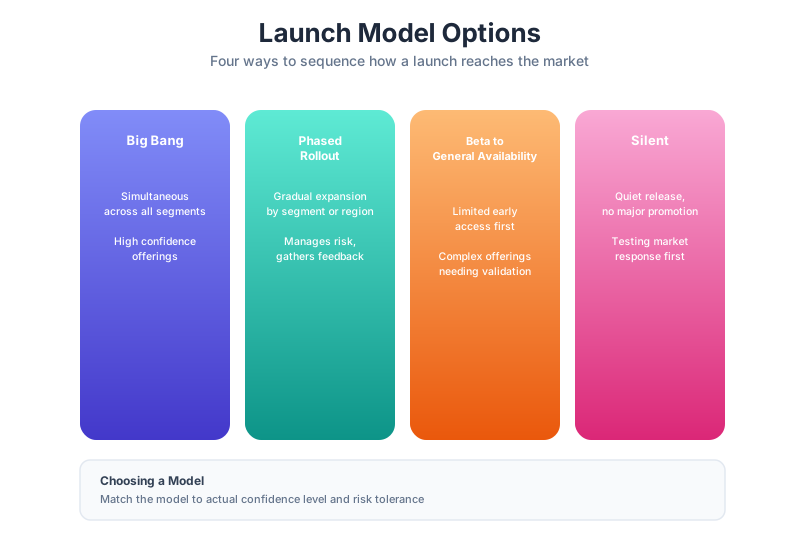
Launch model determines the specific mechanics of how the launch will unfold, such as a single simultaneous launch across all target segments and geographies, or a staged model that introduces the offering to progressively broader audiences over time.
A staged model, while slower to reach full scale, offers considerably more opportunity to catch and fix issues before they affect a larger customer base, making it a prudent default for more complex or higher risk offerings even when the team feels confident in the underlying preparation.
Choosing between these models is rarely purely a strategic decision, it also depends heavily on the organization's own risk tolerance and prior experience with similar launches. A team that has successfully executed several big bang launches in the past may reasonably feel more comfortable with that approach than a team attempting its first major launch of this scale.
| Launch Model | Description | Best Suited For |
|---|---|---|
| Big Bang | Simultaneous launch across all segments | High confidence, well tested offerings |
| Phased Rollout | Gradual expansion across segments or regions | Managing risk, gathering early feedback |
| Beta to General Availability | Limited early access before full launch | Complex products needing real world validation |
| Silent Launch | Quiet release without major promotion | Testing market response before full investment |
Geographic Rollout
Geographic rollout planning determines the sequence in which different regions receive access to the launch, often prioritizing markets with the strongest existing demand signals or infrastructure readiness before expanding to additional geographies.
Sequencing rollout by region also allows local teams to adapt messaging and timing appropriately for each market, rather than forcing a single, undifferentiated global approach that may not account for meaningful differences in language, business culture, or competitive intensity across regions.
Customer Rollout
Customer rollout planning determines which existing or prospective customers gain access first, whether that means prioritizing a specific ideal customer profile segment, existing customers as a lower risk initial audience, or a curated group of design partners who helped shape the offering during development.
Offering early access to a smaller, carefully selected group before opening more broadly gives the team a genuine opportunity to gather real usage feedback and testimonials that can then strengthen the broader launch once it reaches a wider audience.
Phased Deployment Strategy
Phased deployment strategy ties together the geographic and customer rollout decisions into a coherent overall sequence, giving the team a chance to learn and adjust from earlier phases before committing full resources to the broadest possible audience.
Documenting clear criteria for what needs to be true before advancing from one phase to the next, rather than progressing purely on a fixed calendar schedule, keeps the deployment genuinely responsive to real performance rather than moving forward regardless of how the earlier phase actually went.
Launch Timeline & Milestones
A clear timeline keeps every function coordinated around the same sequence of events leading up to and following the launch.
Pre-Launch Activities
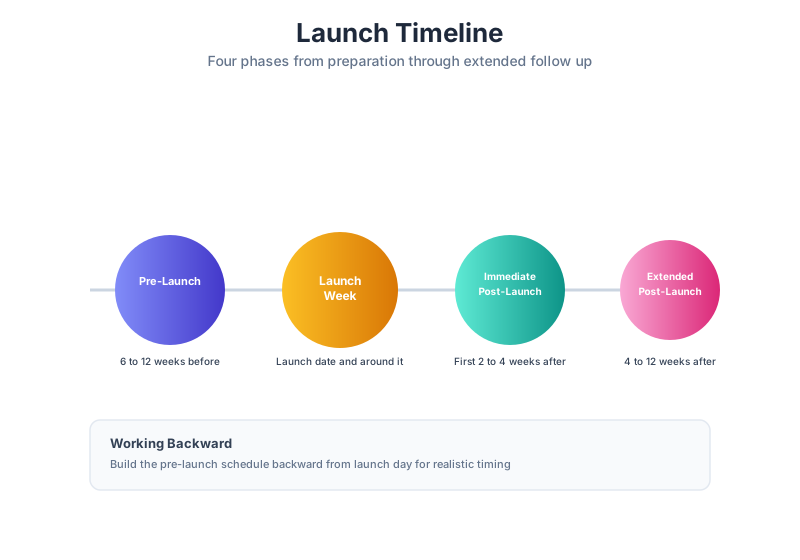
Pre-launch activities cover everything that needs to happen before the launch date itself, including finalizing messaging, completing sales training, preparing marketing assets, and confirming operational readiness, typically spanning several weeks to a few months depending on the scale of the launch.
Building the pre-launch timeline backward from the launch date, rather than forward from today, helps ensure every necessary activity has genuinely enough time allocated, since working forward from the present often leads to an overly optimistic sense of how much time remains before the deadline.
This backward planning approach also naturally surfaces which activities are most time constrained, since working back from a fixed date quickly reveals which preparation steps have the least buffer and therefore deserve the closest ongoing attention throughout the pre-launch period.
Launch Milestones
Launch milestones mark the specific events happening on or immediately around the launch date itself, such as the public announcement, initial press coverage, and the first wave of customer facing communication going out across every relevant channel simultaneously.
Coordinating the exact timing of these milestones carefully, rather than letting each channel publish independently on its own schedule, ensures customers and prospects encounter a coherent, well timed wave of communication rather than a confusing, staggered trickle of disconnected announcements.
| Timeline Phase | Typical Duration | Key Activities |
|---|---|---|
| Pre-Launch | 6 to 12 weeks before | Messaging, training, asset creation, readiness checks |
| Launch Week | Launch date and surrounding days | Announcement, press, customer communication |
| Immediate Post-Launch | First 2 to 4 weeks after | Monitoring, rapid issue resolution, early feedback |
| Extended Post-Launch | 4 to 12 weeks after | Performance review, optimization, expansion planning |
Post-Launch Milestones
Post-launch milestones track key events in the weeks following the launch date, such as the first performance review checkpoint, initial customer feedback synthesis, and any planned expansion to additional segments or geographies once the initial phase has proven successful.
Scheduling these checkpoints in advance, rather than deciding reactively when to check in on performance, ensures the team maintains disciplined attention on the launch even as day to day operational pressure inevitably pulls focus toward other priorities in the weeks that follow.
Critical Dependencies
Critical dependencies identify where one part of the timeline directly depends on another being completed first, such as sales training depending on finalized messaging, requiring careful sequencing to avoid a delay in one area cascading into delays across the entire launch timeline.
Mapping these dependencies visually, showing exactly which activities block which others, helps the whole team recognize where a delay carries outsized risk to the overall timeline, making it easier to prioritize protecting those specific dependencies over less critical activities.
Success Checkpoints
Success checkpoints establish specific points along the timeline where the team pauses to assess whether the launch is on track against the success criteria established earlier, creating natural opportunities to adjust course if early signals suggest the original plan needs refinement.
Treating these checkpoints as genuine decision points, rather than purely informational status updates, ensures the team actually acts on what the data reveals rather than continuing forward on autopilot regardless of what early signals suggest about the launch's actual trajectory.
Inviting a genuinely candid conversation at each checkpoint, including explicit permission to acknowledge when something is not working as hoped, matters more than it might seem, since teams under pressure to demonstrate success can sometimes unconsciously downplay early warning signs that deserved more serious attention.
Cross-Functional Execution Plan
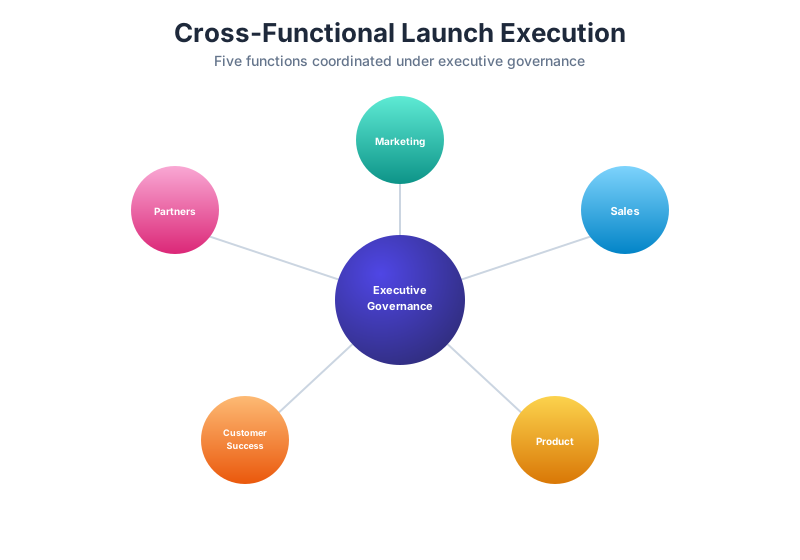
Successful execution requires every function to understand its specific role and how that role connects to every other function's work.
Marketing Execution
Marketing execution covers the specific campaigns, content, and public facing communication marketing is responsible for delivering around the launch, coordinated closely with sales to ensure messaging and timing align with what the sales team is prepared to support.
Sharing a detailed campaign calendar with sales well ahead of launch, rather than surprising them with new campaigns as they go live, gives sales the chance to prepare for an anticipated increase in inbound interest and ensure adequate capacity to follow up promptly.
This advance coordination becomes especially important when campaigns are expected to drive a significant volume of inbound leads within a short window, since a sales team caught unprepared for a sudden surge risks letting genuinely promising leads go unanswered during exactly the moment interest is at its peak.
Sales Execution
Sales execution covers how the sales team engages with prospects and existing customers around the launch, including updated talking points, objection handling guidance, and any specific outreach campaigns targeting priority accounts identified during launch planning.
Equipping sales with a simple, clear script for how to introduce the launch naturally into ongoing conversations, rather than assuming reps will improvise effectively on their own, helps maintain message consistency even across a large, distributed sales team handling many simultaneous conversations.
| Function | Primary Launch Responsibility | Key Coordination Partner |
|---|---|---|
| Marketing | Campaigns, content, public communication | Sales, Product |
| Sales | Customer outreach, deal support | Marketing, Customer Success |
| Product | Feature readiness, technical support | Engineering, Customer Success |
| Customer Success | Onboarding, existing customer communication | Sales, Product |
| Partners | Co-marketing, reseller enablement | Marketing, Partnerships team |
Product Execution
Product execution covers the technical readiness work happening around the launch itself, including monitoring system performance under real world load, and staying available to quickly address any issues that surface once actual customers begin using the new offering.
Having engineering resources explicitly on call and available during the launch window, rather than assuming normal support processes will suffice, ensures technical issues get resolved with the speed a high visibility launch moment genuinely demands.
Customer Success Execution
Customer success execution covers how the team supporting existing customers communicates the launch to that audience and prepares to onboard new customers, ensuring the transition from initial interest to genuine product adoption goes smoothly.
Preparing onboarding capacity in advance for an anticipated surge in new customers, rather than scaling reactively once volume already exceeds capacity, protects the early customer experience during exactly the period when first impressions matter most.
Partner Execution
Partner execution covers how external partners participate in the launch, whether through joint marketing activity, updated sales enablement for their own teams, or technical readiness if the launch involves a new integration or joint offering.
Assigning a clear internal owner responsible for coordinating each significant partner's involvement in the launch prevents important partner facing tasks from falling through the cracks amid the many competing priorities a launch period naturally generates.
Executive Governance
Executive governance provides senior oversight throughout the launch process, creating a forum where cross functional issues can be escalated and resolved quickly during the high intensity period surrounding the actual launch date.
Establishing a lightweight daily or near daily check-in during the most intensive launch week, even if brief, gives leadership real time visibility into how the launch is unfolding and creates a fast path for resolving any issues that need decisions beyond what individual functional teams can make alone.
Launch Assets & Enablement
Every function needs the right materials in hand before the launch date arrives.
Sales Assets
Sales assets include updated pitch decks, competitive battle cards, and objection handling guides that equip the sales team to represent the new offering confidently and consistently across every customer conversation.
Building these assets with direct input from a handful of experienced sales reps, rather than relying purely on marketing's internal perspective, tends to produce materials that feel genuinely practical and usable in a live sales conversation rather than overly polished but disconnected from real world objections reps actually encounter.
Keeping these assets easy to update after launch matters as well, since early customer conversations often surface new objections or questions the original materials did not anticipate, and a rigid, hard to revise asset library makes it harder to incorporate that real world learning quickly.
Marketing Assets
Marketing assets include the website updates, campaign creative, press materials, and content pieces needed to support awareness and demand generation efforts throughout the launch period and beyond.
Building a shared checklist tracking every required asset alongside its current status and owner keeps a large volume of parallel asset production organized, preventing a scenario where a specific, important piece of content is quietly forgotten amid the many moving parts of a launch.
| Asset Type | Owner | Completion Target |
|---|---|---|
| Sales Assets | Product Marketing | 2 to 3 weeks before launch |
| Marketing Assets | Marketing | 3 to 4 weeks before launch |
| Customer Communications | Customer Success, Marketing | 1 to 2 weeks before launch |
| Partner Enablement | Partnerships | 3 to 4 weeks before launch |
Customer Communications
Customer communications cover the specific messages existing customers receive about the launch, timed and tailored appropriately based on how directly the launch affects their own experience with the product.
Segmenting these communications so customers only receive messaging genuinely relevant to their own situation, rather than broadcasting an identical message to the entire customer base regardless of relevance, tends to produce better engagement and avoids diluting the impact of communication that customers actually need to pay attention to.
Partner Enablement
Partner enablement covers the training materials, updated messaging, and any co-marketing assets partners need to represent the launch accurately and effectively to their own customers and prospects.
Providing partners with the same quality of enablement materials given to internal sales teams, rather than a thinner, less complete version, respects the partner relationship and improves the odds that partners represent the launch as accurately and confidently as an internal team would.
Internal Readiness Resources
Internal readiness resources include the training materials, FAQ documents, and internal communication needed to ensure every employee, not just those in customer facing roles, understands the launch and can speak to it accurately if asked.
Every employee is a potential informal ambassador for a launch, whether in casual conversation with friends or on personal social media, and equipping the broader company with at least a basic, accurate understanding of the launch helps ensure that informal representation reinforces rather than undermines the official messaging.
Launch Risks & Contingencies
Even a well planned launch carries risk worth managing deliberately rather than hoping nothing goes wrong.
Execution Risks
Execution risks include the possibility that a specific function fails to complete its preparation on time, whether that is delayed sales training, incomplete marketing assets, or unresolved product issues that push against the planned launch date.
Building in a genuine buffer between the completion of critical preparation activities and the actual launch date, rather than scheduling every activity to finish right up against the deadline, provides some cushion to absorb the inevitable small delays that occur during any complex, multi function initiative.
Market Risks
Market risks include external factors outside the company's control, such as a competitor launching a similar offering simultaneously, an unexpected shift in market conditions, or broader news events that could overshadow the planned launch coverage.
Monitoring competitive and industry signals closely in the final weeks before launch, rather than only during the initial planning phase months earlier, helps the team catch and respond to emerging market risks while there is still time to adjust messaging or timing if genuinely necessary.
| Risk Type | Example | Recommended Contingency |
|---|---|---|
| Execution Risk | Sales training incomplete before launch | Delay launch or provide interim quick reference guide |
| Market Risk | Competitor launches similar offering simultaneously | Sharpen differentiation messaging in response |
| Operational Risk | Support volume exceeds capacity | Pre-arranged surge staffing plan |
| Technical Risk | Critical bug discovered late | Clear rollback and hotfix process |
Operational Risks
Operational risks include the possibility that support, billing, or other operational systems become overwhelmed by launch volume, requiring a pre-arranged contingency plan such as temporary additional staffing or a clear escalation path for urgent issues.
Preparing a specific surge staffing plan in advance, including who could be pulled in temporarily and how quickly, gives the team a genuine option to respond quickly if actual volume significantly exceeds initial projections, rather than scrambling to arrange support only after the strain has already become visible to customers.
Mitigation Strategies
Mitigation strategies outline the specific steps the team will take in response to each identified risk, ideally prepared in advance rather than improvised in the moment, since a launch in progress leaves little time for careful, considered decision making under pressure.
Assigning clear ownership for each mitigation strategy, along with pre-approved authority to act quickly if the associated risk materializes, removes unnecessary delay that would otherwise come from needing to seek approval in the middle of an already time sensitive situation.
Escalation Framework
An escalation framework establishes exactly who needs to be notified and how quickly when a significant issue arises during launch, ensuring problems reach the people with authority to make fast decisions rather than getting stuck in normal reporting channels during a moment that demands unusual speed.
Testing the escalation framework with a simple dry run before launch, such as confirming contact information is current and everyone understands their role, catches gaps in the plan itself before an actual crisis reveals them under much higher pressure circumstances.
A good escalation framework also specifies clear severity levels, distinguishing between an issue requiring immediate executive notification and one that can wait for the next scheduled check-in, since treating every problem as equally urgent tends to produce alert fatigue that dulls response to the genuinely critical issues that do arise.
Launch Success Metrics
Clear, well defined metrics allow the team to evaluate launch performance objectively rather than relying on subjective impressions.
Launch KPIs
Launch key performance indicators define the specific top level metrics used to judge overall launch success, typically combining awareness metrics, pipeline generation, and early adoption signals into a coherent picture of performance.
Presenting these KPIs together on a single, shared dashboard rather than scattered across separate functional reports gives everyone involved a unified, real time view of how the launch is actually performing across every dimension that matters.
Pipeline Metrics
Pipeline metrics track how much qualified sales pipeline the launch generates, both immediately around the launch date and in the weeks following, giving a clear sense of whether the launch is translating awareness into genuine revenue opportunity.
Tracking pipeline sourced specifically from launch related campaigns and outreach, rather than blending it indistinguishably with the broader ongoing pipeline, allows a much clearer read on how much the launch itself actually contributed above and beyond normal baseline activity.
| Metric Category | Example Metric | Typical Review Timing |
|---|---|---|
| Launch KPIs | Overall launch scorecard rating | Immediately and at 30 days |
| Pipeline Metrics | New qualified opportunities generated | Weekly through first 60 days |
| Adoption Metrics | Active usage among new customers | 30, 60, and 90 days post launch |
| Revenue Metrics | Closed revenue attributable to launch | 60 and 90 days post launch |
Adoption Metrics
Adoption metrics track how genuinely customers are using the newly launched offering after acquiring it, since strong initial sales without corresponding adoption often signals a launch that generated interest without delivering on the underlying value proposition.
Watching adoption metrics closely in the first several weeks gives an early warning if customers are signing up but not genuinely engaging, a signal worth investigating quickly since it often points to an onboarding gap or a mismatch between what the launch promised and what customers are actually experiencing.
Revenue Metrics
Revenue metrics connect the launch directly to closed business, providing the clearest measure of whether the launch investment is translating into genuine financial return, though these metrics often take longer to materialize fully compared to earlier awareness and pipeline indicators.
Setting realistic expectations for how long revenue metrics typically take to mature, particularly for longer sales cycles, prevents the team from prematurely judging a launch as underperforming before revenue has had genuinely enough time to develop through the full sales process.
Early Success Indicators
Early success indicators identify the specific signals worth watching closely in the very first days and weeks after launch, giving the team an early read on whether the launch is broadly on track well before the full picture becomes clear through later, more lagging metrics.
Identifying these leading indicators in advance, rather than deciding after the fact which early signals seemed to matter, ensures the team knows exactly what to watch for from the very first day rather than scrambling to figure out what data actually matters once the launch is already underway.
90-Day Execution Roadmap
Translating the launch plan into a specific, actionable near term sequence keeps execution focused and accountable.
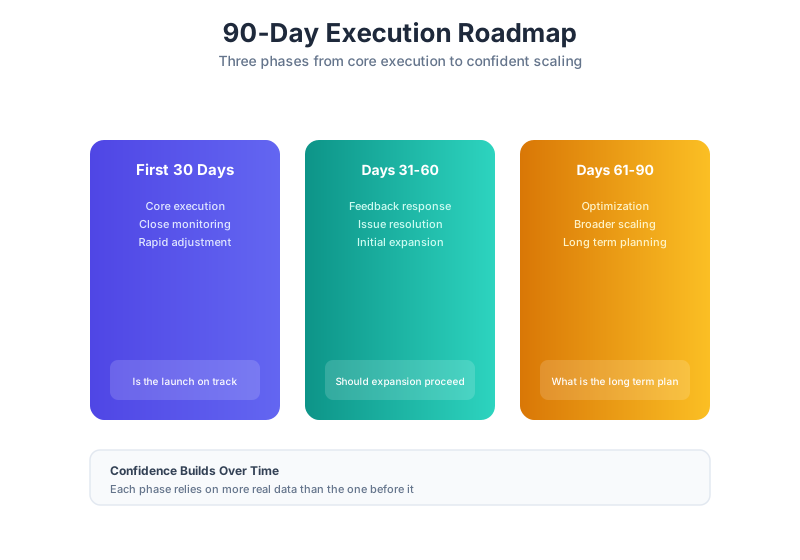
First 30 Days
The first thirty days focus on executing the core launch activities and closely monitoring early performance signals, staying ready to make rapid adjustments if early data suggests the original plan needs refinement.
This period typically demands the most intensive cross functional coordination of the entire launch process, since it combines the highest external visibility with the least amount of real performance data available to guide decisions confidently.
Days 31-60
Days thirty one through sixty typically shift focus toward addressing early feedback, resolving any issues that surfaced during the initial launch period, and beginning to expand into additional segments or geographies if the initial phase performed well.
This phase benefits from a genuine willingness to adjust the original plan based on what has actually been learned, rather than rigidly executing the initial plan regardless of what the first month of real world performance has revealed about what is and is not working.
| Phase | Primary Focus | Key Decision Point |
|---|---|---|
| First 30 Days | Core execution, close monitoring | Is the launch tracking to plan |
| Days 31-60 | Feedback response, initial expansion | Should expansion proceed as planned |
| Days 61-90 | Optimization, broader scaling | What does the long term plan look like |
Days 61-90
Days sixty one through ninety typically focus on broader optimization based on accumulated performance data, along with more confident scaling into additional segments or geographies once the launch has demonstrated clear traction.
By this point, enough data has typically accumulated to make more confident, evidence based decisions about where to focus ongoing investment, moving the team from the more reactive, uncertain posture of the first thirty days toward a clearer, more deliberate long term operating plan.
Immediate Priorities
Immediate priorities identify the specific actions that need attention right away as the ninety day period begins, ensuring the team has clarity on exactly what to focus on first rather than trying to advance every workstream simultaneously from day one.
Communicating these immediate priorities clearly and repeatedly across the organization helps prevent the common problem where individual teams each interpret their own priorities slightly differently, leading to uneven effort across what should be a unified, focused push in the launch's opening days.
Expected Outcomes
Expected outcomes define what success should look like by the end of the ninety day period, giving the team a clear target to plan against and a meaningful checkpoint for evaluating whether the launch has achieved what it set out to accomplish.
Framing expected outcomes as a range rather than a single fixed number, spanning a conservative and an optimistic scenario, sets more realistic expectations across the organization and avoids the all or nothing feeling of measuring success against a single, rigid target that may not fully account for genuine uncertainty in a new launch.
Executive Launch Summary
The executive summary condenses the full launch plan into a format leadership can review quickly without needing to revisit every underlying section in detail.
Launch Strategy
This section clearly restates the overall launch strategy and approach, giving leadership a quick, confident reference point for understanding the direction being pursued.
Keeping this restatement genuinely brief and focused on the core approach, rather than a detailed recap of every decision covered in the full plan, respects the purpose of an executive summary as a fast reference rather than a complete restatement of the underlying document.
Key Milestones
Key milestone summary highlights the most important dates and checkpoints throughout the launch timeline, giving leadership a simple reference for tracking progress without needing to review the full detailed timeline.
Presenting these milestones visually, such as a simple timeline graphic, communicates the overall shape and pacing of the launch far more quickly to a busy executive audience than a long written description of each individual date and activity.
Critical Risks
Critical risk summary highlights the most significant risks identified during planning, paired with a brief note on the mitigation approach already in place to address them.
Presenting risks alongside their prepared mitigation, rather than listing them without a clear response, gives leadership genuine confidence that identified vulnerabilities are being actively managed rather than simply acknowledged and left unaddressed heading into launch.
Success Factors
Success factor summary identifies what needs to be true for the launch to actually succeed, such as sustained cross functional coordination, adequate resourcing, or timely resolution of any outstanding readiness gaps.
Being explicit about these prerequisites helps leadership understand exactly what their own support and attention needs to look like in the weeks surrounding the launch, rather than assuming success depends purely on the effort of the teams directly executing the plan.
Executive Recommendations
The summary should close with a short, clear set of recommendations for leadership, whether that is approving the final launch date, committing additional resources to address a readiness gap, or personally participating in a specific launch activity that benefits from visible executive support.
Pairing each recommendation with a clear sense of what is being asked of leadership specifically, whether that is a decision, a resource commitment, or simply visible participation, helps ensure the summary leads to genuine action rather than passive acknowledgment.
Launch and execution, like every other part of go to market strategy, does not end on launch day itself. The strongest organizations treat the weeks following a launch with the same discipline and attention given to the launch date itself, since sustained follow through in those early weeks often determines whether initial momentum translates into lasting, durable success. Treating the full ninety day period, not just the launch date, as the true measure of a launch's success keeps the organization focused on what actually matters most: whether customers genuinely adopt and benefit from what has been launched, well beyond the initial excitement of the announcement itself.
Contents