
Marketing Alignment Plan: Getting Every Team Rowing in the Same Direction
Even the best go to market strategy falls apart if the teams responsible for executing it are not genuinely aligned. Marketing might be promoting one message while sales tells a different story in the field, product might be shipping features nobody has planned messaging around, and customer success might be left discovering new launches at the same time customers do. Marketing alignment is the discipline of making sure every function involved in reaching and serving customers works from the same shared plan, the same priorities, and the same understanding of what success looks like.
This guide covers the full scope of marketing alignment inside a go to market program, starting with alignment objectives, moving through organizational alignment, roles and responsibilities, shared frameworks, and planning coordination, and finishing with governance, risk management, recommendations, and an executive summary leadership can act on.
Alignment problems rarely announce themselves clearly. They tend to show up quietly, as a slightly confused prospect who heard different things from a marketing email and a sales rep, a support team caught off guard by a change nobody mentioned, or a product launch that lands with far less impact than it should have simply because half the organization did not know it was coming. These are not usually failures of talent or effort within any single function, they are failures of coordination between functions, and coordination failures respond well to deliberate, structured attention rather than hoping goodwill alone will close the gaps.
Marketing Alignment Overview
Before building specific alignment mechanisms, a team needs a clear, shared understanding of what alignment is meant to accomplish and why it matters.
Alignment Objectives
Alignment objectives clarify what the alignment effort needs to prioritize, whether that is faster cross functional decision making, more consistent messaging across every customer touchpoint, or simply reducing the friction and duplicated effort that naturally accumulates as an organization grows. Being explicit about which objective matters most keeps the alignment work focused on solving real problems rather than becoming a vague, feel good exercise without concrete outcomes.
A company struggling with inconsistent messaging across sales and marketing might prioritize a shared messaging framework as the first order of business, while a company struggling with slow decision making might prioritize a clearer RACI framework and governance model instead. Naming the specific pain point driving the alignment effort helps ensure the resulting plan actually addresses it.
Gathering input directly from each function about where they experience the most friction today, rather than assuming leadership already knows the answer, often surfaces a more accurate picture of where alignment work should focus first. Teams closest to the daily friction points frequently identify problems that are invisible from a more senior vantage point.
GTM Alignment Principles
GTM alignment principles establish the guiding philosophy behind how teams are expected to work together, such as prioritizing shared customer outcomes over individual functional metrics, defaulting to transparency and early communication rather than surprises, and resolving disagreements through clear escalation paths rather than allowing friction to fester unaddressed.
| Alignment Principle | Description | Why It Matters |
|---|---|---|
| Shared Outcomes | Teams optimize for customer and revenue outcomes together | Reduces functional silos and competing incentives |
| Early Communication | Information shared proactively, not only when requested | Prevents surprises and last minute scrambling |
| Clear Escalation | Disagreements resolved through defined paths | Avoids unresolved friction slowing execution |
| Single Source of Truth | One shared plan rather than parallel functional plans | Keeps every team working from the same priorities |
Publishing these principles somewhere every team can reference, and referring back to them explicitly when a cross functional disagreement arises, helps keep the principles alive as genuine decision making guides rather than a document written once and quickly forgotten.
Cross-Functional Goals
Cross-functional goals translate alignment principles into specific, shared targets that multiple functions are jointly accountable for, such as a shared revenue target, a shared customer satisfaction metric, or a shared launch timeline that marketing, sales, product, and customer success all measure themselves against together rather than each function tracking entirely separate goals.
Shared accountability changes behavior meaningfully compared to purely functional goals, since a team measured partly on a metric outside its direct control has a genuine incentive to collaborate with the team that does control it, rather than optimizing narrowly for its own isolated targets regardless of the broader impact.
Success Criteria
Success criteria define how the alignment effort itself will be evaluated, typically including faster cross functional decision cycles, improved consistency in customer facing messaging, and reduced instances of teams discovering important information later than they should have. Establishing these criteria upfront ensures the alignment initiative can be judged on real improvement rather than good intentions alone.
Choosing criteria that can actually be measured, even if imperfectly, keeps this evaluation grounded rather than relying purely on subjective impressions of whether things feel more aligned. A simple survey measuring cross functional satisfaction, repeated at consistent intervals, can provide a useful proxy metric even when more precise measurement is difficult.
GTM Organizational Alignment
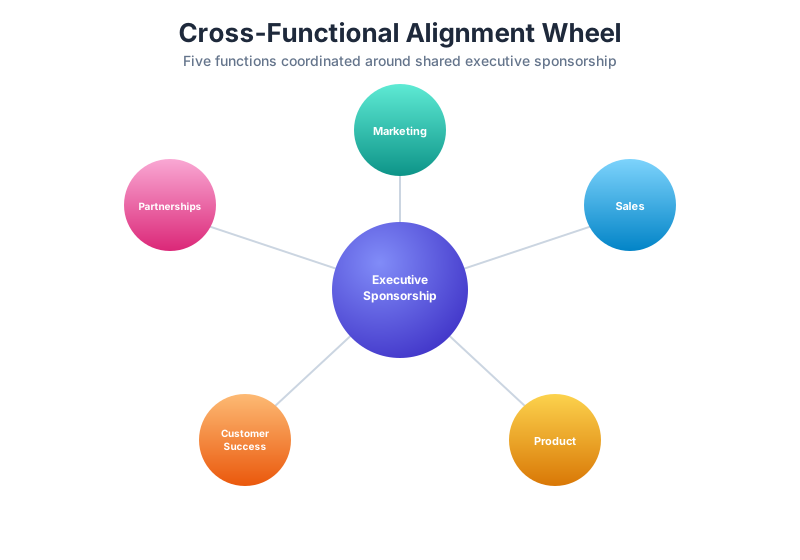
Alignment starts with understanding how each function needs to participate in and support the broader go to market effort.
Marketing Alignment
Marketing alignment ensures the marketing function operates from the same priorities, messaging, and timeline as the rest of the go to market organization, rather than pursuing its own campaign calendar disconnected from what sales needs to close deals or what product is preparing to ship.
Involving sales and product representatives directly in marketing's own planning process, rather than only sharing finished plans after the fact, tends to surface misalignment early enough to actually address it before a campaign launches disconnected from what the rest of the organization is prepared to support.
This kind of early involvement works best when it feels genuinely collaborative rather than a box checking formality, meaning sales and product input should be able to meaningfully shape the final plan rather than being solicited purely as a courtesy after key decisions have already effectively been made.
Sales Alignment
Sales alignment ensures the sales team has the messaging, collateral, and product knowledge needed to represent the company consistently and effectively, and that sales feedback from the field flows back into marketing and product planning rather than disappearing into individual conversations that never inform broader strategy.
Building a structured, lightweight process for capturing and routing sales feedback, rather than relying purely on informal hallway conversations, ensures valuable field insight actually reaches the teams positioned to act on it, whether that means adjusting messaging, prioritizing a product gap, or updating competitive positioning.
| Function | Primary Alignment Need | Common Failure Mode Without Alignment |
|---|---|---|
| Marketing | Consistent priorities and shared timeline | Campaigns disconnected from sales and product reality |
| Sales | Current messaging and product knowledge | Reps improvising inconsistent messaging in the field |
| Product | Visibility into customer and market feedback | Features shipped without go to market readiness |
| Customer Success | Early visibility into launches and changes | Customers learn about changes before support does |
Product Alignment
Product alignment ensures product development stays connected to market feedback, competitive intelligence, and customer needs gathered by go to market teams, while also ensuring go to market teams have adequate advance notice of upcoming releases to prepare messaging, training, and campaigns in time.
Establishing a regular, predictable rhythm for product to share roadmap visibility with go to market teams, even when specific details remain subject to change, gives marketing and sales enough lead time to prepare properly rather than scrambling once a release date is suddenly confirmed with little advance warning.
Customer Success Alignment
Customer success alignment ensures the team supporting existing customers has the same visibility into upcoming changes, messaging updates, and strategic priorities as the teams focused on acquiring new customers, preventing the common problem where customer facing teams learn about important changes from customers themselves rather than internally in advance.
Including customer success explicitly in go to market planning meetings, rather than treating them as a downstream recipient of decisions made elsewhere, tends to surface valuable perspective on how a planned change might actually land with existing customers before that change goes live.
Partnerships Alignment
Partnerships alignment ensures the team managing external partner relationships stays connected to broader go to market priorities, so that partner facing messaging, enablement, and joint initiatives reflect the same current priorities the rest of the organization is working from.
Partner facing teams often operate at arm's length from day to day internal planning, making deliberate effort to keep them informed particularly important, since a partner repeating outdated messaging or unaware of a recent strategic shift can create confusion in front of shared customers.
Executive Sponsorship
Executive sponsorship provides the organizational authority and attention needed to make cross functional alignment genuinely stick, since alignment initiatives without visible senior support tend to lose momentum once day to day operational pressure reasserts itself across individual functions.
A visible, actively engaged executive sponsor, rather than one who delegates the initiative entirely after an initial kickoff, signals to the broader organization that alignment genuinely matters and is worth prioritizing even when it requires short term tradeoffs against a specific function's individual priorities.
GTM Roles & Responsibilities
Clear ownership prevents the confusion and duplicated effort that often undermines cross functional initiatives.
Functional Ownership
Functional ownership defines which team holds primary responsibility for each specific go to market activity, such as marketing owning campaign execution, sales owning deal specific negotiation, and product owning feature prioritization, while making clear where these areas of ownership intersect and require close collaboration.
Documenting ownership explicitly, rather than relying on informal understanding that can vary depending on who happens to be involved in a given situation, prevents the confusion that arises when a new team member or a genuinely ambiguous edge case exposes gaps in shared understanding about who actually owns a specific decision or activity.
This documentation does not need to be exhaustive to be useful. Even a simple, clearly maintained reference covering the most common areas of potential ambiguity resolves the majority of confusion that would otherwise require repeated clarifying conversations every time a similar situation arises.
RACI Framework
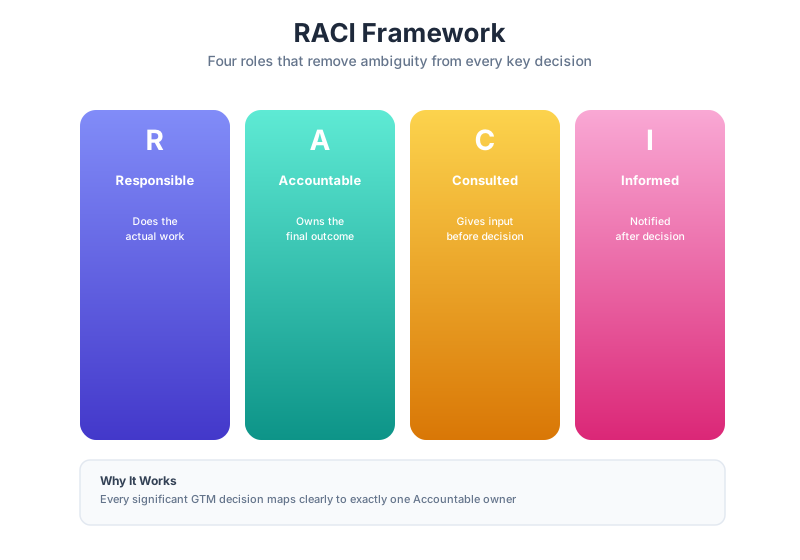
A RACI framework explicitly maps who is Responsible, Accountable, Consulted, and Informed for each significant go to market decision or activity, removing ambiguity about who actually needs to sign off on a decision versus who simply needs to be kept in the loop afterward.
Building this framework collaboratively with representatives from each affected function, rather than having a single team impose it unilaterally, tends to produce a version everyone genuinely understands and respects, rather than a document that looks authoritative but does not reflect how the organization actually operates in practice.
Keeping the RACI framework focused on genuinely significant, recurring decisions rather than attempting to map every possible activity in exhaustive detail also matters, since an overly granular framework becomes cumbersome to maintain and reference, undermining the clarity it was meant to provide in the first place.
| Activity | Responsible | Accountable | Consulted | Informed |
|---|---|---|---|---|
| Product Launch Messaging | Marketing | VP Marketing | Sales, Product | Customer Success |
| Pricing Changes | Product, Finance | VP Product | Sales, Marketing | Customer Success |
| Major Campaign Launch | Marketing | CMO | Sales Leadership | Customer Success |
| Customer Facing Policy Change | Customer Success | VP Customer Success | Sales, Legal | Marketing |
Decision Ownership
Decision ownership clarifies which specific role or team has final say on a given category of decision, preventing the common scenario where multiple stakeholders each believe they hold final authority, leading to conflicting directions being communicated to different parts of the organization.
Revisiting decision ownership periodically matters as an organization grows, since ownership that made sense with a small, tightly coordinated team can become genuinely unclear once the organization scales and more people become involved in adjacent areas of the same broad decision category.
Cross-Functional Collaboration
Cross-functional collaboration guidelines establish how teams are expected to work together on shared initiatives, including how often they meet, what information gets shared proactively, and what tools or documents serve as the shared source of truth for ongoing projects.
Keeping these guidelines lightweight and practical, rather than an elaborate process that itself becomes burdensome to follow, increases the odds that teams actually adopt and sustain the collaboration practices over time rather than abandoning them once initial enthusiasm fades.
Governance Model
A governance model establishes the broader structure within which all these roles and responsibilities operate, including escalation paths for unresolved disagreements and a clear process for updating roles and responsibilities as the organization grows and changes over time.
A well designed governance model anticipates that roles and responsibilities will need to evolve, building in a straightforward process for proposing and approving changes rather than treating the initial RACI mapping as a fixed structure that becomes increasingly outdated as the organization changes around it.
Strategic Alignment Priorities
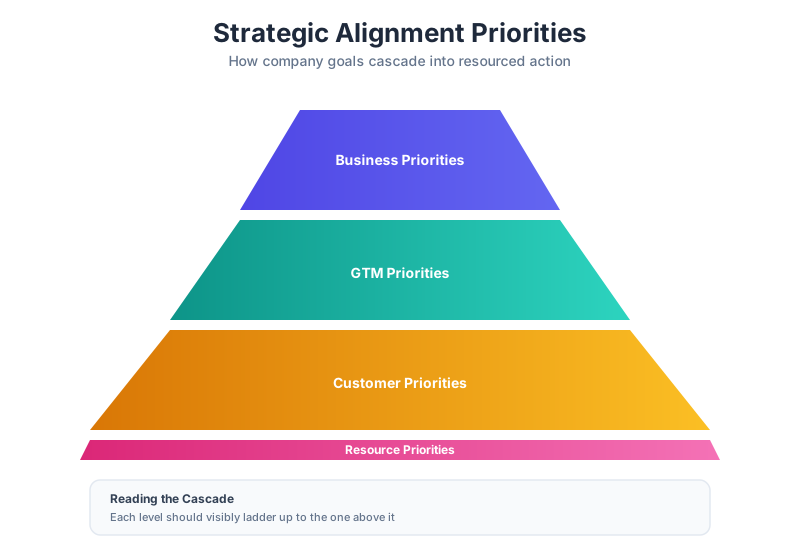
Beyond roles and processes, alignment requires genuine agreement on what the organization is actually prioritizing at any given time.
Business Priorities
Business priorities represent the overarching goals the entire company is working toward, such as a specific revenue target, market share objective, or strategic initiative that every function's individual plans should ultimately ladder up to and support.
Making these business priorities genuinely visible and understood across every function, rather than assuming everyone already knows them, helps every team connect their own day to day work back to a clear sense of why it matters at the broader company level.
Repeating these priorities consistently across multiple channels and forums, rather than communicating them once and assuming the message has fully landed, helps counteract the natural tendency for strategic priorities to fade from daily attention as teams get absorbed in their own immediate, tactical work.
GTM Priorities
GTM priorities translate broader business priorities into the specific go to market focus areas that will receive the most attention and investment, such as a particular target segment, product launch, or competitive response that marketing, sales, and product all need to coordinate around together.
Limiting the number of active GTM priorities at any given time, rather than declaring everything a top priority simultaneously, helps ensure the organization's collective attention and resources genuinely concentrate where they matter most rather than being diluted across too many competing initiatives.
| Priority Level | Owner | Review Frequency |
|---|---|---|
| Business Priorities | Executive leadership | Annually, with quarterly check-ins |
| GTM Priorities | GTM leadership team | Quarterly |
| Customer Priorities | Customer success and product | Ongoing, reviewed quarterly |
| Resource Priorities | Finance and functional leaders | Quarterly, tied to budget cycles |
Customer Priorities
Customer priorities capture what matters most to the target customer base right now, drawn from direct customer feedback, support ticket trends, and market research, ensuring the organization's internal priorities stay grounded in genuine customer need rather than drifting toward internally generated assumptions.
Reviewing customer priorities alongside internal business and GTM priorities during the same planning conversation, rather than as a separate, disconnected exercise, helps surface tension early when internal ambitions and genuine customer need are not fully aligned with each other.
Assigning someone specifically responsible for representing the customer's voice consistently in these planning conversations, whether that is a customer success leader or a dedicated voice of customer program, helps ensure this perspective carries real weight rather than being easily overshadowed by more immediate internal business pressures during prioritization discussions.
Resource Priorities
Resource priorities determine how budget, headcount, and leadership attention actually get allocated across competing initiatives, requiring honest tradeoffs since very few organizations have enough resources to pursue every worthwhile initiative simultaneously.
Making these tradeoffs explicit and visible, rather than allowing resource allocation to happen implicitly through whoever advocates loudest, produces decisions that better reflect genuine strategic priority rather than internal political dynamics or historical habit.
Alignment Scorecard
An alignment scorecard provides a simple, visual way to track how well the organization is actually living up to its stated alignment principles and priorities, typically combining a mix of process metrics, such as meeting cadence adherence, and outcome metrics, such as cross functional satisfaction survey results.
Reviewing this scorecard consistently during executive reviews keeps alignment health visible alongside other business metrics, rather than treating it as a soft, secondary concern that only receives attention once significant friction has already accumulated across the organization.
Sharing scorecard results transparently across the organization, rather than restricting visibility to senior leadership alone, also reinforces the sense that alignment is a shared responsibility every team contributes to, rather than something imposed from above and measured only for leadership's own benefit.
Shared GTM Framework
A shared framework gives every function a common reference point for planning and executing go to market activity.
Common GTM Objectives
Common GTM objectives restate the shared goals every function is working toward together, ensuring marketing, sales, product, and customer success are not each quietly optimizing for a slightly different definition of success that could pull the organization in inconsistent directions over time.
Testing whether these objectives are genuinely shared, rather than assumed to be shared, involves simply asking representatives from each function to describe the top priority in their own words and comparing the answers, which often reveals surprising divergence worth addressing directly.
Shared Messaging Framework
A shared messaging framework, drawing directly from the positioning and messaging work established elsewhere in the go to market strategy, ensures every function communicates about the product and company consistently, whether that communication happens in a sales call, a marketing campaign, or a customer support interaction.
Making this framework genuinely accessible, rather than buried in a document few people ever open, matters considerably for actual adoption. A living, easily searchable resource that teams actually reference during their daily work does far more to maintain consistency than a comprehensive document created once and rarely revisited.
Assigning clear ownership for keeping this shared framework current, rather than allowing it to quietly become outdated as positioning and messaging evolve elsewhere, ensures it remains a genuinely trustworthy reference rather than a source of confusion once it drifts noticeably out of sync with how the company actually talks about itself today.
| Framework Element | Owner | Used By |
|---|---|---|
| Core Value Proposition | Product Marketing | All customer facing teams |
| Competitive Positioning | Product Marketing | Sales, Marketing |
| Pricing and Packaging | Product, Finance | Sales, Marketing, Customer Success |
| Customer Success Metrics | Customer Success | All teams, for prioritization |
Shared KPIs
Shared KPIs give multiple functions a common set of metrics to track together, rather than each function reporting only on metrics specific to its own activity, helping surface a more complete, honest picture of how well the overall go to market motion is actually performing.
Choosing a genuinely small set of shared KPIs, rather than an exhaustive dashboard covering every possible metric, keeps this shared view focused and prevents the kind of information overload that causes teams to disengage from tracking shared performance altogether.
Planning Cadence
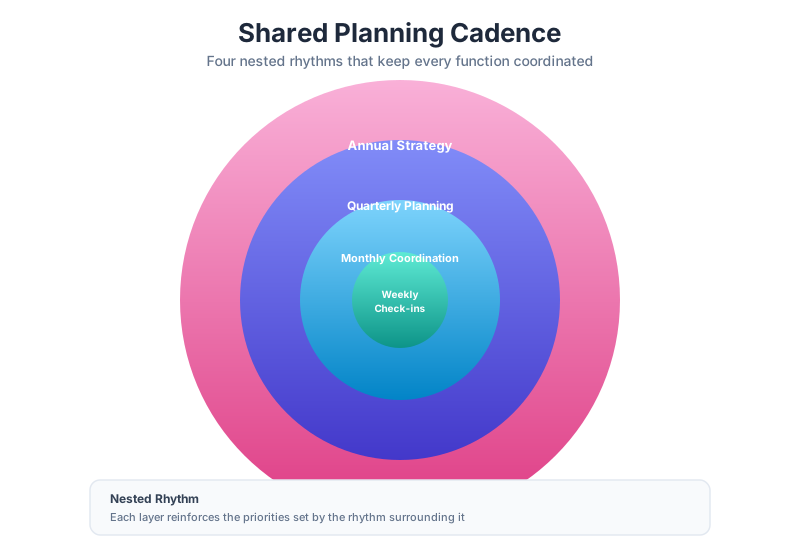
Planning cadence establishes a consistent, predictable rhythm for cross functional planning activities, such as quarterly strategic planning, monthly campaign coordination, and weekly operational check-ins, so that alignment happens through a reliable structure rather than only through ad hoc meetings called in response to problems.
A predictable cadence also reduces the anxiety and reactive scrambling that comes from irregular, surprise coordination meetings, giving teams the ability to plan their own work around a known rhythm rather than constantly needing to drop everything for an unplanned alignment conversation.
Collaboration Model
A collaboration model defines the practical mechanics of how teams actually work together day to day, including shared tools, communication channels, and documentation practices that keep cross functional work organized and accessible rather than scattered across disconnected systems each function manages independently.
Standardizing on a small number of shared tools for cross functional work, rather than allowing each function to maintain entirely separate systems, considerably reduces the friction of finding information and coordinating across team boundaries, even though it may require some individual teams to adjust from their own previously preferred tooling.
The specific tools chosen matter less than the discipline of actually keeping them updated and genuinely used as the shared source of truth, since even the best designed collaboration system fails to deliver value if teams quietly maintain parallel, undocumented processes alongside it out of habit or convenience.
Marketing Planning & Coordination
Translating alignment principles into practice requires deliberate coordination around specific marketing activities.
Campaign Planning
Campaign planning coordination ensures marketing campaigns are planned with direct input from sales and product, so that campaigns align with what sales can actually support and what product can actually deliver, rather than marketing planning in isolation and discovering misalignment only after a campaign has already launched.
Building a simple campaign brief template that explicitly requires sales and product sign off before a campaign moves into full production catches misalignment early, when adjustments are still relatively easy to make, rather than after significant creative and media investment has already gone into a campaign built on a flawed assumption.
This kind of lightweight checkpoint works best when it is genuinely fast and low friction, since a sign off process perceived as slow or bureaucratic tends to get quietly circumvented under deadline pressure, undermining the very coordination it was designed to protect.
Content Alignment
Content alignment ensures marketing content, sales enablement materials, and customer facing documentation all tell a consistent story, avoiding the common problem where a prospect encounters different claims or emphasis depending on whether they are reading a blog post, a sales deck, or a product page.
Periodically auditing a sample of content across every function against the shared messaging framework helps catch drift before it accumulates into genuinely noticeable inconsistency that a sophisticated prospect comparing multiple touchpoints might actually notice and question.
| Coordination Area | Key Stakeholders | Timing Relative to Launch |
|---|---|---|
| Campaign Planning | Marketing, Sales, Product | 6 to 8 weeks before launch |
| Sales Enablement | Marketing, Sales Leadership | 2 to 4 weeks before launch |
| Customer Communication | Customer Success, Marketing | 1 to 2 weeks before launch |
| Post Launch Review | All functions | 2 to 4 weeks after launch |
Product Launch Readiness
Product launch readiness coordination ensures every function has what it needs before a new product or feature goes live, including sales training, updated marketing materials, and customer success documentation, preventing a launch where the product ships before the rest of the organization is actually prepared to support it.
Using a shared launch readiness checklist that every function must confirm before a launch date is finalized creates accountability and visibility, making it much harder for a specific function's readiness gap to go unnoticed until customers are already affected by it.
Building in a genuine go or no go decision point ahead of every launch, rather than treating the launch date as fixed regardless of readiness status, gives the organization a real mechanism to delay a launch when necessary rather than shipping on schedule despite known gaps simply because the date was already publicly committed to.
Sales Readiness
Sales readiness coordination ensures the sales team has been properly trained and equipped before being expected to sell a new offering or respond to a new competitive situation, recognizing that even excellent marketing materials fail to help if sales reps have not had adequate time to absorb and practice using them.
Building in dedicated time for reps to practice new messaging through role play or mock objection handling, rather than simply distributing a document and assuming reps will internalize it independently, considerably improves how confidently and consistently the new messaging actually gets applied in live customer conversations.
Customer Communication Planning
Customer communication planning ensures existing customers receive clear, timely communication about changes that affect them, coordinated between customer success and marketing so that customers hear about important updates from the company directly, rather than discovering changes unexpectedly or through a delayed, inconsistent internal process.
Segmenting customer communication based on how directly a change actually affects a given customer, rather than sending identical broad announcements to the entire customer base regardless of relevance, tends to improve both engagement and customer sentiment, since messaging feels genuinely relevant rather than generic.
GTM Governance & Performance
Sustained alignment requires an ongoing governance structure rather than a one time planning exercise.
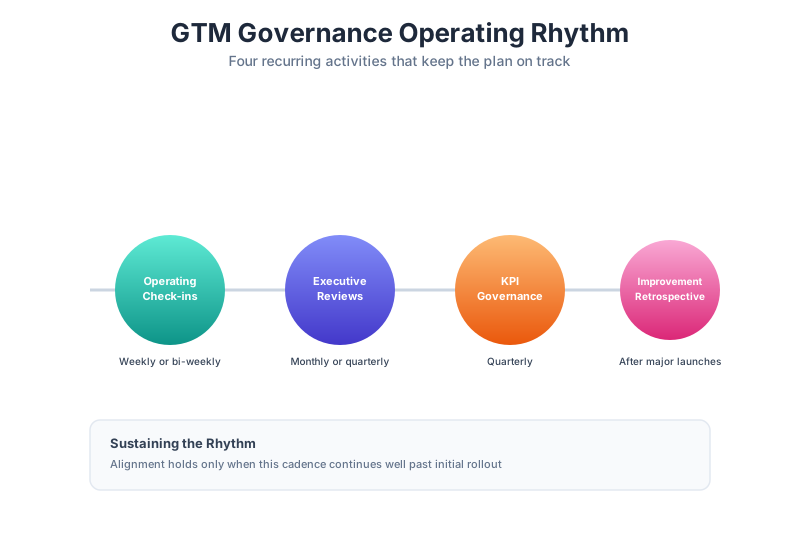
Operating Cadence
Operating cadence establishes the recurring rhythm of meetings and check-ins that keep cross functional alignment active on an ongoing basis, balancing enough structure to maintain genuine coordination against the risk of excessive meetings that consume time without adding proportional value.
Periodically reviewing whether existing meetings still serve a genuine purpose, rather than allowing recurring meetings to persist indefinitely out of habit, keeps the operating cadence lean and respected rather than becoming a source of quiet resentment among teams who feel their time is being wasted.
Executive Reviews
Executive reviews provide senior leadership with regular visibility into go to market performance and alignment health, creating a forum where cross functional issues can be raised and resolved with the authority needed to actually make decisions stick across the organization.
Structuring these reviews around genuine decision making rather than purely status reporting keeps them valuable and worth attending, since a review that consists only of one way updates without any resulting decisions or resource reallocation tends to feel like a waste of senior leadership time over the long run.
| Governance Activity | Cadence | Primary Purpose |
|---|---|---|
| Operating Cadence Check-ins | Weekly or bi-weekly | Tactical coordination and issue surfacing |
| Executive Reviews | Monthly or quarterly | Strategic oversight and decision making |
| KPI Governance Review | Quarterly | Ensure shared metrics remain relevant and accurate |
| Continuous Improvement Retrospective | Quarterly or after major launches | Capture lessons and refine processes |
KPI Governance
KPI governance ensures the shared metrics used to measure go to market performance remain accurate, relevant, and consistently defined across every function using them, preventing the common problem where different teams quietly calculate the same named metric in slightly different ways.
Assigning clear ownership for each shared KPI definition, along with a documented calculation methodology available to everyone using the metric, prevents the confusing situation where two teams present conflicting numbers for what should be the exact same underlying measurement.
Decision Framework
A decision framework clarifies how significant go to market decisions actually get made, including what data or input is required before a decision, who holds final authority, and how quickly decisions should typically be reached to avoid unnecessary delay.
Setting explicit expectations for decision turnaround time, rather than leaving timing entirely open ended, helps prevent important decisions from lingering indefinitely while stakeholders wait for someone else to take the initiative to move things forward.
Continuous Improvement Process
A continuous improvement process establishes a regular practice of reviewing what worked and what did not across recent go to market initiatives, capturing lessons learned in a way that genuinely informs how future initiatives get planned and executed, rather than repeating the same avoidable mistakes.
Documenting these lessons somewhere genuinely accessible, and actively referencing them during future planning rather than letting them accumulate unused in an archive nobody revisits, is what actually turns a retrospective practice into real, compounding organizational learning over time.
Alignment Risks & Dependencies
Even a well designed alignment plan faces specific risks worth managing deliberately.
Cross-Functional Gaps
Cross-functional gaps emerge when responsibility for a specific activity falls between functions, with each assuming another team owns it, leading to important work simply not happening until a customer or deal is negatively affected by the oversight.
Running a periodic exercise where teams walk through a specific customer journey or internal process step by step, explicitly naming the owner at each stage, often surfaces these gaps clearly, revealing steps that everyone assumed someone else was handling.
Communication Risks
Communication risks include information not reaching the teams that need it in time, whether due to unclear ownership of communication responsibility or simply too many disconnected channels making it easy for important updates to get lost.
Consolidating important cross functional communication into a small number of well established channels, rather than allowing critical updates to spread across many different tools and threads, meaningfully reduces the odds that an important piece of information gets missed by the team that needed it most.
| Risk Type | Description | Recommended Mitigation |
|---|---|---|
| Cross-Functional Gap | No clear owner for a specific activity | Explicit RACI mapping for all key activities |
| Communication Breakdown | Information not reaching teams in time | Centralized, single source of truth documentation |
| Resource Constraint | Insufficient capacity to execute aligned plan | Realistic prioritization tied to actual capacity |
| Key Person Dependency | Alignment relies on one individual's effort | Documented processes independent of specific people |
Resource Constraints
Resource constraints occur when the ambition of a shared go to market plan exceeds the actual capacity available across the involved functions, leading to missed deadlines and quality shortfalls if not addressed honestly during planning rather than discovered mid execution.
Building realistic capacity checks into the planning process itself, rather than assuming every function can simply absorb additional work as needed, helps produce plans that are genuinely achievable rather than aspirational documents that quietly fall apart once execution begins.
Operational Dependencies
Operational dependencies identify where one function's work directly depends on another function completing its own work first, such as sales enablement depending on finalized messaging, requiring careful sequencing in planning to avoid one delayed function cascading into delays across the entire go to market timeline.
Mapping these dependencies visually as part of launch or campaign planning helps the whole team see clearly where a delay in one area will ripple forward, making it easier to prioritize resolving a bottleneck before it silently pushes back every downstream deadline.
Organizational Readiness
Organizational readiness considers whether the broader company culture and structure genuinely supports the kind of cross functional collaboration the alignment plan requires, recognizing that even a well designed process will struggle in an organization with deeply entrenched functional silos and competing incentive structures.
Addressing underlying incentive misalignment, such as compensation structures that reward one function for outcomes that inadvertently work against another function's goals, often matters more to genuine organizational readiness than any amount of process design layered on top of a fundamentally misaligned incentive structure.
Marketing Alignment Recommendations
All of the analysis above should translate into clear, actionable recommendations for improving alignment going forward.
Priority Alignment Initiatives
Priority alignment initiative recommendations identify the specific, highest impact changes worth making first, based on the gaps and risks identified earlier, rather than attempting a complete organizational overhaul all at once.
Sequencing initiatives so early wins build momentum and credibility for the broader alignment effort tends to work better than starting with the most ambitious, complex change, since visible early success helps build organizational buy-in for the harder changes that may come later.
Process Improvements
Process improvement recommendations identify specific, practical changes to existing workflows, such as introducing a new planning cadence or clarifying an ambiguous decision ownership area, that could meaningfully improve alignment without requiring a fundamental organizational restructuring.
Piloting a proposed process change with a smaller, contained group before rolling it out organization wide helps surface practical issues early and builds a stronger case for broader adoption once the pilot demonstrates genuine improvement.
Governance Recommendations
Governance recommendations outline specific changes to the operating cadence, executive review structure, or decision framework needed to support better ongoing alignment, connecting directly back to the governance analysis completed earlier.
Framing governance changes around the specific problems they are meant to solve, rather than presenting new process for its own sake, helps teams understand why a change is worth the adjustment required, improving genuine adoption rather than passive, resentful compliance.
Collaboration Opportunities
Collaboration opportunity recommendations identify specific moments or projects where closer cross functional collaboration could produce meaningfully better outcomes, such as involving sales earlier in campaign planning or looping customer success into product roadmap discussions sooner.
Starting with a small number of concrete, well defined collaboration opportunities, rather than a vague call for more collaboration generally, gives teams something specific and actionable to actually implement rather than an abstract aspiration that never quite translates into real change.
90-Day Alignment Roadmap
A ninety day alignment roadmap translates the broader recommendations into a specific, near term action plan, giving the organization a clear, manageable sequence of initial steps rather than an overwhelming, all encompassing transformation attempted all at once.
Breaking the roadmap into clear thirty day phases, each with specific deliverables and a named owner, keeps the plan accountable and gives the organization natural checkpoints to assess progress and adjust course if early results diverge from what was expected.
Executive Alignment Summary
The executive summary condenses the full alignment plan into a format leadership can review quickly without needing to revisit every underlying section in detail.
Alignment Maturity
This section provides an honest assessment of how mature the organization's current cross functional alignment actually is, giving leadership a clear, realistic starting point for understanding how much work the recommended plan genuinely represents.
Being candid about maturity gaps, rather than presenting an overly flattering picture, ultimately serves the organization better, since a realistic starting point produces a more credible and achievable improvement plan than one built on an inflated sense of current alignment health.
Key Organizational Priorities
Key organizational priorities restate the most important shared goals the alignment plan is designed to support, giving leadership a quick reference point connecting the alignment work back to broader business objectives.
Keeping this list genuinely short and focused on what matters most right now, rather than an exhaustive restatement of every priority discussed throughout the full plan, respects the purpose of an executive summary as a fast, high level reference.
Critical Dependencies
Critical dependency summary highlights the most significant operational dependencies and risks identified during the analysis, ensuring leadership understands where the plan's success depends on specific functions delivering their part on time.
Naming these dependencies explicitly, rather than leaving them implicit, helps leadership proactively monitor the areas most likely to threaten the overall plan's success, rather than discovering a critical dependency has failed only after it has already caused downstream delay.
Success Factors
Success factor summary identifies what needs to be true for the alignment plan to actually succeed, such as sustained executive sponsorship, adequate resourcing, or a genuine willingness across functional leaders to prioritize shared goals over individual functional metrics.
Being explicit about these prerequisites helps leadership recognize what they are personally committing to by approving the plan, rather than assuming the plan will succeed purely through the effort of the teams tasked with executing it, without corresponding leadership support.
Executive Recommendations
The summary should close with a short, clear set of recommendations for leadership, whether that is approving the ninety day roadmap, committing to a specific governance cadence, or personally sponsoring the alignment initiative to ensure it receives the organizational attention needed to succeed.
Pairing each recommendation with a brief note on what leadership specifically needs to do to support it, rather than treating approval alone as sufficient, helps ensure the plan receives the ongoing attention it needs well beyond an initial kickoff moment.
Marketing alignment, like every other part of go to market strategy, is never truly finished. The strongest organizations continue investing in cross functional alignment as they grow, recognizing that the coordination challenges facing a fifty person company look very different from those facing a five hundred person company, and that sustained attention to alignment pays dividends in faster execution and a more consistent customer experience over time. Treating alignment as an ongoing organizational discipline, rather than a one time project with a defined end date, keeps a company genuinely capable of executing its go to market strategy well as it continues to scale and change.
Contents