
Product Messaging: Turning Positioning Into Words That Sell
Positioning defines the strategic ground a product stands on. Messaging is what actually gets said out loud, in a sales call, on a landing page, in an email, or in a support conversation. A company can have brilliant positioning locked away in a strategy document and still lose deals if the words showing up in front of customers do not carry that positioning through clearly and consistently. Messaging is the translation layer between strategy and the thousands of small moments where a customer actually forms an opinion about a product.
This guide covers the full scope of product messaging inside a go to market program, starting with the overall messaging strategy, building through audience specific and value based messaging, mapping features to benefits, and finishing with practical guidelines and an executive summary any team can use to stay consistent.
Throughout this guide, the emphasis stays on messaging as a living system rather than a static document. Positioning tells a company where it stands strategically, but messaging is what customers, prospects, and partners actually hear and read every single day, across dozens of different formats and touchpoints. Getting the underlying framework right once is only the beginning, since applying it consistently across a growing team, a widening set of channels, and an evolving competitive landscape is where the real, ongoing work happens.
Messaging Strategy Overview
Before writing a single line of customer facing copy, a team needs to agree on what the messaging strategy is trying to accomplish and how it will stay coherent across dozens of contributors over time.
Messaging Objectives
Messaging objectives describe what specific outcome the messaging strategy needs to drive, whether that is improving conversion on a specific landing page, giving sales reps stronger language to handle a common objection, or building broader awareness of a new product category. Without a clear objective, messaging work tends to drift toward whatever sounds clever in the moment rather than what actually moves a business metric.
Different objectives call for different messaging approaches entirely. Messaging built to drive top of funnel awareness usually needs to be broader and more emotionally resonant, while messaging built to support a late stage sales conversation needs to be sharper, more specific, and often more technical. Writing down the specific objective before starting keeps a messaging project focused on the right outcome rather than trying to accomplish everything at once.
It also helps to prioritize objectives rather than treating them all as equally urgent. A company preparing to enter a new market segment might prioritize awareness messaging that builds category understanding, while a company facing intense competitive pressure in an existing segment might prioritize sharper differentiation messaging instead. Being explicit about which objective matters most right now prevents a messaging project from trying to serve every goal at once and ending up serving none of them particularly well.
Communication Principles
Communication principles are the ground rules that keep messaging consistent across every contributor, whether that is a copywriter, a product marketer, or a sales rep improvising in a live conversation. Strong principles might include always leading with the customer's world rather than the product's features, keeping sentences short and direct, and avoiding jargon that only makes sense to people already deep inside the company.
These principles work best when they come with clear examples of what good and bad look like side by side, rather than existing only as abstract guidance. Showing a weak sentence next to a stronger rewrite, and explaining exactly why the rewrite works better, teaches the underlying principle far more effectively than a rule stated on its own without any illustration.
A good set of communication principles also acknowledges tradeoffs rather than pretending every rule applies universally without exception. A principle favoring short sentences, for example, might occasionally give way to a longer, more detailed sentence when precision genuinely requires it, particularly in technical documentation aimed at a more sophisticated audience. Building this kind of nuance into the principles, rather than treating them as rigid rules applied blindly in every situation, produces messaging that feels natural rather than formulaic.
Audience Alignment
Audience alignment ensures messaging speaks directly to the specific people who will actually read or hear it, rather than a generic, one size fits all voice that tries to reach everyone at once. This means messaging needs to flex depending on whether the audience is a technical buyer evaluating architecture, an executive skimming a summary, or an end user trying to understand what a new feature does for their daily work.
| Audience | Primary Concern | Messaging Tone |
|---|---|---|
| Executives | Business outcomes, strategic fit | Concise, outcome focused |
| Business Stakeholders | Efficiency, cost, team impact | Practical, benefit driven |
| Technical Stakeholders | Architecture, security, integration | Precise, detail rich |
| End Users | Ease of use, daily workflow fit | Friendly, action oriented |
Building this kind of audience alignment table explicitly, rather than leaving it as an unstated assumption every writer carries around in their own head, helps a growing content team stay consistent as new contributors join. It also gives a useful quick reference point when reviewing a new piece of content, since a mismatch between the intended audience and the actual tone used often becomes immediately obvious once compared against a clear reference table like this one.
Strategic Messaging Framework
A strategic messaging framework organizes every piece of messaging work under a shared structure, connecting the core positioning down through specific audience messaging, value based messaging, and eventually individual pieces of content. Having this framework in place prevents messaging from becoming a scattered collection of disconnected phrases that each sound fine individually but do not add up to a coherent overall story.
Building the framework visually, as a simple diagram or chart rather than only as a written document, helps teams internalize how the pieces connect much faster than reading a long narrative description. Many marketing and content teams find it useful to keep this framework pinned prominently in a shared workspace, referring back to it whenever a new content brief is written, so that every new piece of messaging clearly traces back to the same underlying strategic foundation.
Core Messaging Framework
With the overall strategy defined, the next step is building the actual core framework that every other piece of messaging will draw from.
Core Message
The core message is the single, central idea a company wants every audience to walk away understanding, regardless of which specific piece of content or conversation they encountered. This message should be simple enough to say in one breath and specific enough that it clearly belongs to this company rather than sounding interchangeable with any competitor in the same category.
Testing the core message by asking whether a customer could repeat it back accurately after hearing it once is a useful gut check. If the message is too long, too abstract, or too full of qualifiers, it will not survive being repeated by a customer to a colleague, which is exactly the kind of word of mouth moment strong core messaging is designed to support.
It is worth resisting the temptation to make the core message do too much work at once. Teams often try to cram multiple ideas, audiences, and proof points into a single sentence, resulting in a message so dense it fails to stick in anyone's memory. A sharper, narrower core message that clearly represents the most important idea, supported by additional themes elsewhere in the hierarchy, tends to perform far better than an attempt to say everything important all at once.
Messaging Hierarchy
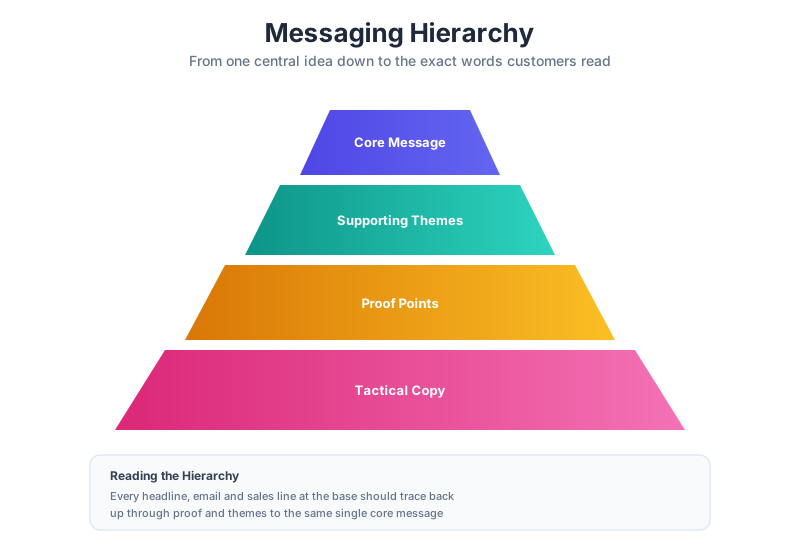
Messaging hierarchy organizes the core message, supporting themes, and specific proof points into a clear structure, so that every piece of content, regardless of length or format, can pull consistently from the same underlying architecture rather than being written from scratch each time.
| Hierarchy Level | Purpose | Example |
|---|---|---|
| Core Message | The single central idea | We help teams close deals faster |
| Supporting Themes | Three to four reinforcing pillars | Speed, reliability, ease of use |
| Proof Points | Specific evidence for each theme | Forty percent faster deal cycles |
| Tactical Copy | Actual words used in content | Headlines, email subject lines |
This layered structure allows individual pieces of tactical copy to vary in tone and wording, while still tracing back to the same consistent core message and supporting themes underneath. A headline written for a paid advertisement can sound quite different from a line used in a technical white paper, yet both can still reinforce the exact same underlying theme if the hierarchy has been built and applied thoughtfully.
Brand Promise
The brand promise, first introduced during positioning work, gets translated into more specific messaging language here, describing the experience customers should expect every time they interact with the company. This promise should show up consistently across every messaging touchpoint, from the tone of a support email to the language used in a product update announcement.
Translating an abstract brand promise into specific messaging guidance often requires writing down concrete examples of what honoring that promise actually looks like in practice, whether that means always acknowledging a customer complaint within a specific timeframe, or ensuring every piece of written communication avoids overly technical jargon that could confuse a non expert reader. These specific applications make an otherwise abstract brand promise far easier for individual writers to apply consistently in their own daily work.
Value Narrative
A value narrative strings together the core message, supporting themes, and proof points into a coherent story arc, typically moving from a customer's current struggle, through the shift the product enables, to the better outcome on the other side. This narrative structure makes messaging feel like a story worth paying attention to, rather than a disconnected list of claims stacked on top of each other.
Building a value narrative around a real, specific customer example, rather than a hypothetical or composite persona, often produces far more compelling messaging. Specific, real details, such as an actual number of hours saved or a genuine quote describing frustration before adopting the product, ground the narrative in something concrete and believable rather than a generic story that could apply to any product in the category.
Key Communication Themes
Key communication themes are the recurring ideas that show up across nearly every piece of messaging, reinforcing the same handful of concepts again and again until they become closely associated with the brand in the customer's mind. Repetition, done deliberately across many different pieces of content, is what actually builds strong brand association over time, far more than any single brilliant piece of copy ever could on its own.
Auditing existing content periodically to check whether these key themes are actually showing up consistently is a useful discipline, since content teams naturally drift over time as new writers join and new trends in language or format emerge. A quarterly review comparing a sample of recent content against the intended key themes often reveals gradual drift long before it becomes a significant, harder to correct problem.
Audience-Specific Messaging
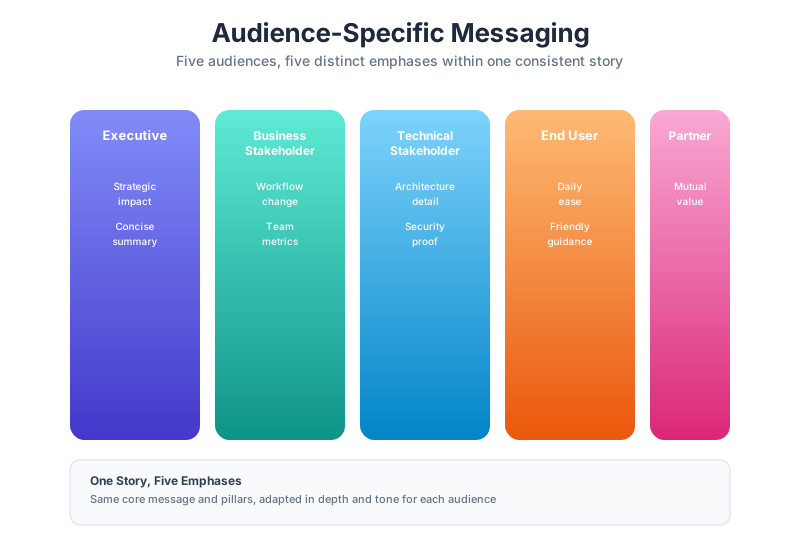
Different stakeholders within a buying organization need messaging tailored to what they specifically care about, even when they are all evaluating the exact same product.
Executive Messaging
Executive messaging should be concise and outcome focused, connecting the product directly to strategic business results such as revenue growth, cost reduction, or competitive advantage. Executives rarely have time to dig through detailed feature lists, so messaging aimed at this audience needs to lead immediately with the bottom line impact rather than building up to it slowly.
A useful test for executive messaging is imagining it needs to work inside a single elevator ride. If the core point cannot be communicated clearly within a few short sentences, it likely needs further simplification before it is genuinely ready for an executive audience, who will often skim rather than read closely regardless of how well crafted the surrounding detail might be.
Business Stakeholder Messaging
Business stakeholder messaging should focus on practical, day to day impact, such as how a solution changes team workflows, reduces operational friction, or improves specific departmental metrics. This audience typically wants enough detail to understand how the solution will actually change their working reality, without needing the full technical depth a more specialized reviewer would require.
This audience often serves as the internal champion discussed earlier in buyer persona work, meaning their messaging needs also serve a dual purpose: helping them personally understand the value, and equipping them with language they can credibly repeat to colleagues and leadership as they advocate for the purchase internally.
Technical Stakeholder Messaging
Technical stakeholder messaging should be precise and detail rich, addressing architecture, security, scalability, and integration capability directly rather than glossing over technical specifics with vague marketing language. This audience tends to be skeptical of overly polished claims and responds better to clear, specific, verifiable technical detail.
Involving actual engineers or technical writers in producing this messaging, rather than leaving it entirely to marketing generalists, tends to produce far more credible content. A technical audience can often tell within a few sentences whether the person writing genuinely understands the underlying technology, and that credibility gap is difficult to paper over with polished but imprecise language alone.
| Audience | Preferred Content Type | Key Message Focus |
|---|---|---|
| Executive | One page briefs, ROI summaries | Strategic business impact |
| Business Stakeholder | Case studies, workflow demos | Operational improvement |
| Technical Stakeholder | Documentation, architecture diagrams | Security, scalability, integration |
| End User | Product tours, quick start guides | Ease of use, daily value |
End-User Messaging
End user messaging should be friendly and action oriented, focusing on how the product makes daily tasks easier or more pleasant rather than abstract business value the end user may not personally experience directly. This audience often responds best to messaging that feels like a helpful guide rather than a formal sales pitch.
Because end users frequently encounter the product directly through onboarding flows, tooltips, and in app messaging rather than external marketing content, this audience segment often needs closer coordination between product, design, and marketing teams than other audiences do, ensuring the tone stays consistent across every touchpoint the end user actually experiences.
Partner Messaging
Partner messaging needs to address a slightly different question than customer facing messaging, focusing on how a partnership creates mutual value, such as revenue opportunity, differentiation for the partner's own offering, or simplified delivery for their existing customer base. Partner messaging should acknowledge the partner's own business goals directly, rather than simply restating customer facing value propositions verbatim.
Building dedicated partner messaging, distinct from the customer facing framework, prevents the common mistake of treating partners as just another customer segment. Partners are evaluating a business relationship on behalf of their own company, and messaging that fails to speak to their specific commercial incentives tends to underperform even when the underlying product value proposition is genuinely strong.
Value-Based Messaging
Beyond audience specific tailoring, messaging needs to consistently emphasize value over features, since value is what actually drives a purchase decision.
Business Outcomes
Business outcome messaging connects the product directly to measurable results a company cares about, such as increased revenue, reduced costs, or improved customer retention. Leading with outcomes, rather than the mechanics of how the product achieves them, keeps messaging focused on what actually matters to the buyer making the decision.
Customer Benefits
Customer benefit messaging translates product capability into a clear statement of what changes for the customer, framed in their own language rather than internal product terminology. A benefit statement should always answer the implicit question a customer is asking, which is simply what is in it for me.
Writing customer benefit statements from the customer's point of view, rather than the company's, often requires a genuine shift in perspective for teams closely involved in building the product. It helps to imagine an actual customer reading the statement and asking themselves whether it clearly describes something they personally want, rather than something the company is simply proud of having built.
Pain Point Resolution
Pain point resolution messaging speaks directly to the specific frustrations a customer experiences today, showing clearly how the product removes or reduces that pain. This messaging works best when it uses the same language customers themselves use to describe their frustration, rather than translating it into more polished internal terminology that loses the emotional recognition a customer feels when they hear their own words reflected back to them.
Pulling authentic pain point language directly from sales call transcripts, support tickets, and customer interviews, rather than generating it internally, tends to produce messaging that feels immediately recognizable to prospects experiencing the same frustration. This authenticity is difficult to fake convincingly through internal brainstorming alone, since real customer language often includes specific, colorful phrasing that an internal team would not naturally generate on its own.
ROI Messaging
ROI messaging quantifies value in financial terms a budget holder can use directly in their own internal business case, ideally backed by real customer data rather than optimistic internal projections. Strong ROI messaging includes enough detail about how a number was calculated that a skeptical buyer can trust it, rather than dismissing it as an inflated marketing claim.
Building a simple, transparent ROI calculation methodology, and making that methodology available to prospects rather than only presenting the final number, tends to build far more trust than a headline statistic presented without any supporting context. Sophisticated buyers, particularly those in finance roles, often want to understand the underlying assumptions before they will confidently repeat a vendor's ROI claim to their own leadership.
| Value Message Type | Focus | Best Suited Audience |
|---|---|---|
| Business Outcomes | Revenue, cost, retention impact | Executives, economic buyers |
| Customer Benefits | What changes for the customer | Business stakeholders, end users |
| Pain Point Resolution | Removing specific frustrations | All audiences |
| ROI Messaging | Quantified financial return | Economic buyers, finance |
Transformation Story
A transformation story frames the customer's journey from their current state, through adopting the product, to a clearly better future state, giving value based messaging an emotional arc rather than presenting value as a flat list of disconnected claims. This narrative approach helps prospects visualize their own success more vividly than a simple list of benefits ever could on its own.
Transformation stories work particularly well in case study and testimonial content, where a real customer's specific before and after experience gives the abstract narrative concrete, believable weight. Prospects considering a similar transformation for themselves often find it easier to imagine their own success after seeing a detailed example of someone in a similar situation who has already made the journey successfully.
Feature-to-Benefit Mapping
Every product capability should connect clearly to a specific customer benefit, since features on their own rarely persuade a buyer who does not immediately understand why that feature matters to them.
Core Capabilities
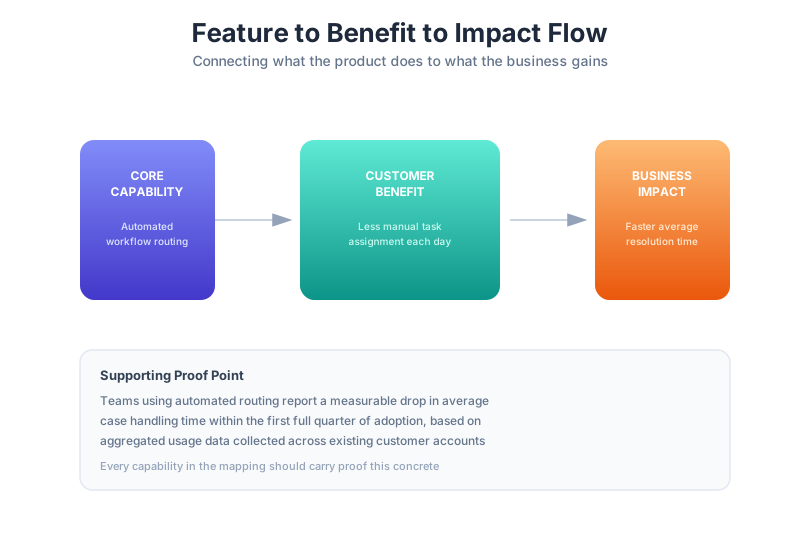
Core capabilities are the specific things a product actually does, described clearly and accurately without exaggeration. This is the foundational layer that every other part of feature to benefit mapping builds from, and it should be described precisely enough that sales and marketing teams share a consistent understanding of what the product genuinely offers today.
Customer Benefits
Customer benefits translate each core capability into a clear statement of value from the customer's point of view, answering directly what changes for them once they are using that specific capability. A capability without a clearly articulated benefit tends to get described in feature heavy language that fails to persuade a buyer who does not already understand the underlying problem it solves.
Building this mapping requires genuine discipline, since it is often tempting to describe a capability using internal, technical language that feels precise to the product team but means little to an outside buyer. Rewriting each capability description through the lens of a specific customer persona, asking what that particular person would actually care about, produces far stronger benefit statements than a generic, one size fits all description.
Business Impact
Business impact takes the customer benefit one level further, connecting it to a broader organizational result that matters to decision makers evaluating the purchase, such as revenue growth, cost savings, or improved customer satisfaction scores at a company wide level.
Connecting business impact back to the specific business outcome messaging covered earlier ensures consistency across the full messaging framework, rather than treating feature to benefit mapping as an isolated exercise disconnected from the broader value based messaging strategy already established. The business impact statements produced here should feel like natural extensions of the outcome messaging discussed previously, not a separate, unrelated set of claims.
| Core Capability | Customer Benefit | Business Impact |
|---|---|---|
| Automated Workflow Routing | Less manual task assignment | Faster average resolution time |
| Real Time Dashboard | Immediate visibility into performance | Faster, more informed decisions |
| Native Integration Library | No custom development required | Lower implementation cost |
| Role Based Permissions | Safer, more controlled access | Reduced compliance risk |
Outcome Mapping
Outcome mapping ties the full chain from capability through benefit through business impact back to a specific, ideally quantified outcome, giving sales and marketing teams a complete, defensible story to tell for every meaningful product capability rather than a disconnected list of features and vague benefit statements.
Supporting Proof Points
Supporting proof points back up each step of the feature to benefit mapping with real evidence, whether that is a customer quote, a usage statistic, or a third party benchmark. Proof points transform a theoretical claim into something a skeptical buyer can actually trust, particularly for benefits and business impact claims that would otherwise sound like unverified marketing language.
Maintaining a centralized, regularly updated repository of proof points, tagged by which capability and benefit they support, saves considerable time for content creators and sales reps who need to quickly find credible evidence to support a specific claim during a live conversation or while drafting new content under a tight deadline.
Differentiation Messaging
Messaging needs to clearly communicate why a customer should choose this product specifically, rather than any of the available alternatives, including doing nothing at all.
Unique Value Messaging
Unique value messaging highlights what genuinely sets a product apart, drawing directly from the differentiation work completed during positioning. This messaging should avoid vague superlatives that every competitor also claims, focusing instead on specific, defensible differences a prospect can actually verify for themselves.
Competitive Differentiation
Competitive differentiation messaging addresses how a product compares directly to the alternatives a prospect is likely considering, ideally in a way that feels informative and confident rather than defensive or dismissive of the competition. Prospects doing serious evaluation appreciate direct, honest comparison content far more than messaging that avoids the topic entirely.
Naming specific competitors directly, rather than only referring to unnamed alternatives, tends to work well for companies confident in their differentiation, since prospects are typically already aware of the main alternatives anyway and appreciate a vendor willing to address the comparison head on rather than dancing around it.
Why Choose Us
Why choose us messaging distills the full differentiation story into a short, clear answer a sales rep or piece of content can deliver quickly when a prospect asks the direct question. This messaging should feel confident and specific, rather than a long list of every possible advantage recited without prioritization.
Sales reps benefit enormously from having a consistent, well rehearsed answer to this exact question ready at all times, since it is one of the most common questions asked directly in a sales conversation. Leaving each rep to improvise their own answer individually tends to produce inconsistent messaging that undermines the carefully built differentiation story established elsewhere in the framework.
| Objection Type | Example Concern | Messaging Response Approach |
|---|---|---|
| Price | This costs more than the alternative | Reframe around total value and return |
| Risk | We are worried about switching | Highlight migration support and track record |
| Capability Gap | This is missing a feature we need | Clarify roadmap or workaround honestly |
| Trust | We have not heard of this company | Lead with proof points and customer evidence |
Objection Handling
Objection handling messaging prepares sales and marketing teams with clear, honest responses to the most common concerns prospects raise during evaluation. Handling objections directly and confidently, rather than avoiding them, tends to build more trust than pretending a legitimate concern does not exist.
Compiling this objection handling library from real, recorded sales conversations, rather than imagined hypothetical concerns, ensures the responses actually address what prospects genuinely raise in practice. Reviewing lost deal feedback regularly also surfaces new or evolving objections that the current messaging framework may not yet address, keeping the objection handling guidance current as market conditions and competitive dynamics continue to shift.
Trust and Credibility Statements
Trust and credibility statements reinforce a company's reliability and legitimacy, particularly important for newer companies or those competing against long established incumbents. These statements often draw on customer count, notable customer names, security certifications, or years of operation to give a skeptical prospect concrete reasons to feel confident moving forward.
Placing trust and credibility statements strategically throughout a buying journey, rather than only at the very end, helps reduce hesitation earlier in the process, before a prospect has invested significant time in an evaluation only to discover a trust concern late that could have been addressed much sooner with clearer messaging upfront.
Messaging by Customer Journey
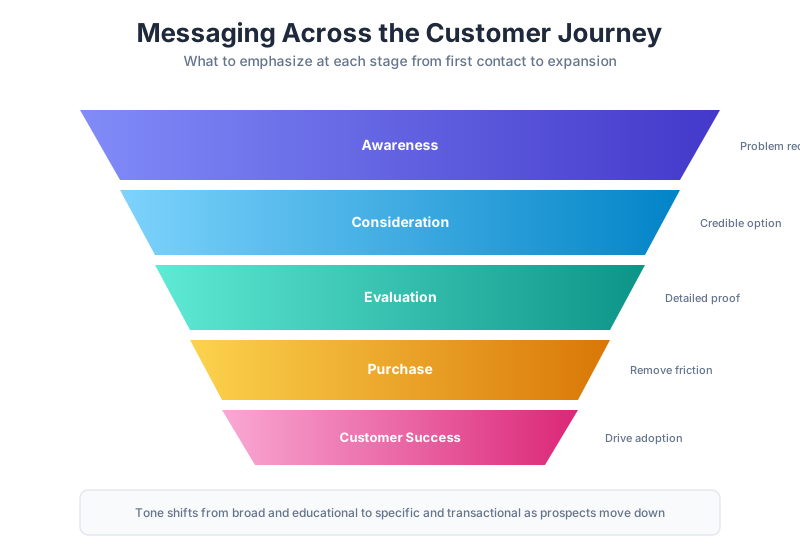
Messaging needs vary considerably depending on where a prospect sits in their journey from first hearing about a product to becoming a successful long term customer.
Awareness Messaging
Awareness messaging introduces a prospect to a problem or opportunity they may not have fully recognized yet, focusing on education and relevance rather than a hard sell. This messaging typically avoids heavy product specifics, instead building interest in the broader topic the product eventually addresses.
Consideration Messaging
Consideration messaging helps a prospect who already recognizes their problem understand the different approaches available to solve it, positioning the product as a credible option worth evaluating further. This stage often benefits from comparison content, buyer guides, and clearer articulation of what makes one approach different from another.
Prospects at this stage are often actively searching for information rather than passively encountering it, which means messaging needs to answer their specific research questions clearly and directly rather than relying purely on persuasive language. Content that genuinely helps a prospect think through their options, even when it does not exclusively favor the company producing it, tends to build more credibility at this stage than overtly promotional material.
Evaluation Messaging
Evaluation messaging supports a prospect actively comparing specific vendors, providing the detailed proof points, technical documentation, and competitive differentiation needed to move a deal toward a decision. This is where the more detailed feature to benefit mapping and objection handling messaging becomes most directly relevant.
Sales teams play a much larger role in delivering messaging at this stage compared to earlier funnel stages, which makes strong sales enablement content particularly important here. Ensuring reps have quick, easy access to the right proof points, comparison materials, and objection responses at exactly the moment they need them during a live conversation can noticeably improve win rates compared to reps relying purely on memory or improvisation.
| Journey Stage | Primary Goal | Example Content |
|---|---|---|
| Awareness | Build problem recognition | Educational blog posts, industry reports |
| Consideration | Establish credible option | Comparison guides, solution overviews |
| Evaluation | Support detailed comparison | Case studies, technical documentation |
| Purchase | Remove final friction | Pricing clarity, implementation guides |
| Customer Success | Drive adoption and expansion | Onboarding content, best practice guides |
Purchase Messaging
Purchase messaging removes remaining friction as a prospect moves toward a final decision, addressing practical concerns such as pricing clarity, contract terms, and implementation timelines. This stage benefits from directness and transparency, since a prospect this close to deciding does not want to dig for basic information that should already be easy to find.
Customer Success Messaging
Customer success messaging continues after the sale, focused on driving adoption, reinforcing the value the customer expected when they purchased, and identifying opportunities for expansion over time. Messaging at this stage should reinforce the original value proposition, helping customers see that the promise made during the sales process is actually being delivered on.
This stage of messaging is frequently underinvested compared to earlier funnel stages, despite playing a direct role in retention and expansion revenue. Treating post sale messaging with the same care and consistency applied to pre sale marketing content often reveals meaningful opportunities to improve customer satisfaction and reduce churn simply through clearer, more consistent communication during onboarding and ongoing use.
Messaging Consistency & Guidelines
Consistent messaging across every team and channel requires clear, shared guidelines that go beyond a single positioning document.
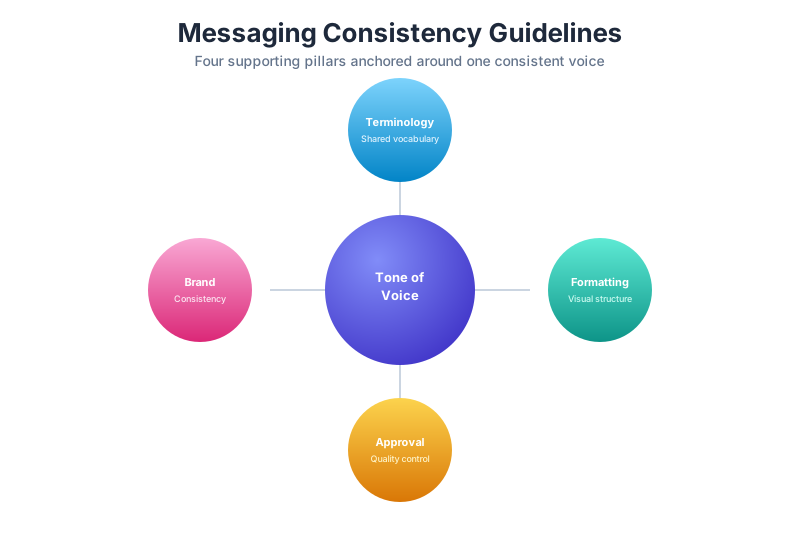
Tone of Voice
Tone of voice describes the personality that comes through in written and spoken messaging, whether that is warm and conversational, precise and technical, or bold and confident. Defining tone of voice explicitly, with examples of what fits and what does not, helps every contributor write in a way that feels recognizably consistent even when many different people are producing content.
Messaging Pillars
Messaging pillars restate the core themes established earlier in the framework, serving as an ongoing reference point that keeps new content aligned with the established strategic messaging rather than drifting toward whatever feels novel or interesting to an individual writer in the moment.
Reviewing new content against these pillars before publishing, even briefly, tends to catch drift early. A simple checklist asking whether a new piece of content clearly reinforces at least one established pillar can be applied quickly during editorial review, without requiring a lengthy or bureaucratic approval process that slows down content production.
Terminology
Terminology guidelines establish a consistent, shared vocabulary for describing the product, its features, and the problems it solves, preventing the confusion that arises when different teams use inconsistent language to describe the exact same thing. A shared glossary, referenced by every team producing customer facing content, prevents this kind of drift from accumulating over time.
Inconsistent terminology often creeps in gradually as a product grows and different teams, sometimes across different offices or even different countries, begin describing the same feature slightly differently without realizing it. Periodically auditing customer facing content and product interface copy against the established glossary helps catch and correct this kind of drift before it confuses customers who encounter inconsistent naming across different touchpoints.
| Guideline Area | Purpose | Example |
|---|---|---|
| Tone of Voice | Consistent personality across content | Warm but precise, never overly casual |
| Terminology | Shared vocabulary for product concepts | Always say workspace, never say portal |
| Formatting | Visual and structural consistency | Sentence case headlines, no exclamation marks |
| Approval Process | Quality control before publishing | Marketing review for all customer facing copy |
Communication Guidelines
Communication guidelines cover practical rules for how messaging should be applied across different formats and channels, such as appropriate length for different content types, how formally or informally to write depending on the channel, and how quickly messaging should be updated after a significant product change.
Brand Consistency Recommendations
Brand consistency recommendations identify specific steps to keep messaging aligned across every team producing customer facing content, whether that means centralizing messaging resources in one easily accessible location, running periodic training sessions, or establishing a lightweight review process for major new content pieces before they go live.
Larger organizations, where many different teams across regions or departments produce customer facing content independently, benefit particularly from a lightweight but consistent governance process. This does not need to be a heavy, slow moving approval bureaucracy, but even a simple shared checklist and a designated point of contact for messaging questions can meaningfully reduce inconsistency compared to leaving every team to interpret guidelines independently without any coordination.
Messaging Recommendations
All of the messaging work above should translate into a clear set of recommendations that guide ongoing refinement and application.
Messaging Improvements
Messaging improvement recommendations identify specific weak points in current messaging, whether that is overly vague language, inconsistent terminology across channels, or missing proof points that would strengthen a currently unsupported claim.
Content Priorities
Content priority recommendations identify which specific pieces of content most urgently need to be created or updated based on the messaging framework, whether that is a refreshed homepage, updated sales enablement materials, or a new comparison page addressing a competitor that has recently gained ground.
Ranking content priorities by expected business impact, rather than working through requests in the order they happen to arrive, ensures the most valuable messaging work gets attention first. A quick scoring exercise weighing audience size, funnel stage importance, and current content gaps helps make this prioritization more objective rather than driven purely by whoever asks loudest for a given piece of content.
Audience Optimization
Audience optimization recommendations identify where messaging for a specific audience segment needs sharpening, based on feedback from sales calls, conversion data, or direct customer research showing where current messaging is not landing as effectively as it should.
Communication Opportunities
Communication opportunity recommendations highlight new channels, formats, or moments where stronger messaging could make a meaningful difference, such as an underused customer touchpoint that currently lacks any deliberate messaging strategy at all.
These opportunities often hide in plain sight within routine, unglamorous touchpoints such as billing emails, error messages, or account renewal notices, moments that receive far less messaging attention than a flagship marketing campaign but that customers actually encounter frequently. Improving the consistency and quality of messaging in these overlooked moments can meaningfully shape overall brand perception over time.
Strategic Recommendations
Strategic recommendations connect messaging work back to broader business priorities, ensuring messaging investment aligns with where the company is placing its biggest go to market bets, rather than being spread evenly and thinly across every possible audience and channel regardless of strategic priority.
Tying each strategic recommendation to a specific, measurable goal, rather than a general aspiration to improve messaging overall, gives the team a clear way to evaluate whether the investment actually paid off once implemented. This discipline also makes it considerably easier to secure budget and cross functional support for messaging initiatives that might otherwise be deprioritized behind more immediately tangible projects.
Executive Messaging Summary
The executive summary condenses the full messaging framework into a format leadership can review quickly without needing to revisit every underlying section in detail.
Core Messaging Strategy
This section restates the overall messaging strategy and its primary objective clearly and concisely, giving leadership a quick reference point for what the messaging work is designed to accomplish across the business.
Primary Value Proposition
A condensed restatement of the primary value proposition anchors the summary, ensuring leadership and new team members have quick access to the single most important message the company wants every audience to understand.
Keeping this restatement genuinely short, rather than a lengthy explanation, respects the purpose of an executive summary, which is to give a busy reader the essential takeaway quickly rather than repeating the full depth of the earlier sections. Anyone wanting to understand the reasoning behind the value proposition in more detail can return to the fuller framework covered earlier in the document.
Key Messaging Pillars
The summary should list the small number of messaging pillars that matter most, giving a quick reference for the recurring themes that should show up consistently across every piece of customer facing content.
Audience Priorities
Audience priority guidance clarifies which specific audiences deserve the most focused messaging investment right now, based on where the business is placing its go to market emphasis, rather than trying to serve every possible audience with equal depth and attention.
This prioritization should be revisited alongside broader go to market planning cycles, since a shift in target segment or a new product launch aimed at a different buyer type often changes which audience deserves the most focused messaging attention going forward. Keeping this guidance current prevents messaging investment from continuing to focus on an audience that may no longer represent the company's top priority.
Executive Recommendations
The summary should close with a short, clear set of recommendations for leadership, whether that is approving investment in updated sales enablement materials, prioritizing a messaging refresh ahead of a major campaign, or committing resources to build out audience specific content that current messaging has not yet fully addressed.
These recommendations work best when they come with a rough sense of expected effort and impact, giving leadership enough context to weigh messaging investment against other competing priorities without needing to dig through the entire supporting framework first. A short table pairing each recommendation with its expected impact and relative effort often communicates this more efficiently than paragraphs of explanation.
Messaging, like positioning, is never truly finished. The strongest companies continue refining their messaging as they learn more about what resonates, testing new language against real conversion and conversation data, and retiring phrases that no longer reflect where the product or the market has moved. Treating messaging as a continuously improving asset, rather than a document written once and left untouched, keeps a company's voice sharp, credible, and genuinely aligned with how customers actually think and talk about their own problems.
Contents