
Distribution Channels: Choosing How Products Actually Reach Customers
A great product with the wrong distribution strategy still struggles to reach the customers who need it. Distribution strategy determines the actual paths a product travels from company to customer, whether that is a direct sales team, a network of resellers, a digital marketplace, or some blend of several routes working together. Getting this right shapes not just how many customers a company can reach, but how efficiently it can reach them, and how sustainable that reach remains as the business grows.
This guide covers the full scope of distribution strategy inside a go to market program, starting with overall objectives, moving through channel ecosystem assessment, partner strategy, economics, and governance, and finishing with recommendations and an executive summary leadership can act on.
Distribution decisions carry a particular kind of weight because they are often harder to reverse than other go to market choices. Building a direct sales team, signing an exclusive reseller agreement, or committing deeply to a specific marketplace all involve investments and relationships that take real time and effort to unwind if the choice later proves wrong. This makes the upfront analysis covered in this guide especially valuable, since a thoughtful, evidence based distribution strategy reduces the odds of building deep commitment to a path that does not actually serve the business well over time.
Distribution Strategy Overview
Before selecting specific channels, a team needs a clear, shared understanding of what distribution strategy is meant to accomplish.
Distribution Objectives
Distribution objectives clarify what the strategy needs to prioritize, whether that is maximizing market reach quickly, maintaining tight control over the customer experience, or achieving the most efficient possible cost of reaching new customers. Different objectives point toward meaningfully different channel choices, so being explicit about which objective matters most avoids a distribution strategy that tries to optimize for reach, control, and efficiency simultaneously without a clear sense of priority.
A company prioritizing rapid market reach might lean heavily into partner and marketplace channels that extend distribution quickly, while a company prioritizing tight control over customer experience might favor a direct sales model even if it grows more slowly as a result. Neither approach is universally correct, but each requires different supporting decisions throughout the rest of the strategy.
Writing these objectives down explicitly, and revisiting them whenever a new channel opportunity presents itself, keeps distribution decisions consistent over time rather than drifting toward whichever opportunity happens to look most appealing in the moment without regard for whether it actually serves the stated priority.
Route-to-Market Strategy
Route-to-market strategy defines the overall path a product takes to reach its end customer, whether that is selling directly, through indirect partners, through a digital marketplace, or some combination. This decision shapes nearly everything downstream, from pricing structure to sales team design to how customer relationships are ultimately owned and managed.
Choosing a route to market should draw heavily on how the target customer actually prefers to buy, rather than defaulting to whichever route the company finds most comfortable or familiar. A target segment accustomed to purchasing through established resellers, for instance, may resist a purely direct sales approach regardless of how compelling the product itself might be.
Channel Philosophy
Channel philosophy establishes the guiding principles behind distribution decisions, such as prioritizing channels that preserve direct customer relationships, favoring channels that can scale efficiently without proportional headcount growth, or maintaining a bias toward channels the company can control and measure closely.
Documenting this philosophy explicitly helps maintain consistency as new channel opportunities inevitably present themselves over time. Without a clear philosophy, a company can find itself accepting new channel partnerships opportunistically without a coherent sense of how each new relationship fits into the broader distribution strategy.
A well articulated channel philosophy also serves as a useful filter when an appealing but poorly fitting opportunity presents itself, such as a large marketplace offering rapid volume that would nonetheless require surrendering the kind of direct customer relationship the company has decided matters more to its long term strategy than short term reach.
| Distribution Principle | Description | Why It Matters |
|---|---|---|
| Customer Proximity | Preference for channels preserving direct relationships | Protects customer insight and retention control |
| Scalability | Preference for channels that scale without linear cost growth | Supports efficient long term growth |
| Measurability | Preference for channels with clear performance visibility | Enables data driven optimization |
| Market Fit | Channels should match how target customers actually buy | Reduces friction and improves conversion |
Distribution Success Criteria
Distribution success criteria define how channel performance will actually be measured, typically including revenue contribution by channel, cost of reaching customers through each channel, and how well each channel serves the specific customer segments it was designed to reach. Establishing these criteria upfront ensures channel decisions can be evaluated objectively against real performance rather than assumption or habit.
Setting these criteria before launching a new channel, rather than deciding after the fact what success should have looked like, keeps evaluation honest and prevents a natural tendency to retroactively justify continued investment in a channel simply because significant effort has already gone into it.
Channel Ecosystem Assessment
Before deciding where to invest, it helps to understand the current state of the broader channel ecosystem a company operates within.
Current Channel Landscape
Current channel landscape assessment maps every channel a company currently uses to reach customers, along with how much revenue and effort each one represents today. This baseline understanding is essential before making any changes, since it clarifies what already exists and works reasonably well versus what may need meaningful rethinking.
Building this baseline honestly, including channels that receive disproportionate effort relative to their actual contribution, often reveals opportunities to reallocate resources toward better performing paths that may have been previously under-resourced simply due to historical inertia rather than genuine underperformance.
Ecosystem Maturity
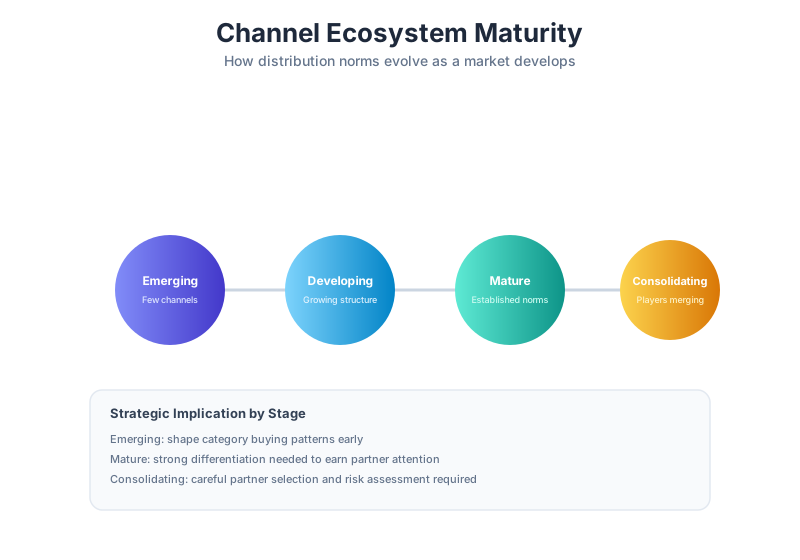
Ecosystem maturity considers how developed the broader channel ecosystem is within a given market or industry, including how many established partners, resellers, and marketplaces already exist and how sophisticated buyer expectations have become around how they prefer to purchase. A mature ecosystem with well established norms requires a different approach than an emerging one still being defined.
Recognizing where a specific market sits on this maturity spectrum helps calibrate expectations for how quickly a new channel investment might pay off. Emerging ecosystems often require more patience and direct investment in establishing channel norms, while mature ecosystems typically demand sharper differentiation to earn attention from already well served partners and resellers.
Regularly reassessing ecosystem maturity, rather than treating an initial assessment as permanently accurate, matters because ecosystems can mature considerably faster than expected, particularly in technology driven categories where new channel types such as marketplaces or embedded finance partnerships can reshape buying patterns within just a few years.
| Maturity Level | Characteristics | Strategic Implication |
|---|---|---|
| Emerging | Few established channels, evolving norms | Opportunity to shape category buying patterns |
| Developing | Some established players, growing structure | Room to differentiate through channel experience |
| Mature | Well established channels and norms | Requires strong differentiation to gain channel attention |
| Consolidating | Channel players merging or exiting | Requires careful partner selection and risk assessment |
Distribution Capabilities
Distribution capabilities assessment looks honestly at what the company can currently execute well, including existing sales infrastructure, partner management experience, and digital commerce capability. Recognizing genuine capability gaps early prevents a distribution strategy that assumes execution capacity the organization does not yet actually have.
Being candid about these gaps, even when uncomfortable, allows a company to sequence its distribution investment realistically, whether that means building internal capability before pursuing an ambitious channel expansion, or bringing in outside expertise to fill a specific, well defined gap.
Market Access Opportunities
Market access opportunities identify specific paths to reach currently underserved segments or geographies, often through channels not yet being used, such as a marketplace with strong presence in a target region or a partner type with established relationships in an underpenetrated segment.
Prioritizing these opportunities based on genuine strategic fit, rather than pursuing every available option, keeps distribution investment focused where it is most likely to succeed. A market access opportunity that looks promising on paper but conflicts with the company's broader positioning or capability may not be worth pursuing despite the apparent reach it offers.
Testing a promising market access opportunity on a smaller, contained scale before committing significant resources helps validate genuine demand and partner fit, reducing the risk of overcommitting to an expansion path that ultimately proves less receptive than the initial opportunity assessment suggested.
Strategic Channel Considerations
Strategic channel considerations weigh broader factors beyond immediate reach and revenue, such as how a given channel choice affects brand positioning, long term customer relationship ownership, and the company's ability to gather direct customer feedback that informs product development.
A channel that generates strong short term revenue but limits direct access to customer feedback can quietly starve product development of the insight it needs to keep improving. Weighing this longer term cost against the immediate revenue benefit helps produce a more balanced view of whether a given channel genuinely serves the company's long term interests.
Building in a deliberate mechanism to preserve at least some direct customer contact, even within a heavily indirect distribution model, such as periodic customer research conducted independently of the channel relationship, helps mitigate this risk without requiring the company to abandon an otherwise valuable channel entirely.
Distribution Channel Analysis
With the ecosystem understood, the next step is analyzing the specific types of channels available for reaching customers.
Direct Sales Channels
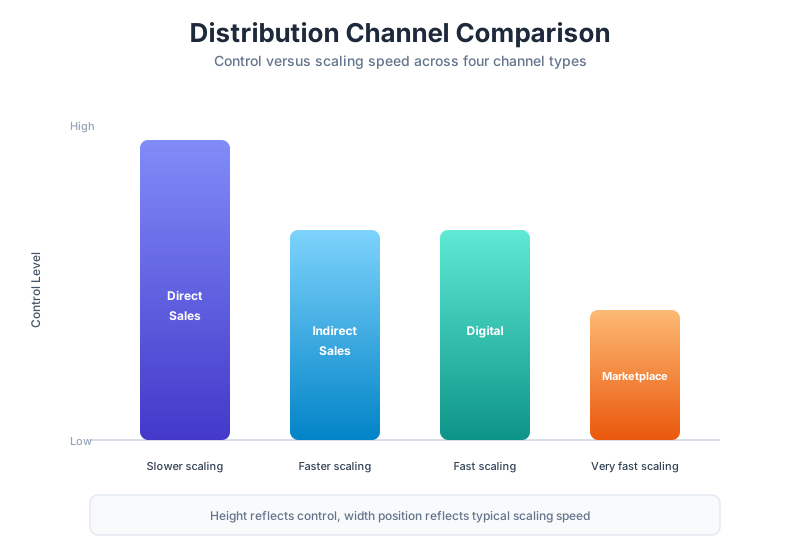
Direct sales channels involve a company's own sales team engaging customers directly, without an intermediary. This approach offers the most control over customer experience and messaging, but typically comes with higher cost to serve and slower geographic scaling compared to indirect alternatives.
Direct sales tends to work best for higher value, more complex deals where the buyer genuinely benefits from a dedicated, knowledgeable point of contact throughout a longer evaluation process, since the higher cost of this channel is more easily justified by a larger average deal size.
Companies that try to apply a direct sales model uniformly across every deal size, regardless of value, often find the economics simply do not work for smaller transactions, where the cost of a dedicated sales representative's time exceeds what the resulting revenue can reasonably support.
Indirect Sales Channels
Indirect sales channels rely on third parties, such as resellers or distributors, to sell on a company's behalf. This approach can extend reach considerably beyond what direct sales alone could achieve, particularly into geographies or segments where a company lacks its own established presence.
The tradeoff with indirect channels is reduced control, both over how the product gets represented to the customer and over the direct customer relationship itself. Companies relying heavily on indirect channels need strong partner enablement to ensure consistent messaging and customer experience despite this reduced direct control.
Regular audits of how partners actually represent the product to prospective customers, whether through mystery shopping, reviewing partner produced materials, or simply gathering direct customer feedback, help catch drift from intended positioning before it meaningfully damages brand perception in the market.
| Channel Type | Control Level | Scaling Speed | Typical Cost Structure |
|---|---|---|---|
| Direct Sales | High | Slower | Higher fixed cost, salaries and commission |
| Indirect Sales | Medium | Faster | Revenue share or margin based |
| Digital Channels | Medium to high | Fast | Lower marginal cost, platform fees |
| Marketplace | Low to medium | Very fast | Listing and transaction fees |
Digital Channels
Digital channels include a company's own e-commerce presence, self serve product experiences, and other online paths that allow customers to discover and purchase without direct human interaction. These channels typically offer the most efficient cost structure for smaller transactions, though they may not suit more complex, higher consideration purchases requiring guided support.
Investing in a genuinely smooth, frictionless digital purchase experience pays off considerably as this channel scales, since even small usability improvements can meaningfully improve conversion across a large volume of self serve transactions in a way that would be harder to achieve through incremental improvements to a human led sales process.
Partner Channels
Partner channels include resellers, systems integrators, and technology partners who incorporate a company's product into their own broader offering. These relationships can meaningfully extend market reach and credibility, particularly in segments where buyers prefer purchasing through a trusted existing vendor relationship rather than a new, unfamiliar company.
These relationships take time to mature into genuinely productive sources of revenue, and companies that expect immediate results from a newly signed partner often abandon promising relationships before they have had a fair chance to develop into meaningful contributors.
Marketplace Opportunities
Marketplace opportunities involve listing a product on established third party platforms where buyers already gather to discover and purchase solutions. Marketplaces can provide rapid access to a large existing buyer audience, though typically at the cost of reduced margin and less direct control over the customer relationship.
Marketplaces work particularly well as a complementary channel alongside a company's own direct efforts, rather than as a sole distribution strategy, since the reduced margin and limited customer relationship ownership make it a less attractive foundation to build an entire business around exclusively.
Hybrid Channel Options
Hybrid channel options combine multiple approaches, such as direct sales for larger enterprise accounts alongside a self serve digital channel for smaller customers, allowing a company to serve different customer segments through the channel best suited to their specific needs and expectations.
Designing a hybrid model thoughtfully requires clear rules for how customers get routed to the appropriate channel, avoiding confusion or internal conflict over which channel owns a given account, particularly as a self serve customer grows large enough to warrant a more dedicated direct relationship over time.
Building in clear graduation criteria, such as a specific usage or spend threshold that triggers a transition from self serve to a dedicated account relationship, helps make this handoff feel like a natural progression to the customer rather than an abrupt, confusing shift in how they are being served.
Channel Prioritization & Selection
With the available channel types understood, the next step is deciding which specific channels deserve the most focused investment.
Primary Distribution Channels
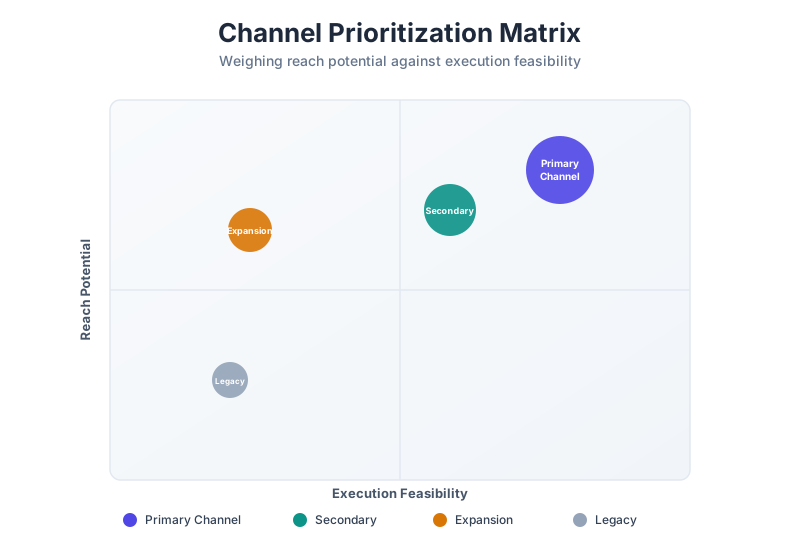
Primary distribution channels represent the core paths a company relies on most heavily to reach the majority of its customers and revenue. These channels typically receive the largest share of investment and management attention, since they carry the greatest weight in overall business performance.
Identifying primary channels clearly, and resisting the temptation to spread investment too thin across too many channels at once, helps a company build genuine depth and expertise in the paths that matter most, rather than a shallow presence across many channels that individually underperform.
Secondary Channels
Secondary channels supplement the primary channels, often reaching specific segments or geographies the primary channels do not serve as effectively. These channels typically receive more modest investment, sized appropriately to their contribution relative to the primary channels.
Reviewing secondary channels periodically helps identify whether any of them are actually quietly outperforming expectations and deserve promotion to primary status, or conversely, whether continued investment in an underperforming secondary channel is genuinely justified relative to its modest contribution.
| Channel Tier | Investment Level | Typical Role |
|---|---|---|
| Primary | Highest investment and focus | Core revenue driver |
| Secondary | Moderate, targeted investment | Fills specific segment or geography gaps |
| Expansion | Experimental, limited investment | Tests new markets or approaches |
| Legacy | Minimal, maintenance only | Winding down or low priority |
Expansion Channels
Expansion channels represent newer or untested paths a company is exploring to reach new segments or geographies, typically starting with a smaller, contained investment to validate potential before committing significant resources.
Setting clear, predefined criteria for what success looks like before testing an expansion channel prevents ambiguity later about whether the experiment justified further investment or should be discontinued in favor of a different approach.
Channel Prioritization Matrix
A channel prioritization matrix weighs each available channel against criteria such as reach potential, cost efficiency, strategic fit, and execution feasibility, producing a clear, structured ranking rather than a purely subjective sense of which channels seem most promising.
Using a consistent scoring approach across every channel under consideration, rather than evaluating each one in isolation with different criteria, makes the resulting prioritization far more defensible and easier to communicate clearly to stakeholders reviewing the recommended strategy.
Strategic Channel Fit
Strategic channel fit considers how well a given channel aligns with the company's broader positioning, target customer profile, and long term strategic direction, beyond the immediate reach and revenue potential a channel might offer in isolation.
A channel offering strong short term revenue potential but poor alignment with the company's premium positioning, for instance, might ultimately do more harm than good if it dilutes the brand perception the company has worked to build elsewhere in its go to market strategy.
Partner Ecosystem Strategy
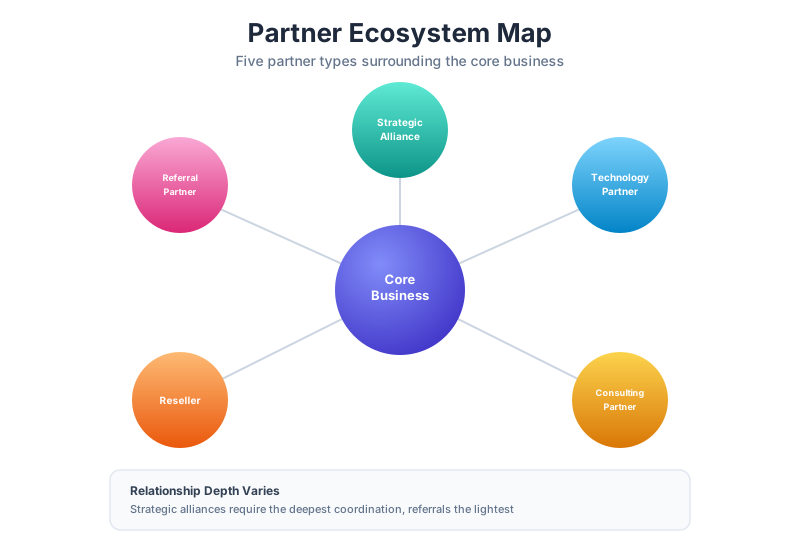
For many companies, partners play a central role in distribution strategy, requiring a deliberate approach to building and managing these relationships.
Strategic Alliances
Strategic alliances involve deeper, often more exclusive partnerships with companies that share significant mutual strategic interest, such as joint go to market initiatives or co-developed offerings. These relationships typically require more senior level investment and coordination than a standard reseller relationship.
Because strategic alliances demand significant ongoing investment, they should be reserved for a small number of genuinely high value relationships rather than extended broadly, since spreading this level of senior coordination too widely dilutes the attention any single alliance actually receives.
Technology Partners
Technology partners integrate with a company's product at a technical level, creating mutual value through combined functionality that benefits shared customers. Strong technology partnerships can meaningfully improve product stickiness and open referral pathways from the partner's own customer base.
Prioritizing technology partnerships with platforms already widely used by the target customer base tends to produce the strongest results, since the integration immediately becomes relevant to a meaningful share of both companies' existing and prospective customers rather than requiring separate demand generation to make the partnership valuable.
Co-marketing activity alongside a technology integration, such as joint webinars or shared case studies, often amplifies the value of the partnership considerably beyond the technical integration alone, helping both companies' customer bases discover the combined value more quickly than relying purely on organic discovery within the product itself.
| Partner Type | Primary Value Exchange | Relationship Depth |
|---|---|---|
| Strategic Alliance | Joint go to market and shared strategic goals | Deep, senior level coordination |
| Technology Partner | Combined product functionality | Moderate to deep technical integration |
| Consulting Partner | Implementation and advisory services | Moderate, project based |
| Reseller | Sales and distribution reach | Moderate, commercial focused |
| Referral Partner | Lead generation and introductions | Lighter touch, transactional |
Consulting & Implementation Partners
Consulting and implementation partners help customers successfully deploy and adopt a product, particularly valuable for more complex offerings requiring significant configuration or change management. These partners often become trusted advisors whose recommendations carry substantial weight with the customers they serve.
Investing in strong enablement and certification programs for these partners pays off considerably, since a well trained implementation partner both improves the customer experience and frees the vendor's own team from needing to handle every implementation directly, supporting more efficient scaling.
Reseller Ecosystem
Reseller ecosystem strategy addresses how a company recruits, enables, and manages a network of resellers who sell the product on the company's behalf, typically earning a margin or commission in exchange for their sales effort and existing customer relationships.
Building a scalable reseller program requires clear, repeatable onboarding and enablement processes, since a reseller network that depends on ad hoc, one off support from the vendor's own team will struggle to grow beyond a handful of relationships before management overhead becomes unsustainable.
Investing in a self serve partner portal, complete with training materials, deal registration, and marketing resources available on demand, allows a reseller program to scale to a much larger number of active partners than a model dependent entirely on direct, individualized support from a small internal partner team.
Referral Partners
Referral partners introduce prospective customers without necessarily handling the full sales process themselves, typically earning a referral fee for qualified introductions that convert into customers. This lighter touch partnership model can extend reach with relatively modest ongoing management overhead.
Making the referral process itself genuinely simple for the partner, such as a straightforward way to submit an introduction and clear visibility into how that referral progresses, tends to sustain higher ongoing engagement than a cumbersome process that discourages partners from bothering after their first referral.
Channel Partner Opportunities
Channel partner opportunities identify specific types of partners or individual companies worth pursuing based on their existing relationships with priority target segments, their complementary positioning, and their track record of successfully partnering with similar companies in the past.
Prioritizing outreach toward partners already serving the company's ideal customer profile, rather than pursuing partners with only a loose or tangential connection to the target market, tends to produce partnerships that become productive more quickly and with less enablement effort required to establish genuine relevance.
Channel Economics & Commercial Model
Beyond strategic fit, distribution decisions need to account for the underlying economics that determine whether a given channel actually supports a healthy business.
Revenue Model
Revenue model considerations examine how revenue actually flows through each channel, whether that is direct revenue recognition, a revenue share arrangement with a partner, or a marketplace transaction fee structure. Understanding these mechanics clearly is essential before committing to a specific channel investment.
Modeling the full revenue flow through a proposed channel before committing to it, including any fees, revenue share, or discount structures involved, often reveals that a channel offering strong top line volume delivers considerably less net value than a smaller but higher margin alternative.
Channel Incentives
Channel incentives determine what motivates a partner or channel to prioritize selling a specific product, whether that is margin, exclusivity, co-marketing support, or other forms of enablement. Well designed incentives align a partner's own business interests closely with the outcomes a company wants to achieve.
Incentive structures that reward the specific behaviors a company actually wants, such as growth in net new customers rather than simply overall transaction volume, tend to produce more targeted results than a generic incentive that does not distinguish between the types of outcomes that matter most strategically.
| Incentive Type | Description | Best Suited For |
|---|---|---|
| Margin or Discount | Financial reward built into pricing | Resellers, distributors |
| Co-Marketing Support | Shared marketing investment and resources | Strategic alliances, technology partners |
| Exclusivity | Protected territory or segment rights | High performing, committed partners |
| Referral Fee | Payment for qualified introductions | Referral partners, lighter touch relationships |
Margin Considerations
Margin considerations address how much of the overall price gets allocated to a channel partner versus retained by the company, requiring careful balance between offering a partner enough incentive to prioritize the product and protecting the company's own profitability.
Benchmarking margin structures against what similar partners receive from comparable vendors helps ensure a company remains competitive enough to earn genuine partner attention, without unnecessarily giving away more margin than the market actually requires to secure a productive relationship.
Partner Profitability
Partner profitability analysis considers the arrangement from the partner's own point of view, evaluating whether the economics genuinely work well enough to motivate sustained partner investment and attention, rather than assuming a partner will remain engaged purely out of goodwill.
Asking partners directly about their own economics, rather than assuming a standard margin structure works universally well, often reveals meaningful differences in what motivates different types of partners, particularly between smaller partners who need faster payback and larger, more established partners who can afford a longer term view.
Commercial Structure
Commercial structure defines the specific contractual and pricing terms governing a channel relationship, including margin or commission rates, payment timing, and any minimum performance commitments expected from either party.
Standardizing commercial structure templates across similar partner types, rather than negotiating every term individually from scratch, speeds up partner onboarding considerably and ensures a baseline level of fairness and consistency across the broader partner ecosystem.
Scalability Assessment
Scalability assessment considers whether a given channel economic model can support significant growth without requiring proportional increases in management overhead or eroding margin below sustainable levels as volume increases.
Modeling channel economics at a meaningfully larger scale than current volume, rather than only evaluating the model at today's size, often reveals structural issues that are not yet visible but would become genuinely problematic once a channel scales considerably beyond its current contribution.
Channel Performance & Governance
Ongoing management of distribution channels requires clear performance measurement and governance structure.
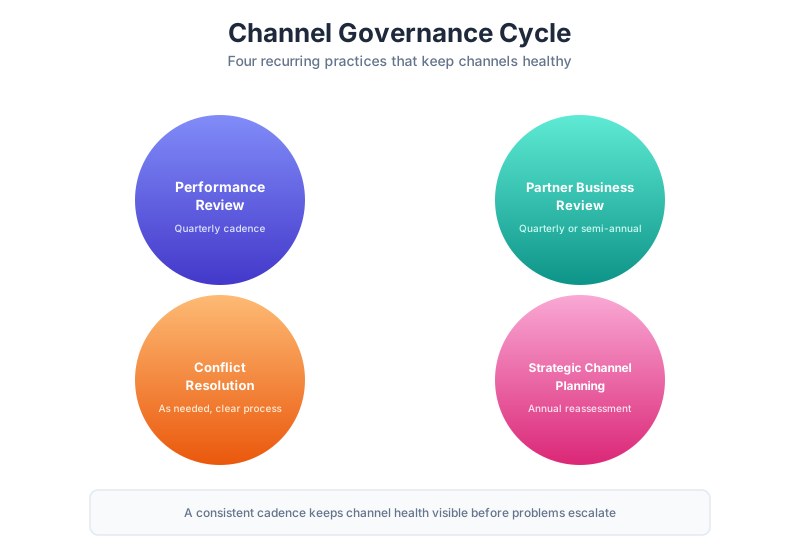
Channel KPIs
Channel key performance indicators define the specific metrics used to evaluate how well each channel is performing, typically including revenue contribution, growth rate, customer satisfaction, and cost efficiency relative to other channels.
Standardizing these KPIs across every channel, rather than tracking different metrics for each one, makes cross channel comparison far more meaningful and helps leadership quickly identify which channels genuinely deserve additional investment relative to others.
Performance Measurement
Performance measurement establishes the systems and cadence for tracking channel KPIs consistently over time, ensuring channel performance conversations are grounded in reliable, up to date data rather than anecdotal impressions.
Investing in proper reporting infrastructure early, even a relatively simple shared dashboard, prevents the common problem of channel performance data living in scattered spreadsheets that different stakeholders interpret inconsistently, undermining confident, aligned decision making across the organization.
| Governance Element | Purpose | Typical Cadence |
|---|---|---|
| Performance Review | Assess channel KPIs against targets | Quarterly |
| Partner Business Review | Align on goals and address issues | Quarterly or semi-annually |
| Channel Conflict Resolution | Address overlapping territory or account issues | As needed, with clear process |
| Strategic Channel Planning | Reassess overall channel mix and priorities | Annually |
Governance Model
Governance model establishes clear rules and processes for how channel relationships are managed, including who owns specific partner relationships internally, how conflicts get resolved, and what escalation paths exist when issues arise between channels or partners.
A clearly documented governance model, shared openly with partners themselves rather than kept purely internal, helps set consistent expectations from the outset and reduces the likelihood of disputes escalating unnecessarily due to ambiguity about how a given situation should be handled.
Designating a single, clearly accountable internal owner for the overall channel governance framework, rather than leaving it as a shared but loosely owned responsibility, ensures the framework actually gets maintained and enforced consistently rather than quietly eroding as individual account teams make exceptions under pressure.
Channel Health Metrics
Channel health metrics go beyond pure revenue performance to capture the underlying strength of a channel relationship, such as partner engagement levels, enablement completion rates, and satisfaction scores that often predict future performance before it shows up in revenue numbers.
Tracking these leading indicators allows a company to intervene proactively with a struggling partner relationship well before declining engagement translates into a visible drop in revenue contribution, giving more time to address the underlying issue before it becomes a larger problem.
Optimization Framework
An optimization framework establishes a consistent, repeatable process for identifying and acting on opportunities to improve channel performance, whether that means adjusting incentive structures, providing additional enablement, or reallocating investment toward better performing channels.
Reviewing this framework on a regular cadence, rather than only reacting when a specific channel problem becomes obvious, keeps channel optimization a proactive, ongoing discipline rather than a reactive scramble triggered only by underperformance.
Distribution Risks & Opportunities
Distribution strategy carries specific risks worth managing deliberately, alongside genuine opportunities worth pursuing.
Channel Conflicts
Channel conflicts arise when multiple channels compete for the same customer or account, creating confusion, price undercutting, or damaged partner relationships if not managed proactively. Clear rules of engagement, established before conflicts arise, help prevent these situations from damaging important relationships.
Establishing these rules explicitly, covering scenarios such as which channel owns an account when both direct sales and a partner have engaged the same prospect, prevents ambiguity from turning into a damaging dispute after the fact, when incentives on both sides make a fair resolution much harder to reach.
Dependency Risks
Dependency risks emerge when a company relies too heavily on a single channel or partner for a disproportionate share of revenue, creating vulnerability if that channel underperforms, changes terms unfavorably, or the relationship deteriorates for any reason.
Setting an internal threshold for acceptable channel concentration, and monitoring against it consistently, helps a company notice and address growing over-dependency before it becomes a genuinely dangerous vulnerability rather than discovering the risk only after a key channel or partner relationship has already faltered.
| Risk or Opportunity | Description | Recommended Response |
|---|---|---|
| Channel Conflict | Multiple channels competing for same account | Clear territory and account rules |
| Over-Dependency | Too much revenue from one channel | Diversify channel mix deliberately |
| Ecosystem Gap | Underserved segment with no clear channel | Pursue targeted new partnership |
| Platform Risk | Marketplace changes terms unfavorably | Maintain owned channel alongside marketplace |
Market Expansion Opportunities
Market expansion opportunities identify new geographies or segments a company could reach through channel partnerships rather than requiring the company to build out its own direct presence, often a faster and lower risk path into a new market.
Partnering with an established local player already serving a target geography frequently proves faster and less risky than building out an entirely new direct presence from scratch, since the partner already brings local market knowledge, relationships, and credibility that would otherwise take years to develop independently.
Ecosystem Gaps
Ecosystem gaps identify segments or use cases the current channel mix does not serve well, representing an opportunity to pursue a new channel type or partnership specifically designed to address that gap.
Mapping the full customer journey against the current channel mix often reveals these gaps clearly, such as a segment that is well served during initial evaluation but poorly supported during implementation, pointing toward a specific type of implementation partner worth recruiting to close that gap.
Future Channel Trends
Future channel trends consider how distribution patterns might evolve, such as growing buyer preference for self serve digital channels, or an increasing role for marketplaces in categories that previously relied heavily on direct sales.
Monitoring how adjacent, more mature categories have evolved their own distribution patterns often provides a useful early signal of where a newer category is likely headed, since many industries follow broadly similar patterns as buyer behavior and channel maturity develop over time.
Distribution Strategy Recommendations
All of the analysis above should translate into clear, actionable recommendations for how the business should invest in distribution going forward.
Priority Channel Investments
Priority channel investment recommendations identify which specific channels deserve the most focused investment based on the prioritization and economics analysis completed earlier, rather than spreading resources evenly across every available option.
Connecting each recommendation clearly back to the specific evidence supporting it makes the case considerably more persuasive to leadership and finance stakeholders who will ultimately need to approve the associated budget and resourcing.
Partner Ecosystem Recommendations
Partner ecosystem recommendations identify specific partner types or individual companies worth pursuing, along with the enablement and relationship investment required to make those partnerships genuinely productive.
Sequencing these recommendations realistically, rather than attempting to pursue every promising partnership simultaneously, respects the genuine capacity constraints of building and managing new relationships well, since a handful of deeply invested partnerships tend to outperform many shallow ones spread too thin.
Channel Optimization Opportunities
Channel optimization opportunities identify specific improvements to existing channels, such as refined incentive structures or additional enablement, that could improve performance without requiring an entirely new channel investment.
These optimization opportunities often represent a faster, lower risk path to improved performance than pursuing an entirely new channel, since they build on relationships and infrastructure the company has already established rather than starting from scratch.
Market Expansion Priorities
Market expansion priorities identify which new geographies or segments deserve the next wave of distribution investment, connecting directly back to the broader market research and segmentation work established earlier in the go to market strategy.
Sequencing expansion priorities based on genuine readiness, rather than pursuing every attractive market simultaneously, helps ensure each expansion effort receives the focused attention needed to actually succeed rather than being one of several simultaneous initiatives competing for the same limited resources.
Strategic Roadmap
A strategic distribution roadmap lays out how channel investment should evolve over a multi year horizon, sequencing near term priorities against longer term structural shifts in how the business reaches its customers.
Revisiting this roadmap at least annually, alongside broader strategic planning cycles, keeps distribution strategy aligned with how the business, its customers, and the broader competitive landscape continue to change over time, rather than becoming an artifact written once and rarely revisited.
Executive Distribution Summary
The executive summary condenses the full distribution strategy into a format leadership can review quickly without needing to revisit every underlying section in detail.
Recommended Distribution Model
This section clearly restates the overall recommended distribution approach and the core reasoning behind it, giving leadership a quick, confident reference point for the direction being proposed.
Priority Channels
A concise restatement of the priority channels gives leadership and new team members quick access to where the business intends to focus its distribution investment going forward.
Keeping this restatement genuinely short, covering only the two or three highest priority channels rather than every option discussed in the full analysis, respects the purpose of an executive summary as a fast reference point rather than a complete restatement of the underlying strategy.
Key Partner Strategy
Key partner strategy summary highlights the most important partnership priorities, giving leadership a clear sense of which relationships deserve the most attention and investment in the near term.
Naming specific partner relationships or partner types explicitly, rather than referring only to a general partnership strategy, gives leadership something concrete to track progress against in future reviews of the overall distribution strategy.
Distribution Risks
Distribution risk summary highlights the most significant channel related risks identified during the analysis, paired with a brief note on the recommended mitigation approach already in motion to address them.
Presenting risks alongside their mitigation plan, rather than listing them without a clear response, gives leadership confidence that identified vulnerabilities are being actively managed rather than simply noted and left unaddressed.
Executive Recommendations
The summary should close with a short, clear set of recommendations for leadership, whether that is approving investment in a specific channel, prioritizing a particular partnership, or committing to the broader strategic roadmap outlined earlier in the strategy.
Pairing each recommendation with a rough sense of expected impact and required investment helps leadership weigh distribution priorities fairly against other competing business needs, rather than evaluating each request in isolation without a clear sense of relative importance.
Distribution strategy, like every other part of go to market planning, benefits from ongoing attention rather than a single decision made once and left unchanged. The strongest companies revisit their channel mix regularly, testing new paths to market, strengthening key partnerships, and adjusting investment as customer buying preferences and the broader competitive landscape continue to evolve over time. Treating distribution as a continuously managed discipline, rather than a structure set once at launch, keeps a business genuinely positioned to reach its customers wherever and however they actually prefer to buy.
Contents