
Demandbase vs Elevate: Which Platform Is Right for Your Business?
Demandbase markets itself as the operating system for enterprise account based marketing, and the pitch is broad by design: account identification, intent data, programmatic advertising through its own demand side platform, website personalization, sales intelligence, and more recently a set of AI agents called Agentbase, all bundled under one product called Demandbase One. Elevate GTM Solutions is a much narrower, much newer platform: an AI native system built to generate go to market strategy rather than identify, advertise to, or personalize experiences for accounts that are already in motion.
The overlap between the two is real but narrower than it first appears. Demandbase identifies which accounts match your criteria and are showing buying intent, then coordinates advertising and personalization around them, scaling ad intensity up as an account's intent score rises and back down once it converts. Elevate defines the criteria in the first place: who your ICP actually is, what your positioning says, and what message should run across whatever channel eventually reaches that account, whether that channel is a Demandbase ad, a sales call, or an email sequence. One platform acts on a target that already exists. The other decides what that target should be.
This guide breaks down what each platform actually does, where a genuine comparison holds up, where it does not, and how a revenue team running both would typically divide the work between them.
Demandbase vs Elevate at a Glance
| Demandbase | Elevate GTM Solutions | |
|---|---|---|
| Category | Enterprise ABM platform with native advertising | AI native GTM strategy platform |
| Solves for | Identifying, advertising to, and personalizing experiences for target accounts | Defining who to target and what to say to them |
| Sits in the stack | Signal, advertising, and orchestration layer | Strategy layer |
| Built around | Account intelligence, intent data, a native B2B demand side platform | A structured, multi module GTM methodology |
| Ideal owner | Marketing operations, ABM program managers, demand generation leaders | Marketing leader, founder, or GTM advisor |
| Starting price | No free tier, custom quotes typically starting around $18,000 to $24,000 per year | $499 per month |
| Output | Identified accounts, targeted ad campaigns, personalized web experiences | ICP, positioning, messaging, launch and channel plans |
| Not designed to do | Generate original positioning or an ICP from first principles | Run programmatic advertising or personalize a website |
The one line version: if your biggest challenge is strategy, defining who your ICP should be and what to say to them, choose Elevate. If your biggest challenge is identifying already defined target accounts and advertising to them in a coordinated, account aware way, choose Demandbase. Most serious enterprise ABM programs eventually need answers to both questions, usually in that order.
Executive Summary
If you only have three minutes, here is the short version.
Demandbase is built for teams that already have a reasonably well defined universe of target accounts and need to identify which of those accounts are actively in market, then reach them with coordinated advertising, personalized web experiences, and sales intelligence, all tied together so that ad spend automatically scales with an account's buying signal. Its strength is breadth within the advertising and orchestration layer: a native B2B demand side platform that most ABM competitors have to integrate with a third party to replicate, website personalization tied to account identity, and Agentbase AI agents layered on top since their 2025 launch. Demandbase's weakness is the same as every platform in its category: it assumes the target account list and the message running through those ads and personalized experiences already exist. It identifies and reaches accounts. It does not generate your ICP or write your positioning from scratch.
Elevate GTM Solutions is built for teams that need that upstream definition established or kept current in the first place. It takes market context, product details, and competitive information as input, and produces structured outputs: ideal customer profiles, positioning frameworks, messaging architecture, channel strategy, and launch plans. Elevate's strength is turning fragmented go to market thinking into a single operating system that marketing, sales, and product can align around before a single Demandbase campaign gets configured. Its weakness is that it does not run programmatic advertising, personalize a webpage, or identify anonymous website visitors. It is not a replacement for an ABM advertising and orchestration platform.
The practical framing that most teams land on: Elevate answers "who is our ICP and what do we say to them," Demandbase answers "which of those specific accounts are in market right now, and how do we reach them with coordinated, account aware advertising and personalization while that window is open." A company with no validated ICP has a strategic gap that no amount of ad targeting sophistication fixes, because Demandbase's advertising engine will run precisely coordinated campaigns against the wrong accounts with real confidence. A company with a sharp ICP and no way to identify or advertise to accounts showing real buying intent has an operational gap that is exactly what Demandbase is built to close.
The rest of this guide unpacks the details behind that summary: feature by feature, philosophy by philosophy, and scenario by scenario, so you can make the call for your own team with full context rather than a marketing headline.
Key takeaway: Demandbase answers an identification and advertising question, who should we reach and how, and Elevate answers a strategy question, who should we be targeting and why. Feeding Demandbase a poorly defined or unvalidated ICP produces beautifully coordinated advertising against the wrong accounts, which is a more expensive failure mode than under investing in advertising at all.
What Is Demandbase?
Demandbase is an enterprise account based marketing platform built around a single unified product called Demandbase One, which the company positions as the operating system for coordinated ABM motions across sales and marketing. The platform grew substantially through acquisition, most notably absorbing Engagio in 2020 to combine advertising focused ABM with engagement focused ABM into one suite, along with InsideView and DemandMatrix for account and contact intelligence, and has continued to raise significant outside financing to fund that consolidation.
Demandbase One bundles several capabilities that competitors often require separate vendors or integrations to replicate:
- Account identification and intent data: identifying which companies are visiting your website anonymously and which accounts across the broader web are showing intent signals around your product category, based on firmographic, technographic, and behavioral data.
- Account based advertising through a native B2B demand side platform: Demandbase is the only major ABM platform that owns its own DSP rather than integrating with a third party ad tech stack, supporting account targeted display, LinkedIn advertising, and connected TV campaigns directly inside the platform.
- Website personalization: dynamically changing website content, messaging, and calls to action based on which account is visiting, without the visitor ever filling out a form.
- Sales intelligence: contact and account data, buying group intelligence that maps the individuals likely involved in a purchase decision, and alerts tied to account engagement.
- Agentbase: a set of AI agents launched in March 2025, layered across the platform to automate parts of campaign management, account research, and orchestration that previously required manual configuration.
The feature most worth understanding in detail is the coordination between intent scoring and advertising spend, since it is the clearest differentiator against a pure intent data provider. When an account's engagement and intent signals rise, indicating it has moved further into an active buying stage, Demandbase can automatically increase advertising intensity toward that account and its buying group. When the account converts to a sales conversation or shows signs of disengaging, spend can scale back down. The pitch is that this removes a layer of manual campaign management that would otherwise require a marketing operations team to monitor scores and adjust budgets account by account.
Pricing is not published and requires a custom quote for every deployment. Demandbase uses a platform fee plus a per user fee structure, with third party pricing data suggesting a base package starting around 18,000 to 24,000 dollars annually for smaller teams, with most mid market deployments landing between roughly 43,000 and 65,000 dollars per year. Enterprise deployments that include the full advertising suite, personalization, and Agentbase agents have been reported starting around 200,000 dollars annually and climbing beyond 300,000 dollars at scale. On top of the platform fee, a one time onboarding and professional services charge of roughly 29,000 dollars is typical for new customers, covering data connections, CRM integration, and initial training, and is generally treated as non negotiable. Additional user seats beyond the base license commonly run between 1,200 and 3,000 dollars per year each, and individual add on modules carry their own separate pricing: visitor deanonymization has been reported around 60,000 dollars annually, personalization between 30,000 and 60,000 dollars, and the advertising module starting around 60,000 dollars plus whatever media budget a team commits on top of the platform fee itself.
Who actually uses Demandbase day to day tends to mirror the operational demands of the category broadly: marketing operations and ABM program managers who configure account lists, intent thresholds, and advertising campaigns, plus demand generation leaders coordinating the resulting programs with sales. Because the platform requires ongoing campaign management, data hygiene, and quarterly optimization cycles to extract real value, most reviewers and buyers describe dedicated marketing operations headcount as close to a prerequisite rather than a nice to have, with estimated fully loaded staffing costs for that role commonly cited in the 80,000 to 120,000 dollar annual range on top of the platform license itself.
A Quick Example
Picture an enterprise data infrastructure company with a defined list of twelve hundred target accounts matching its ICP: large financial services and insurance organizations with specific compliance and data residency requirements. The company runs that account list through Demandbase, which identifies which of those accounts are visiting its website anonymously, tracks broader intent signals across the category, and personalizes the website experience for identified accounts with messaging tailored to their industry. When a previously quiet account's intent score rises sharply, driven by several employees researching the company's product category across multiple sites, Demandbase automatically increases display and LinkedIn advertising intensity toward that account's buying group while surfacing the account to the assigned sales team with buying group intelligence showing who is likely involved in the decision.
Notice what that example assumes already exists: a defined list of twelve hundred target accounts, a specific ICP built around company size, industry, and compliance profile, and messaging ready to personalize into ads and website content once intent is detected. Demandbase did not generate that account list, that ICP, or that messaging. It identified and reached accounts within a universe someone else had already defined, then coordinated advertising spend once a signal appeared.
What Is Elevate?
Elevate GTM Solutions describes itself as an AI native GTM operating system, and the framing is deliberate. Rather than positioning itself as an account identification and advertising platform, Elevate is structured around the idea that go to market strategy, positioning, messaging, channel selection, and execution planning, should live in one connected system instead of scattered across slide decks, static planning documents, and institutional memory that walks out the door when someone leaves.
The platform is organized around what it calls a fourteen module GTM methodology, spanning the full lifecycle from market research through customer advocacy. Practically, a user starts by entering business context: the product, the target market, industry, and segment. Elevate then generates structured outputs across the methodology rather than a single document. Reported categories include:
- GTM Context and Intelligence: market research, competitive intelligence, and ICP or segmentation modeling, meant to replace ad hoc research spread across browser tabs and analyst reports.
- GTM Strategy: product positioning, messaging architecture, and pricing strategy, structured so that every function is working from the same underlying narrative rather than function specific interpretations of it.
- GTM Activation and Execution: customer acquisition planning, distribution and channel strategy, marketing alignment, launch sequencing, and sales enablement material generated from the same strategic inputs.
- GTM Analytics: dashboards intended to track execution against the plan and flag where reality is drifting from the original strategic assumptions.
The philosophical anchor of the product is adaptability rather than a one time deliverable. Elevate frames traditional GTM planning as a static exercise: a strategy gets built once, usually during annual planning, gets turned into a deck, and then sits mostly untouched until the market has already moved past its assumptions. Elevate's pitch is that when market conditions, competitive dynamics, or buyer behavior shift, a user can update the underlying inputs and regenerate the affected parts of the strategy without starting the entire planning process over, keeping strategy and execution connected on an ongoing basis rather than treating them as sequential, disconnected phases.
Elevate also ships what it calls advanced intelligence modules on its top tier plan, abbreviated internally as EVUSP: buyer emotion and intent modeling, a GTM clarity and differentiation scoring system, and a defensible positioning and narrative framework. These sit above the core strategy generation layer and are aimed at teams trying to sharpen competitive differentiation rather than simply document it. Worth noting explicitly here, since the terminology overlaps with Demandbase's own category: Elevate's buyer emotion and intent modeling is a strategic exercise, reasoning about how a defined buyer persona is likely to feel and respond to different messaging, not a behavioral signal detection or website deanonymization system tracking real accounts across the web. It answers a different question than Demandbase's intent data, even though both use the word intent.
Elevate also runs a smaller advisory arm, pairing the software with fractional GTM advisors who use the platform as the operating system for client engagements, which suggests the company is positioning itself as much toward consultative go to market work as toward a pure self serve SaaS motion.
What actually differentiates the architecture. Elevate is a much newer, more focused entrant next to an established, heavily consolidated ABM platform like Demandbase, so the fair way to evaluate it is on how the product is built rather than on the breadth of acquired capability or advertising infrastructure it has not tried to build. Five architectural choices stand out:
- AI native from the ground up. Elevate was not assembled through acquiring separate advertising, intelligence, and personalization products and unifying them under one brand over several years. The generation logic sits at the core of the product from day one, which is why outputs update dynamically when inputs change rather than requiring a manual rewrite across disconnected modules.
- A unified GTM lifecycle in one system. Market research, positioning, channel strategy, and execution planning live inside a single connected model instead of separate documents, decks, and spreadsheets that each need to be manually kept in sync with whatever account list and ad campaigns eventually get configured downstream.
- A structured GTM methodology, not an advertising engine. The fourteen module framework gives the platform a defined shape to generate against, which is a meaningfully different design choice than a platform whose core value is executing advertising and personalization against whatever account list and message it is handed, without evaluating whether that target and message are actually right.
- Multi module strategy generation. A single set of business inputs, product, market, ICP, propagates across positioning, messaging, pricing, and channel modules simultaneously, so those outputs start from shared assumptions instead of being drafted independently and reconciled later against whatever an ad campaign happens to be running.
- A strategy to activation to execution to analytics loop. The product is architected as a cycle rather than a one time output, with the analytics layer explicitly designed to feed back into the strategy layer as execution data comes in.
Key takeaway: Elevate's case rests on how the system is architected, an AI native, unified, methodology driven loop focused on defining the target, rather than on advertising infrastructure or acquired data assets. Those are two different kinds of capability, one strategic and one executional, and a mature enterprise ABM program generally benefits from both rather than treating them as substitutes.
A Quick Example
Picture that same enterprise data infrastructure company, but a step earlier, before the twelve hundred account target list even existed. A CMO opens Elevate, inputs the company's product context and current customer base, and asks the platform to define the ICP more precisely than "large financial services and insurance." Elevate generates a structured buyer profile narrowed by specific compliance triggers, data residency requirements, and organizational signals correlated with the company's best existing customers, along with positioning and messaging tailored to that narrower definition. That refined ICP becomes the account list marketing operations loads into Demandbase, replacing a broader, less precise universe with one built on an actual strategic hypothesis, and the messaging Elevate generated becomes the copy variations used across the personalized web experiences and ad creative Demandbase serves once accounts are identified.
That sequencing is not incidental. It illustrates the core relationship between the two categories these platforms represent.
Feature Comparison Table
| Capability | Demandbase | Elevate GTM Solutions |
|---|---|---|
| Core function | Account-based marketing, intent intelligence, and advertising | AI-native GTM strategy and planning |
| Primary interface | Account dashboards, campaign builders, and personalization tools | Structured GTM strategy dashboards and outputs |
| Primary user | Marketing operations, ABM, and demand generation teams | Marketing leaders, founders, product marketers |
| Intent intelligence | Yes, core feature | Buyer intent and emotion modeling |
| Anonymous visitor intelligence | Yes, core feature | Market and buyer insights |
| Account identification | Yes, core feature | Business context and market segmentation |
| Buying group intelligence | Yes, core feature | ICP and buyer persona strategy |
| AI capabilities | Agentbase for campaign automation | AI-native GTM planning across interconnected modules |
| Programmatic advertising | Native B2B advertising platform | Customer acquisition and GTM strategy |
| Website personalization | Yes | Messaging and content strategy |
| ICP and segmentation | Activates against defined account lists | Yes, structured module |
| Positioning and messaging | Personalized campaign execution | Yes, core module |
| Competitive intelligence | Limited | Yes, structured module |
| Pricing strategy | No | Yes, structured module |
| Channel and distribution strategy | Advertising and ABM execution | Yes, structured module |
| GTM launch planning | No | Yes, structured module |
| Sales enablement | Campaign activation support | Yes, structured module |
| Analytics focus | Account engagement, advertising, and pipeline performance | Strategic execution and GTM alignment tracking |
| Learning curve | Advanced | Moderate, guided workflow |
| Typical setup owner | Marketing operations or ABM lead | Marketing leader or GTM advisor |
| Pricing model | Platform and user-based enterprise pricing | Seat and GTM scope-based subscription |
| Entry price point | Commonly reported from approximately $18,000–$24,000/year | Starts at $499/month |
| Pricing transparency | Quote-based | Published pricing |
This comparison reflects two platforms that support different stages of the go-to-market lifecycle. Demandbase helps organizations identify target accounts, understand buying intent, personalize engagement, and execute account-based marketing campaigns across digital channels. Elevate GTM Solutions helps organizations define the strategy behind those activities, including ICPs, market segmentation, positioning, messaging, pricing, competitive strategy, and go-to-market planning. While both platforms contribute to account-based growth, their focus is different. Demandbase helps teams identify which accounts to engage and how to activate campaigns, while Elevate helps define who the ideal customers are, how to position the offering, and what strategy should guide execution. Together, they provide a complementary combination of strategic planning and account-based execution.
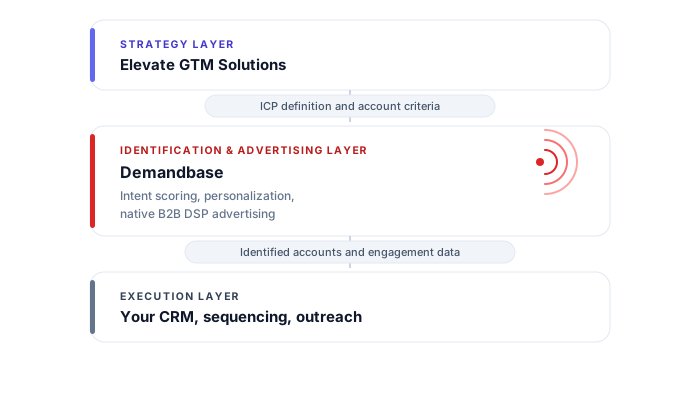
Reading the stack top to bottom is a useful diagnostic exercise on its own. If your organization has never clearly documented the top layer, no amount of Demandbase advertising sophistication in the middle layer can fully compensate, since even the most tightly coordinated ad campaign can only target and personalize within the account universe and message it is given, and a poorly defined universe means that coordination is optimizing the wrong target with real precision. Conversely, if the top layer is documented well but nothing below it is identifying and reaching accounts, that strategy has no way to actually put a coordinated, account aware message in front of the buying group. Most GTM technology evaluations get more useful once a team maps its existing stack this way and identifies which layer is actually thin, rather than starting from a vendor comparison and working backward.
On pricing specifically, the two models could not be more different, so it is worth walking through the actual numbers rather than a single headline price. Demandbase does not publish pricing and quotes every deployment individually based on target account volume, user seats, advertising spend commitments, and which modules are activated. Based on third party pricing data, a base package for smaller teams has been reported starting around 18,000 to 24,000 dollars annually, with most mid market deployments landing between roughly 43,000 and 65,000 dollars per year, and full enterprise deployments including advertising, personalization, and Agentbase reported starting around 200,000 dollars and climbing past 300,000 dollars at scale. Layer on top of that a typical onboarding fee near 29,000 dollars, additional seats at 1,200 to 3,000 dollars each, and modular add ons like visitor deanonymization or personalization that can each run tens of thousands of dollars annually on their own, and the real total cost of ownership for a fully activated deployment routinely exceeds the headline platform fee by a wide margin.
Elevate's structure is closer to traditional SaaS seat and scope pricing, and is published rather than quote only. The Guided GTM tier starts at 499 dollars a month for a single user working within a single GTM scope, meaning one product, market, and segment combination. The Growth tier runs 1,499 dollars a month and expands access to up to three users and up to three GTM scopes, which suits a company managing more than one product line or market simultaneously. The Scale tier is custom and annual, removes user and scope limits entirely, and is the only tier that includes the advanced EVUSP intelligence modules for buyer emotion modeling, differentiation scoring, and narrative defensibility.
Key takeaway: Demandbase's cost reflects the expense of owning and running advertising infrastructure, intent data, and personalization at scale, and its modular pricing means the real total often lands well beyond the initial quote once add ons and media budget are included. Elevate's cost reflects a lighter, strategy focused product and is accessible to teams that have not yet reached the deal size or account volume where six figure ABM advertising tooling makes sense. A company evaluating both should scope Demandbase's total cost, not just the platform fee, before assuming the platforms sit at comparable price points.
Philosophy Comparison
Every GTM tool encodes a belief about where the hard part of go to market actually lives. Demandbase and Elevate encode genuinely different beliefs, and understanding that difference matters more than any individual feature comparison.
Demandbase's implicit philosophy is that go to market success in enterprise ABM is primarily a reach and coordination problem. The belief is that once you know which accounts matter, success comes from consistently, precisely reaching the right people inside those accounts across every channel, web personalization, display advertising, LinkedIn, connected TV, with a coordinated intensity that tracks how close each account is to an active buying decision. This is a philosophy born out of enterprise sales cycles with long buying committees and significant deal sizes, where broad, unpersonalized advertising wastes budget and generic outreach fails to break through. Demandbase's entire architecture, the native DSP, the account level personalization, the buying group intelligence, is built to make sure the right message reaches the right individual at the right account at the right intensity, automatically.
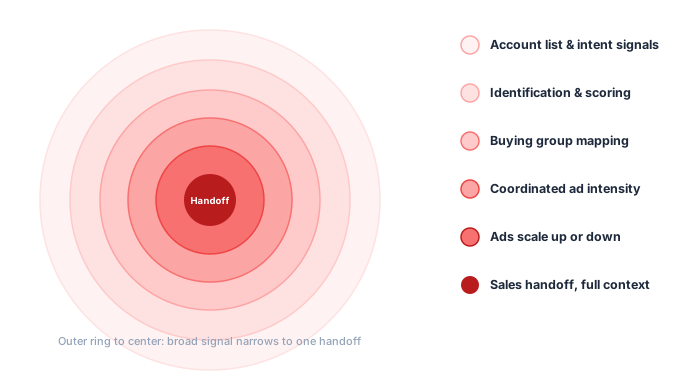
Elevate's implicit philosophy sits a layer upstream of that reach and coordination question entirely. It treats go to market success as primarily a clarity and definition problem that exists before coordination even becomes relevant. The belief embedded in the product is that reaching the wrong accounts with perfectly coordinated, beautifully personalized advertising does not produce better outcomes than doing nothing, it just produces more expensive, more precisely targeted noise. Elevate's architecture, the fourteen module methodology, the shared outputs across functions, the emphasis on continuous adaptation rather than a static annual plan, is built to make sure the account universe and the message running through any advertising and personalization platform are actually right before reach and coordination get layered on top.
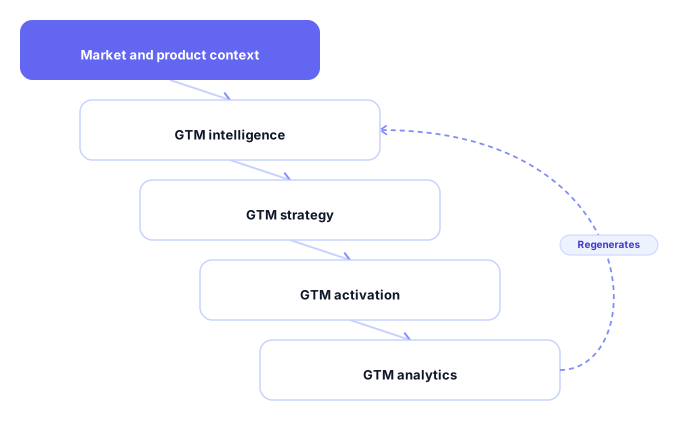
Notice the shape of the two diagrams. Demandbase's flow is a reach and response pipeline, an account is identified, scored, mapped, and reached with coordinated intensity that adjusts as engagement changes. Elevate's flow is a loop that sits above that pipeline entirely, strategy informs execution, execution generates signal, and that signal feeds back into strategy. Neither shape is wrong. They simply describe different layers of the same overall system. A team that only has the reach and coordination pipeline can execute advertising with real sophistication but risks coordinating that sophistication against a poorly defined or generic target. A team that only has the strategic loop can define a sharp ICP and message but has no native system to actually identify, personalize for, or advertise to the accounts inside it.
There is also a philosophical difference in how each platform treats the human expert. Demandbase assumes an operator who wants to manage campaigns, intent thresholds, and personalization rules continuously: marketing operations professionals comfortable configuring account lists, ad creative, and web personalization logic. The product rewards someone who thinks like a demand generation specialist maintaining a living advertising system. Elevate assumes a strategic operator who wants structured guidance and speed: someone who understands go to market thinking conceptually but does not want to manually build a competitive positioning framework in a blank document at midnight before a launch. The product rewards someone who thinks like a strategist working against a deadline.
Neither philosophy is inherently premium or entry level. They are simply optimized for different layers of the same funnel, and the honest answer to "which philosophy is right" depends entirely on whether your organization's actual gap is reach and coordination, or strategic clarity and definition, today.
Can They Work Together?
Yes, and for teams with the deal size and account volume to justify Demandbase's investment, this pairing is a natural one, because Demandbase explicitly needs a well defined account universe and message to identify and advertise against, and Elevate has no native mechanism for running programmatic advertising or personalizing a website once that universe is defined.
The two platforms sit at different layers of the same system. Elevate operates at the strategy layer: defining who the ICP is, what the positioning says, which channels matter, and how messaging should be structured for each segment. Demandbase operates at the identification and advertising layer: taking that ICP definition, building the target account list around it, identifying and scoring those accounts for buying intent, and coordinating personalized advertising and web experiences that adjust in intensity as engagement changes. Used together, the output of one becomes the direct configuration input for the other.
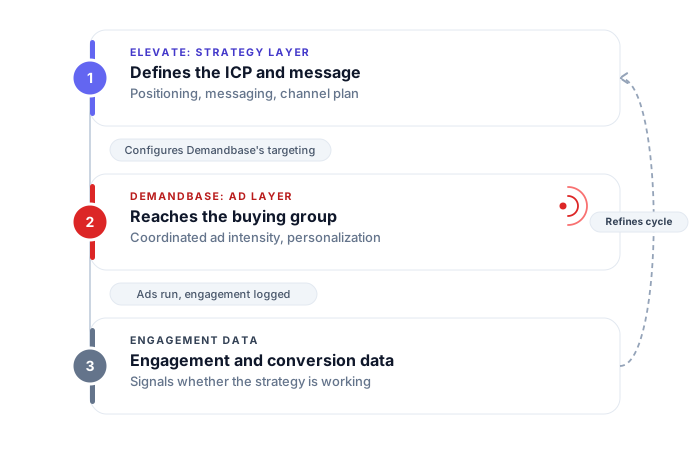
Key takeaway: the output of Elevate is the account universe and message that Demandbase identifies and advertises against. ICP, positioning, and messaging defined in Elevate become the target list criteria and ad or personalization creative inside Demandbase. That handoff, not a feature overlap, is the real relationship between the two platforms.
Consider how that loop plays out in practice. A team runs the ICP and segmentation module inside Elevate and gets a structured definition: company size range, industry, technographic signals, and buyer persona priorities, along with a positioning statement and three messaging angles mapped to different buyer pain points. That structured definition becomes the direct configuration input for Demandbase: marketing operations builds the target account list and segment criteria to match Elevate's ICP exactly, rather than a broader, less precise firmographic filter, and the messaging angles from Elevate become the ad creative and personalized website copy variations Demandbase serves to identified accounts as their intent scores rise.
Once campaigns run, the engagement and conversion data flowing back through Demandbase's reporting becomes a real world signal about whether the strategy actually holds up. If accounts matching one particular segment from Elevate's ICP are engaging and converting at a meaningfully higher rate once identified and reached than accounts in another segment, that is useful information to feed back into the strategy layer, potentially reshaping which segment gets prioritized next quarter, or triggering a fresh Elevate cycle to refine the ICP further. This is the loop shown in the diagram above, and it is the version of "working together" that neither tool can replicate alone: Demandbase has no native mechanism for generating or revising an ICP or positioning from scratch, and Elevate has no native mechanism for running programmatic advertising, personalizing a website, or mapping a buying group.
There is a sequencing consideration worth flagging honestly. Building a Demandbase deployment before strategic clarity exists tends to produce a large, generically defined account list identified and advertised to with real sophistication against the wrong target, which is a genuinely expensive failure mode given how much of the platform's cost sits in media budget and modular add ons. Running Elevate without ever operationalizing its output into an identification and advertising platform produces a well documented strategy with no way to actually reach the accounts inside it with coordinated, account aware messaging. Neither failure mode is really about the tools; both come from treating strategy and advertising execution as separate initiatives instead of a connected pipeline.
For teams evaluating budget across both, a lighter version of this pairing still works: use Elevate, or a comparable structured planning process, to sharpen the ICP and messaging before committing to a Demandbase contract, since a narrower, better defined account universe both improves Demandbase's targeting precision and can reduce the account volume, and therefore some of the modular costs, you need to license. You do not need both running at full scale from day one. You need the strategic layer settled enough that a six figure advertising and identification investment is aimed at the right target from the start.
A concrete quarter by quarter walkthrough makes this less abstract. In month one, a team runs its market research, ICP, and positioning work inside Elevate, resolving open questions about which segment to prioritize and what the core message should be. In month two, marketing operations configures Demandbase's target account list and segmentation to match that refined ICP precisely, and marketing prepares the ad creative and personalized web content Demandbase will serve once accounts are identified and scored. By month three, engagement, ad performance, and pipeline influence data flowing through Demandbase's reporting are available for a marketing leader to pull back into a strategy review, checking whether the original ICP and messaging assumptions are actually holding up against real account engagement or need revision. That review becomes the input for the next Elevate cycle, and the loop repeats. Teams that operate this way tend to treat strategy refreshes as a recurring quarterly discipline rather than an annual event, while Demandbase keeps running continuous identification, scoring, and advertising in the background, only requiring segment or creative updates when the underlying targeting or messaging parameters actually change.
Best For: Matching the Platform to Your Team
| Team Profile | Better Fit | Why |
|---|---|---|
| Seed or early stage startup defining first ICP and positioning | Elevate | Strategic clarity has not been established yet; premature to invest in six figure advertising infrastructure |
| Enterprise team running coordinated ABM advertising at scale | Demandbase | Native DSP, personalization, and buying group intelligence are exactly what the platform is built for |
| Company with a mature Demandbase deployment advertising to a poorly defined account list | Elevate | The tooling works; the target universe and message likely need sharpening first |
| Marketing team entering a new vertical or geography | Elevate | Requires new market research, positioning, and messaging before an account list can be built |
| Company repositioning after a pivot or acquisition | Elevate | The problem is narrative and account definition, not advertising execution capability |
| Team wanting advertising and account identification in one native platform without third party ad tech | Demandbase | Owning the DSP outright is Demandbase's clearest structural differentiator |
| Team with small average deal sizes, no advertising budget, or a short sales cycle | Neither, cautiously | Demandbase's pricing and media spend requirements rarely pencil out here; Elevate is the more accessible starting point |
| Fractional CMO or GTM consultant serving multiple clients | Elevate | Structured methodology speeds up strategy delivery across engagements |
| RevOps or demand gen team needing website personalization tied to account identity | Demandbase | Native personalization tied to account identification is a core, differentiated capability |
| Product marketing team building competitive battlecards | Elevate | Positioning and competitive intelligence modules map directly to this need |
The pattern across this table is consistent enough to state plainly: Demandbase tends to fit organizations with the deal size, account volume, and advertising budget to justify enterprise ABM infrastructure, and Elevate tends to fit organizations at any stage that still need strategic clarity on the target and message before that investment makes sense. That said, this is a rough proxy, not a hard rule. A large enterprise team can still be strategically unclear about a new segment even with a mature Demandbase deployment, and a smaller team with sharp positioning may simply not have the deal economics or advertising budget to justify Demandbase regardless of clarity. The better question than "can we afford Demandbase" is "what is actually broken right now," which the next two sections address directly.
Key takeaway: Demandbase's total cost, platform fee, onboarding, seats, add on modules, and media budget combined, means the decision to adopt it is rarely close. If your deal size and account volume clearly justify the full investment, evaluate it on advertising and personalization fit. If they do not, the more urgent and accessible investment is almost always strategic clarity first.
When to Choose Demandbase
Demandbase makes the most sense when your organization already has clarity on its target market and messaging, has deal sizes and account volumes large enough to justify enterprise ABM pricing and a real advertising budget, and the actual bottleneck is reaching and engaging your defined target accounts with coordinated, personalized advertising.
Specific signals that point toward Demandbase:
Your buying committees are large and your deal sizes justify account level advertising precision. If reaching multiple stakeholders inside a target account with coordinated, personalized messaging across display, LinkedIn, and connected TV would meaningfully move a deal forward, Demandbase's native DSP and buying group intelligence are built precisely for that motion.
You want to own advertising and identification in one platform rather than stitching together a separate DSP, intent data provider, and personalization tool. Demandbase's structural bet, building its own demand side platform rather than integrating with a third party, is its clearest differentiator against competitors in the category, and it matters most for teams that would otherwise be managing several disconnected advertising and identification vendors.
Your average deal size and account volume can absorb Demandbase's full total cost of ownership. Given that a fully activated deployment, platform fee, onboarding, additional seats, and modular add ons like personalization or deanonymization, routinely exceeds the headline quote, and media budget sits on top of all of it, the platform's economics only work when the pipeline it influences is large enough to justify that spend.
You have, or are prepared to build, dedicated marketing operations capacity. Successful Demandbase deployments require ongoing management: maintaining account lists, tuning intent thresholds, managing ad creative and personalization rules, and running quarterly optimization cycles. Teams without that operational capacity tend to underuse the platform relative to its cost.
Your account universe and ICP are already well defined. Demandbase's identification and advertising are only as useful as the account list and criteria they are targeting; feeding the platform a broad, loosely defined universe produces precisely coordinated advertising against accounts that may never have been a real fit in the first place.
A useful gut check: if you already know exactly who you are targeting and what you want to say to them, but you have no reliable way to identify which of those specific accounts are actively engaging and no coordinated way to advertise to their buying committee, your constraint is almost certainly reach and coordination, and Demandbase is the more direct answer, assuming your deal economics and advertising budget support the investment.
When to Choose Elevate
Elevate makes the most sense when the honest answer to that gut check above is no, or is a hesitant maybe, or when your deal size and advertising budget have not yet reached the point where six figure ABM infrastructure is the right next investment regardless of clarity.
Specific signals that point toward Elevate:
Your ICP is broad, dated, or was never formally validated against your actual best customers. If your target account criteria is closer to a rough firmographic guess than a validated profile built from patterns in your existing customer base, identifying and advertising to that universe with even the most sophisticated coordination will not fix the underlying targeting problem.
You are entering a genuinely new market, segment, or product line and have no existing account list or messaging to advertise around in the first place. Launching into unfamiliar territory requires market sizing, competitive mapping, and a fresh ICP definition before any identification or advertising platform has something meaningful to work from. Building that from scratch manually, through analyst reports, competitor audits, and internal debate, is exactly the slow, fragmented process Elevate's platform is designed to compress.
Your deal size or advertising budget does not yet justify enterprise ABM infrastructure pricing. If your average contract value or available media budget would make a platform whose fully loaded cost can reach into six figures difficult to justify on ROI grounds, strategic clarity is both the more urgent and the more affordable investment to make first.
Your positioning has drifted or was never formally documented, even if you already have some form of intent data or advertising tooling in place. If different reps describe the product differently on calls, or marketing messaging contradicts what sales actually says, that is a strategic alignment problem no amount of ad targeting sophistication fixes.
You are a fractional GTM leader, advisor, or lean team without a dedicated strategy function. Elevate's structured methodology can substitute for some of the deliverables a strategy consultant or in house product marketer would otherwise produce manually, which is meaningfully useful for lean teams or advisory practices serving multiple clients at once.
A parallel gut check: if you gave your marketing operations team an unlimited Demandbase budget and every advertising and personalization feature unlocked tomorrow, would your team know precisely which accounts to load into it, what message should run across every ad and personalized web experience, and why that message should win against the alternative your prospects are already considering? If the honest answer is uncertain, the constraint is strategic, and that is Elevate's territory, not Demandbase's.
Key takeaway: the two gut checks above are the fastest way to self diagnose. A defined account list with no way to identify or advertise to it points to Demandbase, assuming the economics fit. A vague or unvalidated account list, regardless of what advertising infrastructure sits behind it, points to Elevate.
Final Verdict
Demandbase and Elevate are not really competitors, even though the shared language of intent and account targeting can make them sound like alternatives on a shortlist. They solve different problems that happen to sit next to each other in the funnel, and comparing them head to head on a single feature grid, as the table above shows, mostly reveals that they were built to answer different questions rather than compete for the same budget line.
If your organization has a validated ICP, deal sizes and buying committees large enough to justify enterprise ABM advertising, and the operational capacity and budget to manage ongoing campaigns, Demandbase is very likely the more direct fix for a real gap: identifying and reaching your target accounts with coordinated, personalized advertising rather than generic, unpersonalized campaigns. Its pricing requires serious budget discipline and total cost of ownership analysis beyond the initial quote, but for organizations with the account volume and advertising budget to support it, owning identification and advertising natively in one platform is difficult to replicate with a lighter or cheaper stack.
If your organization is still working out who its best customer actually is, why that customer should choose you over an obvious alternative, and how that story should translate consistently across marketing, sales, and product, Elevate is the more foundational fix, and very often the necessary one before a Demandbase investment would even make sense. It will not identify an anonymous visitor or run a display campaign, but it addresses a failure mode that no amount of advertising sophistication can solve: identifying and advertising with real precision against a target and message that were never actually right.
The pragmatic recommendation for most growing revenue organizations evaluating this specific pairing: resolve strategic clarity before committing to enterprise ABM advertising spend, not after. Get the ICP, positioning, and messaging genuinely validated, whether through a platform like Elevate, an experienced GTM advisor, or rigorous internal process, and then evaluate whether your deal size, buying committee complexity, and advertising budget actually justify a platform like Demandbase to identify and reach accounts within that now well defined universe. Reversing that order, buying sophisticated identification and advertising infrastructure before the underlying target is validated, is one of the more expensive mistakes a growing ABM program can make, because it is very easy to mistake precisely coordinated advertising for a validated strategy when the account list and message behind it were never quite right.
FAQ
Is Demandbase a competitor to Elevate GTM Solutions? Not directly. Demandbase is an enterprise ABM platform focused on identifying which already defined target accounts are showing buying intent and reaching them with coordinated, personalized advertising. Elevate is a GTM strategy platform focused on defining who those target accounts should be and what to say to them. They operate at different layers of the funnel and are frequently used together rather than as substitutes for one another.
Can I use Elevate without Demandbase, or Demandbase without Elevate? Yes, both platforms function fully independently. Teams with a well established strategy and no identification or advertising bottleneck can use Demandbase on its own, targeting an account list built from internal knowledge. Teams that need strategic clarity but already have a working identification and advertising stack, whether that is Demandbase, 6sense, or something else, can use Elevate on its own and export its outputs into whatever platform they already run.
Which platform is better for a small startup with a limited budget? Elevate, in most cases, and not narrowly. Demandbase's total cost of ownership, typically starting in the tens of thousands of dollars annually before onboarding, seats, add ons, and media budget are included, is built for enterprise deal economics that most early stage startups have not yet reached. A startup without a validated ICP or positioning also would not get proportional value from Demandbase's identification and advertising even if it could afford the platform, since the coordination would be reaching accounts within a target definition that has not been tested yet.
Does Elevate replace the need for an ABM advertising platform like Demandbase? No. Elevate defines the strategic target and message; it does not identify anonymous website visitors, run programmatic advertising, or personalize a webpage. A company with a perfectly validated ICP and positioning still has no way to identify and reach specific accounts with coordinated, account aware advertising without a platform like Demandbase sitting downstream of that strategy.
Does Demandbase replace the need for a product marketer or GTM strategist? No. Demandbase will identify, score, and advertise to whatever account list and criteria it is given with real sophistication, but it does not generate that list, define the ICP from first principles, or write the positioning and messaging that should run across the ads and personalized experiences it serves. That strategic definition has to come from somewhere, whether a hired product marketer, an experienced GTM consultant, or a structured platform like Elevate.
How does pricing compare between the two platforms? The pricing models are structured very differently, and Demandbase's is meaningfully less accessible and less transparent, with a total cost that frequently exceeds the headline platform quote once onboarding, seats, and add on modules are included. Demandbase does not publish pricing, requires a custom quote for every deployment, and third party data suggests real world platform fees commonly range from roughly 18,000 to 24,000 dollars a year for smaller deployments to well over 200,000 dollars a year for full enterprise ABM programs with advertising and personalization active, before onboarding fees near 29,000 dollars and modular add ons are factored in. Elevate charges on a seat and GTM scope basis, starting around 499 dollars a month for a single user and a single product or market scope, scaling up through a growth tier and a custom enterprise tier, with pricing published rather than quote only. A useful way to think about it: Demandbase's cost is driven by the scale and sophistication of the identification and advertising operation you are running, while Elevate's cost is driven by how many strategic scopes you are actively defining.
Which platform is better for programmatic advertising or website personalization? Demandbase, without much ambiguity. Its native B2B demand side platform and account level personalization are purpose built for exactly this, and owning that infrastructure directly rather than integrating with a third party is the platform's clearest structural advantage. Elevate does not run advertising or personalize a website; its output is the strategic brief, the ICP and messaging, that a platform like Demandbase would use to define and target that advertising in the first place.
Is there a risk of these two platforms creating overlapping or conflicting work? The risk is real but avoidable with clear ownership. Because both platforms use language around intent and account targeting, teams that adopt both should be explicit that Elevate's buyer emotion and intent modeling is a strategic exercise, not a behavioral signal detection or advertising system, and that Demandbase's intent data and coordination are an execution operation, not a strategy generator. Establishing Elevate as the source of truth for who and why, and Demandbase as the source of truth for which specific accounts, when, and through which advertising channel, avoids the confusion that can arise when two tools both claim to talk about intent.
How long does it take to see value from each platform? Demandbase's value timeline depends heavily on deployment scope: identification and basic intent scoring can begin relatively quickly once accounts and integrations are configured, but meaningful pipeline impact from coordinated advertising and personalization typically takes a full sales cycle or more to materialize and validate, and ongoing value depends on continuous campaign management and optimization. Elevate's core strategic outputs, ICP, positioning, and messaging, are generated far more quickly since the platform is designed to compress a process that would traditionally take weeks of workshops and drafting into a matter of minutes to hours, though the real test of that strategy's value only shows up once it has been executed against and measured, often through a platform like Demandbase.
Should an enterprise organization use both platforms simultaneously? Enterprise organizations with the deal size, buying committee complexity, and advertising budget to run a full ABM motion are exactly where this combination makes the most sense, since Demandbase's identification and advertising are most valuable when reaching a precisely defined account universe, and Elevate's scope based structure is well suited to defining that universe across multiple products or markets. The main requirement is coordination: someone, typically a RevOps or ABM program leader, needs to own the handoff between the strategic outputs generated in Elevate and the account lists, creative, and personalization rules configured inside Demandbase, so the two systems stay synchronized as strategy evolves rather than drifting apart over time.