
Customer Success and Support: Turning New Customers Into Lasting Ones
Winning a customer is only the beginning of the relationship. What happens after the sale, how quickly a customer reaches genuine value, how consistently they adopt the product, and how well the organization supports them when something goes wrong, ultimately determines whether that initial win becomes a durable, growing relationship or a quiet, disappointing churn statistic. Customer success and support turns the promise made during the sales process into a lived reality, and in doing so protects and compounds the value of every other part of the go to market strategy that came before it.
This guide covers the full scope of customer success and support inside a go to market program, starting with overall strategy, moving through onboarding, adoption, support, and retention, and finishing with operations, performance measurement, recommendations, and an executive summary leadership can act on.
It is worth naming clearly what makes this part of go to market work different from everything that comes before it. Marketing, sales, and positioning all exist to win a decision, a single moment where a prospect chooses to become a customer. Customer success and support exist to sustain a relationship, which is a fundamentally different kind of challenge, measured not in a single closed deal but in a continuous, ongoing pattern of value delivered month after month. A business that treats the moment of the sale as the finish line, rather than the starting point of an ongoing relationship, tends to discover the cost of that mistake slowly and painfully, through rising churn and shrinking expansion revenue that no amount of upstream acquisition investment can fully offset.
Customer Success Strategy Overview
Before building specific programs, a team needs a clear, shared understanding of what customer success is meant to accomplish and how it connects to the broader business.
Customer Success Objectives
Customer success objectives clarify what the function needs to prioritize, whether that is reducing early churn, improving time to value, or driving expansion revenue from an already satisfied customer base. Being explicit about which objective matters most keeps investment focused on the problems that genuinely matter right now, rather than spreading effort evenly across every possible priority without clear focus.
A company struggling with early stage churn might prioritize onboarding and time to value improvements, while a company with strong retention but limited expansion revenue might prioritize a more proactive growth and upsell motion instead. Naming the specific problem customer success is meant to solve keeps the resulting strategy practical and targeted.
Revisiting these objectives periodically matters as well, since the biggest threat to the customer base tends to shift as a company matures, moving from early stage onboarding challenges toward more nuanced retention and expansion questions once the initial wave of customers has settled into steady, established usage.
Customer Lifecycle Strategy
Customer lifecycle strategy maps the full arc of a customer relationship, from initial onboarding through ongoing adoption, renewal, and potential expansion, ensuring the organization has a deliberate plan for supporting the customer at every stage rather than focusing disproportionately on the earliest moments and neglecting the relationship afterward.
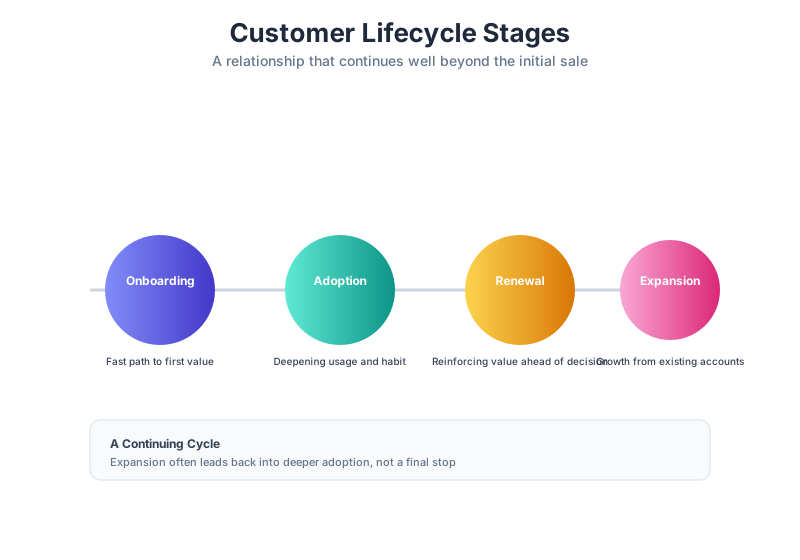
Many organizations invest heavily in onboarding but let attention taper off considerably once a customer reaches steady state usage, missing both early warning signs of quiet disengagement and genuine opportunities for deeper adoption and expansion that a more sustained, deliberate lifecycle approach would have caught.
| Lifecycle Stage | Primary Focus | Key Risk If Neglected |
|---|---|---|
| Onboarding | Fast, guided path to first value | Early disengagement before value is felt |
| Adoption | Deepening usage and habit formation | Shallow usage that never solidifies |
| Renewal | Reinforcing value ahead of decision point | Surprise churn at contract end |
| Expansion | Identifying and acting on growth signals | Missed revenue from ready accounts |
Success Principles
Success principles establish the guiding philosophy behind how the organization approaches customer relationships, such as prioritizing proactive outreach over purely reactive support, treating customer health as a shared cross functional responsibility, and measuring success by genuine customer outcomes rather than purely internal activity metrics.
Documenting these principles explicitly and referring back to them consistently helps a growing customer success team stay aligned as new hires join, preventing the natural drift that occurs when each new team member independently develops their own slightly different sense of what good customer success work actually looks like.
Business Outcomes
Business outcomes connect customer success work back to the broader company goals it ultimately needs to support, such as a specific net revenue retention target, a churn reduction goal, or an expansion revenue target that ties customer success directly to overall company growth.
Making this connection explicit helps customer success secure the organizational investment and executive attention the function needs, since leadership tends to prioritize functions with a clear, demonstrated link to company wide financial outcomes over those whose value remains more abstract or difficult to quantify.
Customer Onboarding Strategy
The earliest weeks of a customer relationship set the tone for everything that follows.
Onboarding Approach
Onboarding approach defines the overall philosophy behind how new customers get started, whether that is a highly guided, white glove approach for complex enterprise deployments or a faster, more self serve model suited to simpler products and smaller customers.
Matching the onboarding approach to the actual complexity of the product and the sophistication of the typical customer matters considerably, since an overly heavy, high touch approach for a simple product can feel unnecessarily slow, while an overly light touch approach for a genuinely complex deployment can leave customers stuck and frustrated early in the relationship.
Implementation Journey
The implementation journey documents the specific steps a customer moves through to get the product properly set up and configured, giving both the customer and the internal team a clear, shared roadmap rather than an ambiguous, open ended process.
Sharing this journey directly and transparently with the customer, rather than keeping it purely as an internal reference, helps set realistic expectations upfront and gives the customer a sense of visible progress and control throughout what can otherwise feel like an opaque process happening largely behind the scenes.
Building in flexibility for the journey to adapt to a specific customer's unique situation, rather than forcing every account through an identical, rigid sequence regardless of their particular needs, tends to produce a smoother experience than a completely standardized process applied uniformly to every customer regardless of how well it actually fits their circumstances.
| Onboarding Element | Key Question | Primary Owner |
|---|---|---|
| Onboarding Approach | Guided, self serve, or hybrid | Customer Success Leadership |
| Implementation Journey | What are the specific setup steps | Implementation or Onboarding Team |
| Time-to-Value | How quickly does the customer see real value | Customer Success and Product |
| Customer Activation | What defines a genuinely activated customer | Customer Success and Analytics |
Time-to-Value
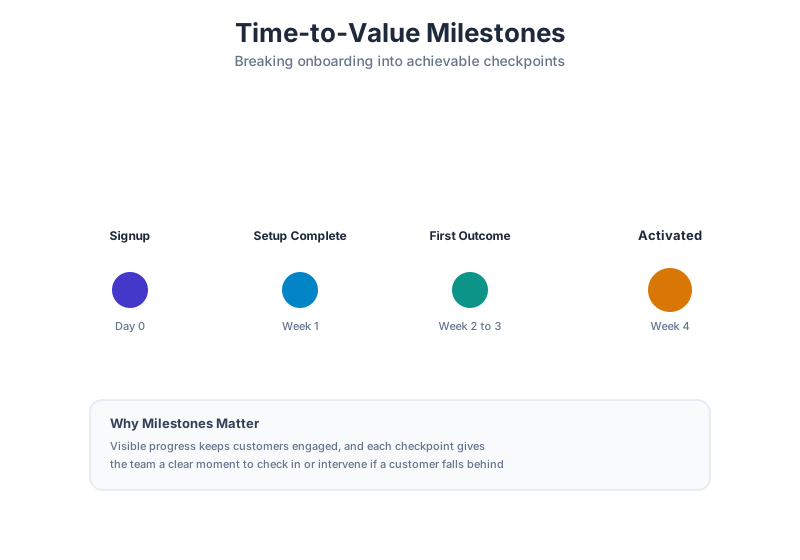
Time-to-value measures how quickly a new customer experiences the core value that motivated their purchase decision, since a long or unclear path to that first meaningful outcome significantly increases the risk of early disengagement and churn.
Measuring time-to-value precisely requires first defining exactly what counts as genuine value from the customer's own perspective, rather than an internal proxy that may not actually correspond to the outcome the customer cares about most.
Shortening time-to-value often has more to do with removing unnecessary steps and friction from the early experience than adding more features or guidance, since a simpler, more focused initial path frequently gets a customer to their first meaningful outcome faster than a more comprehensive but slower, more elaborate onboarding sequence.
Customer Activation
Customer activation defines the specific milestone or set of behaviors that indicate a customer has genuinely gotten started with the product in a meaningful way, giving the organization a clear, measurable signal to track rather than relying on a vague sense of whether onboarding went well.
Validating a proposed activation milestone against actual historical retention data helps confirm it genuinely predicts long term success, rather than assuming a milestone that feels intuitively meaningful actually correlates with customers who go on to become happy, long term accounts.
Early Success Milestones
Early success milestones break the path to full value into smaller, achievable checkpoints, giving customers a sense of visible progress and giving the internal team clear points at which to check in, celebrate progress, or intervene if a customer is falling behind expectations.
Celebrating these milestones explicitly with the customer, rather than only tracking them internally, reinforces a sense of momentum and partnership early in the relationship, helping build the kind of positive engagement that makes a customer more likely to reach out for help rather than quietly disengaging if they hit a later obstacle.
Customer Adoption & Engagement
Beyond initial onboarding, ongoing adoption determines whether a customer continues to receive value over the life of the relationship.
Product Adoption Strategy
Product adoption strategy outlines the deliberate plan for encouraging customers to use the product consistently and deeply over time, recognizing that adoption rarely happens automatically and instead requires ongoing attention, guidance, and encouragement from the organization.
Building this strategy around specific, observable usage patterns that correlate with long term retention, rather than a general aspiration for more usage, gives the customer success team a much clearer, more actionable target to work toward with each individual account.
Feature Adoption
Feature adoption tracks how well customers discover and use the specific capabilities most closely tied to genuine value realization, since broad but shallow usage across many minor features often matters less than consistent engagement with the handful of capabilities that actually drive the outcomes a customer cares about.
Identifying which specific features most strongly correlate with long term retention, through analysis of existing customer usage data, gives the customer success team a clear, evidence based target to guide customers toward, rather than promoting feature adoption broadly without a clear sense of which capabilities actually matter most.
Building lightweight, in-product guidance that surfaces these high value features naturally during a customer's normal workflow, rather than relying entirely on customer success managers to manually walk each account through them, allows this kind of adoption guidance to scale far beyond what any human team could deliver one conversation at a time.
| Adoption Element | Focus | Signal of Success |
|---|---|---|
| Product Adoption Strategy | Overall plan for driving usage | Increasing usage depth over time |
| Feature Adoption | Discovery of high value capabilities | Engagement with core value driving features |
| Customer Engagement | Ongoing interaction with product and company | Consistent, healthy usage patterns |
| Usage Optimization | Helping customers use the product more effectively | Reduced friction, improved efficiency |
Customer Engagement
Customer engagement tracks how actively customers interact with the product and the broader company over time, including usage frequency, participation in community or educational content, and responsiveness to outreach from the customer success team.
Tracking engagement across multiple channels, rather than relying solely on product usage data, provides a fuller picture of the relationship, since a customer who engages actively with educational content and company communications may be building meaningful commitment even during a temporary lull in direct product usage.
Usage Optimization
Usage optimization identifies opportunities to help customers use the product more effectively, whether through proactive tips, workflow recommendations, or direct outreach addressing a customer who appears to be using the product in a way that limits the value they could otherwise be receiving.
Proactively reaching out with specific, personalized optimization suggestions, rather than only responding when a customer explicitly asks for help, demonstrates genuine attentiveness and often surfaces meaningful improvements a customer would not have discovered or requested on their own.
Value Realization
Value realization confirms that a customer is not just using the product, but genuinely experiencing the specific business outcomes that motivated their original purchase decision, closing the loop between what was promised during the sales process and what is actually being delivered.
Documenting the specific outcomes a customer expected during the original sales conversation, and revisiting that documentation during regular check-ins, gives the customer success team a concrete, personalized basis for confirming whether the relationship is genuinely delivering on its original promise.
When this loop reveals a gap between promised and delivered value, addressing it honestly and directly, rather than avoiding an uncomfortable conversation, tends to preserve trust far better than allowing a quiet, unaddressed disappointment to accumulate until it eventually surfaces as an unexpected churn decision.
Customer Support Strategy
Even the best onboarded, most engaged customers eventually need help, and how well that help gets delivered shapes the overall relationship considerably.
Support Model
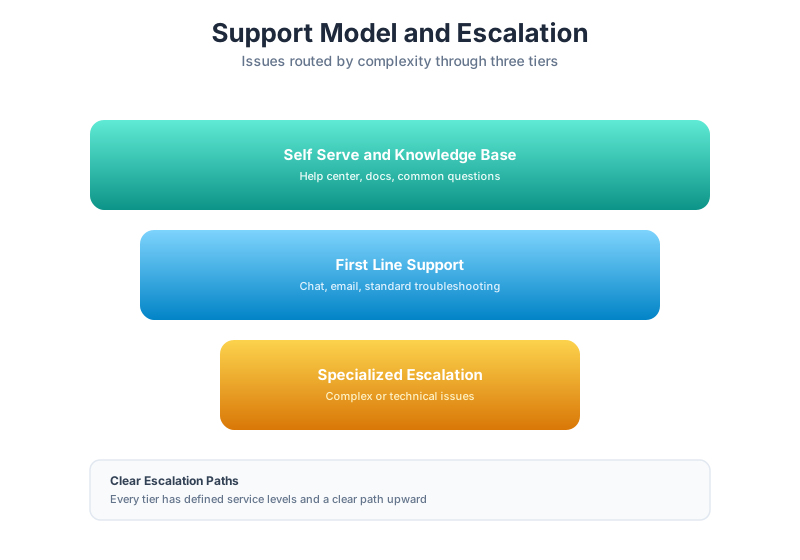
Support model defines the overall structure of how customer support gets delivered, whether that is a tiered model routing issues by complexity, a dedicated support model for premium customers, or a hybrid approach combining self serve resources with human support for more complex issues.
Choosing a support model that genuinely matches the complexity of the product and the sophistication of the customer base prevents both the frustration of an overly thin support model for a genuinely complex product and the unnecessary cost of an overly elaborate model for straightforward customer needs.
Revisiting the support model periodically as the customer base grows and diversifies matters as well, since a model well suited to an early, relatively homogeneous customer base often needs meaningful refinement once the business begins serving a much broader range of customer types, sizes, and levels of technical sophistication.
Support Channels
Support channels define the specific paths customers use to reach the support team, such as email, chat, phone, or a self serve help center, with the right mix depending heavily on customer preferences and the complexity of issues typically encountered.
Offering multiple channels while still maintaining consistent quality and response time across each one matters more than simply maximizing the number of available channels, since a poorly supported channel can damage the customer experience more than not offering it at all.
| Support Element | Key Question | Impact on Experience |
|---|---|---|
| Support Model | How is support structured and routed | Speed and appropriateness of response |
| Support Channels | How can customers reach support | Convenience and accessibility |
| Service Levels | What response and resolution times apply | Customer expectations and trust |
| Knowledge Management | Is self serve information genuinely helpful | Reduced support burden, faster resolution |
Service Levels
Service level definitions establish clear expectations for response and resolution times across different issue types and customer tiers, giving both customers and the internal support team a shared, transparent standard to measure performance against.
Publishing these service levels transparently to customers, rather than keeping them purely as an internal operational target, builds trust and manages expectations, particularly when a specific issue genuinely requires more time than a customer might otherwise assume is reasonable.
Knowledge Management
Knowledge management covers the help center articles, documentation, and internal knowledge base that support both self serve customer resolution and faster, more consistent responses from the support team itself when direct assistance is needed.
Reviewing which help center articles customers actually search for and read most often, compared against which topics generate the most direct support tickets, often reveals specific gaps where existing documentation is either missing or genuinely unhelpful, pointing directly toward where content investment should focus next.
Keeping documentation current as the product evolves requires a clear, assigned ownership process, since outdated help center content can actually create more frustration than no documentation at all, particularly when a customer follows instructions that no longer match the actual current product experience.
Customer Issue Resolution
Customer issue resolution processes define how support tickets actually get handled from initial submission through final resolution, including escalation paths for more complex issues that require specialized expertise beyond a first line support agent.
Tracking not just whether an issue was resolved but how the customer felt about the overall resolution experience provides a fuller picture of support quality, since a technically correct resolution delivered slowly or communicated poorly can still leave a customer feeling frustrated despite the underlying problem being fixed.
Customer Retention & Growth
Beyond day to day support, a deliberate strategy for retention and growth protects and expands the value of the existing customer base.
Retention Strategy
Retention strategy outlines the deliberate approach to keeping customers renewing and remaining engaged over time, recognizing that retention rarely happens automatically and instead requires proactive attention well before a renewal decision point actually arrives.
Treating retention as an ongoing outcome of the entire customer relationship, rather than a discrete activity that only begins shortly before a contract renewal date, keeps the organization focused on sustained value delivery throughout the relationship rather than a last minute scramble to save a decision that may have already been quietly made months earlier.
Renewal Planning
Renewal planning ensures the organization engages customers well ahead of their actual renewal date, reinforcing value delivered and addressing any concerns proactively rather than scrambling reactively once a renewal conversation is already imminent.
Beginning renewal focused conversations several months ahead of the actual decision point, rather than only in the final weeks, gives the organization genuine time to address any concerns that surface, rather than discovering a serious objection too late to meaningfully resolve it before the customer needs to decide.
Preparing a clear, evidence backed value recap ahead of each renewal conversation, summarizing specific outcomes the customer has achieved over the prior contract period, gives the renewal discussion a concrete, factual foundation rather than relying purely on the strength of the ongoing relationship alone.
| Retention Element | Timing | Primary Goal |
|---|---|---|
| Retention Strategy | Ongoing throughout relationship | Sustained engagement and value delivery |
| Renewal Planning | Beginning well before renewal date | Confirm continued commitment early |
| Expansion Opportunities | Ongoing, triggered by usage signals | Grow revenue from existing accounts |
| Risk Management | Continuous monitoring | Early intervention before churn |
Expansion Opportunities
Expansion opportunity identification highlights accounts showing signs of readiness for additional seats, usage, or upsell, representing an efficient source of growth built on an already established, trusted relationship.
Building simple, automated triggers that flag accounts approaching usage limits or showing other clear expansion signals gives customer success and sales teams a practical, timely way to act on this opportunity, rather than relying entirely on manual account review to catch it.
Risk Management
Risk management establishes a systematic approach to identifying accounts showing early warning signs of potential churn, allowing the organization to intervene proactively rather than only discovering a problem once a customer has already decided not to renew.
Assigning clear ownership for acting on flagged risk signals, along with a defined playbook for how to respond to different types of risk, ensures early warning data actually translates into timely outreach rather than sitting unused in a dashboard nobody has responsibility for acting on.
Distinguishing between different categories of risk, such as a temporary dip in usage due to a customer's own seasonal business cycle versus a genuine, sustained decline signaling real dissatisfaction, prevents wasted outreach effort on false alarms while ensuring genuine risk signals receive prompt, appropriate attention.
Customer Health Framework
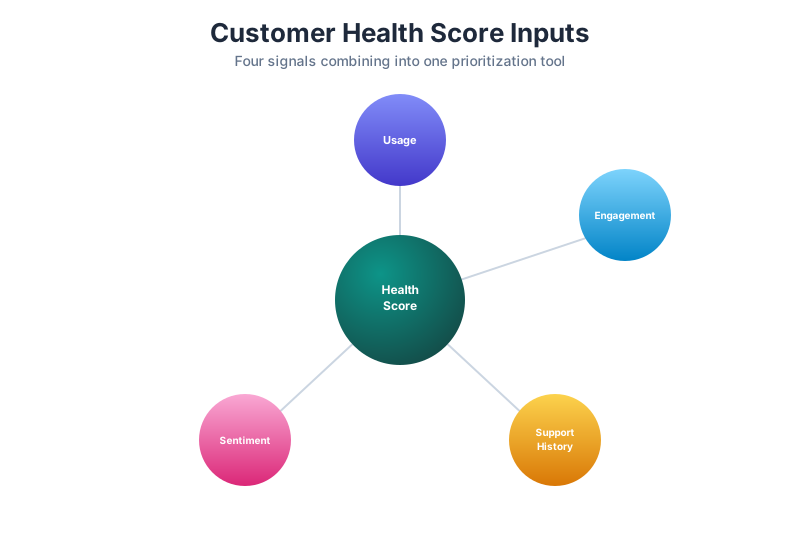
A customer health framework combines multiple signals, such as usage, engagement, and support history, into a single composite view that helps prioritize where the customer success team should focus attention across a large book of accounts.
Validating this framework against actual historical outcomes, rather than assuming the chosen signals are inherently predictive, ensures the resulting health score genuinely identifies at risk and high opportunity accounts rather than simply feeling intuitively reasonable without demonstrated accuracy.
Revisiting the underlying weighting behind a health score periodically as more historical data accumulates allows the model to improve over time, since the specific signals that best predicted churn or expansion a year ago may not remain equally predictive as the product, customer base, and competitive landscape all continue to evolve.
Customer Success Operations
Sustained customer success requires clear operational processes that scale beyond individual relationships and personalities.
Customer Journey Management
Customer journey management ensures the full customer lifecycle, from onboarding through renewal and expansion, follows a consistent, well designed process rather than depending entirely on individual customer success manager judgment and memory.
Mapping this journey explicitly, with clear ownership and expected actions at each stage, helps a growing customer success team maintain consistent quality even as headcount increases and individual managers each bring their own natural style and experience level to the role.
Success Playbooks
Success playbooks provide step by step guidance for common customer success scenarios, such as onboarding a new enterprise account or responding to early warning signs of risk, giving the team a practical, consistent reference rather than each individual improvising independently.
Building playbooks around the specific scenarios a team encounters most frequently, drawing directly on what has actually worked well in past situations, produces far more genuinely useful guidance than a generic set of best practices assembled without reference to real, lived experience.
| Operational Element | Purpose | Primary Owner |
|---|---|---|
| Customer Journey Management | Consistent lifecycle process | Customer Success Operations |
| Success Playbooks | Scenario specific guidance | Customer Success Leadership |
| Cross-Functional Collaboration | Coordination with product, sales, support | All customer facing functions |
| Success Governance | Oversight and accountability | Customer Success Leadership |
Cross-Functional Collaboration
Cross-functional collaboration ensures customer success works closely with sales, product, and support, sharing insight and coordinating on customer facing decisions rather than operating as an isolated function disconnected from the rest of the go to market organization.
Establishing a regular, structured venue for this collaboration, rather than relying purely on informal, ad hoc communication, ensures valuable customer insight consistently reaches the teams positioned to act on it, whether that means product hearing directly about a recurring feature request or sales learning about expansion signals within their existing accounts.
Success Governance
Success governance establishes clear ownership and decision making authority within the customer success function, along with a defined process for updating playbooks and processes as the customer base and product continue to evolve.
Reviewing governance structures periodically, rather than treating them as fixed once established, helps a growing customer success team scale its processes appropriately as headcount and account complexity both increase over time.
Operational Processes
Operational processes cover the practical, day to day mechanics of how the customer success team actually manages its work, including account assignment, workload balancing, and internal reporting that keeps leadership informed of overall team performance.
Reviewing account assignment and workload distribution periodically helps prevent a situation where certain customer success managers become quietly overloaded with a disproportionate share of high risk or high complexity accounts, leading to burnout and inconsistent attention across the broader customer base.
Customer Success Performance
Measuring customer success effectiveness requires connecting team activity to genuine customer and business outcomes.
Customer Health Metrics
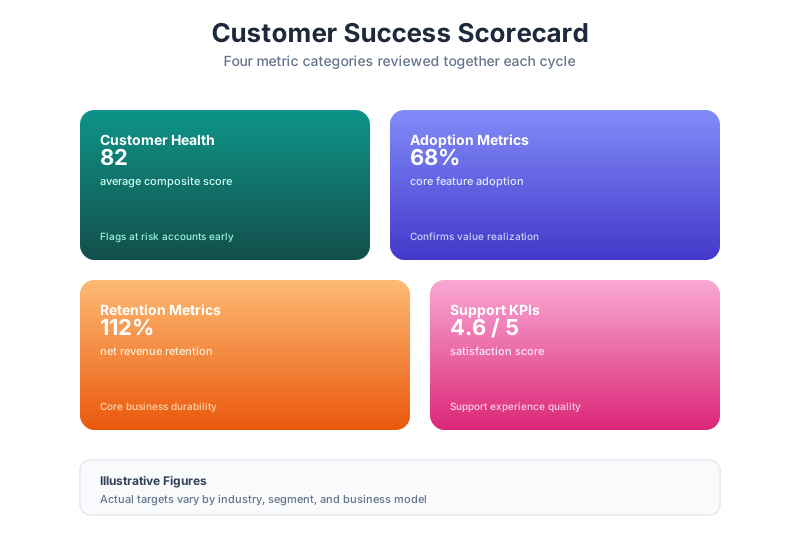
Customer health metrics combine usage, engagement, and support signals into a composite score that helps prioritize attention across a large book of accounts, flagging at risk customers before problems become severe enough to threaten renewal.
Reviewing health scores in aggregate across the full customer base, not just at the individual account level, also helps leadership spot broader patterns, such as a specific segment or cohort trending toward lower health scores that might indicate a systemic issue worth addressing beyond individual account intervention.
Adoption Metrics
Adoption metrics track how deeply and consistently customers use the product over time, providing a direct measure of whether customers are genuinely realizing the value that originally motivated their purchase decision.
Segmenting adoption metrics by customer tenure helps distinguish between genuinely concerning low adoption in an established account and expected lower adoption in a newer account still working through its early implementation and ramp period.
| Metric Category | Example Metric | Primary Insight |
|---|---|---|
| Customer Health | Composite health score | Overall account risk and opportunity |
| Adoption Metrics | Feature usage depth | Genuine value realization |
| Retention Metrics | Net and gross revenue retention | Core business durability |
| Support KPIs | Resolution time, satisfaction score | Support experience quality |
Retention Metrics
Retention metrics measure how many customers and how much revenue the business retains over time, serving as one of the most fundamental indicators of whether customer success efforts are genuinely protecting the value the business has already won.
Tracking both logo and revenue retention separately reveals a fuller picture, since a business can retain the great majority of its customer logos while still losing meaningful revenue if a small number of larger accounts churn disproportionately more often than smaller ones.
Support KPIs
Support key performance indicators track how effectively the support function resolves customer issues, typically including metrics such as first response time, resolution time, and customer satisfaction scores following a support interaction.
Balancing speed metrics against quality metrics matters considerably here, since optimizing purely for fast resolution time can inadvertently encourage agents to close tickets prematurely without genuinely resolving the underlying issue to the customer's satisfaction.
Reviewing a sample of closed tickets qualitatively, alongside the quantitative metrics, helps catch this kind of gaming before it becomes a systemic problem, ensuring the reported metrics genuinely reflect the quality of support customers actually experience rather than a technically favorable but misleading number.
Success Scorecards
Success scorecards bring the full range of customer success metrics together into a consistent, shared view, giving leadership a clear picture of overall function performance rather than reviewing disconnected metrics in isolation.
Reviewing scorecards on a consistent cadence, ideally alongside broader business performance reviews, keeps customer success visibly connected to overall company health rather than existing as a separate, siloed set of metrics reviewed only within the function itself.
Customer Success Risks & Opportunities
Beyond current performance, it is worth identifying where the greatest risks to the existing customer base sit, alongside genuine opportunities for growth.
Adoption Risks
Adoption risks include the possibility that customers never genuinely engage with the product deeply enough to realize lasting value, often traceable to a weak onboarding experience or a mismatch between what was sold and what the product actually delivers well.
Identifying adoption risk early, ideally during the onboarding period itself rather than only after a customer has already been live for many months, gives the organization the best possible chance to intervene while the relationship is still new and the customer remains genuinely open to guidance and course correction.
Churn Risks
Churn risks identify the specific factors most likely to cause a customer to leave, whether that is a competitor's aggressive outreach, an unresolved support issue, or simply a gradual decline in usage that went unnoticed until too late.
Reviewing churn reasons systematically across every lost account, rather than treating each departure as an isolated, unrelated event, often reveals recurring patterns worth addressing structurally rather than only responding to each individual loss after the fact.
Conducting a brief, respectful exit conversation with departing customers whenever possible, rather than simply processing the cancellation and moving on, often surfaces valuable, candid feedback that a customer might not have volunteered while still an active, ongoing relationship depended on maintaining a positive tone.
| Risk or Opportunity | Description | Recommended Response |
|---|---|---|
| Adoption Risk | Customers not reaching genuine value | Strengthen onboarding and early engagement |
| Churn Risk | Declining usage or unresolved issues | Proactive health monitoring and outreach |
| Service Gap | Support capacity or knowledge shortfall | Invest in team capacity and knowledge base |
| Expansion Opportunity | Accounts showing growth readiness | Proactive expansion outreach program |
Service Gaps
Service gaps identify where current support capacity or capability falls short of what customers genuinely need, whether that is insufficient staffing during peak periods or missing expertise for handling more complex, specialized customer issues.
Monitoring support volume trends over time helps anticipate capacity gaps before they become severe enough to noticeably degrade response times, giving the organization time to plan hiring or process improvements proactively rather than reacting only once customers have already begun to notice a decline in service quality.
Expansion Opportunities
Expansion opportunities highlight where the existing customer base represents meaningful additional revenue potential, often a lower cost and lower risk growth path compared to acquiring entirely new customers.
Prioritizing expansion outreach toward accounts already showing strong health and adoption signals tends to produce better results than approaching the entire customer base uniformly, since a genuinely engaged, satisfied customer is considerably more receptive to an expansion conversation than one still working through basic adoption challenges.
Improvement Priorities
Improvement priorities rank the identified risks and opportunities by expected impact, ensuring the organization focuses its limited customer success capacity on the changes most likely to meaningfully protect and grow the existing customer base.
Revisiting this prioritization regularly, rather than fixing it once and following it rigidly, keeps improvement efforts responsive to whatever the most current health and adoption data actually reveals about where the greatest risk or opportunity currently sits.
Customer Success Recommendations
All of the analysis above should translate into clear, actionable recommendations for improving customer success and support going forward.
Priority Initiatives
Priority initiative recommendations identify the specific, highest impact programs worth building first, based on the risks and opportunities identified earlier, rather than attempting every possible improvement simultaneously.
Sequencing initiatives so early efforts build credibility and visible momentum tends to work better than starting with the most ambitious, resource intensive program, since demonstrated early wins help build organizational support for more substantial customer success investment later.
Process Improvements
Process improvement recommendations identify specific operational changes, such as a refined onboarding sequence or a clearer escalation path for at risk accounts, that could meaningfully improve customer outcomes without requiring a complete organizational overhaul.
Piloting a proposed process change with a smaller, contained group of accounts before rolling it out across the entire customer base helps surface practical issues early and builds a stronger case for broader adoption once the pilot demonstrates genuine improvement.
Technology Recommendations
Technology recommendations identify tools or platform investments that could improve how customer health is tracked, how support tickets get managed, or how customer success teams collaborate internally across accounts.
Prioritizing data quality and integration improvements before investing in more sophisticated analytics or automation tools tends to produce better results, since even the most advanced platform cannot compensate for fundamentally unreliable or fragmented underlying customer data feeding into it.
Resource Priorities
Resource priority recommendations translate the broader analysis into specific guidance on where to direct customer success headcount and budget, based on where the risk and opportunity analysis points to the greatest need.
Presenting resource requests alongside a clear expected impact and supporting evidence, rather than a general appeal for more headcount, gives finance and leadership a much clearer basis for approving investment in the customer success function.
90-Day Success Roadmap
A ninety day success roadmap translates the broader recommendations into a specific, near term action plan, giving the organization a clear, manageable sequence of initial steps toward stronger customer outcomes.
Breaking this roadmap into clear phases with specific deliverables and named owners keeps the plan accountable, giving the organization natural checkpoints to assess progress and adjust course if early implementation reveals the original plan needs refinement.
Executive Customer Success Summary
The executive summary condenses the full customer success strategy into a format leadership can review quickly without needing to revisit every underlying section in detail.
Customer Success Strategy
This section clearly restates the overall customer success strategy and approach, giving leadership a quick, confident reference point for understanding the direction being pursued.
Keeping this restatement genuinely brief and focused on the core approach, rather than a detailed recap of every decision covered in the full plan, respects the purpose of an executive summary as a fast reference rather than a complete restatement of the underlying document.
Key Risks
Key risk summary highlights the most significant risks to the existing customer base identified during the analysis, paired with a brief note on the mitigation approach already in place.
Presenting risks alongside their prepared mitigation, rather than listing them without a clear response, gives leadership genuine confidence that identified vulnerabilities are being actively managed rather than simply acknowledged and left unaddressed.
Growth Opportunities
Growth opportunity summary highlights where the existing customer base represents the clearest path to additional revenue, whether through expansion, improved retention, or stronger adoption driving long term account value.
Quantifying these opportunities with a rough estimated dollar impact, even when the estimate carries some uncertainty, gives leadership a more concrete basis for prioritization than a purely qualitative description of where opportunity might exist.
Expected Business Impact
Expected business impact translates the customer success strategy into a clear, quantified sense of what results leadership should expect, whether that is improved retention, faster time to value, or increased expansion revenue.
Presenting these expectations as a realistic range rather than a single fixed target sets more appropriate expectations across the organization and avoids an all or nothing framing that may not fully account for genuine variability in how quickly customer success improvements typically translate into measurable results.
Executive Recommendations
The summary should close with a short, clear set of recommendations for leadership, whether that is approving the ninety day roadmap, committing resources to a specific technology investment, or personally reinforcing the importance of customer success across the organization.
Pairing each recommendation with a clear sense of what specifically is being asked of leadership, whether that is a decision, a budget commitment, or visible personal reinforcement, helps ensure the summary translates into genuine action rather than passive acknowledgment.
Customer success and support, like every other part of go to market strategy, is never truly finished. The strongest organizations treat this work as an ongoing discipline that evolves alongside the product, the customer base, and the broader market, recognizing that a customer relationship, once won, still requires sustained attention to remain healthy and continue growing over time. Treating customer success as a continuously managed function, rather than a program completed once at onboarding and left unattended, keeps a business genuinely capable of protecting and compounding the value of every customer it has already worked so hard to win.
Contents