
Account-Based Marketing - The Definitive Guide
By Elevate GTM Solutions | 21 minute read
Most B2B companies that sell into mid-market and enterprise accounts eventually hit the same wall. Marketing is generating leads, plenty of them, and sales is quietly ignoring most of them. The leads that do get worked tend to be a single person at a company who downloaded an ebook, while the deal itself, when it finally happens, gets decided by six or eight people marketing never spoke to.
This doesn't usually look like a broken funnel from the inside. The dashboards look healthy. MQL targets get hit. Cost per lead trends down. But win rates on the accounts that actually matter stay flat, sales cycles on the biggest deals keep stretching, and the accounts the CRO named as must-wins at the start of the year are still sitting in the same stage they were in two quarters ago, with no one in marketing able to say what's been done to move them.
So how do you point marketing's budget, sales's time, and the company's best content at the specific accounts most likely to become large, durable customers, instead of at whoever happens to fill out a form?
That's the job account-based marketing was built to do. Let's start with what ABM actually is, and why lead-based demand gen breaks down for complex B2B deals.
What is Account-Based Marketing?
Account-based marketing (ABM) is a go-to-market approach in which sales and marketing jointly select a defined set of target accounts, then coordinate research, messaging, and outreach to engage the full buying committee inside each of those accounts. Instead of generating as many leads as possible and filtering down to the ones worth pursuing, ABM starts with the accounts worth pursuing and works outward to the people inside them.
ABM is not a tool, a list of named accounts in a spreadsheet, or a personalized ad campaign. It is an operating agreement between sales and marketing about which accounts matter most, what each account needs to hear, and who is responsible for which part of the engagement. The tooling helps. The agreement is what makes it ABM.
How does ABM work? ABM works by selecting target accounts based on ICP fit and buying signals, mapping the buying committee inside each account, running coordinated plays across advertising, content, email, sales outreach, and events, and measuring results at the account level, by coverage, engagement, pipeline, and revenue, rather than by lead volume.
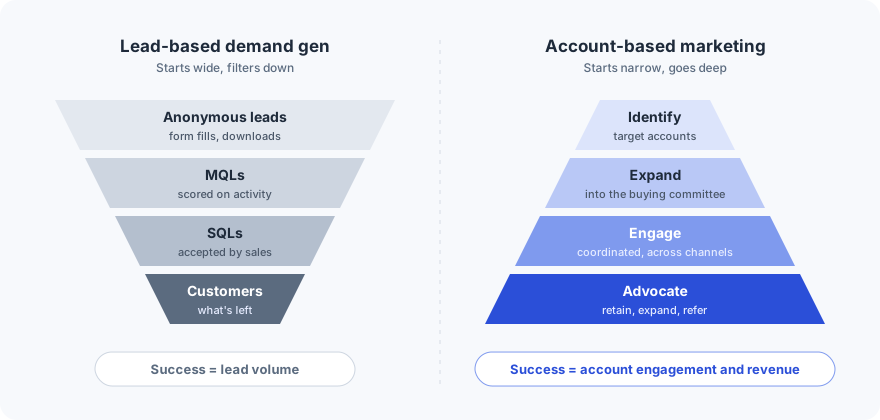
| Lead-based demand gen | Account-based marketing | |
|---|---|---|
| Starting point | Anyone who raises a hand | A defined list of accounts sales and marketing agreed on |
| Unit of measurement | The individual lead | The account and its buying committee |
| Who decides the target | Marketing, through scoring rules | Sales and marketing together, through ICP fit and signal |
| Personalization | By persona or broad segment | By account, cluster, or tier |
| What success means | MQL volume and cost per lead | Account engagement, pipeline, win rate, and expansion |
The two approaches aren't mutually exclusive. Most companies running ABM still run some lead-based demand gen for smaller deals and inbound capture. What changes is which motion owns the accounts that represent the largest share of future revenue, and how those accounts get worked.
Why Does Account-Based Marketing Matter?
Complex B2B purchases aren't made by individuals. They're made by committees, and those committees rarely announce themselves. A champion in operations might be the first person to engage, but the decision depends on a finance leader who needs a business case, a technical evaluator who needs integration proof, a security reviewer who needs documentation, and a procurement team that needs terms. A lead-based funnel captures whichever of those people happens to click first, scores them, and hands one name to sales, which then has to discover the rest of the committee on its own, usually late, often after a competitor has already built relationships with them.
The cost of that mismatch shows up in predictable places. Marketing spend gets spread thinly across thousands of accounts, most of which will never be a good fit, while the accounts that would be a great fit get the same generic nurture sequence as everyone else. Sales reps, measured on pipeline, learn to ignore marketing-sourced leads and build their own prospecting lists, which means the two teams end up targeting different companies without ever deciding to. And the biggest deals, the ones that move the year, get the least coordinated attention, because no one owns the account as a whole.
Quick Stat: When companies first compare marketing's highest-engagement accounts against sales's top-priority named accounts, the overlap is usually far smaller than either team expects. Discovering that gap, and deciding which list wins, is typically the first real step of an ABM program.
Example: A marketing team runs a strong webinar series that generates hundreds of registrations a quarter. Sales follows up on the registrants, finds that most are individual contributors at companies too small to buy, and stops following up. Meanwhile, the twenty enterprise accounts sales actually needs to close this year have each sent one or two people to a webinar, at most, and nobody connected those attendees back to the open opportunities. The webinar program looks successful on marketing's dashboard and invisible on sales's forecast. ABM fixes this by reversing the question: instead of asking who showed up, it asks what each of those twenty accounts needs to see next, and who inside each one hasn't been reached yet.
The quieter cost: wasted precision. Most companies already know a great deal about their best-fit accounts: who uses a competitor, who just raised money, who is hiring for a role the product supports, who visited the pricing page last week. Without ABM, that knowledge sits in separate tools and separate heads. With ABM, it decides where the next dollar and the next hour actually go.
How Account-Based Marketing Works
ABM isn't one campaign. It's a repeatable operating model with three working parts: a tiered approach that matches investment to account value, a deliberate view of the buying committee inside each account, and a loop that keeps the target list current as signal comes in.
Tiered Investment, Not One-Size-Fits-All
Not every target account deserves the same level of effort, and trying to give every account a fully bespoke program is the fastest way to stall an ABM effort before it produces results. Most mature programs run three tiers at once, each with a different balance of personalization and scale.
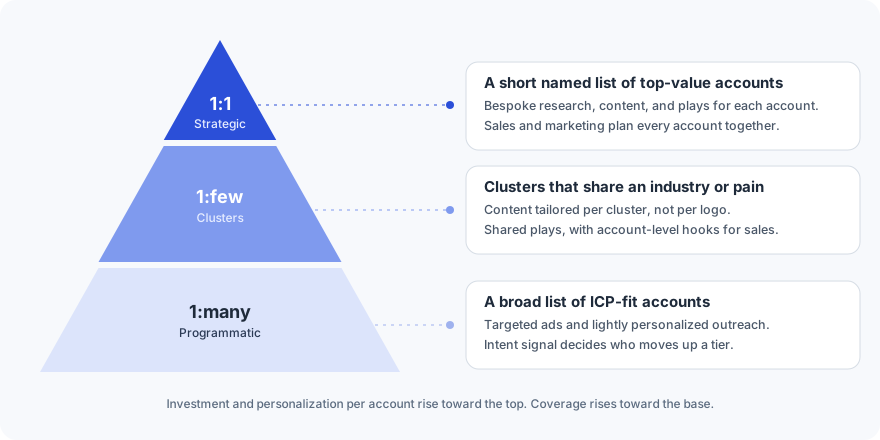
| Tier | Who belongs here | How it's run |
|---|---|---|
| 1:1 strategic | A short named list of the highest-value, best-fit accounts | Account-specific research, custom content, joint sales and marketing plans |
| 1:few clusters | Groups of accounts that share an industry, use case, or pain | Cluster-level messaging and plays, with account-level hooks for reps |
| 1:many programmatic | A broad list of ICP-fit accounts, often hundreds or more | Targeted advertising, light personalization, intent-driven prioritization |
The tiers aren't permanent. An account in the programmatic tier that starts showing strong buying signals should move up, and a 1:1 account that has gone quiet for two quarters should move down to free capacity for one that hasn't. The tiering is a resource allocation decision, and it should be revisited as often as the underlying signal changes.
The Buying Committee Is the Real Target
A target account list is a list of companies, but companies don't buy anything. People do, and in most B2B deals several of them have to agree. ABM treats the buying committee as the unit of engagement: for each target account, the program maps which roles are involved, who fills them, what each one needs to believe, and how engaged each one currently is.
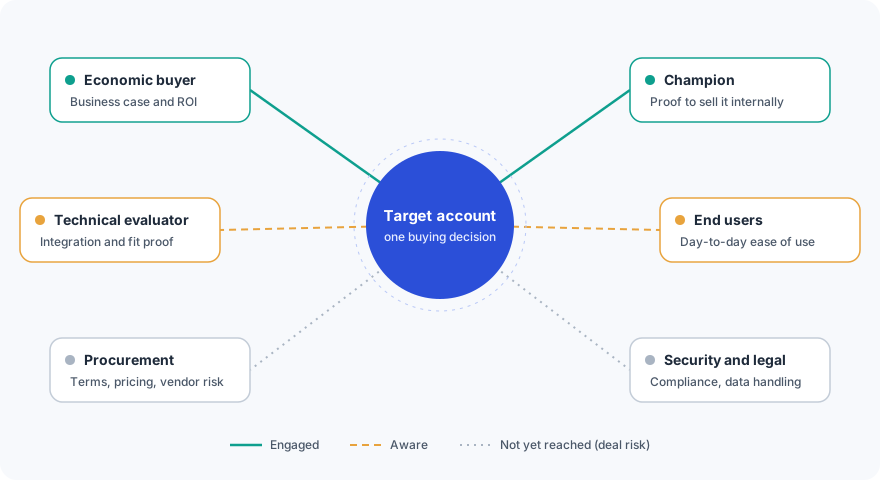
The map does two jobs. It tells marketing what content and channels each role needs, since a finance leader and a technical evaluator are persuaded by different things. And it shows sales where the deal is exposed. An account where only the champion is engaged is a single-threaded deal, no matter how enthusiastic that champion sounds. An account where procurement and security haven't been reached is a deal that's likely to stall late, at exactly the moment the forecast is counting on it.
The Loop That Keeps the List Honest
A target account list built once a year goes stale fast. Companies get acquired, budgets get frozen, champions leave, and new accounts start showing intent that nobody planned for. A working ABM program is built as a loop: account selection feeds research, research shapes engagement, engagement produces account-level results, and those results feed back into which accounts stay on the list, which change tiers, and which get retired.
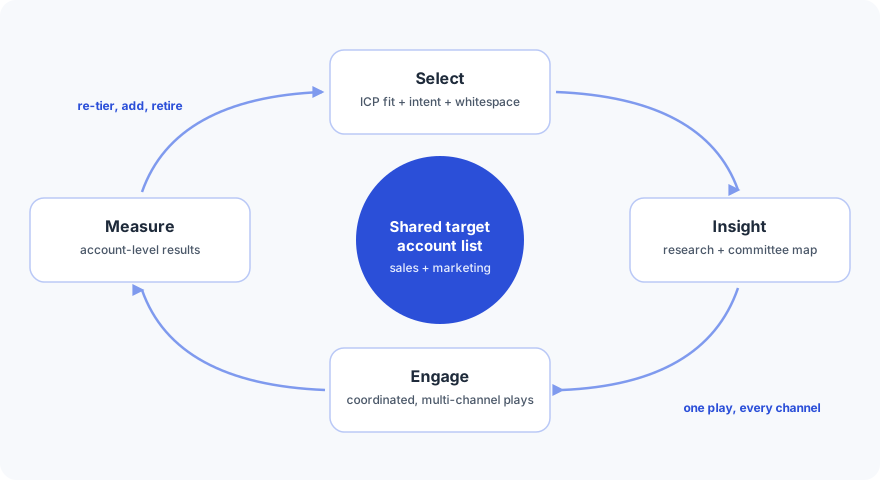
The center of that loop is a single, shared target account list that sales and marketing both own. If marketing has one list and sales has another, the loop never closes, because the results marketing measures and the accounts sales works will never quite be the same accounts.
The Core Components of Account-Based Marketing
ABM programs that hold up over time tend to be built around the same six components. Most companies already have pieces of each. What makes it ABM is that all six are organized around the same list of accounts, and that sales and marketing build them together.
Target Account Selection
The list of accounts the program will pursue, chosen on ICP fit, buying signal, and strategic value, and agreed on by sales and marketing before any campaign runs. A good selection model combines firmographic and technographic fit, which says whether an account could buy, with intent and engagement signal, which says whether it's likely to buy soon. The list is only as good as the ICP behind it: if the ICP is vague, the target list will be a long list of companies that look right on paper and convert like a random sample.
Account Intelligence
What the company knows about each target account: its priorities, current tools, recent changes, competitive situation, and buying signals. For 1:1 accounts this is real research, earnings calls, hiring patterns, leadership changes, public initiatives. For programmatic tiers it's mostly signal, intent data, website visits, product usage if there's a free tier. Either way, the intelligence has to be shared and current, so the ad a stakeholder sees and the email a rep sends are drawing on the same picture of the account.
Buying Committee Mapping
A role-by-role view of who is involved in the decision at each account and how engaged each person is. This is the component most often skipped, because it's tedious, and the one that most directly predicts whether a deal closes. Mapping the committee turns a vague sense that an account is engaged into a specific view of which roles are covered, which are cold, and which are missing.
Personalized Content and Messaging
Messaging tailored to the account, cluster, or tier, built from the company's core positioning rather than invented separately for each campaign. Personalization in ABM isn't about inserting a company's logo into an ad. It's about connecting the product's value to the specific problem the account is facing, in language each member of the buying committee will recognize as being about them.
Orchestrated Engagement
Plays that coordinate advertising, content, email, sales outreach, events, and direct mail around the same account at the same time, in a planned sequence. Orchestration is what separates ABM from a set of personalized campaigns running in parallel: the ad warms the account before the rep's outreach lands, the rep references the content the stakeholder already engaged with, and the event invitation goes to the role that hasn't been reached yet.
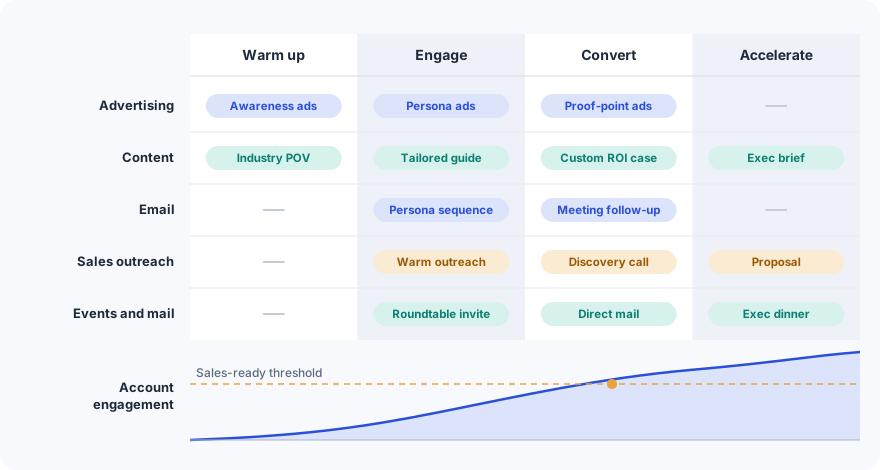
Account-Level Measurement
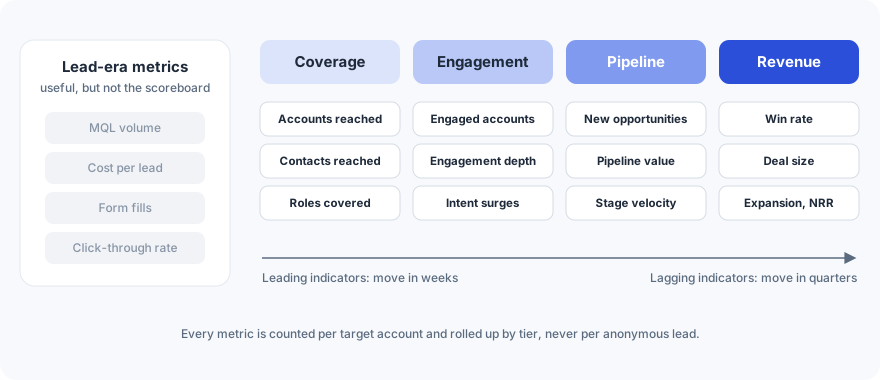
Metrics that count accounts, not leads: how many target accounts are reached, how deeply engaged they are, how much pipeline they produce, and how much revenue they turn into. Account-level measurement is what lets sales and marketing look at the same scoreboard, and it's the component that most often has to be built from scratch, because most reporting systems were set up to count leads.
| Component | What it answers | Where it breaks down without it |
|---|---|---|
| Target account selection | Which accounts are we actually going after? | Marketing and sales pursue different lists without realizing it |
| Account intelligence | What do we know about each account right now? | Personalization is generic, and outreach misses what changed |
| Buying committee mapping | Who decides, and who have we reached? | Deals stay single-threaded and stall when an unknown stakeholder appears |
| Personalized messaging | What does this account need to hear? | Content gets ignored because it isn't about the reader's problem |
| Orchestrated engagement | What happens next, in which channel, and who owns it? | Channels run in parallel, and the account gets mixed signals |
| Account-level measurement | Is the program moving the accounts that matter? | Success is judged on lead metrics that don't reflect deal progress |
Key Takeaway: ABM isn't a set of new activities so much as a reorganization of existing ones around a shared list of accounts. The components only work when they're all pointed at the same accounts and owned by sales and marketing together.
Benefits of Account-Based Marketing
- Spend concentrated where revenue is. Budget and effort go to the accounts most likely to become large customers, instead of being spread evenly across every company that matches a broad filter.
- Real sales and marketing alignment. A shared target list and shared account-level metrics give both teams the same definition of what matters, which removes the most common source of friction between them.
- Larger, multi-threaded deals. Engaging the full buying committee early tends to produce deals that are better understood internally by the buyer, which makes them larger and less likely to stall late.
- Shorter cycles on the deals that matter. When marketing has already warmed the committee and surfaced objections, sales spends less time educating and more time advancing.
- A more relevant buyer experience. Stakeholders see content about their own problems rather than generic thought leadership, which earns attention that broad campaigns can't.
- Clearer attribution on big deals. Measuring at the account level makes it possible to connect marketing activity to specific opportunities, rather than arguing about which lead source gets credit.
- A natural path into expansion. The same account intelligence and committee maps used to win a deal carry directly into upsell and cross-sell plays after signing.
Real Examples
The list nobody agreed on. A company launched ABM by buying an intent data tool and running ads against the accounts with the highest intent scores. Sales, meanwhile, kept working its own named account list from territory planning. Six months in, the two lists overlapped by less than a third, marketing reported strong engagement on accounts sales had never heard of, and sales reported that marketing had done nothing for its priority accounts. Both reports were accurate. The fix wasn't a better tool. It was a single working session where sales and marketing leaders merged the lists, agreed on tiering rules, and committed to one list going forward.
Engaged, but single-threaded. An enterprise opportunity looked healthy for most of a quarter: the champion attended every call, shared internal documents, and pushed for a fast close. Two weeks before the expected signature, a security review surfaced requirements nobody on the vendor side had seen, and a finance leader who had never been engaged asked why the budget wasn't going to an existing vendor. The deal slipped two quarters. A buying committee map would have shown four of six roles unreached from the start, and the program could have targeted those roles with security documentation and a business case weeks earlier.
Personalization that didn't land. A team spent weeks building custom landing pages for each of its top accounts, each one featuring the account's logo and name. Engagement was barely better than the generic page. When the team rebuilt the pages around each account's actual business problem, a specific regulatory change for one cluster, a recent acquisition integration for another, engagement rose sharply. The lesson was that the account's name isn't personalization. The account's problem is.
Tiers that never moved. A program set its tiers at the start of the year and left them alone. By the third quarter, several 1:1 accounts had gone completely cold, one after a leadership change and another after a budget freeze, while a handful of programmatic-tier accounts were showing strong, sustained intent and visiting the pricing page repeatedly. The team was still spending most of its effort on the cold accounts. A monthly re-tiering review, triggered by signal rather than the calendar, would have moved capacity to the accounts actually in market.
A scoreboard that changed behavior. A company replaced its marketing dashboard, which led with MQL volume, with an account-level view showing coverage, engagement, and pipeline for each tier of target accounts. Within a quarter, the conversation in the weekly sales and marketing meeting changed from arguing about lead quality to reviewing which accounts were stuck and which buying committee roles were missing. The underlying activity barely changed at first. What changed was what both teams were looking at together.
Common Mistakes
Starting with the tool instead of the agreement. Buying an ABM platform before sales and marketing have agreed on a target list and tiering rules tends to produce a sophisticated system for running campaigns against the wrong accounts. The agreement comes first.
Treating a target list as a strategy. A list of named accounts is an input, not a program. Without account intelligence, a committee map, and orchestrated plays behind it, a target list is just a shorter version of the same spray-and-pray approach.
Confusing personalization with name insertion. Adding an account's logo or company name to an ad or landing page is easy to scale and rarely changes anything. Personalization that works connects the product to a problem the account is actually facing.
Engaging one contact and calling it an engaged account. An account where one person has clicked an ad and opened two emails isn't engaged in any meaningful sense. Engagement has to be measured across the buying committee, not by the most active individual.
Measuring ABM with lead metrics. Judging an ABM program on MQL volume or cost per lead will make it look like a failure, because it's designed to produce fewer, better-qualified opportunities from a smaller set of accounts. The metrics have to match the motion.
Running too many accounts at the 1:1 tier. Bespoke programs are expensive in time and attention. Trying to run them across too many accounts at once spreads the team thin and produces generic work labeled as personalized.
Leaving sales out of the plays. ABM run entirely by marketing becomes a set of advertising campaigns. The plays work when sales outreach is sequenced into them, and when reps know exactly what each account has already seen.
| Mistake | What it looks like | Fix |
|---|---|---|
| Tool before agreement | A platform running campaigns against a list sales doesn't recognize | Agree on one target list and tiering rules before buying or configuring tools |
| A list mistaken for a program | Named accounts with no research, map, or plays behind them | Build intelligence, committee maps, and plays for each tier |
| Name insertion as personalization | Logo-swapped ads and landing pages with generic messaging | Personalize to the account's problem, not its name |
| One engaged contact counted as engagement | Accounts marked hot based on a single person's activity | Measure engagement across buying committee roles |
| Lead metrics on an account motion | ABM judged on MQL volume and cost per lead | Report coverage, engagement, pipeline, and revenue per target account |
| Too many 1:1 accounts | Bespoke work spread so thin it becomes generic | Keep the 1:1 tier small and move accounts between tiers on signal |
| Sales left out of the plays | Marketing runs ads while reps prospect the same accounts independently | Sequence sales outreach into every play and share account context with reps |
AI and Account-Based Marketing
AI is changing the parts of ABM that used to be the most labor-intensive. Account research that once took an analyst hours per account, reading earnings calls, scanning job postings, tracking leadership changes, can now be summarized in minutes and refreshed continuously. Intent signal from across the web, website behavior, and product usage can be combined to flag which accounts are moving into a buying window, and which buying committee roles are showing activity. Drafting persona-specific messaging for a cluster of accounts, grounded in the company's positioning and each account's situation, is far faster than it was.
That matters because the biggest constraint on ABM has always been capacity. Teams could only run truly personalized programs for a handful of accounts, because the research and content work didn't scale. AI widens that constraint, making it practical to give 1:few and even some 1:many accounts a level of relevance that used to be reserved for the top tier.
What AI doesn't change is the harder part: deciding which accounts the company should pursue, getting sales and marketing to commit to the same list, and making the judgment calls about where a limited team should spend its attention. A model can surface that an account's intent has spiked. It can't decide whether that account matters more than a strategic logo the CEO has committed to the board, or resolve a disagreement between a sales leader and a marketing leader about which tier an account belongs in.
Where AI Helps vs. Where It Doesn't: AI is well suited to researching accounts, detecting buying signals, mapping likely committee members, and drafting tailored messaging at scale. It is not well suited, on its own, to choosing the target list, setting tiers, or enforcing the sales and marketing agreement that ABM depends on. Those remain leadership decisions.
Building an Account-Based Marketing Program
Companies starting ABM often try to launch everything at once: a full target list, three tiers, new tools, new dashboards, and a dozen plays. That usually produces a lot of activity and very little evidence that any of it works. The more reliable path is to start small, prove the motion on a limited set of accounts, and expand once the results are visible.
-
Agree on one target account list with sales. Start from the shared ICP, add buying signal and strategic value, and get sales and marketing leadership to sign off on a single list. Keep the first version small enough that every account on it can be discussed by name.
-
Tier the list and set capacity for each tier. Decide which accounts get 1:1 treatment, which get grouped into clusters, and which stay programmatic. Set the 1:1 tier by how many accounts the team can genuinely research and run bespoke plays for, not by how many accounts sales would like to see there.
-
Map the buying committee for the top tiers. For every 1:1 and 1:few account, identify the roles involved in the decision, who fills them, and how engaged each one is today. Share the map with the account's rep so outreach and marketing are working from the same picture.
-
Build and run a small number of orchestrated plays. Design two or three plays that sequence advertising, content, email, sales outreach, and events around a specific goal, such as reaching unengaged committee roles or accelerating stalled opportunities. Run them, and make sure reps know what each account has already seen before they reach out.
-
Measure at the account level and re-tier on signal. Report coverage, engagement, pipeline, and revenue per target account and per tier. Review the list on a regular cadence and whenever signal changes, moving accounts up or down tiers and retiring ones that have gone cold.
| Stage | Focus | What "ready to move on" looks like |
|---|---|---|
| 1 | One agreed target account list | Sales and marketing can each name the top accounts and give the same answer |
| 2 | Tiers and capacity | Every account has a tier, and the 1:1 tier fits what the team can actually run |
| 3 | Buying committee maps | Top-tier accounts have role-by-role maps that reps actually use in deal reviews |
| 4 | Orchestrated plays | Plays run across channels with sales outreach sequenced in, not running alongside |
| 5 | Account-level measurement and re-tiering | One scoreboard both teams review, and tiers that change when the signal does |
Key Takeaway: The highest-leverage first step in ABM is almost never a tool. It's a single target account list that sales and marketing both agree to work from. Every other component, tiering, committee mapping, plays, and measurement, depends on that agreement being real.
Account-Based Marketing and the Rest of GTM
ABM doesn't stand on its own. It's an execution motion that depends on the strategic foundations underneath it, and it amplifies whatever those foundations already say.
It depends directly on a clearly defined ideal customer profile, since target account selection is only as good as the definition of fit behind it. It depends on strong positioning and messaging, because personalization built on a weak core story just produces many tailored versions of a message that doesn't land. It relies on GTM intelligence to keep account research and buying signals current, and it is one of the clearest expressions of a unified GTM strategy, since it forces sales and marketing to commit to the same accounts, the same story, and the same measure of success. After the deal closes, the same account intelligence and committee maps carry into customer success and expansion.
Companies sometimes launch ABM before these foundations are in place, hoping the program will force clarity. It rarely does. ABM built on a vague ICP targets the wrong accounts with great precision, and ABM built on unclear positioning delivers a confusing message to exactly the right people. Getting the foundations right first is what lets the precision pay off.
Related Reading
- What is an Ideal Customer Profile (ICP)?
- Unified GTM Strategy - The Definitive Guide
- What is GTM Intelligence?
- What is Product Positioning?
- What is GTM Execution?
Final Thoughts
Go back to the company with healthy MQL numbers and stalled enterprise deals. Nothing in that picture is a failure of effort. Marketing is generating demand, sales is working deals, and both are doing what their metrics reward. The problem is that the accounts marketing is engaging and the accounts sales needs to win are different accounts, and nobody owns the gap between them.
Account-based marketing closes that gap by changing the starting point. Instead of beginning with whoever shows up and hoping the right accounts are among them, it begins with the accounts that matter and builds everything, research, messaging, plays, and measurement, around reaching the people inside them. None of it requires a large platform or a reorganization to start. It requires sales and marketing to agree, in writing, on which accounts they're going after together, and then to measure success the same way. The companies that treat that agreement as an ongoing discipline, not a one-time list, are the ones whose largest deals stop being surprises.
Frequently Asked Questions
What is account-based marketing in simple terms?
Account-based marketing is an approach where sales and marketing pick a specific set of target companies together, then coordinate personalized outreach to the people inside each company who influence the buying decision, instead of generating as many leads as possible and filtering them later.
How is ABM different from traditional demand generation?
Traditional demand generation starts with a broad audience and filters down to qualified leads, measuring success by lead volume. ABM starts with a defined list of accounts and works outward to the buying committee, measuring success by account coverage, engagement, pipeline, and revenue.
Is ABM only for enterprise companies?
No, but it fits best when deal sizes are large enough and buying committees complex enough to justify the extra research and coordination. Companies selling smaller, single-buyer deals often get more value from programmatic, 1:many ABM than from bespoke 1:1 programs.
How many accounts should be in an ABM program?
It depends on team capacity and tier. The 1:1 tier should be limited to the accounts the team can genuinely research and run custom plays for. The 1:few and 1:many tiers can be much larger, because the work is shared across clusters or automated.
Who should own ABM, sales or marketing?
Both. Marketing usually runs the program, the research, content, and campaigns, but sales has to co-own the target list, the tiering, and the plays. ABM owned entirely by one team tends to collapse into either an advertising program or a prospecting list.
What metrics should we use to measure ABM?
Measure at the account level across four stages: coverage, such as accounts and buying committee roles reached; engagement, such as engaged accounts and engagement depth; pipeline, such as opportunities created and stage velocity; and revenue, such as win rate, deal size, and expansion.
Do we need an ABM platform to get started?
No. A shared target list, a spreadsheet of buying committee maps, and coordinated plays across existing channels are enough to prove the motion. Platforms become valuable once the program is running and needs intent data, account-level advertising, and reporting at scale.
How long does it take to see results from ABM?
Leading indicators, such as coverage and engagement on target accounts, typically move within weeks. Pipeline and revenue move on the timeline of the company's sales cycle, which for enterprise deals often means several quarters. Judging ABM only on early revenue usually leads to abandoning it too soon.
What's the first thing to do if we want to start ABM?
Get sales and marketing to agree on one target account list built from the shared ICP. Nearly every ABM failure traces back to the two teams working from different lists, and nearly every successful program starts by fixing that.