
Market Research: The Foundation of Every Go To Market Strategy
Every successful go to market strategy starts with one thing: a clear, honest picture of the market you are trying to win. Market research is not a box to check before a launch, it is the backbone that shapes pricing, positioning, messaging, channel selection, and even product roadmap decisions. Companies that skip this step, or rush through it, tend to build products for markets that do not exist, or worse, markets that already have three entrenched competitors nobody bothered to research.
This guide walks through the full scope of market research inside a go to market program, from defining the industry you operate in, to sizing the opportunity, to understanding the regulatory guardrails you need to respect, and finally to turning all of that analysis into an executive summary your leadership team can actually act on.
Market Overview
Before a company can talk about growth, it needs to define the playing field. The market overview section answers a deceptively simple question: what business are we actually in, and who else is in it with us?
Industry Definition
An industry definition sounds basic, but it is where many go to market teams get tripped up early. Defining the industry too broadly leads to vague strategies that try to serve everyone and end up serving no one. Defining it too narrowly can blind a team to adjacent competitors or substitute products that quietly eat into their addressable base.
A strong industry definition includes:
- The core problem the industry solves for customers
- The primary buyer personas involved in purchasing decisions
- Adjacent categories that customers might consider as alternatives
- The typical business model used to monetize solutions in the space
For example, a company selling scheduling software might define its industry as "workforce management software" rather than the narrower "employee scheduling tools," because the broader definition captures budget holders who think in terms of workforce operations rather than a single feature.
It also helps to write the industry definition from the buyer's point of view rather than the vendor's point of view. Vendors tend to describe their industry in terms of the product they sell, while buyers describe it in terms of the outcome they are trying to reach. A go to market team that anchors its definition to the outcome, rather than the feature set, ends up with messaging that resonates far more naturally in sales conversations and marketing content, since it mirrors the language buyers already use when they search for a solution or describe their problem to a colleague.
A useful exercise here is to interview a handful of existing customers and ask them, in their own words, what category they would put the product in if a friend asked them to explain it. The answers are often surprisingly different from how the internal team describes the industry, and those differences are worth paying close attention to before locking in a definition that will guide every other piece of go to market work downstream.
Market Landscape
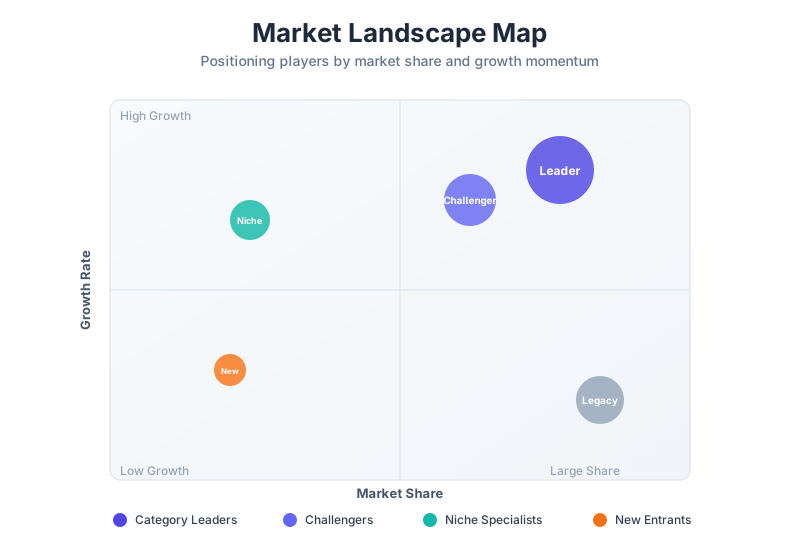
The market landscape maps out the players, big and small, that shape how customers make decisions. This includes direct competitors, indirect competitors, and category creators who are trying to redefine how the problem gets solved altogether.
| Landscape Layer | Description | Example Focus |
|---|---|---|
| Category Leaders | Established players with the largest market share | Brand trust, scale, enterprise reach |
| Challengers | Fast growing companies taking share from leaders | Product velocity, pricing, niche focus |
| Niche Specialists | Companies serving a narrow segment extremely well | Vertical depth, specialized workflows |
| New Entrants | Startups or new product lines entering the space | Innovation, disruption, new business models |
Mapping the landscape this way helps a go to market team understand not just who they are up against, but what kind of positioning gap actually exists.
It is worth noting that a market landscape is never static. Category leaders can lose ground quickly if they stop innovating, and challengers can rocket up the list if they land a few high profile customers or a viral product moment. Building the landscape as a one time exercise and never revisiting it is one of the more common mistakes teams make. A better approach is to treat the landscape map as a quarterly review item, updated alongside win and loss data from the sales team, so the picture stays current rather than reflecting a snapshot from a year ago that no longer matches reality.
Beyond direct competitors, it is worth spending time on indirect competition as well, meaning the manual processes, spreadsheets, or in house built tools that some buyers still rely on instead of purchasing a dedicated solution. In many markets, especially earlier stage ones, the biggest competitor is not another vendor at all, it is the buyer's own inertia and comfort with doing things the old way.
Key Market Segments
Markets are rarely one homogenous group of buyers. Segmenting the market by firmographics, use case, or buying behavior helps a go to market team prioritize where to spend time and budget first.
Common ways to segment a market include:
- Company size, from small business to mid market to enterprise
- Industry vertical, such as healthcare, finance, retail, or manufacturing
- Use case, meaning how the product is applied day to day
- Buying maturity, meaning whether the segment is early adopters or mainstream buyers
Once a market has been broken into segments, the next step is scoring each one against a consistent set of criteria, such as size, growth rate, willingness to pay, and how well the current product fits their needs out of the box. This scoring exercise prevents a common trap where a go to market team chases the segment that shouts the loudest in sales calls, rather than the one that actually represents the best long term fit for the business.
It also helps to distinguish between a segment that is easy to sell into today and a segment that is strategically important for the next several years. Sometimes the easiest early wins come from a segment that will not scale, while the segment worth building a long term motion around requires more patience and upfront investment. Being explicit about this tradeoff keeps sales and marketing aligned on where the real priority sits, rather than quietly drifting toward whatever segment closes the fastest deals this quarter.
Geographic Overview
Geography changes almost everything about a go to market plan, from language and localization needs to payment preferences, regulatory requirements, and even sales cycle length. A geographic overview should capture where demand is concentrated today, where it is growing fastest, and where infrastructure or cultural barriers might slow adoption.
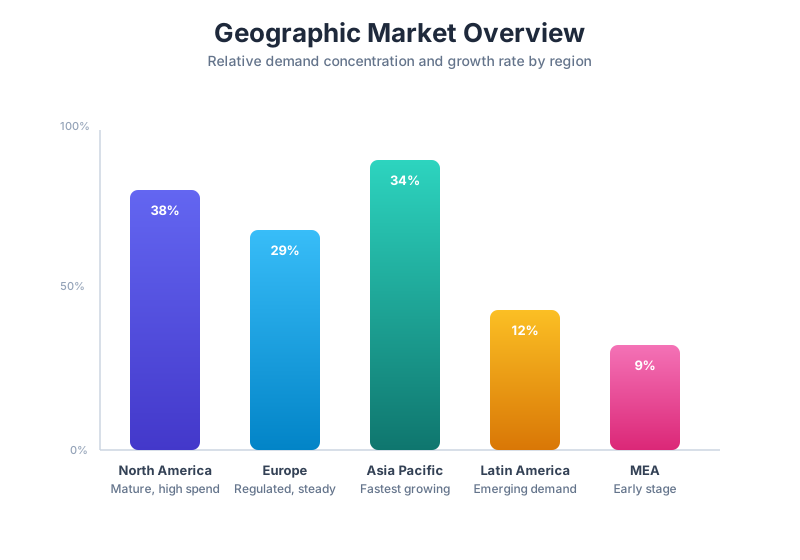
Regions with strong digital infrastructure and high smartphone or broadband penetration tend to adopt new categories faster, while emerging regions often show huge long term potential but require more patience and local partnerships to unlock.
Currency stability and payment infrastructure also deserve a place in the geographic overview, since a brilliant product with no local payment method support will struggle no matter how strong the underlying demand looks on paper. Similarly, language and cultural nuance matter more than most teams expect going in. A pricing page or onboarding flow that converts well in one region can quietly underperform in another simply because the tone, imagery, or currency formatting feels unfamiliar to local buyers.
Time zone overlap is another practical factor that often gets overlooked until a sales or support team is already stretched thin. Expanding into a region with little working hour overlap with existing teams changes staffing requirements considerably, and that cost should be factored into the geographic prioritization rather than discovered after the expansion has already been announced publicly.
Market Size & Growth
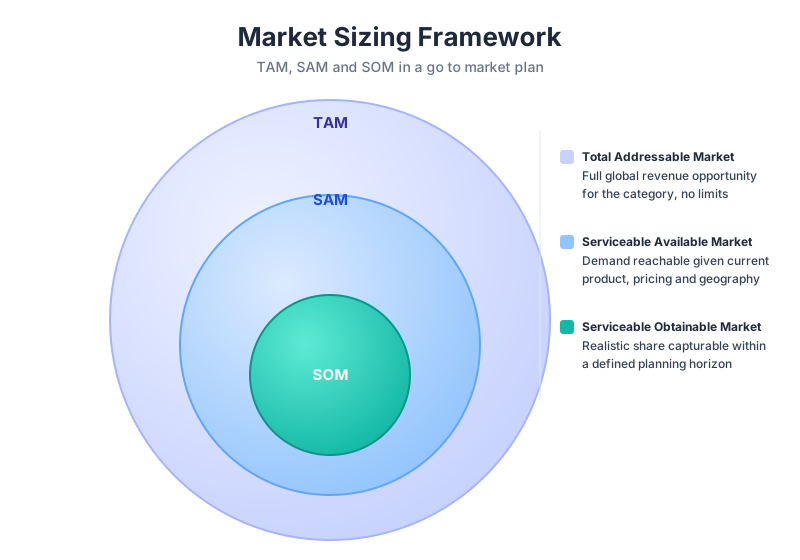
Once the market is defined and mapped, the next step is putting numbers behind the opportunity. This is where the classic TAM, SAM, SOM framework comes into play, a staple of nearly every go to market and fundraising deck for good reason: it forces discipline about what is truly winnable.
Total Addressable Market (TAM)
The Total Addressable Market represents the full revenue opportunity if a company captured one hundred percent of demand for its category, globally, with no competition. TAM is usually calculated using a top down approach, pulling from industry reports, analyst estimates, and government trade data, or a bottom up approach, multiplying the number of potential buyers by average spend per buyer.
Neither method is perfect, and the smartest go to market teams triangulate both approaches to sanity check their numbers rather than relying on a single flashy statistic pulled from a research firm.
A common pitfall with TAM calculations is anchoring too heavily on a single analyst report without questioning the assumptions behind it. Analyst estimates can vary wildly depending on how narrowly or broadly they define the category, and a team that simply quotes the biggest available number without understanding how it was derived often ends up with a figure that impresses in a slide deck but does not hold up under scrutiny from a sharp investor or a skeptical executive.
A more durable approach is to build the TAM from first principles, starting with the number of potential buying units, whether that is companies, households, or individual consumers, and multiplying by a realistic average spend figure grounded in actual pricing data from the category. This bottom up number can then be cross checked against any available top down industry estimates, and where the two numbers diverge significantly, that gap itself becomes a useful signal worth investigating further.
Serviceable Available Market (SAM)
SAM narrows TAM down to the portion of the market that a company's specific product, pricing, and geographic reach can realistically serve. If a company only sells in North America and Western Europe, its SAM excludes demand from regions it has no current ability to reach.
Calculating SAM forces a useful, sometimes humbling, conversation inside a go to market team. It requires being honest about product limitations, language support gaps, and pricing tiers that may not fit every buyer in the broader TAM. Some teams resist narrowing the number because a smaller figure feels less impressive, but a well reasoned SAM is far more useful for planning purposes than an inflated TAM figure that has little bearing on next year's actual revenue targets.
Serviceable Obtainable Market (SOM)
SOM is the most grounded of the three figures. It represents the realistic share of the SAM a company can capture within a defined time frame, usually informed by current sales capacity, brand awareness, competitive intensity, and go to market resourcing.
Calculating SOM well requires looking honestly at current conversion rates, average deal size, and the capacity of the existing sales and marketing engine. A company with a small sales team and limited brand recognition should not assume it can capture the same share of the market as a well funded competitor with years of brand equity already built up. SOM should also be revisited at least twice a year, since sales capacity and competitive intensity both shift over time, and a SOM figure calculated eighteen months ago may no longer reflect current reality.
| Market Layer | Definition | Typical Data Source | Time Horizon |
|---|---|---|---|
| TAM | Total global demand for the category | Industry reports, government data | Long term, 5 to 10 years |
| SAM | Demand reachable given current reach and offering | Internal segmentation, regional data | Medium term, 2 to 5 years |
| SOM | Realistic capturable share given resources | Sales capacity, pipeline data, win rates | Short term, 1 to 2 years |
Market Growth Forecasts
Growth forecasts help a go to market team understand whether they are entering a market on the way up, at a plateau, or in decline. Forecasts are typically expressed as a compound annual growth rate, and should always be paired with the underlying assumptions driving that growth, whether it is regulatory tailwinds, new technology adoption, demographic shifts, or increased digital spend.
A healthy forecast section should also flag downside scenarios, since markets rarely grow in a straight line, and a go to market plan built only on the optimistic case tends to fall apart the moment growth slows.
It is also worth distinguishing between overall category growth and a specific company's ability to capture that growth. A market growing at a healthy pace can still be a difficult place to operate if competitive intensity is increasing even faster, absorbing most of the new demand before smaller players get a chance to compete for it. Pairing the growth forecast with a competitive intensity trend line gives a much more honest picture of what growth actually means for a specific business, rather than assuming a rising tide automatically lifts every boat in the water.
Market Trends & Emerging Shifts
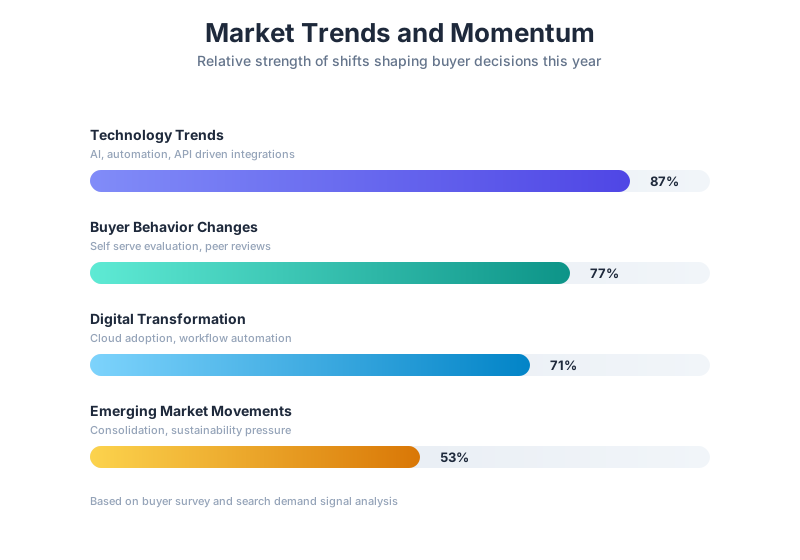
Markets are living systems, constantly reshaped by new technology, shifting buyer expectations, and broader economic forces. A go to market strategy that ignores emerging shifts risks building a plan for a market that no longer exists by the time the product ships.
Technology Trends
Technology trends often act as the single biggest driver of market disruption. Artificial intelligence, automation, and API driven integrations have reshaped buyer expectations across nearly every category in recent years, pushing customers to expect faster implementation, smarter defaults, and less manual work.
Tracking technology trends means watching not just what is being built, but what buyers are starting to expect as table stakes, since yesterday's differentiator quickly becomes today's minimum requirement.
One practical way to stay ahead of technology trends is to monitor what adjacent categories are already doing, rather than only watching direct competitors. Many of the biggest shifts in a market start somewhere else entirely and migrate over once buyers get used to a certain experience elsewhere and start expecting it everywhere. A go to market team that only benchmarks against its closest rivals often misses these cross category shifts until it is playing catch up rather than leading the change.
It also helps to separate genuine technology trends from short lived hype cycles. Not every buzzword translates into a lasting shift in buyer expectations, and chasing every new trend can spread a go to market team's attention too thin. A useful filter is to ask whether a given trend is actually changing how buyers evaluate and select vendors, or whether it is mostly generating conference talks and marketing buzzwords without much real change in purchasing behavior underneath.
Buyer Behavior Changes
Buyer behavior has shifted considerably, with more purchasing decisions being researched independently online before a buyer ever speaks to a salesperson. Self-serve trials, peer reviews, and community recommendations now carry as much or more weight than a polished sales pitch.
Key buyer behavior shifts to monitor include:
- Preference for self-serve evaluation over guided sales demos
- Increased reliance on peer review platforms before shortlisting vendors
- Growing demand for transparent, published pricing
- Shorter attention spans for lengthy sales cycles
These shifts have real implications for go to market planning. A sales process built around a lengthy, multi call discovery process may frustrate buyers who have already done extensive independent research and simply want a fast path to a decision. Similarly, hiding pricing behind a contact form can quietly push buyers toward a competitor that publishes its pricing openly, especially in categories where buyers are comparing several options in the same browsing session.
Buyer committees have also grown larger in many categories, with more stakeholders weighing in before a purchase gets approved. This means content and messaging need to speak to multiple roles at once, from the day to day user to the budget owner to the technical reviewer checking security and integration requirements, rather than assuming a single buyer persona makes the entire decision alone.
Digital Transformation
Digital transformation continues to push even traditionally slow moving industries toward cloud based tools, data driven decision making, and automated workflows. This shift creates enormous go to market opportunity for companies that can position themselves as the bridge between legacy processes and modern digital operations.
Industries that were historically slower to digitize, such as manufacturing, construction, and parts of healthcare, are now under increasing pressure to modernize as workforce expectations change and competitors who have already digitized pull ahead on efficiency. Go to market teams selling into these industries often find success by leading with education rather than a hard sell, helping buyers understand what digital transformation actually looks like in their specific context before asking for a purchase decision.
Emerging Market Movements
Beyond technology, broader movements such as economic pressure toward efficiency, sustainability requirements, and consolidation through mergers and acquisitions all reshape how buyers prioritize spend. A thorough trends section should track these macro movements alongside the more product specific technology trends, since budget holders often make purchasing decisions based on company wide pressures rather than category specific ones.
Consolidation in particular deserves close attention, since mergers and acquisitions among buyers can either create larger deal opportunities or introduce unexpected churn risk if an acquired company standardizes on a competitor's tool instead. Keeping an eye on merger and acquisition activity within a target customer base helps a go to market team anticipate both the upside and the downside of these market movements rather than being caught off guard by them.
Market Opportunities
Once the trends are clear, the next question becomes obvious: where exactly is the opening for growth? This is where market research earns its keep, by translating broad observations into specific, actionable opportunity areas.
High-Growth Segments
Not every segment of a market grows at the same rate. High growth segments are often defined by newer buyer personas, emerging use cases, or previously underinvested verticals suddenly getting budget attention. Identifying these segments early allows a go to market team to build positioning and messaging before competitors catch on.
A practical way to spot a high growth segment before it becomes obvious to everyone else is to watch search demand and community conversation volume around a specific use case or persona, since interest tends to show up in these channels well before it shows up in industry reports. Sales teams are another underused source of early signal, since reps often notice a new type of buyer showing up in inbound inquiries months before that shift gets formally recognized as a strategic priority.
| Opportunity Type | Signal to Watch | Go To Market Action |
|---|---|---|
| High Growth Segment | Rising search demand, new budget lines | Build dedicated messaging and content |
| White Space | No dominant player serving the need | Move quickly with a focused offer |
| Underserved Market | Complaints about existing tools, poor reviews | Target with differentiated value prop |
| Expansion Opportunity | Existing customers asking for adjacent features | Package as upsell or new product line |
White Space Opportunities
White space refers to areas of the market where no single vendor has established clear dominance. These gaps are often the result of a shift in buyer needs that existing players have been slow to address, creating room for a fast moving company to claim the position before it becomes contested.
White space does not always mean an entirely new category. Sometimes it means a well known category served through an outdated pricing model, a clunky user experience, or a lack of support for a specific workflow that a growing number of buyers now expect. The size of the white space opportunity should be weighed against how quickly established competitors could close the gap once they notice a challenger moving into it, since some white space closes fast once it becomes visible to well resourced incumbents.
Underserved Markets
Underserved markets are segments where existing solutions technically exist, but fail to meet buyer expectations on price, usability, or support. These markets often show up clearly in review sites and community forums, where buyers openly complain about the tools they are forced to use.
Reading through negative reviews of established competitors, particularly the two and three star reviews rather than the harshest one star complaints, often reveals a pattern of specific, addressable frustrations rather than vague dissatisfaction. These patterns can directly inform both product roadmap priorities and go to market messaging that speaks to the exact frustrations buyers have already expressed publicly about the alternatives.
Expansion Opportunities
For companies already established in a market, expansion opportunities come from existing customers who need more than the core offering provides. Listening to customer support tickets, sales call notes, and renewal conversations often surfaces natural product line extensions that customers are practically asking for.
Expansion opportunities are often the least risky growth path available to an established company, since they involve selling more to an audience that already trusts the brand rather than convincing an entirely new buyer to take a chance on an unfamiliar vendor. Prioritizing these opportunities alongside net new market expansion tends to produce a more balanced and resilient overall growth plan.
Market Challenges & Barriers
No market research is complete without an honest accounting of what could go wrong. Challenges and barriers shape how aggressive or cautious a go to market plan should be, and ignoring them tends to produce overly optimistic revenue targets.
Adoption Challenges
Adoption challenges include anything that slows a buyer down from saying yes and actually implementing a solution. This can include internal change management resistance, lack of technical resources to integrate a new tool, or simply comfort with the status quo, even when that status quo is clearly worse.
Change management resistance in particular deserves attention, since it often has little to do with the product itself and everything to do with the people who would need to change their daily habits to use it. A go to market team that only addresses the rational, feature level objections while ignoring the emotional and organizational resistance to change tends to lose deals that looked strong on paper right up until the final decision.
Economic Pressures
Broader economic conditions, such as tightened budgets, hiring freezes, or interest rate changes, directly affect how much discretionary spend is available for new tools. A go to market plan built during a growth economy needs adjustment when the broader economic mood shifts toward caution.
During tighter economic periods, buyers tend to scrutinize return on investment far more aggressively, shift budget toward tools that consolidate multiple functions rather than adding another point solution, and lengthen approval cycles as more stakeholders get pulled into every purchasing decision. Messaging and pricing strategy should flex with these conditions rather than staying static across very different economic climates.
Technology Limitations
Sometimes the barrier is not the buyer, but the underlying technology itself. Integration limitations, data privacy constraints, or simply the immaturity of a new technology category can slow adoption even when buyer appetite is high.
Legacy infrastructure is a particularly persistent technology limitation in older, larger organizations, where a new tool may need to connect with systems that are decades old and poorly documented. Go to market teams selling into these environments benefit from being upfront about integration requirements early in the sales process, rather than letting a technical blocker surface late and stall a deal that had otherwise been progressing well.
Customer Concerns
Common customer concerns that slow down go to market momentum include:
- Uncertainty about return on investment
- Concerns about data security and vendor reliability
- Fear of switching costs from an existing tool
- Lack of internal expertise to manage a new system
Market Risks
Beyond individual buyer hesitation, broader market risks include the entrance of a well funded competitor, a shift in regulation that changes the rules of the category, or a macro trend that reduces overall demand. Building a risk register alongside the opportunity analysis keeps a go to market plan grounded in reality.
A useful practice is to rank each identified risk by both likelihood and potential impact, then focus mitigation planning on the risks that score high on both dimensions rather than spreading equal attention across every possible thing that could go wrong. This keeps the risk section actionable rather than turning into an exhaustive, anxiety inducing list that leadership skims past without absorbing the parts that actually matter most.
Market Regulations & Compliance
Regulatory requirements can make or break a go to market timeline, particularly for companies selling into healthcare, finance, or government sectors. Skipping this research often leads to expensive surprises well after a launch date has already been announced.
Industry Regulations
Every industry carries its own regulatory framework, whether that is financial services compliance, healthcare data handling rules, or product safety standards. Understanding these requirements early allows a go to market team to build compliance into the product and messaging from day one, rather than retrofitting it later.
Regulated industries often move more slowly through the sales cycle precisely because compliance sign off adds an extra layer of review that unregulated industries do not face. Building this expectation into sales forecasting from the start prevents the common mistake of applying a general sales cycle benchmark to a regulated vertical that simply takes longer to close, no matter how strong the product fit might be.
Data Privacy Requirements
Data privacy law has become one of the most consistently important compliance areas across nearly every industry, given how much modern software depends on collecting and processing customer data. Regional privacy frameworks vary considerably, and a go to market plan expanding into new regions needs to account for these differences well before launch.
Beyond the well known frameworks that most teams are already familiar with, newer and regionally specific privacy laws continue to appear as more governments introduce their own data protection rules. A go to market team expanding internationally should build a habit of checking the current privacy landscape in each target region rather than assuming a single global compliance posture will satisfy every jurisdiction equally.
| Compliance Area | Common Requirement | Go To Market Impact |
|---|---|---|
| Data Privacy | Consent management, data residency rules | Affects hosting location and onboarding flow |
| Industry Regulation | Sector specific certifications | Affects sales cycle length and required documentation |
| Regional Compliance | Local business registration, tax rules | Affects entity setup and localized contracts |
| Security Standards | Certification requirements for enterprise buyers | Affects enterprise sales readiness |
Regional Compliance
Regional compliance covers everything from business registration requirements to local consumer protection laws. Companies expanding into new geographies as part of their go to market plan need a clear checklist of what is required before they can legally sell, market, and support customers in that region.
Working with local legal counsel during the earliest stages of geographic expansion, rather than after the first customer contract needs signing, tends to prevent costly delays. Some regions also require local business entities or specific tax registrations before a company can legally invoice customers, and discovering this requirement mid deal can push an otherwise closed sale back by weeks or months.
Security Standards
Enterprise buyers increasingly require vendors to meet recognized security certifications before they will even consider a purchase. Building toward these standards early, rather than scrambling once an enterprise deal is on the table, saves significant time later in the go to market journey.
Security certification processes typically take several months to complete properly, which means a go to market team targeting enterprise buyers should start this work well before the first large deal reaches the negotiation stage. Treating security readiness as a growth lever rather than a compliance obligation tends to shift how the whole organization prioritizes it.
Legal Considerations
Beyond formal regulation, general legal considerations such as contract terms, liability limitations, and intellectual property protections all shape how confidently a sales team can move deals forward. A go to market plan should include legal review checkpoints at key milestones rather than treating legal as an afterthought.
Standardizing a set of contract templates in advance, rather than negotiating every clause from scratch with each new customer, considerably speeds up deal velocity. Sales teams equipped with pre approved terms and a clear escalation path for exceptions close deals faster than teams that route every contract question through an ad hoc legal review each time.
Market Landscape Analysis
With the opportunities, risks, and regulatory picture in place, it helps to step back and analyze the overall structure of the market itself, since this shapes how a go to market motion should actually be built.
Market Maturity
Market maturity describes where a category sits in its lifecycle, from early emerging, to growth stage, to mature, to declining. Each stage calls for a different go to market approach. Early markets require significant education and category creation, while mature markets demand sharper differentiation against well known alternatives.
Misreading maturity is a common and costly mistake. A team that treats a mature market as if it were still emerging tends to waste marketing budget explaining a problem buyers already understand well, while a team that treats an emerging market as if it were mature often struggles because there simply is not enough buyer education in the market yet to support a sales motion built around quick, low touch conversions.
Supply and Demand Dynamics
Understanding supply and demand dynamics means looking at how many vendors are competing for buyer attention relative to how much genuine demand exists. A market with too many vendors chasing too little demand tends to produce price wars, while an undersupplied market with strong demand creates room for premium pricing.
Watching funding activity across a category is a useful proxy for supply dynamics, since a sudden wave of new venture funded entrants usually signals that supply is about to increase significantly, often faster than underlying demand can absorb. Teams that notice this shift early can adjust pricing and positioning strategy before increased competition compresses margins across the board.
Ecosystem Participants
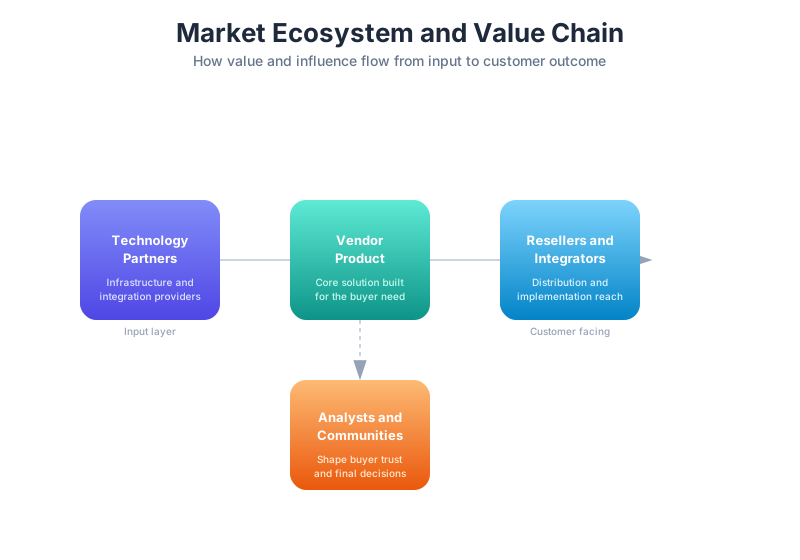
Markets rarely consist of just buyers and sellers. Ecosystem participants include technology partners, resellers, system integrators, and industry analysts, all of whom influence how buyers discover and evaluate solutions.
Building relationships with these ecosystem participants early can meaningfully accelerate a go to market motion, since a favorable mention from a respected industry analyst or a strong integration with a widely used platform often carries more credibility with buyers than any amount of direct marketing spend. Mapping out which ecosystem participants hold the most influence over a target buyer's decision making process helps a team prioritize partnership development rather than spreading effort thin across every possible relationship.
Value Chain Analysis
A value chain analysis traces how value flows from raw inputs through to the final customer experience, helping a go to market team identify where they sit in that chain and where the biggest margin opportunities exist.
Understanding the full value chain also clarifies who else profits from a customer's purchase decision beyond the core vendor itself, whether that is implementation partners, hosting providers, or complementary tool vendors. This visibility often reveals unexpected partnership or channel opportunities that would not be obvious from looking only at the direct vendor to customer relationship.
Industry Structure
Industry structure looks at how concentrated or fragmented a market is. Highly concentrated markets, dominated by a handful of large players, require a very different competitive strategy than fragmented markets with hundreds of small players and no clear leader.
In a concentrated market, a new entrant usually needs a sharply differentiated angle to earn attention against well established brand recognition, since buyers often default to the safe, known choice unless given a compelling reason to consider an alternative. In a fragmented market, the opportunity often lies in becoming the consolidator, whether through superior product experience, more effective marketing, or a business model that smaller competitors cannot easily replicate.
| Structure Type | Characteristics | Go To Market Implication |
|---|---|---|
| Concentrated | Few large players hold majority share | Differentiation and niche focus needed to compete |
| Fragmented | Many small players, no clear leader | Opportunity to consolidate through superior product or brand |
| Emerging | Category still being defined | Education heavy go to market motion required |
| Mature | Slow growth, established buying patterns | Focus on efficiency, retention, and expansion revenue |
Market Forecast & Future Outlook
A forward looking view of the market helps a go to market team plan not just for today's launch, but for the next several years of strategy and investment decisions.
Short-term Outlook
The short term outlook, typically covering the next twelve to eighteen months, should reflect current pipeline data, known competitive moves, and near term demand signals. This is the section leadership will scrutinize most closely, since it directly informs budget and headcount planning.
Because this window is close enough to be reasonably predictable, the short term outlook should be revisited monthly or quarterly, comparing actual results against the original forecast and adjusting future projections based on what is actually happening in the pipeline rather than sticking rigidly to a number set many months earlier.
Long-term Outlook
Longer term outlook, spanning three to five years, should account for broader structural shifts such as technology adoption curves, demographic changes, and evolving regulatory environments. While less precise than short term forecasts, this view helps guide bigger bets like new market entry or product line expansion.
Even though precision naturally decreases the further out a forecast reaches, the long term outlook still serves an important purpose, since it forces leadership to think beyond the current quarter and consider whether today's go to market motion will still make sense several years from now as the underlying market continues to shift.
Growth Scenarios
Rather than presenting a single forecast number, mature go to market teams build multiple growth scenarios, typically a conservative case, a base case, and an aggressive case, each with clearly stated assumptions driving the difference.
Presenting scenarios this way, rather than a single point estimate, gives leadership a much more useful planning tool, since it makes explicit what would need to be true for growth to land at the high end versus the low end. It also protects the go to market team from being held to an overly optimistic number that was really more of a stretch goal than a genuine forecast.
Market Evolution
Markets evolve as customer needs mature and new entrants reshape expectations. Tracking how a market has changed over the past several years, and extrapolating that pattern forward, often reveals where the next wave of disruption is likely to come from.
Looking at how adjacent, more mature markets have evolved over a longer time horizon can also offer a useful preview of where a newer market is headed, since many categories follow similar patterns of consolidation, feature commoditization, and eventual platform expansion as they mature.
Potential Disruptions
Every forecast should include an honest look at what could disrupt it entirely, whether that is a new technology making the current solution obsolete, a shift in buyer preference, or a new regulatory requirement that changes the competitive playing field overnight.
Running a simple exercise where the team imagines the market five years from now and works backward to identify what would have needed to happen to get there is often more revealing than trying to forecast forward one year at a time. This kind of backward looking exercise surfaces disruption scenarios that a purely forward looking forecast, anchored too heavily in current trends, tends to miss entirely.
Strategic Market Recommendations
All of this research exists to inform decisions. This section translates analysis into concrete, prioritized recommendations that a go to market team can actually execute against.
Attractive Market Priorities
Based on the size, growth rate, and competitive intensity analyzed earlier, this section should rank which segments or geographies deserve the most immediate investment, and which should be deprioritized for now.
A simple way to present this ranking is to plot each candidate segment on a two by two grid, weighing market attractiveness against a company's current ability to win in that segment. Segments that score high on both dimensions become the clear near term priorities, while segments that score high on attractiveness but low on current ability to win become longer term targets worth building toward rather than chasing immediately.
Entry Considerations
For new markets or segments, entry considerations should cover the ideal timing, the minimum viable positioning needed to compete, and the resources required to launch credibly rather than half heartedly.
Timing deserves particular attention here, since entering a segment too early, before buyer education has caught up, can be just as costly as entering too late, after competitors have already locked in the strongest customer relationships. Looking at the buyer behavior and trend signals covered earlier in this document helps pin down whether a given segment is genuinely ready for a serious go to market push right now.
Investment Priorities
Investment priorities translate the opportunity analysis into where budget and headcount should actually go, whether that is product development, regional sales hiring, partnership development, or marketing spend.
Tying each investment priority back to a specific piece of evidence from earlier in the research, rather than presenting them as standalone recommendations, makes the case far more persuasive to leadership and finance teams who will ultimately need to approve the associated budget. A recommendation backed by a clear data point tends to survive budget review far better than one that simply sounds directionally correct.
| Priority Area | Recommended Focus | Expected Impact |
|---|---|---|
| Product Investment | Close feature gaps in high growth segments | Improved competitive win rate |
| Regional Expansion | Enter regions with strong demand signals | New revenue streams |
| Partnership Development | Build ecosystem relationships early | Faster market credibility |
| Compliance Readiness | Achieve required certifications proactively | Shorter enterprise sales cycles |
Risk Mitigation Recommendations
Every recommendation should be paired with a corresponding risk mitigation plan, whether that means diversifying across multiple segments to avoid overreliance on one, building compliance early to avoid regulatory delays, or maintaining pricing flexibility to respond to competitive pressure.
Assigning clear ownership for each mitigation item, along with a review cadence for checking progress, prevents these plans from being written once and then quietly forgotten. A risk mitigation plan with no owner and no follow up rhythm rarely gets acted on when the risk actually materializes months later.
Executive Market Summary
The executive summary distills everything above into a format busy leadership teams can absorb in a few minutes, without losing the substance behind the analysis.
Key Findings
The key findings section should highlight the most important two or three insights from the entire research effort, stated plainly and backed by the strongest available data points. Resist the urge to cram every interesting detail from the full report into this section, since the goal here is clarity and focus, not comprehensiveness. The full detail already lives in the sections above for anyone who wants to dig deeper.
Biggest Opportunities
Leadership needs a clear, ranked view of where the biggest opportunities sit, along with a rough sense of the revenue potential and timeline required to capture them. Framing each opportunity with a specific, quantified upside, rather than a vague description of potential, gives decision makers something concrete to weigh against competing priorities elsewhere in the business.
Major Risks
Alongside opportunity, the summary should name the two or three risks most likely to derail the go to market plan, along with the mitigation approach already outlined earlier in the document. Leadership generally responds better to a risk paired with a clear plan than to a risk presented without any accompanying response, since the latter can read as an unresolved problem rather than a managed one.
Executive Insights
This section can include any strategic insight that does not fit neatly into opportunities or risks, such as observations about competitive behavior, shifts in buyer sentiment, or timing considerations that leadership should weigh before greenlighting a full go to market investment. These softer, more qualitative insights often carry as much weight in a final decision as the harder numbers presented elsewhere in the summary.
Recommended Next Steps
Finally, the summary should close with a short, concrete list of next steps, whether that is approving budget for a specific segment, greenlighting a pilot in a new region, or commissioning deeper research into a particular risk area before committing further resources.
Market research is never truly finished. The best go to market teams treat it as a living document, revisited quarterly, updated as new data comes in, and used consistently to keep strategy grounded in what the market is actually doing rather than what the original plan assumed it would do.
Contents