
Salesforce vs Elevate: Which Platform Is Right for Your Business?
Salesforce is the reference point most enterprise buyers measure every other GTM tool against, whether or not the comparison actually makes sense. It is the CRM that built the category, the platform that popularized software as a service, and for a huge share of mid market and enterprise companies, the literal system every deal, every account, and every support case lives inside. Elevate GTM Solutions is a much newer, much narrower product: an AI native platform built to generate go to market strategy rather than run day to day operations.
Those two sentences already tell you most of what you need to know about whether this is really a head to head comparison. Salesforce is infrastructure. It is where a company records what happened, who owns it, and what happens next across sales, service, marketing, and increasingly an AI agent layer called Agentforce. Elevate is upstream of that. It is where a company decides who it is selling to, what it says to them, and how that message should differ across segments, before any of it gets configured into a Salesforce org.
This guide breaks down what each platform actually does, where a genuine comparison holds up, where it does not, and how the two fit together for a team that already runs Salesforce as its system of record and is now looking for a sharper strategic layer feeding into it.
Salesforce vs Elevate at a Glance
| Salesforce | Elevate GTM Solutions | |
|---|---|---|
| Category | Enterprise CRM and customer platform | AI native GTM strategy platform |
| Solves for | Running and recording sales, service, and marketing operations at scale | Defining who to target and what to say to them |
| Sits in the stack | System of record and execution layer | Strategy layer |
| Built around | A highly configurable CRM core plus Sales, Service, Marketing, and Data Clouds | A structured, multi module GTM methodology |
| Ideal owner | Sales ops, RevOps, Salesforce admins, and certified implementation partners | Marketing leader, founder, or GTM advisor |
| Starting price | Free Suite for 2 users, paid editions from $25 per user per month | $499 per month |
| Output | Pipeline records, cases, campaigns, forecasts, and AI agent actions | ICP, positioning, messaging, launch and channel plans |
| Not designed to do | Generate original positioning or competitive narrative | Store CRM records or manage a sales pipeline |
The one line version: if your biggest challenge is strategy, clarity on who to target and what to say, choose Elevate. If your biggest challenge is running and recording complex sales, service, and marketing operations at scale, choose Salesforce. Large, mature organizations very often need both, one feeding configuration and content into the other.
Executive Summary
If you only have three minutes, here is the short version.
Salesforce is built for organizations that need a highly configurable system of record for complex sales, service, and marketing operations, and that have the budget and administrative capacity to configure it properly. Its strength is depth and extensibility: custom objects, workflow automation, a vast partner and app ecosystem through AppExchange, and now Agentforce, a genuinely capable AI agent layer that can act autonomously inside cases, opportunities, and conversations. Salesforce's weakness is that none of that configurability generates a strategy on its own. It is exceptionally good at running whatever go to market motion you configure it to run. It does not tell you what that motion should be.
Elevate GTM Solutions is built for teams that need that upstream definition established or kept current as markets shift. It takes market context, product details, and competitive information as input, and produces structured outputs: ideal customer profiles, positioning frameworks, messaging architecture, channel strategy, and launch plans. Elevate's strength is turning fragmented go to market thinking into a single operating system that marketing, sales, and product can align around before a single Salesforce flow or campaign gets built. Its weakness is that it does not store an opportunity record, run a support case, or forecast a quarter. It is not a replacement for a CRM.
The practical framing that most teams land on: Salesforce answers "how do we run and record this at scale," Elevate answers "what should we run and why." A sales organization with hundreds of reps, complex approval processes, and no unified pipeline visibility has an operational and governance gap that Salesforce is built to close. A company with a fully built out Salesforce org and reps who still describe the product differently on every call has a strategic gap that Elevate is built to close. These are very rarely competing budget lines. In most enterprise GTM stacks, they are sequential and complementary ones.
The rest of this guide unpacks the details behind that summary: feature by feature, philosophy by philosophy, and scenario by scenario, so you can make the call for your own team with full context rather than a marketing headline.
Key takeaway: comparing Salesforce and Elevate feature for feature will make Salesforce look like the categorically larger platform, because it is one of the largest enterprise software categories that exists. That size difference reflects a different product category, not a verdict on which platform is more useful for the specific problem it was built to solve.
What Is Salesforce?
Salesforce was founded in 1999 and is widely credited with popularizing the software as a service model for enterprise applications, built on the pitch that companies should rent CRM software over the internet rather than install and maintain it on premise. Salesforce is publicly traded on the New York Stock Exchange under the ticker CRM and has grown into one of the largest enterprise software companies in the world, with a sprawling ecosystem of certified administrators, implementation partners, and third party applications built around its platform.
The core of the product is a highly configurable relational database with a CRM layer on top, historically sold as Sales Cloud and Service Cloud and, as of Salesforce's 2025 and 2026 rebranding, increasingly marketed under the Agentforce name to emphasize the AI agent capabilities now bundled into each cloud:
- Agentforce Sales (formerly Sales Cloud): opportunity and pipeline management, forecasting, lead and account management, and workflow automation, now available with unmetered AI agent access at the top tier.
- Agentforce Service (formerly Service Cloud): case management, a knowledge base, omnichannel support routing, and AI agents that can resolve or triage support cases autonomously.
- Agentforce Marketing (built on the newer Marketing Cloud Growth engine, distinct from the legacy Marketing Cloud Engagement and Account Engagement products Salesforce acquired over the years): campaign management and marketing automation, priced per organization rather than per user.
- Data Cloud: Salesforce's unified data layer, increasingly the backbone that lets Agentforce agents reason across records from every cloud rather than working from a single object.
- CRM Analytics: AI powered dashboards and reporting, sold as a separate add on starting at a meaningfully higher price point than the base CRM editions.
- Salesforce Platform, marketed as the Agentforce 360 Platform: the low code and pro code layer for building custom applications on top of the same data model, the foundation that makes Salesforce's degree of customization possible in the first place.
Pricing reflects that breadth and that configurability. Sales Cloud, now sold as Agentforce Sales, runs five published editions: a permanent Free Suite capped at two users, a Starter Suite around 25 dollars per user per month, a Pro Suite around 100 dollars, an Enterprise edition around 175 dollars, an Unlimited edition around 350 dollars, and an Agentforce 1 Sales edition around 550 dollars per user per month that bundles in unmetered Agentforce AI usage. Below Agentforce 1, AI agent usage is billed separately through Flex Credits, roughly 500 dollars per 100,000 credits, with each standard agent action consuming a small number of credits, or through a per conversation rate for customer facing agents. Most growing sales teams land on the Enterprise edition, and the jump in list price from tier to tier is driven almost entirely by how much automation, customization, and AI capability is unlocked.
Agentforce is Salesforce's answer to the current wave of AI agents in enterprise software, and it is worth treating as a distinct product line rather than a feature checkbox. Built on Agent Builder and Prompt Builder, it lets an admin configure autonomous or semi autonomous agents that can triage a support case, draft a follow up email, update a record, or recommend a next best action, grounded in the company's own CRM and Data Cloud records rather than general web knowledge. Salesforce Foundations, a tier available at no additional cost to Enterprise edition customers and above, includes a starting allotment of Flex Credits and Data Cloud credits specifically to let existing customers begin experimenting with Agentforce without an immediate new purchase.
Who actually uses Salesforce day to day tends to require more specialized roles than most CRM alternatives, precisely because the configurability that makes the platform powerful also makes it complex: certified Salesforce administrators who own the org's configuration, RevOps and sales ops teams who define process and automation, developers who build custom objects and integrations on the Salesforce Platform, and end users, sales reps, service agents, and marketers, who mostly interact with whatever has already been configured for them. Implementation timelines and cost at the Enterprise and Unlimited tiers routinely involve a certified partner rather than a self serve setup, and ongoing administrative capacity, whether in house or contracted, is close to a prerequisite for getting real value out of the platform at scale.
A Quick Example
Picture a two hundred person enterprise software company with a multi region sales team, a formal deal approval process, and a support organization handling thousands of cases a month across email, phone, and chat. The company runs its entire revenue and service operation inside Salesforce: opportunities move through a custom, multi stage approval workflow built on the Salesforce Platform, an Agentforce Service agent triages incoming cases and resolves routine ones automatically, and leadership pulls forecasting and pipeline reporting that rolls up cleanly across every region because every deal lives in the same underlying data model. None of that was possible off the shelf. A certified implementation partner spent months configuring custom objects, approval rules, and integrations before the system reached that level of sophistication.
Notice what that example assumes already exists: the company already knows its ICP, its deal stages, its approval thresholds, and roughly what its reps should say on a call. Salesforce did not generate any of that. It gave the company an extraordinarily capable, extraordinarily configurable system to run and record that already defined process at scale, once someone else had decided what the process should be.
What Is Elevate?
Elevate GTM Solutions describes itself as an AI native GTM operating system, and the framing is deliberate. Rather than positioning itself as a configurable system of record for enterprise operations, Elevate is structured around the idea that go to market strategy, positioning, messaging, channel selection, and execution planning, should live in one connected system instead of scattered across slide decks, static planning documents, and institutional memory that walks out the door when someone leaves.
The platform is organized around what it calls a fourteen module GTM methodology, spanning the full lifecycle from market research through customer advocacy. Practically, a user starts by entering business context: the product, the target market, industry, and segment. Elevate then generates structured outputs across the methodology rather than a single document. Reported categories include:
- GTM Context and Intelligence: market research, competitive intelligence, and ICP or segmentation modeling, meant to replace ad hoc research spread across browser tabs and analyst reports.
- GTM Strategy: product positioning, messaging architecture, and pricing strategy, structured so that every function is working from the same underlying narrative rather than function specific interpretations of it.
- GTM Activation and Execution: customer acquisition planning, distribution and channel strategy, marketing alignment, launch sequencing, and sales enablement material generated from the same strategic inputs.
- GTM Analytics: dashboards intended to track execution against the plan and flag where reality is drifting from the original strategic assumptions.
The philosophical anchor of the product is adaptability rather than a one time deliverable. Elevate frames traditional GTM planning as a static exercise: a strategy gets built once, usually during annual planning, gets turned into a deck, and then sits mostly untouched until the market has already moved past its assumptions. Elevate's pitch is that when market conditions, competitive dynamics, or buyer behavior shift, a user can update the underlying inputs and regenerate the affected parts of the strategy without starting the entire planning process over, keeping strategy and execution connected on an ongoing basis rather than treating them as sequential, disconnected phases.
Elevate also ships what it calls advanced intelligence modules on its top tier plan, abbreviated internally as EVUSP: buyer emotion and intent modeling, a GTM clarity and differentiation scoring system, and a defensible positioning and narrative framework. These sit above the core strategy generation layer and are aimed at teams trying to sharpen competitive differentiation rather than simply document it.
Elevate also runs a smaller advisory arm, pairing the software with fractional GTM advisors who use the platform as the operating system for client engagements, which suggests the company is positioning itself as much toward consultative go to market work as toward a pure self serve SaaS motion.
What actually differentiates the architecture. Elevate is a new entrant next to a nearly three decade old public company like Salesforce, so the fair way to evaluate it is on how the product is built rather than on the scale or ecosystem depth it has not yet had time to accumulate. Five architectural choices stand out:
- AI native from the ground up. Elevate was not built as a relational database with a CRM layer and AI agents added on top years later. The generation logic sits at the core of the product, which is why outputs update dynamically when inputs change rather than requiring a manual rewrite or a new configuration project.
- A unified GTM lifecycle in one system. Market research, positioning, channel strategy, and execution planning live inside a single connected model instead of separate documents, decks, and spreadsheets that each need to be manually kept in sync with whatever gets eventually configured downstream in a CRM.
- A structured GTM methodology, not a blank canvas. The fourteen module framework gives the platform a defined shape to generate against, which is a meaningfully different design choice than a general purpose agent builder that can be configured to do almost anything, but generates nothing on its own without detailed setup.
- Multi module strategy generation. A single set of business inputs, product, market, ICP, propagates across positioning, messaging, pricing, and channel modules simultaneously, so those outputs start from shared assumptions instead of being drafted independently by different functions and reconciled later inside separate CRM configurations.
- A strategy to activation to execution to analytics loop. The product is architected as a cycle rather than a one time output, with the analytics layer explicitly designed to feed back into the strategy layer as execution data comes in.
Key takeaway: Elevate's case rests on how the system is architected, an AI native, unified, methodology driven loop, rather than on ecosystem breadth or market tenure. That is a fair basis to evaluate a newer, more focused platform on, and it is worth testing directly against how your team currently handles strategic planning today, independent of how sophisticated your CRM configuration already is.
A Quick Example
Picture that same two hundred person enterprise software company, but a step earlier, before the multi stage approval workflow and the Agentforce Service agent existed, back when the company was deciding whether to expand from its core market into a new, adjacent industry vertical. A VP of Sales opens Elevate, inputs the company's product context and existing customer base, and asks the platform to evaluate the new vertical. Elevate generates market sizing, competitive density, and a draft ICP and positioning statement specific to that vertical. That output becomes the brief the RevOps team hands to its Salesforce implementation partner: the new record types, approval thresholds, and Agentforce agent configuration are all built around the ICP and messaging Elevate defined, rather than the implementation team guessing at segmentation logic on its own.
That sequencing is not incidental. It illustrates the core relationship between the two categories these platforms represent.
Feature Comparison Table
| Capability | Salesforce | Elevate GTM Solutions |
|---|---|---|
| Core function | Enterprise CRM and customer operations platform | AI-native GTM strategy and planning |
| Primary interface | CRM workspace, custom objects, automation, and admin tools | Structured GTM strategy dashboards and outputs |
| Primary user | Sales, service, marketing, RevOps, and IT teams | Marketing leaders, founders, product marketers |
| Customer data management | Enterprise CRM and system of record | Business context and AI-powered market research |
| Sales pipeline management | Yes, core feature | GTM planning and sales strategy |
| Workflow automation | Extensive automation across sales, service, and operations | Guided GTM workflows |
| Customer service management | Yes, Service Cloud | Customer success strategy |
| AI capabilities | Agentforce, Einstein AI, and Data Cloud | AI-native GTM planning across interconnected modules |
| Marketing automation | Marketing Cloud and campaign automation | Customer acquisition and GTM strategy |
| CRM and ecosystem integrations | Extensive AppExchange ecosystem and native integrations | Growing integration capabilities plus document export |
| ICP and segmentation | Segmentation using CRM data and business rules | Yes, structured module |
| Positioning and messaging | Limited | Yes, core module |
| Competitive intelligence | Limited | Yes, structured module |
| Pricing strategy | No | Yes, structured module |
| Channel and distribution strategy | Campaign and sales execution | Yes, structured module |
| GTM launch planning | Limited | Yes, structured module |
| Sales enablement | Sales content and AI assistance | Yes, structured module |
| Analytics focus | Sales, service, pipeline, and revenue analytics | Strategic execution and GTM alignment tracking |
| Learning curve | Advanced | Moderate, guided workflow |
| Typical setup owner | Salesforce administrators, RevOps, or implementation partners | Marketing leader or GTM advisor |
| Pricing model | Per-user subscription with edition and AI add-ons | Seat and GTM scope-based subscription |
| Entry price point | Starts from approximately $25/user/month | Starts at $499/month |
| Company type | Public company | Private company |
This comparison reflects two platforms that support different stages of the go-to-market lifecycle. Salesforce helps organizations manage customer relationships, automate sales and service processes, and execute day-to-day revenue operations through its CRM platform. Elevate GTM Solutions helps organizations define the strategy behind those activities, including ICPs, market segmentation, positioning, messaging, pricing, competitive strategy, and go-to-market planning. While both platforms contribute to revenue growth, their focus is different. Salesforce helps teams execute, manage, and measure customer interactions at scale, while Elevate helps define who to target, how to position the offering, and what go-to-market strategy should guide execution. Together, they provide a complementary combination of strategic planning and operational execution.
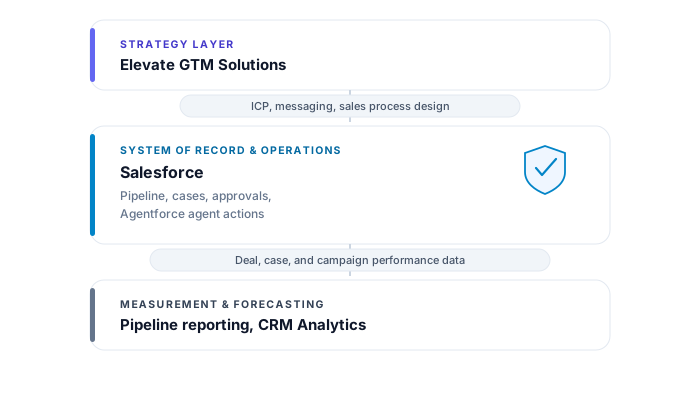
Reading the stack top to bottom is a useful diagnostic exercise on its own. If your organization has never clearly documented the top layer, no amount of Salesforce configuration sophistication in the middle layer can fully compensate, since every custom object and every Agentforce agent still needs a targeting and messaging hypothesis to be configured against. Conversely, if the top layer is well documented but the middle layer is a legacy spreadsheet based process, that strategy stays largely theoretical because there is no operational system of record consistently running it. Most GTM technology evaluations get more useful once a team maps its existing stack this way and identifies which layer is actually thin, rather than starting from a vendor comparison and working backward.
On pricing specifically, the two models reward very different organizational shapes and stages, so it is worth walking through the actual numbers rather than a single headline price. Salesforce's per seat editions scale from a permanent free tier capped at two users up through a published range of roughly 25, 100, 175, 350, and 550 dollars per user per month, with the top tier bundling in unmetered Agentforce AI usage. Below that top tier, AI agent usage is billed separately through Flex Credits, roughly 500 dollars per 100,000 credits, or a per conversation rate for customer facing agents, which means AI cost can be difficult to forecast precisely for a team that has not yet run a pilot to estimate volume. Add ons compound quickly at scale: CRM Analytics starts well above the base per seat price, Premier Support is commonly priced as a percentage of net license fees, and most Enterprise or Unlimited implementations carry a separate, often substantial implementation services quote that is not included in the per seat license figure at all. A fifty seat Enterprise deployment can reasonably run into six figures annually once support and implementation are included.
Elevate's structure is closer to traditional SaaS seat and scope pricing. The Guided GTM tier starts at 499 dollars a month for a single user working within a single GTM scope, meaning one product, market, and segment combination. The Growth tier runs 1,499 dollars a month and expands access to up to three users and up to three GTM scopes, which suits a company managing more than one product line or market simultaneously. The Scale tier is custom and annual, removes user and scope limits entirely, and is the only tier that includes the advanced EVUSP intelligence modules for buyer emotion modeling, differentiation scoring, and narrative defensibility.
Key takeaway: Salesforce's total cost of ownership scales with seats, edition, AI usage, and implementation complexity, and can become substantial well before an organization reaches enterprise scale. Elevate's cost scales with how many distinct strategic scopes you are actively defining. A two hundred person sales organization will spend vastly more on Salesforce licensing and implementation than on Elevate scopes. A company entering several new markets at once, with a lean existing CRM footprint, will see a much narrower gap between the two.
Philosophy Comparison
Every GTM tool encodes a belief about where the hard part of go to market actually lives. Salesforce and Elevate encode genuinely different beliefs, and understanding that difference matters more than any individual feature comparison.
Salesforce's implicit philosophy is that go to market success at scale is primarily a systems and governance problem. If every deal, case, and customer interaction is recorded consistently in one configurable system, with the right approval processes, automation, and now AI agents acting within clearly defined guardrails, growth follows from operational rigor and visibility that a spreadsheet or a patchwork of point tools cannot provide. This is a philosophy born out of enterprise scale, where the constraint is not usually finding a lead or writing an email, it is coordinating hundreds or thousands of employees across regions, product lines, and approval hierarchies without losing data integrity. Salesforce's entire architecture, the configurable object model, the platform layer for custom development, the growing Agentforce AI layer grounded in that same data, is built to give large, complex organizations one governed source of truth.
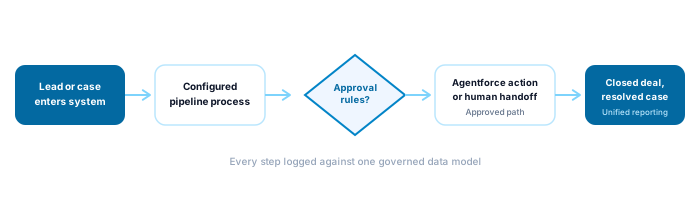
Elevate's implicit philosophy is close to a layer above that governance question. It treats go to market success as primarily a clarity and alignment problem that exists even when the operational system is excellent. The belief embedded in the product is that a company can have a beautifully governed Salesforce org, precise forecasting, and well configured Agentforce agents, and still underperform because the message running through all of that machinery is unclear or inconsistent: sales reps who describe the product differently depending on who trained them, a positioning statement that shifts every time leadership changes, an ICP definition that lives in three different segmentation rules across three different regions. Elevate's architecture, the fourteen module methodology, the shared outputs across functions, the emphasis on continuous adaptation rather than a static annual plan, is built to compress the gap between strategic intent and what every function actually executes inside that governed system.
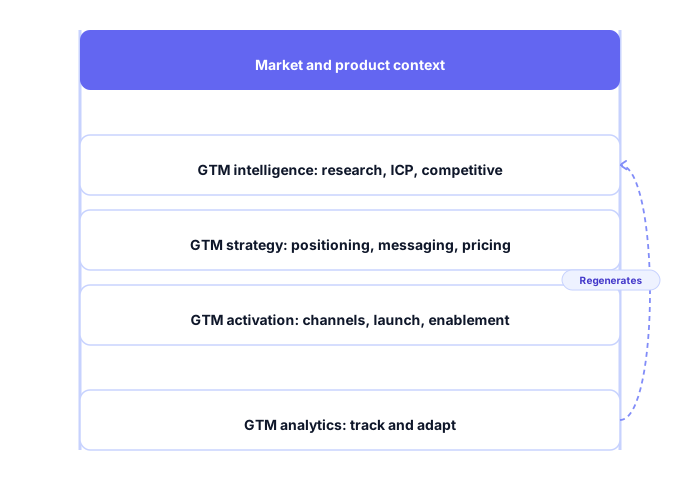
Notice the shape of the two diagrams. Salesforce's flow is a governed pipeline, a record moves through a defined process with approvals and automation, and ends in a measured outcome. Elevate's flow is a loop above that pipeline, strategy informs execution, execution generates signal, and that signal feeds back into strategy. Neither shape is wrong. They simply describe different layers of the same overall system. A team that only has the governed pipeline can run a highly disciplined operation but risks running it against a fuzzy or inconsistent message that no approval rule can catch. A team that only has the strategic loop can define a sharp story but has no native system to actually manage an opportunity, route a case, or forecast a quarter at scale.
There is also a philosophical difference in how each platform treats the human expert. Salesforce assumes an operator who wants deep configurability and governance: custom objects, approval hierarchies, permission sets, and an admin who understands the org's data model in detail. The product rewards someone who thinks like a systems architect building durable, auditable process at scale. Elevate assumes a strategic operator who wants structured guidance and speed: someone who understands go to market thinking conceptually but does not want to manually build a competitive positioning framework in a blank document at midnight before a board meeting. The product rewards someone who thinks like a strategist working against a deadline.
Neither philosophy is inherently premium or entry level. They are simply optimized for different layers of the same funnel, and the honest answer to "which philosophy is right" depends entirely on whether your organization's actual gap is governance and scale, or clarity and narrative, today.
Can They Work Together?
Yes, and for the large share of companies already running Salesforce, this is a far more common pairing than choosing one over the other, because Salesforce has no native mechanism for generating the strategic inputs its own configuration and Agentforce agents depend on.
The two platforms sit at different layers of the same system. Elevate operates at the strategy layer: defining who the ICP is, what the positioning says, which channels matter, and how messaging should be structured for each segment. Salesforce operates at the system of record and operations layer: capturing that ICP as configured segmentation and routing rules, turning that messaging into the actual prompts an Agentforce agent uses or the talk track a rep follows, and tracking the resulting pipeline and case activity against one governed data model. Used together, the output of one becomes the direct configuration input for the other.
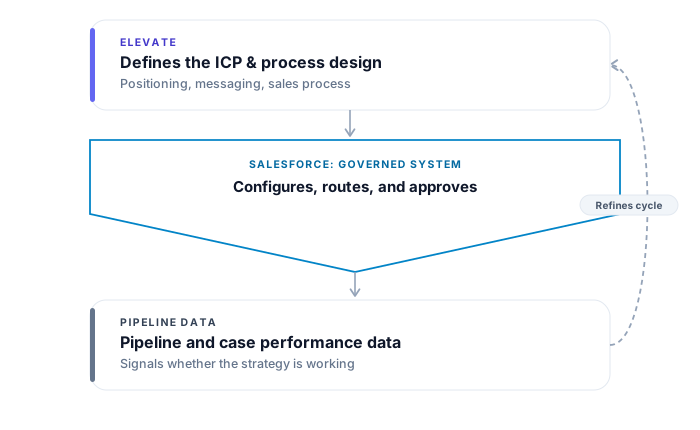
Key takeaway: the output of Elevate is the brief that Salesforce gets configured against. ICP, positioning, and messaging defined in Elevate become the segmentation rules, deal stage definitions, and Agentforce prompt content inside Salesforce. That handoff, not a feature overlap, is the real relationship between the two platforms.
Consider how that loop plays out in practice. A team runs the ICP and segmentation module inside Elevate and gets a structured definition: company size range, industry, technographic signals, and buyer persona priorities, along with a positioning statement and three messaging angles mapped to different buyer pain points. That structured definition becomes the direct configuration input for Salesforce: a RevOps team or implementation partner builds the corresponding lead routing rules and custom fields to capture that segmentation, sales enablement content from Elevate's module becomes the basis for the deal stage playbooks reps follow, and the specific messaging angles Elevate generated become the grounding content an Agentforce agent is configured to draw from when it drafts a follow up email or recommends a next action.
Once that configuration runs, the pipeline and case data flowing through Salesforce's forecasting and reporting becomes a real world signal about whether the strategy actually holds up. If a particular messaging angle from Elevate correlates with meaningfully higher win rates in Salesforce's opportunity data than the other two, that is useful information to feed back into the strategy layer, potentially reshaping which segment gets prioritized next quarter. This is the loop shown in the diagram above, and it is the version of "working together" that neither tool can replicate alone: Salesforce has no native mechanism for generating or revising positioning from scratch, and Elevate has no native mechanism for managing an opportunity, routing a case, or running a forecast.
There is a sequencing consideration worth flagging honestly. Building out sophisticated Salesforce configuration, custom objects, approval rules, Agentforce agents, before strategic clarity exists tends to produce a beautifully governed system running an unclear or inconsistent message, which wastes both implementation budget and the ongoing administrative overhead required to maintain that configuration. Running Elevate without ever operationalizing its output into a governed system produces a well documented strategy that sits in a dashboard while reps keep working deals the old way, disconnected from what the strategy actually says. Neither failure mode is really about the tools; both come from treating strategy and systems as separate initiatives instead of a connected pipeline.
For teams already deep into a Salesforce implementation, a lighter version of this pairing still works: use Elevate, or a comparable structured planning process, at natural strategic checkpoints, a new product launch, a new market entry, a repositioning, and let Salesforce continue running the governed day to day operational motion between those checkpoints. You do not need to reconfigure your entire org every time Elevate generates a new output. You need the strategic layer refreshed periodically and a system of record capable of absorbing that update through a defined change process when it happens.
A concrete quarter by quarter walkthrough makes this less abstract. In month one, a team runs its market research, ICP, and positioning work inside Elevate, resolving open questions about which segment to prioritize and what the core message should be. In month two, RevOps or a certified implementation partner takes those defined parameters and updates the relevant Salesforce segmentation rules, deal stage definitions, and Agentforce prompt configuration, while sales leadership updates the reference playbook reps are trained against. By month three, win rates, case resolution themes, and pipeline velocity flowing through Salesforce's reporting are available for a marketing or sales leader to pull back into a strategy review, checking whether the original ICP and messaging assumptions are actually holding up in market or need revision. That review becomes the input for the next Elevate cycle, and the loop repeats. Teams that operate this way tend to treat strategy refreshes as a recurring quarterly discipline rather than an annual event, while Salesforce keeps running the governed daily operational motion largely untouched between those checkpoints, only requiring reconfiguration when the underlying targeting or messaging parameters actually change.
Best For: Matching the Platform to Your Team
| Team Profile | Better Fit | Why |
|---|---|---|
| Large sales or service organization with complex approval processes | Salesforce | Governance, custom workflow, and audit requirements are Salesforce's core strength |
| Seed stage startup defining first ICP and positioning | Elevate | Strategic clarity has not been established yet; premature to invest in enterprise CRM configuration |
| Company with a mature Salesforce org and flat or inconsistent close rates | Elevate | The system works; the message running through reps and agents likely needs sharpening |
| Enterprise entering a new vertical or geography | Elevate | Requires new market research, positioning, and messaging before configuration and enablement are built |
| Company repositioning after a pivot, merger, or acquisition | Elevate | The problem is narrative and alignment across functions, not system capability |
| Multi region sales team needing unified pipeline visibility and forecasting | Salesforce | Sales Cloud and Data Cloud solve unified, governed reporting at this scale directly |
| Support organization handling high case volume across channels | Salesforce | Agentforce Service and omnichannel routing solve this at enterprise scale |
| Fractional CMO or GTM consultant serving multiple clients | Elevate | Structured methodology speeds up strategy delivery across engagements |
| Company needing custom applications built on a shared data model | Salesforce | The Salesforce Platform is purpose built for this level of customization |
| Product marketing team building competitive battlecards | Elevate | Positioning and competitive intelligence modules map directly to this need |
The pattern across this table is consistent enough to state plainly: Salesforce tends to fit organizations that need a governed, highly configurable operational system, whether or not their strategy is fully settled, and Elevate tends to fit organizations where the operational system already exists but the message running through it is unclear or stale. That said, this is a rough proxy, not a hard rule. A well funded, Salesforce mature enterprise can still be strategically unclear about a new segment, and a lean early team can already have sharp positioning and simply need somewhere to record its first ten deals. The better question than "how big is our Salesforce org" is "what is actually broken right now," which the next two sections address directly.
Key takeaway: running a sophisticated Salesforce implementation does not mean your strategy is settled, and having sharp positioning does not mean you have a governed system capable of running it at scale. Diagnose the actual gap rather than assuming platform maturity implies strategic maturity, or the reverse.
When to Choose Salesforce
Salesforce makes the most sense when your organization's actual bottleneck is operational at a scale that a simpler CRM cannot support: you need governed, auditable processes across a large or complex sales and service organization, and the constraint is process rigor and system visibility rather than message clarity.
Specific signals that point toward Salesforce:
Your sales or service organization has grown past the point where a lighter CRM's default workflows fit your process. If deals need multi stage approvals, custom territory rules, or region specific pipeline logic, and your current system cannot represent that without workarounds, Salesforce's configurable object model is built precisely for that level of process complexity.
You need AI agents grounded in enterprise scale operational data, not just marketing or prospecting workflows. Agentforce's ability to act on cases, opportunities, and records already living inside your CRM, drafting responses, triaging support volume, recommending next actions, is a meaningfully different capability than a lighter AI layer bolted onto a simpler CRM, particularly once Data Cloud is unifying records across every cloud an agent needs to reason over.
You have, or are prepared to invest in, dedicated administrative capacity. Certified Salesforce admins, and for larger deployments an implementation partner, are close to a prerequisite for getting real value from the platform's configurability. Teams that go in without that resource, or the budget to bring in a partner, tend to underuse the platform relative to its cost.
You need a large, vetted ecosystem of prebuilt integrations and applications. AppExchange's scale means most enterprise tools your organization already uses likely have a Salesforce native or near native integration, which reduces custom development work compared to building those connections from scratch on a smaller platform.
Your budget and organizational complexity justify the total cost of ownership. Between per seat licensing at Enterprise or Unlimited tiers, AI usage credits, Premier Support pricing, and implementation services, Salesforce's real cost at scale is substantially higher than its list price alone suggests, and it works best for organizations where that investment is clearly justified by the scale and complexity of what needs to be governed.
A useful gut check: if your team already agrees on who you are targeting and what you say to them, but your pipeline, approvals, and case management have genuinely outgrown what a simpler system can govern reliably, your constraint is almost certainly operational at scale, and Salesforce is the more direct answer.
When to Choose Elevate
Elevate makes the most sense when the honest answer to that gut check above is no, or is a hesitant maybe. If your team would struggle to agree on what a newly configured Salesforce playbook or Agentforce prompt should actually say before building it, the constraint is not the system, it is clarity.
Specific signals that point toward Elevate:
Your positioning has drifted or was never formally documented, even inside a mature Salesforce org. If different reps describe the product differently on calls despite having the same enablement content in the same CRM, or if the messaging embedded in an Agentforce agent's prompts contradicts what your best reps actually say, that is a strategic alignment problem no amount of system configuration fixes.
You are entering a genuinely new market, segment, or product line and your existing Salesforce segmentation and routing rules do not map to it. Launching into unfamiliar territory requires market sizing, competitive mapping, and a fresh ICP definition before any configuration project, however well governed, makes sense. Building that from scratch manually, through analyst reports, competitor audits, and internal debate, is exactly the slow, fragmented process Elevate's platform is designed to compress.
Your GTM plan currently lives in slide decks that get built once a quarter and then quietly ignored while your Salesforce org keeps running on increasingly stale assumptions. If your actual go to market execution has diverged noticeably from your last planning document, you are running a rigorously governed system against institutional memory rather than a living strategy, which is precisely the static planning problem Elevate is architected against.
You need cross functional alignment more than you need more system capability. Teams where marketing, sales, and product are not working from a shared narrative tend to see this show up as flat close rates on well configured Salesforce pipelines that improving automation or AI agent sophistication alone will not fix, because the message itself, not the operational rigor, is the weak link.
You are a fractional GTM leader, advisor, or lean team without a dedicated strategy function, and you already have or plan to have Salesforce handling the operational side at whatever scale you need. Elevate's structured methodology can substitute for some of the deliverables a strategy consultant or in house product marketer would otherwise produce manually, which is meaningfully useful for lean teams or advisory practices serving multiple clients at once.
A parallel gut check: if you gave your RevOps team an unlimited Salesforce and Agentforce budget and every automation feature unlocked tomorrow, would your team know precisely which segments to prioritize, what your reps and agents should say, and why that message should win against the alternative your prospects are already considering? If the honest answer is uncertain, the constraint is strategic, and that is Elevate's territory, not Salesforce's.
Key takeaway: the two gut checks above are the fastest way to self diagnose. A pipeline that has outgrown its governance points to Salesforce. A rigorously governed pipeline running an unclear message points to Elevate. Only when both the system and the message it runs are solid does the conversation shift purely to optimization.
Final Verdict
Salesforce and Elevate are not really competitors, even though a company evaluating its enterprise GTM stack can reasonably end up comparing them in the same breath. They solve different problems that happen to sit next to each other in the funnel, and comparing them head to head on a single feature grid, as the table above shows, will always favor Salesforce on breadth and configurability without capturing what Elevate is actually built to do.
If your organization needs a governed, highly configurable system of record for complex sales, service, and marketing operations, and has or is prepared to build the administrative capacity to run it, Salesforce is very likely the more foundational investment. Its total cost of ownership, licensing, AI usage, support, and implementation combined, requires real budget discipline and often a certified partner, but for organizations operating at genuine enterprise scale and complexity, its depth is difficult to replicate cheaply on a lighter platform.
If your organization already has, or is building toward, that operational foundation, but is still working out who its best customer actually is, why that customer should choose you over an obvious alternative, and how that story should translate consistently across marketing, sales, and product, Elevate is the more direct fix. It will not manage an opportunity or route a support case, but it addresses a failure mode that no amount of platform sophistication can solve: a well governed system executing efficiently and consistently against the wrong or unclear message.
The pragmatic recommendation for most growing and scaling revenue organizations: treat strategic clarity and operational governance as two different investments that happen to compound each other rather than substitute for each other. Get the ICP, positioning, and messaging genuinely settled, whether through a platform like Elevate, an experienced GTM advisor, or rigorous internal process, and make sure you have a system like Salesforce capable of governing that strategy reliably across every function once it is defined, particularly once scale makes rigor non negotiable. Investing heavily in one without the other, a beautifully governed system running an unclear message, or a sharp strategy with no system of record capable of executing it at scale, is one of the more common and expensive mistakes growing enterprise GTM teams make.
FAQ
Is Salesforce a competitor to Elevate GTM Solutions? Not directly. Salesforce is an enterprise CRM and operations platform focused on running and recording sales, service, and marketing activity on one governed system of record. Elevate is a GTM strategy platform focused on defining who to target and what to say to them. They operate at different layers of the funnel and are frequently used together rather than as substitutes for one another.
Can I use Elevate without Salesforce, or Salesforce without Elevate? Yes, both platforms function fully independently. Teams with a well established strategy and no operational bottleneck can use Salesforce on its own, configuring the system around an internally agreed message. Teams that need strategic clarity but already have a working CRM and operations stack, whether that is Salesforce, HubSpot, or something else, can use Elevate on its own and export its outputs into whatever execution platform they already run.
Which platform is better for a small startup with a limited budget? Almost certainly neither should be the first priority for the newest, smallest teams, but between the two, a pre seed or seed stage company that has not yet nailed down its ICP or positioning generally gets more value from resolving that first with something like Elevate, since configuring an enterprise CRM around an undefined message tends to waste both budget and implementation effort. Salesforce's Free Suite and Starter Suite editions do lower the entry cost, but the platform's real value, and real cost, tends to show up at a scale most seed stage teams have not yet reached.
Does Elevate replace the need for a Salesforce administrator or implementation partner? No. Elevate generates the strategic brief; it does not configure a Salesforce org, build custom objects, or set up Agentforce agents. Even a company with a perfectly clear ICP and positioning still needs a certified admin or partner to actually build and maintain the operational system that executes that strategy inside Salesforce.
Does Salesforce replace the need for a product marketer or GTM strategist? No, and this is a common gap even inside sophisticated Salesforce deployments. Salesforce and Agentforce give you an extraordinarily capable engine for running and automating sales, service, and marketing activity, but the platform does not tell you what your reps or agents should say or who they should target. That strategic definition has to come from somewhere, whether a hired product marketer, an experienced GTM consultant, or a structured platform like Elevate.
How does pricing compare between the two platforms? The pricing models are structured very differently, and Salesforce's real cost is meaningfully harder to predict upfront. Salesforce charges per seat across published editions running roughly from 25 to 550 dollars per user per month, with AI usage, premium support, analytics add ons, and implementation services typically layered on top and often approaching or exceeding the base license cost at scale. Elevate charges on a seat and GTM scope basis, starting around 499 dollars a month for a single user and a single product or market scope, scaling up through a growth tier and a custom enterprise tier. A useful way to think about it: Salesforce's cost is driven by how many seats, how much automation, and how much AI usage your operation requires, while Elevate's cost is driven by how many strategic scopes you are actively defining.
Which platform is better for managing enterprise scale pipeline, forecasting, or case volume? Salesforce, without much ambiguity. Its configurable pipeline and case management, paired with Data Cloud and Agentforce, are purpose built for exactly this kind of scale and complexity. Elevate does not manage pipelines or cases; its sales enablement module produces the messaging and positioning content a rep or an Agentforce agent might draw from, not the system that tracks or automates the underlying deal or case itself.
Is there a risk of these two platforms creating overlapping or conflicting work? The risk is real but avoidable with clear ownership. Because both platforms touch messaging, Elevate at the strategic level and Salesforce through Agentforce prompt configuration, teams that adopt both should establish which platform is the source of truth for which decision, typically Elevate for the strategic definition of who and why, and Salesforce for the operational specifics of exactly how that gets configured, executed, and reported on. Without that clarity, a team can end up with an ICP definition inside Elevate that no longer matches the segmentation rules actually configured inside Salesforce, which recreates exactly the misalignment problem Elevate is meant to solve in the first place.
How long does it take to see value from each platform? Salesforce's value timeline depends heavily on edition and configuration scope: the Free Suite or Starter Suite can be useful within days, while Enterprise and Unlimited implementations with custom objects, approval processes, and Agentforce configuration commonly take months of partner led work before the system is running at full capacity. Elevate's core strategic outputs, ICP, positioning, and messaging, are generated far more quickly since the platform is designed to compress a process that would traditionally take weeks of workshops and drafting into a matter of minutes to hours, though the real test of that strategy's value only shows up once it has been executed against and measured, typically inside a system like Salesforce.
Should a large enterprise organization use both platforms simultaneously? Large organizations with multiple product lines, markets, or business units are actually where the combination tends to make the most sense, since Elevate's scope based structure is designed to handle strategy across multiple markets and products in one system, and Salesforce's Enterprise and Unlimited tiers are built to support exactly that kind of complexity operationally across sales, service, and marketing. The main requirement is coordination: someone, typically a RevOps or GTM operations leader, needs to own the handoff between the strategic outputs generated in Elevate and the configuration, playbooks, and Agentforce prompts built inside Salesforce, so the two systems stay synchronized as strategy evolves rather than drifting apart over time.