Clay vs Elevate: Which Platform Is Right for Your Business?
Two names come up constantly in revenue operations Slack channels right now: Clay and Elevate. They get mentioned in the same breath so often that a lot of buyers assume they compete head to head. They do not, at least not in the way most comparison articles suggest.
Clay is a data enrichment and workflow automation platform. It is the tool a GTM engineer opens to pull contact data from a hundred and fifty sources, build a waterfall, and push a personalized sequence into Outreach or HubSpot. Elevate GTM Solutions is an AI native GTM strategy platform. It is the tool a founder or product marketer opens to build an ICP, structure positioning, and generate an execution ready go to market plan before a single email gets sent.
One lives upstream of the funnel. The other lives inside it. This guide breaks down what each platform actually does, where they overlap, where they diverge sharply, and how a revenue team might reasonably use both without duplicating spend.
Clay vs Elevate at a Glance
| Clay | Elevate GTM Solutions | |
|---|---|---|
| Category | Data enrichment and workflow automation | AI native GTM strategy platform |
| Solves for | Finding and reaching the right accounts at scale | Defining who to target and what to say to them |
| Sits in the stack | Data and execution layer | Strategy layer |
| Built around | 150+ provider waterfall enrichment | A structured, multi module GTM methodology |
| Ideal owner | RevOps or GTM engineer | Marketing leader, founder, or GTM advisor |
| Starting price | Free tier, then roughly $185 per month | $499 per month |
| Output | Enriched records, synced CRM data, triggered outreach | ICP, positioning, messaging, launch and channel plans |
| Not designed to do | Generate positioning or messaging strategy | Enrich contacts or trigger outbound campaigns |
The one line version: if your biggest challenge is strategy, clarity on who to target and what to say, choose Elevate. If your biggest challenge is prospecting at scale, finding and reaching more of the right people faster, choose Clay. Most mature teams eventually need both, just not necessarily at the same time.
Executive Summary
If you only have three minutes, here is the short version.
Clay is built for teams that already know who they are targeting and need to find, enrich, and reach those people at scale. It excels at data orchestration: pulling firmographic, technographic, and intent signals from more than a hundred and fifty providers, running AI research agents against unstructured web data, and routing the output into CRMs and outbound tools. Clay's strength is precision execution. Its weakness is that it assumes strategic clarity already exists somewhere in the organization before a single row gets enriched.
Elevate GTM Solutions is built for teams that need to establish or continuously adapt that strategic clarity first. It takes market context, product details, and competitive information as input, and produces structured outputs: ideal customer profiles, positioning frameworks, messaging architecture, channel strategy, and launch plans. Elevate's strength is turning fragmented go to market thinking into a single operating system that marketing, sales, and product can align around. Its weakness is that it does not enrich contact records or send outbound campaigns; it is not a replacement for execution tooling.
The practical framing that most teams land on after evaluating both: Elevate answers "what should we do and why," Clay answers "who exactly should we contact and how do we reach them." Organizations with real go to market ambiguity, a new product line, a new market, a repositioning effort, tend to start with something like Elevate. Organizations with clear positioning but manual, disconnected prospecting workflows tend to start with Clay. Many mature revenue teams eventually use a strategy layer and a data execution layer side by side, because neither tool was designed to replace the other.
The rest of this guide unpacks the details behind that summary: feature by feature, philosophy by philosophy, and scenario by scenario, so you can make the call for your own team with full context rather than a marketing headline.
Key takeaway: neither platform is a smaller or larger version of the other. They answer different questions. Confusing "which tool is more powerful" with "which tool fits my actual bottleneck" is the single most common mistake in this evaluation.
What Is Clay?
Clay is a GTM data orchestration and workflow automation platform built around a spreadsheet style canvas. Founded in 2017, the company pivoted toward sales and GTM automation around 2021 and has since grown into one of the more talked about tools in revenue operations, reportedly crossing nine figures in annual recurring revenue with a valuation in the billions by 2025. That growth trajectory matters context wise: Clay was built by engineers for engineers, and even after several rounds of interface simplification, the product still rewards users who are comfortable thinking in terms of conditional logic, API calls, and data pipelines.
At its core, Clay functions as a programmable table. Each row typically represents a company or a contact. Each column represents an enrichment step, a data pull, an AI research task, or a conditional action. Users import lists from LinkedIn, Google Maps, a CRM export, a CSV, or a webhook, then build columns that call out to Clay's marketplace of enrichment providers.
Waterfall enrichment is the architectural idea that most differentiates Clay from a single point enrichment tool like ZoomInfo or Apollo. Instead of relying on one data vendor, a Clay user configures a prioritized sequence of providers for a given data point, say, a verified work email. Clay queries the first provider; if that provider returns nothing, it automatically queries the second, and so on down the waterfall until a match is found or the sequence is exhausted. Because different providers have different strengths across industries, geographies, and company sizes, stacking providers this way tends to produce meaningfully higher match rates than any single source alone.
Claygent is Clay's AI research agent. Rather than pulling from a structured database, Claygent can be pointed at open web sources, a company's careers page, a press release, a founder's LinkedIn activity, and asked to extract or synthesize specific information in natural language. This is the feature most frequently cited as the reason technical GTM teams adopt Clay over a simpler enrichment tool: it lets a user build custom account research at a scale that would otherwise require an analyst team. The tradeoff is credit cost. Claygent steps consume more credits than a standard structured data lookup, and the agent cannot reach paywalled or private data sources.
Beyond enrichment, Clay has expanded into adjacent capabilities: Audiences, for unifying intent signals into targetable segments; Web Intent, for surfacing buying signals from anonymous website visitors and public web activity; and Sculptor, a newer analytics layer aimed at helping GTM teams measure the output of their Clay workflows rather than just build them. Clay also ships a native integration layer with over a hundred and fifty connectors into CRMs, sequencing tools, ad platforms, and data warehouses, plus an MCP server that lets Clay tables be queried from inside other AI assistants.
Who actually uses Clay day to day tends to be fairly specific: RevOps professionals, GTM engineers, and increasingly a "growth engineer" hybrid role that treats prospecting infrastructure the way a software team treats a data pipeline. Marketing and sales leaders often see the output of Clay, an enriched list, a scored account, a triggered sequence, without ever opening the tool themselves. That division of labor is one of the more consistent patterns across companies that have adopted Clay successfully.
A Quick Example
Picture a Series B security software company expanding into a new vertical, healthcare IT. A GTM engineer builds a Clay table that imports every hospital system with more than five hundred employees from a firmographic database, enriches each account with technology stack data to identify who is running a legacy patient record system, layers in a Claygent step that reads recent compliance related press releases to flag accounts under regulatory pressure, and finally routes the top scored accounts into a sequencing tool with a personalized first line generated from the research. That entire workflow, once built, can run continuously with no manual list building. This is Clay operating exactly as intended: turning a defined targeting hypothesis into a repeatable, scaled execution engine.
Notice what that example assumes already exists: a defined vertical, a defined buyer trigger, a defined value proposition around legacy system replacement. Clay does not generate that hypothesis. It executes against it with considerable precision once someone else has defined it.
What Is Elevate?
Elevate GTM Solutions describes itself as an AI native GTM operating system, and the framing is deliberate. Rather than positioning itself as a single point tool for one part of the funnel, Elevate is structured around the idea that go to market strategy, positioning, messaging, channel selection, and execution planning, should live in one connected system instead of scattered across slide decks, static planning documents, and institutional memory that walks out the door when someone leaves.
The platform is organized around what it calls a fourteen module GTM methodology, spanning the full lifecycle from market research through customer advocacy. Practically, a user starts by entering business context: the product, the target market, industry, and segment. Elevate then generates structured outputs across the methodology rather than a single document. Reported categories include:
- GTM Context and Intelligence: market research, competitive intelligence, and ICP or segmentation modeling, meant to replace ad hoc research spread across browser tabs and analyst reports.
- GTM Strategy: product positioning, messaging architecture, and pricing strategy, structured so that every function is working from the same underlying narrative rather than function specific interpretations of it.
- GTM Activation and Execution: customer acquisition planning, distribution and channel strategy, marketing alignment, launch sequencing, and sales enablement material generated from the same strategic inputs.
- GTM Analytics: dashboards intended to track execution against the plan and flag where reality is drifting from the original strategic assumptions.
The philosophical anchor of the product is adaptability rather than a one time deliverable. Elevate frames traditional GTM planning as a static exercise: a strategy gets built once, usually during annual planning, gets turned into a deck, and then sits mostly untouched until the market has already moved past its assumptions. Elevate's pitch is that when market conditions, competitive dynamics, or buyer behavior shift, a user can update the underlying inputs and regenerate the affected parts of the strategy without starting the entire planning process over, keeping strategy and execution connected on an ongoing basis rather than treating them as sequential, disconnected phases.
Elevate also ships what it calls advanced intelligence modules on its top tier plan, abbreviated internally as EVUSP: buyer emotion and intent modeling, a GTM clarity and differentiation scoring system, and a defensible positioning and narrative framework. These sit above the core strategy generation layer and are aimed at teams trying to sharpen competitive differentiation rather than simply document it.
Elevate also runs a smaller advisory arm, pairing the software with fractional GTM advisors who use the platform as the operating system for client engagements, which suggests the company is positioning itself as much toward consultative go to market work as toward a pure self serve SaaS motion.
What actually differentiates the architecture. Elevate is a newer entrant next to a platform like Clay that has years of market presence, so the fair way to evaluate it is on how the product is built rather than on adoption numbers it has not yet had time to accumulate. Five architectural choices stand out:
- AI native from the ground up. Elevate was not built as a document editor or a template library with AI features bolted on later. The generation logic sits at the core of the product, which is why outputs update dynamically when inputs change rather than requiring a manual rewrite.
- A unified GTM lifecycle in one system. Market research, positioning, channel strategy, and execution planning live inside a single connected model instead of separate tools or separate documents that each need to be manually kept in sync with the others.
- A structured GTM methodology, not a blank canvas. The fourteen module framework gives the platform a defined shape to generate against, which is a meaningfully different design choice than an open ended AI writing tool that produces whatever a prompt happens to ask for.
- Multi module strategy generation. A single set of business inputs, product, market, ICP, propagates across positioning, messaging, pricing, and channel modules simultaneously, so those outputs start from shared assumptions instead of being drafted independently and reconciled later.
- A strategy to activation to execution to analytics loop. The product is architected as a cycle rather than a one time output, with the analytics layer explicitly designed to feed back into the strategy layer as execution data comes in.
Key takeaway: Elevate's case rests on how the system is architected, an AI native, unified, methodology driven loop, rather than on market tenure. That is a fair basis to evaluate a newer platform on, and it is worth testing directly against how your team currently handles the same work.
A Quick Example
Picture that same Series B security software company, but a step earlier in the process, before the healthcare IT vertical decision was even made. A VP of Marketing opens Elevate, inputs the company's product context and existing customer base, and asks the platform to evaluate three candidate expansion markets. Elevate generates comparative market sizing, competitive density, and messaging fit scores across the three options, along with draft positioning statements for each. The team picks healthcare IT, and Elevate then generates the ICP definition, messaging framework, and launch sequencing that the GTM engineer in the earlier Clay example would eventually operationalize into an actual enrichment and outreach workflow.
That sequencing is not incidental. It illustrates the core relationship between the two categories these platforms represent.
Feature Comparison Table
| Capability | Clay | Elevate GTM Solutions |
|---|---|---|
| Core function | Data enrichment and workflow automation | AI-native GTM strategy and planning |
| Primary interface | Spreadsheet-style programmable workspace | Structured GTM strategy dashboards and outputs |
| Primary user | RevOps, GTM engineers, growth engineers | Marketing leaders, founders, product marketers |
| Data providers | 150+ third-party enrichment sources | Business context and AI-powered market research |
| AI capabilities | Claygent for web research and automation | AI-native GTM planning across interconnected modules |
| Contact and account enrichment | Yes, core feature | Not a contact enrichment platform |
| Waterfall data logic | Yes, core architectural feature | Not applicable |
| ICP and segmentation | Indirect, via enrichment and scoring | Yes, structured module |
| Positioning and messaging | Limited | Yes, core module |
| Competitive intelligence | Limited, via Claygent research | Yes, structured module |
| Pricing strategy | No | Yes, structured module |
| Channel and distribution strategy | No | Yes, structured module |
| GTM launch planning | No | Yes, structured module |
| Sales enablement | Limited | Yes, structured module |
| CRM integrations | Yes, 150+ native connectors | Growing integration capabilities plus document export |
| Outbound workflow support | Yes, native integrations | GTM recommendations for outbound execution |
| Audience planning | Audience building for activation | Audience and ICP strategy |
| Intent and signal intelligence | Yes, Web Intent feature | Buyer intent and emotion modeling |
| Analytics focus | Enrichment coverage and workflow performance | Strategic execution and GTM alignment tracking |
| Learning curve | Steep, engineering-focused interface | Moderate, guided workflow |
| Typical setup owner | GTM engineer or RevOps analyst | Marketing leader or GTM advisor |
| Pricing model | Usage-based with data credits and actions | Seat and GTM scope-based subscription |
| Entry price point | Free tier, then approximately $185/month | Starts at $499/month |
| MCP or AI assistant access | Yes, native MCP server | AI-native GTM platform |
This comparison highlights two platforms that serve different roles within the go-to-market process. Clay specializes in data enrichment, prospect research, workflow automation, and connecting hundreds of external data sources to support outbound execution. Elevate GTM Solutions focuses on building the strategic foundation for go-to-market success, including ICPs, market segmentation, positioning, messaging, pricing, competitive strategy, and execution planning. While both platforms touch areas such as competitive intelligence and buyer insights, they approach them from different perspectives. Clay delivers operational intelligence to help teams identify and act on opportunities, while Elevate provides the strategic direction that informs who to target, how to position the offering, and how to execute consistently. Together, they can complement each other by connecting GTM strategy with data-driven execution.
It also helps to see where each platform physically sits in a typical GTM technology stack, since that placement explains a lot of the feature differences above.
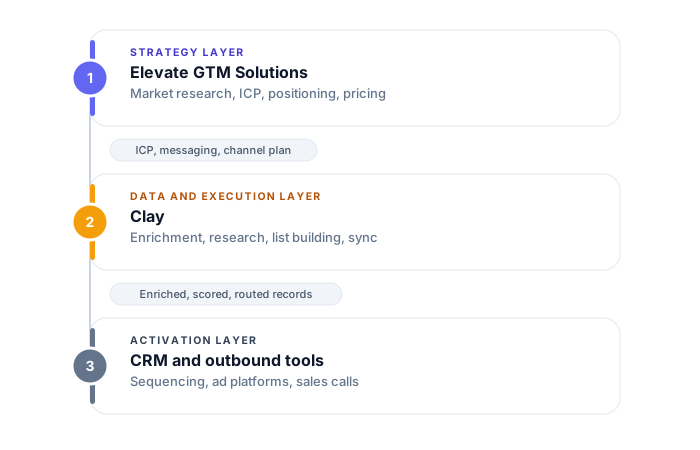
Reading the stack top to bottom is a useful diagnostic exercise on its own. If your organization has never clearly documented the top layer, no tool sitting in the middle or bottom layer can fully compensate, since every enrichment column and every ad audience still needs a targeting hypothesis to execute against. Conversely, if the top layer is documented but nothing below it is connected, that strategy stays theoretical. Most GTM technology evaluations get more useful once a team maps its existing stack this way and identifies which layer is actually thin, rather than starting from a vendor comparison and working backward.
On pricing specifically, the two models reward different usage patterns, so it is worth walking through the actual numbers rather than a single headline price. Clay's 2026 structure moved away from flat seat based tiers toward a credit and action model: a free tier includes a small monthly credit allotment sufficient for light testing, the Launch tier runs in the neighborhood of 185 dollars a month with a defined pool of data credits and actions, and the Growth tier runs around 495 dollars a month with unlimited credits and actions plus CRM sync, HTTP API access, and ad audience building included. Enterprise pricing is custom quoted, and third party contract data suggests actual enterprise spend has ranged widely, from roughly the low five figures annually up past six figures for the heaviest usage organizations. Because the model is usage based, two companies on the same nominal plan can end up with very different real world bills depending on list size, enrichment depth, and how many Claygent research steps they run.
Elevate's structure is closer to traditional SaaS seat and scope pricing. The Guided GTM tier starts at 499 dollars a month for a single user working within a single GTM scope, meaning one product, market, and segment combination. The Growth tier runs 1,499 dollars a month and expands access to up to three users and up to three GTM scopes, which suits a company managing more than one product line or market simultaneously. The Scale tier is custom and annual, removes user and scope limits entirely, and is the only tier that includes the advanced EVUSP intelligence modules for buyer emotion modeling, differentiation scoring, and narrative defensibility. Because this pricing scales with organizational scope rather than raw usage volume, a small team working on a single focused go to market motion can budget with more predictability than they typically can on a pure usage based model.
Key takeaway: Clay's pricing rewards controlled, well configured usage. Elevate's pricing rewards a defined scope. Neither model is objectively cheaper; the right one depends on whether your costs are more likely to scale with data volume or with the number of markets and products you are actively strategizing around.
Philosophy Comparison
Every GTM tool encodes a belief about where the hard part of go to market actually lives. Clay and Elevate encode almost opposite beliefs, and understanding that difference matters more than any individual feature comparison.
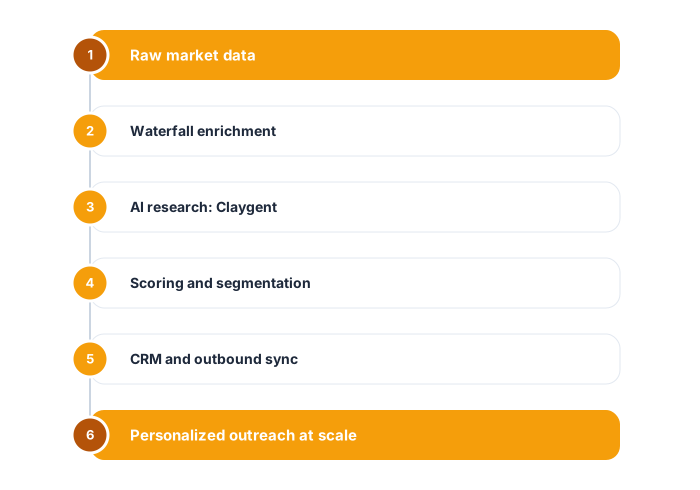
Clay's implicit philosophy is that go to market success is primarily a data and execution problem. If you can identify the right accounts with enough precision, enrich them with enough context, and reach them with enough personalization at enough scale, growth follows. This is a philosophy born out of the modern outbound era, where the constraint shifted from "can we find enough leads" to "can we find, verify, and personalize outreach to the right leads faster than our competitors." Clay's entire architecture, the waterfall, the AI research agent, the workflow automation, is built to compress the time between identifying a target and reaching them with something relevant.
Elevate's implicit philosophy is close to the inverse. It treats go to market success as primarily a clarity and alignment problem. The belief embedded in the product is that most GTM failure does not come from insufficient data or insufficient outreach volume, it comes from teams executing against unclear or inconsistent strategy: marketing messaging that does not match what sales actually says on calls, a positioning statement that shifts every quarter, an ICP definition that lives in three different spreadsheets with three different definitions. Elevate's architecture, the fourteen module methodology, the shared outputs across functions, the emphasis on continuous adaptation rather than a static annual plan, is built to compress the gap between strategic intent and what every function actually does day to day.
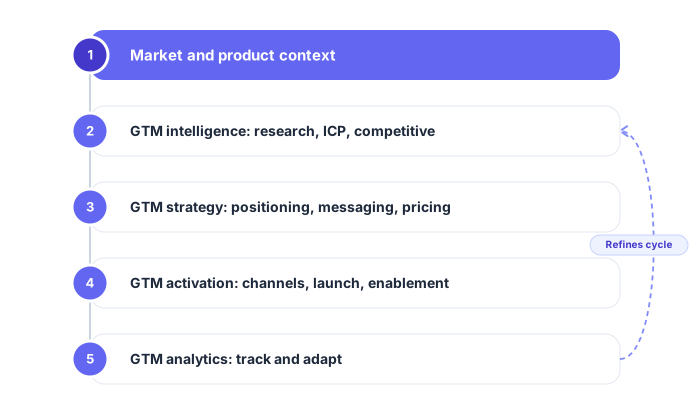
Notice the shape of the two diagrams. Clay's flow is linear, data moves through a pipeline and ends in an outbound action. Elevate's flow is a loop, strategy informs execution, execution generates signal, and that signal feeds back into strategy. Neither shape is wrong. They simply describe different stages of the same overall system. A team that only has the linear pipeline can execute quickly but risks optimizing outreach to a poorly defined target. A team that only has the loop can define a sharp strategy but has no native mechanism for actually reaching a single prospect.
There is also a philosophical difference in how each platform treats the human expert. Clay assumes a technically capable operator who wants granular control: conditional logic, provider sequencing, credit budgeting. The product rewards someone who thinks like an engineer. Elevate assumes a strategic operator who wants structured guidance and speed: someone who understands go to market thinking conceptually but does not want to manually build a competitive positioning framework in a blank document at midnight before a board meeting. The product rewards someone who thinks like a strategist working against a deadline.
Neither philosophy is inherently premium or entry level. They are simply optimized for different bottlenecks, and the honest answer to "which philosophy is right" depends entirely on where your own organization's actual bottleneck sits today.
Can They Work Together?
Yes, and this is arguably the most practically useful section of this entire comparison, because in most real deployments the answer to "Clay or Elevate" is not exclusive at all.
The two platforms sit at different layers of the same system. Elevate operates at the strategy layer: defining who the ICP is, what the positioning says, which channels matter, and how messaging should be structured for each segment. Clay operates at the execution layer: taking that ICP definition and finding real companies and contacts that match it, enriching them with current data, and routing them into outreach. Used together, the output of one becomes the direct input of the other.
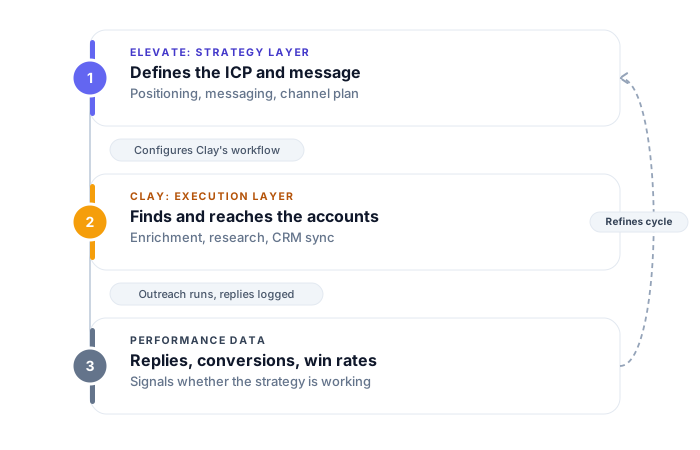
Key takeaway: the output of Elevate is the input to Clay. ICP, positioning, and messaging defined in Elevate become the configuration and personalization logic inside a Clay workflow. That handoff, not a feature overlap, is the real relationship between the two platforms.
Consider how that loop plays out in practice. A team runs the ICP and segmentation module inside Elevate and gets a structured definition: company size range, industry, technographic signals, and buyer persona priorities, along with a positioning statement and three messaging angles mapped to different buyer pain points. That structured definition becomes the direct configuration input for a Clay table: the GTM engineer sets up enrichment columns that match the exact firmographic and technographic criteria Elevate defined, and builds Claygent research steps around the specific trigger events Elevate's competitive intelligence module flagged as buying signals. The messaging angles from Elevate become the variable inputs for Clay's personalization steps, so outreach copy is generated against a strategically validated narrative rather than a generic template.
Once outreach runs, the reply and conversion data flowing back through the CRM becomes a real world signal about whether the strategy actually holds up. If a particular messaging angle from Elevate is converting far better than the other two, that is useful information to feed back into the strategy layer, potentially reshaping which segment gets prioritized next quarter. This is the loop shown in the diagram above, and it is the version of "working together" that neither tool can replicate alone: Clay has no native mechanism for generating or revising positioning, and Elevate has no native mechanism for pulling live enrichment data or triggering an email sequence.
There is a sequencing consideration worth flagging honestly. Running Clay before strategic clarity exists tends to produce enrichment and outreach at scale, aimed at a fuzzy or shifting target, which can waste both data credits and prospect goodwill. Running Elevate without ever operationalizing its output into an execution tool produces a well documented strategy that sits in a dashboard while the sales team keeps manually building lists the old way. Neither failure mode is really about the tools; both come from treating strategy and execution as separate initiatives instead of a connected pipeline.
For teams with budget constraints, a lighter version of this pairing still works: use Elevate, or a comparable structured planning process, at the start of a new initiative, a launch, a new market entry, a repositioning, and lean on Clay primarily for the ongoing execution phase once that initial strategic work is done. You do not need both running continuously in parallel forever; you need strategic clarity refreshed periodically and execution infrastructure that can act on it quickly when it changes.
A concrete quarter by quarter walkthrough makes this less abstract. In month one, a team runs its market research, ICP, and positioning work inside Elevate, resolving open questions about which segment to prioritize and what the core message should be. In month two, a GTM engineer takes those defined parameters and builds the corresponding Clay tables, enrichment waterfalls, Claygent research steps for account specific triggers, and CRM sync logic, so outbound can begin running against a clearly defined target. By month three, reply rates, meeting conversion, and win rates from that outbound motion are flowing back into the CRM, and a marketing leader can pull that performance data back into a strategy review, checking whether the original ICP and messaging assumptions are actually holding up in market or need revision. That review becomes the input for the next Elevate cycle, and the loop repeats. Teams that operate this way tend to treat strategy refreshes as a recurring quarterly discipline rather than an annual event, which lines up closely with Elevate's own framing of continuous adaptation rather than static planning, while Clay's workflows keep running in the background largely untouched between those strategic checkpoints, only requiring adjustment when the underlying targeting or messaging parameters actually change.
Best For: Matching the Platform to Your Team
| Team Profile | Better Fit | Why |
|---|---|---|
| Seed stage startup defining first ICP and positioning | Elevate | Strategic clarity has not been established yet; premature to invest in enrichment infrastructure |
| Series B+ company with clear ICP, scaling outbound | Clay | Strategy is set; the constraint is finding and reaching more of the right accounts |
| RevOps team building custom data pipelines into CRM | Clay | Clay's core architecture is built exactly for this workflow |
| Marketing team entering a new vertical or geography | Elevate | Requires new market research, positioning, and messaging before execution begins |
| Company repositioning after a pivot or M&A | Elevate | The problem is narrative and alignment across functions, not data volume |
| Growth or demand gen team scaling account based marketing | Clay | Needs enrichment, intent data, and ad audience building at volume |
| Fractional CMO or GTM consultant serving multiple clients | Elevate | Structured methodology speeds up strategy delivery across engagements |
| SDR or AE team needing better account research at call prep | Clay | Claygent and enrichment surface account context quickly |
| Product marketing team building competitive battlecards | Elevate | Positioning and competitive intelligence modules map directly to this need |
| Technical GTM engineering team already comfortable with APIs | Clay | Interface and pricing model reward technical fluency |
The pattern across this table is consistent enough to state plainly: Elevate tends to fit earlier stage strategic decisions and Clay tends to fit later stage execution at volume. That said, company stage is a rough proxy, not a hard rule. A well funded Series C company can still be strategically unclear about a new segment, and a scrappy pre seed founder can already have sharp positioning and just need to reach fifty specific people efficiently. The better question than "what stage are we" is "what is actually broken right now," which the next two sections address directly.
Key takeaway: company stage is a proxy, not a diagnosis. Use the "what is actually broken right now" question below instead of a funding round to decide.
When to Choose Clay
Clay makes the most sense when your organization already has reasonable confidence in who it is selling to and why, and the actual bottleneck is operational: finding those accounts, enriching them with accurate and current data, and reaching them without your team manually toggling between six different browser tabs for every single prospect.
Specific signals that point toward Clay:
Your team is spending significant hours per week on manual research that follows a repeatable pattern. If an SDR is looking up the same three or four data points for every account, company size, tech stack, recent funding, a relevant trigger event, that is precisely the kind of repeatable lookup Clay's waterfall and Claygent are built to automate.
Your data coverage from a single provider is inconsistent. Teams relying on one enrichment vendor commonly see coverage gaps that vary by industry or region. Clay's waterfall approach, querying multiple providers in sequence, is specifically designed to close that gap, and organizations that have implemented it have reported coverage improvements from roughly the low forties percentage range up into the eighties.
You have a GTM engineer, or the budget and appetite to hire or train one. Clay rewards technical comfort. Teams that go in without someone willing to learn conditional logic, provider configuration, and credit management tend to underuse the platform and get frustrated by the learning curve. If that resource does not exist yet, either budget for it or expect a slower ramp.
You need to connect enrichment directly into execution tools. If the end goal is a synced CRM record, a triggered sequence, or an ad audience built from enriched intent data, Clay's hundred and fifty plus native integrations make that connective tissue far less painful to build than stitching together point solutions manually.
Your pricing tolerance matches usage based spend. Clay's credit model means costs scale with how much data you pull and how many workflow actions you run, which can be efficient for lean, targeted use but requires monitoring so a broad, sloppy workflow does not quietly burn through budget. Teams that want predictable flat pricing regardless of usage volume should model this carefully before committing.
A useful gut check: if you handed your current sales team a list of a thousand perfectly qualified target accounts tomorrow with zero contact data attached, would they know exactly what to say and who to prioritize? If yes, your constraint is almost certainly execution, and Clay is the more direct answer.
When to Choose Elevate
Elevate makes the most sense when the honest answer to that gut check above is no, or is a hesitant maybe. If your team would need a planning meeting before it could act on a thousand new accounts, the constraint is not data, it is clarity.
Specific signals that point toward Elevate:
Your positioning has drifted or was never formally documented. If different reps describe the product differently on calls, if marketing copy contradicts what sales says in a demo, or if a new hire asks "what do we actually say we do" and gets three different answers, that is a strategic alignment problem no amount of enrichment fixes.
You are entering a genuinely new market, segment, or product line. Launching into unfamiliar territory requires market sizing, competitive mapping, and a fresh ICP definition before any outbound motion makes sense. Building that from scratch manually, through analyst reports, competitor site audits, and internal debate, is exactly the slow, fragmented process Elevate's platform is designed to compress.
Your GTM plan currently lives in slide decks that get built once a quarter and then quietly ignored. If your actual go to market execution has diverged noticeably from your last planning document and nobody has formally updated the plan, you are running on institutional memory rather than a living strategy, which is precisely the static planning problem Elevate is architected against.
You need cross functional alignment more than you need more outreach volume. Teams where marketing, sales, and product are not working from a shared narrative tend to see this show up as low outbound reply rates that improving data quality alone will not fix, because the message itself, not the targeting, is the weak link.
You are a fractional GTM leader, advisor, or small team without a dedicated strategy function. Elevate's structured methodology can substitute for some of the deliverables a strategy consultant or in house product marketer would otherwise produce manually, which is meaningfully useful for lean teams or advisory practices serving multiple clients at once.
A parallel gut check: if you gave your GTM engineer unlimited data budget and access to every enrichment provider on earth tomorrow, would your team know precisely which accounts to prioritize, what to say to them, and why that message should win against the alternative they are already using? If the honest answer is uncertain, the constraint is strategic, and that is Elevate's territory, not Clay's.
Key takeaway: the two gut checks above are the fastest way to self diagnose. A thousand accounts with no plan points to Elevate. Unlimited data budget with no clear priority list also points to Elevate. Only when both answers are confidently "yes, we would know exactly what to do" does the conversation shift purely to execution tooling like Clay.
Final Verdict
Clay and Elevate are not really competitors, even though they show up on the same shortlist during a lot of GTM tool evaluations. They solve different problems that happen to sit next to each other in the funnel, and comparing them head to head on a single feature grid, as the table above shows, only tells part of the story.
If your organization is confident in its ICP, its positioning, and its message, and the actual daily friction is manual research, inconsistent data coverage, and disconnected outreach tooling, Clay is very likely the more direct fix. It has a real learning curve and a usage based pricing model that requires some discipline to manage, but for teams with the technical capacity to build and maintain workflows, its enrichment depth and execution integrations are hard to replicate manually at any reasonable cost.
If your organization is still working out who its best customer actually is, why that customer should choose you over an obvious alternative, and how that story should translate consistently across marketing, sales, and product, Elevate is the more direct fix. It will not replace a data provider or send a single email, but it addresses a failure mode that no amount of enrichment spend can solve: teams executing quickly and precisely against the wrong or unclear target.
The pragmatic recommendation for most growing revenue organizations: treat strategic clarity as the prerequisite and execution infrastructure as the multiplier. Get the ICP, positioning, and messaging genuinely settled first, whether through a platform like Elevate, an experienced GTM advisor, or rigorous internal process, and then invest in an execution engine like Clay to operationalize that clarity at scale. Reversing that order, buying powerful execution tooling before strategic questions are resolved, is one of the more common and expensive mistakes growing GTM teams make, because it is very easy to mistake outreach volume for progress when the underlying target was never quite right.
FAQ
Is Clay a competitor to Elevate GTM Solutions? Not directly. Clay is a data enrichment and workflow automation platform focused on finding, enriching, and reaching accounts and contacts. Elevate is a GTM strategy platform focused on defining who to target and what to say to them. They operate at different layers of the funnel and are frequently used together rather than as substitutes for one another.
Can I use Elevate without Clay, or Clay without Elevate? Yes, both platforms function fully independently. Teams with a well established strategy and no execution bottleneck can use Clay on its own. Teams that need strategic clarity but already have a working execution stack, whether that is Clay, Apollo, or an internal process, can use Elevate on its own and export its outputs into whatever execution tooling they already run.
Which platform is better for a small startup with a limited budget? It depends on what is genuinely unclear versus genuinely broken. A pre seed or seed stage company that has not yet nailed down its ICP or positioning generally gets more value from resolving that first, since scaling outreach against an undefined target tends to waste budget rather than save it. A startup with clear positioning but a founder manually building prospect lists in spreadsheets will likely see faster returns from an execution tool like Clay.
Does Elevate replace the need for a product marketer or GTM consultant? Elevate is built to structure and accelerate the kind of work a product marketer or GTM consultant does, not necessarily to fully replace human judgment on high stakes strategic calls. Many of the advisors in Elevate's own partner network use the platform as an operating system for client engagements rather than as a substitute for their expertise. Think of it as compressing the drafting and structuring work so a human expert can focus on judgment calls and edge cases.
Does Clay replace the need for a RevOps or GTM engineering hire? Not entirely. Clay's interface is powerful but does have a real learning curve, particularly around waterfall configuration, conditional logic, and credit management. Teams without any technical capacity in house often either invest time in training someone on the platform or work with a managed service that operates Clay on their behalf. Clay reduces the manual research burden significantly, but someone still needs to design and maintain the underlying workflows.
How does pricing compare between the two platforms? The pricing models are structured differently, which makes direct comparison tricky. Elevate charges on a seat and GTM scope basis, starting around 499 dollars a month for a single user and a single product or market scope, scaling up through a growth tier and a custom enterprise tier. Clay charges primarily on usage, through data credits and platform actions, with a free tier, a self serve entry tier around 185 dollars a month, a growth tier around 495 dollars a month with unlimited credits, and custom enterprise pricing that has reportedly ranged from roughly twelve thousand to well over a hundred thousand dollars a year depending on scale. A useful way to think about it: Elevate's cost is driven by how many strategic scopes you need to manage, while Clay's cost is driven by how much data and automation volume you actually run.
Which platform integrates better with a CRM like Salesforce or HubSpot? Clay is purpose built for this. It ships more than a hundred and fifty native integrations, including direct CRM sync, and its entire architecture is designed to push enriched data and trigger downstream actions in outreach and CRM tools. Elevate's outputs are typically exported as structured documents and dashboard views intended for team alignment rather than direct CRM synchronization, so if live CRM data movement is the priority, Clay is the more purpose fit tool.
Is there a risk of these two platforms creating overlapping or conflicting work? The risk is real but avoidable with clear ownership. Because both platforms touch competitive intelligence and, to a lesser extent, targeting logic, teams that adopt both should establish which platform is the source of truth for which decision, typically Elevate for the strategic definition of who and why, and Clay for the operational specifics of exactly which records and how. Without that clarity, a team can end up with two different ICP definitions living in two different tools, which recreates exactly the misalignment problem Elevate is meant to solve in the first place.
How long does it take to see value from each platform? Clay's value tends to show up incrementally as workflows are built and refined, meaningful time savings on manual research often appear within the first few weeks, but full ROI usually depends on ongoing workflow maintenance and credit optimization over a longer period. Elevate's core strategic outputs, ICP, positioning, and messaging, are generated far more quickly since the platform is designed to compress a process that would traditionally take weeks of workshops and drafting into a matter of minutes to hours, though the real test of that strategy's value only shows up once it has been executed against and measured in market.
Should an enterprise organization use both platforms simultaneously? Larger organizations with multiple product lines, markets, or segments are actually where the combination tends to make the most sense, since Elevate's scope based structure is designed to handle strategy across multiple markets and products in one system, and Clay's usage based pricing scales naturally with a larger volume of enrichment and outreach activity. The main requirement is coordination: someone, typically a RevOps or GTM operations leader, needs to own the handoff between the strategic outputs generated in Elevate and the execution workflows configured in Clay, so the two systems stay synchronized as strategy evolves rather than drifting apart over time.