Source of Image: Elevate GTM Solutions
Modern go-to-market organizations have access to more information, technology, and expertise than at any other point in history. Market intelligence platforms provide deep industry insights. CRM systems capture customer interactions. Competitive intelligence tools monitor market movements. Analysts publish research. Consultants offer strategic guidance. Agencies execute specialized programs. On paper, organizations should be able to make faster and more informed decisions than ever before.
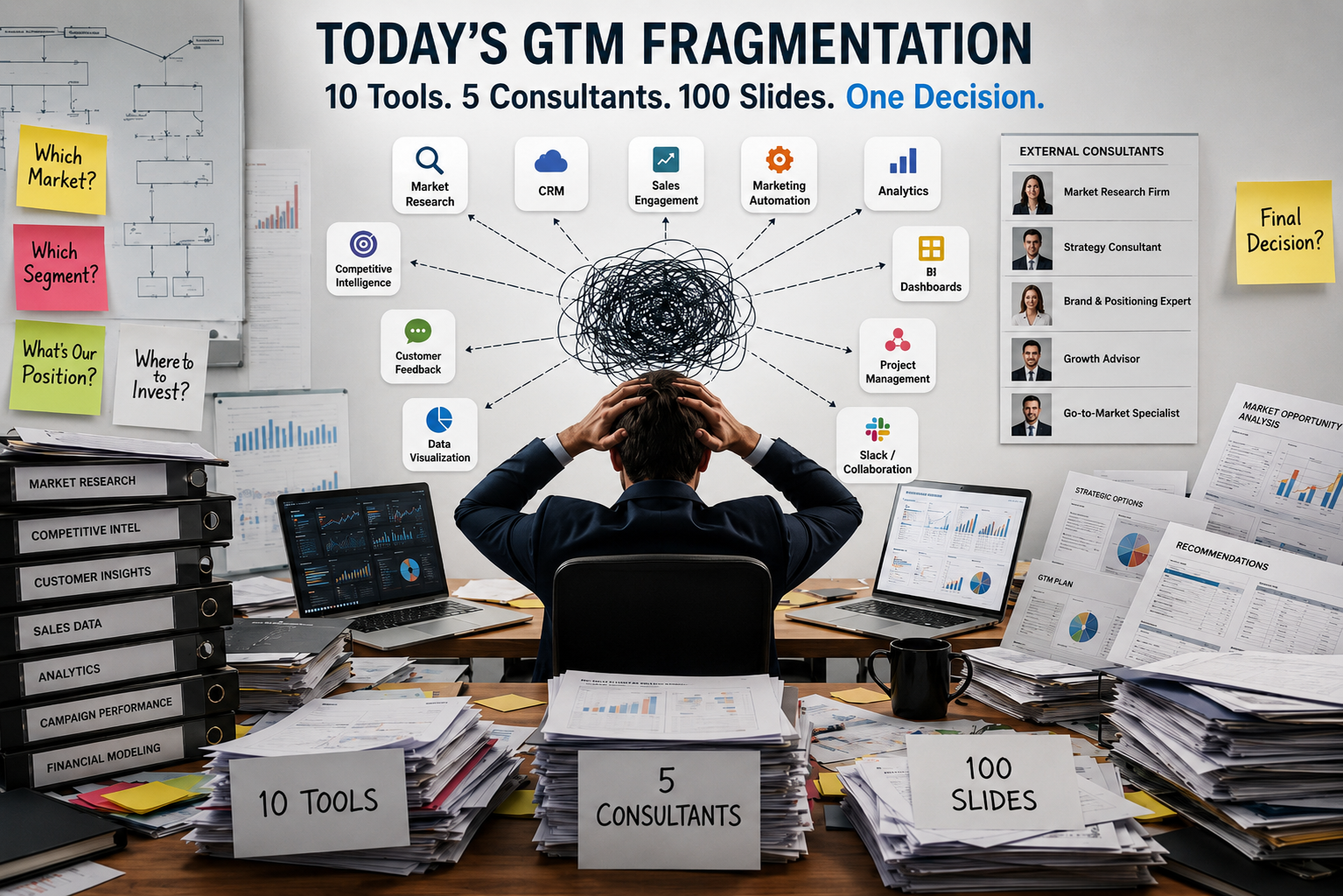
Yet many GTM leaders face a very different reality. Strategic decisions that should take days often take weeks or months. Questions such as which market to target, which customer segment to prioritize, or how to position a new offering frequently trigger extensive research efforts, multiple stakeholder meetings, consultant engagements, and countless presentation decks. The problem is no longer a lack of information. The problem is the growing complexity of turning information into action.
As organizations continue to add tools, data sources, and specialized expertise, many have unintentionally created a fragmented GTM environment that slows decision-making, increases costs, and reduces organizational agility.
The Rise of GTM Fragmentation
Over the years, companies have invested in a wide range of solutions designed to improve specific aspects of the go-to-market process. Marketing teams adopted platforms to better understand audience engagement. Sales organizations implemented systems to improve pipeline visibility. Product teams invested in customer feedback and analytics tools. Leadership teams engaged consultants and analysts to support strategic planning.
Each investment delivered value within its respective function. However, few organizations stopped to consider how all of these inputs would come together when it was time to make strategic decisions.
Today, critical GTM intelligence is often spread across multiple systems, teams, and external partners. Market insights may reside in one platform, customer data in another, competitive intelligence in a third, and strategic recommendations in consultant presentations. Bringing these pieces together requires significant manual effort, coordination, and interpretation. The result is a fragmented operating model where information exists everywhere, but actionable clarity remains difficult to achieve.
Why More Tools Haven't Improved GTM Outcomes
Many organizations assume that additional tools naturally lead to better outcomes. While technology can improve visibility and efficiency within individual functions, adding more systems does not automatically improve decision-making across the organization.
In fact, the opposite often occurs. As new tools are introduced, teams gain access to more dashboards, more reports, and more metrics. Different departments begin working from different versions of the truth. Sales may view the market through pipeline data, marketing through engagement metrics, product through customer feedback, and leadership through analyst reports. While each perspective is valuable, aligning them into a single strategic direction becomes increasingly difficult.
This creates a situation where organizations spend more time discussing information than acting on it. Meetings become longer. Planning cycles expand. Stakeholders debate competing interpretations of the same market. Instead of accelerating growth, the abundance of information can create uncertainty and slow progress.
The Hidden Cost of Decision-Making Complexity
The cost of GTM fragmentation is often underestimated because it rarely appears as a line item in a budget. Organizations can easily calculate software subscriptions, consulting fees, and agency retainers. What is much harder to measure is the cost of delayed decisions.
Every additional week spent evaluating markets, reviewing research, aligning stakeholders, and refining presentations represents time that could have been spent executing. Product launches are delayed. Market opportunities are missed. Competitors gain ground. Teams become frustrated by lengthy planning processes that produce limited momentum.
The cumulative impact can be significant. Companies often believe they are investing in strategy when, in reality, a substantial portion of their resources is being consumed by coordination. Teams are forced to gather information from multiple sources, reconcile conflicting viewpoints, and repeatedly communicate findings across the organization. The more fragmented the environment becomes, the greater the burden of coordination.
The Consultant Dependency Trap
Consultants play an important role in helping organizations solve complex business challenges. Their expertise, experience, and external perspective can provide valuable insights that internal teams may not possess. However, many organizations have become increasingly dependent on consultants to bridge gaps that exist within their own GTM processes.
Market researchers provide industry analysis. Positioning specialists develop messaging frameworks. Strategy consultants recommend growth opportunities. Agencies execute campaigns. Each contributes a piece of the puzzle, but the responsibility for connecting those pieces ultimately falls back on the organization.
This model can create a cycle of continuous dependency. Every new strategic initiative requires another round of research, workshops, presentations, and recommendations. By the time a plan is finalized, market conditions may have already changed. Organizations find themselves repeating the process rather than building a repeatable capability for making GTM decisions.
The challenge is not the quality of external expertise. The challenge is relying on disconnected projects to solve what is fundamentally a systems problem.
GTM Has Become a Coordination Problem
Many organizations assume their biggest GTM challenge is execution. In reality, execution is often constrained by the quality and speed of decision-making that occurs beforehand.
Before campaigns launch, before sales teams engage prospects, and before products enter new markets, organizations must align around a shared understanding of priorities, opportunities, and risks. When information is fragmented across tools, teams, and external partners, achieving that alignment becomes increasingly difficult.
As a result, GTM leaders spend a significant amount of time acting as coordinators rather than strategists. They are responsible for bringing together market data, customer insights, competitive intelligence, financial considerations, and stakeholder perspectives. The more fragmented the environment, the more effort is required to create alignment.
What should be a strategic process becomes an operational challenge.
The Case for a Unified GTM Platform
The future of GTM is unlikely to be defined by adding more tools to an already crowded technology stack. Most organizations already possess enough information to make informed decisions. What they often lack is a way to connect that information within a consistent framework.
A unified GTM platform addresses this challenge by bringing together the critical components of strategy development into a single environment. Rather than forcing teams to navigate multiple systems and disconnected data sources, it creates a shared foundation for market analysis, segmentation, positioning, competitive assessment, planning, and execution.
The goal is not simply consolidation. The goal is alignment. When teams operate from a common set of insights and frameworks, decisions become faster, planning becomes more efficient, and execution becomes more coordinated. Instead of spending weeks assembling information, organizations can focus their energy on evaluating opportunities and driving growth.
Building GTM Around Decisions, Not Tools
For years, GTM investments have focused on improving individual functions. Organizations purchased tools to support marketing, sales, product management, customer success, and operations. While these investments delivered benefits, they often strengthened silos rather than improving cross-functional decision-making.
The next evolution of GTM requires a different mindset. Rather than organizing technology around functions, organizations must organize their operating models around decisions. Strategic questions such as where to compete, who to target, how to position, and how to grow should not require teams to navigate dozens of systems and reconcile multiple sources of truth.
The organizations that excel in the future will be those that reduce complexity, connect intelligence across functions, and enable teams to move seamlessly from insight to action.
Looking Ahead
Go-to-market has reached an inflection point. The challenge facing organizations is no longer gaining access to data, technology, or expertise. The challenge is managing the complexity that comes with them.
As markets become more competitive and change accelerates, lengthy planning cycles and fragmented decision-making processes will become increasingly difficult to sustain. Organizations that continue to rely on disconnected tools, consultant-led projects, and manual coordination will struggle to keep pace with faster-moving competitors.
The companies that succeed will be those that simplify how decisions are made. They will connect intelligence across the organization, create alignment around strategy, and establish a more integrated approach to go-to-market planning and execution.
Because in today's market, competitive advantage does not come from having more information. It comes from turning information into action faster than everyone else.