
Klue vs Elevate: Which Platform Is Right for Your Business?
Of every comparison in this series, this is the one where two platforms come closest to using identical language for what they do. Klue is a competitive enablement and win loss platform, and competitive intelligence is not a side feature of Klue, it is the entire product. Elevate GTM Solutions lists competitive intelligence as one of its fourteen GTM methodology modules, generating a competitive positioning and differentiation narrative as part of a broader strategy output. Both platforms will tell you, correctly, that they help a revenue team win more deals against named competitors. That overlap deserves more direct treatment than any other pairing in this series, because glossing over it would be dishonest.
The distinction, once you look closely, comes down to authorship versus maintenance, and to a single versus a continuous process. Elevate generates a competitive positioning and differentiation narrative as part of a broader strategic exercise, reasoning about how your product should be framed against the competitors you describe to it, largely as a point in time output that gets refreshed when you choose to run a new cycle. Klue continuously monitors real, live competitor activity, pricing changes, product launches, messaging shifts, pulled automatically from external sources, maintains a constantly updated battlecard library, pushes that intelligence directly into a rep's CRM or Slack during an actual live deal, and closes the loop with a built in win loss program that captures what really happened once the deal closed. One authors the initial competitive story. The other keeps that story current against a moving market and proves, deal by deal, whether it is actually working.
This guide breaks down what each platform actually does, addresses the overlap directly rather than around it, and explains how a revenue team running both would typically divide the work between them.
Klue vs Elevate at a Glance
| Klue | Elevate GTM Solutions | |
|---|---|---|
| Category | Competitive enablement and win loss platform | AI native GTM strategy platform |
| Solves for | Continuously monitoring competitors and delivering live battlecards into deals | Defining who to target and what to say to them, including initial competitive positioning |
| Sits in the stack | Ongoing competitive monitoring and sales enablement layer | Strategy layer, competitive narrative authored once per cycle |
| Built around | Automated competitor monitoring, dynamic battlecards, a Compete Agent, and win loss capture | A structured, multi module GTM methodology |
| Ideal owner | Product marketing, competitive intelligence, and sales enablement teams | Marketing leader, founder, or GTM advisor |
| Starting price | No public pricing, quote based, commonly reported $15,000 to $40,000+ per year | $499 per month |
| Output | Live battlecards, competitor alerts, win loss reports, deal specific insights | ICP, positioning, messaging, launch and channel plans, including initial competitive positioning |
| Not designed to do | Generate an ICP, core positioning, or a full GTM plan from first principles | Continuously monitor competitors or capture win loss data from real closed deals |
The one line version: if your biggest challenge is authoring your initial competitive story, the differentiation narrative and where you fit against named rivals, choose Elevate. If your biggest challenge is keeping that story current as competitors actually move, and getting it into reps' hands during live deals, choose Klue. Companies with real competitive pressure very often need both, one writing the story, the other keeping it true.
Executive Summary
If you only have three minutes, here is the short version.
Klue is built for teams that already compete seriously against a defined set of rivals and need a systematic, always on way to track what those rivals are actually doing, pricing changes, new product launches, shifting messaging, and turn that tracking into battlecards reps actually use inside a live deal, inside the CRM or Slack tool they are already working in. Its strength is operational continuity: automated monitoring that does not depend on someone remembering to check a competitor's website, an AI layer called Compete Agent and an assistant called Ask Klue that can answer competitive questions on demand, and a built in win loss program that captures what buyers actually said about the competitive decision once a deal closes, won or lost. Klue's weakness is that it assumes a foundational competitive narrative already exists somewhere for it to monitor against and reinforce. It is exceptional at tracking, enabling, and validating competitive positioning. It does not originate your company's core differentiation story, your ICP, or your broader go to market strategy from scratch.
Elevate GTM Solutions is built for teams that need that foundational narrative established or kept current as part of a much broader strategic exercise. It takes market context, product details, and competitive information as input, and produces structured outputs: ideal customer profiles, positioning frameworks, messaging architecture, channel strategy, and launch plans, including an initial competitive positioning and differentiation narrative generated as one of its fourteen methodology modules. Elevate's strength is turning fragmented go to market thinking, including a first draft of your competitive story, into a single operating system before any of it needs continuous, deal by deal maintenance. Its weakness is that it does not monitor a competitor's pricing page, alert a rep when a rival launches a new feature, or capture what a lost deal's buyer actually said about a competing vendor. It is not a replacement for a dedicated competitive enablement platform.
The practical framing that most teams land on, and the one worth internalizing given how close this comparison runs: Elevate answers "what is our initial competitive story," Klue answers "is that story still true today, and are reps actually using it in the deal happening right now." A company with no competitive narrative at all has a strategic gap Klue's monitoring cannot fix, because Klue will track a competitor's every move with real precision and still have nothing coherent to tell a rep about how to respond, since it has no defined starting narrative to update. A company with a solid initial competitive story and no systematic way to keep it current or get it into live deals has an operational gap that is exactly what Klue is built to close.
The rest of this guide unpacks the details behind that summary: feature by feature, philosophy by philosophy, and scenario by scenario, so you can make the call for your own team with full context rather than a marketing headline.
Key takeaway: both platforms do competitive intelligence, but one authors it and the other maintains it. Elevate generates the initial competitive narrative as part of a broader strategy exercise. Klue keeps that narrative current against a moving market, delivers it into live deals, and validates it with real win loss data. Treating either as a full substitute for the other misunderstands what each was actually built to do.
What Is Klue?
Klue is a competitive enablement and win loss platform built specifically to move competitive intelligence out of a product marketer's static slide deck and into the hands of reps working live deals. The company has raised meaningful outside financing, reported at sixty two million dollars from investors including Salesforce Ventures and Tiger Global, and has grown into one of the more widely adopted platforms in a competitive intelligence category that also includes Crayon and Kompyte, with Klue generally positioned around strategic battlecards and deal level intelligence specifically.
The platform is organized around four core capabilities:
- Automated competitor monitoring: tracking pricing changes, product launches, messaging shifts, and relevant news across a defined set of competitors, pulled automatically from external sources rather than requiring a person to manually check competitor websites and press releases on a recurring basis.
- Dynamic battlecards: rather than a static PDF that goes stale the week it is published, Klue's battlecards update as new intelligence comes in and are delivered directly into a rep's existing workflow, commonly surfaced inside the CRM or a chat tool like Slack, so a rep can pull up current, relevant competitive talking points in the middle of an active deal rather than searching for an outdated document.
- Win loss program: a built in capability for systematically capturing what actually happened once a deal closes, won or lost, closing the feedback loop between what a company assumes is happening competitively in its deals and what buyers actually report experiencing.
- Compete Agent and Ask Klue: an AI agent layered on top of the monitoring and battlecard system that can automate parts of the collection process and answer competitive questions on demand, extending the platform beyond a passive intelligence library into something closer to an active assistant a rep or product marketer can query directly.
Klue's own positioning treats competitive intelligence and win loss as a single connected workflow rather than two separate products, and the company markets itself specifically around competitive enablement, the idea of activating intelligence for revenue teams rather than producing intelligence that sits in a report nobody reads. The platform combines internal data sources, information a company already has about its own deals and product, with external monitoring of competitor activity, and integrates with sales enablement and CRM platforms to keep that combined intelligence inside the tools reps already use daily.
Pricing is not published anywhere and is entirely quote based, structured around number of users, feature tier, typically named Essentials, Professional, and Enterprise, and contract term length, with multi year commitments generally unlocking lower effective per user pricing. Third party transaction data places typical annual contract values for small teams on the Essentials tier in the mid five figure range, with larger deployments reaching low six figures or higher depending on user count and feature depth. More broadly, dedicated competitive intelligence platforms in this category, Klue included, are commonly reported running fifteen thousand to forty thousand dollars per year or more for enterprise deployments.
Who actually uses Klue day to day tends to be product marketing and competitive intelligence professionals who own the monitoring configuration, battlecard content, and win loss program, alongside sales enablement teams responsible for driving rep adoption of the resulting battlecards. Reviewers consistently highlight the platform's ability to centralize competitive knowledge as a genuine differentiator, reducing the information silos that come from competitive intelligence living in someone's personal notes or an occasionally updated shared document, though as with most platforms in this comparison series, value depends meaningfully on reps actually engaging with the delivered intelligence rather than letting it sit unused inside the CRM.
A Quick Example
Picture a mid sized cybersecurity company competing regularly against two well known rivals, with product marketing having already built out an initial competitive narrative explaining where the company's product differs and why that difference should matter to a buyer. The team configures Klue to monitor both competitors' pricing pages, product release notes, and public messaging continuously. When one competitor quietly changes its pricing structure to undercut a segment the company competes in heavily, Klue's monitoring catches the change within the platform's normal detection cycle, automatically updates the relevant battlecard, and surfaces an alert to the account executives currently working deals against that competitor, along with updated talking points reflecting the new pricing dynamic, all without a product marketer manually noticing the change and rebuilding the battlecard by hand.
Notice what that example assumes already exists: an initial competitive narrative explaining the company's differentiation, a defined set of competitors worth monitoring, and battlecard content structured well enough that Klue's automated updates have a coherent framework to update within. Klue did not write that original differentiation story or decide which competitors mattered enough to track in the first place. It kept an existing narrative current against a real, moving market and delivered it precisely where and when a rep needed it.
What Is Elevate?
Elevate GTM Solutions describes itself as an AI native GTM operating system, and the framing is deliberate. Rather than positioning itself as a competitive monitoring and enablement platform, Elevate is structured around the idea that go to market strategy, positioning, messaging, channel selection, and execution planning, should live in one connected system instead of scattered across slide decks, static planning documents, and institutional memory that walks out the door when someone leaves.
The platform is organized around what it calls a fourteen module GTM methodology, spanning the full lifecycle from market research through customer advocacy. Practically, a user starts by entering business context: the product, the target market, industry, and segment. Elevate then generates structured outputs across the methodology rather than a single document. Reported categories include:
- GTM Context and Intelligence: market research, competitive intelligence, and ICP or segmentation modeling, meant to replace ad hoc research spread across browser tabs and analyst reports.
- GTM Strategy: product positioning, messaging architecture, and pricing strategy, structured so that every function is working from the same underlying narrative rather than function specific interpretations of it.
- GTM Activation and Execution: customer acquisition planning, distribution and channel strategy, marketing alignment, launch sequencing, and sales enablement material generated from the same strategic inputs.
- GTM Analytics: dashboards intended to track execution against the plan and flag where reality is drifting from the original strategic assumptions.
This is the section of this guide that requires the most direct honesty about overlap. Elevate's competitive intelligence module, sitting inside GTM Context and Intelligence, generates a competitive landscape assessment and, within GTM Strategy, a differentiated positioning narrative against the competitors a user describes to the platform. That is genuinely the same subject matter Klue's entire product is built around. The difference is mechanism and cadence, not subject matter. Elevate's competitive output is generated from context you provide, it reasons about competitors based on what you tell it about them and the market, and produces a structured, point in time narrative as part of a broader strategy cycle. It does not independently monitor a competitor's actual website, does not detect a real pricing change the moment it happens, and does not know anything about a competitor beyond what a user has described or what the platform's own research modules can find at generation time. Klue's competitive intelligence, by contrast, is built specifically to continuously detect real, live changes in the market and update accordingly, with no need for a person to notice the change and manually feed it back into the system.
The philosophical anchor of the product is adaptability rather than a one time deliverable. Elevate frames traditional GTM planning as a static exercise: a strategy gets built once, usually during annual planning, gets turned into a deck, and then sits mostly untouched until the market has already moved past its assumptions. Elevate's pitch is that when market conditions, competitive dynamics, or buyer behavior shift, a user can update the underlying inputs and regenerate the affected parts of the strategy without starting the entire planning process over, keeping strategy and execution connected on an ongoing basis rather than treating them as sequential, disconnected phases. Even with that emphasis on adaptability, the update mechanism remains a user initiated regeneration cycle, not the always on, automatic detection that defines Klue's monitoring architecture.
Elevate also ships what it calls advanced intelligence modules on its top tier plan, abbreviated internally as EVUSP: buyer emotion and intent modeling, a GTM clarity and differentiation scoring system, and a defensible positioning and narrative framework. The differentiation scoring and defensible positioning components sit closest of anything in Elevate's product to Klue's own territory, since both are ultimately trying to answer how strong and how sustainable a company's competitive differentiation actually is. The distinction holds even here: Elevate's scoring is a strategic assessment generated from the inputs you provide, while Klue's ongoing intelligence and win loss data are built from continuously observed, real market and deal behavior.
Elevate also runs a smaller advisory arm, pairing the software with fractional GTM advisors who use the platform as the operating system for client engagements, which suggests the company is positioning itself as much toward consultative go to market work as toward a pure self serve SaaS motion.
What actually differentiates the architecture. Elevate is a much newer, more broadly scoped entrant next to a well funded, category focused platform like Klue, so the fair way to evaluate it is on how the product is built rather than on continuous monitoring infrastructure or win loss data collection it has neither tried nor needs to build. Five architectural choices stand out:
- AI native from the ground up, generating rather than monitoring. Elevate was not built as a competitor tracking system with strategic outputs added on top. The generation logic sits at the core of the product and is designed to produce a complete initial strategy, including a first competitive narrative, from business context rather than accumulated, continuously observed market data.
- A unified GTM lifecycle in one system. Market research, positioning, channel strategy, and execution planning live inside a single connected model instead of separate documents, decks, and spreadsheets that each need to be manually kept in sync with whatever competitive intelligence eventually gets continuously monitored and delivered downstream in a platform like Klue.
- A structured GTM methodology, not a monitoring feed. The fourteen module framework gives the platform a defined shape to generate against, which is a meaningfully different design choice than a platform whose core value is continuously detecting and surfacing real changes in competitor behavior, without originating the strategic narrative that intelligence should update in the first place.
- Multi module strategy generation. A single set of business inputs, product, market, ICP, propagates across positioning, messaging, pricing, and channel modules simultaneously, so the competitive narrative is generated alongside, and consistent with, the broader ICP and messaging rather than being maintained as a standalone battlecard library disconnected from the rest of the strategy.
- A strategy to activation to execution to analytics loop. The product is architected as a cycle rather than a one time output, with the analytics layer explicitly designed to feed back into the strategy layer as execution data comes in, including the kind of win loss signal a platform like Klue can supply.
Key takeaway: Elevate's case rests on how the system is architected, an AI native, unified, methodology driven loop that generates an initial, complete competitive narrative alongside the rest of a company's strategy, rather than a dedicated, continuously monitoring competitive intelligence engine. Those are two different jobs that happen to share a subject, and a company with real competitive pressure generally needs both rather than choosing one.
A Quick Example
Picture that same mid sized cybersecurity company, but a step earlier, before any formal competitive narrative existed at all, back when the team had a general sense that two rivals mattered but no structured story about how to actually differentiate against them. A VP of Product Marketing opens Elevate, inputs the company's product context and describes the two competitors in detail, and asks the platform to generate an initial competitive positioning. Elevate produces a structured differentiation narrative, specific talking points addressing each competitor's most likely claims, and a defensibility assessment of how sustainable that positioning is likely to be. That output becomes the foundational battlecard content the team then loads into Klue, the starting narrative Klue's continuous monitoring will keep current as the two competitors actually move in the market, rather than Klue's own product marketing team having to write that first draft from scratch inside Klue's editor.
That sequencing is not incidental. It illustrates the core relationship between the two categories these platforms represent, and it is worth restating because the overlap in subject matter makes this sequencing easier to lose track of than in any other comparison in this series.
Feature Comparison Table
| Capability | Klue | Elevate GTM Solutions |
|---|---|---|
| Core function | Continuous competitive intelligence and sales enablement | AI-native GTM strategy and planning |
| Primary interface | Battlecards, monitoring dashboards, CRM and Slack delivery | Structured GTM strategy dashboards and outputs |
| Primary user | Product marketing, competitive intelligence, and sales enablement teams | Marketing leaders, founders, product marketers |
| Continuous competitor monitoring | Yes, core feature | Competitive analysis as part of GTM planning |
| Competitive battlecards | Yes, dynamically updated | Competitive positioning framework |
| Win-loss intelligence | Yes, core feature | Strategic competitive assessment |
| AI capabilities | Compete Agent and Ask Klue | AI-native GTM planning across interconnected modules |
| CRM and collaboration integrations | CRM, Slack, and sales platform integrations | Growing integration capabilities plus document export |
| ICP and segmentation | Limited | Yes, structured module |
| Competitive positioning | Competitive messaging and battlecards | Yes, core module |
| Positioning and messaging | Competitive messaging focus | Yes, comprehensive GTM module |
| Pricing strategy | No | Yes, structured module |
| Channel and distribution strategy | No | Yes, structured module |
| GTM launch planning | No | Yes, structured module |
| Sales enablement | Competitive battlecards and sales content | Yes, structured module |
| Pricing transparency | Quote-based | Published pricing |
| Analytics focus | Battlecard usage, competitor activity, and win-loss outcomes | Strategic execution and GTM alignment tracking |
| Learning curve | Moderate | Moderate, guided workflow |
| Typical setup owner | Product marketing or competitive intelligence lead | Marketing leader or GTM advisor |
| Pricing model | Per-user, tiered, quote-based | Seat and GTM scope-based subscription |
| Entry price point | No public pricing, commonly reported at $15,000–$40,000+ per year | Starts at $499/month |
This comparison highlights two platforms with meaningful overlap in competitive intelligence and sales enablement, but different approaches. Klue focuses on continuous competitive monitoring, automatically tracking competitor changes, updating battlecards, and delivering intelligence to sales teams. Elevate GTM Solutions focuses on defining competitive strategy within a broader go-to-market framework, helping teams develop positioning, differentiation, messaging, pricing, and sales enablement. Klue helps organizations stay current as competitors evolve, while Elevate helps organizations build and refine the strategic foundation behind their go-to-market approach. Many organizations can benefit from using both together, combining strategic planning with ongoing competitive monitoring.
It also helps to see where each platform physically sits in a typical GTM technology stack, since the usual clean separation between strategy and execution gets more nuanced here than in other comparisons in this series.
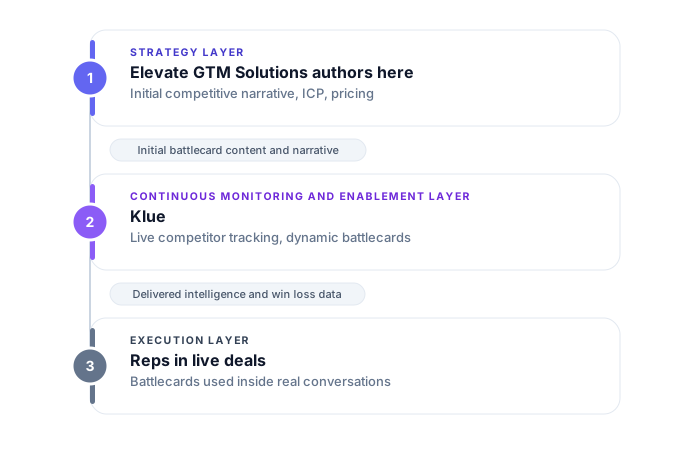
Reading the stack top to bottom, the key insight specific to this pairing is that the top and middle layers are handling the same subject, competitive positioning, at different points in its lifecycle. If your organization has never authored an initial competitive narrative, Klue will still monitor competitors faithfully, but reps will receive alerts and updates with no coherent underlying story to anchor them to, which several reviewers describe in practice as a battlecard library that tracks activity without ever quite explaining why any of it matters strategically. Conversely, if the narrative exists but nothing is continuously monitoring whether it still holds up against a competitor's actual behavior, that narrative quietly goes stale the first time a rival changes pricing or launches a feature that undercuts the story's central claim. Most GTM technology evaluations get more useful once a team maps its existing stack this way and identifies which layer is actually thin, rather than starting from a vendor comparison and working backward.
On pricing specifically, the two models diverge in both structure and predictability. Klue follows a fully quote based model with no published pricing, structured around user count, feature tier, Essentials, Professional, or Enterprise, and contract term length, with multi year commitments typically unlocking lower effective per user rates. Third party transaction data places small team Essentials deployments in the mid five figure annual range, with larger, more feature rich deployments reaching low six figures or higher, and the broader dedicated competitive intelligence category, Klue included, commonly cited in the fifteen thousand to forty thousand dollar per year range or more for enterprise scale.
Elevate's structure is closer to traditional SaaS seat and scope pricing, and is published in full rather than requiring a sales conversation to estimate. The Guided GTM tier starts at 499 dollars a month for a single user working within a single GTM scope, meaning one product, market, and segment combination. The Growth tier runs 1,499 dollars a month and expands access to up to three users and up to three GTM scopes, which suits a company managing more than one product line or market simultaneously. The Scale tier is custom and annual, removes user and scope limits entirely, and is the only tier that includes the advanced EVUSP intelligence modules for buyer emotion modeling, differentiation scoring, and narrative defensibility.
Key takeaway: Klue's cost reflects the expense of continuous, automated market monitoring and deal embedded delivery at scale, a genuinely different and more operationally intensive undertaking than authoring a strategic narrative, which is why its pricing sits meaningfully higher than Elevate's despite both platforms touching competitive intelligence. Elevate's cost reflects a lighter, generative, point in time product, and most organizations would reasonably use it to produce the initial narrative before ever needing Klue's continuous monitoring investment.
Philosophy Comparison
Every GTM tool encodes a belief about where the hard part of go to market actually lives. Klue and Elevate encode genuinely different beliefs about competitive intelligence specifically, which is worth examining closely given how much subject matter they share.
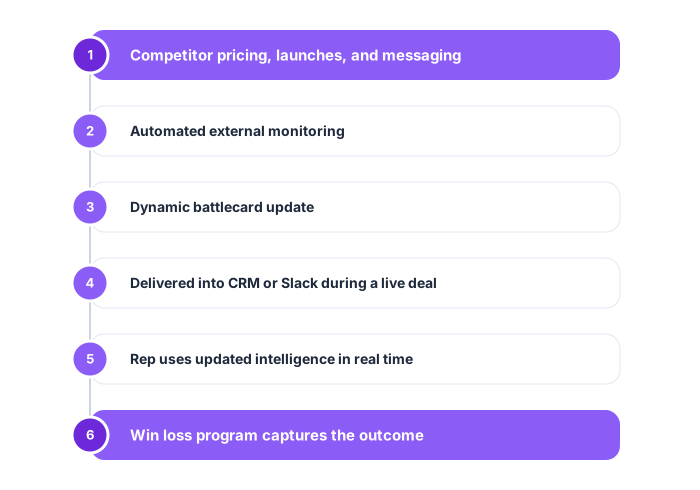
Klue's implicit philosophy is that competitive intelligence fails, in practice, not because companies lack a story but because that story goes stale and never reaches the rep who needs it in the exact moment a deal is at risk. The belief is that a battlecard written once and stored in a shared drive is functionally useless within a quarter, because competitors keep moving, and that the real challenge is building a system that continuously detects those moves and gets the resulting intelligence in front of a rep inside the tool they are already using, at the moment they are actually negotiating against that competitor, not a week later after a product marketer notices the change and updates a document. Klue's entire architecture, the automated monitoring, the dynamic battlecards, the CRM and Slack delivery, the win loss program closing the loop with real outcomes, is built around operational continuity: competitive intelligence as a living system rather than a document.
Elevate's implicit philosophy treats the same subject differently: it believes the harder, more foundational problem is that many companies never actually author a coherent, differentiated competitive story in the first place, relying instead on a scattered mix of a few talking points a founder came up with early on, whatever a sales rep improvised that worked once, and general assumptions about why customers choose the company. Before that story can be continuously monitored, kept current, and validated with real win loss data, someone has to write it, and write it well, grounded in an honest assessment of the competitive landscape rather than optimistic assumptions. Elevate's architecture, the fourteen module methodology generating the competitive narrative alongside a consistent ICP and broader positioning, is built to make sure that foundational authorship happens deliberately and is grounded in the same strategic logic as everything else the company says, rather than being written in isolation from the rest of the go to market strategy.
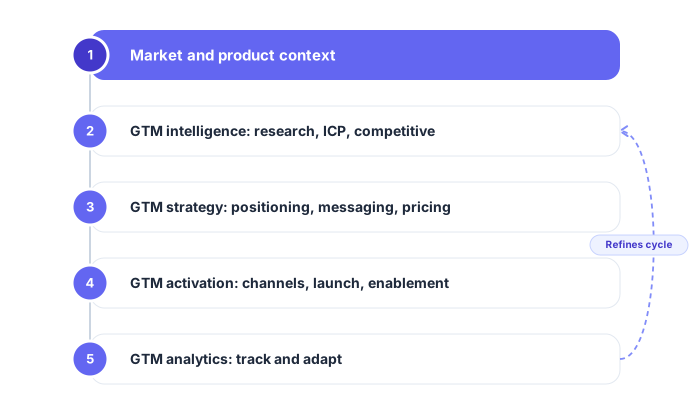
Notice the shape of the two diagrams. Klue's flow is a living, continuously running system, competitor activity flows in, updates a battlecard, and reaches a rep in real time, with outcomes feeding back automatically. Elevate's flow is a loop that authors the initial version of that same subject matter as part of a broader strategic exercise, refreshed on a cycle a user initiates rather than automatically in response to external change. Neither shape is wrong, and this is one of the few pairings in this series where the two loops are genuinely trying to solve adjacent parts of the exact same problem rather than entirely different problems. A team that only has Klue's continuous monitoring, with no coherent initial narrative underneath it, ends up with a very well maintained battlecard about a story that was never actually good. A team that only has Elevate's initial narrative, with nothing continuously monitoring whether it still holds, ends up with a well written story that quietly stops being true the first time a competitor moves.
There is also a philosophical difference in how each platform treats the human expert. Klue assumes an operator who wants systematic, always on operational rigor: product marketing and competitive intelligence professionals comfortable configuring monitoring sources, curating incoming intelligence, and managing rep adoption of the resulting battlecards. The product rewards someone who thinks like an intelligence operations manager running a continuous system. Elevate assumes a strategic operator who wants structured guidance and speed of authorship: someone who understands go to market thinking conceptually but does not want to manually draft a competitive positioning framework from a blank page at midnight before a launch. The product rewards someone who thinks like a strategist writing a first, well reasoned draft.
Neither philosophy is inherently premium or entry level. They are simply optimized for different points in the lifecycle of the same competitive story, and the honest answer to "which philosophy is right" depends entirely on whether your organization's actual gap is authoring that story in the first place, or keeping an existing story current and getting it into live deals.
Can They Work Together?
Yes, and given how directly the two platforms address different stages of the exact same subject, this pairing is arguably the most naturally sequential in this entire comparison series, because Klue explicitly needs a coherent competitive narrative to monitor and maintain against, and Elevate has no native mechanism for continuously tracking real competitor behavior or capturing win loss outcomes from actual closed deals.
The two platforms sit at different points in the same competitive intelligence lifecycle. Elevate operates at the authorship stage: generating the initial competitive positioning, differentiation narrative, and talking points as part of a broader, internally consistent GTM strategy. Klue operates at the maintenance and delivery stage: taking that narrative, continuously monitoring whether it still holds up against real competitor behavior, keeping the resulting battlecards current, and delivering them into live deals while capturing win loss data that shows whether the story is actually working. Used together, the output of one becomes the literal starting content for the other.
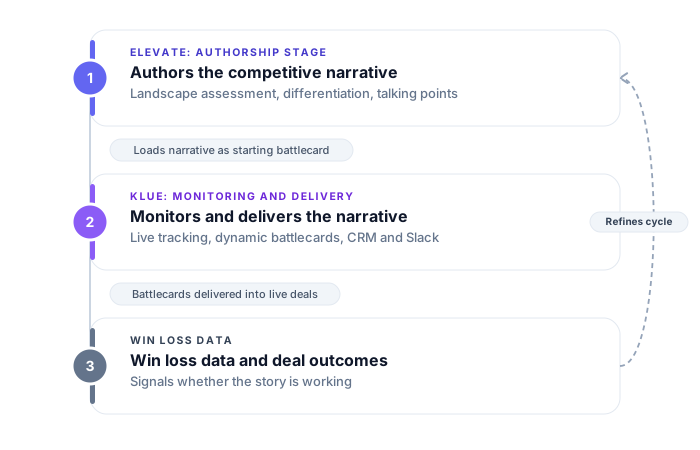
Key takeaway: the output of Elevate is the first, coherent draft of the competitive story. Klue takes that draft as its starting battlecard content, keeps it current against real market changes, and closes the loop with win loss data that tells you whether the story is actually winning deals. That handoff, initial narrative to continuous validation, is the cleanest version of "working together" in this entire series, because both platforms are explicitly built to hand off the same subject matter to each other.
Consider how that loop plays out in practice. A team runs the competitive intelligence and positioning modules inside Elevate and gets a structured initial narrative: a differentiation story against two named competitors, specific talking points addressing each rival's most likely objections, and a defensibility assessment flagging which parts of the story are more durable and which are more vulnerable to a competitor's next move. That narrative becomes the starting battlecard content loaded into Klue, rather than product marketing writing that first draft from inside Klue's own editor. Klue's automated monitoring then takes over, watching the two named competitors for pricing changes, product launches, and messaging shifts, and updating the battlecard as those changes occur, while reps pull the current, live version directly inside their CRM or Slack during real deals.
Once deals close, Klue's win loss program captures what buyers actually said about the competitive decision, whether the differentiation story genuinely resonated, which specific talking points came up, and whether the deal was won or lost. That data is a direct, evidence based signal about whether Elevate's original narrative is actually correct, not just internally coherent. If win loss data consistently shows one of Elevate's talking points falling flat with real buyers, or a competitor's recent move undermining a claim the narrative depends on, that is exactly the kind of signal worth feeding back into a fresh Elevate cycle to revise the underlying story, closing the loop between what the two platforms respectively author and validate.
There is a sequencing consideration worth flagging honestly, more acutely here than in any other pairing in this series given how directly the subject matter overlaps. Investing in Klue's continuous monitoring and deal delivery infrastructure before a coherent competitive narrative exists produces a very well maintained system tracking a story that was never actually good, wasting real budget on operational rigor applied to a weak foundation. Running Elevate's competitive intelligence module without ever operationalizing the output into a continuous monitoring and enablement system produces a well reasoned initial narrative that goes stale the moment a competitor makes its next move, with no mechanism to detect that drift or get updated intelligence in front of a rep who needs it mid deal. Neither failure mode is really about the tools; both come from treating the authorship and maintenance of the same competitive story as unrelated tasks rather than sequential stages of one ongoing process.
For teams evaluating budget across both, a lighter version of this pairing still works: use Elevate to author and periodically refresh the core competitive narrative, and bring in Klue's continuous monitoring specifically once the competitive stakes, deal volume, and number of named rivals are significant enough to justify always on tracking and deal embedded delivery. A company with light competitive pressure and only one or two named rivals may reasonably rely on Elevate's periodic regeneration cycle alone for longer before Klue's continuous infrastructure becomes clearly necessary.
A concrete quarter by quarter walkthrough makes this less abstract. In month one, a team runs its competitive intelligence and positioning work inside Elevate, producing an initial differentiation narrative against its named competitors. In month two, product marketing loads that narrative into Klue as the starting battlecard content and configures monitoring against those same named competitors, while sales enablement drives rep adoption of the resulting, now continuously maintained battlecards. By month three, Klue's win loss program has captured enough real deal outcomes for a product marketing leader to pull that evidence back into a strategy review, checking whether Elevate's original narrative is actually resonating with real buyers or whether specific talking points need revision. That review becomes the input for the next Elevate cycle, and the loop repeats, with each new narrative cycle grounded in real, validated competitive evidence rather than starting from assumption again.
Best For: Matching the Platform to Your Team
| Team Profile | Better Fit | Why |
|---|---|---|
| Company with no existing competitive narrative or positioning against named rivals | Elevate | Authorship has to happen before there is anything coherent for continuous monitoring to maintain |
| Company with real, ongoing competitive pressure from several defined rivals and real deal volume | Klue | Continuous monitoring, dynamic battlecards, and deal embedded delivery are exactly what the platform is built for |
| Company with a mature Klue deployment but a competitive story reps do not find compelling | Elevate | The delivery infrastructure works; the underlying narrative likely needs to be rewritten |
| Early stage startup with only one or two known competitors and light competitive pressure | Elevate | A periodically refreshed narrative may be sufficient before continuous monitoring infrastructure is justified |
| Company repositioning after a pivot, with new or different competitors to address | Elevate | Requires authoring a new competitive narrative before any monitoring system has something coherent to track |
| Enterprise sales team needing win loss data to validate competitive assumptions | Klue | The built in win loss program directly closes this feedback loop |
| Product marketing team wanting a first, structured competitive draft before manual battlecard writing | Elevate | Compresses the authorship work that would otherwise start from a blank page |
| Fractional CMO or GTM consultant serving multiple clients | Elevate | Structured methodology speeds up strategy delivery across engagements |
| Sales enablement team needing competitive intelligence delivered directly into CRM and Slack | Klue | Native, deal embedded delivery is a core, differentiated capability |
| Broader GTM strategy work beyond just the competitive narrative, ICP, messaging, channels | Elevate | Klue is purpose built for competitive intelligence specifically, not the full GTM methodology |
The pattern across this table is consistent enough to state plainly: Elevate tends to fit the moment a competitive narrative needs to be authored or substantially rewritten, and Klue tends to fit once that narrative exists and needs continuous, operational maintenance against real market movement and real deals. That said, this is a rough proxy, not a hard rule. A company with a mature Klue deployment can still need a fresh Elevate cycle after a major repositioning, and an early stage company with intense competitive pressure from day one might reasonably invest in both sooner than its size would otherwise suggest. The better question than "how many competitors do we track" is "do we have a coherent story to maintain in the first place," which the next two sections address directly.
Key takeaway: because both platforms touch competitive intelligence, the most useful diagnostic is not which platform is more powerful, it is whether your organization's gap is authorship, you do not have a good enough story yet, or maintenance, you have a good story that is not being kept current or delivered into real deals.
When to Choose Klue
Klue makes the most sense when your organization already has a reasonably coherent competitive narrative and real, ongoing competitive pressure from a defined set of rivals, and the actual bottleneck is keeping that narrative current and getting it in front of reps at the moment they actually need it.
Specific signals that point toward Klue:
You are competing regularly against a defined, relatively stable set of named rivals with real deal volume. If the same two or three competitors show up in most of your competitive deals, and those competitors are actively moving, changing pricing, launching features, shifting messaging, Klue's continuous monitoring is built precisely to track that movement without requiring a person to notice it manually.
Your current competitive battlecards are static documents that go stale between updates. If your existing battlecards live in a shared drive or a wiki page that gets revised every quarter at best, and reps sometimes reference outdated information in a live deal, Klue's dynamic, continuously updated battlecards delivered directly into the CRM or Slack are a direct fix for that staleness problem.
You need a systematic way to capture and act on win loss data. If your organization currently relies on informal, inconsistent debriefs to understand why deals were won or lost against a specific competitor, Klue's built in win loss program is purpose built to close that feedback loop systematically rather than anecdotally.
You want an AI layer that can answer competitive questions on demand rather than requiring a rep to search through a static document. Compete Agent and Ask Klue extend the platform beyond a passive intelligence library into something a rep or product marketer can query directly in the moment a question comes up.
Your budget can absorb a substantial, quote based annual investment specifically for competitive enablement. Given that even entry level deployments commonly run into the mid five figures annually, with larger deployments reaching low six figures or more, the platform's economics work best for organizations where competitive win rates against specific, known rivals are a clear, quantifiable priority.
A useful gut check: if you already have a competitive story your team is generally confident in, but that story is not being kept current against real competitor moves, or reps are not actually using it inside live deals, your constraint is almost certainly maintenance and delivery, and Klue is the more direct answer.
When to Choose Elevate
Elevate makes the most sense when the honest answer to that gut check above is no, or is a hesitant maybe, specifically because there is no coherent competitive narrative yet for a maintenance and delivery platform to maintain.
Specific signals that point toward Elevate:
You do not yet have a structured, coherent competitive narrative against your named rivals. If your current competitive positioning is closer to a handful of talking points different reps have independently developed than a deliberate, internally consistent differentiation story, authoring that story is the prerequisite step, and it is exactly what Elevate's competitive intelligence module is built to compress from a blank page into a structured first draft.
You are entering a new market or facing new competitors following a pivot, expansion, or repositioning. A previously solid competitive narrative built against one set of rivals does not automatically transfer to a new market with different competitors, and building the new narrative from scratch is a strategic authorship task, not a monitoring task.
Your competitive pressure is still light, with only one or two known rivals and lower deal volume. A continuously monitoring, deal embedded platform like Klue delivers the most value at real competitive scale and volume; a smaller, earlier stage company may reasonably rely on Elevate's periodically refreshed narrative for longer before that additional infrastructure investment is clearly justified.
Your broader GTM strategy, not just the competitive narrative, still needs definition. If ICP, core positioning, messaging, and channel strategy are all still unsettled alongside the competitive story, Elevate's fourteen module methodology addresses that full scope in one connected system, whereas Klue is purpose built for competitive intelligence specifically and does not extend into the rest of the GTM methodology.
You are a fractional GTM leader, advisor, or lean team without a dedicated competitive intelligence function. Elevate's structured methodology can substitute for some of the deliverables a competitive intelligence consultant or in house product marketer would otherwise produce manually, which is meaningfully useful for lean teams or advisory practices serving multiple clients at once.
A parallel gut check: if you gave your product marketing team unlimited Klue budget and every monitoring source connected tomorrow, would your team know precisely what the underlying competitive story should say, which talking points actually reflect a defensible differentiation, and why that story should hold up against a competitor's next move? If the honest answer is uncertain, the constraint is authorship, and that is Elevate's territory, not Klue's.
Key takeaway: the two gut checks above are the fastest way to self diagnose. A coherent story with no systematic way to keep it current or deliver it into live deals points to Klue. No coherent story yet, regardless of how sophisticated the monitoring infrastructure behind it would be, points to Elevate.
Final Verdict
Klue and Elevate are the closest pairing in this entire comparison series, both genuinely doing competitive intelligence, and the honest verdict reflects that closeness rather than forcing an artificial separation. They are sequential stages of the same underlying work rather than competing approaches to it: one authors the competitive story, the other keeps that story true against a moving market and gets it into the hands of reps at the exact moment they need it.
If your organization already has a coherent, internally consistent competitive narrative and faces real, ongoing pressure from a defined set of rivals, Klue is very likely the more urgent investment. Its pricing requires real budget commitment and, like most platforms in this category, real negotiation given the lack of published rates, but for organizations with genuine competitive stakes and deal volume, its continuous monitoring, dynamic delivery, and win loss validation are difficult to replicate with static documents and informal debriefs.
If your organization does not yet have that coherent narrative, whether because it was never formally authored, or because a pivot or new market has introduced competitors the existing story was never built to address, Elevate is the more foundational fix, and it is the step that logically precedes a serious Klue investment. It will not monitor a competitor's pricing page or capture what a lost deal's buyer actually said, but it addresses the failure mode that undermines every other investment in this category: a very well maintained, very well delivered battlecard built around a story that was never actually compelling.
The pragmatic recommendation for organizations facing real competitive pressure: treat authorship and maintenance as sequential, not competing, investments, and be honest with yourselves about which stage you are actually in. Author or substantially refresh the competitive narrative through a platform like Elevate, an experienced product marketer, or rigorous internal work first, and once that narrative is solid, invest in a platform like Klue to keep it current, deliver it into every relevant deal, and validate it with real win loss evidence. Skipping the first step and investing directly in monitoring infrastructure means building an excellent delivery system for a story that was never good enough to deliver.
FAQ
Is Klue a competitor to Elevate GTM Solutions? Closer than any other pairing in this series, but still not directly, because the two platforms address different stages of the same competitive intelligence lifecycle. Klue continuously monitors real competitor behavior and delivers dynamic battlecards into live deals. Elevate authors the initial competitive narrative as part of a broader GTM strategy exercise. One writes the story, the other keeps it current and proves whether it works.
Can I use Elevate without Klue, or Klue without Elevate? Yes, both platforms function fully independently, though this is the pairing in this series where using only one leaves the most obvious gap. A company can use Elevate to author a competitive narrative and maintain it manually through periodic regeneration cycles without ever adopting Klue, particularly at lower competitive stakes. A company can use Klue on its own if it already has a coherent competitive story from another source, an experienced product marketer, an agency, prior internal work, and simply needs the continuous monitoring and delivery infrastructure Klue provides.
Which platform is better for a small startup with a limited budget? Elevate, clearly, for the authorship work specifically. A pre seed or seed stage company almost certainly does not yet have a formally authored competitive narrative, and Klue's pricing, commonly starting in the mid five figures annually even at the entry tier, is built for companies with established, ongoing competitive stakes rather than a team still figuring out its core differentiation story. Authoring that story through Elevate first is both the more urgent and dramatically more affordable investment at that stage.
Does Elevate replace the need for a competitive intelligence platform like Klue? No, and this is worth stating plainly given how much subject matter the two platforms share. Elevate generates an initial, coherent competitive narrative; it does not continuously monitor a competitor's actual pricing page, detect a real product launch the day it happens, or capture what a real buyer said about a lost deal. A company with a well authored competitive story from Elevate still has no systematic way to keep that story current or deliver it into live deals without a platform like Klue.
Does Klue replace the need for a product marketer or GTM strategist? No. Klue is exceptional at monitoring, maintaining, and delivering an existing competitive narrative, but it assumes that narrative already exists in a coherent form. It does not originate a company's core differentiation story, its ICP, or its broader positioning from first principles. That foundational strategic authorship has to come from somewhere, whether a hired product marketer, an experienced GTM consultant, or a structured platform like Elevate.
How does pricing compare between the two platforms? The pricing models are structured very differently, and Klue's sits meaningfully higher, reflecting the more operationally intensive nature of continuous monitoring versus point in time generation. Klue follows a fully quote based model with no public pricing, typically starting in the mid five figures annually for small teams on its Essentials tier and reaching low six figures or higher for larger, more feature rich deployments, consistent with the broader fifteen thousand to forty thousand dollar per year range commonly cited for dedicated competitive intelligence platforms. Elevate charges on a seat and GTM scope basis, starting around 499 dollars a month for a single user and a single product or market scope, scaling up through a growth tier and a custom enterprise tier, with pricing published rather than quote only. A useful way to think about it: Klue's cost reflects continuous, always on monitoring and delivery infrastructure, while Elevate's cost reflects a lighter, generative product focused on authorship.
Which platform is better for tracking real time competitor moves and delivering battlecards into live deals? Klue, without much ambiguity. Automated external monitoring, dynamic battlecard updates, and native CRM and Slack delivery are purpose built for exactly this. Elevate does not monitor competitors in real time or deliver intelligence into a live deal; its output is the initial competitive narrative that a platform like Klue would then continuously maintain and deliver.
Is there a risk of these two platforms creating overlapping or conflicting work? Yes, more than any other pairing in this series, which is exactly why clear ownership matters here specifically. Teams that adopt both should explicitly establish that Elevate owns the initial authorship of the competitive narrative, generated as part of the broader GTM strategy, and Klue owns the ongoing monitoring, maintenance, and deal level delivery of that narrative once it exists. Without that clarity, a team risks maintaining two separate, potentially inconsistent versions of the same competitive story, one inside Elevate's periodically regenerated output and one inside Klue's continuously updated battlecards, which recreates exactly the fragmentation problem both platforms are independently trying to solve.
How long does it take to see value from each platform? Elevate's competitive intelligence output is generated quickly, typically within minutes to hours once business and competitor context is provided, since the platform is designed to compress what would traditionally be a multi week authorship process into a structured first draft. Klue's value builds over a longer period: initial monitoring configuration and battlecard setup can be relatively quick, but the platform's full value, consistently detected competitor moves, meaningful win loss data, demonstrated rep adoption, accumulates over multiple deal cycles and generally strengthens the longer the monitoring and delivery system has been running.
Should an enterprise organization use both platforms simultaneously? Yes, and this is the pairing in this series where doing so is most clearly the recommended default for any organization with real competitive stakes, rather than a nuanced "it depends." Larger organizations facing sustained competitive pressure from multiple named rivals across multiple markets are exactly where Elevate's authorship, generating and periodically refreshing the core narrative across each market or product scope, and Klue's continuous monitoring and deal embedded delivery compound in value together. The main requirement is coordination: someone, typically a product marketing or competitive intelligence leader, needs to own the handoff between the narrative Elevate generates and the battlecard content Klue continuously monitors and maintains, so the two systems stay synchronized as the competitive landscape evolves rather than drifting into two separate, conflicting versions of the same story.