
What is GTM Strategy? The Complete Guide
Almost every company that sells something, a product, a service, a platform, has some version of a go to market strategy already, whether or not anyone in the building would call it that. There is a target customer written down somewhere, a pitch the sales team uses, a price on the website, a handful of channels that bring in leads. The plan exists in some form. The problem most companies run into is not that a plan is missing. It is that the plan was never actually built as a plan. It grew, piece by piece, decision by decision, usually made under time pressure by whoever happened to own that part of the business that quarter.
That is how a company ends up with a pricing page built by one person, a sales pitch refined by another, and a marketing campaign run by a third, none of whom sat in the same room when the decisions were made. Each piece can look reasonable on its own. Together, they rarely add up to a coherent story about who the company serves, why that customer should choose them over an alternative, and how the business intends to reach that customer efficiently enough to grow without burning through its budget in the process.
A real GTM strategy is what turns that scattered collection of decisions into a single, deliberate plan. It answers a small number of specific questions before a company spends money on marketing, hires a sales team, or sets a price: who is this for, what problem does it solve for them, why should they believe it solves that problem better than what they are using now, and what is the most efficient path to get in front of enough of the right people to build a real business.
So what exactly separates a genuine go to market strategy from the informal collection of decisions most companies already have, and why does getting this right matter enough to justify slowing down and doing it deliberately?
What is a GTM Strategy?
A go to market strategy, usually shortened to GTM strategy, is a company's plan for how it will reach the right customers, convince them to buy, and deliver value to them efficiently enough to build a sustainable business. It covers who the target customer is, what the company offers them and why it matters, how the company will price and position the offer, which channels will be used to reach buyers, and how sales, marketing, and the product itself will work together to convert interest into revenue.
A GTM strategy is not a marketing plan, and it is not a sales playbook, though it informs both of those things. It sits one level above them. Marketing decides how to run campaigns. Sales decides how to run a deal cycle. The GTM strategy decides, before either of those functions gets to work, who the target customer actually is, what the company's core message needs to be, and which paths to market are worth investing in at all.
What does a GTM strategy actually include? At minimum, a working GTM strategy defines the target customer and the problem being solved for them, a positioning statement that explains why the company's approach is different, a pricing and packaging model, the primary channels the company will use to reach buyers, and a rough sequencing of how the company plans to move from its first customers to a much larger base without needing to rebuild the whole plan from scratch every time it grows.
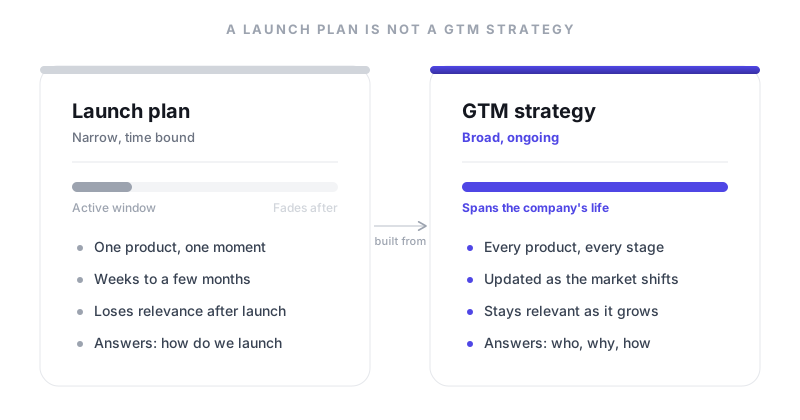
| Launch plan | GTM strategy | |
|---|---|---|
| Time horizon | A single launch window, usually weeks or months | An ongoing plan that spans the life of the product or company |
| Scope | One product, one moment | Every product, every stage of growth, revisited as conditions change |
| What it answers | How do we make noise around this specific release | Who do we sell to, why do they buy, and how do we reach them efficiently over time |
| What happens after it's used | Loses relevance once the launch window closes | Gets updated as the market, the product, and the customer base evolve |
The distinction matters because a lot of companies confuse the two. A launch plan is a useful, narrow document built around a specific event. A GTM strategy is the broader, ongoing plan that a launch plan should be built from, not a substitute for it. A company can execute a genuinely clever launch and still be operating without a real GTM strategy underneath it, the same way a business can run a great ad campaign for a product nobody actually wants once the ad stops running.
Why Does GTM Strategy Matter?
Companies rarely fail because the product is bad. Plenty of decent products fail to find a market, not because customers wouldn't have valued them, but because the company never worked out, with any precision, who those customers were, how to reach them at a reasonable cost, or what to say to them that would actually move them to buy. A GTM strategy exists to prevent that specific kind of failure: a good product, built by capable people, that never finds an efficient way to reach the customers who would have wanted it.
Without a deliberate strategy, a company tends to default to whichever channel or message worked once, early on, often by accident, and keeps repeating it long after it has stopped being the most efficient option available. A founder's personal network produces the first ten customers. Those ten customers do not represent the market the company eventually needs to serve, but the company keeps building around them anyway, because that early success feels like proof rather than a small, possibly unrepresentative sample.
The cost of skipping this work rarely shows up as one obvious failure. It shows up as a slow accumulation of inefficiency: marketing spend going toward an audience that never converts well, a sales team improvising a different pitch on every call because there is no agreed story to tell, a price set early on gut instinct that turns out to leave significant revenue on the table, or worse, that scares away exactly the buyers who would have been the best long term customers.
Quick Stat: Among companies that later go back and rebuild their GTM strategy from scratch, one of the most common findings is that the original target customer definition and the customer base the company actually ended up serving successfully have diverged significantly, often without anyone noticing until someone finally compares the two side by side.
Example: A company selling project management software originally built its pitch around solo freelancers, since that was the easiest audience to reach with a low cost, self serve signup flow. Over eighteen months, the company noticed that its highest retention and its largest expansion revenue were both coming from small agency teams of six to twelve people, a segment the original messaging barely spoke to at all. Marketing kept running ads aimed at freelancers because that is what the original GTM plan specified, sales kept fielding inbound leads that matched the freelancer profile and closing them at a low average deal size, and nobody had explicitly revisited the plan to notice that the business the company was actually becoming looked nothing like the business the original strategy had been built around. Revenue kept growing, slowly, while a faster, more profitable path sat mostly untouched because the strategy itself never caught up with what the data was already showing.
A working GTM strategy exists to catch exactly that kind of drift early, and to make sure that the customer the company is spending its marketing budget to reach, the customer sales is actually equipped to close, and the customer the product is genuinely built to serve are, in fact, the same customer.
A second, less visible cost. Beyond the obvious inefficiencies, a missing or outdated GTM strategy tends to produce a steady drain on leadership attention. Every pricing question, every debate about which feature to prioritize next, every disagreement about which market segment deserves the next quarter's budget, turns into its own standalone argument, because there is no shared, written down answer to point back to. Leadership ends up re-deciding the same basic questions, who are we really building this for, again and again, in slightly different words, in a dozen different meetings a year, without ever settling the question once in a way that sticks.
How GTM Strategy Works
Building a genuine GTM strategy is not a single planning session that produces a finished document. It is closer to a small operating system with a few interlocking parts: a clear picture of the market and the customer, a specific plan for how the offer will be positioned and reached, and a mechanism for updating that plan as real evidence comes in from actual selling.
Research Before Decisions, Not Instinct Alone
The starting point of a real GTM strategy is understanding the market well enough to make decisions from evidence instead of assumption. That means knowing who else is competing for the same buyer's attention and budget, what those buyers currently do to solve the problem the company is trying to address, and what would actually have to be true for a meaningful number of them to switch.
Skipping this step is the single most common shortcut companies take, usually because research feels slow compared to just shipping something and seeing what happens. The trouble is that decisions made without this groundwork tend to be built on whatever the founding team happens to already believe about the market, which is not the same thing as what is actually true about it. A founder who came from enterprise software will often default to an enterprise shaped GTM plan even when the actual early buyers turn out to be small businesses, simply because enterprise is the shape of market the founder instinctively understands.
One Clear Customer Definition, Not a Vague Audience
A GTM strategy without a specific customer definition tends to collapse into vague language: "businesses that need better software," "teams looking to save time." That kind of description cannot actually guide a decision. It does not tell a marketer which keywords to bid on, does not tell a sales rep which accounts to prioritize in a list of a thousand leads, and does not tell a product team which feature request from this week actually matters.
A working customer definition is specific enough to be operational: a particular size of company, in a particular industry or set of industries, dealing with a particular problem in a particular way today, with a particular trigger that tends to make them start looking for a new solution. The test for whether a customer definition is actually useful is simple: can two different people, working from the same written definition, independently agree on whether a specific real company is or is not a fit. If they cannot, the definition is still too vague to be doing real work.
Positioning and Pricing Built Together, Not in Sequence
Positioning and pricing often get treated as separate decisions made by separate teams at separate times, which tends to produce a mismatch that shows up later as a hard to explain sales objection. A product positioned as a premium, best in class solution but priced like a commodity confuses buyers, who reasonably wonder what the catch is. A product priced at the premium end but positioned with generic, feature list language struggles to justify the number on the invoice.
Getting this right means deciding, at the same time, what the product's core differentiated value actually is, who values that enough to pay for it, and what price makes sense given how much that value is actually worth to that specific buyer, rather than pricing based on what a competitor happens to charge or what feels intuitively fair.
A Feedback Loop From Real Selling Back Into the Plan
A GTM strategy is only useful if it changes based on what actually happens once the company starts selling. Win rates, the objections that come up repeatedly on sales calls, which channels produce customers that stick around versus churn quickly, all of this is real evidence about whether the original assumptions in the strategy were correct. A strategy that gets written once and never revisited against this evidence stops being a strategy and becomes, in effect, a historical document nobody is actually using anymore.
| Strategy without a feedback loop | Strategy with a feedback loop | |
|---|---|---|
| Source of change | The next scheduled planning cycle | Real signal from win rates, churn, and sales conversations |
| Speed of correction | Slow, often a full quarter or more behind reality | Fast, adjustments happen as evidence arrives |
| Risk | The company keeps executing a plan the market has already outgrown | The plan stays close to what is actually working right now |
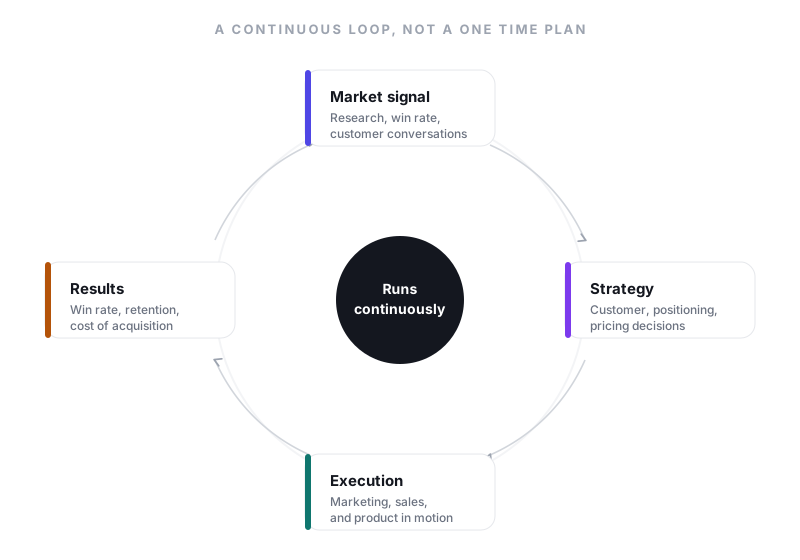
Research and market signal feed into strategy decisions about customer, positioning, and pricing. Strategy decisions get translated into execution across marketing, sales, and product. Execution produces real results, measured through win rates, retention, and cost of acquisition. Those results feed back into the strategy, closing the loop rather than leaving it as a one time exercise.
The Core Components of a GTM Strategy
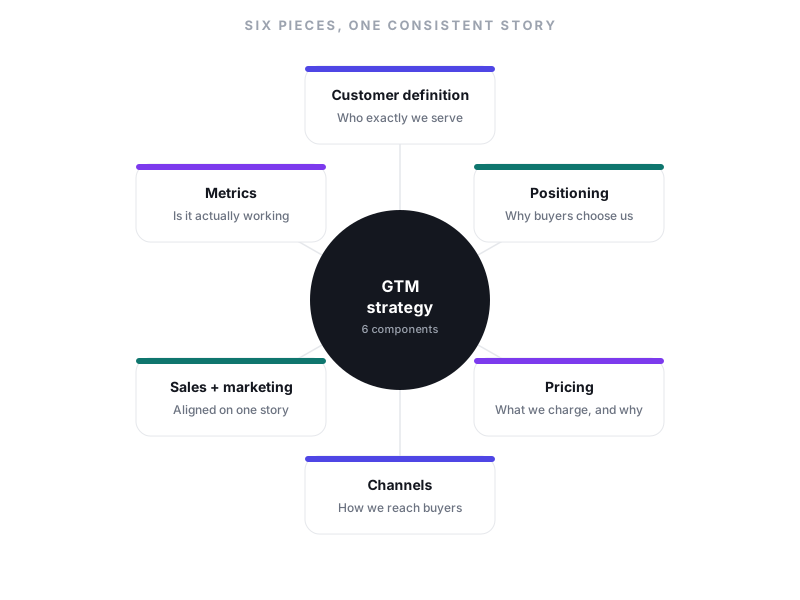
Nearly every functioning GTM strategy, no matter the size of the company or the industry, is built around the same handful of components. None of these components is exotic or hard to name individually. What separates a strong strategy from a weak one is usually not whether these pieces exist, but how specific, evidence based, and internally consistent they actually are with each other.
Target Market and Customer Definition
The starting point for everything else: a specific, evidence based description of who the company is building for. This includes firmographic detail where relevant, company size, industry, geography, and behavioral detail that matters even more, what the buyer is currently doing to solve the problem, what triggers them to look for something new, and who inside the buying organization actually makes or influences the decision.
Value Proposition and Positioning
A clear statement of the specific value the company delivers and why that value matters more, to this specific customer, than what any alternative currently offers. Good positioning is not a list of features. It is a claim about outcomes, stated in language the target customer would recognize as describing their own situation, and backed by evidence the company can actually point to.
Pricing and Packaging
How the offer is priced, structured, and bundled, built to reflect the value the customer actually receives rather than simply what it costs to deliver or what a competitor happens to charge. Pricing decisions ripple into almost every other part of the plan: they affect which customer segment the sales team can realistically pursue, how long a sales cycle needs to be, and what kind of marketing spend the business can sustainably afford per customer acquired.
Distribution and Channel Strategy
The specific paths the company will use to actually reach buyers: direct sales, self serve signup, channel partners, marketplaces, content and inbound marketing, outbound prospecting, or some combination. The right channel mix depends heavily on the price point, the complexity of the buying decision, and how much the target buyer already knows about the category before they ever encounter the company.
Sales and Marketing Alignment
How marketing generates and qualifies interest, and how sales converts that interest into closed revenue, built from the same customer definition and message so the two functions are reinforcing each other rather than working at cross purposes. Misalignment here is one of the most common and most expensive GTM failures: marketing hits its lead volume targets while sales quietly disqualifies a large share of those same leads as poor fits for what the company actually sells well.
Metrics and Iteration
A shared, specific definition of what success looks like at each stage, cost of acquisition, conversion rate through each stage of the funnel, time to close, retention and expansion revenue, so that the company can tell, with real evidence, whether the strategy is working and where it needs to change.
| Component | What it answers | Where it commonly goes wrong |
|---|---|---|
| Target market and customer definition | Who exactly are we building and selling for | Left too vague to actually guide a marketing or sales decision |
| Value proposition and positioning | Why should this customer choose us over an alternative | Built around features instead of the outcome the customer actually cares about |
| Pricing and packaging | What do we charge, and how is the offer structured | Set on instinct or copied from a competitor rather than tied to actual value delivered |
| Distribution and channel strategy | How do we actually reach the buyer | Chosen based on what worked once by accident rather than what fits the buying decision |
| Sales and marketing alignment | How does interest turn into closed revenue | Marketing and sales quietly working from two different definitions of a qualified lead |
| Metrics and iteration | Is this actually working, and where do we need to adjust | No shared definition of success, so every function measures a different thing |
Key Takeaway: None of these six components is unusual on its own. Most companies already have some version of all six. What actually separates a strong GTM strategy from a weak one is whether each component is specific enough to guide a real decision, and whether all six are built to agree with each other rather than existing as six separate, loosely connected efforts.
Types of GTM Strategy
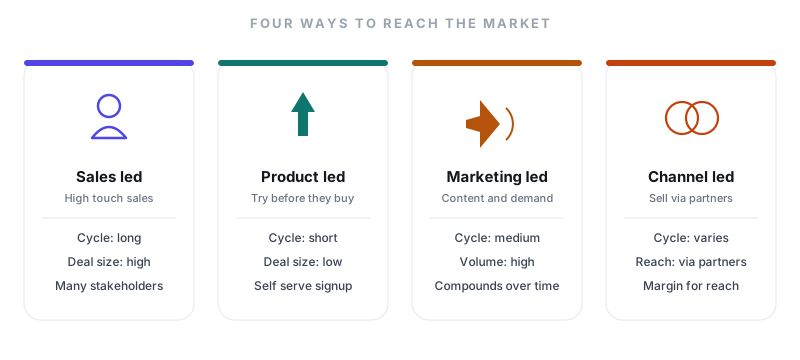
Not every company should use the same approach to reach its market, and one of the most common strategic mistakes is copying the GTM motion of a well known company in a completely different situation, without asking whether the underlying conditions actually match.
Sales led GTM. A dedicated sales team drives most or all of the buying process, typically used when the product is complex, expensive, or requires custom configuration, and when the buying decision inside the customer's organization involves multiple stakeholders who need to be convinced individually. This motion tends to have a longer sales cycle and a higher average deal size, and it depends heavily on the sales team's ability to navigate a buying committee rather than a single decision maker.
Product led GTM. The product itself does much of the convincing, usually through a free trial, a freemium tier, or a self serve signup that lets a prospective buyer experience real value before ever talking to a salesperson. This motion tends to work best for products with a fast time to value, a relatively simple buying decision, and a price point low enough that an individual user or a small team can adopt it without needing formal budget approval.
Marketing led GTM. Demand generation and content build broad awareness and inbound interest, which then gets converted through a lighter touch sales process or a self serve path. This motion depends on the company's ability to consistently produce content and campaigns that reach the right audience, and it tends to take longer to compound into meaningful volume than either of the other two approaches.
Channel or partner led GTM. The company reaches customers through resellers, systems integrators, or platform marketplaces rather than a direct relationship, useful when the target customer already trusts an existing relationship with a partner more than they would trust a new, unfamiliar vendor. This motion trades direct margin for reach, and it depends heavily on how well incentivized and enabled the partner actually is to prioritize selling the product.
Most real companies end up blending more than one of these rather than using a single pure motion, often shifting the blend as the company matures, a self serve product led motion in its early years gradually adding a sales led enterprise track once larger customers start asking for it.
Benefits of a Strong GTM Strategy
- Faster, more efficient growth. Marketing spend goes toward the audience most likely to actually convert and stick around, instead of being spread across an audience defined more by guesswork than evidence.
- Shorter sales cycles. A sales team working from a clear, well tested positioning and a specific customer definition spends less time re-explaining the basics on every call and more time addressing the objections that actually matter to a qualified buyer.
- Lower cost of acquisition. When marketing, sales, and the product itself are all pointed at the same customer for the same reasons, spend stops getting split across overlapping but not identical audiences, which tends to show up as a meaningfully lower blended cost per customer within a few quarters.
- Better product decisions. A clear picture of who the company serves and why they buy gives product teams a much sharper filter for prioritizing what to build next, rather than reacting to whichever customer request happened to arrive most recently.
- Higher retention. Customers who were sold accurately, based on a real fit between what they needed and what the product actually delivers, tend to stay longer and expand their spend, compared to customers acquired through a message that overpromised relative to reality.
- Faster decisions during ambiguity. When a new opportunity or a competitive threat shows up, a company with a clear strategy can quickly test it against an existing, agreed framework instead of starting every debate from scratch.
- Easier onboarding for new hires. A written, specific GTM strategy gives every new marketer, salesperson, and product manager a shared starting point, rather than requiring months of osmosis to figure out who the company actually sells to and why.
Real Examples
A pricing model that quietly mismatched the buyer. A company selling analytics software priced its product per seat, which worked well for its early customers, mostly small teams where everyone who touched the tool was also a named user. As the company moved upmarket toward larger organizations, per seat pricing started actively working against the sale: larger buying committees wanted broad internal access for occasional viewers who did not need to be full paying seats, and the per seat model made that expensive and awkward to negotiate. Deals that should have closed quickly stalled for weeks over seat count arguments that had nothing to do with the actual value of the product. Once the company introduced a usage based tier alongside the per seat model, deals in the enterprise segment closed measurably faster, because the pricing structure finally matched how the larger buyer actually wanted to use and pay for the product.
Two channels quietly competing for the same customer. A company running both a self serve signup flow and an outbound sales team discovered, after several quarters, that both motions were frequently reaching the exact same mid sized companies, sometimes the same individual buyer got a cold outbound email in the same week they signed up for a free trial on their own. Neither team had visibility into what the other was doing, so the company was effectively paying twice, once in sales rep time and once in marketing spend, to reach the same prospect through two uncoordinated paths. Once the two teams agreed on a simple rule, any account above a certain employee count gets routed to outbound sales rather than left in self serve, the overlap dropped sharply and the sales team's time went toward accounts self serve genuinely could not close on its own.
Positioning that tested well but did not survive real objections. A company tested a positioning statement extensively with a marketing panel and found strong, positive reactions to language emphasizing speed and simplicity. Once that positioning reached actual sales calls, reps found that speed and simplicity was not what serious buyers in the target segment cared most about, those buyers cared more about reliability and data security, and the speed focused pitch actually made some buyers slightly suspicious that the product cut corners to achieve that speed. The company rewrote its core message around reliability, backed by specific evidence, and win rates on qualified calls improved within the following quarter, a reminder that a message testing well in isolation is not the same as a message holding up under a real buyer's specific concerns.
A channel strategy built around what worked once. An early stage company landed several of its first customers through direct founder outreach on a professional networking platform, and treated that early success as proof that the same channel would scale as the primary way to reach the broader market. It did not. The founder's personal network and reputation were doing much of the real work in those early conversations, something a scaled outbound team without that same personal credibility could not replicate. The company spent several months and a meaningful budget trying to force the same channel to produce the same results at volume before recognizing that the channel itself was not the actual reason those early deals closed, and shifting investment toward a channel that did not depend on any one individual's personal network to work.
A target customer definition that widened too much, too fast. A company saw strong early success with mid sized manufacturing companies and, eager to grow faster, expanded its target definition to include almost any company with physical operations, regardless of size or industry. Marketing and sales both broadened their targeting to match. Lead volume went up. Win rates fell sharply, because the broader definition included a large number of companies whose actual problems and buying processes looked nothing like the original, successful segment. Narrowing the definition back to something closer to the original, well tested customer profile, rather than the broader one, recovered win rates within two quarters, at the cost of a smaller addressable pipeline that was, in practice, far more efficient to convert.
Common Mistakes
Skipping research and relying on instinct. Building a GTM plan entirely from what the founding team already believes about the market, without testing those beliefs against real conversations with actual prospective buyers, tends to produce a plan that is internally consistent but disconnected from what buyers actually want and how they actually decide.
Defining the customer too broadly. A customer definition vague enough to include almost anyone cannot actually guide a marketing or sales decision. If a definition does not let someone confidently say a specific real company is or is not a fit, it is not specific enough yet to be useful.
Copying a competitor's playbook without checking the underlying conditions. A GTM motion that works well for one company depends on specific conditions, price point, sales cycle complexity, how much the buyer already understands the category, that may not hold true for a different company simply because the two happen to compete in the same broad market.
Treating pricing as an afterthought. Setting a price late, based mostly on instinct or on matching a competitor's number, after the product and the positioning are already locked in, tends to produce a mismatch between what the product is worth to the customer and what the company is actually charging for it.
Letting sales and marketing define the qualified customer differently. If marketing counts a lead as qualified using different criteria than what sales actually uses to decide whether to pursue an opportunity, the two functions will look successful on their own dashboards while quietly working against each other in practice.
Never revisiting the plan once it is written. A GTM strategy built once, early on, and never checked again against real sales data, win rates, and churn tends to drift further from reality every quarter it goes unexamined, until the company is executing a plan for a market and customer that no longer exists in quite the way the plan describes.
Building the plan without input from the people executing it. A strategy designed entirely by leadership without direct input from the salespeople, marketers, and support staff who talk to real customers every day tends to miss the specific, granular detail that only shows up in those daily conversations, and it tends to earn less genuine buy in from the teams asked to execute it.
| Mistake | What it looks like in practice | Fix |
|---|---|---|
| Skipping research | The plan reflects what the team already believed, not what buyers actually said | Talk to real prospective and existing customers before locking in the strategy |
| Customer definition too broad | Nobody can confidently say whether a specific company is a good fit | Narrow the definition until two people would independently agree on real examples |
| Copying a competitor's motion | A sales led or product led approach adopted without checking if the underlying conditions match | Match the motion to the actual price point, sales complexity, and buyer familiarity |
| Pricing as an afterthought | Price set late, based on instinct or a competitor's number | Tie pricing directly to the value the customer receives, decided alongside positioning |
| Sales and marketing disagree on qualified | Marketing hits lead targets while sales disqualifies most of those same leads | Build one shared definition of a qualified opportunity that both functions use |
| Never revisiting the plan | The strategy quietly describes a market and customer that no longer exists | Review the strategy against real win rate, churn, and sales data on a regular cadence |
| No frontline input | A technically sound plan the frontline teams do not trust or actually use | Involve salespeople, marketers, and support staff directly in building the plan |
AI and GTM Strategy
AI has changed how quickly a company can gather and process the market and customer signal that a GTM strategy depends on. Tools that analyze sales call transcripts, support tickets, product usage patterns, and public competitive activity can surface a shift in buyer priorities or a gap in messaging within days, work that used to take a team of analysts weeks to piece together by hand from scattered sources. That speed matters directly, because one of the most common reasons a GTM strategy goes stale is simply that updating it by hand, across every affected part of the business, is slow and nobody is explicitly responsible for doing it regularly.
What AI has not changed is the harder, more judgment dependent part of the work: deciding what the strategy should actually say, and choosing between two reasonable but conflicting directions when the evidence itself does not point clearly to one answer. A model can flag, with real precision, that win rates in a particular segment have started declining or that a specific objection is showing up repeatedly on calls. It cannot decide, on its own, which of two plausible responses the company should commit to, whether to reposition around a different value proposition or to instead double down and fix the underlying product gap the objection is actually pointing at. That remains a decision made by people who are accountable for the outcome, not something a model can respectably resolve on its own.
In practice, this means AI is genuinely useful for keeping the underlying picture of the market and the customer current, and for surfacing early signals that the existing plan is starting to drift from reality faster and more consistently than a manual quarterly review ever would. The actual strategic decisions built on top of that picture, and the discipline of getting every function to actually operate from the same plan day to day, still depend on real organizational judgment and a specific person with the standing to make the call and enforce it.
Where AI Helps vs. Where It Doesn't: AI is well suited to detecting that something has shifted, a segment's win rate moving, an objection appearing more often, a competitor's new positioning showing up in public materials. It is not well suited, on its own, to deciding what the company's answer to that shift should be, or to making sure every function actually adopts the new answer. Both of those remain a human responsibility.
Building a GTM Strategy
Companies building a GTM strategy from scratch, or rebuilding one that has clearly stopped working, often try to solve everything at once: a new customer definition, new pricing, a new channel strategy, all decided in the same planning cycle. That tends to be too much simultaneous change for any team to actually absorb and execute well, since it asks marketing, sales, and product to abandon their existing habits all at the same time, with no evidence yet that the new plan will actually hold up once it meets real customers. A steadier path starts narrower and builds confidence one working piece at a time.
-
Start by talking to real customers and prospects, not just reviewing internal assumptions. Specifically ask what they are doing today to solve the problem, what would need to be true for them to switch, and what almost stopped them from buying or from staying. This step is the one most often skipped under time pressure, and it is also the one most likely to surface a detail that quietly reshapes everything downstream.
-
Write a specific, testable customer definition, then check it against a handful of real companies or individuals the team already knows. If two people cannot independently agree on whether a specific real example fits the definition, the definition still needs to be narrowed further before it is useful.
-
Build positioning and pricing together, rather than in sequence, so the story the company tells about its value and the number on the price tag actually agree with each other in the eyes of the buyer.
-
Choose a primary channel deliberately, based on the actual complexity of the buying decision and how much the target buyer already understands about the category, rather than defaulting to whichever channel happens to be fashionable or whichever one produced a lucky early result.
-
Put a specific person in charge of revisiting the plan on a real cadence, tied to actual sales and retention data rather than only to the calendar. A GTM strategy that nobody is explicitly responsible for updating tends to quietly go stale the moment the market shifts, long before anyone notices.
| Stage | Focus | What "ready to move on" looks like |
|---|---|---|
| 1 | Talk to real customers and prospects | Specific patterns emerge about triggers, objections, and what would cause a switch |
| 2 | Write and test a specific customer definition | Two people can independently agree on real world examples of fit and non fit |
| 3 | Build positioning and pricing together | The value story and the price point agree with each other from the buyer's point of view |
| 4 | Choose the primary channel deliberately | The channel matches the actual complexity of the buying decision, not just past luck |
| 5 | Assign ownership of ongoing review | A specific person is responsible for checking the plan against real data on a set cadence |
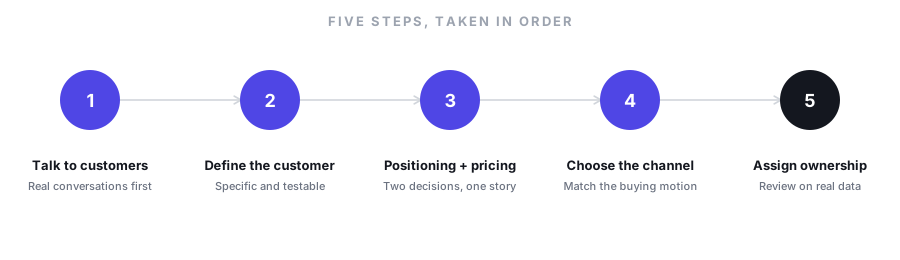
Key Takeaway: The highest leverage first step is almost always talking to real customers before writing anything down, not because it is the most sophisticated part of the process, but because every other decision in the strategy, positioning, pricing, channel choice, depends on getting this foundational picture right first.
GTM Strategy and the Rest of the Business
A GTM strategy does not operate in isolation from the rest of the company. It is the connective layer that determines whether marketing, sales, product, and customer success are all building toward the same outcome or quietly working past each other.
It depends directly on a clear, specific understanding of the ideal customer, since without one, positioning and channel decisions have nothing solid to be built around. It connects tightly to the product roadmap, since a strategy built around a customer the product cannot actually serve well yet is a plan for a business the company does not yet have. It shapes how sales and marketing organize themselves day to day, since the specific motion chosen, sales led, product led, marketing led, or some blend, determines what kind of team, what kind of comp plan, and what kind of content actually make sense. And it depends on a real feedback loop from actual results back into the plan, since a strategy that never gets checked against real win rates and retention data is, in practice, just a document rather than something guiding actual decisions.
Companies sometimes try to build a strong GTM strategy without first getting the underlying product and market fit genuinely right, effectively trying to find an efficient way to sell something the market has not yet clearly shown it wants. A GTM strategy amplifies whatever is true underneath it. Applied to a product with a real, validated fit for a specific customer, it compounds into efficient, durable growth. Applied to a product still searching for that fit, it mostly means the company reaches its confusion faster and at greater expense.
Final Thoughts
Picture the manufacturing software company from earlier in this guide, the one whose customer definition quietly widened until win rates started falling, without anyone deciding that should happen. That is closer to the default outcome than the exception, whenever a company treats its GTM plan as something decided once, early, and then left alone while the market and the customer base keep moving underneath it. A real GTM strategy is not a document that gets written at the start and filed away. It is the ongoing, shared answer to who the company serves, why they buy, and how to reach them efficiently, an answer that has to keep being checked against what is actually happening in the market rather than what was true when the plan was first written.
None of this requires an enormous team or an elaborate planning process to start. It requires a genuine willingness to talk to real customers before assuming what they want, a specific enough customer definition to actually guide a decision, and someone with the standing to keep checking the plan against real evidence rather than letting it quietly go stale. As markets shift faster and buyers have more alternatives than ever, the companies whose growth compounds are usually the ones treating their GTM strategy as a living plan they actively maintain, not a slide deck from a kickoff meeting nobody has opened since.
Frequently Asked Questions
What is the simplest definition of a GTM strategy?
A GTM strategy is a company's plan for who it sells to, what it offers them and why that matters, how it prices and packages the offer, and which channels it uses to reach buyers efficiently enough to build a sustainable business.
How is a GTM strategy different from a marketing plan?
A marketing plan describes how a specific team will run campaigns and generate demand. A GTM strategy sits above that, deciding who the target customer is, what the core message needs to be, and which channels are worth pursuing at all, decisions the marketing plan should then be built from.
Do small companies and startups actually need a formal GTM strategy?
Yes, though it does not need to be elaborate. Even a short, specific written answer to who the target customer is, why they would buy, and how the company plans to reach them tends to produce far better decisions than relying on instinct alone, especially once the company grows past its first handful of customers.
Who should own the GTM strategy inside a company?
It varies by company size, but it works best with one clearly accountable owner, often a founder in an early stage company or a dedicated GTM or revenue operations leader later on, who has the standing to get marketing, sales, and product to actually build from the same plan.
How often should a GTM strategy be updated?
Based on real signal rather than a fixed calendar. A meaningful shift in win rate, a new competitor entering the market, or a change in what customers are asking for should each prompt a review, rather than waiting for the next scheduled annual or quarterly planning cycle.
What is the most common reason a GTM strategy fails?
A customer definition too vague to actually guide decisions, combined with skipping real conversations with prospective buyers in favor of internal assumptions about what the market wants.
Can a GTM strategy change as a company grows?
It should. A strategy that works well for a company's first hundred customers often needs real adjustment once the company moves toward a different customer size, a different price point, or a different buying process, and treating the original plan as permanent tends to slow that necessary adjustment down.
Does a GTM strategy replace the need for separate sales and marketing plans?
No. Sales still needs its own account and territory plans, and marketing still needs its own campaign plans. The GTM strategy is the shared foundation those individual plans are built from, not a replacement for either of them.
What is the very first thing to fix if a company's GTM strategy is not working?
Start with the customer definition. If sales, marketing, and product cannot each independently point to the same specific type of customer and agree, most other symptoms, weak messaging, inefficient channel spend, mismatched pricing, tend to trace back to that same underlying gap.