GTM Platform Trends 2026: What's Changing and What It Means for Your Stack
Seven real shifts reshaping GTM platforms in 2026 — planning cycles, agentic execution, stack consolidation, signal-based prioritization, GTM engineering, agent-intermediated buying and continuous strategy — and what each means for your stack.
Published 2026-09-24
Every January, someone publishes "40 GTM trends for the year ahead," and most of those lists are the same five ideas restated forty times with different bullet formatting. That's not useful, so this isn't that. This is seven shifts we can actually see happening in how GTM platforms are built, bought and used in 2026 — with what each one changes about the decisions in front of you this year, not just a headline.
A caveat before the list: 2026 is a year of genuinely confident predictions about AI and go-to-market, and a lot of them come from vendors selling the thing they're predicting will win. We've tried to separate what's observably happening — job postings, product roadmaps, how teams are actually restructuring — from what's still a forecast. Where something is a projection rather than a fact, we've said so.
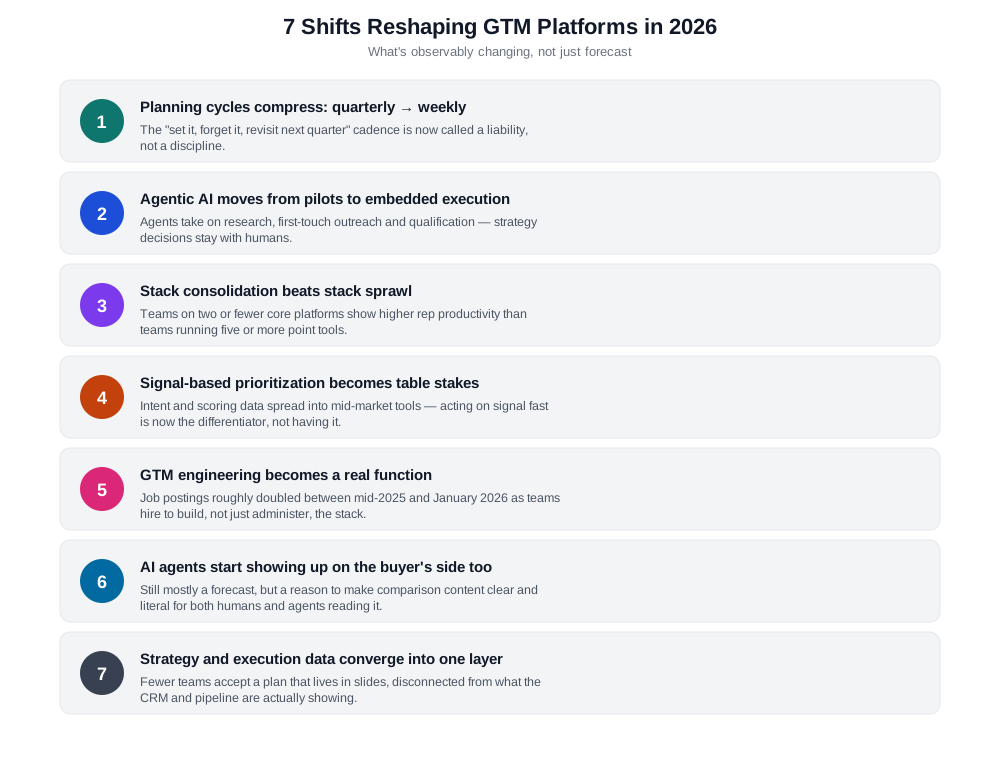
Shift 1: Planning cycles are compressing from quarterly to weekly
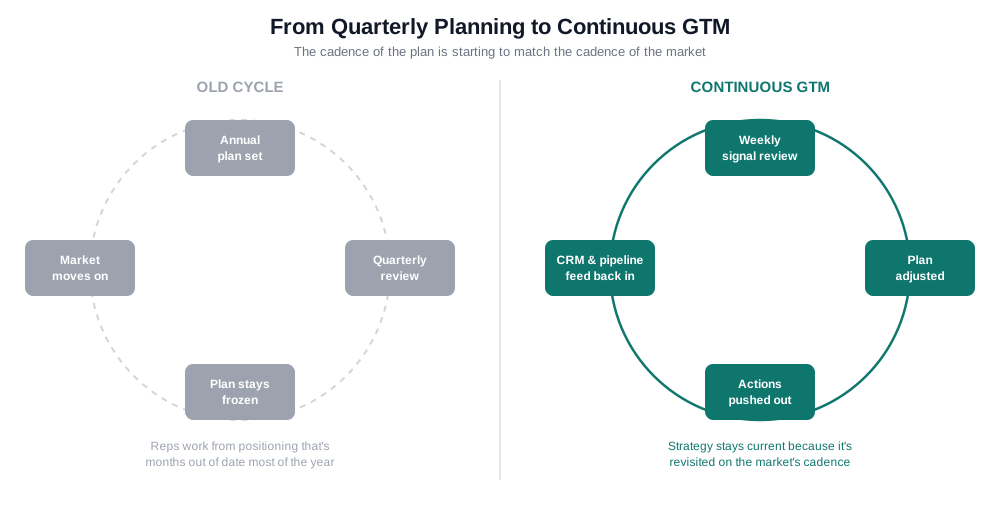
For most of the last decade, "GTM strategy" meant an annual planning exercise — usually built in Q4, presented in a kickoff deck, and revisited (if it was revisited at all) at the next quarterly business review. That cadence is increasingly being called out, including by sales enablement vendors with no stake in the strategy layer specifically, as a liability rather than a discipline. The argument shows up consistently across 2026 sales technology commentary: the "set it, forget it, revisit next quarter" cycle can't keep pace with how fast messaging, positioning and channel mix now need to move.
What's driving the compression isn't just impatience — it's that the tools underneath a GTM plan now update in real time (intent signals, pipeline data, competitive moves), while the plan itself still updates on a calendar. That gap is where the friction shows up: reps working from positioning that's two quarters stale, campaigns targeting a segment that's already been deprioritized, pricing that hasn't moved even though the market has.
What it means for your stack: the plan itself needs an owner and a cadence, not just the campaigns that execute it. If nobody revisits ICP, messaging and pricing more often than once a quarter, no amount of execution tooling underneath it will close the gap.
Shift 2: Agentic AI moves from pilot projects to embedded execution
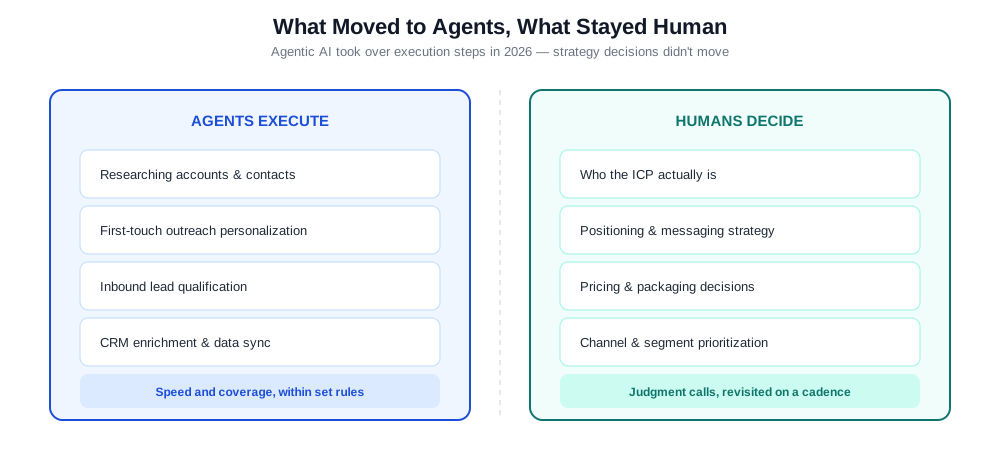
2025 was the year of AI pilots in sales and marketing. 2026 is the year those pilots stopped being pilots. Autonomous agents that research accounts, personalize first-touch outreach, qualify inbound leads and hand off structured context to a rep are now showing up as standard line items in GTM tooling, not experimental add-ons — the shift is commonly described in the market as agents moving from assisting a workflow to executing steps of it independently, within defined boundaries.
The important nuance, and the one a lot of vendor messaging glosses over: agents are taking on execution, not strategy. Multiple 2026 industry analyses draw the same line — AI agents can compress the time between a signal and an action, but the decisions about who your ICP is, how you're positioned, and what you charge are still, and will likely remain, a human call. The practical risk in 2026 isn't under-adopting agents; it's over-trusting them with decisions they were never built to make.
What it means for your stack: audit where agents are doing execution versus where they've quietly been handed strategic decisions (which segments to target, which messages to test) with nobody reviewing the output. The first is a productivity win. The second is a risk you probably didn't sign up for.
Shift 3: Stack consolidation is winning over stack sprawl
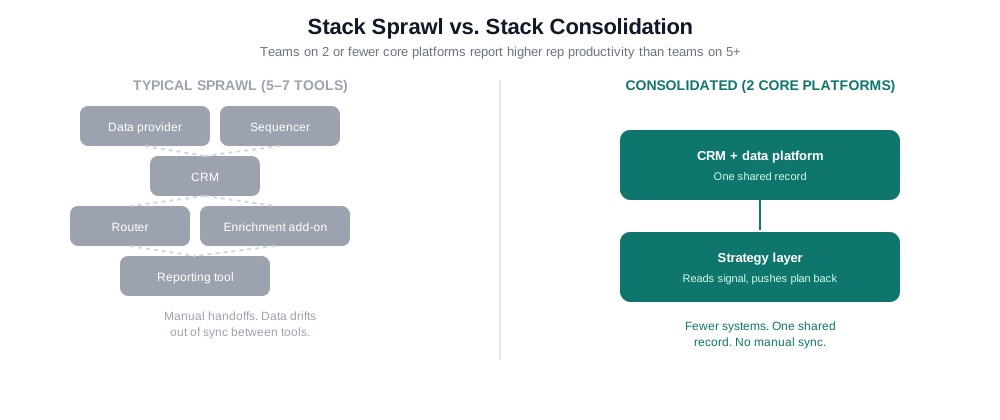
The average B2B revenue team still runs somewhere between five and seven disconnected point tools — a data provider, a sequencer, a CRM, a routing layer, an enrichment add-on — each doing its job in isolation, with manual handoffs between them. That sprawl is increasingly the thing companies are actively correcting for rather than adding to. Gartner's 2025 sales technology research, cited widely across 2026 GTM tooling coverage, found that B2B teams consolidated onto two or fewer core platforms saw meaningfully higher rep productivity than teams running five or more.
This doesn't mean the "one platform to rule them all" pitch is right — as our companion guide on GTM platform types lays out, no single tool actually replaces a CRM, a data layer, an orchestration platform and a strategy layer at once. What's changing is buyer behavior: teams are getting more disciplined about which layers genuinely need a dedicated tool and which can be consolidated, instead of adding a new point solution every time a new problem shows up.
What it means for your stack: before adding a new tool in 2026, the more useful question is whether an existing platform in your stack already covers that job, not whether the new tool's feature list looks impressive in a demo.
Shift 4: Signal-based prioritization becomes table stakes, not a premium feature
Intent data and account scoring used to be an enterprise-tier differentiator — something you bought once your ABM program justified a six-figure ABM platform. In 2026, some version of signal-based prioritization (website visitor identification, job-change alerts, technographic fit scoring) is showing up further down-market, bundled into CRMs, sales engagement tools and even some marketing suites, rather than sold only as a standalone enterprise platform.
The result is that "we don't have intent data" is a weaker excuse for slow prioritization than it used to be. The differentiator is shifting from having signal at all to acting on it fast and consistently — which is a strategy and process question, not just a data question.
What it means for your stack: if you're evaluating whether to buy an intent platform, also evaluate whether the signal you already get from your CRM or engagement tool is actually feeding into how reps prioritize their day. A lot of signal gets captured and never acted on.
Shift 5: GTM engineering becomes a real function, not a job title experiment
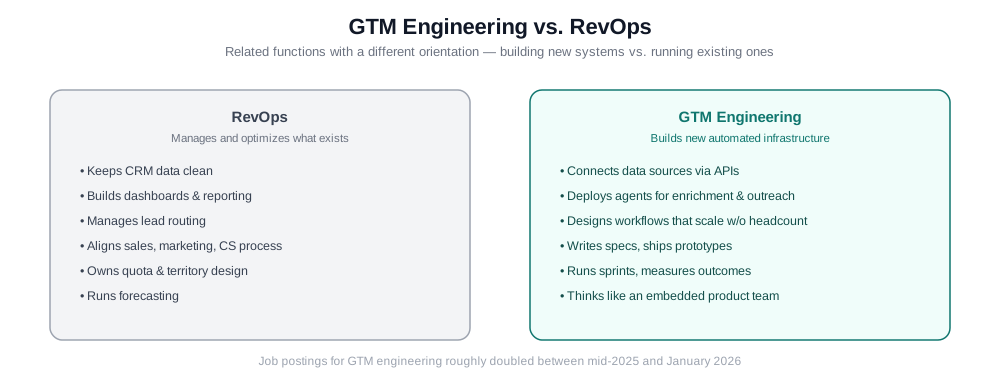
One of the more concrete, verifiable trends in this list: "GTM Engineer" job postings grew roughly from the low thousands in mid-2025 to over 3,000 by January 2026, and the role is showing up at name-brand tech companies with dedicated teams, not just as an experimental hire. The function sits at the intersection of RevOps, data and automation — the person (or team) who builds the pipelines connecting a CRM, a data provider, and outbound tooling into something that runs without manual glue work.
It's worth distinguishing this from RevOps, which it's often confused with. RevOps manages and optimizes the systems that already exist — clean data, dashboards, lead routing. GTM engineering builds new automated infrastructure — connecting data sources, deploying agents, designing workflows that scale without added headcount. The two are complementary, and the emergence of the second is a direct response to how much more technical the GTM stack has gotten in a short time.
What it means for your stack: if your team is still manually stitching together data from your CRM, your intent platform and your outreach tool, that's the gap this function exists to close — either by hiring for it, or by choosing platforms designed to reduce how much custom engineering the stack needs in the first place.
Shift 6: Buying committees start to include AI agents on the buyer's side
This one is more forecast than fully realized fact, so it's worth flagging as such — but it's showing up in enough 2026 GTM commentary to be worth tracking. Analyst projections (Gartner's among the most cited) suggest a growing share of B2B buying research and even early-stage evaluation will be mediated by AI agents acting on a buyer's behalf, rather than a human alone reading a website or a sales deck.
Whatever the exact timeline turns out to be, the directional implication is already actionable: content, pricing pages and comparison guides increasingly need to be structured in a way that's legible to both a human evaluator and an agent doing research on that human's behalf — clear claims, honestly stated limitations, and comparison content that doesn't rely on vague marketing language to make its point. Vague, hype-heavy positioning doesn't parse well for either audience.
What it means for your stack: it's a reason to make comparison and evaluation content (like buyer's guides, comparison pages and pricing pages) clearer and more literal, not just more persuasive. That's good practice regardless of how fast agent-mediated buying actually grows.
Shift 7: Strategy and execution data are starting to live in one place, not two
The last few years produced a wave of "GTM operating system" language — treating go-to-market as something you build, version and operate continuously, borrowed explicitly from the software engineering metaphor. The concrete shift underneath that language: fewer companies are content with a strategy plan that lives in slides, disconnected from the CRM and campaign data showing whether that plan is working. The direction of travel is toward strategy and execution data converging into fewer systems, so that a change in market conditions or pipeline reality can actually update the plan, rather than the plan and the pipeline living in separate tools that never talk to each other.
This is the trend most directly relevant to why a strategy layer exists as its own category at all — the seven shifts above only compound the value of having one place where ICP, positioning, messaging and pricing get revisited against what the rest of the stack is actually seeing, instead of a plan that was accurate the day it was written and stays frozen after that.
What it means for your stack: the test isn't whether you have a strategy document. It's whether that document has been updated in the last month based on something your CRM, your intent data or your pipeline actually showed you.
Where this leaves a 2026 buyer
None of these seven shifts argue for buying more tools. Most of them argue for the opposite — fewer, better-connected systems, a shorter distance between a signal and a decision, and a plan that gets revisited on the same cadence the market actually moves. If you're evaluating your stack against these trends, the useful starting questions are: how often does our actual GTM strategy get updated, who owns that update, and does the update reach the tools our reps and marketers use every day — or does it stay in a slide deck until the next quarterly review.
That last question is the one most stacks still fail, regardless of how many of the other six trends they've already adopted.
Frequently asked questions
Is agentic AI actually replacing SDRs in 2026? The evidence points to augmentation rather than full replacement so far. Multiple 2026 industry reports describe hybrid human-AI models — agents handling initial research, prospecting and first-touch personalization, with humans focused on relationship-building and complex qualification — as the dominant pattern, not full autonomy. Claims of agents running the entire top of funnel unsupervised should be treated as a vendor's aspiration more than an observed norm.
Should a mid-market company invest in GTM engineering as a function? It depends on how much manual, repeated integration work your team is already doing between systems. If reps or ops staff are regularly hand-copying data between a CRM, a data provider and an outreach tool, that's the exact gap the function exists to close. If your stack is small and well-integrated already, hiring for the role ahead of that need is premature.
Is stack consolidation always the right move? Not universally — consolidation helps when the tools being merged are genuinely redundant, and hurts when it forces a team to drop a capability with no adequate replacement in the consolidated platform. The research favoring consolidation compares two-or-fewer-platform teams to five-or-more-platform teams; it doesn't argue that one platform is always superior to two.
How real is the "agent-intermediated buying" trend right now, in 2026? It's a documented direction with real momentum in analyst forecasting, but the specific adoption percentages circulating (including multi-year-out projections) are forecasts, not measured 2026 outcomes. Treat it as a reason to make your content clearer and more structured now, rather than as a fully arrived reality to build an entire GTM motion around today.
What's the single trend most likely to be overstated? Full autonomous "revenue engines" that run without human strategic input are the trend most likely to be ahead of where most B2B companies actually are in 2026. The more consistently supported pattern across independent sources is AI compressing the time from signal to action, with humans still setting the direction that action serves.