
ZoomInfo vs Elevate: Which Platform Is Right for Your Business?
ZoomInfo has spent close to two decades becoming the default answer to a very specific question: who works at this company, and how do I reach them. What started as a contact and company database has grown into something considerably broader, a bundled go to market platform that now includes intent data, account based marketing tooling, an AI layer called Copilot, and, through its acquisition of Chorus, conversation intelligence that competes directly with Gong. Elevate GTM Solutions has grown in the opposite direction: narrower and more focused, an AI native GTM strategy platform built to generate the ICP, positioning, and messaging a team needs before any of ZoomInfo's data, intent signals, or AI features are worth pointing at anything.
The comparison is worth taking seriously precisely because ZoomInfo has expanded so far beyond its original category that it now touches almost every layer this comparison series has covered separately, data enrichment, intent signals, ABM, even conversation intelligence, all under one increasingly consolidated platform. Elevate sits entirely outside that consolidation, at a layer ZoomInfo has never tried to build: the strategic definition of who your ICP actually is and what you should say to them, independent of how much data or how many signals you can access about them.
This guide breaks down what each platform actually does, where a genuine comparison holds up, where it does not, and how a revenue team running both would typically divide the work between them.
ZoomInfo vs Elevate at a Glance
| ZoomInfo | Elevate GTM Solutions | |
|---|---|---|
| Category | B2B contact database and go to market platform | AI native GTM strategy platform |
| Solves for | Finding, enriching, and reaching contacts and accounts, increasingly across the whole funnel | Defining who to target and what to say to them |
| Sits in the stack | Data and execution layer, expanding into signal and conversation layers | Strategy layer |
| Built around | A proprietary database of 230M+ contacts, plus Copilot AI, intent data, ABM, and Chorus conversation intelligence | A structured, multi module GTM methodology |
| Ideal owner | Sales ops, RevOps, SDR and marketing teams | Marketing leader, founder, or GTM advisor |
| Starting price | No public pricing, custom quotes typically starting around $15,000 per year | $499 per month |
| Output | Enriched contact and account records, intent signals, AI generated talking points, CRM synced data | ICP, positioning, messaging, launch and channel plans |
| Not designed to do | Generate original positioning or an ICP from first principles | Provide contact data, intent signals, or a database of any kind |
The one line version: if your biggest challenge is strategy, defining who your ICP should be and what to say to them, choose Elevate. If your biggest challenge is finding accurate contact and company data, along with intent signals and increasingly conversation intelligence, at scale, choose ZoomInfo. Almost every serious outbound motion eventually needs both, one defining the target, the other supplying the data and reach to act on it.
Executive Summary
If you only have three minutes, here is the short version.
ZoomInfo is built for teams that need accurate, current contact and company data at scale, and increasingly for teams that want that data bundled with intent signals, account based marketing tooling, and an AI layer that can summarize accounts and draft outreach. Its strength is breadth built on top of database depth: more than 230 million contacts, mature integrations into every major CRM, and a Copilot AI layer that generates account summaries, surfaces buying signals, and drafts talking points and follow ups grounded in that underlying data. ZoomInfo has also expanded well past its original category through acquisition, most notably absorbing Chorus to add conversation intelligence, meaning a fully bundled ZoomInfo deployment can touch nearly every layer this comparison series has covered separately. ZoomInfo's weakness is that none of that breadth generates a strategy on its own. It is exceptional at finding, enriching, and surfacing information about accounts and contacts you tell it matter. It does not decide which accounts should matter or what your message to them should say.
Elevate GTM Solutions is built for teams that need that upstream definition established or kept current before a single contact record is worth pulling. It takes market context, product details, and competitive information as input, and produces structured outputs: ideal customer profiles, positioning frameworks, messaging architecture, channel strategy, and launch plans. Elevate's strength is turning fragmented go to market thinking into a single operating system that marketing, sales, and product can align around before a single ZoomInfo search is run. Its weakness is that it does not maintain a contact database, track intent signals, or record a sales call. It is not a replacement for a data and intelligence platform.
The practical framing that most teams land on: Elevate answers "who is our ICP and what do we say to them," ZoomInfo answers "who specifically, by name and title, matches that ICP, and how do we reach and understand them at scale." A company with no defined ICP has a strategic gap that no amount of database size fixes, because ZoomInfo will return thousands of precisely matched, accurately enriched contact records against criteria that were never the right target. A company with a sharp ICP and no reliable way to find the actual people and companies that match it has an operational gap that is exactly what ZoomInfo is built to close.
The rest of this guide unpacks the details behind that summary: feature by feature, philosophy by philosophy, and scenario by scenario, so you can make the call for your own team with full context rather than a marketing headline.
Key takeaway: ZoomInfo answers a coverage question, who exists that matches our criteria and what do we know about them, and Elevate answers a definition question, what should that criteria actually be and what should we say once we find them. Enriching and reaching a large volume of contacts against a poorly defined ICP produces confident, well documented outreach to the wrong people, which is a more expensive mistake than reaching fewer, better targeted contacts more slowly.
What Is ZoomInfo?
ZoomInfo began as a B2B contact and company database and has grown, largely through acquisition and sustained product investment, into what the company now markets as a go to market platform. The core of the product remains a proprietary database reported to include more than 230 million contacts, widely regarded as one of the largest and most mature datasets of its kind, particularly strong for North American company and contact coverage. That database sits at the foundation of everything else ZoomInfo has built on top of it.
The platform today spans several product families rather than a single offering:
- SalesOS: the core contact and company database, search and list building tools, a Chrome extension, pipeline management features, and native integrations into Salesforce, HubSpot, and other major CRMs.
- ZoomInfo Copilot: an AI layer introduced to help sales teams prioritize accounts and personalize outreach, generating customized account summaries, surfacing real time buyer intent signals, highlighting recent developments at target accounts, and drafting outreach emails and follow ups. Copilot can also field natural language queries to research accounts, pull deal details, and identify buying groups. A separate Copilot Enterprise tier adds deeper automation, advanced reporting, custom integrations, and custom intent configuration.
- Intent data and ABM tooling: ZoomInfo sells separate Marketing Demand, ABM Lite, and ABM Enterprise packages aimed at marketing teams running account based programs, layering intent signals and account prioritization on top of the core database.
- Chorus: ZoomInfo's conversation intelligence product, acquired to add call recording, transcription, and analysis directly into the platform, functioning as a direct competitor to Gong within ZoomInfo's own bundled ecosystem.
Because ZoomInfo spans this many product families, buyers evaluating the platform are rarely comparing a single price point; they are assembling a bundle from seat count, credit allocation for contact reveals, and whichever combination of Copilot, intent data, ABM, and Chorus they choose to add. Pricing is not published anywhere and is entirely quote based, requiring direct engagement with ZoomInfo's sales team. Third party pricing analysis places typical entry level contracts for small teams starting around 15,000 dollars annually, with mid market deployments commonly landing in the 25,000 to 45,000 dollar range, particularly once intent data is added, which several analysts now describe as close to table stakes rather than a true add on given how competitive B2B outbound has become. The Elite tier, which unlocks the fuller feature set including Copilot, pipeline management, and real time buying signals, is commonly reported starting around 40,000 to 45,000 dollars annually. Larger enterprise deployments with twenty or more seats commonly run 60,000 to 100,000 dollars or more per year, and some enterprise customers with over one hundred seats and multi million credit allocations have reportedly paid upward of 140,000 dollars annually.
Who actually uses ZoomInfo day to day tends to be broad relative to more narrowly scoped platforms in this comparison series: sales development reps and account executives pulling contact data and using Copilot to research accounts before a call, RevOps managing the platform's CRM integrations and credit budgeting, and increasingly marketing teams running ABM programs off the same underlying database. Reviewers consistently describe the database depth and accuracy as a genuine differentiator, several specifically noting that competitors have not matched it, but pricing is a near universal complaint, particularly for small and mid sized teams, alongside contracts that auto renew with limited notice and little monthly flexibility.
A Quick Example
Picture a fifty person B2B software company with a clearly defined ICP of mid market manufacturing companies using a specific category of legacy equipment. An SDR uses ZoomInfo to search for VP and Director level operations contacts at every company matching that profile within a defined revenue range, pulls verified emails and direct dials for the resulting list, and uses Copilot to generate an account summary and draft a first outreach email referencing a recent expansion the target company announced, all found automatically through ZoomInfo's intent and account data rather than manual research. The entire workflow, from search to enriched, personalized first draft, takes minutes rather than the hours manual prospecting would require.
Notice what that example assumes already exists: a defined ICP, a specific title and seniority level worth targeting, and a revenue range narrow enough to make the resulting list meaningful rather than overwhelming. ZoomInfo did not define that ICP or decide which title level actually correlates with the company's best customers. It found, enriched, and helped personalize outreach to a universe someone else had already defined.
What Is Elevate?
Elevate GTM Solutions describes itself as an AI native GTM operating system, and the framing is deliberate. Rather than positioning itself as a contact database or intelligence platform, Elevate is structured around the idea that go to market strategy, positioning, messaging, channel selection, and execution planning, should live in one connected system instead of scattered across slide decks, static planning documents, and institutional memory that walks out the door when someone leaves.
The platform is organized around what it calls a fourteen module GTM methodology, spanning the full lifecycle from market research through customer advocacy. Practically, a user starts by entering business context: the product, the target market, industry, and segment. Elevate then generates structured outputs across the methodology rather than a single document. Reported categories include:
- GTM Context and Intelligence: market research, competitive intelligence, and ICP or segmentation modeling, meant to replace ad hoc research spread across browser tabs and analyst reports.
- GTM Strategy: product positioning, messaging architecture, and pricing strategy, structured so that every function is working from the same underlying narrative rather than function specific interpretations of it.
- GTM Activation and Execution: customer acquisition planning, distribution and channel strategy, marketing alignment, launch sequencing, and sales enablement material generated from the same strategic inputs.
- GTM Analytics: dashboards intended to track execution against the plan and flag where reality is drifting from the original strategic assumptions.
The philosophical anchor of the product is adaptability rather than a one time deliverable. Elevate frames traditional GTM planning as a static exercise: a strategy gets built once, usually during annual planning, gets turned into a deck, and then sits mostly untouched until the market has already moved past its assumptions. Elevate's pitch is that when market conditions, competitive dynamics, or buyer behavior shift, a user can update the underlying inputs and regenerate the affected parts of the strategy without starting the entire planning process over, keeping strategy and execution connected on an ongoing basis rather than treating them as sequential, disconnected phases.
Elevate also ships what it calls advanced intelligence modules on its top tier plan, abbreviated internally as EVUSP: buyer emotion and intent modeling, a GTM clarity and differentiation scoring system, and a defensible positioning and narrative framework. These sit above the core strategy generation layer and are aimed at teams trying to sharpen competitive differentiation rather than simply document it. Worth noting explicitly here, since the terminology overlaps with a capability ZoomInfo also markets under its own intent data products: Elevate's buyer emotion and intent modeling is a strategic exercise, reasoning about how a defined buyer persona is likely to feel and respond to different messaging, not a real time signal detection system tracking actual account behavior the way ZoomInfo's intent data does. It answers a different question than ZoomInfo's intent signals, even though both use the word intent.
Elevate also runs a smaller advisory arm, pairing the software with fractional GTM advisors who use the platform as the operating system for client engagements, which suggests the company is positioning itself as much toward consultative go to market work as toward a pure self serve SaaS motion.
What actually differentiates the architecture. Elevate is a much newer, far narrower entrant next to a nearly two decade old, increasingly consolidated platform like ZoomInfo, so the fair way to evaluate it is on how the product is built rather than on database scale or acquired product breadth it has neither tried nor needs to build. Five architectural choices stand out:
- AI native from the ground up. Elevate was not built as a contact database with an AI layer, Copilot, added on top years later to summarize and draft around existing data. The generation logic sits at the core of the product, which is why outputs update dynamically when inputs change rather than requiring a manual rewrite or a new Copilot query.
- A unified GTM lifecycle in one system. Market research, positioning, channel strategy, and execution planning live inside a single connected model instead of separate documents, decks, and spreadsheets that each need to be manually kept in sync with whatever account lists and outreach eventually get built downstream in a platform like ZoomInfo.
- A structured GTM methodology, not a database to search. The fourteen module framework gives the platform a defined shape to generate against, which is a meaningfully different design choice than a platform whose core value is returning accurate, comprehensive data against whatever search criteria it is given, without evaluating whether that criteria itself defines the right target.
- Multi module strategy generation. A single set of business inputs, product, market, ICP, propagates across positioning, messaging, pricing, and channel modules simultaneously, so those outputs start from shared assumptions instead of being drafted independently and reconciled later against whatever Copilot happens to summarize about a given account.
- A strategy to activation to execution to analytics loop. The product is architected as a cycle rather than a one time output, with the analytics layer explicitly designed to feed back into the strategy layer as execution data comes in.
Key takeaway: Elevate's case rests on how the system is architected, an AI native, unified, methodology driven loop focused on defining the target, rather than on database scale or the breadth of acquired product lines. Those are two different kinds of value, one strategic and one informational, and a mature GTM program generally benefits from both rather than treating them as substitutes.
A Quick Example
Picture that same fifty person software company, but a step earlier, before the ICP of mid market manufacturing companies with legacy equipment was even settled, back when the team had a general sense of who bought their product but no precise, validated definition. A VP of Sales opens Elevate, inputs the company's product context and its existing customer base, and asks the platform to define the ICP with more precision than "manufacturing companies." Elevate generates a structured buyer profile narrowed by the specific equipment category, company revenue range, and buying committee roles most correlated with the company's best existing customers, along with positioning and messaging tailored to that narrower definition. That refined ICP becomes the exact search criteria the SDR configures inside ZoomInfo, replacing a broad, generic manufacturing search with one built on an actual strategic hypothesis.
That sequencing is not incidental. It illustrates the core relationship between the two categories these platforms represent.
Feature Comparison Table
| Capability | ZoomInfo | Elevate GTM Solutions |
|---|---|---|
| Core function | B2B data intelligence and go-to-market platform | AI-native GTM strategy and planning |
| Primary interface | Search, list builder, Copilot AI, and Chrome extension | Structured GTM strategy dashboards and outputs |
| Primary user | SDRs, AEs, RevOps, and marketing teams | Marketing leaders, founders, product marketers |
| Contact and company database | Yes, 230M+ business contacts | Business context and AI-powered market research |
| Verified contact data | Yes, core feature | Not a contact data platform |
| AI capabilities | Copilot for account research and sales productivity | AI-native GTM planning across interconnected modules |
| Intent intelligence | Behavioral intent signals and buying intent | Buyer intent and emotion modeling |
| Account-based marketing | Dedicated ABM solutions | Customer acquisition and GTM strategy modules |
| Conversation intelligence | Yes, via Chorus | Sales enablement strategy |
| CRM integrations | Native Salesforce, HubSpot, and other CRM integrations | Growing integration capabilities plus document export |
| ICP and segmentation | Search filters and audience building | Yes, structured module |
| Positioning and messaging | Limited | Yes, core module |
| Competitive intelligence | Limited | Yes, structured module |
| Pricing strategy | No | Yes, structured module |
| Channel and distribution strategy | No | Yes, structured module |
| GTM launch planning | No | Yes, structured module |
| Sales enablement | Outreach assistance and conversation insights | Yes, structured module |
| Pricing transparency | Quote-based | Published pricing |
| Analytics focus | Data coverage, intent signals, and sales engagement | Strategic execution and GTM alignment tracking |
| Learning curve | Moderate | Moderate, guided workflow |
| Typical setup owner | Sales Operations or RevOps | Marketing leader or GTM advisor |
| Pricing model | Seat and credit-based | Seat and GTM scope-based subscription |
| Entry price point | No public pricing, commonly reported from ~$15,000/year | Starts at $499/month |
This comparison reflects that ZoomInfo and Elevate GTM Solutions solve different problems. ZoomInfo is designed to help sales and marketing teams discover companies and contacts, enrich data, monitor buying signals, and support account-level execution. Elevate GTM Solutions is designed to help organizations define their go-to-market strategy, including ICPs, positioning, messaging, pricing, competitive strategy, and execution plans. As a result, ZoomInfo leads in data and sales execution capabilities, while Elevate leads in strategic planning and GTM definition. The two platforms are complementary rather than direct substitutes.
It also helps to see where each platform physically sits in a typical GTM technology stack, since ZoomInfo's breadth means it actually spans more than one layer.
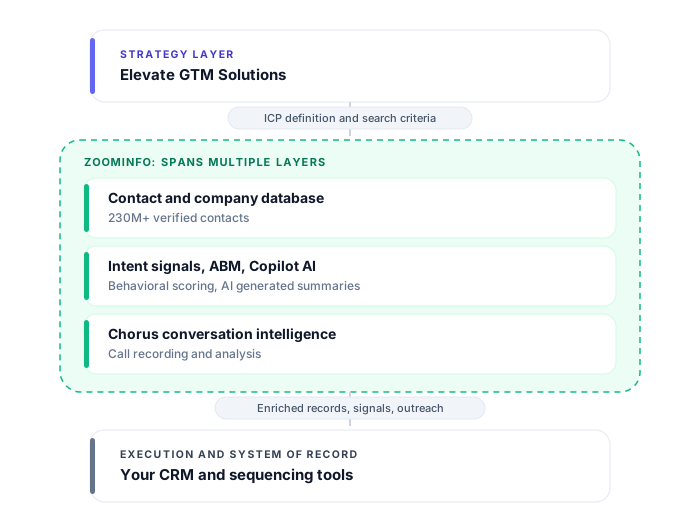
Reading the stack top to bottom is a useful diagnostic exercise on its own, and ZoomInfo is a genuinely interesting case within it because a fully bundled deployment, database plus Copilot plus intent plus ABM plus Chorus, actually spans a large horizontal slice of the middle layer rather than sitting in a single narrow band the way most tools in this series do. That breadth is real value for a team consolidating vendors, but it does not change the fundamental relationship to the top layer: if your organization has never clearly documented the strategy layer, no amount of ZoomInfo's data depth, AI summarization, or conversation analysis can fully compensate, since every search filter and every Copilot generated talking point still needs a targeting and messaging hypothesis to run against. Most GTM technology evaluations get more useful once a team maps its existing stack this way and identifies which layer is actually thin, rather than starting from a vendor comparison and working backward.
On pricing specifically, the two models diverge sharply in both structure and transparency. ZoomInfo does not publish pricing anywhere and requires direct engagement with sales for any quote, with the final number shaped by seat count, credit allocation for contact reveals, and which combination of Copilot, intent data, ABM, and Chorus a buyer bundles in. Third party pricing data places typical entry contracts for small teams starting around 15,000 dollars annually, mid market deployments in the 25,000 to 45,000 dollar range once intent data and Copilot are added, and larger enterprise deployments with twenty or more seats commonly landing between 60,000 and 100,000 dollars or more per year, with the very largest reported contracts, over one hundred seats with multi million credit allocations, reaching upward of 140,000 dollars annually.
Elevate's structure is closer to traditional SaaS seat and scope pricing, and is published in full rather than requiring a sales conversation to estimate. The Guided GTM tier starts at 499 dollars a month for a single user working within a single GTM scope, meaning one product, market, and segment combination. The Growth tier runs 1,499 dollars a month and expands access to up to three users and up to three GTM scopes, which suits a company managing more than one product line or market simultaneously. The Scale tier is custom and annual, removes user and scope limits entirely, and is the only tier that includes the advanced EVUSP intelligence modules for buyer emotion modeling, differentiation scoring, and narrative defensibility.
Key takeaway: ZoomInfo's cost reflects the expense of maintaining one of the largest B2B contact databases in the market and increasingly bundles in several adjacent product categories, which is real consolidated value for a team otherwise paying for multiple separate vendors, but the total is substantial and requires real negotiation given the platform's opaque, quote only pricing. Elevate's cost reflects a much lighter, strategy focused product and sits at a scale most organizations would reasonably fund independently of, and often before, a ZoomInfo investment.
Philosophy Comparison
Every GTM tool encodes a belief about where the hard part of go to market actually lives. ZoomInfo and Elevate encode genuinely different beliefs, and understanding that difference matters more than any individual feature comparison.
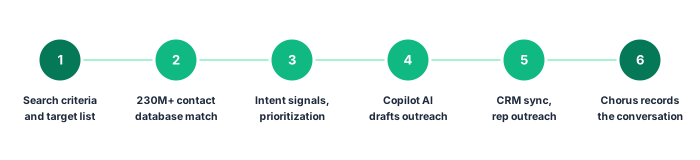
ZoomInfo's implicit philosophy is that go to market success is primarily a coverage and consolidation problem. The belief is that if a team has access to the most accurate, most comprehensive data about the accounts and contacts that match its criteria, along with intent signals, account prioritization, and even conversation intelligence, all inside one platform rather than scattered across several disconnected vendors, execution becomes faster and more informed at every stage. This is a philosophy that has intensified as ZoomInfo has grown through acquisition: rather than staying a single purpose contact database, the company has bet that owning more of the surrounding stack, intent, ABM, conversation intelligence, reduces the friction and cost of a team having to stitch several point solutions together themselves. ZoomInfo's entire architecture, the database scale, the Copilot AI layer summarizing and drafting around that data, the Chorus acquisition extending the platform into live conversations, is built around consolidation and coverage as the path to GTM effectiveness.
Elevate's implicit philosophy sits a layer upstream of that coverage and consolidation question entirely. It treats go to market success as primarily a clarity and definition problem that exists no matter how comprehensive or consolidated the underlying data platform is. The belief embedded in the product is that even the most complete database, the most accurate intent signals, and the most sophisticated AI summarization can only ever execute against the criteria you give it, and that comprehensive, well consolidated execution against a poorly defined or unvalidated target does not produce better outcomes, it just produces faster, more confident coverage of the wrong accounts. Elevate's architecture, the fourteen module methodology, the shared outputs across functions, the emphasis on continuous adaptation rather than a static annual plan, is built to make sure the criteria feeding any data platform, ZoomInfo included, is actually right before coverage and consolidation get layered on top.
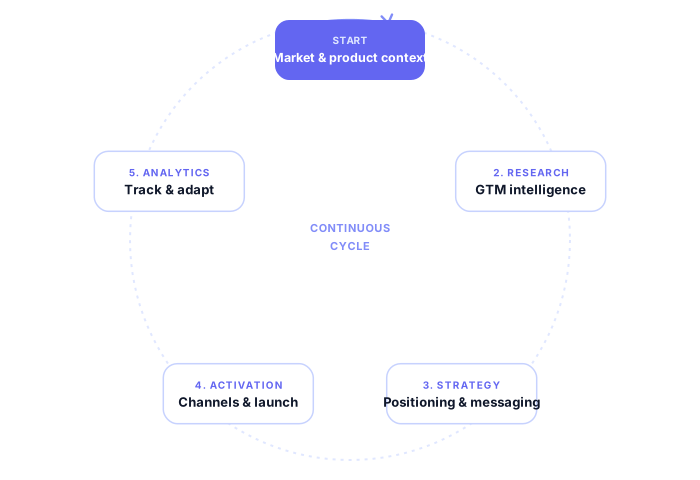
Notice the shape of the two diagrams. ZoomInfo's flow is a coverage and consolidation pipeline, a target definition finds matches in a large database, gets enriched with signals and AI generated context, and moves into outreach and recorded conversation, all increasingly inside one platform. Elevate's flow is a loop that sits above that pipeline entirely, strategy informs execution, execution generates signal, and that signal feeds back into strategy. Neither shape is wrong. They simply describe different layers of the same overall system. A team that only has the coverage and consolidation pipeline can execute with real comprehensiveness but risks consolidating that comprehensiveness around a target that was never carefully validated. A team that only has the strategic loop can define a sharp ICP and message but has no efficient system to actually find the real people and companies that match it at scale.
There is also a philosophical difference in how each platform treats the human expert. ZoomInfo assumes an operator who wants breadth, depth, and increasingly AI assisted speed across a large volume of accounts: SDRs and RevOps professionals comfortable configuring search filters, managing credit budgets, and reviewing Copilot generated summaries and drafts across many accounts at once. The product rewards someone who thinks like a high volume operator maximizing coverage and efficiency. Elevate assumes a strategic operator who wants structured guidance and speed of a different kind: someone who understands go to market thinking conceptually but does not want to manually build a competitive positioning framework in a blank document at midnight before a launch. The product rewards someone who thinks like a strategist working against a deadline.
Neither philosophy is inherently premium or entry level. They are simply optimized for different layers of the same funnel, and the honest answer to "which philosophy is right" depends entirely on whether your organization's actual gap is data coverage and consolidated execution, or strategic clarity and definition, today.
Can They Work Together?
Yes, and given how directly ZoomInfo's entire value proposition depends on being pointed at the right search criteria, this pairing is close to essential rather than optional for any team that has genuinely invested in a ZoomInfo deployment, because ZoomInfo has no native mechanism for generating an ICP or positioning from scratch, and Elevate has no native mechanism for returning a single verified contact record.
The two platforms sit at different layers of the same system. Elevate operates at the strategy layer: defining who the ICP is, what the positioning says, which channels matter, and how messaging should be structured for each segment. ZoomInfo operates at the data, signal, and increasingly conversation layer: taking that ICP definition, finding the real companies and contacts that match it inside its database, layering intent signals and Copilot generated context on top, and, if Chorus is part of the deployment, capturing and analyzing the resulting conversations once outreach leads to a call. Used together, the output of one becomes the direct search and messaging input for the other.
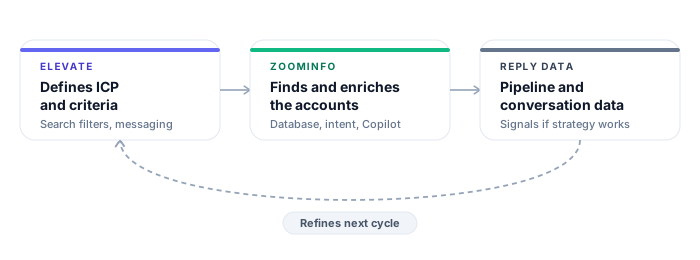
Key takeaway: the output of Elevate is the search criteria and message that ZoomInfo finds, enriches, and drafts outreach around. ICP, positioning, and messaging defined in Elevate become the filters, talking points, and Copilot prompts inside ZoomInfo. That handoff, not a feature overlap, is the real relationship between the two platforms.
Consider how that loop plays out in practice. A team runs the ICP and segmentation module inside Elevate and gets a structured definition: company size range, industry, technographic signals, and buyer persona priorities, along with a positioning statement and three messaging angles mapped to different buyer pain points. That structured definition becomes the direct configuration input for ZoomInfo: an SDR builds the search and list criteria to match Elevate's ICP exactly, rather than a broader, less precise filter, and the messaging angles from Elevate become the grounding content Copilot uses when drafting personalized first touch outreach, so the AI generated email reflects a strategically validated narrative rather than a generic template built from whatever account data happens to be available.
Once outreach runs and, where Chorus is part of the deployment, resulting conversations are captured, the reply, pipeline, and conversation data flowing back through ZoomInfo becomes a real world signal about whether the strategy actually holds up. If a particular segment or messaging angle from Elevate's ICP is converting at a meaningfully higher rate than another, that is useful information to feed back into the strategy layer, potentially reshaping which segment gets prioritized next quarter, or triggering a fresh Elevate cycle to refine the ICP further. This is the loop shown in the diagram above, and it is the version of "working together" that neither tool can replicate alone: ZoomInfo has no native mechanism for generating or revising an ICP or positioning from scratch, and Elevate has no native mechanism for returning a single accurate contact record or intent signal.
There is a sequencing consideration worth flagging honestly. Running large, well resourced ZoomInfo searches before strategic clarity exists tends to produce enormous, precisely enriched lists aimed at a fuzzy or overly broad target, which burns through credit allocation quickly and wastes the platform's genuine strength on the wrong universe. Running Elevate without ever operationalizing its output into a data platform produces a well documented strategy with no efficient way to actually find the real accounts and contacts that match it. Neither failure mode is really about the tools; both come from treating strategy and data execution as separate initiatives instead of a connected pipeline.
For teams evaluating budget across both, a lighter version of this pairing still works: use Elevate, or a comparable structured planning process, to sharpen the ICP and messaging before committing to a larger ZoomInfo tier with expanded credits and add on product families, since a narrower, better defined target both improves search precision and reduces the credit volume, and therefore some of the cost, needed to reach it effectively. You do not need both running at full scale from day one. You need the strategic layer settled enough that ZoomInfo's data and AI capabilities are aimed at the right target from the start.
A concrete quarter by quarter walkthrough makes this less abstract. In month one, a team runs its market research, ICP, and positioning work inside Elevate, resolving open questions about which segment to prioritize and what the core message should be. In month two, sales ops configures ZoomInfo's search criteria and Copilot prompts to match that refined ICP precisely, and reps begin outreach using AI drafted messaging grounded in Elevate's positioning. By month three, reply rates, pipeline conversion, and, if Chorus is active, conversation level data are available for a sales or marketing leader to pull back into a strategy review, checking whether the original ICP and messaging assumptions are actually holding up in market or need revision. That review becomes the input for the next Elevate cycle, and the loop repeats. Teams that operate this way tend to treat strategy refreshes as a recurring quarterly discipline rather than an annual event, while ZoomInfo keeps returning fresh, enriched data against the current criteria largely untouched between those strategic checkpoints, only requiring updated search filters and Copilot prompts when the underlying targeting or messaging parameters actually change.
Best For: Matching the Platform to Your Team
| Team Profile | Better Fit | Why |
|---|---|---|
| Seed or early stage startup defining first ICP and positioning | Elevate | Strategic clarity has not been established yet; premature to invest in a large scale data platform |
| Sales team with a defined ICP needing accurate, scaled contact data | ZoomInfo | Database depth and CRM integration are exactly what the platform is built for |
| Team consolidating several separate data, intent, ABM, and conversation intelligence vendors | ZoomInfo | Bundled product families reduce vendor sprawl in a way few competitors match |
| Company with a large ZoomInfo deployment and inconsistent reply or close rates | Elevate | The data works; the target definition or message likely needs sharpening first |
| Marketing team entering a new vertical or geography | Elevate | Requires new market research, positioning, and messaging before search criteria can be built |
| Company repositioning after a pivot or acquisition | Elevate | The problem is narrative and target definition, not data coverage |
| RevOps team needing mature CRM integration and pipeline visibility from prospecting data | ZoomInfo | Native CRM sync and pipeline management are core, well established capabilities |
| Fractional CMO or GTM consultant serving multiple clients | Elevate | Structured methodology speeds up strategy delivery across engagements |
| Small team with a tight budget and a narrow, already validated target list | Neither at full scale | ZoomInfo's enterprise pricing may exceed what a narrow, validated motion needs; evaluate lighter data tools alongside Elevate |
| Product marketing team building competitive battlecards | Elevate | Positioning and competitive intelligence modules map directly to this need |
The pattern across this table is consistent enough to state plainly: ZoomInfo tends to fit organizations with a validated ICP and either real scale or genuine appetite to consolidate several data and intelligence vendors under one platform, and Elevate tends to fit organizations at any stage that still need strategic clarity on the target and message before that data investment produces its full value. That said, this is a rough proxy, not a hard rule. A large, well resourced sales organization can still be strategically unclear about a new segment even with a mature ZoomInfo deployment, and a smaller team with sharp positioning may still need scaled, accurate contact data sooner than its size would suggest. The better question than "how big is our contact database need" is "what is actually broken right now," which the next two sections address directly.
Key takeaway: ZoomInfo's consolidated breadth, data plus intent plus ABM plus conversation intelligence, is genuinely valuable for a team otherwise juggling several vendors, but that consolidation only pays off once the underlying target and message are clear. Evaluate the platform on coverage and integration fit, not as a substitute for strategic definition.
When to Choose ZoomInfo
ZoomInfo makes the most sense when your organization already has clarity on its target market and messaging, and the actual bottleneck is finding accurate, current data about the specific companies and people inside that target, at a scale manual research cannot support.
Specific signals that point toward ZoomInfo:
Your team needs accurate contact data at real volume. If SDRs are spending meaningful time manually searching LinkedIn and company websites for emails and direct dials, ZoomInfo's database depth and accuracy, particularly for North American coverage, is built precisely to eliminate that manual research burden.
You are consolidating several separate vendors and want fewer platforms to manage. If your current stack includes a separate contact database, a separate intent data provider, a separate ABM tool, and a separate conversation intelligence platform, ZoomInfo's bundled product families, SalesOS, Copilot, ABM, and Chorus, can meaningfully reduce vendor sprawl, provided the bundled versions of each capability meet your bar relative to best in class point solutions.
You need mature, well established CRM integration and pipeline visibility. ZoomInfo's native integrations into Salesforce, HubSpot, and other major CRMs are a long standing strength, and its pipeline management features give sales ops a reasonably mature way to track how prospecting activity translates into pipeline.
You want AI assistance grounded in a large proprietary dataset rather than open web research alone. Copilot's account summaries and drafted outreach are built directly on ZoomInfo's own data and intent signals, which can produce more specific, more current context than a general purpose AI assistant working from public information alone.
Your budget can absorb a substantial, quote based annual investment. Given that even entry level contracts commonly start around 15,000 dollars annually, with most mid market and Elite tier deployments running well into five figures and enterprise deployments reaching six figures, the platform's economics work best for organizations with the seat count and deal value to justify that ongoing spend, and real negotiation leverage to manage the platform's notoriously opaque pricing.
A useful gut check: if you already know exactly who you are targeting and what you want to say to them, but your team is losing real time to manual contact research or juggling several disconnected data and intelligence vendors, your constraint is almost certainly coverage and consolidation, and ZoomInfo is the more direct answer.
When to Choose Elevate
Elevate makes the most sense when the honest answer to that gut check above is no, or is a hesitant maybe, or when your organization is not yet at the scale where a substantial ZoomInfo investment is the right next spend regardless of clarity.
Specific signals that point toward Elevate:
Your ICP is broad, dated, or was never formally validated against your actual best customers. If your target account criteria is closer to a rough industry guess than a validated profile built from patterns in your existing customer base, searching that universe with even the most comprehensive database and the most sophisticated AI summarization will not fix the underlying targeting problem.
You are entering a genuinely new market, segment, or product line and have no existing search criteria or messaging to configure in the first place. Launching into unfamiliar territory requires market sizing, competitive mapping, and a fresh ICP definition before any data platform has meaningful criteria to search against. Building that from scratch manually, through analyst reports, competitor audits, and internal debate, is exactly the slow, fragmented process Elevate's platform is designed to compress.
Your positioning has drifted or was never formally documented, even if you already have a substantial ZoomInfo deployment in place. If different reps describe the product differently on calls despite having the same Copilot generated talking points available, or marketing messaging contradicts what sales actually says, that is a strategic alignment problem no amount of data depth or AI drafting fixes.
Your budget or deal size does not yet justify a substantial, quote based annual data platform investment. If your average contract value or current sales volume would make a platform whose real cost commonly reaches into the tens or hundreds of thousands of dollars difficult to justify on ROI grounds, strategic clarity is both the more urgent and the more affordable investment to make first, potentially alongside a lighter weight data tool.
You are a fractional GTM leader, advisor, or lean team without a dedicated strategy function. Elevate's structured methodology can substitute for some of the deliverables a strategy consultant or in house product marketer would otherwise produce manually, which is meaningfully useful for lean teams or advisory practices serving multiple clients at once.
A parallel gut check: if you gave your sales team an unlimited ZoomInfo budget and every bundled product family unlocked tomorrow, would your team know precisely which accounts to search for, what message every piece of Copilot drafted outreach should carry, and why that message should win against the alternative your prospects are already considering? If the honest answer is uncertain, the constraint is strategic, and that is Elevate's territory, not ZoomInfo's.
Key takeaway: the two gut checks above are the fastest way to self diagnose. A clear target with no efficient way to find and reach it at scale points to ZoomInfo. A vague or unvalidated target, regardless of how comprehensive the data platform behind it is, points to Elevate.
Final Verdict
ZoomInfo and Elevate are not really competitors, even though ZoomInfo's expansion into intent data, ABM, and conversation intelligence means it now brushes up against several categories this comparison series has covered as separate platforms. They solve different problems that happen to sit next to each other in the funnel, and comparing them head to head on a single feature grid, as the table above shows, mostly reveals that ZoomInfo's breadth is about consolidated coverage and execution, not strategic definition, no matter how many adjacent product categories it absorbs.
If your organization has a validated ICP, real scale, and either a genuine need for accurate contact data at volume or a real appetite to consolidate several data and intelligence vendors under one platform, ZoomInfo is very likely the more direct fix. Its pricing is opaque and requires real negotiation, and the total cost of a fully bundled deployment can be substantial, but for organizations with the seat count and deal value to justify it, its database depth, CRM integration maturity, and increasingly broad product bundle are difficult to replicate by stitching together several smaller vendors.
If your organization is still working out who its best customer actually is, why that customer should choose you over an obvious alternative, and how that story should translate consistently across marketing, sales, and product, Elevate is the more foundational fix, and very often the necessary one before a ZoomInfo investment would produce its full value. It will not return a single contact record or intent signal, but it addresses a failure mode that no amount of database depth or bundled product breadth can solve: comprehensively, accurately, and confidently reaching a target and delivering a message that were never actually right.
The pragmatic recommendation for most growing revenue organizations: treat strategic clarity as the prerequisite and data coverage as the multiplier. Get the ICP, positioning, and messaging genuinely settled first, whether through a platform like Elevate, an experienced GTM advisor, or rigorous internal process, and then invest in a platform like ZoomInfo to find, enrich, and reach that now well defined target at the scale your growth requires. Reversing that order, buying substantial data and intelligence infrastructure before the underlying target and message are validated, is one of the more common and expensive mistakes growing GTM teams make, because it is very easy to mistake comprehensive coverage for a validated strategy when the criteria behind that coverage were never quite right.
FAQ
Is ZoomInfo a competitor to Elevate GTM Solutions? Not directly. ZoomInfo is a B2B contact database and increasingly broad go to market platform focused on finding, enriching, and reaching accounts and contacts that match criteria you define, now spanning intent data, ABM, and conversation intelligence through acquisitions like Chorus. Elevate is a GTM strategy platform focused on defining what that criteria should be and what to say to the people inside it. They operate at different layers of the funnel and are frequently used together rather than as substitutes for one another.
Can I use Elevate without ZoomInfo, or ZoomInfo without Elevate? Yes, both platforms function fully independently. Teams with a well established strategy and no data coverage bottleneck can use ZoomInfo on its own, searching against criteria built from internal knowledge. Teams that need strategic clarity but already have a working data and enrichment stack, whether that is ZoomInfo, Clay, or something else, can use Elevate on its own and export its outputs into whatever platform they already run.
Which platform is better for a small startup with a limited budget? Elevate, in most cases, and not narrowly. ZoomInfo's total cost, typically starting around 15,000 dollars annually and climbing well past that once intent data, Copilot, and additional product families are added, is built for organizations with real scale and a validated need for comprehensive contact data. A startup without a validated ICP or positioning also would not get proportional value from ZoomInfo's database depth even if it could afford the platform, since the search and enrichment would be against a target definition that has not been tested yet.
Does Elevate replace the need for a contact database or data platform like ZoomInfo? No. Elevate defines the strategic target and message; it does not maintain a database of contacts and companies, track intent signals, or return a verified email address. A company with a perfectly validated ICP and positioning still has no way to find the specific real accounts and people that match it at scale without a platform like ZoomInfo sitting downstream of that strategy.
Does ZoomInfo replace the need for a product marketer or GTM strategist? No. ZoomInfo, even with Copilot's AI assistance, will find, enrich, and draft outreach around whatever search criteria and messaging brief it is given with real sophistication, but it does not generate that criteria, define the ICP from first principles, or decide what the underlying competitive narrative should be. That strategic definition has to come from somewhere, whether a hired product marketer, an experienced GTM consultant, or a structured platform like Elevate.
How does pricing compare between the two platforms? The pricing models are structured very differently, and ZoomInfo's is meaningfully less transparent, with no public pricing anywhere and a final quote shaped by seat count, credit allocation, and which product families are bundled in. Third party data places typical entry contracts starting around 15,000 dollars annually, mid market and Elite tier deployments in the 25,000 to 45,000 dollar range, and larger enterprise deployments commonly reaching 60,000 to 100,000 dollars or more per year, with the largest reported contracts exceeding 140,000 dollars annually. Elevate charges on a seat and GTM scope basis, starting around 499 dollars a month for a single user and a single product or market scope, scaling up through a growth tier and a custom enterprise tier, with pricing published rather than quote only. A useful way to think about it: ZoomInfo's cost is driven by seat count, credit volume, and how many bundled product families you add, while Elevate's cost is driven by how many strategic scopes you are actively defining.
Which platform is better for finding verified contact data or building a target account list? ZoomInfo, without much ambiguity. Its database depth, reported at more than 230 million contacts, and its mature search and enrichment tooling are purpose built for exactly this. Elevate does not maintain a contact database or return a single email address; its output is the strategic brief, the ICP and messaging, that a platform like ZoomInfo would use to define which specific accounts and contacts actually matter in the first place.
Is there a risk of these two platforms creating overlapping or conflicting work? The risk is real but avoidable with clear ownership, and ZoomInfo's breadth makes this slightly more likely than with narrower point solutions, since its intent data, Copilot, and Chorus features can each sound adjacent to something Elevate also touches. Teams that adopt both should be explicit that Elevate's buyer emotion and intent modeling is a strategic exercise, not a behavioral signal detection or conversation analysis system, and that ZoomInfo's intent data, Copilot outputs, and Chorus recordings are operational and data layer capabilities, not a strategy generator. Establishing Elevate as the source of truth for who and why, and ZoomInfo as the source of truth for which specific accounts, contacts, and conversations, avoids the confusion that can arise when a broad platform and a strategy platform both touch adjacent sounding capabilities.
How long does it take to see value from each platform? ZoomInfo's value timeline depends on deployment scope: teams using SalesOS for basic search and enrichment can see value almost immediately after onboarding, while a fuller deployment incorporating Copilot, intent data, ABM, and Chorus takes longer to configure and typically requires more administrative investment to get real value from every bundled component. Elevate's core strategic outputs, ICP, positioning, and messaging, are generated far more quickly since the platform is designed to compress a process that would traditionally take weeks of workshops and drafting into a matter of minutes to hours, though the real test of that strategy's value only shows up once it has been executed against and measured, often through a platform like ZoomInfo.
Should an enterprise organization use both platforms simultaneously? Larger organizations with multiple product lines, markets, or business units are exactly where this combination tends to make the most sense, since Elevate's scope based structure is designed to handle strategy across multiple markets and products in one system, and ZoomInfo's Elite and enterprise tiers are built to support real scale and, through bundled product families, a wide range of execution needs across sales and marketing. The main requirement is coordination: someone, typically a RevOps or GTM operations leader, needs to own the handoff between the strategic outputs generated in Elevate and the search criteria, Copilot prompts, and campaign configuration built inside ZoomInfo, so the two systems stay synchronized as strategy evolves rather than drifting apart over time.