
By the Elevate GTM Solutions Team · Updated November 10, 2026 · 20 min read
Gong vs. Seismic After the Highspot Merger
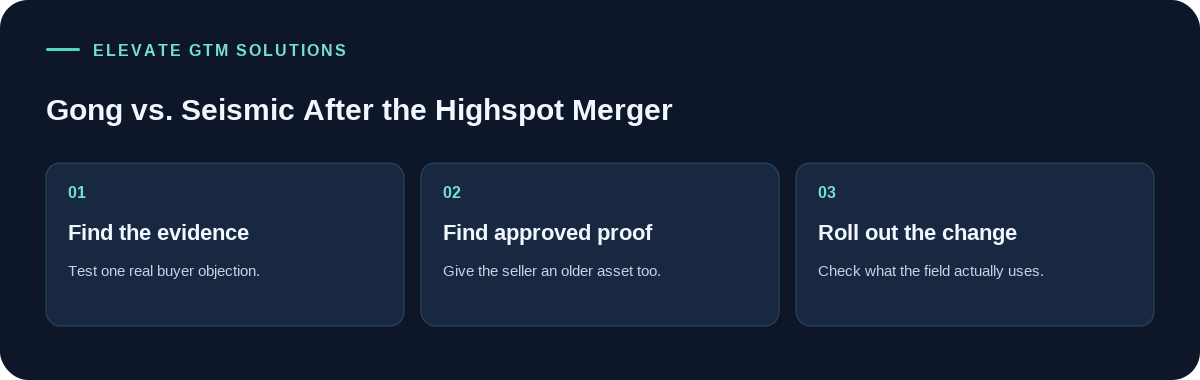
Start with the job your revenue team is struggling to do. If a manager cannot reconstruct what happened in a deal, test conversation and deal intelligence. If a seller cannot find the current approved answer, test content and enablement. If both problems matter, test the handoff between them on a real opportunity before buying an overlapping feature set.
Seismic completed its merger with Highspot on August 18, 2026. The combined company operates under the Seismic name. The buyer comparison is now Gong versus Seismic, with Highspot by Seismic relevant when evaluating a proposed environment or planning an existing Highspot renewal. Seismic’s post-merger materials still refer to both product environments. A shared owner or a capability announced for both does not tell you which features, terms or migrations are included in your contract. Seismic’s merger announcement · Seismic’s merger information for customers · Seismic’s October 2026 platform update
Compare the workflow and the proposed environment
| What the team needs | Where to start the test | What to confirm before buying |
|---|---|---|
| Reconstruct buyer conversations and see deal risk | Ask Gong to run a conversation-to-deal review using the proposed package | Capture sources, access, coaching workflow, CRM behavior and what requires an additional package |
| Govern seller assets and train teams on a changing offer | Ask Seismic to demonstrate the proposed enablement environment | Approval rules, regional versions, assignment of learning and ownership after launch |
| Keep or change an existing Highspot deployment | Ask the Seismic account team to show what is available in Highspot by Seismic and what would require a different setup | Renewal scope, support, data transfer, migration effort and written commitments |
| Connect an observed objection to approved field guidance | Test how Gong and the proposed Seismic environment would handle the same case, independently and together if relevant | Which system owns each record, which steps require people, and which integrations are included |
Gong’s public materials cover conversation intelligence, coaching and deal execution. Seismic describes governed content, coaching, seller readiness and deal-related workflows. The overlap matters. The vendors should demonstrate the specific package they would sell you rather than assuming that a feature label means the same workflow in either product. Gong Conversation Intelligence · Gong Deal Execution · Seismic platform
What an existing Highspot customer should ask at renewal
Bring the current agreement, an inventory of integrations and two workflows your field uses every week. The account team should explain which environment the renewal covers. Separate what is available in that environment today from any capability that is in preview, planned, or depends on a different commercial arrangement. Ask for written confirmation of the items that would change the purchase decision.
A proposed move can affect more than the content library. If your organization relies on existing permissions, learning assignments, workflow history or links embedded in CRM, ask how each would transfer. Request a representative migration test. Give a seller an asset with an older link, a manager a training record and an administrator a regional permission change. Find out what transfers as-is, what can be mapped, and what must be rebuilt. The exercise is useful even if the company chooses to stay on its current environment.
Separate renewal and migration in the cost comparison. One option may keep the current deployment while the team tests a new capability. Another may move users or content to a different environment. List the license, implementation work, parallel operation and internal training for each. Confirm support and timing with the account team. An announcement about a combined roadmap is a reason to ask better questions, rather than evidence that a particular migration is required.
A purchasing brief for new buyers
If you are new to both vendors, lead with one deal and one field problem. A manager may need a usable record of buyer interactions and a way to coach the next step. An enablement owner may need regional control of approved claims and a reliable way to retire old materials. Agree on which one is the immediate constraint and give each vendor the same test inputs. The receiving owners should score the work under ordinary permissions.
You may already own one part of the solution. A sales team with a reliable content workflow could need better interaction evidence. A business that already understands what buyers say may need a better way to turn those findings into approved materials. Buying both can make sense when the handoff is explicit. Ask who owns the source, who decides whether the guidance changes and where the seller finds the current version. Then run that path with the proposed integration instead of estimating it from a slide.
A scorecard should distinguish demonstrated behavior from confirmed contractual scope. For example, a seller may complete a task in a demo tenant, but the feature might need a separate package or administrator access. Record the setup, package, manual steps and review owner. The shortlist should reflect the work your people can repeat, with a clear list of conditions to confirm before signing.
A buyer test for three everyday tasks
Test one. A manager coaches a deal after a buyer call
The vendor should receive an approved sample interaction with a specific objection about deployment. The manager should find the relevant exchange, see what the rep promised and turn that into useful feedback. Keep the task grounded. The manager wants to know whether the rep verified the prerequisite and what the rep should ask on the next call.
Check how the platform supports the workflow and what the team can see. Can the rep review the evidence? Can the manager coach without sharing restricted material more widely than the company allows? Can another manager reproduce the process? Where call capture or analysis is involved, have the responsible teams review permissions, applicable notices and handling of records for the actual environment.
Record what the manager does after the demo. When the result is a highlight the manager still has to copy into another system, that can be acceptable. The buyer should understand the extra work and whether the coach or rep will actually do it. A quick search is valuable only if it reaches a decision or action.
Test two. A seller needs the current offer and proof
The seller should receive a deal with two conditions. The buyer is in a particular market and asks about a feature that is available only in a supported configuration. The seller should find the current approved asset, check the scope and send the appropriate version through the enterprise’s normal process. Include an obsolete file that looks plausible to test whether the tool steers people toward the right one.
The content owner should update the offer while the evaluation is underway. What happens to the previous version? Can the owner find material that references it? Can a regional team adapt an example without changing an approved claim? These steps tell you how much work governance will take after implementation.
If the vendor shows buyer engagement metrics, ask what the event measures and who can see it. An open or view may help a seller plan a follow-up. It doesn’t establish buyer approval or the reason for a deal outcome. Agree on what the business will do with the data before relying on it.
Test three. Enablement rolls out a changed discovery question
A competitor has changed its offer. Product marketing approves a new discovery question for a defined set of sellers. Ask each vendor to show how the relevant team receives it, how managers know what to reinforce and how the business can check whether the question is being used appropriately. This is where conversation insight and enablement can meet.
A team might use one platform to identify the objection, another to distribute the guidance and its CRM to record the follow-up. That can be a reasonable design if roles and handoffs are clear. The buyer should see exactly where someone has to move information and who owns the current version. If an integration is part of the proposal, run it on one sample instead of relying on the connector logo.
Measure the effort for the owner as well as the rep. Ask how they target the right teams, retire the old version and evaluate whether the change worked. A broad campaign to every seller may be easier to configure and less useful than a small rollout to the accounts affected.
Use the same rubric for the people who will run it
| Reviewer | Ask them to complete | Record |
|---|---|---|
| Sales manager | Find a relevant objection and prepare a coaching action | Time, evidence found and any work outside the platform |
| Seller | Locate approved proof and use it in a representative deal | Whether the version, scope and next step were clear |
| Content owner | Replace a claim and check what happens to earlier versions | Approval effort and ability to find affected assets |
| Enablement lead | Roll out one change to a defined team | Targeting, manager follow-up and visibility into use |
| Administrator | Adjust access and recover from a failed step | Permissions, auditability and reliance on vendor support |
Ask each reviewer to rate the task while the details are fresh. Use a short scale anchored in evidence. A task completed without help is different from one completed after the demo operator supplied a workaround. Put any permissions or package conditions next to the result. You’ll need them to compare implementation effort.
Decide where interactions, approved assets and actions live
Run one scenario where conversation intelligence and enablement both matter
Suppose managers can find call clips quickly but sellers have five versions of the same competitive deck. Buying more conversation visibility won’t fix the content ownership problem. Start by assigning a person to approve and retire the asset. Then test whether the selected enablement workflow makes it easier for sellers to find the current version. Keep the conversation evidence available so the owner knows which objection prompted the change.
Now reverse the conditions. The company has one reliable content source and sellers use it, but managers don’t know which objections occur in live deals. Run the conversation-to-coaching test first. The company may improve the workflow without adding another content system if the managers can identify recurring evidence and route it to the person who owns the guidance.
Where both constraints are material, test how the finding travels. The manager should be able to point to a relevant example. The content owner should be able to decide whether it warrants a revision. The seller should see the approved update. If the tools don’t connect the way the buyer needs, define the manual step and measure its effort before committing to an integration project.
Examine two ways a combined stack can fail
The finding reaches enablement without the evidence
A manager flags that buyers are asking about an implementation promise. Product marketing sees a note but cannot trace it to an approved source or identify which customer group was affected. The update goes to the entire field, even though it applied to one configuration. The issue is how context moves, not the number of tools.
Test the handoff with a single approved record. The manager should be able to point to what was observed. The content owner should be able to decide which claim to change and where it applies. The rep should see the approved guidance and its effective date. Do not assume a connector transfers those details merely because it transfers some records.
Teams count the same work twice
Two tools might both show activity associated with training or asset use. The enterprise needs an agreed definition for the review. An asset view may show that a seller opened a page. A completion event may show they finished assigned training. Neither establishes that the seller used the right message in a deal. Decide what action each measure supports before combining reports.
Decide what the enterprise wants each tool to own
Start with the object instead of the vendor
A sales team might need to find a call, review an approved asset, assign a coaching activity or record a follow-up. Those are different objects with different owners. Draw a simple map of where each originates and which system controls the current record. Ask how the user finds it from the place where the work already happens.
For example, a buyer’s question may come from an approved interaction. The enablement owner reviews the evidence and updates a field guide. The CRM records a next action. A manager can then see whether the seller applied the approved guidance. The enterprise may already have two of those parts working. Buy the missing capability and verify the handoffs that become more important.
Identify where overlap can actually remove work
A product may offer search, coaching and content workflows that appear similar to features the company already owns. Ask whether a current system can really be retired. Check which teams depend on it, what information must be migrated and which permissions need to change. A duplicate feature may serve a different audience or use case. Cost savings should reflect systems the enterprise can actually stop paying for.
Test the remaining work after consolidation. A single product can reduce switching for the rep and increase maintenance work for the content owner. Conversely, two focused products can work well when the handoff is explicit and users do not need to enter the same information twice. Ask the people doing the work to estimate their effort rather than relying on the vendor’s workflow diagram.
Identify which task could make the purchase unnecessary
The buyer should repeat the proposed pilot using tools it already owns. A sales manager might already be able to find a useful interaction record but lack a standard coaching step. The content owner might already have a workable versioning process that the field does not know to use. Fixing those issues may reduce the need for another platform, or it may reveal exactly what capability is still missing.
Use comparable effort. Use one sample deal with the seller, manager and content owner. Observe where the current system works, what requires a workaround and what cannot be completed. Record the baseline before watching the new demo. A demo can look faster because the vendor prepared the example. The relevant comparison is what the enterprise’s own people can do.
Governance, access and what happens when a claim is withdrawn
Verify regional operating constraints
Consider scope and permission separately
A seller might need access to an approved asset for their market. That does not imply they should see every underlying call or internal review. Ask which records are governed by role, team, territory or another source. Check the behaviour when an employee moves or a regional version changes. Give each user only the access the company proposes to grant.
Where recorded conversations are part of the workflow, ask the enterprise’s responsible teams to review the use case, retention and permissions before testing real information. Use approved samples. Ask how the setup handles recordings, transcripts, generated summaries and exports. Review the product’s actual configuration with the owners who would sign off on the pilot.
Include localized content in the demo
Give one team the right to use a claim and a second team a variant that needs review. Ask both to find the correct version and explain its scope. Have the administrator show how a change is targeted and how the enterprise retires the outdated material. A global rollout depends on the ability to manage local differences without making the process too slow for the field.
Put a governance issue in front of each proposed setup
Test how a restricted finding becomes usable guidance
A manager reviews an approved interaction and sees evidence that one customer group may misunderstand a claim. The enablement team needs a usable explanation but does not need unrestricted access to the underlying record. The vendor should show how the manager routes the finding and how the content owner can approve an appropriate update. Check what information stays restricted and what the field can see.
Include a regional exception. The same claim may be approved for a different configuration or territory. Give one seller the current version and another a reason to look for a different version. Watch whether they can explain what applies. If a regional team maintains part of the content, ask who can approve a change that affects another market.
Test what a manager can do after an integration fails
The workflow might depend on a link, a destination record or a scheduled transfer. Ask what happens when the destination is temporarily unavailable. The manager should know whether a task was created, who can retry it and where the approved guidance still lives. The buyer should know how much support it will need to keep the link reliable.
If the provider demonstrates a manual workaround, ask the owner to run it with normal access. A manual handoff may be acceptable for a low-volume workflow. Estimate the cost at the volume the enterprise expects and check the consequence of a missed update. This gives the sponsor a basis for deciding whether to fund a more complete integration.
Give the content owner a withdrawal exercise
The owner should remove a customer example that no longer has approval. Have them locate the affected versions, tell sellers what to use instead and identify the channels where an earlier copy might remain. Ask a seller outside the pilot team to find the current alternative. The test should distinguish what the platform can retire from what the company must handle through policy or training.
Then record what the owner would do if the same example appears in a recording or an approved conversation summary. Different records can have different retention and access requirements. Confirm the process with the appropriate owners before making any production change. A useful evaluation shows the enterprise how each record is governed, even when the source and destination sit in different tools.
Renewal, migration and the total cost of the proposed setup
Ask for the maintenance and exit plan before scoring
What happens when a claim expires?
Have the content owner retire a piece of proof and identify which materials reference it. Ask how they would notify sellers working active deals. Verify whether exports or attachments can still circulate and how the enterprise can identify the current version. The goal is to see whether the owner can maintain the process after the vendor team leaves.
How do permissions change when someone moves?
Move a test user between teams and ask what they can see. Check one interaction record, one approved asset and one training item. Confirm which system owns access and when the change takes effect. Use the approved process for testing with synthetic or restricted data. Record any step that requires an administrator rather than assuming managers can do it.
What can the business keep if the setup changes?
Ask how the enterprise can retrieve the content, decision history or approved records it needs. Confirm the proposed data access, formats and scope in writing. The company may choose to change tools, change packages or move an ownership boundary. A usable exit path is part of the operating design even if the product performs well in the pilot.
Compare operating costs after the demo
The proposed owner should estimate time for content maintenance, user support, reporting and access changes. Include training and any remaining manual steps between products. Include that effort alongside the license quote if the enterprise would rely on two administrators or an implementation partner.
Do not treat adoption as a revenue result. A pilot can show that more users found the right content or that managers prepared useful coaching faster. Those are meaningful operating results. If leadership wants to test deal outcomes, define a separate comparison that accounts for opportunity mix, timing and other changes to the sales motion. The buyer can approve the workflow based on what the pilot actually showed.
Manage the case where the vendor proposes an overlapping add-on
The provider should show the work the add-on would replace, using the proposed edition and data. A comparison matrix can identify features that sound similar. It cannot tell the enterprise whether the receiving team can operate them. Verify one example from setup through maintenance. Decide which one the company will use if the add-on simply adds another version of the same record.
Compare the total cost to keep the workflow working. Include administration, content migration, user training and any manual handoff the company retains. Verify that the functions that depend on it can move if an existing system could be retired. If it cannot, include both costs and explain what capability the new purchase adds.
What the pilot can establish
Run the final review with the people who did the work
Score task completion, recovery and ongoing effort. Where reviewers disagree, reconstruct the exact steps instead of averaging impressions. One reviewer may have completed a task using a workaround the receiving team cannot maintain. Another may have rejected a capability because a permission was deliberately withheld. Compare the intended configuration and the actual effort.
Record what the selected product is expected to improve first. That could be coaching preparation, access to current proof or control over a rollout. Pick a measure tied to the workflow and agree when it will be reviewed. When the team wants to test revenue outcomes later, give it a separate design and enough time for a comparable set of opportunities.
Decide how to interpret the first commercial measures
A faster search can give sellers time back. More consistent guidance can improve control of what they send. A useful coaching process can show managers where to focus. Treat these as workflow outcomes. They can be measured during a short trial without claiming a change in revenue.
If leadership wants to test revenue impact, choose a comparable group and time window. Check which sellers use the workflow, what kinds of deals they work and which other changes occurred. A new package, territory assignment or promotion can affect conversion. Use the results to decide whether to extend the test rather than assigning a precise revenue gain if the pilot is small.
Give the sponsor a real option to narrow the purchase
The enterprise can choose one workflow and defer another. It can buy a tool for one user group and keep existing processes elsewhere while it learns. It can also decide that two products are justified if the proposed roles and handoffs are clear. Put these options on the same page with cost, effort and evidence.
State what the chosen tool will own and what the other systems still own. Set a review date with the administrator, content owner and manager. At that review, compare the observed workflow with the original baseline. Require evidence that the receiving teams can operate it under their actual permissions and policies if the enterprise wants to expand.
A post-merger contract and migration checklist
| Check | Evidence to request from the account team | Why it changes the decision |
|---|---|---|
| Current deployment | The named environment, edition and services on the proposed order | A common company name does not identify the tenant or the capabilities included |
| Feature commitment | Availability, dependencies and any written commitment for future functionality | A roadmap item should not be scored as delivered |
| Migration plan | A sample transfer of assets, access rules, links, training and history | Existing users may need support even when core content transfers |
| Parallel operation | Planned overlap, admin support and the process for stopping either setup | Migration cost can extend beyond the license quote |
| Renewal and exit | Supported exports, support responsibilities and dates agreed for this account | The buyer needs a practical option if a move is deferred |
Use the checklist alongside the workflow scorecard, not as a substitute. A technically attractive package can still be the wrong near-term choice if the enterprise cannot spare the people required for migration. A renewal can be reasonable while the company tests a different environment, provided the agreement supports that approach. Ask for written confirmation from the relevant parties instead of inferring the treatment from general product announcements.
For a controlled test, start with a small group that uses the existing workflow regularly. Keep one critical link, one restricted item and one incomplete training record in the test set. Record what is preserved and what the administrator must correct. If the company cannot complete that exercise before approval, carry the open items into the purchase decision as conditions rather than counting them as passed.
Frequently asked questions
Are Highspot and Seismic still independent vendors?
Seismic completed its merger with Highspot on August 18, 2026, and the combined company operates under the Seismic name. The company still refers to the Highspot by Seismic product environment in post-merger materials. Verify the specific setup and terms your account team is proposing.
Will an existing Highspot customer have to migrate?
A merger announcement does not establish the requirements for an individual customer. Ask Seismic to confirm the proposed renewal, support arrangements and any migration requirements in writing. Test the effect on your integrations, content, permissions and learning history if a move is proposed.
Can a company use Gong and Seismic together?
Evaluate the two against the jobs you need to perform. If you plan to use both, verify how interaction evidence becomes approved guidance and how the update reaches the seller. Check the proposed editions, permissions and integration in a representative case.
What should the pilot measure?
Measure whether users can finish the workflow, how much assistance they need, and whether the process handles a correction or exception. Compare costs and ongoing effort across the proposed setups. Revenue outcomes need a separate evaluation and an appropriate time window.
Where Elevate fits in this stack
If call evidence shows buyers keep questioning eligibility or price, someone still has to decide what to change in the GTM strategy. Elevate can help structure that decision and turn the approved response into an activation plan. Use the tools you choose for conversation capture, content governance or coaching to carry out their part of the work, and verify any connection you plan to rely on. Explore Elevate’s strategy-to-activation workflow
Contents