
By the Elevate GTM Solutions Team · Updated November 10, 2026 · 20 min read
How to Demo Continuous GTM Planning Software
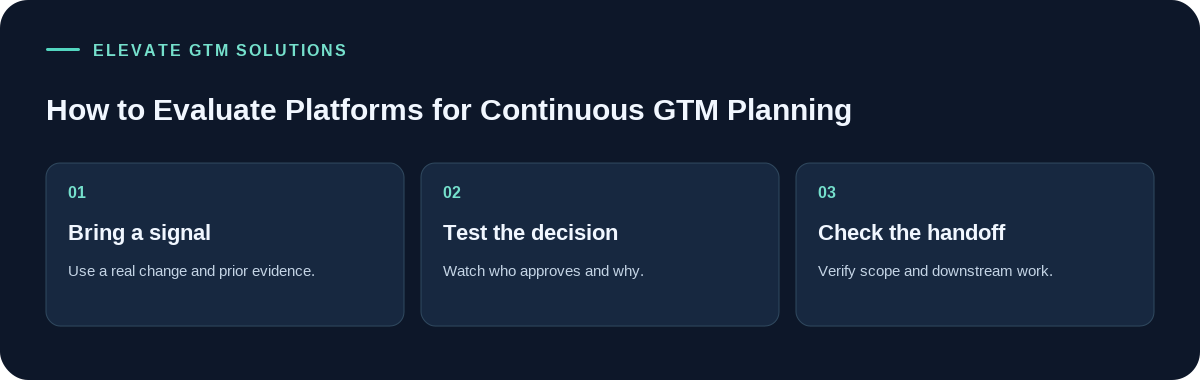
Evaluate continuous GTM planning software with a change to an existing strategy. Give each vendor the old decision, new evidence and an approver. Then introduce a correction after approval and see whether a field manager can find the right instruction. Use the same inputs and permissions in every demo.
For a broader evaluation of platform categories, see How to Choose a GTM Platform. This guide focuses on a repeatable demo and approval test for one continuous planning workflow.
This guide starts after the shortlist. For the earlier decision about what kind of platform to evaluate, see how to choose a GTM platform.
Choose the planning decision you want the tool to handle
Start with a recent decision
Pick a case people remember. Perhaps a partner paused an integration or a customer segment converted poorly once it saw standard terms. Reconstruct the signal, who checked it, who made the decision and which systems changed afterward. Write down both delays if the business spent a week assembling evidence and two weeks waiting for someone to approve the response. Better access to evidence won’t settle a missing approval mandate.
Give each vendor a strategy decision, an affected assumption, a current observation and an older item that appears to contradict it. Add a region or product boundary and a field asset that references the old rule. Synthetic data is fine if it resembles real work. The vendor should show the source, date, affected cohort and what happens if the evidence remains unresolved.
Run one case that should cause no change. A competitor has rewritten a page but kept the same terms. A useful process lets a reviewer close the alert with a reason rather than circulating a recommendation. Ask whether an identical alert will arrive again next week and how a new reviewer would learn why the team chose to hold.
Worked example. Narrow targeting while protecting open deals
A hypothetical SaaS company discovers that one configuration requires substantially more deployment effort. It narrows eligibility for the next cohort. Three open opportunities began under the older rule. The team wants to honour specific commitments without letting new accounts enter under obsolete guidance.
The platform should help the owner record the evidence, scope and effective date. The approval should identify who owns the existing commitments. The activation work could update a targeting guide and create a RevOps task. At the next review, check whether new accounts met the revised rule and whether deployment effort changed. You’ll need the old definition as well as the new one to make that comparison.
Demo script for a strategy change and correction
Test a complete change in the demo
| Step | Give the vendor | Look for |
|---|---|---|
| Capture | A new observation and an older source | Source, date, scope and distinction between facts and inference |
| Triage | A material signal and an incidental change | A way to prioritize, dismiss or ask for evidence |
| Decide | Two responses and an approval requirement | Named owner, version history and recorded rationale |
| Activate | One field asset and a controlled destination | An approved update and a traceable handoff |
| Review | A sample outcome and an exception | An audit trail and a way to revise or roll back |
Include a deliberate error in the demo. Enter a duplicate item, choose the wrong destination or reject a recommendation. Can a user see what happened and recover without creating more work? Have a new team member find the rule in force when an open opportunity began. A history view is useful if someone outside the original meeting can explain the decision.
Bring a common demo script to every vendor
Set the starting conditions
A one-page demo brief can describe the company, its current plan and the decision the team wants to test. Include a rule with an effective date, two sources with different levels of confidence and one named reviewer. Run the demo with the package and permissions the vendor actually proposes. Do not allow a prebuilt example to stand in for the test unless it shows the same constraints.
The first input might be a verified competitor change in one market. The second might be an internal note that seems to contradict it but refers to a different edition. The vendor should show how the platform separates those scopes and which information a reviewer can see. Have the reviewer decide which fact is credible enough to act on. The product should help them find the relevant evidence without forcing them to accept the conclusion generated from it.
Put the request for a decision into an ordinary work queue. The proposed owner should be able to state exactly what the approval covers. If they need another source or approver, let them request it. Then ask a sales manager to find the current rule. The test should show the transitions between roles, including what a person can do when the item is incomplete.
Introduce a correction after approval
Once the first change is approved, reveal that its effective date was wrong or that one cohort should be excluded. The same operators should be able to correct it. Have the manager identify which version applies to a deal opened before the change. A tool may store several versions while still making it hard for the field to find the right one. Watch which record the users actually select.
Ask what happens to any downstream action already taken. A task may need to be cancelled or updated. A note may have gone to a manager who now needs a correction. A destination might not allow the same type of update. The buyer should understand which corrections the platform can make, which require a human action and how the team can find the affected records.
Do not assume the system will send the correction everywhere automatically. The vendor should identify the exact connection, permissions and behaviour. Include it in the pilot and measure the effort if the enterprise is comfortable with a manual process. A visible manual step can be a sound choice. An unacknowledged dependency is harder to manage.
Ask one owner to explain the result without help
An owner who missed the demo should be able to work from the decision record. Ask what changed, which evidence supports it, when it takes effect and what the field should do. Have the person find the current record with ordinary permissions. If they must ask a vendor specialist for a link or interpretation, note what the implementation would need to provide.
Repeat the test with a restricted source. The seller should receive approved guidance, while the reviewer can access the underlying material according to the company’s policy. Ask whether the visibility of a generated summary follows the same rules as the sources. If it doesn’t, the enterprise needs a way to keep sensitive material out of the wrong workflow.
Verify how planning works when an approval is late
A missed approval date makes a useful demo case. The analyst has verified the evidence, the field needs guidance and the person authorized to change the offer is unavailable. Ask how the platform distinguishes the pending decision from the existing rule. A seller should be able to find the instructions that still apply while the sponsor is being asked for a decision.
Test the fallback. A manager might be allowed to pause outreach or run a discovery-only test within existing policy. They may have no authority to publish new terms. The manager should rehearse with the permissions and instructions they would have in production. Ask them to find the relevant source and route the issue. The platform should help the team carry out the policy the enterprise has approved.
Ask what happens when the approval finally arrives. Does the field see the effective date and the treatment of cases started earlier? Can a reviewer tell which work was performed under the old rule? The answer matters when the team compares performance. A simple timestamp on an updated record may not establish what the enterprise communicated to each group.
Put this test next to the ordinary approval demonstration. It can reveal a need for better delegation, a different setup or a clearly documented manual step. You can still buy the platform if the overall workflow works and the unresolved condition is manageable. The operating owner needs a practical instruction that addresses the risk documented in the notes.
Finally, ask a manager to explain the result in one sentence. Which rule applies, who approved it, and what happens next? That is the answer the pilot was supposed to make easier. If it takes a vendor walkthrough to find it, improve the workflow and run the test again.
Permissions, failed transfers and the system of record
Test permissions and integration failures without production data
| Case | Setup | Evidence the buyer needs |
|---|---|---|
| Approved update | A regional owner can review, while a seller can only read | The audit shows approval and the seller sees the right scope |
| Restricted source | The record contains context a field team should not see | Guidance reaches the field without exposing the source |
| Duplicate event | Submit the same change twice | The owner can tell whether it created duplicate work |
| Destination unavailable | An approved destination rejects the action | A visible failure, an accountable owner and a safe retry path |
| Correction after release | The approved date or scope changes | The owner can identify earlier users and publish a correction |
| Expired evidence | The original source has aged out or been withdrawn | The decision remains readable and the review owner can act |
Decide whether the platform should be the system of record
Assign an authoritative home for each object
A CRM can remain the source for accounts, an enablement system can hold published materials, and a planning platform can track the strategy decision. Draw those boundaries before evaluating write access. Ask where each item originates, where it can be edited and how another system refers to it. The same decision can have several useful views while retaining one approved source.
Decide what happens if records disagree. A field asset may reference an older eligibility rule after the strategy changes. An account may have an approved exception that the general strategy does not describe. Make the precedence explicit. A user should know which rule applies and where to take a discrepancy. Integrations can move information. The enterprise still needs to define which record controls the decision.
Test identity and scope. Verify how it matches it to the source system and how it handles transfers or duplicates if a platform imports an account or opportunity. If a change applies only to one market, verify that other teams do not receive global guidance. These tests matter more than the number of available connections because they affect whether the company can trust the work.
Review what the platform can prove and what needs another system
A platform may show that a decision was approved and an action was assigned. It may not establish that the field applied the new rule or that the buyer outcome improved. Use source records to check those effects. A company can measure task completion in one system and conversion in another if it preserves consistent definitions and an appropriate time window.
Think through recovery before making a purchase decision. If an approved output fails to reach the destination, who can see the failure and who can retry? If a user repeats the action, does it create another record? If the company corrects a decision after a task is completed, what happens to the related records? Request an operational answer rather than a promise that failures are rare.
Measure the pilot under normal working conditions
Give the proof of concept a budget and an exit
Compare cost using the workflow you tested
Record the package, connector requirements, implementation work and the time your own staff spend. Some of that cost will be recurring. Someone may need to validate evidence, manage access, and repair a handoff when a destination changes. Ask who does the work and whether they can do it with ordinary permissions. The enterprise should know the operating cost before adding another market.
Test the economics against a plausible baseline. If the company currently spends five hours preparing a material review and the tool cuts preparation to two hours but requires two hours of verification, the observed improvement is one hour before any other overhead. That may still be worthwhile if the decision reaches the field faster. Describe what changed and which result the pilot can actually support.
Measure one outcome at each handoff
Start with evidence capture. Can reviewers trace the material claims? Then measure the decision. How much time passed after the evidence became credible? Then test activation. Can the recipient find and apply the current rule? Finally, review the outcome for a few representative records. Counting alerts, generated summaries and saved documents is useful only if those events help explain a real decision.
Define the baseline before people see the new workflow. Otherwise, a reviewer may compare the best new case with the most difficult old case. Use the same starting event and a comparable set of situations. Record exceptions, delays and work that still happens offline. Describe the result as a pilot observation if the sample is small.
Ask how the company would leave
Have the provider show how the team can retrieve strategy assumptions, source references, approvals and the current version of the guidance. Check which material can be exported and which needs to be transferred manually. A good exit path protects the team even if the product stays in place. People change roles and older decisions still need to be explained.
An independent reader who missed the demo can test whether the exported material is usable. Ask them to reconstruct which rule was approved, when it applied and why the decision changed. If they can't do it, ask what record needs to move with the export. Add that to the purchase conditions before relying on the workflow for important customer decisions.
Test adoption before adding the second workflow
Start with the people who already make the decision
A planning tool is easier to evaluate when there is a real meeting, a named owner and a regular need. A software pilot can become a test of organizational authority if the company hasn’t decided who approves changes. Put the current decision path on a page and identify where software might improve it. The pilot can answer one important question before the buyer considers replacing the planning process.
Have the users bring one familiar case. The analyst should explain where they get the facts, the sponsor how they decide and the field manager how they communicate the result. Use what they say to define the baseline. You may discover that the most expensive step is finding the old decision or correcting duplicated guidance. A vendor that excels at another part of the work could still be useful, but you should know which problem it solves first.
Give the pilot a limited number of scenarios
A first pilot could include one approved change, one rejected signal, one correction and one handoff failure. Give each a clear expected result. Do not change the success criteria after watching a demo unless you retest every candidate against the new rules. Keep a record of what worked, where users needed help and what required a different package or configuration.
The product should fit the team’s normal operating cadence. A dedicated demonstration may be faster because every participant is present and the vendor prepared the data. The working pilot should show what happens when the analyst, approver and manager complete the steps at different times. Include the effort needed to keep the record up to date. A tool that requires daily cleanup may be hard to support across several regions.
Verify the measure the sponsor cares about
The sponsor may want decisions to reach the field faster. Define the starting event and completion event. For example, measure from a verified source entering review until the affected manager can find the approved guidance. Track time spent on approval separately from time spent on handoff. A faster summary is helpful only if it reduces a meaningful delay.
The sponsor may instead want a more reliable record. Ask an independent reviewer to explain a sample of decisions, including one that was rejected. Count which ones could be reconstructed and which lacked a source, date or scope. Describe the sample. A small pilot can show that a workflow is workable without proving the same result at enterprise volume.
Include maintenance and user training in the cost
List who creates the first workflow, who can edit it and who handles a broken connection. Ask whether changes require an administrator or the vendor. Give the proposed maintainer a small task, such as adding a new region or modifying an approval step. The person should be able to understand how the change affects existing records and which tests to rerun.
Include the time users spend checking sources, approving changes and updating downstream systems. That may be a reasonable cost of better control if the tool creates work that was previously invisible. The enterprise should know what it is taking on. A total that includes licenses and implementation fees but excludes ongoing review time cannot support a useful comparison.
Put a second use case through the same review
The first use case can prove a single workflow. A second one can reveal whether the platform only works in the configuration built for the demo. Pick a small variation. If the original test was a competitor offer change, try a change to eligibility after delivery identifies a capacity limit. Keep the review path similar and change the people or source material. Ask whether the receiving owner can configure the difference without a new project.
Work through one open account. The old rule allowed a deployment that the new rule excludes. The business will honor one existing commitment while moving new accounts to the revised policy. The vendor should show both facts in the same decision record. A field manager should be able to see which rule applies, when it changed and who can approve a further exception.
Then simulate a false positive. A partner announcement looks like a withdrawal, but the team discovers the announcement applies only to a different product. The reviewer should dismiss the item and preserve the scope. Check that the field receives no premature instruction. The organization needs the ability to decide that a signal should change nothing.
Maintenance and procurement sign-off
Write an approval memo that the team can revisit
Separate pilot findings from purchase conditions
Document the cases tested, the configuration used and the result. Identify which work was performed by client users and which relied on vendor staff. Note where a proposed feature was demonstrated and where the team received only a description. Then list the conditions that must be confirmed before buying, such as permissions, data location, package or support.
Give each open issue an owner. If a connection requires review from the CRM administrator, schedule that review before signing. If the field manager could not find the current rule, ask whether training, configuration or a product limitation explains it. Decide which conditions are essential and which the enterprise can handle through a temporary process.
State the scope of the approval
The sponsor may approve one workflow and defer broader implementation. Record the markets, users, data and actions included. The receiving owner should know when results are due and what would justify widening scope. When the company later connects a different system or allows a higher-risk action, reassess the relevant conditions rather than assuming the original pilot covered it.
A useful approval memo also describes a stop condition. The business may need to pause if it cannot verify sources, if users depend on vendor support for ordinary work or if a write path creates unmanageable errors. Put the condition in the same place as the success criteria. A good pilot earns a decision either way.
Ask vendors how they handle ownership after implementation
Name the people who can keep the workflow current
Who will add a source, manage access, change an approver and maintain the link to the systems that use the decision? Ask a proposed owner to show one of those tasks under ordinary permissions. Check whether that capacity is already available if the process requires a specialist. A workflow can perform well in a pilot and still be a poor fit for the team expected to run it.
Ask what happens when the workflow owner changes jobs. Give a second person the current rule and have them explain which source led to it, who approved it and what they can change. The buyer has evidence about handoff if the system makes that easy. Include the extra support or process change in the purchase decision if a vendor needs to reconstruct the history.
Compare the cost of integration with the cost of manual transfer
A one-way task or approved link may be enough for a first pilot. A more complex transfer could be justified when repeated manual work delays decisions or introduces errors. Estimate how often the action occurs, how much effort it takes and the consequences of mistakes. Then ask what the proposed integration needs to operate, including monitoring, access and maintenance.
An integration can produce value even when part of the workflow remains manual. A platform might maintain the approved decision while a manager updates a customer-facing asset in another system. Make the handoff visible and check whether the person can find the right version. That is a better first test than asking a connector to move everything without a clear owner.
Close the purchasing review with a usable scorecard
| Question | Evidence to record | Decision it informs |
|---|---|---|
| Can reviewers trace the source? | A reconstructed decision and its evidence | Whether the output is suitable for consequential review |
| Can someone reject or correct a change? | A tested rejection and revised record | Whether the workflow can handle ordinary uncertainty |
| Does the right manager see the update? | The receiving user applies it to one account | Whether the handoff works under intended access |
| Who can maintain the workflow? | A successful routine change by the owner | How much implementation and support to buy |
| What would stop expansion? | A documented failure and response | How to limit exposure after the pilot |
Give each open condition an owner, date and verification task. If the conditions pass, approve only the scope you tested and define the next review. If they fail, choose whether to revise the workflow, select a different product or leave the process where it is. That decision is more useful than an overall score without a record of what the buyer actually observed.
A worked score for two platform pilots
Assume Platform A prepares the right brief in 20 minutes. Its approval and field handoff take another 70 minutes, including 25 minutes of manual work. Platform B takes 35 minutes to prepare the brief and 40 more to review and deliver it, including ten minutes of manual work. In this hypothetical test, the faster writer delivered the decision in 90 minutes, compared with 75 for the other platform. Record the time by step. A sponsor deciding what to buy should be able to see whether the difference came from evidence preparation, review or handoff.
Now run the correction. Platform A keeps both versions but does not show the revised rule where the field manager normally works. Platform B sends a correction but cannot distinguish the three open opportunities that were approved under the earlier policy. The result changes the evaluation. For A, ask whether a reliable manual notification or supported connection can cover the gap. For B, decide whether the existing account system can retain the approved exception and show it to the seller. Compare the cost of those paths under the proposed setup.
Set one pass condition that neither vendor can buy its way around. The field should be able to identify the rule that applies to a representative account and explain who can change it. Do not include the workflow in the first purchase if the work cannot pass under ordinary permissions. An enterprise can still buy the product for another scope if that scope passes and the economics work.
Use the observed effort to design the next trial. Add a second region or another approved source if the first version works with one owner and one destination. Keep the decision and acceptance criteria comparable. The team should be able to tell whether the added scope created more value or simply more review work. That is a better expansion signal than the number of summaries or alerts the product produced.
Frequently asked questions
Is a GTM planning platform the same as a CRM?
A CRM can hold account evidence and execute approved policies. A planning platform may add a place for assumptions, strategy decisions and changes across teams. Evaluate the workflow and which system should own each record.
What makes AI useful here?
It can help collect or organize evidence for review. Test whether the source and uncertainty stay visible, whether people can correct an output and whether the next action reaches the right owner.
What should stop a purchase after the demo?
A critical workflow may require permissions, a package or maintenance capacity you don’t have. Set pass conditions before the demo and test them with the proposed configuration.
Related reading
See How to Choose a GTM Platform.
Run the same test with Elevate
Elevate connects GTM context, strategy, activation and execution. Bring one material change into a demo and ask to see it go from an updated assumption to an approved next action. If the scenario requires a particular approval, audit trail or connection, verify it in the proposed setup. Use the same pass conditions you give the other vendors. Explore the Elevate platform · Check supported integration directions