
By the Elevate GTM Solutions Team · Updated November 10, 2026 · 23 min read
AI-Native GTM Planning for Enterprise Teams
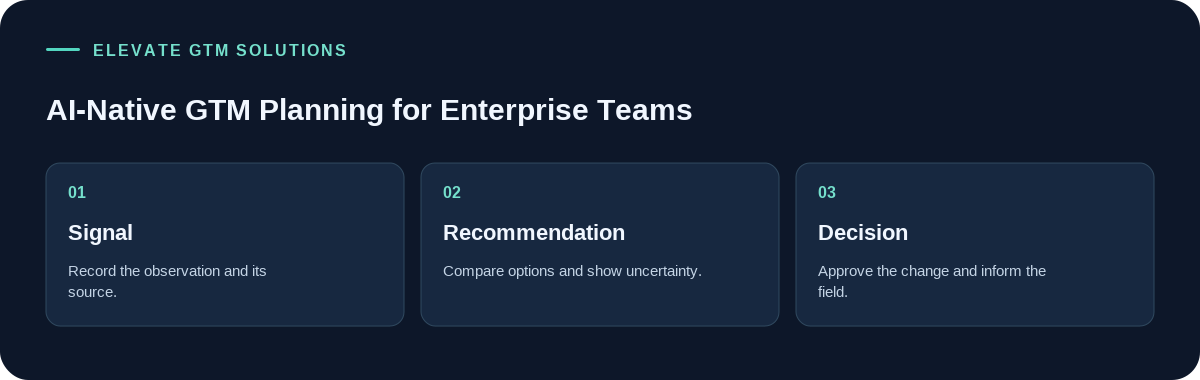
An AI-native GTM planning process uses approved evidence and AI-assisted analysis to review a strategy between planning cycles. The commercial owner still decides what changes. The test is whether teams can move from a verified observation to a reviewed decision and an approved field action without losing the source or scope.
Define the decision cycle
Start with the decisions that can actually change
A new planning system often begins by connecting every available data source. That creates a large amount of material to review and little agreement about what to do with it. Start by listing decisions that can change between annual planning sessions. A segment priority can often move within an approved budget. A public price change can require finance, channel and legal review. A new geography might need investment committee approval. These distinctions tell you where a faster evidence loop will help.
| Decision | Evidence worth reviewing | Typical first action |
|---|---|---|
| Change account selection within a segment | Coverage, opportunity progress, customer fit and available capacity | Run a bounded targeting test |
| Reopen the offer or pricing assumption | Repeated buyer evidence, confirmed competitive terms and margin implications | Model the trade-off and define a pilot |
| Revise positioning | Changes in buyer vocabulary, lost-deal reasons and proof available to the field | Test a revised message with a defined group |
| Change market investment | Cohort economics, qualified demand, delivery cost and risk | Bring the recommendation to the budget owner |
| Pause a launch or campaign | Changed delivery readiness, invalidated claims or an approval gap | Contain the exposure and record restart criteria |
Use the list to define the scope of automated work. An analyst may want AI to summarize competitor updates every week. The planning owner should also specify which updates would be material enough to investigate. A small feature rename and a change to the offer that competes in current deals should not receive the same level of attention.
The difference between a signal and a decision
A screenshot of a competitor’s pricing page is a signal. “We should test a smaller package” is a recommendation. “Run that test with six accounts in one region and leave standard terms in place elsewhere” is a decision. Give each one a different place to live. Otherwise someone will eventually forward the screenshot with the proposed response and the field will read it as approved guidance.
For example, a competitor’s website appears to include a security capability in a lower-priced tier. A model can capture the page and draft a comparison against the last known terms. A reviewer should check the date, region, edition and eligibility, and distinguish public pricing from terms mentioned in a sales conversation. Sales can then check whether the change has appeared in current deals. The pricing owner decides whether to test a response. Connecting these stages avoids sending a seller an unverified claim dressed up as a recommended action.
The evidence record needs enough detail to survive a handoff. Capture the source, date, affected market, observation, known limitations and owner. If an assertion depends on a private call, note who can confirm it and how it can be shared. A separate recommendation record should identify the alternatives and the commercial consequence of waiting. That is where AI may assist with summarization and scenario preparation. It does not get to erase uncertainty from the record.
A workable planning cadence
Weekly evidence review. The market, RevOps and field representatives review new items against the decisions in scope. Duplicates can be merged, low-confidence items can be parked and urgent items can be routed to the right owner. The meeting should produce a small list of decisions or investigations, each with a named owner. Avoid turning it into a tour of all the data collected that week.
Monthly operating review. Leaders compare the signals with cohort performance, execution constraints and investment priorities. They can approve bounded experiments, change sequencing or send a larger choice to finance and leadership. Bring both a rationale and a next step. A proposed segment change should say how existing opportunities will be treated and what would cause the team to reverse it.
Quarterly investment review. Confirm whether the accumulated changes alter the business case. Review customer outcomes and operating cost as well as activity and pipeline. Decide which experiments to scale, stop or extend. Record the versions of the strategy, claims and forecast assumptions that the business will use for the next quarter.
Immediate escalation. Some events need a separate route. If an approved claim becomes inaccurate, a security issue affects what can be offered or a partner withdraws a key capability, route the event to the designated owner. The review cadence should provide an ordinary path and an emergency path.
What changes in the plan itself?
An annual GTM plan commonly contains strategic commitments, operating assumptions and near-term work. Those components age at different rates. A board-approved investment may hold for a year. The number of reachable accounts in a segment could change after two weeks of account research. A claim in a sales asset may need correction the day a feature slips. When all of these items live in the same static deck, it is difficult to change one without creating doubt about the rest.
Separate them before adding AI. Keep the approved commitments in a short strategy record with owners and dates. Put testable assumptions in an evidence register where the people closest to them can update the supporting facts. Track current execution in the tools teams already use. The three records should reference each other. An update to a demand assumption should make it easy to see which investment or campaign relies on it and who needs to review the change.
The planning record can be simple. Capture the target customer, the buying problem, the offer, the route to market, the investment boundary and the date the owner will review it. Add any non-negotiable commitments, such as the regions approved for launch or the product claims that need a particular review. Attach a short rationale. A future owner should know why leadership made the choice and what kind of evidence could reverse it.
The assumption register needs more detail. A forecast may assume that 400 named accounts fit the target profile. Explain how the count was produced, which data were missing, and whether the number represents companies, subsidiaries or buying entities. An assumption is easier to revisit when the record identifies its source date and reviewer. When a model later reports that the addressable list has doubled, the reviewer should be able to tell whether the market changed or the data provider changed its definition.
The execution record holds the actual work. This might include an approved target list, a launch board, an enablement page, or a CRM rule. Decide which of these can be edited by an authorized operator and which require a decision record. When the team approves a different buyer segment, sending a summary is only one step. Someone still needs to update campaign targeting, qualification criteria, routing rules, the forecast, and any asset that promises the original offer.
Work through two different market signals
Worked example. A competitor changes its entry offer
In this hypothetical example, an enterprise workflow vendor sells an analytics add-on to its largest customers. A competitor adds a basic analytics feature to a standard package in one region. Several sellers ask for a discount so they can keep deals moving.
The planning team first confirms which competitor edition changed and which region is covered. It pulls a recent cohort of deals where that competitor was actually mentioned. Two buyers cite the entry package, and a third has a larger reporting requirement the entry package does not appear to address. The team records where it has a source and where it has an inference.
The first response is a two-week discovery test. In competitive deals, sellers ask about reporting complexity, governance and implementation constraints before discussing packaging. Product marketing prepares two evidence-backed proof points and delivery confirms which promises the team can make. Pricing holds the standard policy while the test runs, with an existing exception route for time-sensitive deals.
At review, the team looks at deals in the affected segment and checks which objections remained after the new discovery approach. A general decline in win rate would not, on its own, validate a price cut. Consistent evidence that buyers value the basic feature but reject the bundled offer might justify testing a narrower package. The planning owner documents the decision and closes the loop with marketing and sales.
Work through a second scenario. The apparent ICP shift
Consider a hypothetical enterprise platform that sells through direct account teams. Its analytics show that opportunities from smaller companies are advancing faster than opportunities from its original enterprise segment. A model notices the pattern and proposes moving more campaign spend to the smaller accounts. The output is plausible. The buying cycles and sales coverage may simply differ.
The team first checks the dates, qualification definition and deal mix. It finds that the newer accounts came through a targeted event and were offered a standard product configuration. The enterprise opportunities include several strategic accounts with multiple regions, longer evaluation cycles and different delivery needs. The two cohorts can still inform planning. Their raw stage progression rates do not establish which audience offers the better commercial outcome.
The team adds contract size, sales effort, delivery cost and expected retention to the comparison. It also checks whether the smaller accounts would remain reachable once the event audience is exhausted. The immediate decision is to run a bounded acquisition test using the standard configuration while keeping the existing enterprise investment in place. The test has a budget limit, a customer profile and a review date. It can be expanded if the relevant evidence improves.
Now imagine the cohort review reveals that several small accounts actually belong to enterprise parents. The change may reflect how the CRM stores subsidiaries. The appropriate action is to repair classification and rerun the analysis before changing campaign spend. A good planning workflow can arrive at either outcome. Its purpose is to help the team decide responsibly, including when the best decision is to do nothing yet.
What belongs in the decision memo
Write the observed result, what may explain it, the options, the recommendation, expected impact and the downside if the team is wrong. Name the owner, review date and systems that must change. Include the conditions under which the business would revert. A recommendation to shift spend could be reversed at the end of a short campaign. A territory restructure or a new customer promise has a different cost of reversal.
The memo should distinguish the proposed test from the intended strategy. A trial of a smaller segment can test demand and servicing economics without committing the company to a permanent coverage model. Sellers need to know which accounts are in the test and which terms apply to them. Avoid describing a bounded experiment as a company-wide pivot.
Set evidence and permission rules
Establish boundaries before connecting data
Decide which information the system can ingest and which destinations it can write to. Public product pages and approved analytics are different from restricted customer transcripts or forecast notes. Use access consistent with the data owners’ approvals. For any automated action, decide whether it prepares a draft, requests approval or executes a change. The consequences differ if a model drafts a message for review versus updates a field that drives seller outreach.
Also plan for errors in source text. Public pages may change without a reliable timestamp. CRM records can reflect what was entered at the close of a quarter rather than the day a buyer raised an objection. A model may summarize contradictory evidence as if both sources agree. Sample outputs, use traceable references and establish an easy way to flag mistakes. NIST’s generative AI risk profile provides a broader reference for identifying and managing risks. NIST Generative Artificial Intelligence Profile
Start with a read-only workflow if the team has yet to agree on evidence standards. Once the review and approval path works, automate a narrow handoff. A useful first integration might create an internal task for a verified competitor update. Publishing a new seller claim automatically carries a very different risk.
Build an evidence record someone can audit
| Field | Example | Why it matters |
|---|---|---|
| Observation | Public pricing page lists basic analytics under a different edition | The record describes what was seen |
| Source and date | Captured approved page with retrieval date and prior version | Reviewers can trace and compare the claim |
| Scope | One named market and edition, with eligibility unclear | The record stays within the available evidence |
| Corroboration | Two qualified deals mention the change in the same market | The team can judge commercial relevance |
| Open questions | Bundling conditions and effective date still unverified | The next step has a specific purpose |
| Owner and review date | Competitive intelligence lead with a short review window | A person can confirm, revise or retire the item |
A record may need multiple sources. Give each source enough identity to know what it represents. A company’s public pricing page is evidence of published terms at retrieval. A seller’s account note is evidence of what the seller recorded about one conversation. A buyer’s recollection of a competitive quote is relevant but may omit a contractual condition. Treating them as interchangeable turns different observations into an apparent consensus.
Separate inference from observation. An observation might be that three customers asked for a different deployment option. An inference might be that the existing product scope excludes a valuable segment. The inference requires evidence about how often the request appears, the economics of serving it, and whether customers would pay. A model may surface the pattern. A person needs to decide whether the pattern justifies action and what else could explain it.
Use a status that preserves uncertainty. A new item can be unreviewed, corroborated, contradicted, expired or approved for a specific use. Avoid turning all information into a binary true-or-false field. The same observation might be credible enough to guide an interview and too weak to support an external claim. A status attached to a use case makes those distinctions operational.
Decide how long evidence remains useful. A feature page may change every week. A finance-approved cost assumption may hold until the next budget review. A statement about buyer behaviour may need fresh cohort data before the company bases a large decision on it. Expiry is a request for review. It does not imply the evidence was false.
Define what AI can do at each stage
At collection, AI can summarize approved records, extract dates and named entities, identify likely duplicates, and route an observation to a queue. Test whether the system can handle missing dates, conflicting versions and records with irrelevant terms. Make it possible to inspect the original material from the draft.
At analysis, AI can organize arguments, suggest comparisons and identify assumptions the team may have overlooked. Keep analytical calculations reproducible. Define the cohort rules separately and calculate the result from governed data if the model proposes comparing two cohorts. A narrative should be traceable to the same definitions the commercial team uses.
At recommendation, AI can draft a decision memo that includes evidence, alternatives, expected consequences and unanswered questions. Require the reviewer to confirm which assertions are supported and to revise the alternatives if the model missed a constraint. Some decisions depend on context the system will never hold, such as a confidential partnership negotiation or a delivery team’s promised work for a key account.
At activation, use automation where the consequences are well defined and reversible. A task can route a verified item to an owner. A prepared draft can populate a review queue. Updating a live qualification rule or sending a customer claim usually deserves explicit approval and an audit record. Define who can halt or roll back a workflow if it creates inconsistent records.
This distinction also helps procurement. Ask providers which actions their products can take, where the action happens, what permissions it needs, how reviewers approve it, and how the team can see or reverse the result. A feature described as automation can range from a draft in a private workspace to a change in a production system. Assess the proposed behaviour, including the failure path. NIST AI Risk Management Framework
Pilot the operating model
Establish a reference case before choosing technology
Start with a real decision the team recently made. Pick a case with enough evidence to reconstruct what happened. A useful example might be a product messaging change prompted by a recurring objection or a coverage decision after a drop in partner referrals. Record the date of the first signal, when someone validated it, who approved the response, which systems had to change, and when the field learned about it.
Then identify where the time went. Better evidence capture may help if the delay came from waiting for ten sellers to share examples. Adding more analysis will have little effect if the evidence was assembled in an hour but two executives could not agree on authority. The first investment belongs in the handoff if the decision was made quickly but it took weeks to update collateral. This baseline gives the team a reason to buy or build a specific capability.
The people should explain who handle the work to replay the case with a draft workflow. An analyst might use a model to extract competitor claims from approved public materials. A product marketer can check whether the output links to evidence and preserves scope. A field leader can tell whether the resulting brief would change the next customer conversation. Observe the work instead of asking whether the output looks impressive. A fluent summary can conceal missing dates and contradictory sources.
Use one historical case that should have triggered a change and one that should have been left alone. The first tests whether the system notices material evidence. The second tests whether it floods the review with irrelevant activity. For instance, a competitor may update its wording across many pages without changing its offer. A useful system can distinguish a wording change from something that affects the enterprise’s strategy, or flag uncertainty for review.
A 90-day implementation plan
Days 1–20. Choose one evidence loop
Pick one use case with a named owner and an observable decision. Competitor changes in live deals, recurring objections during evaluation, or onboarding constraints in a pilot may work. Define sources, allowed uses, review cadence, and what would count as a material finding. Reconstruct a past decision and agree on the baseline for time and evidence quality.
Collect inputs manually for at least one review if the team has never run the loop. Manual work makes the real decisions visible. It also reveals where teams use words differently. One seller may call a company a competitor when it appears on a shortlist, while another uses the term for a product that buyers already own. Agree on a definition appropriate to the decision before counting occurrences.
Days 21–50. Add assisted preparation
Allow the system to extract and summarize approved evidence into a review queue. Sample the output against original sources. Record missed findings, unsupported statements, wrong dates, wrong company or segment names, and duplicate records. Decide which errors need a workflow change and which need a reviewer instruction.
Introduce a clear feedback path. If a field user disputes an observation, they should know who can correct it and what evidence to provide. A person who sees an error but cannot act will either ignore the new system or fix the problem locally. Neither outcome improves the shared planning record.
Days 51–90. Connect one approved action
Choose a low-risk handoff. A verified observation could create a task for product marketing or update a private review queue. Define what happens on retry and how the operator can tell whether the action already succeeded. The handoff should link to the evidence and state what the recipient needs to do next. A task saying “review competitor” creates a new search job rather than moving the decision forward.
At the end of the trial, examine decision quality and operating effort. Did the team see important changes earlier? Could reviewers reproduce the conclusions? Did the handoff reach people who could act? How much time did it take to verify outputs? Compare the results with the baseline. Expand to another decision only if the first workflow produced evidence that justifies the effort.
What to measure during the pilot
| Measure | How to interpret it |
|---|---|
| Time from first credible signal to reviewed decision | A shorter interval can indicate faster review if the starting and ending events are consistently defined |
| Share of material claims with a usable source | A higher share makes review and correction easier |
| False escalations or missed changes in the sampled set | Both show whether the review queue is useful |
| Approved changes reflected in the field workflow | Shows whether a decision reached execution |
| Review effort per actionable item | Helps assess the cost of operating the process |
| Relevant commercial result by cohort | Helps evaluate whether the approved action changed buying or delivery outcomes |
Use counts alongside rates when volume is low. One unsupported statement in a queue of five and twenty in a queue of one hundred have the same rate but different operational consequences. Report where the sample came from. An evaluation based on clean vendor materials may not predict performance on messy field notes. Re-test when sources, model behaviour or the types of decisions change.
Track leading outcomes before claiming downstream impact. Faster preparation can free time. A shorter approval cycle can help the company react sooner. Neither establishes that revenue rose because of the workflow. If the business needs a revenue answer, define the cohort, comparison, period and confounding changes, such as a new pricing policy or a different sales territory. Some results will remain uncertain, especially for small pilots.
Common failure modes and how to catch them
A dashboard becomes the work. Teams report how many sources were monitored or alerts generated, but cannot name a decision that changed. In the next review, ask which item had an owner, which choice it informed and where the result was recorded. Remove sources that do not support a decision the team can make.
The model treats old claims as current. The system retrieves a previous page or archived slide and summarizes it as if it were new. Require retrieval dates and compare changes against an approved prior snapshot. When the date is unclear, ask a reviewer to resolve it before the material is used in the field.
Approval turns into a click. Reviewers accept fluent text without checking the sources because the queue is too large. Limit the number of items, sort by decision relevance and make original evidence easy to inspect. Give reviewers time and authority to send an item back.
Each function edits its own version. Sales circulates a new talk track while marketing and delivery keep the prior promise. Publish an approved change notice with affected assets, the effective date, the owner and treatment for open opportunities. Check adoption at the next operating review.
A narrow success becomes a broad policy. An early result from one region is copied to others before anyone checks product scope, customer access or partner terms. Record where the result applies and what should be validated in the next market. Standardize the decision process where it transfers, and test assumptions that may be local.
What the weekly review sounds like in practice
A planning review should start with the decision that needs attention. Assume the competitive intelligence lead brings a verified packaging change from the earlier example. The field lead says it has affected two active evaluations. The product manager confirms the distinction between the competitor’s entry feature and the reporting workflow the enterprise sells. Finance asks whether a price response would change the margin on existing deals. The group can now choose a narrow response and assign a review. It does not need to debate every competitor mentioned in the queue.
A little preparation makes the meeting easier to use. Send the evidence and decision request ahead of time, with a link to the current strategy or operating rule. If a relevant owner cannot attend, ask for their input or defer the decision. Use the meeting to resolve the trade-off and the follow-up work. A summary generated before or after the meeting can save time if it preserves the choice and commitments. A reviewer should still confirm what was decided and who owns the result.
Keep an explicit list of items that need investigation. An item belongs there when the consequences could be material but the available information is insufficient. Assign a bounded next step, such as confirming which region a price applies to or checking a sample of recent deals. Close the item when it is answered or no longer relevant. Otherwise the queue becomes a second backlog that reviewers learn to ignore.
When to keep the annual plan as written
A segment can underperform for a month because several deals slipped, while the underlying opportunity remains attractive. A large account can raise an unusual objection that deserves a response in the deal but gives little reason to rewrite positioning. A new prospect can ask for a feature the company could build, even though the target group as a whole would not pay for it. A faster planning cycle makes it easier to see these events. It also makes overreaction easier.
Set a higher bar for consequential or hard-to-reverse changes. Changing an email sequence for one cohort can be a small experiment. Changing packaging across regions may affect compensation, forecasts, partners and customer expectations. Bring more than one kind of evidence to that decision and explain what waiting would cost. Record why the plan remained in place if the team investigated a material signal and chose to hold. The decision history should preserve choices to stay the course as well as choices to change.
Build in a way for dissent to surface. A delivery manager may know that a proposed change would create a bottleneck the forecast does not show. A field leader may see that a promising pilot depends on a relationship that will not transfer to a new segment. Ask each affected function for one constraint and one way the proposal could fail. The best answer may be to narrow scope so the business can learn while limiting the downside.
How to move the decision into the tools sellers use
Choose the smallest reliable destination for the approved change. Revise the canonical field brief and notify the sellers working on affected opportunities if the update affects competitive discovery. If it changes account eligibility, update the CRM or targeting workflow only after the owner confirms the rule and how it applies to open deals. Keep the decision reference and effective date with the asset so users can verify what changed.
Check adoption with a real workflow. Ask a manager to find the current rule, apply it to two sample accounts and explain what they would do if the cases differ. If they cannot distinguish old and new guidance, the system delivered a message without completing the handoff. Correct the source asset and remove or label superseded copies where users are likely to find them.
The first handoff can remain manual while the team learns what the business needs to verify. Once the owner, approval and destination are stable, automate the repetitive part and keep the review path accessible. This reduces duplicate effort without asking a model to infer which customer promise or field policy the organization has approved.
What a field study tells us about measuring assisted work
Brynjolfsson, Li and Raymond studied the rollout of an AI assistant to 5,172 support agents at an anonymized software company. In their published study, access increased issues resolved per hour by 15% on average. The authors report that gains varied across workers. Less experienced and lower-skilled agents benefited more, while the most experienced and highest-skilled workers saw smaller speed gains and small declines in quality.
The study measured customer support inside one company. It cannot forecast the benefit of using AI to choose a segment or respond to a competitor. The measurement design is useful. Track how long the work takes, whether it passes review and how the result varies by task or user. Faster first drafts have little value when the analyst transfers the same amount of checking to a senior reviewer.
Frequently asked questions
Does AI-native planning replace the annual plan?
The annual plan can still establish budgets, capacity and company objectives. An evidence loop helps leaders update assumptions and adjust decisions within those commitments, or request approval when a change exceeds the agreed authority.
What is the minimum viable version?
Pick one decision, one data owner and one review cadence. For instance, start with verified changes to competitors mentioned in enterprise deals. Track whether the information changes what sellers ask or what the business tests. Expand when the process reliably turns evidence into accountable decisions.
How should we measure the new process?
Measure the time from a credible signal to a decision, the proportion of recommendations with traceable evidence, and whether approved changes actually reach the field. Then track relevant commercial outcomes by cohort. A faster review process is useful evidence about operations. Revenue impact needs its own evaluation.
Who signs off on changes?
The person with authority over the consequence should sign off. Product marketing may own an approved messaging update. Finance may need to approve a commercial term. Decide the owners, escalation conditions and audit trail before connecting automation to the workflow.
Related reading
See Continuous GTM Optimization and the Continuous GTM Loop for related concepts.
Where Elevate fits between planning reviews
Try one material change in Elevate before expanding the trial to the annual plan. Use supported inputs to capture the market context, review what it means for the GTM strategy, and turn the approved response into work for the next GTM Pulse cycle. If you connect a destination tool, check the exact action it supports before you build your process around it. See Elevate’s execution workflow · Check supported integrations