
By the Elevate GTM Solutions Team · Updated November 10, 2026 · 22 min read
How to Build a GTM Strategy Without a Consultant: A 30-Day Plan
You can build a credible go-to-market strategy without hiring a consulting firm. Many companies do, particularly early-stage teams and mid-sized companies with a capable product marketing lead. The work is not mysterious. It is a sequence of decisions about who you serve, why they buy, how you are different, what you charge and how you reach them, supported by evidence and written down so that others can use it.
What goes wrong in do-it-yourself strategy is rarely the framework. It is the evidence. Teams write from opinion, skip the customer conversations, and produce a polished document that describes what they wish were true. A good process forces contact with reality early and often, and keeps the result in a form you can update.
This guide gives you a thirty-day plan. It assumes you have a product in market or about to launch, a small group of people who can spend a few hours a week, and access to some customers or prospects. It uses a GTM platform for the structured parts, because structuring and drafting are where time disappears. You can follow the same plan with documents and spreadsheets, and we note where. Elevate sells a GTM platform, so we have an interest in recommending one. The plan stands on its own either way.
Can You Build a GTM Strategy Without a Consultant?
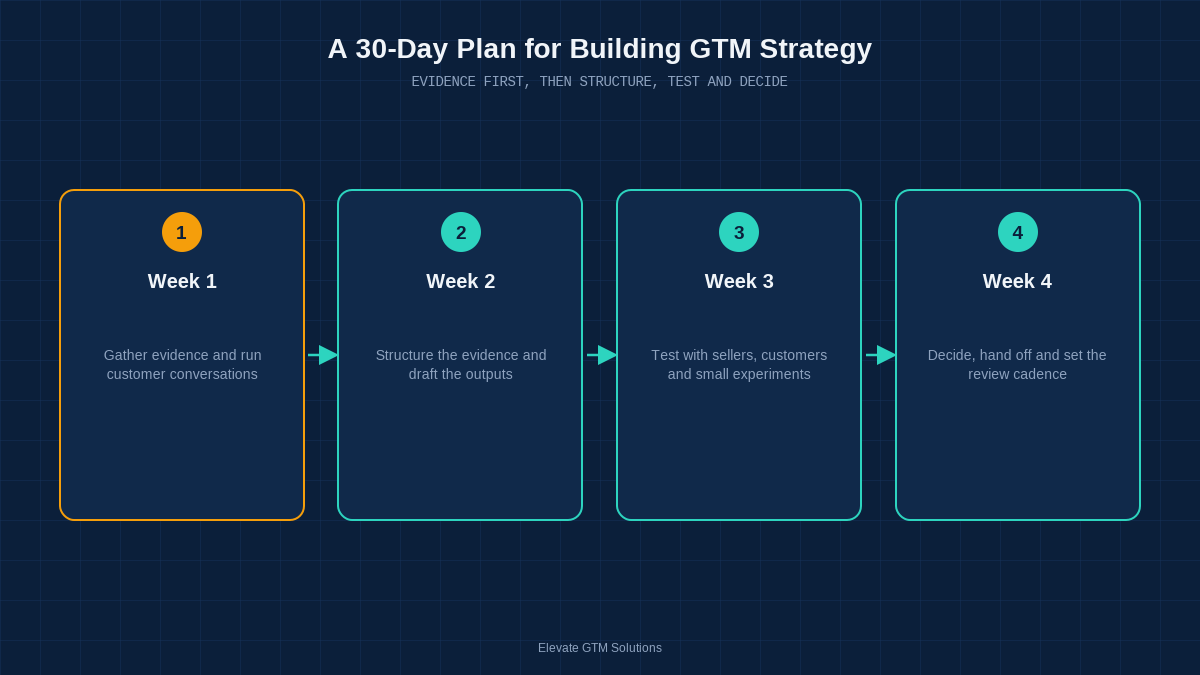
Yes. A strong GTM strategy needs four things: evidence from real customers, a clear customer definition and positioning, a pricing and channel logic that fits them, and a plan that people can execute and update. A small team can build this in about thirty days by gathering evidence in the first week, structuring and drafting in the second, testing with the field in the third and deciding and handing off in the fourth. A platform speeds the structuring and drafting. Customer conversations and a named decision owner remain essential.
What is the biggest risk? Writing from opinion. Get customer evidence early.
When should you still bring in an advisor? For a high-stakes decision with internal disagreement, or when you cannot gather the evidence yourself.
Before you start: five prerequisites
A thirty-day plan works only if a few conditions are in place.
- A named decision owner. One person approves the customer definition and positioning. Without this, drafts circulate and nothing is decided.
- A small working group. Three to six people from product, marketing, sales and customer success, each giving a few hours a week.
- Access to customers or lost deals. You need at least a handful of conversations. Without them, you are guessing.
- A defined scope. One product and one market or segment. Do not try to build the whole company's strategy at once.
- A place to keep the work. A platform, or a shared workspace, where inputs, drafts and decisions live together and can be updated.
If one of these is missing, fix it first. Starting without a decision owner is the most common reason strategy efforts stall.
What the thirty days produce
By the end you should have the following, in a form your team can use and revise.
| Output | What it contains |
|---|---|
| Customer definition | Who the ideal customer is, who is not a fit, and why |
| Segment priorities | Which segments come first and the reasoning |
| Positioning | Category, differentiation and the value you claim, with proof |
| Messaging | A core narrative and variants by role |
| Pricing logic | The value metric, packaging options and what customers say about price |
| Channel plan | The two to four channels you will run, with success measures |
| Launch or go-to-market plan | Owners, dates and metrics for the next quarter |
| Assumption log | What you believe, the evidence, and what you still need to test |
| Decision record | What was decided, by whom, and why |
The assumption log and decision record are the least glamorous and the most useful. They let you see later why you chose what you chose, and they make updates cheap.
Week one: gather evidence
The first week is about getting facts, not writing.
Collect what you already have
Pull together the evidence that exists inside the company.
- Closed-won and closed-lost deals from the last six to twelve months, with the reasons given.
- Customer lists with basic attributes: size, industry, use case, how they found you.
- Sales call recordings or notes, if you have them.
- Support tickets and onboarding notes that show where customers struggle.
- Pipeline data by segment.
- Competitor material: websites, pricing pages, decks, review sites.
- Existing messaging, sales decks and website copy.
You are not analyzing yet. You are creating a pile and noting its gaps. The gaps become questions.
Run customer and lost-deal conversations
This is the most valuable work of the month, and it cannot be outsourced to a tool. Aim for eight to twelve conversations if you can, including a mix of happy customers, recent wins, lost deals and prospects who stalled.
How to run them.
- Keep each to thirty minutes.
- Ask about the situation before the product: what was happening when they started looking?
- Ask what they tried, what alternatives they considered and why they chose or rejected you.
- Ask who else was involved and what each person worried about.
- Ask what almost stopped them.
- Ask them to describe your product in their own words.
- Record, with permission, or take careful notes. Capture exact phrases.
Questions that work.
- What was going on that made this a priority?
- What did you try first?
- Who had to agree, and what did each person need?
- What would have made you choose someone else?
- How would you describe us to a colleague?
- What nearly made you walk away?
What to avoid. Do not pitch. Do not lead the witness. Do not ask whether they like the product. Ask about their behavior and decisions.
Write down your assumptions
At the end of week one, list what you currently believe about the customer, the problem, the competition, the price and the channels. Mark each as known from evidence, believed but untested, or unknown. This is your assumption log, and you will return to it.
Week two: structure and draft
The second week is where a platform saves the most time. Structuring evidence and drafting outputs are tasks that consume days when done by hand and hours when assisted.
Structure the evidence
Group what you learned into themes.
- Segments. Which types of company or buyer show up repeatedly among your best customers? What do they share?
- Problems and triggers. What events started the search? What outcomes did buyers want?
- Alternatives. What did they compare you with, including doing nothing?
- Objections. What concerns appeared again and again?
- Words. What phrases did customers use to describe the problem and the value?
In a platform, you enter these as structured inputs, and the system organizes them. In a document, a simple table with one row per conversation and one column per theme does the job.
Draft the core outputs
Draft in this order, because each depends on the one before it.
- Customer definition. Describe the ideal customer in specific terms, with disqualifiers. A definition that excludes some companies is more useful than one that includes everyone.
- Segment priorities. Rank segments by fit, evidence and your ability to reach them. Choose one or two to start.
- Positioning. State the category, the key differentiator and the value, tied to the customer's alternatives.
- Messaging. Write a short narrative and three supporting claims, each with proof. Draft variants for the main roles.
- Pricing logic. Identify what customers value, how they prefer to buy and what the price should signal. List packaging options.
- Channel plan. Choose two to four channels that match where your buyers research and decide.
With a platform, you can generate options for each of these from your inputs, compare them, and edit. Elevate states that its platform can produce a complete strategy from structured inputs in minutes. Treat the result as a first draft that must pass the tests in the next weeks. If you work without a platform, expect to spend most of this week writing and refining.
Check the draft against the evidence
Before moving on, read each output and ask: what in our evidence supports this? Mark anything unsupported as an assumption. This habit separates a strategy from a wish.
Week three: test with the field
A strategy that has not met the people who must use it is an opinion. Week three is about testing.
Share drafts with the people closest to customers
Take the customer definition, positioning and messaging to a small group of sellers, customer success staff and, if possible, a few customers. Ask specific questions.
- Does this describe the customers you actually win?
- Which part sounds wrong or aspirational?
- What would you say differently?
- What objections will this not survive?
- Which proof do we lack?
Listen for disagreement. It is the most valuable output of the week.
Run small tests
Where you can, test claims with real behavior.
- Send two versions of a message to a small segment and compare responses.
- Show the positioning to a few prospects and note whether they can repeat it.
- Ask sellers to use the talk track on a handful of calls and report what happened.
- Check price reactions in live conversations.
You do not need statistical certainty. You need enough signal to know which assumptions held and which did not.
Update the strategy and the assumption log
Revise the outputs based on what you learned. Move items in the assumption log from believed to known, or to wrong. In a platform, update inputs and regenerate affected outputs, and review what changed. Otherwise, edit the documents and note the changes.
Week four: decide and hand off
The last week turns drafts into decisions and decisions into action.
Hold a decision meeting
Bring the decision owner and the working group together for a single session.
Prepare a one-page brief with the customer definition, segment priorities, positioning, messaging pillars, pricing logic, channel plan and the main risks. Attach the assumption log.
Structure the meeting.
- Review the evidence in ten minutes.
- Walk through each decision and ask for objections.
- Decide, or name what evidence would let you decide.
- Assign owners and dates.
- Record the decisions and reasons.
Rules that help. Decide one thing at a time. Separate disagreement about facts, which evidence can settle, from disagreement about values, which the owner must settle. End with owners and dates.
Produce the handoff material
A strategy matters when the field uses it. Produce:
- A short customer profile for sellers.
- Messaging pillars and role-specific talk tracks.
- Competitive notes for the top alternatives.
- Qualification criteria.
- A launch or quarter plan with owners and metrics.
If you use a platform, many of these derive from the same inputs, which keeps them consistent with the strategy. Our guide to what a strategy handoff should contain covers this in detail.
Set the cadence
Put two recurring meetings on the calendar before you finish.
- Monthly: review what changed, update inputs, decide whether anything needs action.
- Quarterly: revisit the customer definition and positioning with fresh customer evidence.
Without a cadence, the strategy ages. With one, updates are small and cheap.
Deeper guides for the three hardest steps
A one-day recipe for reading your own win and loss data
Most companies hold more evidence than they use. A single focused day can turn it into patterns.
- Export the last six to twelve months of closed deals with company size, industry, role of the main contact, deal size, sales cycle length, source and the stated reason for winning or losing.
- Add a column for what you know from conversations, such as who the champion was, what alternative was considered and whether a trial was used.
- Sort wins by deal size and speed. Look at the fastest and largest wins. What do they share?
- Sort losses by reason. Group reasons into price, fit, timing, competitor and no decision. Count each group.
- Compare wins and losses on one attribute at a time. Company size, industry and use case are good starting points. Look for attributes where wins and losses differ sharply.
- Write three sentences that describe your best customer and three that describe the deals you should stop chasing.
- List what you cannot tell from the data. Those are questions for the interviews.
Treat the output as a set of hypotheses. Small samples mislead, so use the patterns to decide what to ask customers, not to settle what is true.
Choosing between two segments
When two segments both look promising, a simple scoring exercise makes the discussion concrete. Score each segment from one to five on each criterion, then talk about the differences.
| Criterion | Question to ask | Segment A | Segment B |
|---|---|---|---|
| Pain | How urgent is the problem for them? | ||
| Fit | How well does the product solve it today? | ||
| Evidence | How many wins and conversations support this? | ||
| Access | Can we reach them through channels we can run? | ||
| Economics | Does the likely deal size support the cost of reaching them? | ||
| Competition | How crowded is the alternative landscape for this group? | ||
| Learning | How quickly can we get feedback? |
Do not let the totals decide. Use the scores to find the criterion on which people disagree, then gather evidence on that point. If two criteria are tied, choose the segment that lets you learn faster. A first segment is a starting point, not a permanent commitment.
Writing positioning that survives a skeptical seller
Positioning fails when it cannot withstand the first hard question from a prospect. Stress-test your draft with three checks.
The alternative check. Name what a customer would do if your product did not exist, including doing nothing or using a spreadsheet. Does your positioning explain why they should switch?
The proof check. For each claim, write the proof you can show. Remove any claim without proof, or label it as something you are testing.
The repeat check. Say the positioning to a seller, then ask them to repeat it in their own words. If they cannot, it is too complex. If they change the meaning, it is ambiguous.
If a draft fails any check, revise before it reaches the field. The cost of a vague story rises with every seller who tells it differently.
Who does what, and how much time it takes
A thirty-day plan is realistic only if people know their part. This split assumes a small team.
| Role | Responsibilities | Approximate time |
|---|---|---|
| Decision owner | Approves the customer definition, positioning and priorities; attends the decision meeting | A few hours a week, more in week four |
| Project lead, often product marketing | Runs the plan, gathers evidence, drafts, keeps the assumption log | A large share of their week |
| Sales representative | Shares deal history, joins customer conversations, tests talk tracks | Two to three hours a week |
| Customer success representative | Provides onboarding and renewal insight, introduces customers | One to two hours a week |
| Product representative | Checks fit claims and roadmap constraints | One to two hours a week |
| Finance contact | Supplies deal economics and reviews pricing logic | A few hours in total |
Treat the hours as planning figures, and adjust for your team. If the project lead cannot spare the time, the plan will take longer, and it is better to extend the calendar than to cut customer conversations.
Troubleshooting: when the plan stalls
You cannot book customer conversations. Start with lost deals and churned customers, who are often more willing to talk than happy ones. Ask sales and customer success to make introductions, and offer something in return, such as early access or a summary of what you learn.
The evidence contradicts itself. That is normal. Group conversations by segment and check whether the contradiction disappears. If it does not, note it in the assumption log and design a test.
Leaders disagree about the segment. Use the scoring table, find the criterion on which you disagree, and gather evidence on that point. If the disagreement persists, consider a facilitated decision session.
The draft sounds generic. Add specifics: real customer phrases, the exact alternative buyers used, a concrete outcome. Generic input produces generic output, whether it comes from a person or a tool.
Nobody uses the output. Check whether the handoff material is short and practical. Ask sellers what they would need to use it tomorrow.
The strategy is stale after a quarter. Check whether anyone owns the monthly review and whether fresh evidence is flowing in.
Templates you can copy
Assumption log
| Assumption | Evidence | Status | Test | Owner | Date |
|---|---|---|---|---|---|
| Mid-sized companies with a dedicated operations team convert fastest | Eight of the last twelve wins | Supported | Review next quarter's wins | Sales lead | |
| Buyers value speed of setup over breadth | Two interviews | Untested | Ask in the next six calls | Product marketing | |
| Price is a barrier for small teams | One lost deal | Weak | Offer a smaller plan to a few prospects | Sales lead |
Decision record
| Decision | Options considered | Evidence | Decided by | Date | Review date |
|---|---|---|---|---|---|
| Prioritize mid-sized operations teams first | Three segments | Win and loss reasons, interviews | Decision owner |
These two documents cost almost nothing to maintain and save a great deal of argument later.
Where a platform helps most, and where it does not
| Task | How a platform helps | What still needs you |
|---|---|---|
| Structuring evidence | Organizes inputs into themes and gaps | Gathering the evidence |
| Drafting outputs | Generates structured options quickly | Judging which fits |
| Keeping outputs consistent | Updates downstream outputs when inputs change | Deciding what to change |
| Handoff material | Derives talk tracks and notes from the strategy | Making sure the field uses them |
| Updating | Regenerates after changed assumptions | Bringing fresh evidence |
| Challenge | Lists risks and counterarguments | Someone willing to push back |
A platform shortens the structuring and drafting weeks, and makes updating cheap. It does not replace customer conversations or the decision owner.
Common mistakes
Skipping customer conversations. This is the most damaging shortcut. Without them, you will write a strategy from internal opinion.
Trying to cover everything. A strategy for the whole company is too large for thirty days. Start with one product and one segment.
No decision owner. Drafts circulate and nothing is decided.
Treating the output as finished. The first version is a hypothesis. Test it.
Writing a long document. A short, specific strategy is easier to use than a long one.
Ignoring disagreement. Disagreement is information. Surface it and resolve it with evidence or a decision.
Forgetting the cadence. A strategy with no review rhythm goes stale.
Handing the field a document instead of tools. Sellers need talk tracks, qualification criteria and competitive notes, not a strategy deck.
When to bring in an advisor
A thirty-day self-run plan does not rule out outside help. It makes outside help cheaper and more targeted. Consider an advisor when:
- Leaders disagree and no neutral person exists to settle it.
- The decision is large and hard to reverse.
- You cannot get customer access and need outside relationships.
- The team has no capacity to run the interviews.
- A board or investor expects an independent view.
In each case, arrive with the draft, the evidence and the assumption log. A short challenge session on a prepared draft is cheaper and often more useful than a long engagement starting from scratch. Our guide to when you still need a GTM consultant goes into more detail.
An illustrative scenario
This scenario is a composite meant to show how the plan plays out. It is not a description of a specific company.
A software company with about fifty employees had a product that sold well to a mix of customers and a messaging problem: sellers each told a different story. The head of product marketing proposed a thirty-day plan and named the chief executive as decision owner. In week one, the team pulled twelve months of wins and losses and ran ten customer and lost-deal conversations. Three themes appeared: the best customers were mid-sized companies with a dedicated operations team, they chose the product for fast setup, and lost deals mostly went to a spreadsheet-based approach, not a competitor.
In week two, the team structured the evidence in a platform, generated options for the customer definition and positioning, and edited them. In week three, sellers tested the draft talk track on a handful of calls and reported that the "fast setup" claim landed, while a claim about breadth sounded generic. In week four, the decision meeting settled the segment priority, the positioning and three messaging pillars. The company produced short handoff materials and set monthly and quarterly reviews. The whole effort used a few hours a week from six people and no outside firm. Several months later, when a competitor repriced, the team updated the inputs and revised messaging within days.
Where Elevate fits
Elevate is an AI-native GTM operating system. It connects GTM context, intelligence, strategy, activation, execution and analytics, with 15 specialist modules plus Unified GTM Strategy, and Elevate Pulse for recurring priorities. It is designed for the structuring, drafting and updating work in weeks two to four of this plan. Published plans start with Enable at USD 499 per month, billed annually, and Growth at USD 1,499 per month, billed annually, with custom Scale pricing. See the pricing page for what each includes.
Elevate does not run customer interviews for you or make the decision. For teams that want advisor support, it offers Guided GTM and focused advisory engagements, and it publishes a self-serve GTM Strategy Framework for teams building their foundation. For related reading, see Can a GTM Platform Replace GTM Consulting?, the GTM Planning approach for enterprises, and the platform page. You can request a demo to run weeks two to four with your own inputs.
Final thoughts
A GTM strategy built without a consultant is not a lesser strategy. It is a strategy built by the people who will carry it out, from evidence they gathered themselves, in a form they can update. That ownership is often worth more than the polish an outside firm would have added.
The plan is small on purpose. Get evidence in the first week. Structure and draft in the second. Test in the third. Decide and hand off in the fourth. Keep an assumption log and a decision record. Set a cadence. If you do those things, you will have something more useful than a document: a working system you can improve every month.
If you remember one thing, let it be the first week. The quality of the strategy depends far more on the conversations you have with customers than on the tools or frameworks you use to organize them.
Frequently Asked Questions
Can you build a GTM strategy without a consultant?
Yes. A small team can do it in about thirty days: gather customer evidence in week one, structure and draft in week two, test with the field in week three, and decide and hand off in week four. A named decision owner and real customer conversations are essential.
How long does it take to build a GTM strategy?
A focused first version for one product and one segment can take about thirty days with a small team giving a few hours a week. Updating it afterward should take days, not weeks, if you keep inputs and decisions in a structured place.
What do you need to build a GTM strategy yourself?
A decision owner, a small working group, access to customers or lost deals, a defined scope, and a place to keep inputs, drafts and decisions. Evidence from real customer conversations matters most.
How many customer interviews should I run?
Eight to twelve conversations is a reasonable target for a first pass, across happy customers, recent wins, lost deals and stalled prospects. Stop when new conversations stop revealing new themes.
Can a GTM platform build my strategy for me?
A platform can structure your evidence and draft outputs quickly, but it works from the inputs you give it. It does not replace customer conversations or the decision owner, and its output should be tested with the field.
When should I hire a consultant instead?
When leaders disagree and no neutral facilitator exists, when the decision is large and hard to reverse, when you cannot access customers yourself, or when a board expects an independent opinion. Arrive with a draft and evidence to keep the engagement short.
How do I keep the strategy from going stale?
Set a monthly review to update inputs and a quarterly review to revisit the customer definition and positioning with fresh evidence. Keep an assumption log and a decision record so changes are traceable.
What should the strategy include?
A customer definition, segment priorities, positioning, messaging, pricing logic, a channel plan, a launch or quarterly plan, an assumption log and a decision record.