
By the Elevate GTM Solutions Team · Updated November 10, 2026 · 21 min read
When You Still Need a GTM Consultant, and When a Platform Is Enough
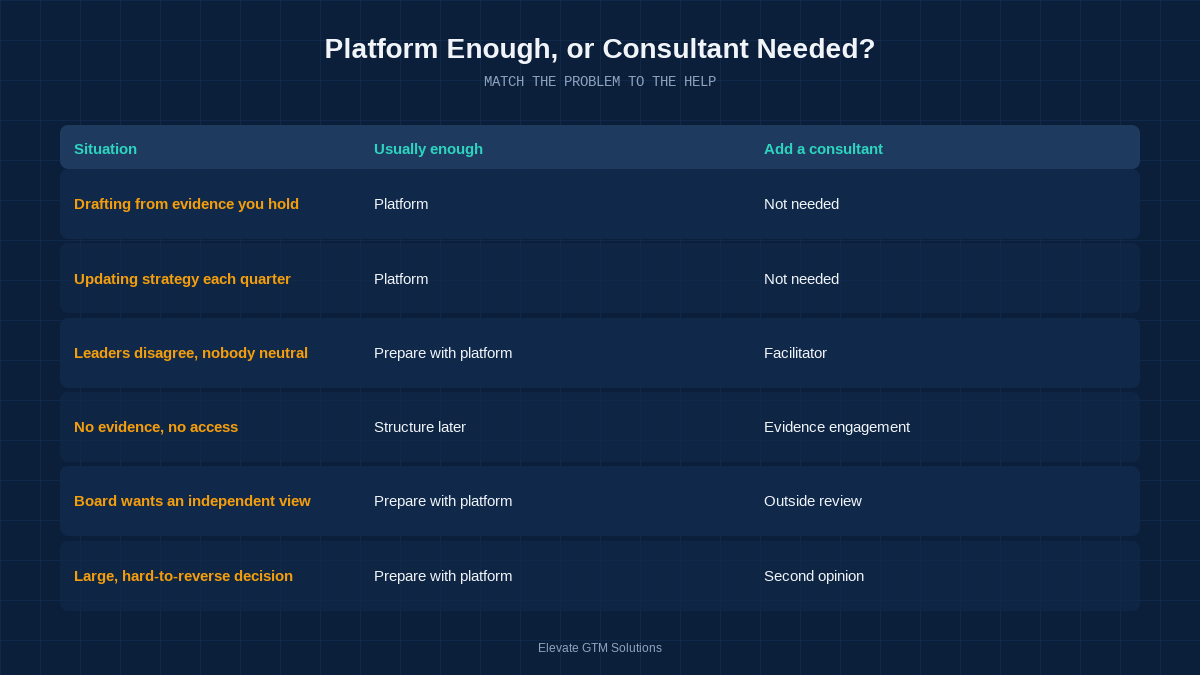
A guide that argues for using a GTM platform owes its readers a straight answer to the opposite question: when is a consultant still the right call? There are situations where no software, however good, substitutes for an experienced person in the room. Pretending otherwise would waste your money and ours.
The useful way to frame the decision is by the type of problem, not by the type of vendor. Some problems are structured and repeat: describing a customer, drafting positioning, building a plan, updating it when conditions change. Others are unstructured and one-off: settling a standoff between two leaders, entering a market where you have no evidence, convincing a board. The first kind suits a platform. The second kind often needs a person.
This guide gives you a decision framework, a set of situations that justify outside help, a way to scope a consultant narrowly so that the fee stays small, and a hybrid model that most companies end up using. Elevate sells a GTM platform and runs a small advisory practice, so we have a stake in both halves of the answer. We have tried to be even-handed.
When Do You Still Need a GTM Consultant?
You still need a GTM consultant when the problem is unstructured or one-off: a high-stakes decision with internal disagreement, a market where you lack evidence and cannot gather it, a need for neutral facilitation, a board or investor expecting an independent opinion, or a team with no capacity to run the work. A platform is enough when the work is structured and recurring: drafting the customer definition, positioning and messaging, building plans and keeping them current. Many companies use a platform for the system and a consultant for the narrow decisions.
Is it either-or? Rarely. A hybrid model is common and usually cheaper than a full engagement.
How do you keep a consultant's cost down? Arrive with a draft, supply the evidence, and scope a short engagement around one decision.
A decision framework
Ask four questions about the problem in front of you.
1. Is the work structured or open-ended? Structured work follows a known pattern, such as turning evidence into a customer definition. Open-ended work does not, such as deciding whether to abandon a segment.
2. Does it repeat? Work that recurs, such as quarterly updates, is a candidate for a system. Work that happens once, such as a major repositioning, may justify a one-time outside effort.
3. Is independence part of the value? If the main reason to hire is neutrality or an outside name, a platform cannot supply it.
4. Do you have the evidence? If you hold the data and customer access, a platform can structure it. If you do not, you may need someone who can obtain it.
| Answers | What it suggests |
|---|---|
| Structured, recurring, no need for independence, evidence in hand | A platform is enough |
| Structured, recurring, but the decision is contested | Platform plus a facilitator |
| Open-ended, one-off, high stakes | A consultant, scoped to the decision |
| Open-ended, and evidence is missing | A consultant for evidence, then a platform to structure it |
| Board-facing validation needed | A consultant, with the platform as preparation |
Most real problems are a mixture, which is why hybrids are common.
Eight situations that justify a consultant
1. Leaders disagree and nobody neutral exists
When a sales leader and a product leader hold incompatible views and both have data, the problem is not analysis. It is a decision that nobody is willing to concede. A skilled outsider can structure the argument, test each side's evidence, and help the group decide. A platform can prepare the material for that session, and it will not break the standoff.
2. The decision is large and hard to reverse
Entering a new region, repricing a core product, restructuring sales coverage or shutting down a line are decisions that are costly to undo. A second opinion from someone who has seen similar decisions play out can be worth the fee, even when the analysis itself could be done in-house.
3. You lack evidence and cannot get it
Sometimes the evidence sits outside your reach: buyers in a market where you have no relationships, benchmarks you cannot access, or a partner ecosystem you do not know. A firm with networks in that market can shorten the path. Be specific about what evidence you are buying, and ask how it will be gathered.
4. Your team has no capacity
A company in the middle of a launch, an acquisition or a leadership transition may not have people to run interviews and workshops. Temporary outside capacity can be sensible. Make sure the work is handed back in a form your team can maintain.
5. A board or investor expects an independent view
Some decisions need an outside stamp. That is a legitimate reason, as long as you are clear that you are paying for independence and reputation.
6. You are doing something unusual
Platforms and templates follow patterns. If your situation does not fit the pattern, such as a new category with no comparables or an unusual regulatory constraint, an experienced advisor may handle the ambiguity better than a structured tool.
7. You need change management
Getting a strategy adopted across several teams takes leadership, coaching and sometimes incentive changes. A consultant with change experience can help, and a platform cannot.
8. You need to build a skill, not a document
If the goal is to teach your team how to run interviews, win and loss reviews or a planning cadence, an advisor can coach. That is a capability investment, not a deliverable purchase.
Situations where a platform is usually enough
| Situation | Why a platform tends to be enough |
|---|---|
| Drafting a first customer definition and positioning from existing evidence | Structured work from known inputs |
| Keeping the strategy current as the market changes | Updating inputs is cheaper than a new engagement |
| Producing consistent messaging for several roles | Outputs from shared inputs stay aligned |
| Planning across several products or segments | Multiple scopes with shared structure |
| Generating handoff material for sellers | Derived from the agreed strategy |
| Preparing for a quarterly review | Updated outputs and a decision record are already available |
| Creating a launch plan from a settled strategy | Plans follow from decisions and constraints |
In these cases, a consultant would mainly be producing drafts from information you already have, which is expensive per hour of insight.
How to scope a consultant narrowly
If you decide you need outside help, the way you scope it largely determines the cost.
Start from the decision. Write the question in a sentence. For example: "Should we prioritize the mid-market or the enterprise segment for the next two quarters?" A narrow decision produces a narrow engagement.
Arrive with a draft. If your team and a platform have produced a structured draft and an assumption log, the consultant starts at the interesting part. Share it in advance.
Supply the evidence. Provide win and loss data, customer quotes and the pipeline analysis. The consultant should not charge to rediscover what you hold.
Define the output. Ask for a decision record, not a long report. A one-to-three page recommendation with reasoning and risks is often enough.
Limit the senior time. Ask for senior hours on the parts that need them, such as the facilitated session and the final review.
Set acceptance. Agree what finished looks like and who accepts it.
Plan the handoff. Decide how the outputs will be updated after the engagement ends.
Prefer short phases. Authorize a first phase, review, and decide whether to continue.
| Typical scope | Narrow scope |
|---|---|
| Discovery, analysis, strategy and rollout over several months | A two-to-four week engagement on one decision |
| A final report of many pages | A short decision record and an updated model |
| Weekly steering committee | Two working sessions and a review |
| The firm builds everything | The firm challenges, and your team builds |
A narrow scope can reduce the fee substantially, and often produces a better decision, because the consultant's time is spent on judgment.
The hybrid model in practice
Most companies that use both end up with a model like this.
The platform carries the system. Customer definition, segment priorities, positioning, messaging, pricing logic and plans live in a structured place and are updated monthly and quarterly.
Your team owns the evidence. Product marketing and sales gather win and loss reasons and customer conversations.
An advisor is used sparingly. Perhaps one challenge session a quarter or a year, or an engagement on a specific decision.
Decisions are recorded. A decision log captures what was decided and why.
This model has three advantages. It keeps the recurring cost low. It keeps the knowledge inside the company. And it makes each use of an advisor more productive, because the advisor arrives to a prepared team and a documented history.
Elevate's own model follows this pattern. Its Guided GTM offering combines the platform with advisors, and its GTM advisory engagements are described as focused and fast rather than long-term consulting.
How to run a short facilitated decision session
One of the best uses of outside help is a single, well-prepared session on a contested decision. The format below works whether the facilitator is an external advisor or a trusted internal neutral.
Before the session.
- Write the decision as a single question and share it a week ahead.
- Circulate a pre-read of no more than three pages: the options, the evidence for each, the assumptions, and the risks.
- Ask each leader to write down, privately, what evidence would change their mind.
- Agree who will make the final call and by when.
Agenda for a two-hour session.
- Restate the question and the decision rule, ten minutes.
- Walk through the evidence for each option, thirty minutes. The facilitator keeps facts separate from opinions.
- Surface the disagreements, twenty minutes. Name which are about facts, which are about values and which are about risk appetite.
- Test each option against the strongest objection, thirty minutes.
- Decide, or name the evidence that would let you decide, twenty minutes.
- Assign owners and dates, ten minutes.
Ground rules that help.
- Evidence beats seniority.
- Everyone states a position before discussion.
- Disagreements are written on a shared page, not argued in circles.
- The decision owner decides, and the group commits.
After the session. Record the decision, the reasons and the review date. Update the strategy inputs so that the outputs reflect what was decided.
A session like this can replace weeks of workshops, and it costs little when the pre-read is prepared by your own team and a platform.
Types of advisors and what each is good for
Not every advisor does the same work. Matching the type to the need saves money.
| Type | Good for | Less suited to |
|---|---|---|
| Strategy consultant | Market choices, prioritization and independent challenge | Day-to-day execution |
| Positioning and messaging specialist | Differentiation, narrative and proof | Pricing models or sales coverage |
| Pricing specialist | Value metrics, packaging and willingness to pay | Brand or channel questions |
| Sales or revenue design advisor | Coverage, roles and operating cadence | Messaging and positioning |
| Interim or fractional leader | Running a function for a period | Short advisory questions |
| Market-entry specialist | Local evidence, partners and regulation | Product strategy |
| Facilitator | Reaching a decision among leaders | Producing analysis |
If your need is a facilitated decision, you may not need a strategy firm at all. If your need is local evidence, a regional specialist may be a better fit than a global brand.
A scorecard for comparing advisors
Use one scorecard across all candidates, and score the same way each time.
| Criterion | What a strong answer looks like | Weight |
|---|---|---|
| Fit to the decision | They describe similar decisions and what they did | High |
| Team and time | Named people with committed hours | High |
| Evidence plan | A clear route to the evidence you lack | High |
| Scope and acceptance | Short phases, defined outputs, a test for done | High |
| Reuse | You keep the work product in a usable form | Medium |
| Independence | Clear handling of conflicts and incentives | Medium |
| Collaboration style | They work with your draft and your people | Medium |
| Price relative to scope | Cost makes sense for what is included | Medium |
Write the weights before opening the proposals. A rushed team often gives price too much weight or too little, depending on the mood of the week.
Managing the relationship so the money is well spent
Even a well-scoped engagement can drift. A few habits keep it on course.
Appoint one internal owner. A single person who answers questions, arranges access and accepts deliverables.
Hold short check-ins. Fifteen minutes weekly to review progress, risks and what is needed from your team.
Review early output. Ask for a rough version in the first week. Problems with scope show up fast.
Control change. Any addition in writing, with a cost and a date.
Keep the work product in your system. Ask that findings and recommendations be recorded in the structured place you use, not only in a deck.
Agree the ending. Before the engagement closes, decide who will own the outputs, how they will be updated and when you will review them.
Keeping the gains after the engagement
A consulting engagement can create a burst of clarity that fades. To keep it:
- Record the decision and the reasoning in a decision log.
- Update the structured strategy so that messaging, plans and handoff material reflect the decision.
- Brief the field with short, practical materials.
- Put the first review on the calendar, usually thirty to ninety days out.
- Identify the signals that would show the decision is wrong, and watch for them.
- Decide who will brief the next advisor, if there is one, using the record you have built.
Companies that do this find that each outside engagement leaves them better equipped than the last, and that later engagements are shorter.
What to hand a consultant on day one
A good briefing pack cuts discovery time and lowers the fee. Prepare it before the first meeting.
| Item | What to include |
|---|---|
| The decision | One sentence, plus what happens if you decide nothing |
| Constraints | Budget, timing, regulatory limits and anything already committed |
| Current strategy | The customer definition, positioning and messaging as they stand |
| Evidence | Win and loss reasons, customer quotes, pipeline data by segment |
| Assumption log | What you believe, what supports it and what is untested |
| Stakeholders | Who is affected, who decides and where views differ |
| History | Earlier attempts, past engagements and what was learned |
| Success test | How you will know the decision was sound in six months |
If your strategy lives in a platform, much of this can be shared as an export. If it lives in scattered documents, assembling the pack is a useful exercise in itself, and often reveals that you know more than you thought. Either way, the consultant begins from your reality instead of a blank page.
Also tell the consultant what you do not want. If you do not need a long report or a rollout plan, say so. Scope that is stated clearly at the start is easier to hold to.
Questions to ask a consultant you are considering
- What exactly will you do that my team and a tool could not?
- Who will do the work, and how many hours will senior people spend?
- What do you need from my team, and how many hours is that?
- What will I keep when you leave, and in what form?
- How will the output be updated afterward?
- What would change your recommendation?
- What do you not do?
- Can I speak with a client who used you for a similar decision?
- What is the smallest first phase that would settle the main question?
- How do you handle disagreement between my leaders?
Good consultants answer these directly. Be cautious if answers are vague, or if the proposed scope keeps growing as you ask questions.
Warning signs that a consultant is not the right answer
- The proposal is mostly drafting from information you already have.
- The deliverable is a long document without a plan for updates.
- The scope is broad and the first decision is unclear.
- The senior people in the pitch do not appear in the staffing plan.
- The fee is large compared with the value of the decision.
- You would not know how to tell whether it worked.
- Nobody on your side has time to support the engagement.
When several of these appear together, consider a smaller scope or a different route.
Warning signs that a platform is not enough
- The decision is stuck because of disagreement, not because of analysis.
- You have no evidence and no way to gather it.
- The stakes are high enough that an independent view is expected.
- Your team lacks the capacity to maintain inputs.
- The situation does not fit the structure of the tool.
When these appear, add outside help for the missing part.
Two illustrative scenarios
These scenarios are composites meant to show how the decision plays out. They are not descriptions of specific companies.
A company that used a consultant well. A company planned to enter a second region. Its team had built a structured strategy for the home market in a platform and had a clear customer definition. For the new region, it lacked buyer relationships and local evidence. It hired a firm with regional networks for a four-week engagement, scoped to answer one question: which of two countries to enter first. The company supplied its own customer definition and assumption log. The firm ran buyer interviews and delivered a short decision record. The company then loaded the findings into its platform to adapt positioning and messaging for the chosen country. The consultant supplied evidence and judgment, and the platform handled the structured work around them.
A company that did not need one. Another company had commissioned positioning work for each of three product launches. When planning the fourth, the product marketing lead reviewed the previous engagements and found that most of the cost had been drafting and revising documents from information the company held. She moved the customer definitions and positioning for all four products into a platform, ran customer conversations herself and held a two-hour decision session. The fourth launch cost a fraction of the previous ones. The company kept an advisor on call for a yearly challenge session and did not need to use it that year.
Where Elevate fits
Elevate is an AI-native GTM operating system. It connects GTM context, intelligence, strategy, activation, execution and analytics, with 15 specialist modules plus Unified GTM Strategy and Elevate Pulse for recurring priorities. It is designed for the structured, recurring work described above. The pricing page states that Elevate is a product and not a consulting service.
For the situations that need people, Elevate offers Guided GTM, which pairs the platform with advisors, and targeted GTM advisory engagements for specific problems such as positioning, pricing and expansion, described as fast and focused instead of long-term consulting. Published platform plans are Enable at USD 499 per month and Growth at USD 1,499 per month, both billed annually, with custom Scale pricing. See the pricing page for details.
For related reading, see Can a GTM Platform Replace GTM Consulting?, GTM Platform vs GTM Consultant, and How to Build a GTM Strategy Without a Consultant. The platform page explains how the modules connect, and you can request a demo to see the platform with your own inputs.
Final thoughts
The right question is not whether to use a consultant or a platform. It is which part of the problem is which. Structured, recurring work belongs in a system your team owns. Contested, high-stakes or evidence-poor decisions benefit from an outside voice. Treating them as the same thing is how companies overspend on drafting and underspend on judgment.
A sensible default is to build the system first, run your own customer conversations, and bring in an advisor for the narrow questions that need one. Arrive prepared, scope the engagement around a decision, and ask for a short record you can reuse.
If you remember one thing, let it be the scoping test: the best use of a consultant is the question your team cannot answer by itself, asked with evidence in hand and a clear owner for the answer.
Frequently Asked Questions
When do I still need a GTM consultant?
When the problem is unstructured or one-off: leaders disagree and no neutral facilitator exists, the decision is large and hard to reverse, you lack evidence you cannot gather yourself, your team has no capacity, or a board expects an independent view.
When is a GTM platform enough?
When the work is structured and recurring, such as drafting the customer definition, positioning and messaging, building plans, generating handoff material and keeping the strategy current as conditions change.
Can I use a platform and a consultant together?
Yes. A common model is a platform for the structured system, your own team gathering evidence, and an advisor used sparingly for challenge, facilitation or a specific decision.
How do I keep consulting costs down?
Scope the engagement around one decision, arrive with a draft and your own evidence, ask for a short decision record instead of a long report, limit senior hours to the parts that need them, and agree acceptance and handoff in advance.
What should I ask a GTM consultant before hiring?
Ask what they will do that your team and a tool could not, who will do the work and how many senior hours, what they need from you, what you keep afterward, how the output will be updated and what the smallest first phase would be.
What are signs I do not need a consultant?
The proposal is mostly drafting from information you already hold, the deliverable is a long document with no update plan, the scope is broad and the first decision is unclear, or you cannot say how you would know it worked.
Does Elevate offer advisors?
Yes. Elevate offers Guided GTM, which pairs the platform with advisors, and focused GTM advisory engagements for specific challenges. The platform itself is a product and not a consulting service.
What if I do not have customer evidence?
You can gather it with your own conversations, or hire a firm with relevant networks for a narrow evidence engagement. Either way, load the findings into a structured system so that they are reusable.