
By the Elevate GTM Solutions Team · Updated November 10, 2026 · 22 min read
GTM Platform vs GTM Consultant: Cost, Speed, Control, and Fit
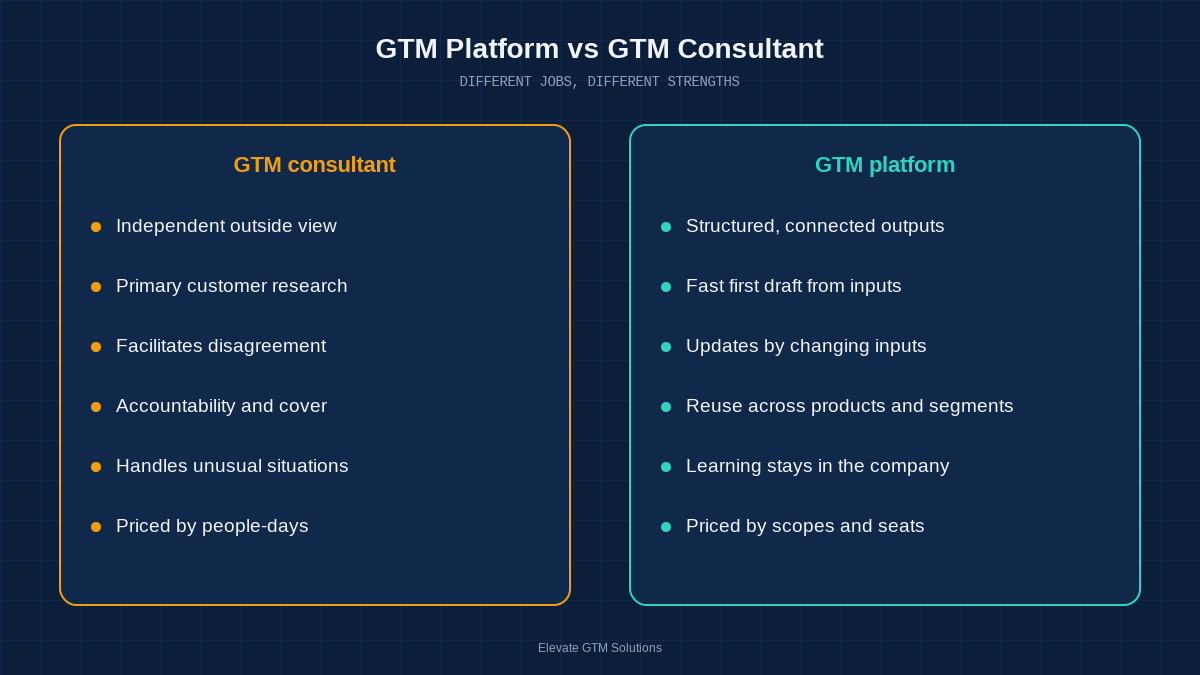
When a company decides it needs a stronger go-to-market strategy, the first instinct is usually to hire someone. A consultant arrives, interviews people, builds a plan and leaves. That model has worked for decades. In the last few years a second option has appeared: a GTM platform that generates and maintains structured strategy from the inputs you supply. Buyers now find themselves comparing a software subscription with a human advisor, and the comparison is awkward because the two are not selling the same thing.
A consultant sells judgment, experience and time. A platform sells structure, speed and repeatability. Neither is better in general, and treating them as direct substitutes leads to mistakes in both directions: buying a consultant to do work a tool could do for a fraction of the cost, or buying a tool to fix a problem that needed a person in the room.
This guide compares them head to head on the dimensions that tend to decide the purchase, including cost, speed, depth, independence, consistency, ability to update, effort required from your team, and accountability. It says plainly where each one wins. Elevate sells a platform and offers a small advisory practice, so we have a point of view. We have tried to write the comparison so that you could use it to choose a consultant if that is the right answer.
GTM Platform vs GTM Consultant: Which Is Better?
A GTM platform is better for structured, repeatable work: drafting a customer definition, positioning and messaging, building plans and keeping them current at a predictable subscription cost. A GTM consultant is better for independent judgment, primary customer research, facilitating disagreement and external validation. Platforms cost less per update and can be revised by your own team. Consultants bring outside experience and accountability. Many companies use a platform for the system and a consultant for the decisions that need an outside voice.
Which is cheaper? For recurring work, a platform usually costs less. For a one-time decision that needs outside judgment, a short engagement can cost less than building the capability.
Which is faster? A platform produces a first draft quickly. A consultant needs time for discovery, but may reach a decision faster when internal disagreement is the blocker.
The comparison at a glance
| Dimension | GTM platform | GTM consultant | Who tends to win |
|---|---|---|---|
| Cost structure | Subscription by scopes and seats | People-days at blended rates | Platform for recurring work |
| Time to a first draft | Quick, from structured inputs | Weeks, including discovery | Platform |
| Independent outside view | None; it is a tool | Core strength | Consultant |
| Primary customer research | Organizes what you bring | Can run interviews | Consultant |
| Consistency across outputs | High, from shared inputs | Depends on the team | Platform |
| Keeping strategy current | Update inputs and review | New engagement or retainer | Platform |
| Facilitating disagreement | Supports with shared outputs | Core strength | Consultant |
| Effort from your team | You supply and review inputs | You supply access and review | Similar, differently shaped |
| Accountability | Your team owns decisions | Shared in practice | Consultant |
| Reuse across products and segments | Strong, with multiple scopes | Often a new engagement each time | Platform |
| Handling unusual situations | Limited to its structure | Flexible | Consultant |
| Learning stays in the company | Yes, in the structured record | Often leaves with the firm | Platform |
The table is a map, not a score. The right choice depends on which rows matter most for your situation.
Cost: different structures for different work
Consulting cost. A consulting fee is built from people-days at a blended rate, plus overhead, margin, a premium for scope risk and expenses. It grows with time, team size and seniority, and each new question tends to be a new scope. Our guide to why GTM consulting is expensive walks through the build-up.
Platform cost. A platform charges for access. Elevate's published plans are Enable at USD 499 per month and Growth at USD 1,499 per month, both billed annually, with custom pricing for Scale. At those monthly rates, the annual amounts are USD 5,988 and USD 17,988. Enable covers one GTM scope with one revision cycle. Growth covers up to three users and three scopes, with up to two revisions per scope. Scopes are products, markets or segments. See the pricing page for current terms.
What the comparison does and does not show. Putting the two prices side by side is meaningful only if you compare what each buys. A subscription does not buy an outside opinion, interviews or facilitation. A consulting fee does not buy a strategy you can update yourself next quarter. The fairer comparison is between the cost of the structured work, repeated as often as you need it, and the cost of the judgment work, bought only when you need it.
A useful way to frame it. Take the last consulting quote you received. Estimate how much of it was drafting, structuring and producing documents from information you already had, and how much was independent judgment and facilitation. The first portion is the part a platform can address. The second is the part that justifies the consultant.
Speed: two kinds of fast
Speed means different things for each.
Platform speed is the time from inputs to a structured draft. Once the product, market and segment details are entered, a platform can generate a first version quickly, and regenerate it when you change an assumption. Elevate states that its platform can produce a complete strategy in minutes. That is a claim to test with your own inputs, and it describes a draft, not a validated strategy.
Consultant speed includes discovery, interviews, analysis and review, which takes weeks. That is slower to a first draft. But a consultant can be faster to a decision when the blocker is disagreement among leaders or missing outside evidence, because a platform does not resolve those.
The practical rule. If the delay is in producing and organizing structured material, a platform shortens it. If the delay is in getting people to decide, a skilled facilitator may shorten it more than any tool.
Depth and independence
Where consultants have the edge. An outside team has seen many companies in similar positions. It can notice that your problem resembles a pattern, suggest options you had not considered, and say hard things safely. That outside view is a real asset.
Where platforms have the edge. A platform applies the same structure every time, which keeps outputs consistent and complete. It will not forget to address pricing logic, channel plans or launch sequencing because it is following the same framework each time. Consistency of coverage is a quiet strength.
Where both are limited. Both depend on the quality of the inputs. A consultant working from thin evidence and a platform working from vague inputs both produce plausible, generic answers. The remedy for both is the same: bring specific, honest evidence about your customers.
Primary research
Customer and lost-deal interviews are often the highest-value input to any GTM strategy. A consultant can run them, bringing a skilled interviewer who hears what is not said. A platform cannot sit across from a buyer.
What a platform can do is structure the results of interviews you or an advisor run: tagging themes, comparing segments, flagging contradictions and updating outputs. Teams that pair self-run interviews with a platform often get most of the benefit at far lower cost than commissioning the whole research effort, though a skilled outside interviewer can add value when buyers will speak more freely to a third party.
Consistency and the problem of drift
A consulting engagement often produces several documents: customer definition, positioning, messaging, launch plan. They are written at different times, sometimes by different people, and small inconsistencies creep in. A year later they are further apart.
A platform that generates all of these from shared inputs keeps them aligned. Change the target segment and the downstream outputs update. That consistency is easy to underestimate until you are reconciling three documents before a launch.
Drift also affects the field. If sellers use talk tracks written from last year's positioning, they will tell a story that no longer matches the strategy. Structured handoff material generated from the current strategy narrows that gap.
Staying current
This is the dimension where the cost difference compounds.
With a consultant, keeping strategy current means another engagement, a retainer or an internal team doing the work in between. Each option has a cost. The deliverable itself does not update.
With a platform, updating means changing inputs, reviewing the differences and deciding what to act on. The cost is mostly internal time. Over several years, the difference between buying a refresh each time and maintaining the strategy in a system is often larger than the difference in first-year price.
The caveat. A platform only stays current if someone updates it with fresh evidence. If nobody does, you have an outdated platform instead of an outdated document.
Facilitation and alignment
Getting leaders from sales, marketing, product and finance to agree on a plan is hard. A neutral facilitator who can surface disagreements and guide the group to a decision is valuable, and a platform does not replace them.
A platform does help in a smaller way: it gives the group a shared set of outputs to argue about. Disagreeing over a concrete draft is usually more productive than disagreeing over abstractions. Some teams use the platform to prepare the material, then bring in an advisor for the decision meeting itself.
Accountability
When a recommendation turns out to be wrong, someone owns it. A consultant who signed a recommendation shares the burden in a way a tool does not. That can be valuable for executives who want a second name behind a major decision.
With a platform, accountability stays inside the company. For many teams that is a feature, since the people who run the plan own the plan. For others it is a risk, because it removes outside cover.
Choosing by situation
| Your situation | Likely better fit | Why |
|---|---|---|
| Recurring need to update customer definition, positioning and messaging | Platform | Repeated structured work |
| One high-stakes decision with internal disagreement | Consultant, or a facilitator | Needs neutrality |
| Several products or segments needing consistent strategy | Platform | Multiple scopes, shared structure |
| Need for primary customer research you cannot run | Consultant | Skilled outside interviewers |
| Limited budget and a small team | Platform, with founder-led customer conversations | Lower cost per update |
| Board wants an independent opinion | Consultant | The name and independence are the product |
| Strategy goes stale every few months | Platform | Update by changing inputs |
| New market entry with no internal evidence | Consultant plus platform | Outside evidence, structured system |
If your situation matches more than one row, a hybrid is likely the answer. Our guide to when you still need a GTM consultant covers the hybrid model in more detail.
What each option asks of your team
Neither choice is hands-off. Both need time from your people, in different shapes.
| Need | With a platform | With a consultant |
|---|---|---|
| Initial input | Product, market, segment and constraint details, entered in structured form | Interviews, data requests, documents and access to people |
| Ongoing input | Updates to assumptions as the market changes | Availability for workshops, reviews and steering meetings |
| Review | A panel tests outputs against what the field hears | Leaders review drafts and a final readout |
| Decision | A named owner approves changes | The sponsor accepts deliverables and decides |
| Follow-through | Your team acts on outputs and updates the system | Your team implements the recommendations |
| Hidden load | Keeping inputs honest and current | Scheduling, briefing and managing the engagement |
A platform asks for steady, light attention. A consultant asks for concentrated, heavier attention during the engagement and then very little. Companies with thin teams sometimes underestimate the first and overestimate their ability to absorb the second. Match the shape of the effort to the shape of your calendar.
The risks of each choice
Every option has a typical failure. Knowing it helps you guard against it.
Platform risks:
- Thin inputs, generic output. A tool fed vague information returns plausible averages. Specific evidence is the cure.
- Unowned system. If nobody maintains inputs, the platform becomes a place where drafts sit.
- False confidence. Polished output can be mistaken for validated truth.
- Lock-in or portability concerns. You should be able to export outputs and keep your work.
Consultant risks:
- Document that goes stale. The deliverable is a snapshot, and the work is bought again when the market moves.
- Dependence on named people. A strong senior advisor may spend less time on the project than the pitch implied.
- Re-discovery cost. A new firm or a new engagement repeats learning.
- Misaligned incentives. Firms that sell implementation may favor recommendations that need it.
Ask each vendor, and yourself, how you would notice if the failure were happening. A platform failing looks like unused outputs and disputed numbers. A consultant failing looks like a polished report that nobody acts on.
How contracts and terms differ
The commercial terms you should examine differ by option.
For a platform:
- Term and renewal. Annual billing is common. Check what happens if your needs shrink or grow.
- Scopes and seats. Know what counts as a scope, how many revisions you get and what an upgrade costs.
- Data and export. Confirm who owns inputs and outputs and how you can export them.
- Security and access. Review how data is stored, who can see it and how it is used, in line with your company's policies.
- Support. Ask what help is included during onboarding.
For a consultant:
- Scope and acceptance. Written deliverables with a test your team can apply.
- Named people and time. Commitments for senior hours.
- Work product ownership. What you can reuse after the engagement.
- Change control. How extra work is approved and priced.
- Confidentiality and conflicts. What the firm sees, and whether it works for competitors.
Procurement teams that are used to buying consulting sometimes apply consulting terms to software, and the reverse. Reading each against the right checklist avoids both mistakes.
How to judge claims from either side
Both platforms and consultants make confident claims. Some habits help you separate evidence from sales language.
- Ask for an example built on a company like yours. Look at the actual output, not a summary.
- Ask what the output assumes. A good answer lists the assumptions and the evidence behind them.
- Ask what would change the recommendation. Honest advisors and honest tools can name conditions under which their answer would change.
- Ask what they will not do. A short, specific answer is a sign of integrity. A long list of everything is not.
- Ask about failures. A consultant should be able to describe an engagement that did not go well and what they learned. A vendor should be able to describe limits of the product.
- Talk to a customer. Ask someone who has used the option for six months how it holds up.
- Look for testable claims. Statements such as "we can generate a complete strategy in minutes" are testable. Run the test with your own inputs.
If a vendor of either kind resists tests, treat that as information.
Considerations specific to larger organizations
At enterprise scale, a few additional questions appear.
Governance. Who is allowed to change the customer definition or positioning, and how is the change reviewed? A platform with version history and clear approval paths helps. A consultant's deliverable lacks those controls unless you add them.
Multiple stakeholders. Large companies often have competing business units. A platform can give each unit a scope with shared structure. A facilitator can still be needed to resolve conflicts between them.
Security and data handling. Review any tool against your security requirements before entering sensitive information. The same applies to sharing data with a consulting firm.
Procurement fit. Enterprise purchasing processes may favor familiar models. A subscription may need a different approval path than a services contract.
Independence for decisions that carry risk. Regulated decisions or those affecting investors may benefit from outside review regardless of how much structured work is done in-house.
A short decision checklist
Answer these before choosing.
- Is most of the work structured drafting from information you already have?
- Will you need to update the strategy at least every quarter?
- Do you have several products or segments that need consistent treatment?
- Is the main blocker disagreement, or the effort of producing the material?
- Do you need primary customer research that you cannot run yourself?
- Does a board or investor expect an independent opinion?
- Does your team have capacity to maintain inputs, or to host an engagement?
- Who will own the decision after the work is delivered?
Mostly yes on the first three points to a platform. Mostly yes on the next three points to an advisor. A mix suggests a hybrid, with the platform carrying the system and a consultant brought in on specific questions.
A side-by-side test
You can compare the two directly on a real question.
- Pick one decision. For example, which segment to prioritize for a new product.
- Give both the same inputs. Provide the same evidence to a platform and to an advisor.
- Set the same timeframe. Ask for a draft within two weeks.
- Review both with the same panel. Ask sales, product and customer success leaders to score clarity, completeness and usefulness.
- Compare effort and cost. Include your team's time.
- Decide on the split. Note which parts the platform handled and which parts needed the advisor.
The test is small enough to run cheaply. It replaces opinion with evidence from your own situation.
A three-year view of cost
A one-year comparison favors whichever option has the lower first invoice. A three-year view is more honest, because strategy work recurs.
Use this simple structure and fill it with your own numbers.
| Line | Consultant path | Platform path |
|---|---|---|
| Year one, initial work | Engagement fee plus expenses | Subscription plus onboarding time |
| Year one, internal time | Interviews, reviews and access work | Input entry and review |
| Year two, keeping it current | A refresh engagement or retainer | Subscription plus input updates |
| Year three, keeping it current | Another refresh | Subscription plus input updates |
| Outside judgment, if needed | Included in the engagement | A short advisory session, bought separately |
| Total over three years | Sum of the above | Sum of the above |
Two points make the arithmetic less obvious than it looks. First, a company that moves to a platform and also buys a small amount of outside advice each year is paying for two things, so the platform path is not just the subscription. Second, a company that commissions a consultant once and does not refresh pays less, but ends the period with a strategy that may no longer fit. Compare the cost of the path you will actually follow, not the cheapest theoretical one.
Elevate's published monthly rates, billed annually, work out to USD 5,988 per year for Enable and USD 17,988 per year for Growth. Those figures describe the platform line only. Add your own estimate for internal time and for any outside advice you expect to buy.
What to ask your finance team
Finance leaders often want a single number. These questions turn the comparison into something they can evaluate.
- What outcome is the spend meant to produce? A defined decision, a launch, a faster update cycle.
- How will we know it worked? Win rate by segment, sales cycle length, message consistency across teams, time to update.
- What is the cost of delay? A stalled launch or a stuck decision has a cost that may exceed the fee.
- What is the cost of being wrong? A high-stakes, hard-to-reverse choice justifies more outside input.
- What happens at renewal or at the end of the engagement? Know the exit terms of each option.
These questions often change the conversation from the cheapest option to the option with the best fit for the problem.
Two illustrative scenarios
These scenarios are composites meant to show how the choice plays out. They are not descriptions of specific companies.
A growing company that needed a system. A B2B company with two products and a third on the way kept commissioning positioning work every time a product launched. Each project was good. Each started from zero. The company moved its customer definitions, positioning and messaging into a platform with a scope for each product. When a competitor repriced, the product marketing lead updated the inputs, reviewed the changes and adjusted messaging in days. The company kept an advisor for an annual challenge session. The platform handled the system and the advisor handled the outside view.
A company that needed a person. Another company had a sales leader and a product leader who disagreed about which segment to prioritize. Both had data. Neither would concede. A platform produced clear outputs for each option, but the disagreement persisted. The company hired an advisor to facilitate a decision session using those outputs as material. The session produced a decision in a day. The platform provided the structure, and the advisor provided the neutrality that resolved the standoff.
Where Elevate fits
Elevate is an AI-native GTM operating system. It connects GTM context, intelligence, strategy, activation, execution and analytics, with 15 specialist modules plus Unified GTM Strategy and Elevate Pulse for recurring priorities. It is designed for the structured, repeatable part of go-to-market work.
Elevate also offers Guided GTM, which combines the platform with advisors, and targeted GTM advisory engagements for specific problems. The pricing page is clear that the product itself is not a consulting service. That is consistent with the conclusion above: the platform and the advisor do different jobs, and most companies benefit from both in the right proportion.
For related reading, see Can a GTM Platform Replace GTM Consulting?, How Much Does GTM Consulting Cost?, and GTM Consulting Alternatives. Published plans are on the pricing page, the platform page explains how the modules connect, and you can request a demo to run the side-by-side test with your own inputs.
Final thoughts
The platform versus consultant question looks like a contest and behaves like a division of labor. A platform is built for the work that repeats: structuring evidence, drafting outputs, keeping them consistent and updating them as things change. A consultant is built for the work that does not repeat: independent judgment, facilitation, interviews and validation.
Companies that frame the choice as either-or often overspend, buying a consultant for structured work or a tool for a human problem. Companies that ask which tasks belong where tend to end up with a lower recurring cost, a strategy that stays current, and a narrow, well-scoped role for outside help.
If you remember one thing, make it this: compare what each option buys, not what each costs. Then run a small side-by-side test on a real decision. The result will tell you more than any comparison page.
Frequently Asked Questions
What is the difference between a GTM platform and a GTM consultant?
A GTM platform is software that structures and generates go-to-market strategy from inputs you provide and keeps it current. A GTM consultant is a person or firm that brings outside judgment, research and facilitation. The platform sells structure and repeatability. The consultant sells judgment and experience.
Is a GTM platform cheaper than a consultant?
For recurring work, usually. A platform charges a subscription and a consultant charges for people-days. Elevate's published plans are USD 499 and USD 1,499 per month, billed annually, with custom Scale pricing. Compare what each includes, since a subscription does not provide an outside opinion or facilitation.
Which is faster, a platform or a consultant?
A platform is faster to a structured first draft. A consultant needs time for discovery but can be faster to a decision when disagreement among leaders is the blocker.
Can a GTM platform replace a consultant completely?
Rarely. It can replace much of the structured, repeatable work. It cannot replace independent judgment, primary customer research, facilitation, change management or accountability.
When should I hire a GTM consultant instead of using a platform?
When you need an independent view on a high-stakes decision, facilitation between disagreeing leaders, primary research you cannot run yourself, or external validation for a board.
Can I use a GTM platform and a consultant together?
Yes. A common pattern is a platform for the structured system and updates, with a consultant used sparingly for challenge, facilitation or validation. Elevate's Guided GTM follows this model.
Does a GTM platform keep strategy current?
It can, if someone updates the inputs. You change an assumption and review what shifts in the outputs. Without updates it becomes outdated like any document.
How do I compare a platform and a consultant fairly?
Compare what each buys, not just the price. Estimate how much of a consulting quote was structured drafting versus judgment, then run a small side-by-side test on a real decision with the same inputs.