
By the Elevate GTM Solutions Team · Updated November 10, 2026 · 21 min read
Why GTM Consulting Is Expensive: What You Are Actually Paying For
A go-to-market consulting proposal usually arrives as a PDF with a number on the last page, and that number tends to produce the same reaction in almost every finance team: surprise. The work described does not look like it should cost that much. A few interviews, some analysis, a positioning document, a launch plan. Where does the money go?
The short answer is that you are not paying for a document. You are paying for people's time, for the machinery that keeps those people busy and available, and for the risk the firm carries when it promises to answer a question nobody can fully scope in advance. Once you see how a fee is assembled, the number stops being mysterious, and you can also see which parts of it are fixed and which parts you can influence.
This guide takes a fee apart. It explains the cost drivers behind GTM consulting, separates the parts that buy real value from the parts that buy repetition, and shows what changes when part of the work moves into a platform. It does not claim consulting is overpriced, because that depends on what you buy and whether you needed it. It does claim that the cost structure has features that make it expensive in ways most buyers never notice until the second engagement. Elevate sells a GTM platform and a small advisory practice, so we have a stake in this question. We say plainly where consulting is worth every dollar.
Why Is GTM Consulting Expensive?
GTM consulting is expensive because the fee is built from people-days at senior rates, plus the firm's overhead, a margin, and a premium for scope risk. Each engagement also starts with discovery from scratch, produces a deliverable instead of a system, and has to be bought again when the market changes. A platform changes the cost structure by replacing repeated analysis and drafting with a subscription, but it does not replace independent judgment, stakeholder facilitation or accountability.
Is it overpriced? Not necessarily. A fee can be fair for the work and still be a poor purchase if you needed something cheaper and repeatable.
Can you reduce the cost without reducing the value? Often yes. Narrow the question, supply your own evidence, and move recurring analysis into a tool.
How a consulting fee is built
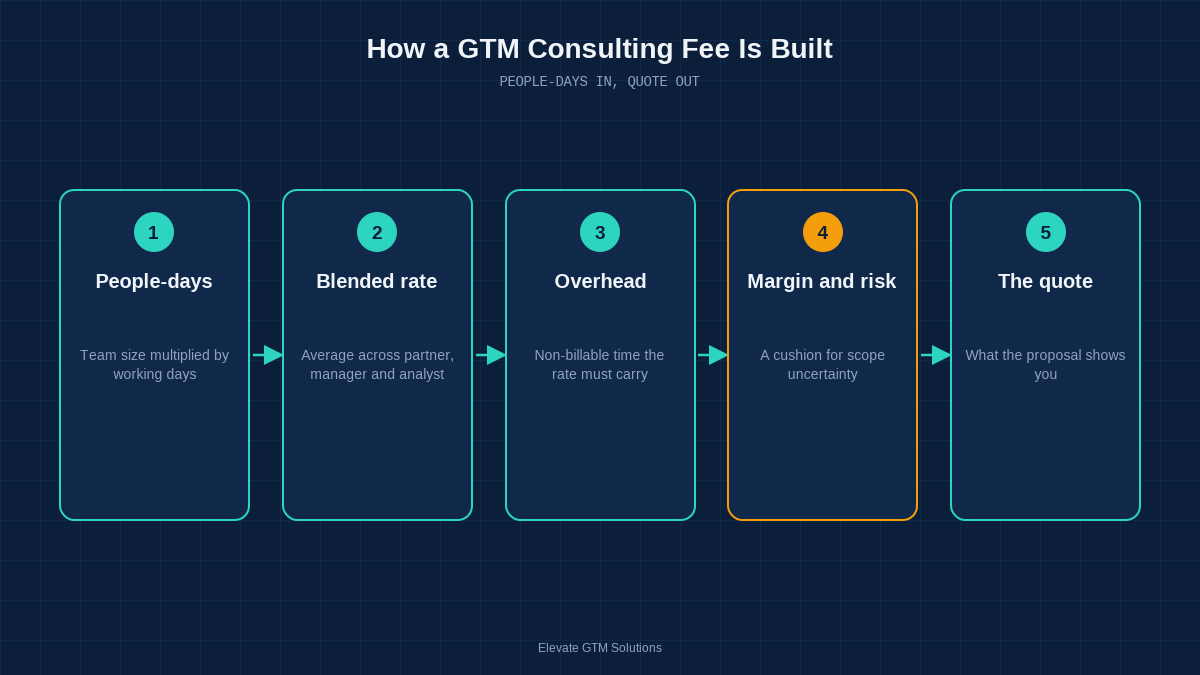
Most proposals reduce to one formula, even when the document hides it behind phase names and deliverable lists.
Fee = people-days × blended daily rate + expenses, with margin and risk loaded into the rate.
Each part of that line has its own logic.
People-days. A firm estimates how many working days it will spend. A team of four working for six weeks is 120 working days before anyone counts partner review, specialist input or the days spent selling and scoping the work. The number is an estimate, and estimates under uncertainty usually lean upward, because the firm bears the cost of being wrong.
Blended rate. The rate is an average across seniority levels. A partner, a manager, two consultants and an analyst all appear in one number. The more senior the mix, the higher the rate. Firms that sell on senior attention charge for it even when most of the hours are junior.
Overhead. A consulting firm has to pay for the days people are not billable: training, business development, bench time between projects, research subscriptions, offices, insurance, recruiting. Those costs are folded into the daily rate. Because staff are never billable for every hour, the rate has to be high enough to carry the hours that are not. You pay for those hours without seeing them.
Margin. The firm wants a return. Margin is rarely stated and usually exists in some form.
Risk. Fixed-fee proposals include a cushion for the chance that the work takes longer than planned. Time-and-materials proposals shift that risk to you, and the price shows up later as a bill that exceeds the estimate.
Expenses. Travel, research panels, translation, data purchases and subcontractors may be inside the fee or billed on top. Always ask which.
Nothing in that formula is unreasonable. The point is that every term in it scales with people and time. That is the root of the expense, and it explains why the cost does not fall much when the work becomes more routine.
Seven drivers behind the number
| Driver | How it raises the fee | What to ask |
|---|---|---|
| Senior time | Partners and principals cost several times what analysts do, and they are the draw | How many hours will senior people spend, and on which days? |
| Discovery from scratch | Every engagement starts by learning your product, market and customers again | What do you already know that we have paid to learn before? |
| Scope uncertainty | A broad question needs a larger cushion in the quote | What is the narrowest decision we could pay for first? |
| Coordination | Interviews, workshops, reviews and steering meetings consume days beyond the analysis | Which meetings produce a decision, and which produce updates? |
| Deliverable production | Slides and documents take real time to build and revise | Which deliverables will we actually use after the engagement? |
| Travel and field costs | Site visits, customer interviews and workshops add expenses | Which of these can be done remotely without losing evidence? |
| Repetition | The strategy goes stale and the work is bought again | What do we keep when the engagement ends? |
Two of these drivers deserve a closer look because they are less visible than the rest.
Discovery is paid for every time
A firm that has never worked with you needs to understand your product, your pricing, your buyers, your competitors and your internal politics before it can say anything useful. That learning is real work, and it is billable. When the engagement ends, much of what the firm learned leaves with it, unless you captured it in a form you can reuse.
This is why a second engagement with the same firm often feels cheaper per insight, and why a second engagement with a different firm feels as expensive as the first. The cost of discovery recurs unless the company holds its own structured record of what it knows.
The deliverable is not the system
Consulting produces a deliverable, usually a document, at a point in time. The market then keeps moving. Competitors change their pricing, a segment stalls, a new buyer role appears. The deliverable does not update. A year later, someone suggests a refresh, and the same drivers apply again.
You can see the pattern in how companies talk about strategy documents. They describe them as a snapshot, a baseline, an input. Nobody calls them a live asset. That is not a criticism of the work. It is a feature of the delivery model, and it means the true cost of keeping a strategy current is the fee multiplied by the number of times you commission it.
Why GTM work in particular feels expensive
Several features of go-to-market work make the cost pressure sharper than in some other advisory fields.
It crosses functions. A GTM decision touches marketing, sales, product, finance and customer success. Aligning them takes meetings, and meetings are days.
It depends on evidence the client holds. The best inputs, such as win and loss reasons, customer conversations and pipeline data, sit inside your company. The consultant has to extract them, which takes time, and which your team also spends time supporting.
The answers expire. Positioning, ICP and messaging need regular revisiting. A one-off engagement answers one moment.
Outcomes are hard to attribute. If a launch succeeds, was it the strategy, the execution or the market? Because attribution is murky, buyers often pay for confidence, and confidence is expensive.
The work is bundled. A proposal that mixes research, strategy, messaging, assets and rollout makes it hard to see which part is worth the money.
What the expense buys, honestly
It would be dishonest to treat the fee as waste. A good engagement buys things that are hard to get any other way.
Independence. An outside team can say things that employees cannot say safely, such as that a flagship product is aimed at the wrong buyer.
Pattern recognition. A firm that has seen many companies in similar positions can spot a problem early and suggest options you would not have considered.
Facilitation. Getting a sales leader, a product leader and a finance leader to agree on one plan is a skill, and a neutral facilitator makes it easier.
Capacity. If your team is full, outside people can do the work without pulling anyone off their jobs.
Accountability and cover. Boards and executives sometimes want an external opinion before approving a major change. A reputable firm provides that, and the value can be real even when the analysis itself is ordinary.
Speed on a specific decision. For a time-boxed problem with a known question, a focused engagement can be faster than building the capability yourself.
These benefits are worth paying for when you need them. The trouble starts when a company buys all of them to get something that only needed one, such as a well-structured first draft of a customer definition.
Where the structure creates avoidable spend
Some of the cost in a typical engagement is not buying judgment. It is buying production and repetition. Look for these patterns in a proposal.
Re-discovery. If you ran a strategy exercise last year, ask whether the findings are in a form the new team can reuse. If not, you are about to pay for them again.
First-draft work at senior rates. Drafting a customer profile, a positioning statement or a messaging architecture from known inputs is mostly structured writing. It does not always need a partner's hours.
Documents nobody opens twice. A long report may be impressive and unused. A short decision record plus a working model is usually worth more.
Meetings that exist to maintain the engagement. Status calls and steering committees have a purpose, but they add days.
Rework from unclear acceptance. When the client and the firm have different ideas of what finished looks like, the fee grows through revision cycles.
Annual repeats. A company that commissions a fresh engagement each year to keep strategy current pays the discovery cost annually.
What changes when part of the work moves into a platform
A GTM platform changes the shape of the cost, because it replaces repeated, structured work with a subscription.
Elevate is an AI-native GTM operating system that builds structured GTM strategies, including customer definition, positioning, messaging, pricing logic, channel plans and launch plans, from inputs you provide, and helps keep them current as conditions change. Its published plans are Enable at USD 499 per month and Growth at USD 1,499 per month, both billed annually, with custom pricing for Scale. At those monthly rates, the annual cost is USD 5,988 for Enable and USD 17,988 for Growth. Enable covers one GTM scope, meaning a product, market or segment, with one revision cycle. Growth covers up to three scopes and three users, with up to two revisions per scope. Check the pricing page for current terms.
Compare structures, not just totals.
| Typical consulting engagement | Platform subscription | |
|---|---|---|
| What you pay for | People-days at blended rates | Access, scopes and seats |
| Cost grows with | Time, team size and seniority | Number of scopes and users |
| Starting a new question | New scope, often a new quote | Update inputs and regenerate |
| Keeping the strategy current | Another engagement | Update inputs as things change |
| What you keep | A deliverable | The structured strategy and its history |
| Independent opinion | Yes, from outside | No, the platform is a tool |
| Facilitating stakeholder agreement | Yes, a core strength | Supports it with shared outputs |
Two honest caveats apply. First, the comparison is partial: a subscription price does not buy an outside opinion, a facilitator or a team that does customer interviews for you. Second, platform output is a structured draft that your team must test against real customers, as any strategy should be. Elevate states on its pricing page that the product is not a consulting service, and that is the right way to read it. It covers the structured, repeatable work. It does not claim to replace the human parts.
A hypothetical example
The following is an illustration, not a description of a real company.
A mid-sized software company commissioned a GTM engagement to define its ideal customer and positioning for a new product line. The engagement ran for eight weeks. Six of the eight weeks were spent on discovery and drafting, and the final two were spent on workshops and a readout. The deliverable was a well-made report. Seven months later, a competitor launched a similar product and the sales team asked whether the positioning still held. Nobody could answer without another round of analysis, and the company faced a second engagement of similar size.
Had the first engagement been used to settle only the questions that needed independent judgment, such as which segment to prioritize, while the structured drafting lived in a tool the team could update, the second question would have taken days of internal work instead of a new contract. The firm's work would still have had value. The cost structure around it would have been different.
A worksheet for testing any quote
You do not need the firm's internal numbers to sanity-check a proposal. You need a few figures from the document and a calculator. Fill in the blanks with the values from the quote in front of you, not with market averages.
| Line | What to enter | Why it matters |
|---|---|---|
| A. Fee | The total quoted fee | The headline number |
| B. People-days | Team size multiplied by working days on the project | Shows how much time you are buying |
| C. Implied daily rate | A divided by B | Lets you compare quotes with different team sizes |
| D. Senior share | Hours from partners and principals as a share of all hours | Explains why one quote costs more than another |
| E. Expenses outside the fee | Travel, research and data billed at cost | Adds to the true total |
| F. Your own time | Estimated days from your team for interviews, data pulls and reviews | The cost nobody invoices |
| G. Total cost of the engagement | A plus E plus the value of F | The figure to compare with alternatives |
| H. Recurrence | How often you expect to repeat the work | Multiplies G over time |
Three results are worth watching. If the implied daily rate in line C is much higher than in a competing quote, look at line D, because seniority usually explains the gap. If line F is large compared with line B, the project depends heavily on your team, and the real cost to the company is higher than the fee. And if line H is more than one, the annualized cost of keeping the strategy current is the number to compare with a subscription.
Do the same arithmetic for a platform. Take the published monthly price, multiply by twelve, and add the internal time for your team to enter inputs and review outputs. The platform line will usually be smaller. The more important comparison is what each line buys, which the next sections cover.
Cost patterns by engagement type
Not every engagement has the same cost profile. Knowing the type tells you where the money tends to go.
| Engagement type | Where the cost concentrates | Typical hidden cost |
|---|---|---|
| Diagnostic or discovery sprint | Interviews and analysis by a small senior-led team | Your team's time to arrange access and review findings |
| Strategy and positioning project | Workshops, synthesis and deliverable production | Rework when stakeholders disagree late |
| Launch support | Asset production and rollout coordination | Scope growth as launch dates move |
| Commercial design or pricing project | Modeling, benchmarks and scenario analysis | Data requests across finance, sales and product |
| Transformation program | Long duration, many people, change management | Management attention and parallel internal workstreams |
| Retainer advisory | Reserved capacity whether or not it is used | Drift, and difficulty ending the arrangement |
A diagnostic sprint is the cheapest way to buy outside judgment on a narrow question. A transformation program is the most expensive way to find out that the question was wrong. Many overspending stories begin with buying the second when the first would have shown what was needed.
Building the capability yourself is not free either
A fair comparison includes the option of doing the work internally. Doing so has its own cost structure.
Salaries and time. A product marketing manager or a head of strategy costs salary, benefits and management attention. That is a real cost, and it is attractive only if the work is continuous.
Tools and data. Research subscriptions, customer interview tools and analytics all cost money.
Learning curve. A new hire needs time to understand the product and market before producing good work.
Opportunity cost. Time spent on strategy documents is time not spent on selling, shipping or supporting customers.
The point is not that internal work is cheaper. It is that consulting, internal work and a platform are three different cost structures, and the right mix depends on how often you need the work, how structured it is, and how much independent judgment it requires. The pages on consulting alternatives and the hybrid model explore the mix in more detail.
When high cost is justified
Some expensive engagements are the right call. Use these tests before concluding that the cost is too high.
- The decision is large and hard to reverse. Entering a new market, repricing a flagship product or restructuring coverage can justify an outside opinion.
- Internal views conflict and nobody neutral exists. A facilitator can be worth the fee if it unlocks a decision that has been stuck.
- You lack the evidence and cannot gather it. If customer access, benchmarks or data need an outside party's relationships, a firm may be the only route.
- Your team has no capacity. A temporary shortage of staff can justify temporary help.
- A board or investor expects an independent view. That is a legitimate reason, though it is worth being clear that you are paying for the independence.
If none of these apply, the fee is probably buying production and repetition, and a cheaper structure may serve you as well.
Questions finance teams ask, and honest answers
Is the fee negotiable? Usually, but price moves are best traded for scope or timing changes, not for fewer senior hours on the parts that matter. A lower price with no change in scope tends to reappear as thinner staffing or change requests.
Should we prefer fixed fees? A fixed fee gives budget certainty and shifts the risk of overrun to the firm, which often adds a cushion to the quote. It works best when the scope is clear.
Is a retainer cheaper? A retainer can be cheaper per hour and more expensive overall if the capacity goes unused. Check what you will actually need each month.
What should we measure? Measure whether the decision the work supported was made, how quickly, and whether the company still uses the output after six months. Fee divided by usable decisions is more informative than fee divided by deliverables.
How do we avoid paying for the same work twice? Insist on reusable work product, keep a structured record of evidence and decisions, and agree on a plan for updates before the engagement ends.
How to read a proposal for cost
Use these questions on any GTM consulting proposal.
- Can you see the people-days, and how many are senior?
- Which parts are discovery of things your team already knows?
- Which deliverables will you still use in six months?
- What is the narrowest first phase that would settle the main decision?
- Which tasks are recurring and could move into a repeatable tool?
- What happens to the work product at the end, and can you reuse it?
- What are the exclusions, and what does each cost to add?
- How much of your own team's time does the plan assume?
- What is the cost of the next engagement if the market changes?
- If you spent a tenth of the fee on a platform subscription first, what would you still need the consultant for?
The last question is the most useful. It converts a purchase of everything into a purchase of the parts you cannot get elsewhere.
AI changes the arithmetic, with limits
Two well-known studies help frame what AI can and cannot do for knowledge work. In a field study published in the Quarterly Journal of Economics, researchers followed 5,172 customer-support agents and found that access to an AI assistant raised issues resolved per hour by about 15 percent on average, with larger gains for less experienced workers. A Harvard Business School field experiment with 758 consultants found that AI helped on tasks inside its capability and reduced performance on a task outside it.
For GTM work, the lesson is balanced. AI can speed up the structured, repeatable parts of strategy work, such as drafting and organizing evidence. It does not remove the need for judgment about which task is which, or for checking output against real customers. That is the case for pairing a platform with human review, instead of treating either alone as the answer.
Where Elevate fits
Elevate is an AI-native GTM operating system. It connects GTM context, intelligence, strategy, activation, execution and analytics, with 15 specialist modules plus Unified GTM Strategy, so the structured work that consulting fees often pay for can be built once and updated. It also offers Guided GTM, which pairs the platform with advisors, and focused GTM advisory engagements for specific problems, described as fast and focused instead of long-term consulting.
It does not replace independent judgment, customer interviews or the people who run your go-to-market. For related reading, see Can a GTM Platform Replace GTM Consulting?, The Total Cost of GTM Consulting, and GTM Platform vs GTM Consultant. Published plans are on the pricing page, the platform page explains how the modules connect, and you can request a demo to see how Elevate would apply to your market.
Final thoughts
GTM consulting is expensive for reasons that are mostly structural. The fee is made of people's time, loaded with overhead and risk, and every engagement begins and ends as a separate purchase. None of that makes the work bad. It means the price is high in proportion to the number of times you pay for the same kinds of effort: learning your business, drafting from known inputs, and refreshing a document that went stale.
The practical response is to be specific about what you actually need from outside. Buy independence, facilitation and pattern recognition when those are the gap. Move the repeatable, structured work into something your team can own and update. Then use a consultant, if you use one at all, on the narrow questions where judgment is the product.
If you remember one thing from this guide, make it the last question in the checklist: what would you still need a consultant for after the structured work is handled? The answer is usually smaller and cheaper than the proposal in front of you.
Frequently Asked Questions
Why is GTM consulting so expensive?
The fee is built from people-days at senior blended rates, plus the firm's overhead, margin and a premium for scope risk. Each engagement also repeats discovery, produces a point-in-time deliverable and must be bought again when the market changes.
How are GTM consulting fees calculated?
Most fees reduce to people-days multiplied by a blended daily rate, plus expenses, with overhead, margin and risk included in the rate. Ask for the number of days, the seniority mix and what expenses are included.
Is GTM consulting worth the cost?
It can be, when you need independence, pattern recognition, facilitation or capacity for a specific decision. It is harder to justify when the work is mainly structured drafting or recurring analysis that a tool and your own team could handle.
How can I reduce the cost of GTM consulting?
Narrow the question, supply your own evidence, ask for a smaller first phase, avoid unused deliverables, and move recurring structured work into a tool you can update yourself.
Can a GTM platform replace a consultant?
A platform can replace much of the structured, repeatable work, such as drafting a customer definition, positioning and messaging from your inputs and keeping them current. It does not replace independent judgment, customer interviews or stakeholder facilitation.
How much does Elevate cost compared with consulting?
Elevate publishes plans at USD 499 per month for Enable and USD 1,499 per month for Growth, both billed annually, with custom Scale pricing. That is USD 5,988 and USD 17,988 per year at the monthly rates. Compare it with your quote by scope and by what each includes, since a subscription does not provide an outside opinion or facilitation.
Why does GTM strategy need to be redone so often?
Markets, competitors and buyers change, so positioning, ICP and messaging go stale. A document does not update itself, which is why many companies pay for a refresh. Keeping the strategy in a structured system you can update reduces how often you need to start over.
What should I ask a consultant about cost?
Ask for the people-days and seniority mix, which expenses are included, what the narrowest first phase would be, how acceptance works, what you keep at the end and what a second engagement would cost.