
By the Elevate GTM Solutions Team · Updated November 10, 2026 · 20 min read
The Total Cost of GTM Consulting: Fees, Hidden Costs, and What Repeats
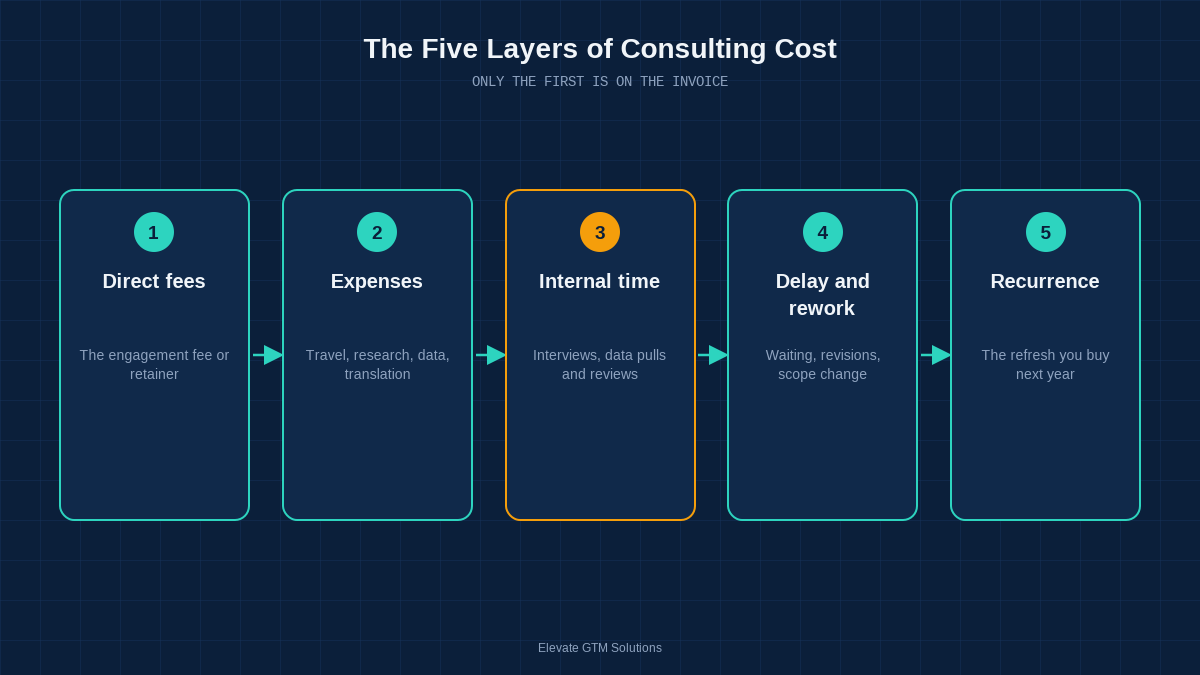
The fee on a consulting proposal is the cost you can see. It is rarely the cost you will bear. Between signing and the final readout, your team will spend days in interviews and reviews, a launch may wait on a recommendation, and a year later you may buy a refresh of the same work. Each of those costs is real, and none appears on the invoice.
Finance teams know this in principle. In practice, consulting decisions are often made on the headline fee, because the other costs are hard to estimate and easy to ignore. That is a pity, because the full picture often changes which option looks best, and it changes the comparison with alternatives such as building the capability internally or using a platform.
This guide lays out the components of total cost, gives you a way to estimate them without special data, and shows how the same framework applies to a platform subscription, so that you compare like with like. It is written for operators and finance partners deciding how to buy go-to-market strategy work. Elevate sells a GTM platform and offers a limited advisory practice, so we have an interest. The framework works whichever way your numbers come out.
What Is the Total Cost of GTM Consulting?
The total cost of GTM consulting is the fee plus expenses, plus the value of your own team's time, plus the cost of delay while you wait, plus the cost of rework and stale output, plus the cost of repeating the work when the market changes. For many engagements, the fee is only the visible part. A fair comparison with a platform or an internal team looks at all of these over a multi-year period.
What do companies most often miss? Their own team's time and the cost of buying the same work again.
Does the same logic apply to a platform? Yes. A subscription also has costs beyond its price, mainly input effort, review time and the cost of keeping the system owned and current.
Five layers of cost
Think of the total as five layers. The first is visible. The others are not.
| Layer | What it contains | Where it appears |
|---|---|---|
| 1. Direct fees | The engagement fee and any retainer | The invoice |
| 2. Expenses | Travel, research panels, data, translation, subcontractors | Invoices or reimbursement requests |
| 3. Internal time | Interviews, data pulls, reviews, workshops and approvals | Nowhere, until you ask |
| 4. Delay and rework | Waiting for a decision, revising deliverables, resolving disagreements about scope | Calendars and schedules |
| 5. Recurrence | The next engagement, the refresh, the retainer renewal | Next year's budget |
The rest of this guide takes each layer in turn.
Layer one: direct fees
The visible fee is built from people-days at blended rates, with overhead, margin and risk loaded in. Our guide to why GTM consulting is expensive explains the build-up. For total-cost purposes, three things matter.
Fixed fee versus time and materials. A fixed fee gives certainty about the first layer and usually includes a cushion for risk. Time and materials gives flexibility and exposes you to overrun. Know which one you have and what each implies for the final total.
Retainers. A retainer reserves capacity. If you use less than you pay for, the effective rate per hour of work rises. If you use more, check whether the extra is billed.
Optional phases. Many proposals list optional work. If you expect to need it, price it into the base case.
Layer two: expenses
Expenses can be inside the fee, billed at cost, or capped. Ask which, and write the answer down.
Typical items include travel for workshops and customer visits, paid research panels, purchased datasets, translation or localization, and subcontractors. For a European or global scope, these can add up. They also scale with the number of markets or segments in scope.
A simple practice helps: ask for a ceiling on expenses and a rule that anything above it needs written approval.
Layer three: your own team's time
This is the largest hidden cost, and the easiest to estimate if you bother to try.
List every internal activity the engagement needs, who does it, and how many hours it takes.
| Activity | Typical people | Questions to estimate |
|---|---|---|
| Kickoff and scoping | Sponsor, project lead | How many meetings, and how long? |
| Data and document requests | Sales operations, finance, product | How many requests, and how long does each take to fulfill? |
| Interviews and workshops | Executives, sellers, customer success | How many people, how many sessions, and how long? |
| Customer and prospect introductions | Account owners | How many introductions, and how much preparation? |
| Draft reviews | Leaders in each function | How many review rounds, and how long does each take? |
| Approvals and security or legal review | Legal, security, procurement | How many approvals, and what is the lead time? |
| Follow-through | Whoever inherits the work | How much time to turn recommendations into action? |
Multiply hours by a rough loaded cost of each person's time. You do not need precision. Even a conservative estimate usually shows a number that is a meaningful fraction of the fee. For a company with a thin team, the number can be larger than expected, and the real constraint is not the budget but the calendar.
Two cautions apply. First, the time of senior executives is the most expensive and the most constrained. If the plan assumes many hours from a few leaders, check that they are available. Second, internal effort tends to be underestimated at the start. Add a margin.
Layer four: delay and rework
Time has a cost, even when no invoice records it.
Cost of delay. If a launch, a pricing change or an entry into a new market waits for the engagement, the revenue or learning that would have occurred in the meantime is deferred. Estimate it roughly: what is one month of delay worth? Even a rough number reveals whether speed matters more than the fee.
Rework. Deliverables often go through several rounds of revision. Disagreement about scope or about what finished looks like is a common cause. Each round consumes consultant time that may be billed and internal time that never is.
Scope expansion. A change that looks like a small wording tweak can add work. If change control is loose, the fee grows through small requests.
Stalled decisions. A beautiful recommendation that nobody acts on is a cost with no return. Ask who will own the decision and what will make it happen.
Layer five: recurrence
This is the layer with the largest long-term effect.
GTM strategy is not a one-time artifact. Markets, competitors and buyers change, so positioning, customer definitions and messaging need revisiting. If you commission an engagement each time, you buy the layers above again.
Re-discovery. A new engagement begins by learning your business. Even with the same firm, some relearning is likely if the knowledge was not captured in a reusable form.
Refresh cycles. Companies often refresh strategy annually or after a major event. If the cost of each refresh is similar to the first engagement, a three-year horizon contains three engagements.
Knowledge loss. What the consultant learned about your customers can leave with them. If your internal team did not keep a structured record, the learning must be bought again.
To estimate recurrence, ask how often you expect to repeat the work and multiply the layers accordingly. A company that expects to revisit positioning twice a year has a very different cost profile from one that expects to do it once in three years.
A total-cost template
Use a table like the following, filled with your own estimates, for each option you are considering.
| Year 1 | Year 2 | Year 3 | |
|---|---|---|---|
| Direct fees | |||
| Expenses | |||
| Internal time (hours multiplied by loaded cost) | |||
| Cost of delay (months of delay multiplied by value per month) | |||
| Rework allowance | |||
| Refresh or renewal | |||
| Outside advice bought separately | |||
| Total |
Complete it for each path: the consulting engagement, an internal build, a platform with occasional outside advice, and a hybrid. Then add the three-year totals and compare. The values are yours, and the exercise matters more than the precision. It forces assumptions into the open, so people can argue about them.
Sensitivity: which assumption moves the answer
A total-cost comparison is only as good as its inputs. Test the ones that might flip the conclusion.
How often will you repeat the work? If once in three years, the consulting path looks better than it does if twice a year.
How much internal time does each option really take? A tool that is never maintained and a consultant who needs constant briefing both cost more than their estimates.
How valuable is speed? If a month of delay is expensive, a faster path may win despite a higher price.
How much outside judgment will you need? If you need a facilitator and a challenger several times a year, a platform alone will not suffice.
What is the cost of a wrong answer? For a high-stakes decision, paying more for independence can be rational.
Change each assumption within a plausible range and see whether the ranking of options changes. If it does not, the choice is robust. If it does, that assumption deserves attention and perhaps a small test.
The same framework applied to a platform
A platform has costs beyond its price. Applying the same layers keeps the comparison fair.
Direct fees. Elevate's published plans are Enable at USD 499 per month and Growth at USD 1,499 per month, both billed annually, with custom pricing for Scale. At the monthly rates, that is USD 5,988 and USD 17,988 per year. Plans vary by scopes, users and revision cycles, so check what each includes on the pricing page.
Expenses. Typically none beyond the subscription, though you may buy outside advice or research separately.
Internal time. Entering inputs, reviewing outputs, and running reviews take time. This is lighter than hosting an engagement, and it recurs. Estimate hours per month.
Delay and rework. A platform produces drafts quickly, but outputs need review, and thin inputs produce generic results. Include a rework allowance for the first cycles while your team learns to give good inputs.
Recurrence. Updating is part of the model. The cost is internal time and the subscription, not a new project.
Ownership. A platform only pays off if someone owns it. Without an owner, the system decays and you are paying for a subscription that is not used.
A balanced view acknowledges the platform's costs too. In many cases the comparison still favors a platform for recurring work. For one-off decisions that need outside judgment, it may not.
When cheap becomes expensive
Some savings turn out to be false economies.
The cheapest proposal with unclear scope. A low fee with vague deliverables often grows through change requests.
An engagement without internal ownership. If nobody will act on the result, the whole fee is wasted.
A tool without evidence. A platform fed with thin inputs creates polished mediocrity. The savings are real only if the output is used and tested.
Skipping customer conversations to save money. Customer evidence is the most valuable input to any strategy. Cutting it to lower cost usually reduces quality more than it saves.
Underestimating your own time. A small team that cannot support an engagement or maintain a system will get little value from either.
Cost per usable decision
Companies measure consulting by the fee. A more useful measure is the cost per decision that the company actually made and used.
Count the decisions an engagement was meant to support: a segment priority, a positioning choice, a pricing structure, a launch sequence. Then count how many were made, how quickly, and how many were still guiding behavior six months later. Divide the total cost, including internal time, by that number.
This metric has two advantages. It is hard to game by producing more deliverables, because deliverables do not count unless a decision followed. And it surfaces waste in the tail: an engagement that produced a thick report and no decisions has a very high cost per decision, whatever the fee was.
Use the same measure for a platform. If the system produces drafts that the team reviews and acts on each month, the cost per decision falls quickly, because the fixed subscription is spread across many decisions. If the drafts sit unused, the cost per decision is high, and the subscription is not the problem. Ownership is.
How cost changes by engagement type
Different kinds of work carry different mixes of the five layers.
| Engagement type | Direct fees | Internal time | Delay risk | Recurrence |
|---|---|---|---|---|
| Short diagnostic on one question | Lower | Moderate, concentrated | Low | Low if the question is stable |
| Positioning and messaging project | Moderate to high | High, across product, sales and marketing | Moderate | High, as messaging goes stale |
| Launch support | Moderate to high | High, near launch dates | High, tied to the date | Per launch |
| Pricing or commercial design | High | High, with finance and sales data | Moderate | Per pricing cycle |
| Transformation program | Highest | Very high, over months | High | Ongoing |
| Retainer advisory | Steady | Moderate and continuous | Low | Built in, and hard to end |
The pattern is that engagements which depend on your data and people, such as positioning, launch and pricing, carry large internal time. Engagements that are narrow and bounded, such as a short diagnostic, carry less. Knowing the profile helps you plan for the right layers.
Ways to lower total cost without lowering quality
Some tactics reduce cost across several layers at once.
Narrow the first question. A smaller initial phase reduces fees, internal time and delay. If the answer is clear, you can stop. If not, you can authorize more with better information.
Bring your own evidence. If you already have win and loss reasons, customer quotes and pipeline data in a usable form, the consultant spends less time extracting them. That lowers the fee and shortens the engagement.
Keep a shared, structured record. If what is learned lives in a system your team owns, the next engagement or the next refresh starts from a better position. This is one of the main benefits of using a platform for the structured part of the work.
Separate judgment from production. Pay outside advisors for challenge, facilitation and decisions. Use a tool, or your own team, for drafting and formatting.
Agree acceptance in advance. Clear tests for each deliverable reduce rework.
Tie payment to decisions. Where possible, link a payment to an accepted decision record, not to the delivery of a document.
Plan the handoff before the start. Decide who will own the outputs and how they will be updated. Handoffs planned late are more expensive and less effective.
Budgeting for GTM strategy as an ongoing line
A lot of the cost problem comes from treating strategy as a project instead of a recurring need. Finance teams can help by budgeting it as a line with several components.
| Component | What it covers | How it behaves |
|---|---|---|
| System | A platform or internal tooling for the structured strategy | Predictable, subscription-like |
| Evidence | Customer interviews, win and loss reviews, research | Variable, tied to the decisions ahead |
| Judgment | Outside advice for specific high-stakes questions | Occasional, narrow |
| Execution support | Assets, enablement and campaign production | Tied to launches and cycles |
| Internal time | Owners and reviewers inside the company | A real cost, even if not a budget line |
Presented this way, the discussion shifts from approving a large project to funding a standing capability with a small number of variable items. That makes budgeting steadier and gives leaders a better sense of what they are paying for each month.
What finance should insist on
Whatever you buy, a few controls reduce surprises.
A written scope with exclusions. Know what is not included and what adding it costs.
A cap on expenses. Pre-approval above the cap.
A named owner inside the company. Someone accountable for acting on the output.
Reusable work product. Rights to use what was produced after the engagement or subscription ends.
An exit plan. Notice periods, minimum terms and data export for subscriptions. Termination and wind-down for engagements.
A review point. A scheduled moment to decide whether to continue, narrow or stop.
A definition of success. A short list of decisions or measures that show the spend worked.
These controls cost almost nothing to request and often prevent the largest overruns.
A worked example of internal time, using hours instead of dollars
Cost conversations get stuck on rates, so it helps to start with hours. This example is hypothetical and uses round numbers to show the method.
Suppose a six-week positioning engagement plans the following internal involvement.
| Activity | People | Hours each | Total hours |
|---|---|---|---|
| Executive interviews and a kickoff | 2 | 12 | 24 |
| Seller and customer success interviews | 6 | 6 | 36 |
| Draft reviews by functional leaders | 3 | 10 | 30 |
| Data and document requests handled by operations | 1 | 40 | 40 |
| Total | 130 |
That is 130 hours of internal time, close to three full working weeks of one person's calendar, spread across eleven people. None of it is on the invoice. Multiply by a loaded hourly cost for each group, and the figure becomes a real number to add to the fee. The calendar pressure matters even more: two executives giving twelve hours each over six weeks is a real draw on scarce attention.
Now run the same exercise for a platform. Suppose a product marketing lead spends a few hours a month entering and updating inputs, a panel of three leaders spends an hour reviewing outputs each month, and a quarterly session takes two hours for five people. Add it up in hours, as above. The platform number is usually smaller and spread more evenly. The comparison is not about which is zero. It is about which shape of effort your team can sustain.
Common mistakes in cost comparisons
Comparing fee to subscription and stopping there. The fee and the subscription are only one layer each.
Ignoring recurrence. A one-time cost compared with a recurring cost looks different over three years.
Leaving out outside advice under the platform option. If you will still buy a few advisory sessions, include them.
Valuing internal time at zero. Because it is not invoiced, it is easy to forget. It is still the largest unbudgeted cost for many teams.
Assuming perfect usage. Both a consultant's recommendations and a platform's outputs need action to produce value. Include an allowance for the realistic share you will use.
Comparing the best case of one option with the worst case of another. Use the same level of optimism for each.
Two illustrative scenarios
These scenarios are composites meant to show how the framework changes decisions. They are not descriptions of specific companies.
The engagement that cost twice its fee. A company accepted a proposal that looked competitive. Midway through, the team discovered that it had to produce a large volume of data, arrange fifteen customer conversations and review four drafts. Senior leaders spent far more time than planned. The project ran several weeks beyond the original date, and a product launch waited for the recommendation. When the company added up internal time and the value of the delay, the total was close to twice the fee. Had it estimated these costs in advance, it might have chosen a smaller first phase or moved some structured work into a tool.
The platform that was not owned. Another company bought a platform to reduce reliance on consultants. It entered inputs once and produced good outputs. Then nobody updated the inputs. Six months later, the sales team was using messaging that no longer matched the market. The company had saved consulting fees and ended up with a stale system. It assigned an owner, set a monthly review and added win and loss reasons as a standing input. The cost of the platform had been small compared with the cost of leaving it unowned.
A checklist for estimating total cost
- List every cost layer for each option.
- Estimate internal time by activity and person.
- Estimate the value of a month of delay.
- Decide how often you will repeat the work.
- Add an allowance for rework and scope change.
- Include the cost of outside advice you expect to buy under each option.
- Test the assumptions that could change the ranking.
- Name an owner for whatever you buy.
- Decide how you will measure whether it worked.
- Write down what you will do differently if the estimate turns out wrong.
Where Elevate fits
Elevate is an AI-native GTM operating system. It connects GTM context, intelligence, strategy, activation, execution and analytics, with 15 specialist modules plus Unified GTM Strategy and Elevate Pulse for recurring priorities. It is designed to turn the structured, recurring part of go-to-market work into something your team can maintain, which is the layer where consulting costs repeat.
Elevate also offers Guided GTM, which pairs the platform with advisors, and focused advisory engagements for specific problems. It does not replace independent judgment, customer interviews or the people who run your go-to-market, and a platform does not remove the need for an owner.
For related reading, see Why GTM Consulting Is Expensive, How Much Does GTM Consulting Cost?, and GTM Platform vs GTM Consultant. The platform page explains how the modules connect, and you can request a demo to estimate the platform side with your own scope.
Final thoughts
The fee is the beginning of the cost conversation, not the end. A fair view adds expenses, your team's time, the cost of delay and rework, and the cost of repeating the work. Over three years, the repetition often matters most, because it multiplies everything else.
The practical result is not that consulting is a bad purchase. It is that the right comparison is between full paths, not between invoices. A company that estimates all five layers will usually discover which parts of its spend buy judgment worth paying for and which buy production and repetition that could be structured differently.
If you remember one thing, make it the template. Fill it in honestly for each option, change the assumptions that could flip the answer, and name an owner for whatever you buy. The result will be a decision you can defend, whichever way it goes.
Frequently Asked Questions
What is the total cost of GTM consulting?
It is the fee plus expenses, plus the value of your own team's time, plus the cost of delay and rework, plus the cost of repeating the work when the market changes. The invoice usually shows only the first of these.
What hidden costs come with GTM consulting?
The largest are your team's time for interviews, data pulls and reviews, the cost of delay while you wait for a recommendation, rework from unclear scope, and the cost of buying a refresh later.
How do I estimate internal time for a consulting engagement?
List every activity the engagement needs, who does it and how long it takes, then multiply by a rough loaded cost per hour. Add a margin, since internal effort is usually underestimated.
How should I compare consulting with a platform?
Use the same cost layers for each: direct fees, expenses, internal time, delay and rework, and recurrence. Compare totals over three years, including any outside advice you expect to buy under each option.
What does an Elevate subscription cost per year?
At the published monthly rates, billed annually, Enable is USD 5,988 per year and Growth is USD 17,988 per year, with custom Scale pricing. Add your estimate for internal time and any outside advice. See the pricing page for current terms.
Does a platform have hidden costs too?
Yes. Entering inputs, reviewing outputs, running reviews and keeping the system owned all take time. A platform that nobody maintains becomes stale, so name an owner.
How often should I expect to repeat GTM work?
It depends on how fast your market changes. Many companies revisit positioning and customer definitions at least yearly, and some more often. The more often you repeat the work, the more recurrence dominates total cost.
Which assumption matters most in a total-cost comparison?
Usually how often you will repeat the work, followed by how much internal time each option takes and how valuable speed is. Test those first.