
By the Elevate GTM Solutions Team · Updated November 10, 2026 · 21 min read
How Much Does GTM Consulting Cost? Fixed-Fee, Retainer and Milestone Pricing Compared
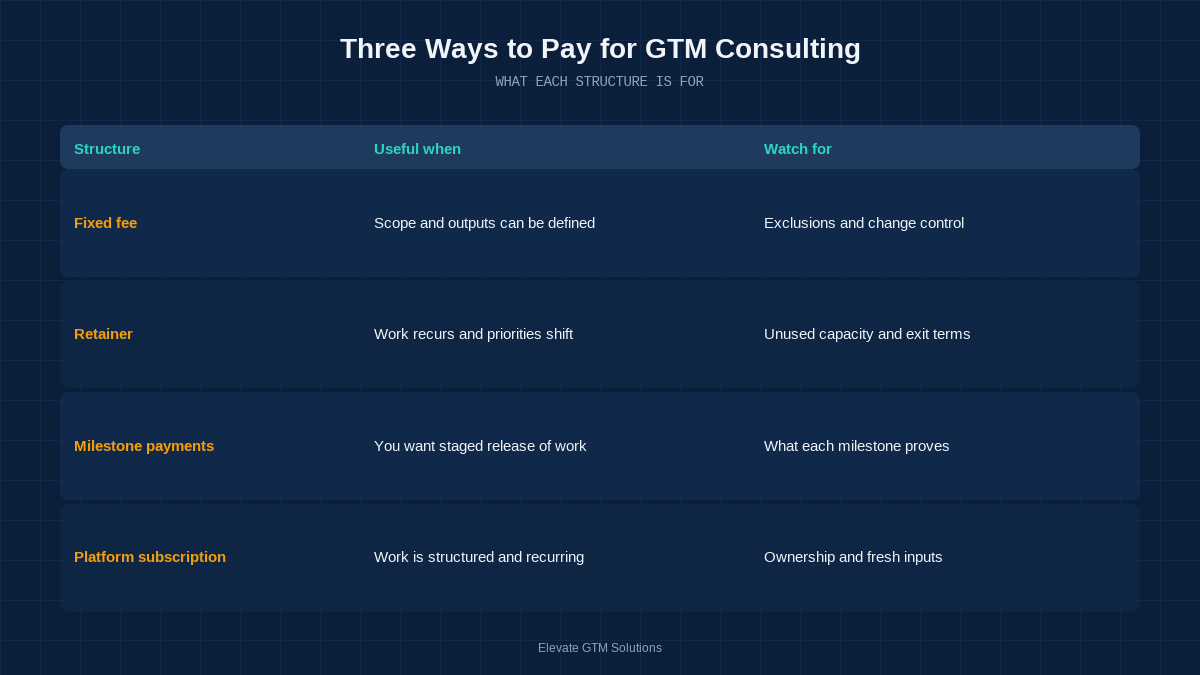
GTM consulting has no standard price. The fee depends on who works on the engagement, for how long, how much risk the firm takes on and how the agreement is structured. That makes the question "how much does it cost?" hard to answer in a sentence, and easy to answer misleadingly.
What you can do is understand how the price is built, compare the three common payment structures on the same terms, and check what you are actually committing to. This guide does that, and then adds the comparison most pricing guides leave out: how a platform subscription changes the cost structure. Elevate sells a GTM platform and a small advisory practice, so we have an interest. The pricing logic below applies whichever way you decide.
How Much Does GTM Consulting Cost?
There is no standard price. A GTM consulting fee is built from people-days at blended rates, plus overhead, margin, a premium for scope risk and expenses, and it varies with team seniority, duration and scope. Fixed-fee, retainer and milestone-based structures allocate that cost and risk differently. Ask for the people-days, the seniority mix and what is excluded, then compare the total, including your own team's time, with alternatives such as a platform subscription.
Is a retainer cheaper than a fixed fee? Not necessarily. It depends on how much of the reserved capacity you use.
How does a platform compare? A platform charges for access, scopes and seats instead of people-days, so recurring work costs less per update, though it does not provide an outside opinion.
What drives the price of GTM consulting
Whatever the payment structure, most fees come from the same drivers.
| Driver | Effect on price | What to ask |
|---|---|---|
| Seniority mix | Partner-led teams cost more per day than manager-led teams | How many hours will senior people spend? |
| Duration and intensity | More people for more weeks raises the total | How many people-days are in the quote? |
| Scope breadth | More products, markets or segments add interviews and analysis | What is in scope, and what does the next market cost? |
| Dependencies on your team | Late data or access can stall paid time | What do you assume we will provide, and by when? |
| Risk carried by the firm | Fixed fees and outcome-linked fees include a premium | Which part of the fee is at risk? |
| Expenses | Travel, research and data may be inside or on top of the fee | Which are included, and what is the cap? |
Our guide to why GTM consulting is expensive walks through how these combine, and the total cost of GTM consulting covers the costs outside the fee.
Match the commercial model to the uncertainty
Match the commercial structure to the work
| Structure | Useful when | What to check |
|---|---|---|
| Fixed fee | Scope, outputs and client dependencies can be defined | Acceptance, exclusions, assumptions and change control |
| Retainer | Work recurs and priorities can change across review cycles | Named people, usable capacity, response time, carryover and exit |
| Milestone-based payments | The buyer wants to review progress and release later work in stages | What each milestone proves, who accepts it and which payments are committed |
| Fixed fee with milestones | Deliverables are bounded but the client wants defined reviews | Whether the milestone is a delivery date, an acceptance test or a decision to continue |
Watch for a proposal that uses the labels loosely. An “outcome-based” payment may be tied to delivery of a document, not to a result the enterprise values. Ask exactly what triggers payment and what happens if the work is usable but the market decision is still uncertain. The answer should match the uncertainty both sides can control.
Give a retainer a job it can finish
For a retainer, define what a month of good work looks like. It might include reviewing new buyer evidence, helping the sponsor resolve one commercial decision and maintaining a work queue. Name the people assigned and the availability the client is buying. Specify how urgent requests are handled and what happens to unused time or deferred work.
Run an early review. Ask which decisions moved faster, which tasks went unfilled and whether demand for help is stable. The client may need a different mix of skills or a shorter operating cadence. Agree on the notice and transfer requirements before the first month. A good retainer is easy to renew because the work is visible and easy to end because the client can take ownership.
Compare what each model does with uncertainty
When the scope can be described
A fixed fee can fit a defined market comparison or an approved set of implementation tasks. State the inputs, number or type of cases, decision and output. The provider should be able to estimate the work and the client should be able to evaluate it. Keep assumptions visible. A fixed price for a defined scope is different from a guarantee that nothing will change.
Before signing, ask which variable is most likely to change the estimate. It might be buyer recruitment, data quality or availability of a sponsor. Write down what happens if it changes. The provider can continue work within agreed limits, submit a change request or pause a dependent activity. Give both parties a clear route to resolve it.
When priorities recur and can shift
A retainer can help when the enterprise needs ongoing advice, review or a predictable amount of delivery support. Name the people and the work the buyer can expect. Define how requests are prioritized and how reserved capacity is measured. A monthly arrangement can support changing priorities, but the client still needs to know whether the provider can take on the work when it arrives.
Agree on a review cadence. Ask what was requested, what was delivered, which decisions moved and which work did not fit. The next month may need a better operating owner if the provider was available and the client could not direct the work. If requests consistently exceed the agreed capacity, reduce the scope or price the additional work explicitly.
When the enterprise wants a decision before the next phase
Use milestones to make progress and authorization visible. A milestone can trigger payment for work already agreed. It can also coincide with a separate decision about whether to continue. Distinguish the two. A sponsor who accepts the research may decide against rollout. The agreement should reflect how accepted work is paid and what happens to the proposed next phase.
Compare the actual commitment through the first live case
Model how the same project would be paid for
Suppose an illustrative first phase includes a market assessment and pilot recommendation for USD 60,000. The parties can agree to a single fixed fee on delivery or divide the same total across agreed reviews. A phased structure might allocate USD 15,000 at kickoff, USD 25,000 when the evidence pack is accepted and USD 20,000 when the recommendation meets the agreed criteria. The amount is still fixed for the stated scope. The payment dates and review rights differ.
Now imagine the sponsor needs help for three months after the recommendation. A retainer might reserve a named advisor and defined support each month. Before agreeing, describe what that support can cover and how the company will prioritize requests. If several months are already committed, show the full exposure and termination provisions in the procurement comparison. A monthly invoice does not automatically mean a monthly cancellation option.
Model the commitment through the next decision. Include cash payments, provider expenses, client staffing and any optional phase. Put the proposed terms in front of the delivery lead. They should be able to explain how a change to the project would affect the remaining work and what the company can keep if it stops.
Put a complete example in front of the buying group
Suppose an enterprise wants to test a new offer with existing customers. Discovery and design can be described, but implementation depends on what the buyer and delivery team learn. The company compares a USD 75,000 fixed scope, a USD 25,000 monthly retainer and a phased proposal with USD 40,000 for discovery and USD 45,000 for optional rollout. These are illustrative commercial structures, not fee benchmarks.
The sponsor should ask what the fixed scope includes through the same milestone. If it ends with a recommendation, compare it with the discovery phase and estimate the cost of work the client retains. If it includes a pilot, check the number of supported cases, staffing and acceptance. The fee is useful only in relation to what the enterprise can actually use.
The retainer could cost USD 75,000 for three months if all three months are committed. Ask which results the team can expect by the end of each month and whether the provider is reserving enough capacity to reach them. The arrangement may create unused time if the buyer cannot supply a work queue or make timely decisions. Define who will manage it.
The phased option has a lower initial commitment if the rollout is genuinely optional. It could cost USD 85,000 if both phases are approved. Compare staffing and handoff against the other options, then consider how valuable the option to stop is. A higher total price can be reasonable when the enterprise wants to buy evidence before committing to implementation.
Compare the cash commitment with the work still at risk
Follow the approval path through a real example
Suppose the client can approve discovery today but needs another executive to release implementation. A supplier offers a fixed fee that includes both phases. Another proposes a lower initial phase and a separately approved rollout. Ask the client which part it can authorize and what it needs to see before funding the rest. The contract should represent those approvals rather than forcing the sponsor to promise work before they have authority.
Make a timeline of what happens at each review. Discovery can produce evidence and options. The sponsor can accept that work and decide whether to proceed. Implementation can start after the next approval if that phase is optional. Write down which payments cover the earlier work and which commitments exist only after authorization. Ask procurement to check that the agreement reflects the operating plan.
Compare downside in practical terms. If discovery shows that the offer cannot be delivered, the company might stop, narrow or fund a different solution. The provider still needs to be paid for work accepted under the agreement. The enterprise needs a way to avoid buying implementation it can no longer use. A well-scoped milestone gives both parties a clear decision.
Price the staff time the project will need
List the buyer’s tasks: provide approved data, recruit interview participants, attend reviews, make decisions and prepare the receiving team. The provider should explain which roles it needs and when. Check the schedule against other work. A proposal that assumes prompt responses may be viable when leaders reserve time and difficult when access must be negotiated after kickoff.
For a retainer, estimate the internal work required to maintain a useful queue. An advisor may be available and still have little productive work if requests arrive without evidence or priorities. Assign a person to own the cadence, prepare decisions and confirm which tasks should use the reserved capacity. Count that effort when comparing a retainer with a project.
For a fixed scope, estimate effort that sits outside the agreement. The supplier may prepare the recommendation while the client owns systems changes or field training. The enterprise can purchase that work elsewhere or supply it internally. Include it in a comparison through the first live outcome. Otherwise the apparent saving may be a transfer of work to another budget.
Use an illustrative comparison through the first live case
| Cost item | Fixed diagnostic plus client rollout | Three-month advisory retainer | Discovery with optional rollout |
|---|---|---|---|
| Initial commitment | Defined price for diagnostic | Verify how many months are committed | Defined first phase |
| Research and design | Check assumptions and included sources | Check whether the advisor has capacity to complete the work | Define acceptance before approval |
| Implementation | Usually a separate client or provider scope in this example | Confirm which work is included and what remains with the client | Buy only after a separate approval if truly optional |
| Client effort | Data, approvals and an implementation team | Work direction, review and operating ownership | Access, approvals and receiving owners |
| Exit | Transfer the approved outputs and open items | Confirm notice and treatment of work in progress | Confirm which outputs are usable independently |
Replace the illustrative cells with the actual proposals. Add dates, people and quoted fees. Compare costs through the same end state or clearly show where the end states differ. If a quote leaves a job unassigned, ask the provider to price it or give the internal owner a chance to estimate it. The table should help leadership understand the purchase rather than merely rank the invoices.
Write a milestone the client can accept
Write a milestone so both parties know if it has passed
| Example milestone | Evidence to require | Who accepts it |
|---|---|---|
| Discovery complete | Relevant sources, limits and the implications for the choices | Sponsor with evidence owners |
| Recommendation ready | Alternatives, rationale, decision boundary and pilot plan | Commercial decision owner |
| First workflow ready | Representative rehearsal and recorded exceptions | Receiving field and delivery owners |
| Handoff complete | Editable assets, access and a successful test by the internal owner | Sponsor and maintainer |
State what happens if an output needs revision. Set a practical review window and identify what the provider is expected to fix. The client should receive an obligation to supply feedback on time. The sponsor should know whether that meets acceptance if the evidence is inconclusive but the agreed analysis was performed. A clear trigger avoids treating disagreement with a recommendation as a dispute over whether work occurred.
Keep acceptance separate from permission to continue
At the end of a diagnostic, the enterprise can accept the work and decide against a larger engagement. It can also ask for a bounded follow-up if one assumption remains open. Write the agreement so the sponsor can distinguish those choices. If later phases are optional, document the notice and approval needed to begin them. The commercial structure should give the enterprise room to learn without creating unnecessary uncertainty for the provider.
Design acceptance for the work people can verify
Use a deliverable the receiving team can test
A research pack can be accepted when its sources and limitations are documented and the sponsor can see how the evidence informs the choice. A rollout deliverable can require a representative seller and delivery owner to run an approved customer case. A retainer review can require a record of work completed, hours or capacity used and the decisions it supported.
Decide what happens when an output is incomplete. Name the person who can raise a concern, when they must provide feedback and how the provider responds. Separate a material gap in the agreed work from a preference for a different recommendation. The buyer should be able to accept high-quality work that finds the case for expansion weak.
Reserve special treatment for things nobody controls
Customer approvals, procurement delays and product readiness can affect commercial outcomes. Identify which party controls the inputs and how the result will be measured if the agreement ties payment to an outcome. Check the plan with the appropriate internal owners. A trigger that depends on a measure nobody can reproduce will be difficult to administer.
Make acceptance work when the recommendation is unwelcome
A provider can meet the agreed standard and find that the sponsor’s preferred option is weak. Define acceptance by evidence, analysis and usability. The provider should show the alternatives, the relevant limitations and the next decision. Avoid requiring a particular business conclusion unless the engagement has been explicitly scoped as implementation of an approved choice.
A client should still be able to challenge incomplete work. If the agreed sources are missing, the comparison cannot be reproduced or the implementation artifact fails a defined test, record the issue and give the provider the agreed opportunity to respond. Distinguish changes in preference from gaps in the contract. A clear review process protects both the buyer and the team doing the work.
Handle client delays and scope changes
Set rules for work that changes after kickoff
| Change | Practical question | Owner to identify |
|---|---|---|
| Buyer access arrives late | Can other approved evidence answer part of the question? | Research lead and client access owner |
| The target segment changes | Does the new scope fit the original evidence plan and effort? | Sponsor and procurement |
| The provider proposes a new specialist | Is the work necessary and already included? | Delivery lead and commercial owner |
| An acceptance test fails | Is the issue missing work or a new requirement? | Receiving owner and provider lead |
| The sponsor wants to extend rollout | What additional spend and client effort are needed? | Budget owner |
Before approving the change, ask what work can continue safely and what should wait. Record the change, revised date and any downstream effects. The project can remain productive while one decision is open. Avoid letting informal requests accumulate into a larger project neither side has priced.
Ask the provider to walk through the hard month
Retainer. Demand exceeds the agreed capacity
The provider should receive a realistic month with three urgent requests and one larger decision. Ask who prioritizes the work and how the provider handles requests that do not fit. Clarify whether capacity is based on hours, roles, deliverables or availability. Check whether the named specialist will be present when the client needs them. A retainer gives the enterprise flexibility only if there is a workable way to use it.
Ask what happens to unfinished work. Some agreements may allow it to move into a later period, while others reserve time that expires. Confirm the proposed terms and decide what the company will do when priorities change. Reserve that person’s time if the retainer needs a lead to run the queue. A flexible commercial model still needs an operating owner.
Fixed scope. Discovery points to a different problem
A project may begin with a request to improve buyer access and find that customers are already reachable but cannot buy the approved offer. Ask whether the provider can use the remaining effort to investigate that problem. Record the expected change in fee and timing if the answer depends on a new specialty or more interviews. The sponsor can decide whether it is worth pursuing.
Keep completed work usable. The provider can document the original question, sources, finding and alternatives even if the next decision requires a new scope. The buyer should be able to accept that result and continue elsewhere if appropriate. A clear handoff makes it easier to stop or change the engagement without losing the evidence.
Milestone payments. The work arrives and needs revision
Define who reviews the deliverable, what they check and how long they have to respond. If a report lacks the agreed evidence, the reviewer can identify the gap and ask for a correction. That is a business discussion if the recommendation differs from what the sponsor expected but meets the agreed standard. Separate the two so acceptance does not become an argument about the answer.
Decide whether other work can continue during the review. The next phase may depend on approval, while a separate preparation task can proceed. Identify who can authorize that work and whether it is already included. A milestone is most useful when it improves control of timing and scope without unnecessarily stopping every activity.
Set a commercial review cadence both parties can use
At kickoff, confirm the scope, dependencies and decision dates. At each review, show work completed, approvals needed, current commitments and proposed changes. For a retainer, include how capacity was used and what will take priority next. For a fixed project, show whether assumptions remain valid. For a phased proposal, make the next authorization visible.
Use a consistent change record. Describe the request, why it matters, which deliverables are affected, additional client work, cost and timing. Name who can approve it. State how the project will proceed under the existing scope if the change is declined. This lets the enterprise control commitments without having to renegotiate every ordinary adjustment.
Check whether the people who approve spend can see the same status as the delivery leads. A supplier may believe additional work was requested, while procurement may see no approved change. Make the route and record clear enough that neither party has to rely on an email thread after the work is complete.
Review payment triggers, handoff and exit
Write the first-phase purchase decision
State what is authorized today, what must be delivered, who can accept it and which payments the enterprise has committed to make. Name the work that stays with the client. Explain how the sponsor will decide whether to buy the next phase. The receiving owner should receive a date to verify that the outputs can be used.
Include the scenario where the enterprise stops. What will it keep, what will it pay, and who will handle unresolved work? The agreement can still allow future collaboration. A clear stop option helps both parties understand what the first decision actually buys. The buying group should be able to explain it without interpreting the entire contract from memory.
Close the loop with the people who will use the work
The internal owner should confirm that they can access the evidence, maintain the materials and use the approved outputs in the relevant workflow. Check any rights and restrictions with the proper internal owners. Record which work is complete and which responsibilities remain with the provider. This final review can reveal costs or dependencies that never appeared in the initial comparison.
Return to the original commercial reason for the purchase. Verify that the sponsor can make it if the enterprise needed a market decision. If it needed an operating workflow, verify that a representative user can run it. If it needed ongoing access to an advisor, check whether that access produced useful decisions. The payment structure serves the work when the buyer can connect spending to those outcomes.
Ask what each invoice can explain
A useful invoice or review record should connect the charge to the agreement. For a fixed fee, it may refer to the agreed milestone and accepted deliverable. For a retainer, it may refer to the period, named capacity and the work the client prioritized. For optional phases, it should identify the authorization that released the work. Request a format the finance and operating teams can both understand.
Review the record during the project rather than waiting for closeout. If a supplier describes a new workstream as in progress and the client has not approved it, address the scope before more effort is committed. Record the effect on timing if the client owes feedback or access. This keeps the agreement connected to the way the work is actually being managed.
What to do if the buying group wants outcome-linked fees
Start with a measure both parties can reproduce and a time period that fits the outcome. An accepted research deliverable can be checked quickly. A revenue result may depend on buyer behaviour, client execution and delivery well after the consulting work ends. Ask who can influence the result, how the parties will handle changes to the baseline and what evidence will determine payment.
Consider whether the provider’s work can be accepted independently of the outcome. The enterprise may want to pay a defined amount for diagnosis and implementation, then separately evaluate an incentive tied to a measurable result. Confirm the proposal with the appropriate procurement, legal and finance owners. The comparison should show which commitments are certain and which depend on the later measure.
Close out a retainer with a usable record
Before the last period ends, list open decisions, work products, pending requests and any support the client will retain. Ask who will maintain the current materials and where approved evidence lives. If another team will take over, let it run one review while the advisor is still available. Use the result to correct the handoff rather than automatically extending the agreement.
A retainer may have been valuable because it gave the company time to build internal capacity. The sponsor can still decide to renew if the work continues to justify it. The final review should show which services the enterprise can operate itself, which remain useful to buy and what a narrower future scope might look like.
Compare spend when the project ends at different points
Suppose an illustrative USD 72,000 engagement includes diagnosis, recommendation and rollout support. Procurement asks for a price through recommendation only. A provider offers USD 46,000 for the first phase and USD 30,000 for an optional rollout. The staged price is higher if the buyer chooses both. It exposes less money before the sponsor has evidence about the first decision. Which option is better depends on whether the later work is necessary and how valuable the choice to stop is.
Do the same calculation for a retainer. At USD 16,000 per month with a three-month minimum, the initial commitment is USD 48,000 even if invoices arrive monthly. Ask what the provider has agreed to deliver or reserve during those months. Compare the committed amount with the decisions and work the enterprise can expect to reach. Do not assess it as though it bought a fixed list of deliverables if the buyer is actually purchasing availability.
Give procurement a short list of commercial questions
Ask what the buyer owes if it stops after accepted discovery, what the supplier retains if capacity goes unused, and which outputs the client can take to another team. Ask what triggers a new scope, who can approve it and whether the supplier will provide an estimate first. Put the answers in the commercial review so operating leaders can refer to them without interpreting the payment terms by themselves.
A payment plan can make the work easier to govern if each obligation is visible. Compare the options after client effort, evidence and implementation are on the same page. The sponsor can then choose a lower initial commitment, a defined fixed scope or ongoing support for a known operating need.
How a platform subscription changes the comparison
Payment structures are one lens. Another is whether the work should be bought by the day at all.
A GTM platform charges for access, not for people-days. Published platform plans are Enable at USD 499 per month and Growth at USD 1,499 per month, both billed annually, with custom Scale pricing. At the monthly rates, that is USD 5,988 and USD 17,988 per year. Enable covers one GTM scope with one revision cycle. Growth covers up to three users and three scopes, with up to two revisions per scope. See the pricing page for current terms.
| Consulting engagement | Platform subscription | |
|---|---|---|
| What you pay for | People-days at blended rates | Access, scopes and seats |
| Price moves with | Time, team size and seniority | Number of scopes and users |
| Cost of a second question | Often a new scope or quote | Update inputs and regenerate |
| Cost of keeping strategy current | Another engagement or a retainer | Subscription plus internal updates |
| Outside opinion and facilitation | Included | Bought separately, if needed |
| What you keep | A deliverable | A structured, updatable strategy |
Three practical rules follow. First, put each cost on its own line when proposals bundle research, planning software and delivery. Second, compare over three years, because recurring work is where the structures diverge. Third, remember that a subscription does not buy judgment, interviews or facilitation. If you need those, price them separately and narrowly.
For a fuller side-by-side, see GTM Platform vs GTM Consultant.
Where Elevate fits in a cost comparison
Elevate is an AI-native GTM operating system. It connects GTM context, intelligence, strategy, activation, execution and analytics, with 15 specialist modules plus Unified GTM Strategy and Elevate Pulse for recurring priorities. Its published plans let you price the structured, recurring part of GTM work separately from outside advice. Elevate also offers Guided GTM, which pairs the platform with advisors, and focused advisory engagements. If proposals bundle research, planning software and delivery, put each cost on its own line and confirm the actual inclusions for your scope. See the pricing page, the platform page and our guide to the total cost of GTM consulting, or request a demo.
Frequently Asked Questions
How much does GTM consulting cost?
There is no standard price. Fees depend on people-days, seniority mix, scope, duration and the structure of the agreement, so the useful question is what a specific quote includes. Ask for the people-days, the exclusions and the expenses, then add your own team's time.
How does a GTM platform's cost compare with consulting?
A platform charges for access, scopes and seats, not people-days. Elevate's published plans are USD 499 and USD 1,499 per month, billed annually, with custom Scale pricing. Compare what each includes, since a subscription does not provide an outside opinion or facilitation.
Should I choose a fixed fee, a retainer or milestones?
Choose by uncertainty. Fixed fees suit well-defined scope, retainers suit recurring work with changing priorities, and milestones suit staged commitments. Whichever you choose, define acceptance, change control and exit terms.
Can a contract be both fixed fee and milestone based?
Yes. The fee can be fixed for the agreed scope and paid in installments linked to deliverables or acceptance. Specify whether later phases are optional or already committed.
Which model works when the problem is unclear?
Consider a bounded first phase to resolve the uncertainty. The next phase can use a different structure if the evidence changes the work.
What belongs in a change request?
State what changed, why it matters, the effect on scope, fee and timing, and who can approve it. Also identify work that can continue while the change is reviewed.