
By the Elevate GTM Solutions Team · Updated November 10, 2026 · 22 min read
Can a GTM Platform Replace GTM Consulting? What It Can Do and What It Cannot
Plenty of companies reach the same point with go-to-market consulting. The first engagement was useful. The second was useful but felt like paying for the same discovery again. By the third, someone in finance asks whether a tool could do part of this. Then a vendor, possibly one reading this page, says yes.
The honest answer is more interesting than yes or no. A GTM platform can take over a large share of the work that consulting fees pay for, specifically the structured, repeatable parts. It cannot take over the parts that depend on an outsider's independence, a skilled facilitator in a tense room, or a person willing to stand behind a recommendation. Where the line falls depends on what you bought consulting for in the first place.
This guide draws that line task by task. It explains what a platform can replace, what it can only support, and what still needs people. It gives you a test for whether a past or planned engagement could have been handled differently, and a way to pilot the idea before you cancel anything. Elevate sells a GTM platform and a limited advisory practice, so we have an interest in the answer. We have tried to write it so that it would still be useful if you chose never to buy from us.
Can a GTM Platform Replace GTM Consulting?
Partly. A GTM platform can replace the structured, repeatable work that consulting fees often pay for: organizing evidence, drafting customer definitions, positioning and messaging, building plans and keeping them current. It cannot replace independent judgment, primary customer research done by people, stakeholder facilitation, change management or accountability for results. Most companies end up with a hybrid: a platform for the recurring work and a consultant, used sparingly, for the decisions that need an outside voice.
What does it replace best? Engagements whose main output was a document built from inputs you could have supplied.
What does it replace worst? Work that depends on trust, persuasion or neutrality between internal groups.
Start with what you actually bought
Before asking whether a platform can replace consulting, look at the last engagement you commissioned and break it into tasks. Most GTM engagements bundle several kinds of work.
- Gathering evidence. Interviews, win and loss reviews, market scans, competitor analysis.
- Structuring evidence. Turning raw material into themes, segments and hypotheses.
- Drafting outputs. A customer definition, positioning, messaging, pricing logic, a channel plan, a launch plan.
- Challenging and deciding. Testing options, arguing against the preferred answer, choosing.
- Aligning people. Getting sales, marketing, product and finance to agree and commit.
- Handing off. Materials and guidance that let the field act on the decision.
- Staying current. Updating everything as the market moves.
A platform is strongest in tasks two, three, six and seven, can assist task one and task four, and is weakest in task five. A consultant is the reverse in several of these. That asymmetry is the whole story.
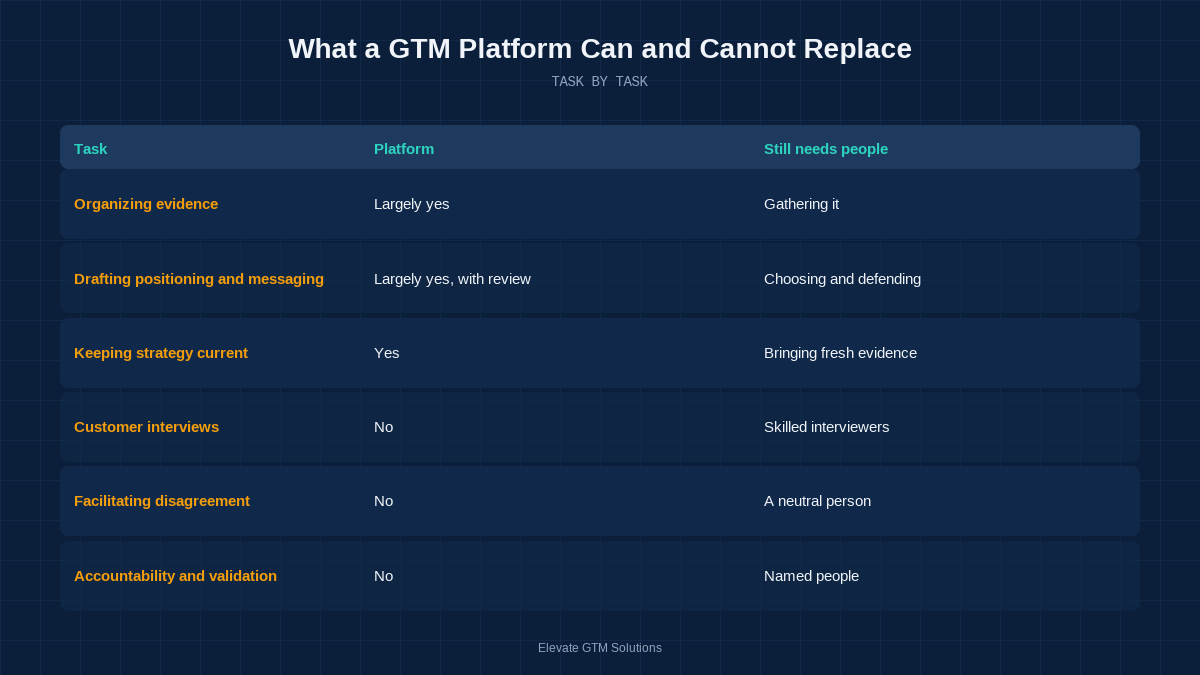
A task-by-task map
| Task | Can a platform replace the consultant? | Why |
|---|---|---|
| Organizing existing evidence into themes | Largely yes | Structured synthesis of material you supply is repeatable |
| Drafting a customer and segment definition | Largely yes, with review | A first draft from clear inputs is structured writing |
| Drafting positioning and messaging options | Largely yes, with review | Options can be generated and compared quickly |
| Drafting pricing logic and packaging options | Partly | Logic can be structured, but willingness to pay needs buyer evidence |
| Building channel and launch plans | Largely yes, with review | Plans follow from the strategy and constraints |
| Producing enablement inputs and talk tracks | Largely yes | Derived from agreed positioning and messaging |
| Keeping the strategy current | Yes, this is where it helps most | Updating inputs beats commissioning a refresh |
| Primary customer interviews | No | Needs people who listen, probe and build trust |
| Independent challenge of the preferred option | Partly | A tool can list counterarguments, but it lacks stakes and outside context |
| Facilitating disagreement between leaders | No | Depends on neutrality and interpersonal skill |
| Change management and adoption | No | Depends on people and leadership |
| Accountability for the recommendation | No | A tool is not a party to the decision |
| Board-facing external validation | No | The value is the outside name and judgment |
Notice that the "yes" rows are tasks that consume many hours in a typical engagement. That is why the savings can be real. And notice that the "no" rows are the ones people remember when they say a consultant was worth it. Both observations are true at once.
What a platform replaces well
Structured drafting from known inputs
A large share of consulting hours goes into producing first drafts from things the company already knows: who buys, why they buy, who loses, what competitors say. A platform that takes your product, market and segment inputs and produces a structured customer definition, positioning options and messaging architecture compresses that effort. The draft still needs review, but a team reviewing a draft is a different job from a team writing one.
Elevate describes this on its pricing page as building a GTM strategy from structured inputs, with the ability to update inputs and regenerate outputs as assumptions change. The company also states that it can produce a complete strategy in minutes. Treat that as a claim to test in a demo with your own inputs, not as a promise about quality.
Consistency across outputs
Consultants produce a positioning document, then a messaging document, then a launch plan, often by different team members. Inconsistencies creep in. When outputs come from shared inputs, a change to the customer definition flows through to messaging and plans. This is one of the most practical benefits, and one that is easy to undervalue until you have tried to reconcile three documents written at different times.
Keeping the strategy current
This is where the economics shift most. A one-off engagement answers one moment. The market then changes, and a refresh means another engagement. A platform treats the strategy as something you update: change an assumption, review what shifts, and decide. The cost of a revision is closer to internal time than to a new project.
Handoff material
Battlecard inputs, role-specific messaging, and launch checklists derived from an agreed strategy are structured outputs. Generating them from the same source as the strategy reduces drift between what leadership decided and what the field hears.
Repeatability across products and segments
If you have several products or segments, a consulting engagement for each is expensive. A platform with multiple scopes lets the team apply the same structure across them. On Elevate's published plans, the Enable tier covers one scope, the Growth tier covers up to three, and Scale is custom with unlimited scopes. Scopes are products, markets or segments.
What a platform only supports
Some tasks can be helped by a platform but not completed by one.
Challenge. A good consultant argues against your preferred plan. A tool can list risks and counterarguments, which is useful, but it does not have the standing or the outside experience to push back when the room has already made up its mind. Use the tool to prepare the challenge. Do not treat its output as the challenge itself.
Pricing decisions. A platform can structure pricing logic, packaging options and scenarios. Whether customers will pay for a package depends on evidence from buyers, which has to come from real conversations or tests.
Evidence gathering. A tool can organize the material you give it and point to gaps. It cannot sit across from a customer and learn what they did not think to say.
Prioritization. A platform can rank options by criteria you set. Deciding which criteria matter is a leadership call.
What still needs people
Primary research. Customer and lost-deal interviews are among the highest-value inputs to any GTM strategy. A person who listens well, notices hesitation and asks the next question gets information that no template produces. If you outsource nothing else, you may still choose to outsource this, or do it yourself.
Neutral facilitation. Where two leaders disagree about which segment to prioritize, an outsider with no stake can help them reach a decision. This is a human skill, and a tool cannot substitute.
Change management. A strategy that nobody adopts changes nothing. Coaching managers, adjusting incentives and handling resistance are leadership tasks.
Accountability. When a recommendation fails, someone has to own it. A consultant who puts their name to a recommendation shares that burden in a way a tool does not.
External validation. Sometimes a board or investor wants a third-party opinion. The value is the independence and reputation of the name, which a platform cannot provide.
Three tests for whether an engagement was replaceable
Apply these to the last consulting project you commissioned, or to the next proposal.
Test one: could you have written the inputs? If most of the evidence came from your own data and people, and the consultant's contribution was structuring and writing, the engagement was largely replaceable.
Test two: did the main output sit in a document? If the deliverable was a report or deck you referred to for a few weeks, a platform that keeps the strategy updatable would have served better.
Test three: was independence the point? If the reason you hired outside help was neutrality, facilitation or an external stamp, the engagement was not replaceable.
Score each test. If two or three point to replaceable, you probably spent a large part of the fee on structured work. If the third test is a strong yes, keep a consultant in the mix for that part.
Who can replace the most
The share of consulting a platform can replace varies by company.
| Company profile | How much a platform can replace | Typical pattern |
|---|---|---|
| Early-stage or small team with limited budget | A large share | Platform for structure and updates, founder-led customer conversations, occasional advisor |
| Mid-sized B2B with several products or segments | A large share of recurring work | Platform for the system, targeted advisory on specific decisions |
| Large enterprise with many stakeholders | A moderate share | Platform for drafting and consistency, consultants for facilitation and independent validation |
| Regulated or high-stakes decisions | A smaller share | Hybrid, with external review of key decisions |
| Company in crisis or major transition | A smaller share | People-led, with tools in support |
None of these is a rule. They describe where the economics and the need for human judgment usually fall.
What to verify in any platform before you rely on it
If you are considering replacing some consulting with a platform, ask for evidence in a demo, not a description.
- Bring your own inputs. Give the vendor a real product, segment and set of constraints, and ask to see what the platform produces.
- Change an assumption. Alter the target customer and see what updates across positioning, messaging and plans.
- Ask where the evidence comes from. A good platform shows how outputs trace to inputs you supplied and flags what it assumed.
- Ask what it will not do. The answer tells you how honest the vendor is.
- Check export and ownership. You should be able to export outputs and keep them.
- Test with a skeptic. Have a sales leader or product leader read the output and say what is missing.
- Compare to a past deliverable. Recreate a previous consulting output and compare it for coverage and quality.
Our guide to demoing continuous GTM planning software goes deeper on evidence, approvals, version history and field handoffs.
The risks of replacing too much
A platform can be oversold, and it is possible to lean on it too hard.
Generic output. Tools that generate strategy from thin inputs tend to produce plausible, average answers. The cure is specific input and real customer evidence.
False confidence. A well-formatted output feels finished. Teams can mistake structure for validation.
Strategy on autopilot. If nobody owns the decision, a regenerating plan can drift. Keep a named decision owner.
Loss of outside perspective. If you stop talking to people outside the company, blind spots grow. Keep some external input in the mix.
Two published studies are useful context. In a field study of 5,172 customer-support agents published in the Quarterly Journal of Economics, access to an AI assistant raised issues resolved per hour by about 15 percent on average, with larger gains for less experienced workers. In a Harvard Business School field experiment with 758 consultants, AI helped on tasks within its capability and reduced performance on a task outside it. The lesson is not that AI works or fails. It is that you need to know which tasks are which, and check.
A thirty-day replacement test
You can test the idea before changing any contracts.
Week one: choose a past deliverable. Pick a consulting output your team still refers to, such as a customer definition and positioning document. Gather the inputs the consultant used.
Week two: recreate it in a platform. Enter the same inputs, generate the equivalent outputs, and note what needed correction.
Week three: review with the people who use it. Ask sales, marketing and product which version is clearer, which is more complete and what is missing.
Week four: decide on the split. List the tasks the platform handled well, the tasks that needed people, and the tasks you would still hire out. Estimate the cost of each path.
The result is a concrete division of labor, not a general view about tools versus consultants.
What a consultant's role becomes
If a platform carries the structured work, the case for hiring outside help narrows to a few high-value jobs. That changes how you scope and buy.
| Old scope | New scope |
|---|---|
| Discovery, analysis, drafting and a final report | A short challenge session on a draft your team and platform produced |
| Weeks of workshops to reach a decision | One facilitated session on a defined decision, with pre-read material |
| A full positioning engagement | A review of positioning options against buyer evidence you gathered |
| Launch planning and asset production | A readiness review of a plan generated from your strategy |
| Annual refresh of the strategy | A light annual outside review of the system you maintain |
Notice that the new scopes are shorter and sharper. They assume the consultant arrives to a prepared team with a structured draft, which shifts the fee toward judgment and away from production. Many advisors work this way already when clients arrive prepared, and some prefer it because the conversation starts at the interesting part.
Who owns the platform inside the company
A tool does not run itself. Replacing consulting with a platform shifts responsibility to your team, so name owners.
| Role | Responsibility |
|---|---|
| Decision owner | Approves changes to the customer definition, positioning and priorities |
| Input owner | Keeps product, market and segment inputs accurate and current |
| Evidence owner | Brings in win and loss reasons, customer interviews and pipeline data |
| Reviewer panel | Sales, product and customer success leaders who test outputs against what they hear |
| Cadence owner | Runs the monthly and quarterly reviews |
In a small company, one person may hold several of these. What matters is that each responsibility has a name. When none is assigned, the platform becomes a place where drafts sit and the strategy drifts, which is the same failure a stale consulting document produces.
A practical operating rhythm
A platform-first model works best with a steady cadence, not an occasional burst of activity.
Monthly. Review what changed: new wins and losses, competitor moves, pricing signals. Update inputs and read the differences in outputs. Decide which changes warrant action.
Quarterly. Revisit the customer definition and positioning as a group. Bring customer evidence, not opinions. Decide priorities for the next quarter and record the reasoning.
After a major event. A new competitor, a large loss or a pricing change can trigger an off-cycle review.
Annually. Consider a short outside review. This is where a consultant or advisor fits best: a fresh pair of eyes on a system the team has maintained.
This rhythm keeps cost low and attention high. It also generates a record of decisions and reasons, which makes any later outside engagement cheaper because the history is already written down.
What the first ninety days look like
A realistic start is gradual. The aim is to move one area of work at a time and keep the evidence flowing.
Days one to thirty: pick the scope and load the inputs. Choose one product and one segment. Gather what you know: who buys, why, who does not, how deals are won and lost, what competitors say. Enter it in a structured form and read the first outputs critically. Expect gaps. Writing them down is useful in itself, because each gap is a question to answer with a customer.
Days thirty-one to sixty: test with the field. Share the draft customer definition and messaging with a handful of sellers and customer success staff. Ask what rings true and what does not. Run a few customer or lost-deal conversations to fill the largest gaps, and update the inputs.
Days sixty-one to ninety: decide and compare. Take the revised outputs to leadership and make decisions. Compare the effort and cost with your last consulting engagement. List what you would still hire outside for, and scope it narrowly.
By the end of ninety days you will have a working view of how much of your consulting spend can move, and a record of reasoning that makes any remaining outside work faster and cheaper.
How to tell whether the replacement is working
Watch for signs in both directions.
| Sign it is working | Sign it is not |
|---|---|
| Teams describe the customer in the same words | Different teams still give different answers |
| Updates take days, not a new project | Updates stall because nobody owns inputs |
| Sellers use messaging derived from the strategy | Sellers say the messaging does not match the buyer |
| Win and loss reasons feed the next review | Reviews happen without customer evidence |
| Leaders trust the outputs enough to act | Leaders ignore outputs or rewrite them from scratch |
| Outside advice is used on narrow questions | Outside advice is used as a crutch for everything |
Check these after one quarter. If the right-hand column dominates, the issue is usually ownership or evidence, not the tool. Fix those before concluding that the approach does not work.
Objections consultants raise, and honest responses
Consultants raise fair points, and it helps to hear them.
"A tool cannot understand your business." True in the sense that a tool does not have context unless you give it. The response is to supply specific inputs and to treat outputs as drafts for informed people to correct.
"Strategy is about judgment, not documents." Also true, and consistent with this guide. A platform handles the document-like work so that judgment can be the focus of paid time.
"Clients who skip discovery get generic answers." Correct if the inputs are thin. The remedy is real customer evidence, which a platform can structure and a consultant can help gather.
"You still need someone to challenge you." Agreed. That is one of the best uses of outside help in a platform-first model.
"Tools cannot manage organizational politics." They cannot, which is why facilitation remains a human job.
None of these objections argues against moving structured work into a tool. They argue for keeping people where people matter.
Two illustrative scenarios
These scenarios are composites meant to show how the decision plays out. They are not descriptions of specific companies.
A mid-sized company with three products. A software company had paid for a separate positioning engagement for each of its three products over two years. Each was well done. Each also took weeks, and by the time the third was finished, the first was out of date. The company moved the customer definitions, positioning and messaging for all three products into a platform with three scopes, with product marketing owning the inputs. It kept a consultant for one question that needed neutrality: how to prioritize investment across the three products when leaders disagreed. The platform handled the recurring work and updates. The consultant handled the one decision where an outside voice mattered.
A company that replaced too much. Another company decided to stop using consultants entirely and generate its strategy from a platform. Within two quarters, outputs looked polished while the team's understanding of its customers weakened, because nobody was running interviews. A win and loss review showed that a competitor's repositioning had changed buyer expectations in a way no input captured. The company restarted customer interviews, using the platform to structure what it learned, and brought in an advisor for a quarterly challenge session. The lesson was that a platform is a system for structuring knowledge, and it still needs fresh evidence.
Where Elevate fits
Elevate is an AI-native GTM operating system. It connects GTM context, intelligence, strategy, activation, execution and analytics, with 15 specialist modules plus Unified GTM Strategy, so the structured work described above can be built once and updated. Elevate Pulse surfaces recurring priorities as conditions change. The pricing page states plainly that Elevate is a product and not a consulting service.
Elevate also offers Guided GTM, which pairs the platform with advisors, and focused GTM advisory engagements for specific problems. That reflects the position of this guide: the platform covers the structured, repeatable work, and advisors are most useful on judgment, facilitation and validation.
For related reading, see Why GTM Consulting Is Expensive, GTM Platform vs GTM Consultant, and When You Still Need a GTM Consultant. Published plans are on the pricing page, the platform page explains how the modules connect, and you can request a demo to run the tests above with your own inputs.
Final thoughts
The question "can a platform replace consulting" is better asked as "which parts of our consulting spend were structured work, and which parts were judgment." The first group can move into a platform, usually with real savings and a better ability to keep the strategy current. The second group should stay with people, and it often costs less when it is the only thing you buy from outside.
A sensible path is gradual. Pick one past deliverable and recreate it. Compare the result honestly. Move the recurring work first, keep customer conversations and a challenger in your process, and treat every output as a draft to test against buyers. If after a quarter the platform is carrying the structured load, you will have a clear view of where outside help is worth its price.
If you take one point from this guide, let it be that the platform is not a cheaper consultant. It is a different kind of asset: a strategy you can update, owned by your team, with outside advice reserved for the questions that need it.
Frequently Asked Questions
Can a GTM platform replace a GTM consultant?
Partly. A platform can replace much of the structured, repeatable work, such as organizing evidence, drafting customer definitions, positioning and messaging, building plans and keeping them current. It cannot replace independent judgment, primary customer research, stakeholder facilitation, change management or accountability.
What can a GTM platform do that consulting does not?
It keeps the strategy updatable. You change an assumption and review what shifts, instead of commissioning a new engagement. It also keeps outputs consistent because they come from shared inputs.
What can consulting do that a GTM platform cannot?
Consultants can run customer interviews, challenge a preferred option from outside, facilitate disagreement between leaders, support change management and provide external validation for a board.
Is a GTM platform cheaper than consulting?
The cost structures differ. Consulting is priced by people-days. A platform is priced by access, scopes and seats. Elevate's published plans are USD 499 per month for Enable and USD 1,499 per month for Growth, both billed annually, with custom Scale pricing. Compare what each includes, since a subscription does not provide an outside opinion or facilitation.
How do I know if my consulting engagement could have been replaced?
Ask whether you could have written the inputs, whether the main output was a document that went stale, and whether independence was the reason you hired outside help. If the first two are yes and the third is no, the engagement was largely replaceable.
Should I stop using consultants entirely?
Usually not. Many companies keep a consultant for specific decisions that need neutrality, facilitation or validation, and move recurring structured work into a platform.
Is AI-generated GTM strategy reliable?
It is a useful structured draft. Published field studies show AI can raise productivity on some tasks and hurt on others, so outputs should be checked against real customer evidence and reviewed by a named decision owner.
How can I test a platform before replacing consulting?
Choose a past consulting deliverable, recreate it in the platform with the same inputs, have the people who use it compare the two, and decide which tasks the platform handled well and which still need people.