
By the Elevate GTM Solutions Team · Updated November 10, 2026 · 21 min read
GTM Consulting Alternatives: 7 Ways to Get GTM Strategy Without a Retainer
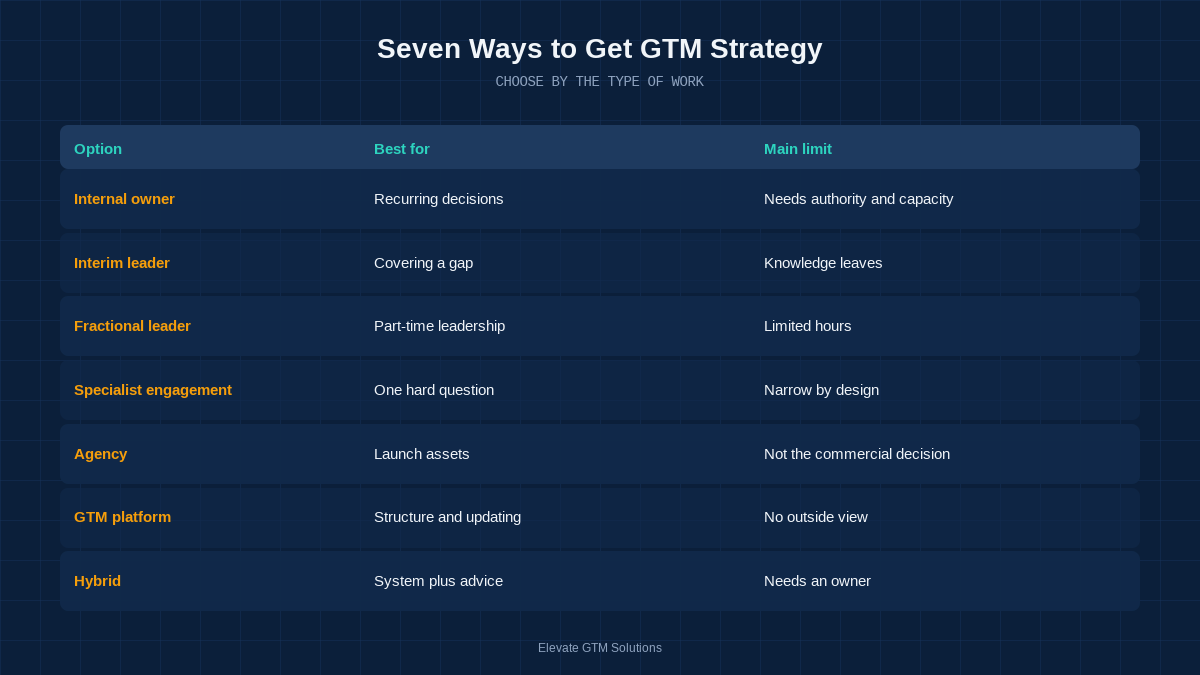
When a company needs stronger go-to-market strategy, the choice is rarely between a full-time hire and a consulting retainer. There are at least seven ways to get the work done, and each fits a different kind of problem. This guide compares them, including one that has become practical only recently: using a GTM platform to carry the structured work while your own team owns the decisions.
Start by listing the decisions that sat unresolved last quarter. Separate recurring executive work from a one-time launch and from a gap in analytical capacity. Then test which option can handle the work within a clear mandate. Elevate sells a GTM platform and a limited advisory practice, so we have an interest in one of the options. We have tried to describe all seven fairly.
What Are the Alternatives to GTM Consulting?
The main alternatives are an internal owner, an interim leader, a fractional leader, a specialist engagement, an agency, a GTM platform and a hybrid of a platform with limited outside advice. Choose by the type of work: recurring structured work suits an internal owner with a platform, a one-time launch may suit an agency or specialist, ongoing leadership gaps suit interim or fractional leaders, and contested decisions suit a facilitator.
Which is cheapest? It depends on how often the work recurs. For recurring work, an internal owner with a platform usually costs least.
Which is the most flexible? A hybrid, because you can add outside help to specific questions.
Seven alternatives compared
| Option | Best for | Main limit | Cost shape |
|---|---|---|---|
| Internal owner | Continuous, recurring decisions | Needs authority and capacity | Salary and management time |
| Interim leader | Covering a gap for a defined period | Knowledge leaves at the end | Fixed-term fee or salary |
| Fractional leader | Ongoing leadership at part-time cost | Limited hours and attention | Monthly retainer |
| Specialist engagement | One hard question, such as pricing or entry | Narrow by design | Project fee |
| Agency | Producing launch assets and campaigns | Not a source of the commercial decision | Project or retainer fee |
| GTM platform | Structured drafting, consistency and updating | No independent outside view | Subscription by scopes and seats |
| Hybrid | Recurring system plus occasional outside help | Needs an owner and discipline | Subscription plus small advisory spend |
Each row is a pattern, not a rule. Real situations often combine two.
Separate the recurring decisions from the temporary workload
Separate the work that repeats from the work that ends
Pull five decisions from the past quarter. Write down how often each happens, what happens when it’s late, which functions it touches and who can decide today. A country entry recommendation may need a short project. Weekly decisions about segment exceptions across three product lines may need a permanent owner. A launch can create a temporary workload that looks permanent until the offer stabilizes.
Now look at authority. A strategy lead without a budget mandate may still have to escalate every week if the company needs someone to decide how seller capacity moves across products. An interim leader can help if the CEO delegates that authority and tells the affected managers. Give the interim role ownership of evidence and follow-up and set a time for approvals if the CEO wants to keep the decision.
Measure the job before deciding who should take it
Audit the past quarter’s decisions
Pull the last set of decisions about segment, offer, channel, launch scope and seller capacity. Identify which ones repeated, where they stalled and whose approval was required. Ask what happened after approval. An executive may have made the choice quickly while the work never reached account teams. That points to a different staffing need than a slow or contested decision.
Give each decision an estimate of how often it recurs and what happens when it waits. A quarterly portfolio choice may need a senior sponsor and a small amount of preparation. A weekly series of customer and delivery exceptions can justify an operating lead. The enterprise may need a temporary team that can disband after the first review if the work peaks around launches.
Decide what authority can actually be delegated
Ask whether the person can change which accounts qualify, approve exceptions, move capacity or only coordinate the work. The scope should be specific enough that a manager can use it on a Tuesday afternoon. A fractional lead who must seek approval for every adjustment can still provide useful analysis, but the company should not expect the role to resolve decisions independently.
Define what stays with the sponsor. Product commitments, investment and changes to compensation may require other approvals. The interim owner needs a way to reach those people and an operating rule to use while the decision is pending. This keeps routine customer work moving without turning ambiguity into permission.
Decide whether the business has a temporary or recurring gap
Work from the calendar the lead will actually inherit
Take the next six weeks of reviews, launch work and portfolio decisions. Mark which meetings need preparation and which require authority. Identify how often the company expects an urgent issue outside the scheduled cadence. A part-time assignment can work if it owns a manageable set of recurring decisions. It can become frustrating if everyone assumes the lead is available whenever a customer exception appears.
Decide what the enterprise can defer. A leader covering a product launch does not necessarily need to redesign every sales meeting. Ask which work must happen now and which can wait until a permanent hire. A temporary owner can concentrate on the assignment when the sponsor protects their time. Otherwise their work may be evaluated against a mandate they did not have time or authority to execute.
Look at the work that moves without the lead
A strong arrangement should leave routine decisions with managers. Give them rules for eligibility, scope and escalation. Ask which cases they can resolve by themselves and which need an executive. This helps the company distinguish a leader who builds operating capacity from a role that becomes the only way to get a decision.
Observe a live review when the temporary lead is unavailable. Can the team find the current guidance, handle the usual exceptions and identify the issues that need later approval? If it can, the model may be sustainable. If every issue waits for the same person, adjust delegation or reconsider whether a part-time commitment is enough.
Where a GTM platform fits among the alternatives
A GTM platform is different from the other six, because it is a system, not a person. That gives it a distinct strength and a distinct limit.
Strength: it carries the recurring structured work. Drafting a customer definition, positioning and messaging from your inputs, keeping outputs consistent and updating them when assumptions change is repeatable work. A platform does this at a subscription price, whoever holds the owner role.
Limit: it needs an owner. A platform does not decide. A named person approves changes and brings fresh evidence. Without one, the system goes stale.
Pairing options. A platform works well with an internal owner, with a fractional leader who needs structure between sessions, and with a specialist who arrives to a prepared team. It works poorly as a substitute for facilitation or independent challenge.
Published platform plans are Enable at USD 499 per month and Growth at USD 1,499 per month, both billed annually, with custom Scale pricing. At the monthly rates, that is USD 5,988 and USD 17,988 per year. Enable covers one GTM scope with one revision cycle. Growth covers up to three users and three scopes, with up to two revisions per scope. See the pricing page for details, and our guide to when you still need a GTM consultant for the cases where outside help remains the right call.
Compare the staffing options and their cost
Four ways to cover the work
| Approach | When to try it | Who remains accountable |
|---|---|---|
| Assign a named executive and give a product marketing or strategy lead time | The enterprise has the skills and needs a clear mandate | The executive approves scope, priority and investment |
| Hire a specialist for a bounded project | One decision requires evidence or experience the team lacks | The sponsor owns the choice and handoff |
| Bring in a fractional GTM leader | Decisions and coaching recur, but the scope fits part-time availability | The sponsor delegates specific authority and retains larger commitments |
| Run a temporary cross-functional team | A launch or acquisition creates a short-lived coordination problem | A named leader resolves disputes and sets the end date |
The decision changes if the work requires ongoing people management. A product marketing lead can synthesize buyer evidence and build the plan, while a CRO or GM owns account coverage and budget. Don’t give someone a coordination title and leave them to negotiate every commercial decision from scratch.
Compare three practical mandates
A short commercial strategy project
A sponsor needs an informed choice about where to start selling an offer. The internal team can run the pilot if it receives a usable decision. A short external project can bring buyer research or an independent comparison. Give it a narrow decision and a receiving owner. Its value comes from the evidence and recommendation, not from indefinite responsibility for the sales cadence.
A fractional operating lead
The company needs someone to run a weekly review, resolve bounded cross-functional conflicts and coach managers through a transition. The lead needs explicit decision rights and enough time to use them. Define the roles that still report to internal managers and the issues the sponsor will handle. A fractional lead can coordinate change without becoming the permanent owner of every commercial outcome.
A cross-functional launch team
The launch needs specialists from marketing, sales, product and delivery for a short period. One sponsor should be accountable for the group, with an agreed end date. Put the work on the same calendar and show which people are responsible for customer commitments. The team can close once the first cohort is operating reliably and the owners can handle routine decisions without the project structure.
What the four operating options cost the enterprise
| Option | Cost that is easy to overlook | What to check before committing |
|---|---|---|
| Internal assignment | Work the current leader must stop or delegate | A protected allocation and a manager who supports it |
| Specialist project | Client effort needed to supply evidence and act on the result | A receiving owner and an acceptance test |
| Fractional leadership | Coordination and coverage outside scheduled availability | Authority, expected response and named backup |
| Permanent role | Hiring time, onboarding and supporting capacity | A recurring mandate with decisions the role can own |
A permanent hire may be the better choice even if the enterprise can patch the gap temporarily. Ask whether the work continues across planning cycles and whether the company wants to build the capability internally. A temporary engagement may be the better choice when the problem is concentrated in a launch or transition. Compare the choices through the same operating period.
Include the economic cost of leadership attention. The company is buying support rather than delegation if a sponsor has to join every decision. That may be appropriate for a consequential transition. It is a poor assumption for an ongoing operating model if the sponsor expects the role to free time. Make the intended balance explicit.
Set an interim mandate people can actually use
Write an interim mandate a candidate can accept
State the decisions the person can make, the teams they can direct, and the work they’re expected to leave behind. If they need to run the launch review and adjust pilot scope within an approved budget, say so. If they’re expected to manage people, name those people and explain how their current reporting lines will work. A broad title can obscure a mandate that is too limited to achieve the outcome.
Set availability against the work. One day a week might cover a review, coaching and some preparation. It may be inadequate if the person needs to coordinate several time zones and respond to daily customer exceptions. Decide who handles urgent issues on other days. Put the rule into the same place managers use to ask for approval.
Make the assignment visible. Tell sales, product, marketing and delivery which choices the person can make. Include one example of a decision they own and one that needs sponsor approval. When the interim lead exercises that authority, back the decision or explain the route for review. Leaving teams to infer the mandate from a title undermines the arrangement.
A practical authority matrix for a fractional lead
Decisions the role can own
The lead might be authorized to run the launch review, adjust the order of work within a funded scope and approve routine targeting changes within the agreed segment. They can work with managers to resolve ordinary exceptions. The sponsor should tell those managers which decisions they must accept from the lead. Otherwise the new mandate exists only in a contract.
Decisions that should return to the sponsor
Moving capacity across product lines, changing the standard commercial offer or making a new customer commitment may exceed the agreed mandate. Specify who can approve those changes and what evidence they expect. The interim lead should know when to request the decision and which temporary rule sellers should follow. The role can then keep work moving without taking on authority it was never given.
What to do outside the lead’s availability
A customer may need a decision on a day the fractional leader is not available. The regional or account manager needs an approved response and a named escalation owner. Some questions can wait. Others affect a commitment and need an immediate answer. Write down the difference and test it with the people who will use it. This protects the customer and gives the enterprise a realistic view of the part-time model.
Set the expectations in writing before the first day
The new or interim leader should receive the current strategy, open commercial choices, existing customer commitments and the people who own the key dependencies. Give them an operating calendar and identify the work that can wait. That lets them spend early time on decisions the enterprise needs, rather than learning the mandate through conflict.
The sponsor should share the mandate with the affected managers. Tell them which choices have moved, who retains final approval and how they can raise a concern. A new owner can exercise authority only if the people doing the work know it exists. Put a review date in the same note and ask managers to bring examples of what improved or remained difficult.
The managers handling customer exceptions should acknowledge the change. They are usually the first people who find out whether the new authority works under pressure.
Test the arrangement through real decisions
Worked example. Cover a six-month gap without creating another committee
Imagine an enterprise SaaS company has two new offers, a strong product marketing team and a CRO occupied by a regional sales transition. The CEO wants a Head of GTM Strategy, but hiring will take time. Start by assigning the CEO or GM to the investment decisions, then give one internal lead protected time to coordinate the offers and a defined set of decisions they can make without approval.
Bring in short-term help for the part the internal team cannot cover. A specialist can design the first customer research and a fractional leader can coach managers on the rollout if the mandate warrants it. Give each an end date and acceptance test. For example, the internal lead should be able to run the next launch review using the evidence record and have the authority to narrow targeting within agreed limits.
Set a 60-day review. Ask which decisions were resolved, which ones still waited for the sponsor and how much time the coordination required. The temporary arrangement can end if the work fits inside existing leadership after the launch. If it remains constant across products and the sponsor is still a bottleneck, build the permanent mandate around the decisions that need regular ownership.
Turn the staffing decision into a real operating experiment
Choose a problem that exposes the role’s authority
A company considering a senior GTM hire should test a choice that cannot be solved by writing another strategy document. Consider a product team that wants to expand a pilot and a sales leader who needs the same specialists for renewals. The rehearsal should use the same evidence, authority and deadline the proposed owner would have in the role. Ask them to bring the decision to the right people and communicate the outcome.
Document what happened. Did the owner resolve the choice or merely schedule another meeting? Could they move the capacity, or did another executive retain that authority? Did the field learn what changed before making another commitment? Those answers tell the enterprise which part of the job it is trying to fill.
Do not design a trial so narrow that it avoids the issue the enterprise needs to solve. A short research project can test whether the company needs commercial evidence. It cannot show whether a person can manage a weekly operating cadence across several regions. Choose a representative decision and enough time to see the work after approval.
Compare the temporary model with current practice
Last quarter’s performance gives the sponsor a baseline. Identify the decisions that waited, the number of times teams requested exceptions and the downstream work required to make a change. Ask how often the same issue returned. A fast answer that never reached the people who needed it was not a fast operating decision.
During the trial, track the same events. A fractional owner may reduce the time it takes to prepare the options but still need the sponsor for the final call. That can be useful if the bottleneck was preparation. Revise the delegated authority or the cadence if the bottleneck is executive availability. The staffing model should be judged against the gap it was chosen to close.
Record where the work moves. An interim owner may reduce the load on the CEO while increasing the time product marketing spends collecting evidence. That can be a good trade if the roles are clear and the evidence improves. Make the new work visible so the company does not approve a permanent role with unsupported assumptions about the team around it.
Choose the model for a second hypothetical company
Imagine a company with three products and one commercial organization. The CFO and sales leadership approve investment annually, while product marketing prepares launch plans. The recurring problem is who can decide which product gets the field’s attention when two releases overlap. Both product leaders can argue that their release is important. The account managers see conflicting instructions.
A short strategy project could help design a priority rule and bring evidence about each product’s demand and delivery. It would not necessarily provide the operating capacity to apply the rule every week. A fractional lead could run a six-week trial if the sponsor delegates decisions within set limits. An internal GM could also run it with protected time and analytical support. Compare which arrangement can settle conflicts at the pace the enterprise needs.
Suppose the trial finds that the most consequential choices happen monthly and that field managers can handle ordinary exceptions once the policy is clear. The company may not need a full-time head. It might give the GM a standing review and name a commercial operations owner to maintain the rule. The permanent role can be designed around the decisions the trial exposed if the trial instead reveals a constant stream of issues across regions and products.
Decide whether the work warrants a permanent hire
A six-week review that can inform the hire
| Evidence | What it might tell you |
|---|---|
| Decisions repeatedly wait for the same executive | The enterprise may need delegated authority or regular sponsor time |
| Managers make routine choices independently | The temporary mandate may be working |
| The team needs more analysis than coordination | Invest in the analytical role or support the existing lead |
| The scope expands after every review | Confirm whether the permanent job should cover more than the initial launch |
| Customer or capacity conflicts keep crossing functions | A permanent leader may need a cross-functional mandate and explicit decision rights |
The people who receive the decisions to explain should explain what changed. An interim leader can report a completed review while the account team still uses an older eligibility rule. Test the operational result. Have a manager find the approved rule and apply it to an actual account. If the change never reached them, fix the handoff before judging the staffing model.
Write a permanent role brief from the evidence
Start with outcomes and decisions
The brief should name the commercial choices the role owns, the functions it works with and the capacity it can direct. The sponsor should explain how the role changes a real decision. “Lead GTM strategy” is broad. “Approve product and segment priorities within an agreed investment envelope and resolve cross-unit coverage conflicts” gives a candidate something to evaluate.
Describe the analytical and operating support. A senior leader may need help with market research, financial modeling or data. Set the scope and outcomes accordingly if the role is expected to do all of that alone. Otherwise the company may hire someone for executive authority and spend most of their time producing plans.
Check whether the work is permanent
A transition can create a temporary concentration of decisions. Review whether the company still needs the same involvement once the new offer or coverage rule stabilizes. A permanent role may be justified if the sponsor continues to face recurring trade-offs across products or regions. Give it to the relevant managers with a review process if the work has shifted to routine operations.
Define how the business will know the new model works. Track decisions, time to approval, implementation and the number of issues that still have to reach the sponsor. Ask a field manager which guidance actually changed. A good staffing decision should improve the work people do, not just create a clear box on the org chart.
Write a review memo that can lead to a hire
Include the responsibilities tested, the evidence used, the decisions that moved and the work that still depended on a sponsor. Describe the parts of the role the company can delegate today and the authority it would need to add for a permanent position. Include the team and systems support required. A candidate can then see the job rather than infer it from a broad title.
The sponsor owns the next decision and its date. The enterprise could extend a limited mandate, transfer the work internally, or begin a search. An extension should answer a question the trial did not settle. A transfer should name the receiving owner and acceptance test. A search should specify how the role will improve the decisions the company has struggled to make.
Questions to ask a candidate before offering the job
The candidate should describe a choice they would make in the first month and the evidence they would need. Give them a trade-off between two commercial priorities and ask how they would involve the owners. Listen for how they separate a decision that needs executive approval from one a manager can handle. An experienced lead should be able to work through the scope without inventing authority.
Ask how they would transfer work to the people closest to customers. A strong answer should name the receiving roles, tools or records and a review that can verify adoption. This matters even when the person is hired permanently. A team that can operate the decisions without constant intervention gives the leader more time to handle consequential work.
Give hiring leadership a concrete threshold
Suppose a sponsor reviews six weeks of interim work. Four decisions affected the overall commercial strategy. Two were resolved by the lead under delegated authority, one needed the CFO and one needed both sales and product leadership. The organization also handled a number of routine customer exceptions without escalation. That record is more useful than an activity report. It shows the volume of executive work and the point where the existing model still depends on the sponsor.
Ask what will repeat over the next two planning periods. Assign a temporary owner through the end of the rollout and verify that managers can take over if the major decisions were tied to one release. If comparable choices arrive every week across products, determine which ones a full-time leader can own and what support they need. The business should have a reason to expect the permanent role to resolve the problem the trial exposed.
Set a threshold for revisiting the choice. For example, if the same issue reaches the sponsor in three consecutive reviews and causes an observable delay, reconsider the delegated model. Fix the rule first if the internal team can resolve the issue using a clearer rule. The threshold should fit the stakes. An exception that changes a customer commitment deserves attention even if it is rare.
Transfer the work before the mandate ends
Check the handoff using a live review
Have the receiving owner run one meeting before the temporary lead leaves. Give them an open decision, one completed choice and one exception. They should be able to find the evidence, identify who can approve the next action and explain what the field needs to know. The temporary lead should observe and answer questions only when needed.
If the new owner cannot complete the review, ask what is missing. They may need access to the evidence, clearer authority or time to work with the managers. A longer engagement is only useful if it addresses that specific gap. Set another test and give the sponsor a clear reason to approve it.
What to preserve if the company makes the permanent hire
Keep the decision inventory, operating calendar, delegated rules and current work products. The incoming leader should receive the decision history for any commitments that still affect active customers. Identify which temporary rules expire and which have become part of normal operations. The new leader can then decide what to keep without reopening every choice from the trial.
Make sure the role has access to the people it must influence. A senior title will not fix a structural conflict if the company has not named the sponsor or set the approval path. Show the candidate how the role would handle one realistic disagreement. The way leadership answers that question is part of the hiring decision.
Make the choice visible to the people affected
Once leadership chooses a model, tell the relevant managers what will change. Name the owner of recurring decisions, the route for urgent exceptions and the date to review the arrangement. Give it a clear boundary if the mandate is temporary. Specify how it works with the existing commercial and product leaders if the role is permanent. The enterprise should not need to discover the design one disagreement at a time.
Where Elevate fits among the alternatives
Elevate is an AI-native GTM operating system. It connects GTM context, intelligence, strategy, activation, execution and analytics, with 15 specialist modules plus Unified GTM Strategy and Elevate Pulse for recurring priorities. It works as the system underneath an internal owner, a fractional leader or a specialist, and it offers Guided GTM and focused advisory engagements for teams that want outside help on specific problems. If decisions still wait because nobody can approve the trade-off, address the mandate before widening the workflow. See the platform page, the pricing page and Can a GTM Platform Replace GTM Consulting?, or request a demo.
Frequently Asked Questions
What are the alternatives to GTM consulting?
An internal owner, an interim leader, a fractional leader, a specialist engagement, an agency, a GTM platform, or a hybrid of a platform with limited outside advice. Choose by the type of work: recurring structured work, a one-time launch, a leadership gap or a contested decision.
Can a GTM platform replace a consultant?
It can replace much of the structured, repeatable work, such as drafting and updating customer definitions, positioning and messaging. It cannot replace independent judgment, primary customer research, facilitation or accountability.
What is the cheapest way to get GTM strategy?
For recurring work, usually an internal owner supported by a platform. For a single narrow question, a short specialist engagement can cost less than building the capability.
Can a fractional lead run GTM strategy?
Yes, when the mandate fits the available time and the sponsor defines what the person can decide. Give them a route for issues that cannot wait until their next scheduled day.
Can product marketing own the work?
It can often lead the market, buyer and offer work. Name the people who approve pricing, investment, product commitments and field capacity so the team can act on the recommendation.
What should the first review measure?
Look at decisions reached, how quickly they reached the teams that had to act, and how many still depended on the sponsor. Compare the results with the previous operating cadence.