
By the Elevate GTM Solutions Team · Updated November 10, 2026 · 23 min read
Who Owns GTM Strategy in a Multi-Product Company?
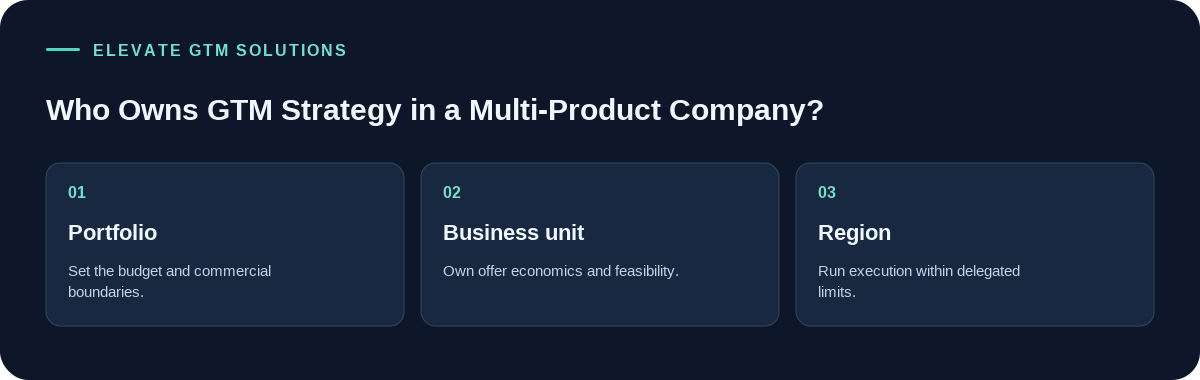
GTM ownership belongs with the person who can make the decision and carry its consequences. In a multi-product company, that often means different owners for the product offer, account coverage and cross-product capacity. Write down which calls managers can make independently and which require a sponsor before the first customer commitment.
Assign decision rights before drawing the org chart
Start with the commercial bet
Define the bet in business terms. “Launch analytics” is too loose to assign. “Sell a paid analytics pilot to existing enterprise customers in two territories using the direct account teams” identifies an audience, an offer, a route and a capacity constraint. The decision owner must be able to see the impact across those elements. Someone who owns only demand generation or only the sales target can contribute to that decision. Name the sponsor who does have it if the role lacks authority over the consequences.
The accountable owner may differ by company. A business-unit GM may own a standalone product with its own budget and delivery. A cross-sell initiative could require a portfolio sponsor because one unit provides the seller, another receives the revenue, and a third absorbs implementation cost. Assign ownership by the commercial exposure and the ability to resolve it.
Who decides what?
| Decision | Likely owner | Inputs to require | Escalation trigger |
|---|---|---|---|
| Allocate investment across product lines | Portfolio leadership | Unit economics, sales capacity, customer impact and opportunity cost | The change displaces a previously approved investment |
| Define a product’s target offer | Business-unit commercial owner | Product readiness, buyer evidence, delivery cost and pricing | The offer creates a portfolio-wide promise or pricing precedent |
| Decide how to cover named accounts | Sales leadership within delegated authority | Capacity, account history, channel agreements and compensation | Two units claim authority over the same account or territory |
| Adapt market execution | Regional commercial lead | Local buyer evidence, legal review where needed and service capacity | The change alters a product claim, standard contract or economics |
| Approve positioning and public claims | Product marketing and applicable product or commercial approvers | Evidence, source of proof, scope and geography | A claim expands beyond what the product or delivery team can support |
| Authorize exceptions | Owner of the affected commercial or delivery risk | Cost, precedent, customer impact and expiration | The exception changes a commitment outside delegated limits |
Use the table to settle decisions before the calendar gets crowded. Ask each executive to name one decision they believe they can make without consulting another function. Compare the answers. If two people believe they can approve a pricing exception or reassign the same seller, record the precise boundary and who resolves the next case.
Keep ownership distinct from contribution
The seller who spotted an expansion opportunity should be in the discussion. That doesn’t give them the right to reassign the account. Likewise, the person who approves the reassignment doesn’t have to build the new coverage plan. For each choice, write down who decides, who can stop it for a specific reason, and who does the work the next morning.
For each decision, record three roles. The decision owner issues the decision and owns its follow-up. Required approvers can stop it for a defined reason. Contributors provide evidence within a time limit. A regional delivery lead can stop a rollout if there is no approved implementation capacity. A leader who would simply prefer a different territory can contribute their case without acquiring a veto.
Put the same logic into meeting design. A working team can refine options. A steering group can resolve investment conflicts if it has the authority. A weekly update can communicate decisions already made. The meeting titles are masking a decision problem if the same slide goes to all three meetings and none produces a binding answer.
The decision inventory comes before the org chart
Take the last ten commercial decisions that caused people to wait, escalate or do the work twice. Include small decisions if they repeat, such as approving an account exception or deciding whether a regional campaign can use a new claim. Include large decisions such as funding an entry into another market. Write down who initiated each decision, who actually decided it, and which teams had to act afterward. The resulting inventory is a more reliable picture of GTM ownership than the organization chart.
Look for decisions that travel farther than they should. A regional marketing manager may need three executives to approve a local customer example, while a seller can make an informal implementation commitment that consumes weeks of delivery time. The first decision is likely overcontrolled. The second probably needs clearer authority. Tighten the rule where the cost of a mistake is high and delegate where people can act safely and reverse a decision.
Classify the decisions by their effect. A change to an executive presentation can often be made by the author. A change to the standard commercial offer can affect every region. Changing which product takes priority in an existing account affects the buyer relationship and the allocation of seller time. A decision inventory can record those differences without forcing every choice into a standard approval matrix.
Assign someone to maintain the decision inventory. The GTM operations lead or chief of staff can maintain the record and bring repeat problems to leadership. The role does not require authority over every decision it tracks. It needs access to the people who own the rules and a way to find out whether a rule actually works. Review the inventory whenever a business unit, regional team or commercial system changes its mandate.
An example decision inventory
| Decision | Cost if it is wrong | Who should be able to decide | Who supplies evidence | Review or escalation |
|---|---|---|---|---|
| Change an example in an approved sales presentation | Limited if the underlying claim remains approved | Local enablement owner | Product marketing | Reopen if the claim or geography changes |
| Redirect twenty named accounts to a specialist team | Lost coverage and potential disruption to renewals | Regional sales lead within the approved territory model | Account owners and RevOps | Portfolio sponsor if more than one unit loses capacity |
| Expand a pilot from one region to three | Delivery effort and customer commitments | Commercial sponsor | Product, delivery, Finance and regions | Investment approval if scope exceeds the current mandate |
| Change the default offer for a product line | Margin, pricing precedent and customer expectations | Business-unit commercial owner within delegated limits | Pricing, product and sales | Portfolio approval if shared terms or product promises change |
| Approve a company-wide exception to standard terms | Contractual and economic exposure | Owner designated by commercial policy | Finance, legal and relevant product owners | Record the effective date and treatment of open deals |
The names in the table are examples. The enterprise should use its own authority levels and approval rules. The test is whether a person faced with an unfamiliar case can use the inventory to find the right owner without polling several executives. A working rule should also tell the owner which decisions they can make independently and what evidence they need when they escalate.
Work through competing claims on shared teams
Worked example. Two products, one installed base
A hypothetical company sells workflow software to large accounts. A newer business unit wants to sell its governance product into the same accounts. The core product GM worries about distraction ahead of renewals. The governance GM wants qualified opportunities this quarter. The regional VP controls the account executives.
The portfolio sponsor approves a limited cross-sell pilot and names one commercial owner for it. The owner sets eligibility jointly with both business units. Customers close to renewal are excluded unless the account lead can show that the new offer supports the relationship. Existing account owners stay in charge of the customer conversation. The governance team supplies a specialist and pays for pilot onboarding. Finance records the time and cost so the business can evaluate the full effort.
The plan still leaves room for judgment. A customer might be outside the default eligibility rule but have a governance deadline and a strong sponsor. The account lead can propose an exception with a documented reason. The owner escalates it to the portfolio sponsor if the request would divert more delivery hours than the pilot allows. Sellers know where to go, and neither business unit needs a blanket right to overrule the other.
A model for enterprises with shared account teams
When products share an account team, each product can appear attractive in isolation. The team has one relationship and finite time. A portfolio model has to protect the customer from conflicting outreach while deciding which opportunities deserve scarce capacity. This is usually where product ownership and account ownership diverge.
Give account owners responsibility for the relationship, the sequence of conversations, and the record of commitments to the customer. Give product owners responsibility for the offer, specialist guidance and delivery prerequisites. Give a portfolio or regional sponsor authority to resolve cases where product priorities compete. Write the rules in terms of actions. A product owner can request a conversation with a customer. The account owner can decide when and how to introduce it within the relationship plan. The sponsor decides what happens when the proposed priority displaces other approved work.
A shared account team also needs a way to handle signals from different products. Suppose an existing customer asks the support team about a capability sold by a new business unit. The support team should have a simple route to register the interest and alert the relationship owner. The product specialist can help evaluate fit. An automated notification that goes straight to multiple prospecting teams may generate duplicated outreach and confuse the customer. Decide where the signal belongs before automating the handoff.
Address how commercial credit works with the compensation owner. A cross-sell motion may require a seller to invest time without knowing how it affects quota or credit. A sales manager may reasonably prioritize renewals if renewals are the only activity tied to their commitments. Leadership can resolve the incentive question separately from customer ownership. Assigning one person to own the relationship does not settle how work and commercial credit should be shared.
Worked example. One customer, three competing opportunities
In a hypothetical enterprise software company, a global retail customer is renewing its core platform in six months. The account manager also sees interest in an analytics add-on and a supplier governance pilot. The analytics product has approved customer proof and can deploy quickly. The governance product would need a specialist and requires access to a system the customer has not approved. Each product team wants the first meeting.
The relationship owner starts with the customer’s priorities. The customer is under pressure to reduce reporting effort this quarter and will consider a governance project after its internal review. The account team can discuss analytics during the renewal planning window without implying that governance is available. The governance specialist can prepare a future discovery plan with clear prerequisites. The strategy owner can reserve capacity for that plan after the customer confirms its timing.
If portfolio leadership decides that the governance pilot deserves priority because it tests an important assumption, the sponsor should make the trade-off explicit. It could move specialist capacity from another account, approve a separate discovery conversation, or let the account manager defer until the renewal is secure. Each option has a different effect on the relationship and the forecast. The business should record the decision and what would change it.
The example also illustrates what the relationship owner can settle alone. They can choose how to sequence approved conversations. They cannot approve a new implementation promise to create a reason for a meeting. The product owner can define what the pilot includes. They cannot unilaterally move the customer’s renewal. A shared decision rule reduces personal negotiation and clarifies which conflicts are strategic.
Where product marketing, RevOps and Finance fit
Product marketing often leads synthesis. It can bring buyer evidence, product scope, alternatives and positioning into a coherent proposal. Give the function authority over the messaging it maintains and a clear path to secure approval for consequential commercial choices. When product marketing is expected to lead a launch without authority over scope or funding, name the executive sponsor who can resolve disagreement.
RevOps owns important parts of implementation and measurement. It can define how an approved policy appears in CRM and reporting, assess the downstream effect of a routing change, and tell leaders when existing data cannot support a comparison. The enterprise should avoid asking an administrator to resolve a commercial ambiguity through configuration. An example is a disputed account rule that gets implemented differently in two systems. Decide the policy first, then test how it operates.
Finance brings the investment view and can identify when an apparently local decision changes the economics of the portfolio. A narrow launch might use specialist capacity that is already budgeted. That time still has an opportunity cost. A finance partner can show the alternatives and model the effects, then route approval to the person who owns the budget or risk. This is most useful before teams have made commitments based on capacity that does not exist.
Delivery and customer success should be able to challenge a promise that exceeds approved scope. Their input belongs in the decision before the promise reaches the field. Give them a direct route to the owner when a change affects onboarding, support or the treatment of existing customers. A risk raised after a contract is signed is more expensive to resolve than the same risk raised during offer design.
A second case. Shared specialists across regions
A hypothetical vendor has one team of solutions specialists for two regions. The first region has a steady stream of existing customer expansions. The second is launching a new product and argues that its first evaluations deserve priority. The specialists receive requests from both regions. Without a common allocation rule, they may serve whichever manager escalates first.
The portfolio sponsor allocates a fixed number of specialist hours to the launch and names the regional leader who can use them. Expansion requests continue through their normal path. The sponsor also states what would justify a transfer between the two pools, such as a critical existing customer commitment or strong evidence that the launch can close a specific set of qualified opportunities. The specialists can now schedule work without choosing the enterprise’s commercial priorities themselves.
At the first review, the launch team has used most of its time on accounts that never met the technical prerequisites. The allocation is not the only issue. The regional owner can tighten intake and reserve time for accounts that qualify. If demand still exceeds capacity after the change, the sponsor can decide whether to move resources. The ownership model lets the enterprise address the operational problem before treating it as an investment conflict.
Handle disagreements and vetoes
Rules for cross-functional disagreements
Name the actual trade-off. “Sales and marketing are misaligned” gives leadership very little to decide. “A broader launch would add demand the onboarding team cannot deliver this quarter” identifies competing benefits and a constraint.
Give the decider two real options. Present the consequences of each and the date by which the business needs an answer. A sponsor can choose a narrow launch with early learning or delay to build capacity. A menu of activities without options forces leaders to reopen the analysis.
Write down the scope of the decision. A one-time approval can become a standing rule if it is left undocumented. Record which product, geography or account it covers and when it expires. Attach the approval to the relevant operating artifact so sellers and implementation teams can find it.
Move the downstream work. Once an owner approves a change, assign updates to the forecast, field materials and customer commitments. A decision recorded in a meeting note but absent from the tools people use is unlikely to change behaviour.
Establish a narrow set of rules for vetoes
An approval right should protect a defined exposure. A delivery owner can stop a new scope if the implementation path is untested or capacity is unavailable. A finance owner can hold an exception when the economics exceed delegated limits. A regional leader can flag a customer or partner commitment that the global team has overlooked. Those rights can coexist with a single person accountable for reaching and communicating the final decision.
Distinguish an approver from a contributor in the meeting invite and the decision memo. Contributors can bring evidence, recommend a different choice and ask that the owner record a concern. Approvers can stop the decision for a defined reason. If everyone who attends can veto any option, accountability will be hard to locate. If people with genuine risk cannot stop a bad commitment, the rule will be ignored once the first serious problem appears.
Set an escalation time for urgent cases. A seller may need an answer on an exception before the buyer’s procurement deadline. The designated owner should know how to consult the necessary people, what to do if an approver is unavailable, and which default applies while a decision is pending. The field should receive a safe holding response, such as confirming that the company is checking feasibility and will reply by an agreed date. This avoids turning silence into permission.
Also decide who owns a review after an exception. A series of similar exceptions can reveal an unclear standard offer or a market the company is serving informally. The operational owner can count and classify exceptions. The strategic owner decides whether to change the rule, narrow the offer or fund the missing capability. Exceptions become evidence once someone reviews them together.
What to do when formal and actual authority differ
Ask a group of managers who can approve a cross-sell exception. The documented answer may be the regional lead. The managers may instead wait for the product GM because the regional lead has never been able to secure delivery resources. Both answers contain useful information. The policy describes who is accountable, while practice reveals who controls a necessary dependency. An ownership change will work only if it addresses both.
Map the gap for one decision. Ask what action the official owner can take directly, what resource requires someone else’s agreement and how the current workaround functions. If a regional lead can approve an exception only when the product team releases capacity, add a capacity approval with a clear response deadline. Alternatively, reserve a small amount of capacity in advance and let the regional lead allocate it. The two arrangements offer different trade-offs in control and speed.
Avoid assigning a senior sponsor to every case simply because a process is new. The sponsor can reserve decisions with material effects, such as reallocating staff between business units or changing commitments to strategic customers. Delegate the rest with limits. That gives people permission to act and gives leadership a way to identify decisions that exceed the expected scope.
A reorganization can be justified when the mismatch is persistent and affects many decisions. A smaller change may be sufficient when only one resource or approval causes the delay. Test a delegated rule on actual cases before changing reporting lines. Check whether the people affected recognize the decision as legitimate. An org chart can establish formal authority, but teams still need to see it exercised consistently.
Run a 30-day reset and measure the result
Choose an operating cadence around decisions
A weekly operating review is useful for decisions within delegated authority. Examples include prioritizing a few delivery slots, responding to new buyer evidence, or correcting a misrouted account. Give the group a short record of the proposed decision and the people who need to be present. Take routine project updates out of the meeting if they do not require a choice.
A monthly commercial review can examine trends that cut across products or regions. Bring the smallest useful cohort, the planned result, what changed and the plausible explanations. If a sales team wants a segment added, ask whether the available evidence warrants a bounded test or a broader change. Make sure the decision owner can see the cost to serve and the work that will be displaced.
A quarterly portfolio review is where leadership can move investment, change coverage boundaries or reconsider an offer with company-wide implications. Give business units a consistent way to present assumptions and dependencies. They can still describe differences in buyer or channel conditions. A comparable format helps leaders see which choices share a resource or create an unintended customer promise.
The cadence needs an exception path. Some issues cannot wait for the next scheduled review. A key product promise might become inaccurate after a release change. A partner might lose a capability that several deals rely on. Write down who can initiate an urgent decision, who owns the response and where users will find the updated instruction. Review urgent decisions later so temporary rules do not become permanent by accident.
An example one-page decision memo
Use one page when the choices are straightforward. Open with the requested decision and the date an answer is needed. Briefly explain the current rule, the evidence that prompted the proposal and which customers or teams would be affected. Present the alternatives with their material differences. Give a recommendation and explain what evidence would make the owner change it.
Then add the operational consequences. For a cross-sell policy, name the account team, specialist team, delivery owner, and person who will revise the CRM or playbook. Record which existing opportunities stay under their earlier terms. State when the new policy takes effect and how the business will verify that it reached the people who use it.
A decision memo should be easy to revisit. Attach the evidence or identify its approved source. Record the review date, what the business intends to measure, and what it can reverse. If the proposed rule is permanent, explain why a time-limited test is insufficient. When the business learns that a pilot was built on an incomplete assumption, it should be able to see which parts of the decision need to change.
How to fix ownership without reorganizing the company
Begin with one recurring conflict and resolve it at the lowest practical level. For example, two teams claim the same customer when a second product enters the conversation. Name the relationship owner, the rule for requesting specialist support, the exceptions and the person who resolves disputes. Run the rule on real examples before applying it broadly. If it works, publish it in the field tools and ask managers to use it in their next review.
When ownership cannot be delegated, name a sponsor with the relevant authority. A cross-unit investment may require an executive who can move money or capacity. Adding another coordinator can improve visibility but will do little if no one has authority to settle the trade-off. Set a deadline for the sponsor to respond and specify the default action if they do not. Teams need a rule they can follow when the calendar is busy.
Look for incompatible responsibilities. A leader may be asked to maximize product growth while also protecting the same pool of specialist time for a different product. Both mandates can be reasonable, but the decision criteria should be explicit. A portfolio sponsor can set priority by customer commitments, expected commercial value and delivery exposure. The criteria should be visible before product teams start asking for exceptions.
Once the model is in use, evaluate it through evidence. Track decisions that were reopened, exceptions that bypassed the process, and updates that did not reach a downstream system. Ask field users where they went for guidance. A low number of escalations may mean ownership is clear, or it may mean people stopped using the process. Check a few examples before drawing a conclusion.
A 30-day ownership reset
| Period | Work to complete | What to check |
|---|---|---|
| Week 1 | Collect recent decisions, delays and disputes | Whether the sample includes more than one region or product line |
| Week 2 | Name decision owners, approvers and escalation routes | Whether each owner can actually make the choice |
| Week 3 | Test the rules on active opportunities and one edge case | Whether teams reach the same answer without informal exceptions |
| Week 4 | Update the field materials and operating reviews | Whether the new rules appear where people make the decisions |
The reset can be scoped to one motion or product pair. A pilot is often easier to govern than a company-wide mandate. Choose a scope with enough real decisions to learn from and a sponsor who can revise the rules. If different regions have genuinely different obligations, keep that variation visible rather than standardizing it away.
At the end of the month, ask the sponsor to review one decision that moved faster and one that is still stuck. Compare the underlying causes. A working model should make some choices easier, identify which disagreements belong with leadership and give the company a place to record what it learns. It should also make it easier for new people to join the work without discovering the rules through trial and error.
How ownership changes as an initiative matures
A new initiative may need a dedicated commercial owner because the company is still deciding who to serve, what to offer and whether the economics can work. That owner can bring the functions together for a bounded test and use a clear approval path for exceptions. As the offer becomes repeatable, routine choices can move to field leaders and operations. The sponsor continues to own decisions that change investment, scope or material risk.
Set the handoff conditions early. The receiving team should be able to describe customer eligibility, handle common exceptions and reproduce the reporting. Product and delivery should know which promises they are responsible for maintaining. Finance should know how the new offer appears in planning. If a specialist is still needed for every decision, the initiative may need more work before it can be treated as normal operations.
A mature initiative may eventually need to return to portfolio review. Evidence can show that a new segment is more attractive, that a shared account team is overloaded, or that a region needs a materially different route to market. The ownership model should allow those proposals to reach the right sponsor without requiring a new reorganization. Its purpose is to help the enterprise make and carry out the decisions it will inevitably face.
How to tell whether the rules are helping
Track time to decision for a few common cases, and check whether the outcome reaches the field. A regional exception can be approved in a day and still arrive after the seller sends a proposal. Measure when the seller or operations owner received the updated instruction. For consequential decisions, review whether affected systems and customer commitments reflect what was approved.
Keep an eye on the quality of escalations. A good escalation identifies the actual choice, relevant evidence, people affected and date a decision is needed. If most escalations arrive as general requests for alignment, the ownership rules may be unclear or managers may lack a useful template. Fix the recurring issue before adding more meetings.
Look for cases that never reached the formal path. A team might quietly keep the old rule because it is easier to apply, or avoid raising an issue because it expects no answer. Sample open deals and ask field leaders how they resolved a recent conflict. Their explanations help the sponsor see whether the ownership model works when no one from the project team is present.
At the end of the review, choose one rule to keep, one to revise and one decision to delegate if the evidence supports it. Record who owns the change and when it takes effect. That small cycle can make the model more useful over time without requiring the enterprise to redesign its entire operating structure.
Frequently asked questions
Should GTM report to sales, marketing or product?
The reporting line is less important than the commercial mandate for the decisions at hand. Product marketing can own synthesis, sales can own field execution and product can own scope. A named sponsor resolves decisions that exceed any single team’s authority.
Can one person own the strategy for every product?
A portfolio executive can set shared priorities and guardrails. Product-level or market-level ownership is still useful where trade-offs require detailed evidence and frequent decisions. Delegate within boundaries so the portfolio leader sees only the choices that need portfolio authority.
How should ownership work for an existing account?
The customer should know exactly who owns the relationship. Assign product specialists and delivery responsibilities behind that role. Put rules for compensation, credit and exceptions in writing before the teams are asked to collaborate in a deal.
What should we do when leaders cannot agree?
Send a focused decision to the named escalation owner with options, evidence and a deadline. Record the outcome and who must update their plans. If no role can settle the choice, that authority gap is the first issue leadership needs to fix.
Related reading
See the GTM Operating Model and Unified GTM Strategy for related planning guidance.
Where Elevate fits once you’ve named the owner
For a shared-account launch, use the strategy work to spell out which product and customer cohort you’re pursuing. Then carry the approved actions into Elevate’s execution workflow and give each one a named owner. That makes it easier to see who owes the next action. Keep decisions about territory, compensation and renewal priorities with the leaders who have authority over them. Explore Elevate’s execution workflow