
By the Elevate GTM Solutions Team · Updated November 10, 2026 · 22 min read
Global vs. Local GTM Decisions in Enterprise SaaS
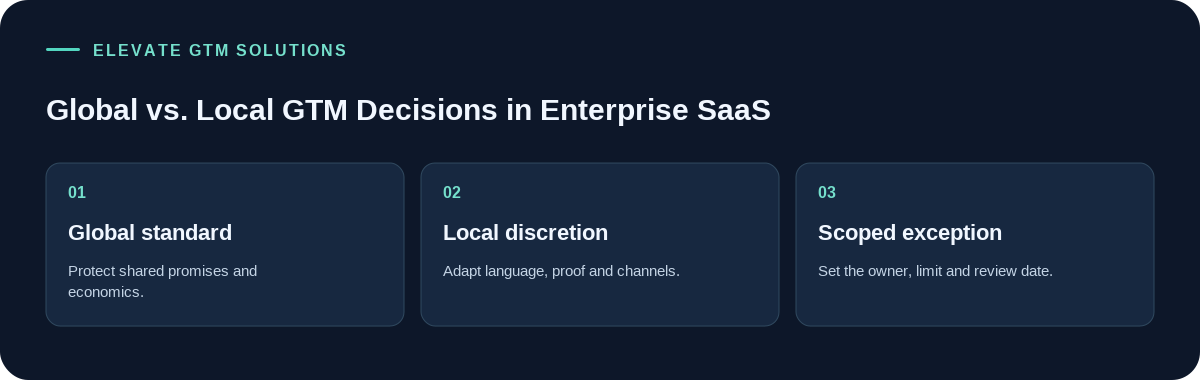
A global GTM playbook needs to distinguish local discretion from decisions that change the offer. A region can often adapt language and proof. A change to eligibility, implementation commitments or margin belongs with the people who own those obligations. Use qualified deals to determine which kind of change is needed.
Decide what stays global and what can change locally
Classify decisions by the cost of getting them wrong
Some choices have company-wide consequences. A region that makes a new data residency promise or changes a global account’s commercial terms can create exposure elsewhere. Other choices are low-risk and reversible. Adapting a campaign example or choosing a local event can be delegated if the claims and audience remain within the approved scope.
| Decision | Good global default | Where local discretion helps |
|---|---|---|
| Product promise | Define supported use cases, availability and approved claims | Use local proof and language within the supported scope |
| Positioning | Set the target problems, differentiation and evidence standard | Adapt buyer vocabulary, examples and narrative order |
| Pricing and packaging | Establish economic floors, approval rules and standard offer structure | Propose currency, channel or package changes with local evidence |
| Route to market | Define coverage policy and partner obligations | Choose tactics and partners within delegated authority |
| Measurement | Use shared definitions for opportunity, bookings and delivery outcomes | Add market-specific indicators needed to explain results |
| Customer support | Define service commitments and escalation standards | Design hours and delivery coverage within those commitments |
Treat the table as a starting point. A company operating through independent business units may delegate more than a company with a single global product and shared account teams. The right boundary depends on the exposure, ability to reverse a decision and cost of central review.
Distinguish translation, adaptation and a new offer
Changing a North American customer example to a locally approved one is a straightforward adaptation. Telling buyers the package includes local implementation changes what you’re selling. Give managers a short rule for each case and someone they can reach when the request falls in between. It will serve them better than a general instruction to stay on brand.
For example, a local team may replace a North American customer story with an approved example from its region. It can do that quickly. If the local evidence suggests buyers only want the analytics feature bundled with implementation, the proposed package changes economics and delivery. That deserves a commercial review even if the first suggestion appears as a copy edit.
Write practical examples into the approval policy. Abstract guidance such as “stay on brand” gives a regional manager little direction about an enterprise buyer asking for a different service commitment. Use a decision card describing what the region may change, where it needs approval and who can provide an answer in time.
Worked example. One product, two ways to reach the buyer
A hypothetical B2B SaaS vendor sells supplier governance software to enterprise procurement teams. In its home market, large accounts come through direct sales and established executive relationships. A second market has credible specialist partners and customers who prefer a local point of contact during implementation. The regional lead wants to use a partner-led motion.
Global leadership keeps the core offer and product claims consistent. It approves a pilot with two partners, a limit on early implementations and an exception path for accounts served by global teams. The local group chooses how to present the use case and which approved proof to lead with. It also tests whether the partner can identify technical prerequisites early enough to avoid stalled opportunities.
The next decision depends on evidence. If partner leads are well qualified but implementation cost is higher than assumed, leadership can adjust scope or support. The team may need a co-selling model if the partners generate strong initial interest but lack access to the economic buyer. Comparing lead counts alone would miss both issues.
Make the distinction in the planning brief
A global plan should state what the enterprise is building once, what a region may adapt, and where adaptation requires a fresh investment decision. Put the boundaries next to the commercial objective. “Enter a new region with the existing product and two approved partners” is an intelligible choice. “Take the playbook global” leaves the region to infer what it can change and what it must preserve.
Give local leaders a clear starting point. Describe the intended segment, buyer problem, approved product scope, customer proof and commercial terms. Explain which assumptions came from the original market and should be checked locally. If the first market depends on a particular source of demand or an installed-base relationship, say so. A regional team can adapt more intelligently when it understands why the original model worked.
The region should respond with an adaptation brief. It should identify what it will reuse, where it proposes a change, evidence for the change, and what it needs from global teams. The brief can be short if the differences are modest. For a new sales motion, show which resources, customer commitments and economics are affected. A useful planning conversation takes place while the market can still influence the launch.
The four levels of local discretion
| Level | Example | Decision route |
|---|---|---|
| Reuse | Publish approved product claims and eligibility | Local execution owner applies the global standard |
| Adapt within bounds | Change event format, example or approved message order | Local owner records the change if it affects the test |
| Request an exception | Offer an approved package through a new partner in one cohort | Commercial and affected owners review a scoped proposal |
| Reopen the global rule | Several markets show that the standard scope prevents viable sales | Portfolio owner examines evidence and decides whether to change the standard |
Make the decision route part of the process people already use. If a rep receives a request that crosses a boundary, they should know whom to ask and what they can tell the customer before approval. A regional lead should know which changes can be made without waiting for global review. Both need a record of decisions that affect open deals.
Diagnose the local difference before changing the motion
A weak launch result can reflect several different conditions. Buyers may have different priorities. The company may have limited access to the people with budget. Local teams may lack proof that the buyer recognizes. The product may require a deployment condition the region cannot support. A local adaptation should address the cause the team can actually observe.
Start with a small number of buyer cases. For each, record the problem, champion, budget owner, decision process, alternatives and outcome. Compare cases that progress with those that stall. A recurring objection may indicate a positioning problem. The region may need better targeting if the objection comes only from buyers outside the intended segment. If several qualified buyers make the same request after a strong evaluation, leadership should consider whether the standard offer is incomplete.
Ask local sellers and partners for evidence about access, not just for opinions about what buyers prefer. A partner may claim strong relationships in a market. Ask which buying groups it can reach, what role it has played in relevant deals, and whether it can support the first steps in the proposed motion. The enterprise can test a partner’s ability to qualify and hand over accounts before committing to a wider commercial relationship.
Check whether the local difference affects the business model or the presentation of it. A different buyer title may be a translation issue if the role and decision rights are the same. A different department with its own budget and procurement process can require a new economic argument. A preferred buying channel can change the sales motion without changing the core product promise. Treat the evidence with enough precision to choose the right level of change.
Design a local test and compare the evidence
Design a regional pilot that teaches the right lesson
Select a scope the team can serve with known capacity. Define which accounts qualify, how they will enter the funnel and what the partner or local team must verify. Set the test budget and decision date together. Identify what outcome would justify expanding, narrowing or ending the pilot.
Suppose a region believes partner-led access is essential. A useful test could compare a small number of co-sold accounts with a comparable group the company reaches directly, while keeping the product and offer consistent. The purpose is to understand access, qualification and the role of the partner. Changing the package, price and partner terms at the same time may make the outcome hard to interpret.
Track both commercial and operational results. A partner can generate conversations without consistently confirming eligibility. A direct motion can produce fewer opportunities but allow the company to manage delivery more efficiently. Compare the buyer’s progress, cost to serve, quality of handoff and time required from specialists. A route to market succeeds when it can reliably carry the promise the company is making.
Be clear about transfer. A regional pilot can provide evidence that a particular partner can sell to a particular segment under specified conditions. It may tell leadership little about a different country or a different partner. Record which conditions are essential and which should be tested again. The enterprise can replicate the process without treating the first market’s outcome as a universal forecast.
Worked example. A regional team asks to change the package
Consider a hypothetical enterprise platform that sells a standard analytics package globally. A regional team reports that local buyers want implementation bundled into the offer. Global pricing is concerned about margin and the precedent it could create. Delivery says the effort varies widely depending on the customer’s environment.
The first question is what buyers mean by “bundled.” They may want a single purchase order, a fixed deployment scope, or confidence that they will have support after signing. Each explanation suggests a different response. A single invoice may be possible without changing the product bundle. A fixed deployment scope requires eligibility and delivery estimates. A support expectation may require a different handoff or operating commitment.
The local team reviews a small set of qualified opportunities and finds that several buyers want predictable implementation costs for budget approval. The region proposes a fixed-scope offer only for customers using an approved configuration. Global pricing supplies a commercial boundary. Delivery validates the scope and sets a limit on the number of pilots. The regional lead owns the test and reports exceptions separately.
At review, the team compares the quality of buyer commitment, delivery hours and actual scope. If most accounts fit and progress more smoothly, the enterprise may extend the bounded offer. It may narrow eligibility or change how implementation is priced if the required work regularly exceeds the estimate. The team should investigate other causes before assuming the bundle solved the problem if the buyers still cannot obtain approval.
This is a local test with global implications. When the company changes its standard terms, other teams need to know which evidence supports that decision and how to treat existing agreements. A regional success can inform a portfolio choice. The regional pilot should not silently become the default offer for all markets.
Decide which proof can travel
A strong customer example can still lose force when a buyer cannot see how it applies to their environment. Local teams may need examples of similar company structures, workflows, procurement conditions or implementation paths. Give them approved proof and explain its scope. A case from another region can be useful when the relevant conditions are comparable and the claims stay within the available evidence.
Separate permission to use an example from the strength of the underlying evidence. A customer quote may be approved for one market or channel. A numerical outcome may depend on the way the customer measured it. The local team should know which version it can use and where to get approval for changes. Keep the reference owner and source date visible.
Be careful with public claims during translation. A term that means “supports the workflow” in the source material can become a claim about compliance or a guarantee in another version. Ask local reviewers to check how buyers will interpret the wording, and give product or other required reviewers a clear role when the meaning changes. The goal is to let the region use natural language while keeping the promise accurate.
When local proof is scarce, use appropriate alternatives. A representative demo, an approved technical walkthrough or a limited evaluation can help a buyer understand scope. Label hypothetical examples. Do not substitute another customer’s outcome for a claim that has yet to be verified in the region. The next pilot can be designed to produce the evidence the local team needs.
Handle shared accounts and partners deliberately
International customers may buy centrally, locally or through a mixture of both. A company can have local demand and a central agreement that governs the transaction. Before launching, decide who owns the relationship, who can speak for the enterprise, and where regional teams should record interest. The customer should not receive different terms from different parts of the company without an approved reason.
Discuss the same issue with partners. A local partner may already work with a subsidiary while the vendor’s global team manages the parent relationship. Decide what evidence establishes ownership, what happens when both teams are involved, and who can resolve a dispute. Include the practical details in registration, routing and communications. A rule known only to senior managers will be hard to apply when a real deal moves quickly.
Protect current commitments when the local motion changes. A company may test a partner in one segment while keeping existing direct deals under their original ownership. Define the effective date and the transition rule. Give sellers and partners enough context to explain the choice to customers. When an exception changes commercial terms, use the approved review path rather than treating it as a simple routing adjustment.
A sample cross-region account rule
For a named global account, the relationship owner coordinates any local opportunity and records the applicable commercial agreement. The regional team can lead discovery with the local buyer if the global owner approves the sequence. The partner manager verifies registration and scope. Product or delivery approves any new commitment that falls outside the standard offer. The commercial sponsor resolves it by the agreed deadline if the groups cannot agree and the decision has material exposure.
The rule can be tested with a realistic account and one borderline example. Ask who talks to the customer, who prepares the offer, where the opportunity appears, and how the company handles credit and delivery. If different teams produce different answers, settle those differences before the launch depends on them.
Make local evidence comparable across markets
A shared scorecard should define the starting population and the event being measured. An eligible account is not the same as a reachable one. A discovery call is not the same as a qualified opportunity. A signed pilot is not the same as a commercial rollout. Agree on the definitions that support global comparisons and let regions add local fields where they need context.
Compare by cohort and route to market. A region that starts with a few warm accounts cannot be compared directly with a region that begins with net-new buyers. A partner-led cohort can also have a different mix of account sizes and needs. Put those differences beside the conversion figures. The global team can still compare whether the business reached qualified buyers and delivered the offer under the chosen conditions.
Include delivery, margin and operating effort. High demand can be an incomplete signal if each customer requires unplanned work. A region with lower volume might be more viable if it can serve the offer reliably. Review which costs sit locally and which are absorbed by a shared team. A global plan can become too optimistic when regional results omit central specialist effort.
Keep the global report useful for decisions. Ask each region to state what it learned, what it proposes next and what would make it reconsider. Leaders can then compare whether the same issue recurs, where a local adjustment is sufficient and where the portfolio should change the standard. Use the review to move resources or revise a choice, rather than collecting reports that no one uses.
Budget and operate the regional pilot
A 60-day operating plan for a new region
| Window | Regional work | Global decision |
|---|---|---|
| Days 1–15 | Check audience access, buyer needs, constraints and initial proof | Confirm what is fixed and which local tests are allowed |
| Days 16–30 | Validate one direct or partner path and rehearse customer handoff | Approve a bounded launch and any documented exceptions |
| Days 31–50 | Run the first cohort, record buyer outcomes and delivery effort | Review material issues and keep policy current |
| Days 51–60 | Compare results with the assumptions and recommend next action | Continue, revise, expand or stop the test |
The timing is illustrative. Adjust it to the customer’s buying cycle and the approvals the region needs. A short planning period can still be useful if it produces credible evidence about access and feasibility. It should not force the region to claim sales outcomes before enough customers have completed evaluation.
The regional team needs a regular review and a clear way to raise urgent decisions. During the pilot, check exceptions and customer commitments frequently enough to catch a misunderstanding before it spreads. At the end, separate the changes that can be adopted locally from those that need global review. Leave a clear owner for each result.
The most useful global model gives local teams room to act on evidence, while making the cost and scope of those actions visible. A regional leader can move faster when the boundaries are clear. A global leader can make better decisions when local tests produce evidence that can be compared and understood.
Plan the market entry budget around the decisions it can answer
A local team may ask for campaign spend, a partner incentive and extra specialist capacity in the same budget request. Before approving the total, ask which decision each line supports. Research spend can help determine whether the offer fits local buyers. A limited campaign can test access to those buyers. Delivery capacity can test whether the company can serve them under the proposed terms. The business does not need to approve every step at once if the early evidence can change the plan.
The region needs enough budget to run the pilot. If local teams must seek approval for every small change, the pilot may stop learning whenever the campaign or audience needs adjustment. Define what can move within the budget and what requires approval. For example, a team can change the channel mix within an approved test while a price change or new service commitment needs review.
Include support supplied by global teams. A regional campaign can appear inexpensive while depending heavily on central solutions engineers or implementation staff. Ask those teams to estimate their contribution and show which other work it displaces. A proposal for the next region should reflect the full effort, including support that was treated as temporary during the first pilot.
At the first review, compare expected and observed effort. If the team used more time because the materials needed local adaptation, that work may be reusable. If every customer needs a unique deployment, the cost may recur. These are different reasons to revise a budget. The distinction helps global leadership decide whether to fund shared capability or keep the offer narrow.
Build a market entry packet local managers can use
The packet should connect strategy with actual operating instructions. Include the intended buyer and use case, supported configurations, approved claims, permitted channels, pricing boundaries, routing rules and contact for exceptions. Give regional managers a place to record local evidence and propose changes. The packet can be concise if it links to current sources and explains which version applies.
Add a section for questions to test. The team may need to learn whether a partner can reach the economic buyer or whether standard implementation fits the first accounts. Name the evidence needed and the date to review it. A packet that contains only instructions may work well for a mature market. A new region also needs permission and structure to learn.
Share enough context for other functions to support the launch. A delivery specialist needs to know what was promised and when customers can start. Finance needs to know which commercial terms are approved. Marketing needs to know which claims can be used and where examples are available. An enterprise can distribute different views without creating separate versions of the strategy.
A prelaunch conversation with local owners
Ask a local seller to identify one eligible customer and explain the first conversation. Ask a partner manager to describe how a partner opportunity would be registered. The delivery lead should show which requirements must be confirmed before a commitment. If each person relies on a different description of the offer, the team needs to reconcile the materials before going to market.
Check one customer outside the standard scope. The buyer may need a language, configuration or commercial term that the team cannot yet support. Agree on what the local team can say, where it can route the request and how quickly it expects a decision. Give the regional lead authority to make routine decisions and a safe path for the others.
Avoid copying the first region’s economics
The first region may have advantages that are hard to repeat. It might have established customer relationships, a trusted local partner or a team that can handle exceptional work. Those conditions can make early results encouraging while hiding the cost of building the same capability elsewhere. Describe the conditions separately from the outcome.
Suppose one region reaches ten qualified opportunities through a partner who already serves the target segment. Another region has no comparable partner. A global forecast that applies the same conversion and acquisition assumptions to both may overstate reachable demand. The second region can use the first region’s process as a starting point while testing a different acquisition path and cost structure.
The same issue applies to delivery. A region may report smooth onboarding because a central specialist personally guided the first customers. Before expanding, ask whether the receiving team can reproduce that support and what it costs. If a higher-volume launch needs a different delivery model, fund or test it explicitly rather than assuming the initial result will transfer.
Review exceptions and decide what should travel
Build an exception record that prevents permanent drift
A simple exception record should identify the rule, the proposed change, eligible customers, commercial and delivery effects, the owner, effective date and review date. Attach the evidence and describe what happens to existing commitments at expiry. If the change depends on a partner or a local capability, state what would happen if that dependency changes.
Make the next decision visible. Some exceptions should end after the test. Some can become a regional policy within delegated authority. Others reveal a broader need and should go to the global owner. Record the outcome and inform the people who maintain the relevant systems and materials. A successful local adjustment can create confusion if sellers still see the old rule or if another region copies it without approval.
Avoid asking the local team to resubmit the same question indefinitely. Delegate it or establish a standard if a pattern is stable and within acceptable risk. Put it through a proper strategic review if the evidence suggests a different customer promise or economic model. The exception process should help the enterprise learn which decisions belong locally.
Decide when a local change deserves a global review
A single request can justify a local test if the cost is limited and the effect can be reversed. Multiple qualified buyers across markets raising the same issue may justify a portfolio review. The evidence should describe who is affected, why the current rule fails and what a change would cost. A larger number of anecdotes is useful only if the cases are relevant and comparable.
Bring alternatives to the review. Keep the existing global rule and allow an exception. Set a new default for a defined market or segment. Change the global offer. Each choice has an operational effect. A new default can reduce local friction while increasing complexity for pricing and support. A global change may simplify the rule but expose the company to a commitment it cannot support everywhere.
Assign responsibility for the downstream work. If leadership approves a new rule, identify who updates public claims, field materials, partner agreements, system records and performance definitions. Set an effective date and clarify treatment of customers already in evaluation. The global review is complete when the decision reaches the people who use it.
The first cross-market review
Give each region the same three questions. What did the team learn about the buyer, offer and route? Which conditions made the result possible? What does it recommend doing next? Request one example where the approach worked and one where it failed. Compare the cases before comparing aggregate numbers.
Look for a distinction between a common problem and different causes. Several regions may report weak conversion, while one lacks buyer access, another has an implementation gap and a third is still early in a long sales cycle. A single global remedy may help none of them. Conversely, a consistent objection from qualified buyers can reveal a shared issue with the offer. The review should tell leadership which decision belongs at each level.
Close by naming the approvals, owners and dates for the next tests. Give regions a clear answer about what they may change and what remains fixed. This creates a record the enterprise can use when the next market enters the program. It also keeps local learning connected to the company’s broader strategy.
Check which policy applies during a regional transition
An account can enter the funnel before the regional policy changes and reach negotiation after it takes effect. Decide whether the original terms still apply and who can verify the answer. Give sellers and partners one source for that decision. Otherwise, a local change intended to reduce friction can lead to different offers for similar customers during the same period.
How to use country-level digital commerce data
Eurostat’s 2025 digitalisation release reported that 24% of EU enterprises conducted e-sales in 2024, and its 2026 edition continues to show roughly one in four businesses selling electronically. The indicator describes ways businesses receive orders. It does not measure willingness to buy a particular software product or establish which channel a new supplier should use.
A company can use the figure to decide what to investigate. In an industrial segment, a buyer might rely on a procurement system, an existing distributor or a direct agreement even when ordering happens online. Compare similar enterprise sizes and sectors when the available data allow it. Then verify how a recent purchase worked. The regional team can distinguish a difference in channel infrastructure from a difference in who approves a supplier.
Frequently asked questions
Should positioning be identical in every market?
The core customer problem, product promises and differentiation should have consistent evidence. Regional teams can adapt language, examples and message order to fit local buyers. Material changes to the target buyer or offer deserve a fresh commercial decision.
When should an enterprise allow a local sales motion?
Consider a local motion when buyer access, partner economics or service expectations differ enough to affect outcomes. Use a test with explicit account rules and a shared measurement standard. Confirm how global accounts are handled before launch.
How much decision-making should a regional leader have?
Delegate decisions the region can make well and reverse within approved limits. Give the leader a clear authority boundary and a route for asking for exceptions. An unclear mandate encourages either slow approvals or inconsistent promises.
What should we keep standardized?
Start with the decisions that protect the shared product and economics, such as approved claims, commercial boundaries, outcome definitions and global account ownership. Change those standards when multiple markets present evidence that the existing rule is failing.
Related reading
For the related structure and coverage choices, see the GTM Operating Model and Distribution Channels.
Where Elevate fits in a regional test
Use Elevate to build the GTM strategy for one proposed market and compare it with the assumptions behind the current motion. Keep the global product promise visible and put the local questions next to it. If the uncertainty is partner access in one segment, use the plan to design a small test before changing coverage across the region. See Elevate’s market-entry use case