
By the Elevate GTM Solutions Team · Updated November 10, 2026 · 21 min read
What a GTM Strategy Handoff Should Contain
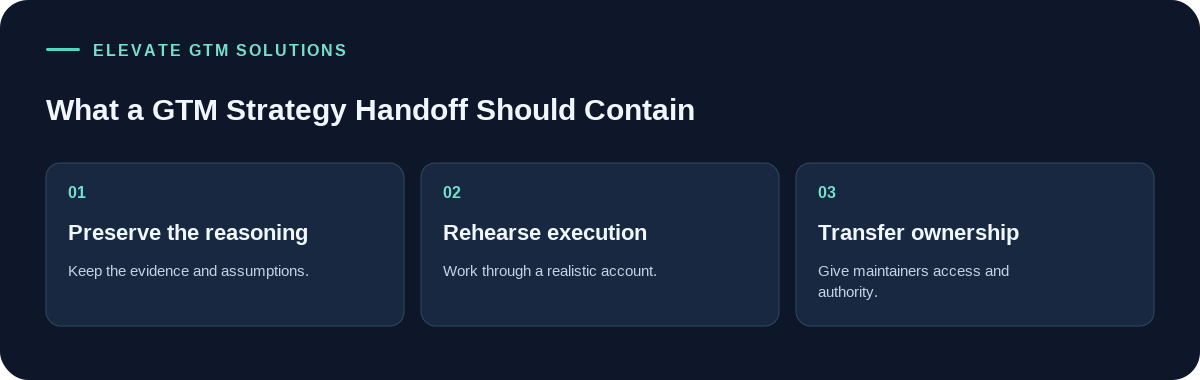
A GTM handoff is complete when the receiving team can act on the decision without calling the person who wrote the plan. Give sales, marketing and delivery the approved scope, the reason it was chosen, and a place to check changes. Then have them run a real account through it.
Transfer the decision, evidence and ownership
Seven parts of a handoff an enterprise can use
| Part | What it needs to contain | Acceptance test |
|---|---|---|
| Decision record | Segment, buying problem, offer, route, scope and alternatives declined | The sponsor can explain what changed and why |
| Evidence register | Sources, dates, definitions, confidence and open questions | An analyst can reproduce a material assumption |
| Offer and claims | Eligibility, package, supported use cases, exclusions and approved proof | A seller can describe what is available to a buyer |
| Activation plan | Work, owners, dependencies, dates and escalation path | A function lead can identify the next work item |
| Field kit | Discovery questions, objection handling, examples and exception route | A rep can work through an unfamiliar account |
| Measurement plan | Definitions, data sources, baselines and decision thresholds | RevOps can recreate the first review |
| Maintenance agreement | Custodian, permissions, version control and update schedule | A new owner can make and communicate an approved change |
The list describes responsibilities, not seven separate documents. A small launch might use one decision memo, an evidence appendix and an operating board. A larger program might need distinct assets by region or channel. Create separate artifacts when the owner, update frequency or access permissions differ.
Preserve why the decision was made
A strategy often reaches the field as a recommendation with no record of alternatives. This makes it hard to update. When an account executive challenges the target segment, a new owner cannot tell whether the original team considered that segment and rejected it, or simply never looked.
Include the options evaluated, evidence that favoured the chosen one, constraints at the time and the conditions that would make leadership reopen it. Mark where the team made an assumption. A provisional conversion rate can be useful for a pilot if the handoff says when and how to replace it. The same rate presented as a measured result can distort the next forecast.
Keep sources attached at the right level. A slide with a source list may still leave an analyst guessing which source supports a claim. Use a record that pairs the assumption with the evidence and its date. Protect restricted information while giving downstream users an approved way to verify or escalate questions about it.
Start by naming the people who inherit the work
A useful handoff begins before the final presentation. Ask which team will operate the new policy, which system will hold it and who can approve a change after the project closes. The project has not identified its receiving organization if the strategy team cannot answer those questions. Assign owners while they can still shape the deliverables.
Give each owner a practical task. The marketing lead can identify where approved positioning and proof will live. The RevOps lead can confirm which parts of the policy need fields, reports or routing. The sales leader can decide what managers will coach and how exceptions should reach the right person. A delivery lead can check whether the scope matches the operating model. Give each owner permission to reject a handoff artifact that cannot be used for its stated purpose.
Distinguish asset ownership from decision ownership. An enablement team may maintain a field brief, but only the commercial owner can change account eligibility or offer terms. The asset owner needs a path to request approval and a date to update the material after a decision. Conversely, an executive sponsor who approves strategy should not need to edit every downstream artifact personally.
Use a short table to align the handoff. Record the source asset, its users, the maintainer, the approver, the current version and the first review date. Where another system depends on the asset, name the integration or manual step. This record makes it easier to find out why a change to an offer did not reach the CRM or why a seller still has an older version.
Keep the evidence visible as ownership changes
A common handoff problem is that strategy outputs outlive access to their sources. A consultant’s research folder may contain references that the internal team cannot use after the engagement ends. A model may depend on extracts that are never transferred. A recommendation may cite a customer interview without explaining what can be shared or how it was obtained. Plan the access and usage rights before the final deliverable.
Create an evidence summary that travels with each material choice. Describe the source, time period, scope, known limitations and the decision it supported. Name the approved owner who can validate the claim if the original data are restricted. Give reviewers the ability to distinguish a measured observation from an estimate or assumption. This lets the internal team revise a recommendation without reconstructing the entire project.
Define what would trigger a fresh evidence review. A market price can change. A product may stop supporting a configuration. A CRM report may start counting opportunities differently. Attach expiration or review conditions where they matter. A source link is useful, but the receiving owner also needs to know when the underlying claim should be rechecked.
Make the work usable in the field and in systems
Hand off assets to the people who use them
The seller should receive the current qualification rule and a way to handle exceptions. The analyst should receive the definition behind the field. Give delivery the prerequisites and the promise that went to the customer. You may have three views of the same decision. Link them to the same approved source so the next change reaches all three.
Choose the systems the teams already use where possible. A sales kit may live in the enablement system and a launch plan in the project board. Link to canonical versions from the strategy record. The rollout will depend on personal relationships and memory if a rep must search a consultant’s shared drive to learn the latest eligibility rule.
Check permissions with the actual owners. Access that works for the project lead may fail for a regional seller or partner manager. Confirm which files can be shared externally. A sanitized customer-facing proof point and a detailed internal analysis need different permissions even if they cover the same result.
What the field kit should contain
A field kit should answer the questions a seller asks during a customer interaction. Who is eligible? What problem should the seller look for? What can the company promise? What proof is approved? What does the buyer need to do next? Where does a request go if it falls outside the standard offer? Put these answers in the order people use them.
Develop discovery prompts against the strategy assumptions. If the company is testing a paid pilot for existing customers, the seller needs to confirm the buying trigger, eligible systems, decision owner and a path to payment. A long list of generic discovery questions can delay learning. Add prompts where the response changes qualification, scope or the next action.
Include examples of what to say when a customer requests something outside scope. A seller may need to explain that a configuration requires feasibility review and give the buyer a date for a response. Make the route to that review clear. An approved claim is only useful if the field can distinguish it from a potential future capability or a one-time customer exception.
Test where the materials are found. An enterprise might have an approved field brief in an enablement portal and older copies in shared drives or attachments. Decide which link is canonical. Remove, archive or label copies where people are likely to encounter them. Train managers to use the canonical asset when coaching so the guidance enters the operating cadence.
What to give a seller and what to keep with the owner
| Item | Field view | Owner view |
|---|---|---|
| Eligibility | Clear criteria and how to verify them | Source assumptions, exception history and review rules |
| Customer promise | Approved scope, proof and boundaries | Approval dates, supporting evidence and renewal conditions |
| Qualification | Questions and evidence needed to advance | Definitions, field mapping and rationale |
| Exceptions | Route, expected timing and safe interim response | Authority levels, risk assessment and disposition log |
| Measurement | Required records and practical meaning | Cohort definitions, data lineage and review thresholds |
The same artifact can hold both views if permissions and readability allow it. Where underlying evidence contains confidential details, give sellers the approved claim and a way to request more context. They should not need broad access to customer interviews or commercial terms to use the new strategy.
Translate strategy into operating systems
Before the project closes, walk through each approved change and identify where it takes effect. A new account eligibility rule might affect an account list, a CRM field, a lead router and a seller’s discovery brief. The change could also affect partner registrations or an implementation intake form. State how users will handle the rule there until it can be updated if a system is out of scope.
Ask RevOps to identify the difference between a policy and a field. A field can record whether an account is eligible. The policy explains how eligibility is determined and who can change it. Testing whether the field works is separate from testing whether two people apply the rule the same way. Do both with representative records.
Plan a migration for existing records. Some accounts may already be in evaluation under the old policy. Some customers may have received terms that the company intends to honour. Define what should happen to those records when the new policy takes effect. Apply different treatment only where the business has approved it and make the reason visible to the people handling the account.
Use a test environment where possible. Exercise the happy path, a common exception and a case that should be rejected. If the rollout relies on manual instructions, run the same test with the people who will do the work. Confirm that the process produces a record the review team can find. An operational change cannot be evaluated if it disappears after the first handoff.
Rehearse and test acceptance
Worked example. Handoff after a channel change
A hypothetical SaaS vendor decides to serve a segment through partners. The strategy team has estimated the economics, identified partner profiles and recommended a pilot. To accept the handoff, the channel leader needs the scope, approved commercial terms and a recruiting brief. The direct sales leader needs rules for named accounts and escalation. Finance needs the model assumptions. Support needs to know what first-line requests the partner will own.
Before the handoff is complete, the receiving team rehearses three cases. The first is a straightforward partner-led sale. The second is an existing customer that already has a direct account owner. The third is a customer asking for an unsupported deployment. The exercise exposes a routing gap: the strategy assigned partner eligibility at company level but the contract system identifies purchasing entities. The team records a temporary rule and gives RevOps an owner and due date for a durable fix.
The project sponsor accepts the handoff with that exception documented, rather than treating the issue as either a failed project or an unrecorded workaround. The decision owner can monitor how often the exception is used. If it becomes common, the eligibility model may need to change before expansion.
Worked example. Handoff for a paid product pilot
Imagine an enterprise introduces a paid evaluation for a new reporting product. The strategy sets a small cohort of existing customers that have a reporting deadline, a named executive sponsor and a supported configuration. The pilot offers a fixed deliverable and a review at the end. Product marketing, sales, delivery and Finance each need a different part of the handoff.
The account team needs a qualified list and a discovery guide. The pricing owner needs approved terms, including what happens if the customer wants to extend the pilot. Delivery needs a standard intake form and a capacity reservation. RevOps needs to decide how a paid pilot will appear in the funnel without being mistaken for an annual subscription. The customer success team needs to know how to handle the customer relationship if the pilot does not convert.
The handoff rehearsal starts with an account that appears eligible. The seller finds a buying trigger and a potential sponsor. The solutions lead discovers that the configuration is supported only if the customer can make a specific data source available. The intake form has no place to record that prerequisite. The receiving team adds the field, assigns an owner and defines what happens if the customer cannot satisfy it. They rerun the case and check how the decision reaches the quote and forecast.
A second account requests a free pilot. The seller needs to know whether a free evaluation is permitted and who can approve it. Finance says payment is one of the assumptions the program is testing. The sponsor decides that any free evaluation will be tracked separately and will not count as evidence of willingness to pay. The handoff includes that decision, the safe field response and the route for exceptions. The program can now learn from the results without confusing different offers.
At the first operating review, the sponsor asks whether the internal team can reproduce the process without the original strategy lead. The account owners explain qualification, delivery can show how capacity was reserved, and RevOps can identify which events count toward the agreed outcome. The remaining gaps are assigned rather than hidden. This gives leadership evidence that the handoff works in practice.
How to set acceptance criteria that reveal real gaps
Start with a business outcome the recipient can demonstrate. For a segmentation change, ask a seller and an analyst to classify a sample account independently using the delivered rules. For a channel change, ask a partner manager and a direct account owner to resolve a deal registration conflict. For a launch plan, ask delivery to estimate and schedule a representative customer using the provided materials.
Describe which evidence proves that the test passed. The point is not to create paperwork. It is to distinguish “delivered” from “usable.” An owner can accept an artifact with a documented exception if the remaining risk is understood and someone can address it. A review should also specify whether the exception affects the customer experience or only internal efficiency.
Agree on thresholds before closeout. A project may be acceptable when all standard cases work and one rare case is covered by an approved temporary process. It may need more work if common cases depend on the project team’s judgment. The organization should know which conditions allow handoff, which require a remediation plan and which mean the work cannot yet transfer.
Record what happens if acceptance fails. The team might revise the asset and repeat the test, narrow the operating scope, or temporarily assign support. The receiving owner should receive authority to request the check again. Avoid moving the handoff date simply to meet a milestone if it leaves an operational gap that the customer will encounter.
A sample acceptance record
| Work product | Recipient | Test | Result to record |
|---|---|---|---|
| Eligibility guide | Account team | Classify a standard account and a borderline account | Criteria applied consistently or exception routed correctly |
| Approved claims | Product marketing and enablement | Find and verify one claim with approved proof | Current wording, scope and approval available |
| Transaction path | RevOps and Finance | Complete a representative approved test transaction | Correct offer, reporting and ownership |
| Delivery instructions | Implementation lead | Schedule a pilot and identify access requirements | Capacity, prerequisites and fallback confirmed |
| Review scorecard | GTM owner | Reproduce the first cohort view | Definitions and sources match the decision record |
Use the record to compare which teams are ready. An asset may be usable for one role but incomplete for another. A seller may be able to pitch an offer while delivery lacks the details to schedule it. The handoff must cover the path the customer will actually experience.
Handoff for a strategy that spans several regions
Give regional teams the same core decision record and a version that identifies local implications. The core record should explain the approved segment, offer, scope and measurement rules. The local view should identify the buyers, channel, eligibility evidence, local owners and any approved exceptions. The two should link to each other so a change in the global policy can be traced to the region’s materials.
Assign a person to resolve differences before they reach the field. A regional lead may need to adapt a campaign or partner example. A change to customer terms may require a different approval. Make the difference visible in the handoff. A receiving team can move faster when it knows which choices it can make without consulting the original sponsor.
Test transfer with a case that crosses regions. A local team wants to pursue a subsidiary of a customer with a centrally managed agreement. Ask who owns the conversation, what commercial terms apply and which system will show the opportunity. The handoff should explain where the approved answer lives and who can settle an exception. That is more useful than a general statement that local and global teams will coordinate.
Transfer ongoing maintenance
Plan the first 30 days after the handoff
In the first week, confirm access and publish the canonical versions. A short rehearsal led by the internal owner can use a representative opportunity. Resolve missing permissions and unclear rules. If any external support remains, put the issue path and end date in writing.
In weeks two and three, review real use. Ask managers to identify one example where the new guidance helped and one where it fell short. Check whether the same exceptions recur. Look for differences between what the project team intended and what the field was able to do with the available systems. Assign fixes to the people who own those systems and assets.
At the end of the month, hold a small operating review. Confirm which work products are current, whether the owner can reproduce the metrics, and which assumptions need new evidence. Decide whether to extend support, update the scope or move the work into normal operations. Do not let an informal relationship with the original project team become the permanent way to answer routine questions.
Make the transition period proportionate. A small launch with one cohort might need a single rehearsal and one review. A new sales motion across regions could require multiple teams to demonstrate they can use the same rules. The point is to prove ownership where it will actually be exercised.
Common failure modes and the signals that reveal them
There is no receiving owner. People attend the final meeting, but nobody can say who updates the source after a change. Name a role with time and authority and give it a first operating task. Write down the route if the task requires a different approver.
The recommendation assumes a system that does not exist. A workflow depends on a CRM field, approval queue or partner record that the enterprise has not built. Mark the dependency and decide whether to implement it, use a bounded manual process, or narrow the rollout. The handoff should identify the date when a temporary process expires.
Training was completed but the work is still hard to find. Attendance shows the material was presented. It does not show whether people can use it when they need it. Ask a rep to find the current rule without help and apply it to a customer example. Use the result to improve the system, wording or training.
Metrics lose their definitions. Reports continue to show numbers, but a new analyst cannot tell which accounts were included. Preserve the cohort and time-window definitions, and ask the receiving team to reproduce a result. When a definition changes, document the effective date and what can be compared.
Exceptions quietly become the policy. A temporary workaround may be copied by other teams. Record exceptions with a clear owner, scope and expiry. Review repeated exceptions to see whether the standard needs to change. A pattern can justify a strategic review without making every one-off a permanent rule.
A minimum set of fields for the first review
A review scorecard should give leaders enough information to decide whether the strategy is operating as intended. Include the cohort, expected outcome, current outcome, key exceptions, decision owner and next review. Keep definitions close to the figures. A view that counts account responses in one region and opportunities in another cannot support the same decision without more context.
For the paid pilot example, distinguish the number of eligible accounts, qualified evaluations, paid starts, completed pilots and approved rollouts. Ask whether the source systems can reproduce each transition. Document how to handle a customer that starts under one offer and converts under another. Identify the field or workflow that must change and who will maintain it if the data cannot answer the business question.
A receiving owner should know when to bring a finding back to strategy. An incomplete record may need a process fix. A recurring request for a different deployment scope may require an offer decision. Define the threshold or pattern that prompts review. The first handoff can remain useful even when the original choice changes, provided it tells the team how to assess and approve the next choice.
Move maintenance into an existing workflow
A strategy asset competes with the rest of a team’s work. Assign its review to a cadence that already exists where possible. A commercial review can check whether eligibility and offer assumptions remain current. A product release review can check which claims changed. A sales manager meeting can identify which exceptions reps are encountering. Give each meeting a concrete maintenance task, rather than adding a general update request.
Decide how version changes reach users. A small clarification may require a direct edit and an updated date. A change to eligibility may need an approved decision, revised records and notice to affected teams. Give the custodian a simple way to distinguish the two. Link the decision or approved source to the asset so the next person can see why it changed.
Review old materials where they are likely to be reused. A slide exported for one launch can end up in several seller decks. A customer-facing PDF may remain attached to a CRM template. Identify the major reuse paths and update or retire them after a material change. Some copies cannot be removed easily. Give users a visible way to find the current source before sending the material.
A straightforward change notice
A useful notice can fit on one screen. State what changed, when it applies, who is affected and what those people need to do. Include the current source and the treatment of open opportunities. Name the person who can answer questions. Make that visible rather than relying on a future reminder if a rule has an expiry or temporary exception.
Test the notice with the receiving team. Ask a rep working an active case whether the new rule applies to that case and where they would find proof. Ask a manager to show how they would coach it. A notice that only makes sense to the person who wrote it is unlikely to survive a transfer.
Close the work even when a dependency remains
Projects rarely finish with every question settled. A usable handoff distinguishes the work the enterprise can operate today from open dependencies. List each dependency, its business effect, temporary operating rule, responsible person and date for review. The sponsor should receive enough information to decide whether it is safe to proceed.
Suppose a partner launch is ready except for automatic reporting from the partner system. The sponsor might accept that constraint if a secure and approved manual process can provide the needed records for a small pilot. The handoff should state how records are collected, who checks them and how long the manual process can continue. A larger rollout should wait for a more durable path if the work cannot scale.
A different dependency might affect the promise itself. A manual reporting fix does nothing to make the offer deliverable if the partner cannot provide the agreed implementation support. The sponsor can narrow the scope, reassign the work or delay release. Recording the dependency helps leadership decide whether the issue is a manageable operating exception or a reason to change the launch.
Check who can retire a temporary rule. A project team may dissolve before the first exception expires. Assign a receiving owner to review the issue and give them access to the evidence. Where the original sponsor is still needed, put the review in the existing cadence. This keeps an open item from disappearing when people move to other work.
A published handoff example from software enablement
IDC’s public account of an unnamed enterprise software provider describes industry learning tracks and workshops at regional sales kickoffs. The intervention translated industry material into something the territories could practice. The source was published by the organization that delivered the work.
A receiving manager can turn that idea into an acceptance test. Ask a seller to explain a buyer’s operational problem, find the relevant approved evidence and choose the next step. The manager should be able to run the same exercise after the specialists leave. That verifies the handoff. A change in sales cycle length is a separate question and needs evidence from later opportunities.
Frequently asked questions
What is the difference between a strategy deck and a handoff?
A deck can summarize decisions and reasoning. The handoff connects those decisions to execution, ownership and maintenance. It should let the receiving team qualify a customer, act on the plan and explain how it would revise the strategy if evidence changes.
What files should be editable?
Make the artifacts the receiving team will maintain editable, subject to the engagement terms and data permissions. These commonly include the decision log, assumptions model, activation plan, field materials and measurement definitions. Agree on access and ownership before the engagement ends.
How can we tell if the handoff has worked?
The receiving team needs a realistic case and ask them to work through it with the delivered assets. Observe whether they can resolve eligibility, offer, approval and measurement questions. Record where they had to rely on someone who will no longer be involved.
Who keeps strategy assets current?
Assign a custodian for each maintained asset and name the person who approves consequential changes. One person may coordinate the overall handoff, while marketing, sales, finance and delivery maintain their own operating materials.
Related reading
See the GTM Strategy Framework and GTM Execution for the planning and delivery context.
Where Elevate fits after the strategy meeting
Elevate’s activation workflow can turn the approved strategy into plans and assets. Its execution workflow can help assign the next actions and carry them into the weekly review. Test one real handoff from the approved decision to the receiving team. Can a rep find the right version, and does the delivery owner see what was promised? If part of the handoff goes through a connected tool, verify that specific transfer. Explore Elevate GTM Activation · See Elevate integrations