
By the Elevate GTM Solutions Team · Updated November 10, 2026 · 22 min read
Enterprise Product Launch Readiness Checklist
An enterprise launch is ready when the people who sell, quote, onboard and support the offer can carry out the same approved promise. Product availability is one dependency. A test quote, a delivery rehearsal and a clear answer for the first out-of-scope account are stronger evidence than a green status report.
The Launch Execution module covers managing a launch. Use this guide to decide whether to authorize the release, narrow its scope or hold it.
Set the launch boundary and the proof required
Define what is being launched
Before making a checklist, write the offer, customer eligibility, availability, supported geographies and the first customer outcome. Describe what buyers can actually do on day one. Can they request access, sign a contract, begin installation or use the product in production? The same public announcement can imply different answers to each group.
Include the exceptions you expect to see. An integration that works for a particular identity provider may be reliable inside the first release and unavailable to customers using other providers. Sellers need an eligibility rule and a way to verify it. A footnote in the technical documentation is rarely enough to guide an account conversation.
Evidence to require at each gate
| Gate | What must be true | Evidence to bring | Owner who can stop it |
|---|---|---|---|
| Offer | A defined buyer can understand the scope and value | Approved offer sheet, eligibility, exclusions and usable proof | Commercial owner |
| Product | The supported use case works in the intended environment | Acceptance evidence, known limits and rollback plan | Product owner |
| Commercial | The enterprise can quote, contract and invoice correctly | Tested quote, approved terms, product identifiers and billing check | Commercial operations and Finance |
| Field | Sellers can recognize fit and route exceptions | Role-play, discovery checklist and approved claims | Sales enablement and sales leadership |
| Delivery | The team can onboard the expected customers | Staffing, onboarding path, test deployment and support handoff | Delivery or support owner |
| Review | Leadership can see problems early and change scope | Named metric owners, review dates and pause triggers | Launch sponsor |
The table is an initial model. Add specialist gates where the business needs them. The accountable teams should decide which approvals apply if the offer handles sensitive data or makes claims about regulated workflows. Record what the approver is being asked to verify so the approval does not become a blanket endorsement.
Work backward from the first customer commitment
A practical launch plan starts with the first transaction the enterprise wants to support. Describe a buyer who qualifies, what the seller can offer, how the order is recorded, which steps begin onboarding and when the customer can expect a useful outcome. That path exposes dependencies a product release calendar can miss. An integration can ship on time while the sales organization still lacks a way to quote it or the implementation team lacks access to the buyer’s environment.
Break the path into observable events. A rep confirms eligibility. A product specialist checks prerequisites. The buyer receives accurate pricing and a description of scope. Finance can recognize the correct product and billing arrangement. The implementation team receives the context it needs. Support knows how to handle the first issue. Each event needs an owner, evidence and a fallback. A readiness gate is useful when its owner can explain what was tested and what remains outside scope.
Keep one representative case and one exception at hand. The representative case shows whether the designed flow works. The exception reveals how the company behaves under pressure. A customer who needs an unsupported connector may still be an attractive account. An approved response tells sellers what to say now and where to take a case for later review. If no one can give the seller an answer, the easiest way to keep the opportunity moving may be to make a promise the company did not approve.
Turn the launch boundary into field instructions
“Available to enterprise customers” can mean any account with a certain package, customers in a specific region, or only customers with a technical prerequisite and reserved capacity. Write the conditions in a form a seller and an implementation manager can apply independently. If they produce different answers for the same account, either the rule is ambiguous or the evidence they can access differs.
Include the effective date and what happens before that date. A team may be able to offer discovery now, issue quotes next week and begin production deployment the following month. The offer should distinguish those commitments. A vague reference to early access can cause customers to assume availability and sales teams to assume that delivery will work out later.
Specify how to verify each condition. A rep may be able to check edition and region in CRM, while a specialist needs to confirm data access. Name the system where the evidence belongs. For a limited launch, make the number of remaining onboarding slots visible to the people who can reserve them. A capacity limit without a reservation process can be exceeded even when everyone follows the written policy.
Use a brief example in training. Show an account that qualifies, an account that needs further review and an account outside scope. The exercise tests how the rep explains the offer to each buyer. Listen for promises about dates or capabilities that are missing from the approved offer. Correct the source guidance as well as the answer. The next seller should be able to get it right without attending the same conversation.
What counts as evidence at a gate?
| Gate | Weak substitute | Better evidence |
|---|---|---|
| Offer approval | A deck marked final | A versioned offer sheet with explicit eligibility, scope and exclusions |
| Product verification | A successful demo run by the product team | A representative use case completed under launch conditions with known limitations |
| Quote and contract | Confirmation that a SKU exists | A tested quote, order and billing path using the intended package and terms |
| Sales readiness | A completed training session | A seller can qualify a case, use approved claims and route an exception |
| Implementation capacity | A staffing spreadsheet | A named team, a capacity reservation and a rehearsed onboarding path |
| Support readiness | A new help article | A representative issue routed to an owner and resolved using the runbook |
| Monitoring | A dashboard link | A defined review cadence, checked source data and a named person who can act |
The evidence should fit the size of the decision. A pilot may need one repeatable path and clear limits. A broad release may need tests across configurations, markets or channels. A demonstration that used privileged access can be useful for product learning. It cannot establish that a customer or a support agent has the same access in production. Record the environment and permissions used in the test.
Every gate also needs a definition of an acceptable unresolved issue. A launch can proceed with a known cosmetic defect if it does not affect the commercial promise or the operation of the service. An unresolved prerequisite that blocks the supported workflow has a different consequence. The sponsor needs to be able to tell those two situations apart. A long defect list with no customer impact assessment is difficult to use in a launch decision.
Rehearse the customer transaction
A launch rehearsal the team can run in one meeting
Send the participating teams a representative customer record and a short description of what the customer wants. Ask them to begin at the point they would encounter the work in real life. Sales should qualify it. Product or a solutions specialist should verify the technical path. Operations should prepare the transaction in an approved test environment. Delivery should describe what it needs from the customer and how it would schedule onboarding. Support should handle a plausible first issue.
Avoid having the project lead walk everyone through the preferred answers. The exercise is meant to show what the receiving teams can do with the materials and access they will have after release. If someone needs a private message to find a document, record the dependency. If the seller uses an outdated slide because it appears first in search, fix the underlying distribution problem.
Introduce an exception midway. The customer needs an unsupported system, a quote in a currency outside the launch, or a start date the delivery team cannot meet. Ask who can decide, how long the answer would take and what the seller should tell the buyer in the meantime. The group should be able to reach a safe temporary response even if the exception itself needs a later decision.
Close the rehearsal with a brief action record. List each gap, the person who can fix it, the verification step and the date the sponsor needs an answer. Group related gaps. An incorrect quote and an inaccurate product description might share the same stale package definition. Fixing both separately can leave the underlying problem in place.
Review dependencies in the order they can fail
Some tasks can run in parallel. Messaging development can begin while the product team prepares final validation, as long as the claims are marked provisional. Others have a strict order. A seller cannot promise availability before the delivery boundary is agreed. Training should use the final qualification and escalation rules. An approved quote must be tested before the team uses it with customers.
Draw the path from the earliest decision to the latest customer commitment. Mark what depends on a person outside the launch team, such as an approval from Finance, a partner enablement session or a production access change. If a dependency slips, ask which customer promise changes and whether the launch can be narrowed safely. This produces a better decision than moving every milestone by the same number of days.
Watch for hidden assumptions in work estimates. “Train the sales team” might include preparing materials, finding a time across regions, coaching managers and checking whether a rep can apply the rules. The work can be completed in stages. Identify which stage is required before a limited launch and which can happen before a later rollout. That distinction can protect the schedule without reducing the quality of the first customer experience.
Plan for an existing customer and a net-new customer
An installed-base launch can take advantage of an established relationship, existing vendor approval and account knowledge. It may still need a new contract, a different support owner or a change in the customer’s permissions. An account manager may know the customer’s business priorities but lack the technical information required for onboarding. Check these assumptions before using an existing relationship as evidence of readiness.
A net-new customer may need more time for procurement, security review and implementation. It may also have a different view of the offer because it cannot compare it with products the company already supplies. Prepare the right proof and a clear path to an approved evaluation. Test one representative path for each if the enterprise launches to both groups. A working upgrade transaction does not prove the company can onboard a customer it has never served.
The two groups also require different measurements. For the installed base, review adoption, commercial fit and the effect on ongoing commitments such as renewal. For net-new buyers, examine reach, qualification and progress through evaluation and procurement. If one group has a longer decision cycle, report outcomes on a comparable basis and make the timing visible. Avoid calling the early results a general demand signal until the company can separate these effects.
What changes when the launch runs through a partner?
Add the partner’s customer path to the readiness test. The partner needs to recognize an eligible buyer, use an approved description, register the opportunity, arrange specialist support and know what its own team is expected to deliver. A vendor can be ready for direct sales while the partner path remains untested. Treat them as separate launch scopes until both work.
Check where the contract and support responsibilities sit. If the partner can sell the product but the vendor handles onboarding, the handoff needs the customer’s scope, timing and technical prerequisites. Confirm the approved boundaries and the route for escalating a case it cannot support if the partner delivers. A successful first meeting does not prove that either company can meet the customer’s commitments.
Rehearse a conflict with an existing account. The partner brings a division of a company already served by the direct team. The launch owner needs a rule for who contacts the buyer and which terms can be used. The account and partner teams need to see where the decision is recorded. If they rely on an informal conversation, the same issue can recur in another region.
Measure the first partner cohort on more than introductions. Review the accuracy of qualification, the number of viable evaluations, the quality of the handoff and the effort the vendor supplies behind the scenes. A promising channel can justify further testing even when early volume is low. A high volume of poorly qualified accounts can exceed support capacity and teach the enterprise little about repeatable demand.
Choose go, narrow or hold
Worked example. A limited release that can safely go ahead
A hypothetical enterprise SaaS company is preparing a governance add-on. Its existing customers can activate it using one of two identity configurations. A third configuration works in a test environment but has no support runbook. The marketing launch is four weeks away, and a strategic customer wants the third configuration.
The launch owner can delay everything, launch with two configurations, or approve a separately governed exception for the strategic account. The company chooses the second option and keeps the exception open as a separate decision. The eligibility checklist names the two supported configurations. The partner brief and product page describe availability accurately. Sales receives a short script for accounts that are not ready.
Delivery runs a realistic load test based on expected pilot starts and reserves onboarding time. Finance and RevOps run one quote and activation test. On launch day, the team knows how many deployments it can begin and which problems require a pause. It can keep the public promise without treating an incomplete edge case as a reason to stop a well-defined release.
Make a go, narrow or hold decision
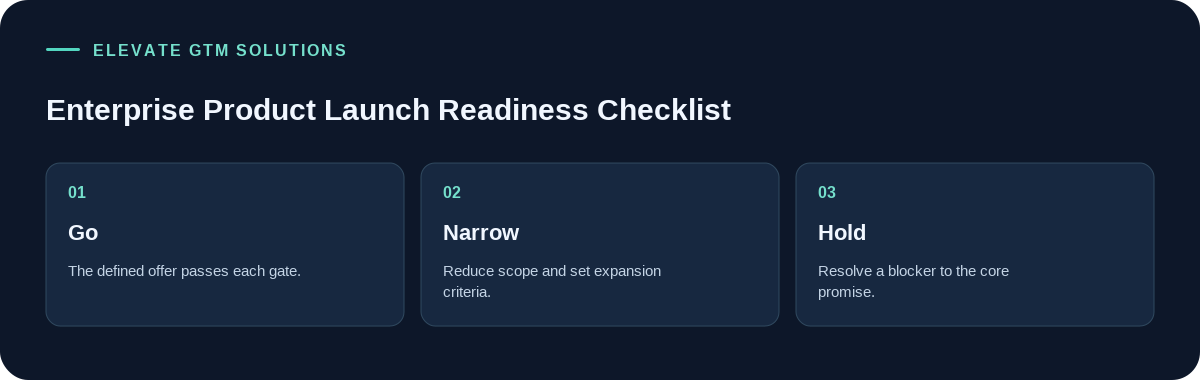
A status grid can help reveal risk but it cannot decide for the sponsor. Bring three options where possible. Go when the defined scope passes the gates. Narrow when a separable audience, region or feature can be removed without misleading buyers or breaking the business case. Hold when the open issue affects the core promise, the ability to contract or the capacity to support customers.
Write what the decision authorizes and who will review it next. A narrow launch should have a measurable condition for expansion. A hold should identify which evidence will reopen the gate. If someone accepts a known risk, record the owner, exposure and fallback. The decision record should be clear enough to explain to a new executive who did not attend the meeting.
Decide how to communicate a narrow launch
A narrow launch should have clear boundaries in all materials that reach the customer. Product, sales, marketing and support should agree on the supported configurations and use cases. If marketing says the product is generally available while the sales guide describes a limited release, buyers may reasonably expect more than the delivery team can support. Use language that describes what a customer can do now.
Give partner and regional teams the same decision record with examples that fit their context. A partner may need to explain why a prospect can request an evaluation but cannot yet buy through its normal channel. A local team may need to adapt terminology without changing the offer. Establish who can approve those adaptations. The launch owner should know where a regional or channel-specific version lives and who will update it after a change.
Prepare a response for customers who are interested but outside the first scope. The response could invite them to discuss future eligibility, offer an approved alternative or schedule a later review. Keep the distinction between a request and a commitment visible. A waitlist can reveal demand. It does not establish a delivery date or justify putting an unapproved capability in a proposal.
Worked example. An approved product with a failed transaction
Imagine a company plans to release an analytics add-on through direct sales. Product has verified the supported deployment and marketing has prepared the page. During rehearsal, the team finds that the quote works for new annual contracts but does not calculate the correct charge for customers adding the product mid-term. Most launch prospects are existing customers.
The sponsor has three options. Launch to net-new customers only. Hold until the amendment path is fixed. Narrow the launch to a small number of approved existing accounts with a tested manual path. Each choice changes the business case. A net-new release might prove that the system works but provide little evidence about installed-base demand. A hold protects the transaction path and delays learning. A manual exception may be viable if Finance owns it, validates the result and can manage the workload.
Suppose the sponsor chooses the third option. The decision record should name the approved cohort and the staff who can issue and verify a quote. Marketing should direct general inquiries to the existing account team without suggesting that all customers can buy immediately. The rollout expands only after the automated quote and amendment path passes the same tests. The manual step has an end date. This lets the company learn without hiding the operational gap.
Run an early review after the first transaction. Confirm whether the estimate was correct, what internal effort it took and whether the customer received the expected documentation. If the path works once because a senior employee personally corrected it, that is evidence about the exception process, not readiness for a broad release. Use the example to check the scope of the decision before more accounts enter the funnel.
Use a launch-day decision record
A brief decision record can prevent multiple interpretations of “go.” Include the product or offer version, eligible customer groups, sales channels, regions, conditions, capacity, effective date and responsible sponsor. List known exclusions and how teams will communicate them. State what evidence is required to expand if the decision is a narrow launch. If it is a hold, state what can continue, such as discovery or enablement preparation.
Give it a short distribution list. The people who change website copy, quoting rules, seller material or support instructions need to receive the current version. Ask them to confirm the operational change, not merely receipt. A launch may be announced at one time and become available at another. Make the order visible to the people responsible for each event.
Include the treatment of open deals. If a seller used an earlier offer in a conversation, they need to know whether the promise was authorized and what to say if scope changed. An agreed transition rule can protect customers and prevent the field from applying a new offer retrospectively. Review high-exposure cases directly rather than assuming a general announcement is sufficient.
A launch-day briefing
Start with what customers can do today and which ones qualify. Give sellers the one link they should use for current guidance and the escalation route for exceptions. Tell delivery how many starts are authorized and how capacity is assigned. Tell support what kinds of issues may arise and which cases need immediate attention. State the time of the first review and the person who can pause the rollout.
The briefing should answer common questions without repeating the entire launch plan. Test it by asking someone outside the core project to handle a realistic case after reading it. If they need another presentation to understand availability, eligibility or ownership, revise the briefing. A clear launch note makes the right action easier to take under pressure.
The case for leaving a launch gate open
A gate can remain open without creating confusion if the team states exactly what is pending and what the company may do while it waits. A security review might be needed before production access while internal training can continue. A connector may need more verification while customers using another supported configuration can move forward. The sponsor should know what work can safely proceed and where the boundary sits.
The risk is treating “pending” as progress without an owner or date. Each open item should have an acceptance test and a person responsible for bringing evidence. State what happens if it misses the next review. This helps the enterprise make a real choice at the right time instead of quietly slipping into an unapproved launch.
Launch readiness improves when the company can trace its promises to the people and systems that deliver them. Start with the first customer commitment. Work through the actual transaction. Then choose a scope the enterprise can sell, deliver and learn from.
Run the launch and watch for reasons to pause
What to examine in the first operating review
Bring a small number of actual cases. Include an account that moved through the intended path, an account that failed eligibility and an account that required an exception. Check which evidence was available at each stage. If several accounts failed for the same reason, ask whether the rule was hard to verify, the audience was wrong or the product scope needs a strategic review.
Review delivery effort against the estimate. Track time required to schedule, configure and support the first customers. An issue that takes two hours in a pilot can become material at higher volume. Ask which steps rely on a particular specialist and what would happen if they were unavailable. The business can use early evidence to simplify the workflow or keep the rollout narrow until it can support more demand.
Look for changes in the customer promise. A seller might describe a future capability as available because the boundary was unclear. A customer may interpret a limited pilot as a production commitment. Correct the message and check whether similar assumptions appear in active deals. The sponsor should know which issues can be addressed through guidance and which require a change to the offer.
Decide what the review authorizes. The enterprise may continue at the same scope, extend to another cohort, pause new starts, or change the plan. Record who must act and what will be checked next. This decision is more useful than a general label such as “launch progressing well.”
Put a pause and restart rule in writing
A pause can apply to a specific promise, configuration, region or channel. Decide who has authority to call it, which teams receive the message and what happens to active customer work. A support issue may require holding new starts while continuing to serve current customers. An invalid claim may require correcting public material and notifying sellers even when the product itself is available.
State what evidence will restart the work. A restored integration should pass a representative workflow under the actual launch conditions. A billing problem should be verified on a valid test order and reviewed by Finance. An issue with staffing should have named capacity rather than a general assurance that a team will help. Re-run the relevant gate and record the decision.
Prepare a safe customer response in advance. The field can acknowledge that the team is checking a specific issue and explain when it expects to provide an update. Avoid promising a date without approval. Give managers a way to identify the affected accounts and route urgent cases. This is part of readiness because a launch will inevitably expose information the planning team could not know.
A narrow pause can preserve learning in the rest of the rollout. If one configuration fails, the sponsor can continue with those already verified as long as the issue does not affect the shared promise. A pause that applies to everything may be appropriate when the team cannot yet isolate the problem. Make the reasoning visible so the decision can be revised as evidence improves.
An illustrative week-by-week runbook
| Week | Owner action | Decision or evidence |
|---|---|---|
| Four weeks before | Confirm the intended buyer, package and supported configurations | Sponsor agrees on the first scope and open dependencies |
| Three weeks before | Run transaction and delivery tests with realistic records | Finance and delivery show which paths work |
| Two weeks before | Rehearse seller, support and exception cases | Managers can apply the launch rules without the project lead |
| One week before | Hold the final gate review and prepare the field briefing | Sponsor records go, narrow or hold |
| First week after | Review actual quotes, starts and support cases | Owner decides whether to hold scope or correct a specific issue |
| Before expansion | Test the next cohort’s conditions and reserve capacity | Sponsor approves the added scope with evidence |
This is an example, not a schedule to copy regardless of buying cycle or operating conditions. Add time for approvals that determine whether the enterprise can proceed. Keep the final gate review close enough to launch to reflect current evidence, while allowing time to make the changes the decision might require.
One useful check is to identify the person who can say what has changed since the previous review. Record how it was verified if a defect closed. Update the customer commitment it affects if a dependency moved. Make sure the teams responsible for claims and delivery have the same version if the scope changed.
What a buyer trial adds to the launch rehearsal
Forrester’s 2026 business buying summary identifies trials as a means of reducing purchase risk and describes a growing role for procurement. That finding supports testing what happens after a qualified prospect asks to try the product. It does not make a trial appropriate for every offer or show that offering one improves conversion.
A rehearsal should start with a plausible request. A buyer wants to try the product in one approved environment. Can the seller identify who authorizes the trial? Can the customer sign the appropriate terms and get the permitted access? Does the support team know the scope and exit date? Repeat the exercise with an ineligible environment. The sponsor now has evidence about two decisions the launch needs to handle in practice.
Frequently asked questions
Who owns launch readiness?
A cross-functional launch owner assembles the evidence and issues the recommendation. Individual owners verify their gates. A sponsor with commercial authority decides what the company will launch and what risks it will accept.
Can we launch before all sales teams are trained?
A limited launch can be viable if the participating field teams can handle the approved scope and the rest of the business knows how to route demand. A broader launch needs coverage and support that match the public promise.
Which issues should stop the launch?
Issues that break the core customer promise, prevent a valid transaction, create unacceptable customer risk or leave the team unable to support the approved scope should reach the sponsor before launch. Define precise stop criteria for the offer and operating environment.
What is the difference between availability and readiness?
Availability describes whether a customer can access the product. Readiness includes the whole commercial and operational path, from qualification through delivery and support. A feature can be available while the enterprise is still unprepared to sell it.
Related reading
See the Launch and Execution guide and the GTM Strategy Framework for the broader launch process.
Where Elevate fits before a launch
Once you know what you can sell and to whom, Elevate’s GTM Activation workflow can help turn those choices into a launch plan, campaigns and field assets. Use the plan to line up the work, then run the test quote and onboarding rehearsal in the systems the teams actually use. Put any failed checks back on the launch plan with an owner and a date. Explore Elevate GTM Activation
Contents