
Elevate GTM Readiness Framework
A finished positioning document is not the same thing as validated positioning. The GTM Readiness Framework measures whether the evidence underneath a launch actually holds up, not whether the paperwork got done.
Published 2026-07-31
A Series B company spent eight weeks preparing to launch into a new market segment. By the time launch day arrived, the team had a finished positioning document, a published pricing page, a full sales enablement deck, and sign-off from every relevant stakeholder in a final readiness meeting. Six weeks after launch, the company pulled back, rewrote the positioning, and relaunched with different messaging, because the segment simply did not respond to the original pitch the way the team had assumed it would. Every document had been completed. Every box had been checked. None of it had actually been validated against the market before the team committed to it.
This is the specific gap the Elevate GTM Readiness Framework is built to close: the difference between having done the work and having evidence that the work is actually correct. Most organizations conflate the two, treating a finished document as equivalent to a validated answer, because a finished document is easy to observe and a validated answer requires a more deliberate, evidence based check that most teams skip under the pressure of a launch deadline. This piece defines readiness precisely, distinct from both raw activity and the ongoing operational maturity covered elsewhere in this content series, and lays out the specific dimensions and evidence standard a genuine readiness assessment needs to apply before a company commits real resources to a launch, a market entry, or a significant scale-up.
The company from the opening example is not an outlier, and the pattern it illustrates is common enough that most experienced GTM operators will recognize a version of it from their own history. What makes this pattern worth naming explicitly, rather than treating as an unfortunate but unavoidable cost of doing business, is that it is largely preventable, provided an organization is willing to apply a genuinely evidence based check before committing resources rather than after the fact, once the cost of being wrong has already compounded.
Readiness Is Not the Same Thing as Maturity
Before defining the framework itself, it is worth distinguishing readiness from a related but different concept this content series has covered elsewhere: GTM maturity. Maturity describes how sophisticated an organization's ongoing GTM operation is, how continuously its signal, scoring, and feedback loops run, assessed as a standing characteristic of the organization over time. Readiness is narrower and more specific: whether a particular initiative, a launch, a market entry, a major scale-up, has enough validated clarity across the dimensions that actually predict its success to justify committing real resources to it right now.
A highly mature organization, with sophisticated ongoing GTM operations, can still launch a specific initiative without adequate readiness, if the specific evidence underneath that particular initiative was never actually validated. Conversely, a less operationally mature organization can still assess and achieve genuine readiness for a specific, well scoped initiative, even without the broader continuous infrastructure a maturity assessment would evaluate. The two concepts are related, a mature organization typically has better tools for assessing readiness quickly, but they are not the same question, and conflating them is itself a common source of false confidence, where a company assumes its overall operational sophistication guarantees that a specific initiative has actually been validated.
This distinction matters practically because the two assessments call for different remedies. A maturity gap is addressed by investing in the kind of continuous, connected infrastructure described elsewhere in this content series, closing feedback loops, unifying signal, building the organizational discipline to act on both consistently. A readiness gap is addressed by validating the specific claims underneath a specific initiative before committing resources to it, which can often be done relatively quickly even at an organization whose broader maturity is still developing. Treating a readiness gap as if it required a full maturity overhaul, or treating a maturity gap as if a quick readiness check could substitute for it, both lead to misallocated effort relative to the actual problem at hand.
Why Teams Mistake Activity for Readiness
The core failure mode this framework addresses is subtle enough that it rarely gets named directly inside the organizations experiencing it.
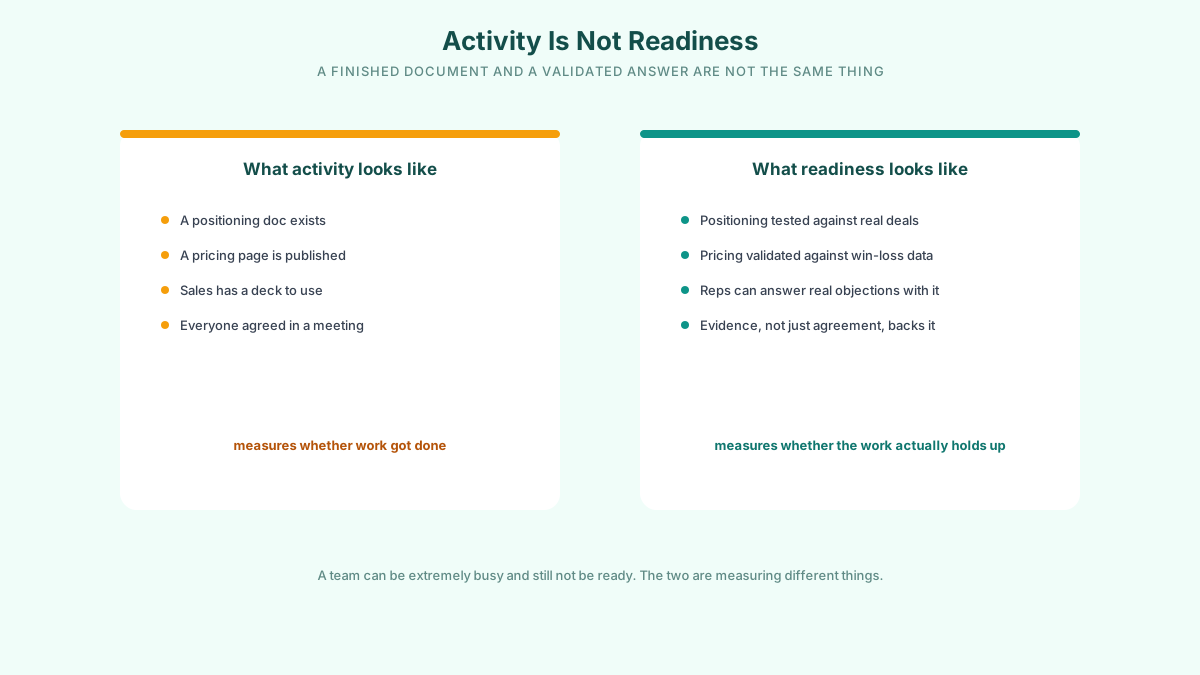
Activity is visible, schedulable, and satisfying to complete. A positioning document gets written, reviewed, and signed off. A pricing page gets published. A sales deck gets built and distributed. Each of these is a real, necessary piece of work, and completing them genuinely feels like progress, because it is progress, toward having something to launch with. What activity does not measure is whether the underlying claims in that positioning document, that pricing structure, that sales narrative, actually hold up against real market evidence, rather than simply reflecting what the team internally believed to be true at the time they wrote it down.
Readiness asks a different, harder question: not whether the work got done, but whether the work is actually correct, evidenced against real, current signal rather than assumption, internal consensus, or a plan that made sense when it was first drafted but has not been checked since. A team can be extremely busy, meeting every internal deadline, and still not be ready, because busyness and validation are simply different things, measured by different evidence, and an organization under launch pressure has every incentive to substitute the more visible, more schedulable one for the harder, less visible one.
This confusion is compounded by a related bias: internal consensus feels like validation, even when it is not. A room full of smart, well intentioned people agreeing that a positioning angle sounds right is a genuinely useful signal, but it is not the same kind of evidence as that positioning angle actually testing well against real prospects, real competitors, and real market signal. The Readiness Framework is built specifically to keep these two kinds of evidence, internal agreement and external validation, from getting collapsed into a single, falsely reassuring readiness score.
The Five Dimensions the Framework Assesses
Genuine readiness assessment requires evaluating specific, distinct dimensions rather than a single, undifferentiated sense of whether a team feels prepared.
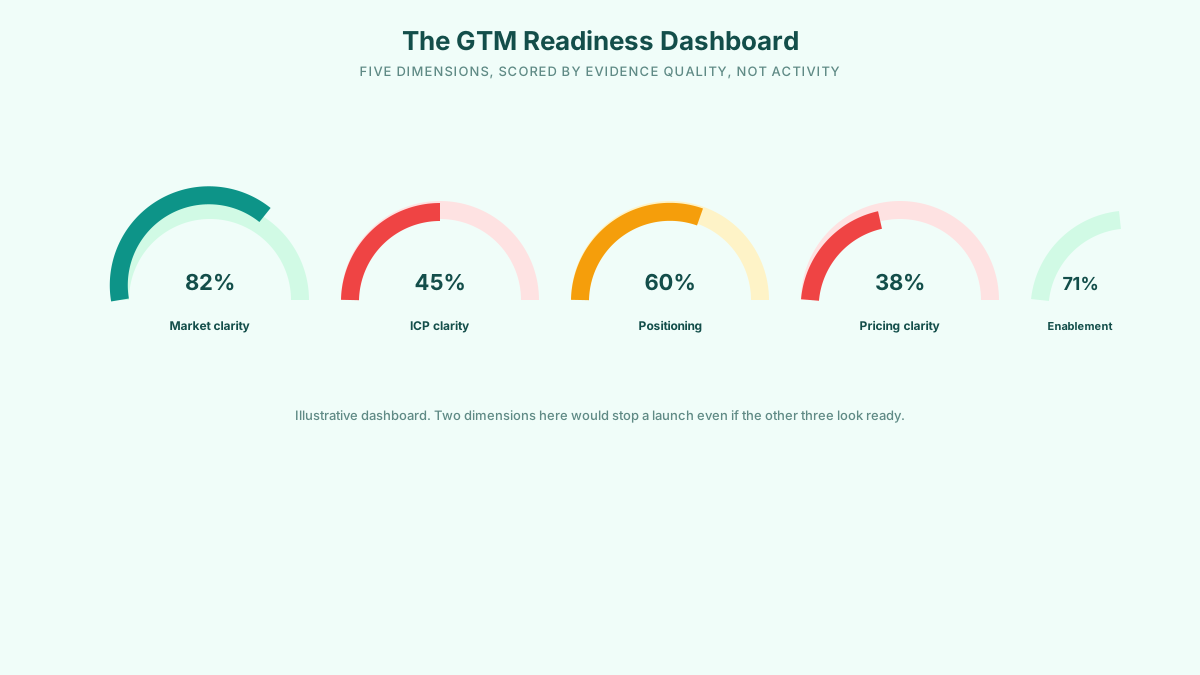
Market clarity asks whether the team has a validated, current understanding of the market it is entering, not just an assumption carried over from a previous planning cycle or a competitor's publicly stated positioning. This dimension is frequently the weakest in a new market entry specifically, since a team entering an adjacent market often extrapolates from its existing market's dynamics rather than validating that the new market actually behaves the same way.
ICP clarity asks whether the ideal customer profile for this specific initiative has been tested against real conversion or engagement evidence, rather than defined once, early, and never revisited against what has actually happened since. A common failure pattern here is an ICP that was accurate at the company's previous stage but has not been re-validated against how the company's actual customer base has evolved, a specific version of the broader ICP drift problem covered in more depth elsewhere in this content series.
Positioning clarity asks whether the specific narrative planned for this launch has been checked against real buyer language and real competitive context, not just internally agreed upon as directionally correct. Internal agreement is a genuinely useful early signal, but it reflects what the team believes will resonate, not evidence that it actually does, and the two can diverge more than a confident internal team typically expects.
Pricing clarity asks whether the planned pricing and packaging has been validated against actual win-loss data and competitive pricing reality, rather than set based on an internal cost-plus calculation or an intuition about what the market will bear. Pricing is disproportionately likely to be under-validated relative to how consequential it is, since it is often finalized late in a launch process, under time pressure, with less rigorous testing than positioning or messaging typically receive.
Enablement readiness asks whether the people responsible for executing, sales reps, channel partners, customer success, actually have what they need to represent the initiative accurately and confidently, tested against real objections rather than assumed sufficient because the material exists. A deck that exists is not the same as a deck a rep has actually practiced defending against the specific, difficult questions real prospects are likely to ask.
| Dimension | Core readiness question | Common false signal |
|---|---|---|
| Market clarity | Is the market understanding current and validated? | An old market analysis nobody has revisited |
| ICP clarity | Has the ICP been tested against real conversion evidence? | An ICP defined once, early, and never rechecked |
| Positioning clarity | Has the narrative been checked against real buyer language? | Internal agreement that the positioning sounds right |
| Pricing clarity | Is pricing validated against win-loss and competitive data? | A cost-plus number nobody has stress tested |
| Enablement readiness | Can the team represent this accurately under real objections? | A deck exists, but nobody has practiced with it live |
A critical design principle in this framework is that these five dimensions are scored independently, not averaged into a single number. A launch with strong market clarity and enablement readiness but genuinely weak pricing clarity is not seventy percent ready in any meaningful sense, it has a specific, identifiable gap that will likely surface as a real problem regardless of how strong the other four dimensions are. Averaging obscures exactly the information a readiness assessment exists to surface.
Evidence Quality, Not Just Presence
Within each of the five dimensions, the framework applies a further, equally important distinction: not just whether a claim exists, but how strong the evidence behind that claim actually is.
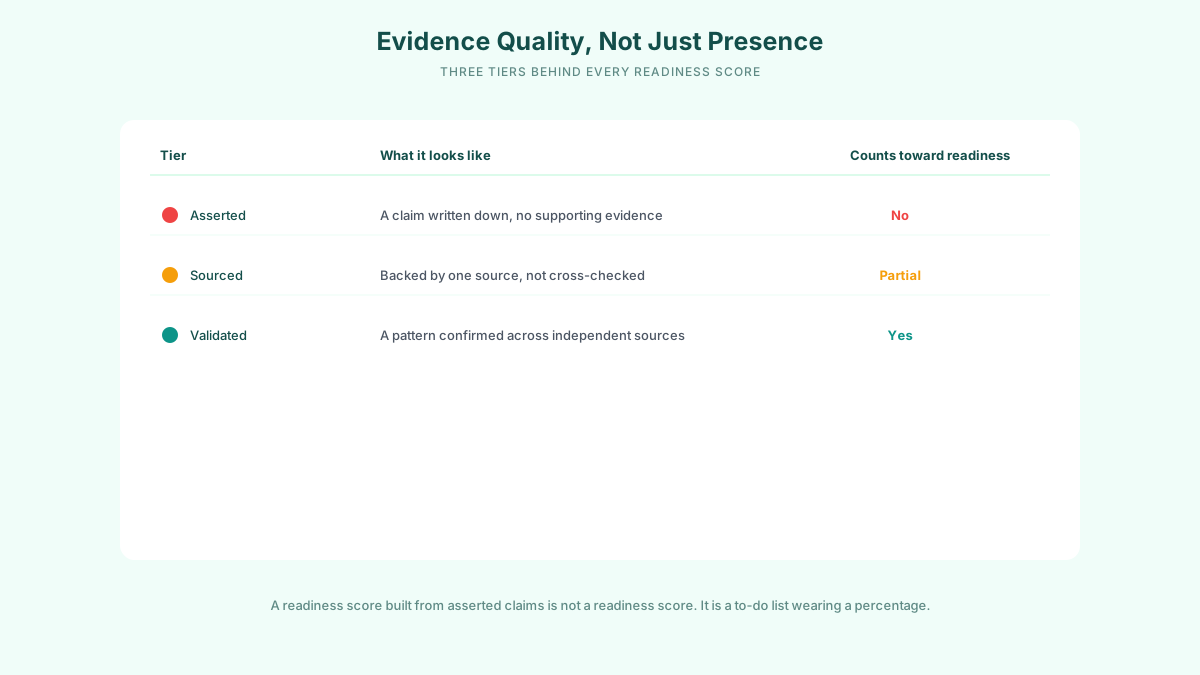
An asserted claim is a statement written down without meaningful supporting evidence, an internal belief presented as fact because nobody has yet checked it against anything external. This is the most common tier in a rushed launch process, since it is the fastest to produce and the easiest to mistake for something more solid once it has been repeated confidently enough times in internal meetings.
A sourced claim is backed by at least one piece of evidence, but that evidence has not been cross-checked against independent sources, meaning it could still reflect that one source's particular bias or blind spot rather than something genuinely true about the market. A single customer interview, a single competitor's public pricing page, a single analyst report, each represents real evidence, genuinely better than an unsupported assertion, but still vulnerable to being wrong in a way a broader check would catch.
A validated claim is backed by a pattern that holds up across multiple, independent sources, the same evidence standard this content series has described elsewhere as the foundation of genuine strategic synthesis, applied here specifically to the question of whether a claim is strong enough to build a launch decision on. This is the tier that should actually drive a go decision, since it reflects a level of cross-checking that meaningfully reduces the risk of building a launch on a single source's specific error or blind spot.
Only validated claims should count fully toward a readiness score in this framework. Sourced claims count partially, reflecting real but incomplete evidence. Asserted claims should not count toward readiness at all, regardless of how confidently or how often they have been repeated internally, since repetition inside an organization does not change how well a claim has actually been tested against the outside world. This distinction is what keeps a readiness score honest, since a team under launch pressure has every incentive to round asserted claims up to validated ones simply because deadlines are approaching, and an evidence tiered framework makes that rounding considerably harder to do without noticing. Making the evidence tier explicit and visible for each specific claim, rather than folding it into a single overall confidence level, is what turns this from a vague gut check into something a team can actually audit and disagree about productively.
The Cost of Launching Without Readiness
The cost of skipping this evidence check is not evenly distributed. It grows sharply once readiness falls below a certain threshold, rather than declining in a smooth, predictable line as readiness improves.
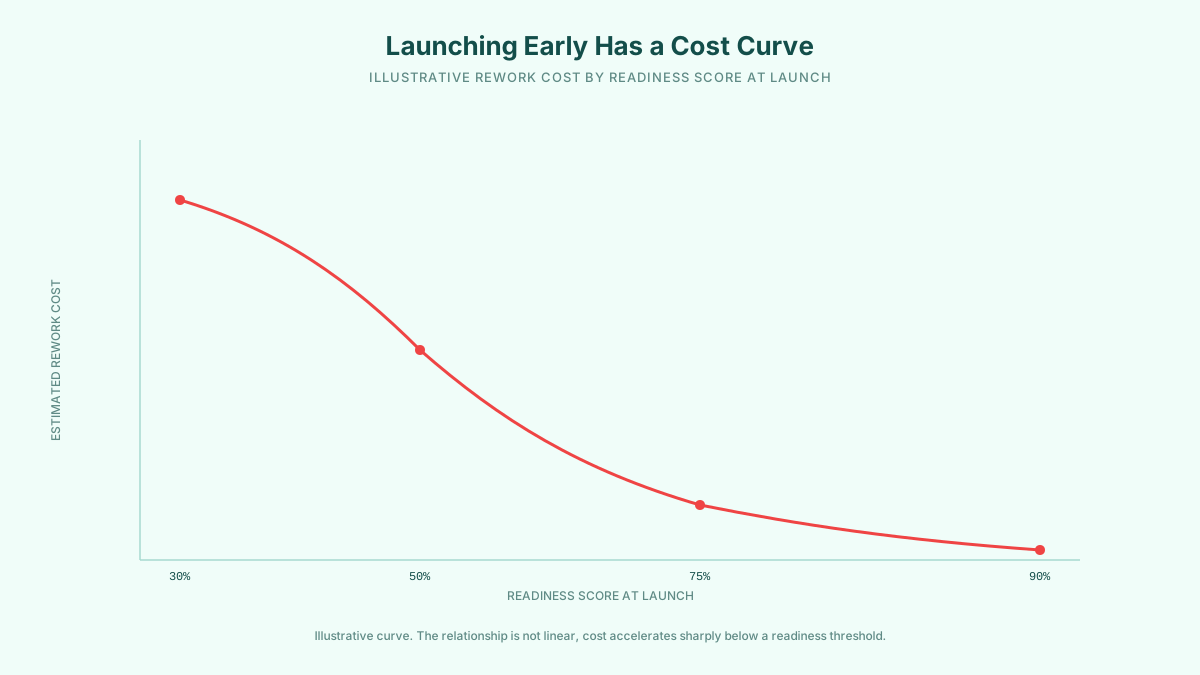
This pattern echoes a well documented phenomenon in the broader startup and product literature, often described as premature scaling: committing significant resources to growth or launch before the underlying product-market or GTM assumptions have actually been validated. Research on startup failure has repeatedly identified premature scaling as one of the more common, avoidable causes of otherwise preventable failure, distinct from genuinely running out of market demand. The specific mechanism in both cases is similar: resources get committed based on assumed rather than validated readiness, and the resulting rework, repositioning, replatforming, or in the more severe cases, winding down entirely, costs considerably more than the time it would have taken to validate the underlying assumptions before committing.
The nonlinearity of this cost curve is worth dwelling on specifically, since it explains why a readiness assessment often feels unnecessary right up until the moment it clearly was not. A launch at seventy five percent readiness and a launch at ninety percent readiness may look similarly prepared from the outside, both have most of the visible activity completed, but the seventy five percent launch is disproportionately more likely to hit the specific, compounding rework costs this piece has described, precisely because the remaining unvalidated claims tend to be concentrated in exactly the areas, pricing or ICP definition most commonly, where being wrong is most expensive to discover after the fact rather than before it.
This is why the framework treats readiness assessment as a gate, not just a score. A number alone, seventy percent ready, is easy to round up under pressure, treated as good enough to proceed. A gate, tied to specific evidence thresholds on specific dimensions, is harder to talk past, precisely because it forces the conversation to be about a specific, identifiable gap rather than a vague, negotiable overall impression.
Readiness Gates Along the Timeline
In practice, the framework applies not as a single checkpoint before launch, but as a series of gates at each major commitment point along a GTM initiative's timeline.
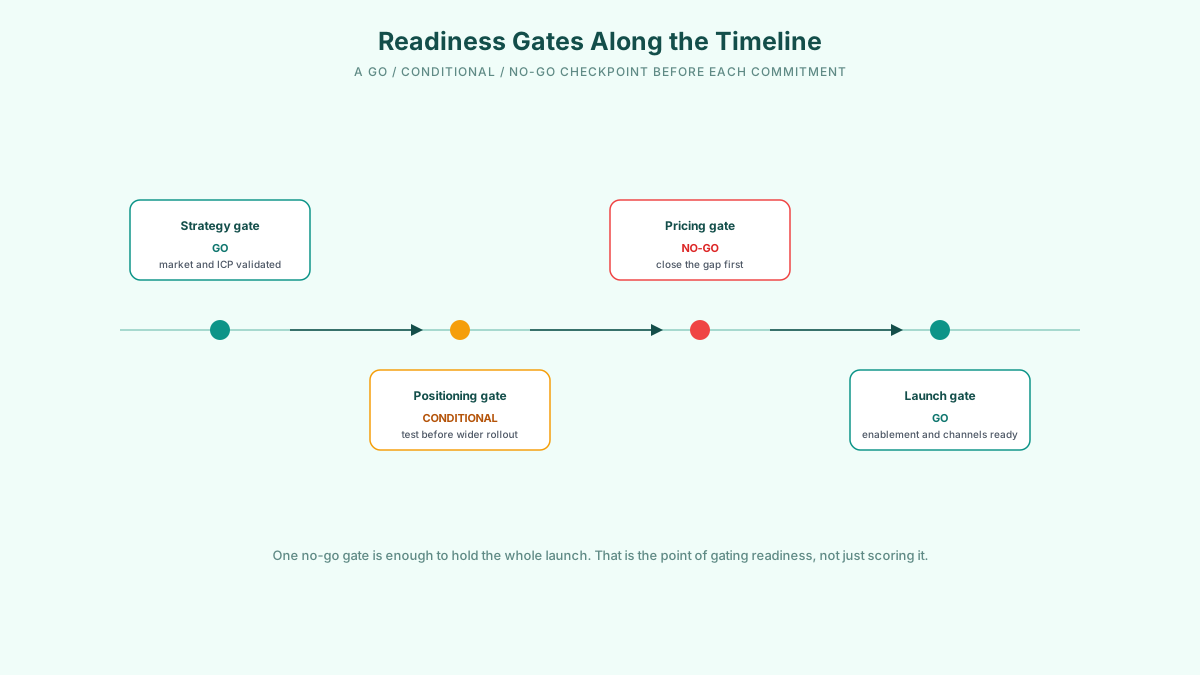
A strategy gate sits before significant resources get committed to building out a specific market entry or launch plan, checking whether market and ICP clarity are validated enough to justify that investment. A positioning gate sits before broad rollout of a specific narrative, often producing a conditional result, testing the positioning against a narrower audience before committing to it at full scale. A pricing gate sits before a pricing structure gets published or committed to contractually, and it is one of the more common points where a genuine no-go result surfaces, since pricing assumptions are frequently among the least validated inputs in a typical launch plan despite being among the most consequential to get wrong. A launch gate sits at the final commitment point, checking that enablement and channel readiness specifically, the dimensions most directly tied to execution quality, are validated before the broader organization commits its full go-to-market effort.
The value of applying gates at each stage, rather than a single check immediately before launch, is that it catches gaps earlier, when the cost of closing them is still relatively low, rather than only at the final moment when the cost of a no-go finding is highest and the organizational pressure to proceed anyway is strongest.
How This Connects to Broader Pattern Intelligence
The evidence tiering system described throughout this piece is not a standalone idea specific to readiness assessment. It applies the same underlying discipline described elsewhere in this content series regarding how genuine strategic synthesis should work, gathering evidence broadly, forming patterns from what recurs across independent sources, and reasoning from that pattern layer rather than from any single input directly.
Applied specifically to readiness, this means a claim about market clarity, ICP fit, or pricing validity is assessed the same way a broader strategic synthesis would assess it, checking whether the underlying evidence reflects a pattern across multiple, independent sources rather than a single report or a single internal assumption. This is precisely why the asserted, sourced, validated tiering described earlier in this piece is not an arbitrary scoring convention, it is a direct application of the same pattern intelligence principle that governs how evidence gets weighted throughout the broader Unified GTM Framework this piece builds on. A readiness assessment built this way inherits the same structural defense against single-source bias that the broader strategic synthesis process relies on, rather than reinventing a separate, less rigorous standard specifically for pre-launch checks.
This connection also explains why readiness assessment benefits from being run against a current, continuously maintained evidence base rather than a one time research effort scoped narrowly to the specific launch in question. A market clarity claim validated using an already broad, continuously refreshed picture of the market is considerably stronger than one validated using research gathered from scratch, under time pressure, specifically for this one launch decision. Readiness assessment, done well, draws on the same underlying evidence infrastructure a genuinely unified GTM strategy depends on more broadly, rather than treating each launch as an isolated research exercise disconnected from everything the organization already understands about its market.
Objections and Counterarguments
"A formal readiness gate process will slow down teams that need to move fast in a competitive market." This is a legitimate tension, and the framework is not built to add ceremony for its own sake. The specific evidence tiers and gates described in this piece are designed to be applied quickly, often in days rather than weeks, precisely because they focus on a small number of high leverage dimensions rather than attempting to validate every possible assumption exhaustively. The realistic alternative to a fast, focused readiness gate is not a faster launch, it is the same launch followed by the slower, more expensive rework this piece has described, which in aggregate typically costs more time than the gate itself would have taken. A team that has internalized this tradeoff tends to experience the gate less as friction and more as a genuine time saver measured over the full lifecycle of an initiative, not just its initial launch date.
"Some markets genuinely reward speed over validation, and this framework risks over-indexing on caution." This is true for a narrower set of situations than is often assumed, generally markets with very low switching costs, very short sales cycles, and very cheap experimentation, where a fast, imperfect launch followed by rapid iteration is a reasonable strategy. Even in these situations, the framework's value shifts rather than disappears, from gating a single, high-stakes launch to rapidly validating the specific claims a fast iteration cycle is testing, which is a lighter but still real application of the same underlying evidence tiering principle. The distinction that actually matters is not speed versus caution in the abstract, it is whether the cost of being wrong is genuinely low and quickly correctable, in which case lighter validation is reasonable, or high and slow to correct, in which case the full framework earns its cost.
"Assigning a percentage score to something as qualitative as market clarity or positioning strength is inherently subjective and potentially misleading." This is a fair caution about any quantified assessment of a genuinely qualitative question. The response is that the specific number matters less than the underlying evidence tier it is built from, and a score explicitly grounded in the asserted, sourced, validated distinction described earlier is more defensible and more useful than an unstructured, purely intuitive sense of readiness, even though neither approach eliminates judgment entirely. The framework's discipline is in forcing that judgment to be evidence based and explicit, not in claiming false precision through the number itself, and a team using this framework well should always be able to explain exactly which specific claims and which specific evidence tier produced any given score, rather than treating the number as a black box output.
"Teams under real organizational pressure will find ways to round up scores regardless of the framework's structure." This is a genuine, common risk, and no framework can fully eliminate organizational incentive to declare readiness prematurely when a launch date has already been publicly committed to. The evidence tiering system described in this piece is a structural defense against this specific risk, not a complete solution, since it makes rounding up harder to do without an explicit, visible misclassification of evidence, but it depends on an organization actually being willing to let a gate produce a genuine no-go result when the evidence warrants it, which is ultimately a cultural commitment the framework can support but cannot substitute for. Organizations that pair this framework with genuine psychological safety around delivering a no-go result, rather than treating it as a personal or team failure, tend to get considerably more honest use out of it than those that quietly punish the messenger.
What This Means for GTM Teams
Build the five dimension assessment into your existing launch process, rather than treating it as a separate, additional step. Most organizations already have some version of a pre-launch review. The change this framework recommends is scoring that review against the five specific dimensions and three evidence tiers described in this piece, rather than relying on a general, unstructured sense of whether the team feels ready.
Assign explicit ownership for closing gaps a readiness gate identifies, before the next gate arrives. A gate that surfaces a genuine gap is only useful if someone is specifically responsible for closing it, on a defined timeline, rather than the gap simply being noted and carried forward unaddressed into the next review.
Resist the instinct to average dimension scores into a single overall number. As described earlier in this piece, a single averaged score obscures exactly the specific, actionable information a readiness assessment exists to surface, and reporting the five dimensions independently, even when it produces an uncomfortable or inconvenient picture, is more useful than a smoother, more reassuring but less informative summary.
Treat a no-go result as valuable information, not organizational failure. A gate that occasionally produces a no-go result is working as intended. A gate that always produces a go result, regardless of the underlying evidence, has stopped functioning as a genuine check and become a formality, which is precisely the outcome a well designed readiness process is meant to prevent.
Frequently Asked Questions
How is GTM readiness different from GTM maturity? Maturity describes an organization's ongoing operational sophistication over time. Readiness describes whether a specific initiative has enough validated evidence behind it right now to justify committing resources to it. A mature organization can still have an unready initiative, and a less mature organization can still achieve genuine readiness for a specific, well scoped launch.
How long does a genuine readiness assessment typically take? This varies by the scope of the initiative, but a focused assessment against the five dimensions in this framework, using evidence already available or quickly gatherable, typically takes days rather than weeks for most launches, since the framework is built to identify specific gaps efficiently rather than to exhaustively validate every possible assumption.
What should happen when a readiness gate produces a no-go result close to a planned launch date? The honest answer depends on the severity and nature of the specific gap identified. A gap in a single dimension, clearly scoped and quickly closeable, may justify a short delay. A broader pattern of weak evidence across multiple dimensions is a stronger signal that the underlying plan needs more substantial rework before launch, regardless of the pressure to hold the original date.
Can this framework be applied retroactively to an initiative that has already launched? Yes, and it is often a valuable diagnostic exercise for understanding why a completed launch underperformed. Applying the same five dimensions and evidence tiers to a launch after the fact frequently reveals which specific gap, unvalidated pricing, untested positioning, thin enablement, actually drove the underperformance, which is more useful for the next initiative than a general, undifferentiated sense that the launch simply did not go as well as hoped.
Does a high readiness score guarantee a successful launch? No, and the framework does not claim otherwise. Readiness reduces a specific, identifiable category of risk, launching on unvalidated assumptions, but it does not eliminate the broader uncertainty inherent in any market entry or launch, including factors outside any team's control. The framework's value is in ensuring failure, if it happens, is not attributable to a gap the team could reasonably have caught and closed in advance.
How does a team avoid turning readiness gates into a bureaucratic checkbox exercise over time? The most reliable safeguard is keeping the evidence tiering explicit and auditable, as described throughout this piece, rather than letting the gate degrade into a single, unsupported readiness percentage nobody can trace back to specific evidence. A gate that regularly produces the same reassuring result regardless of the underlying evidence has usually already become the checkbox exercise this question is worried about, and periodically auditing a sample of past readiness assessments against what actually happened after launch is a useful way to catch that drift before it becomes the norm.
Conclusion
The gap between having done the work and having evidence that the work is correct is easy to overlook precisely because activity is so much more visible and so much more satisfying to complete than validation. A finished positioning document feels like progress. A pricing page going live feels like progress. Neither one actually confirms that the underlying claims hold up against real market evidence, and the specific, sharp cost curve this piece has described, rework accelerating once readiness falls below a certain threshold, is what happens when that gap goes unexamined until after a company has already committed real resources based on it.
The Elevate GTM Readiness Framework closes this gap by scoring five specific dimensions independently, applying an explicit evidence tier to each claim within them, and gating major commitment points along a launch timeline rather than checking readiness only once, under the most pressure, immediately before launch. None of this eliminates the judgment a team brings to a genuinely uncertain, high stakes decision, and it is not a guarantee against failure for reasons outside any team's reasonable control. What it offers is a structural defense against the specific, avoidable failure mode this piece has described throughout: mistaking a finished document for a validated answer, and discovering the difference only after the cost of that confusion has already compounded well past the point where it would have been cheap to catch.
The company from this piece's opening example eventually did relaunch successfully, once positioning had actually been validated against the segment's real response rather than the team's original assumption about it. The six weeks lost, and the cost of rebuilding sales enablement, competitive materials, and internal confidence around the corrected narrative, were real and avoidable costs, not an inevitable part of entering a new market. The purpose of this framework is not to eliminate uncertainty from a GTM initiative, which is not realistically possible, it is to make sure the specific, identifiable gaps a disciplined evidence check would have caught do not become the reason an otherwise sound initiative underperforms.
Contents
Related Frameworks
GTM Frameworks
Explore frameworks for assessing, structuring, aligning, and evolving go-to-market.
View Framework Library →