
Elevate GTM Maturity Framework
Most maturity assessments ask a team to rate itself and call the answer data. The Elevate GTM Maturity Framework scores maturity from evidence instead, and turns the result into a specific, closeable roadmap rather than a generic recommendation to coordinate more.
Published 2026-07-31
A revenue operations leader ran an internal survey asking each function to rate the company's GTM coordination on a five point scale. The average came back at 3.8, comfortably into what the company's own framework described as Level 4, connected and largely automated. A follow-up audit, tracing five actual signals from detection through to a documented action and a recorded outcome, told a different story: only one of the five signals had made it through the full chain without a manual gap somewhere along the way, a result closer to Level 2. The gap between what the team believed and what the evidence showed was not a matter of anyone being dishonest. It was a matter of self-rating measuring confidence and intent, while an evidence based trace measures what actually happened.
This gap is common enough to be the default outcome, not the exception, whenever maturity gets assessed through opinion rather than evidence. The companion piece in this content series on the GTM Maturity Model defines the five levels and the dimensions they span. This piece addresses a different, more practical question: how to actually assess where an organization sits, using evidence rather than self-report, and how to turn that assessment into a specific, closeable roadmap rather than a general, hard to act on recommendation to coordinate better. The Elevate GTM Maturity Framework is built around this distinction, treating the assessment methodology and the progression path as the actual work, not an afterthought to a level definition that already existed.
This is the fourth piece in a series of thirty framework pieces this content series is publishing, and it builds directly on two ideas introduced earlier in that series. The evidence tiering distinction, asserted, sourced, validated, described in the companion GTM Readiness Framework, applies here to organizational self-perception rather than to a single strategic claim. And the specific, closeable roadmap approach echoes the same discipline described in the GTM Strategy Framework, where a general recommendation is treated as considerably less useful than a specific, verifiable next action. This piece applies both ideas to the particular problem of measuring and progressing organizational maturity.
Why Self-Assessment Runs High
Before describing how the framework assesses maturity, it is worth understanding why the more common alternative, asking a team to rate itself, produces results that reliably run higher than what an evidence based check would find.
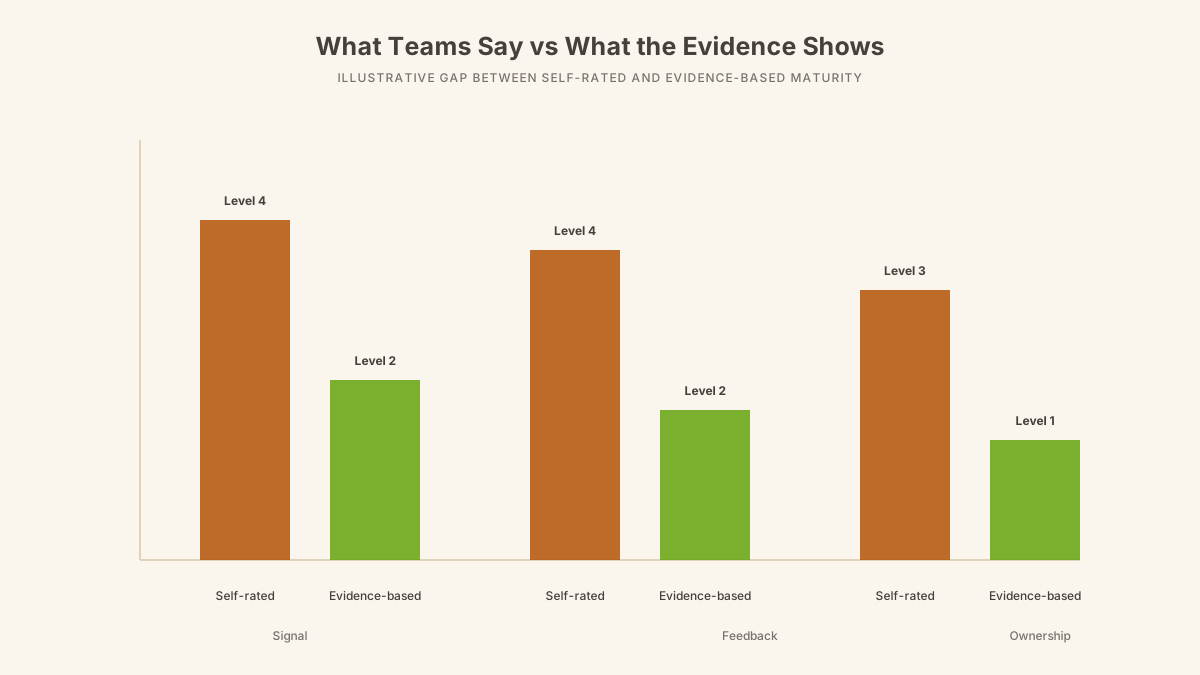
A self-rating question asks a person to recall, under time pressure and usually from memory, how well a process generally works. This kind of recall is naturally biased toward recent, positive examples, the time the signal did get caught and acted on well, rather than a representative sample of what actually happens across every instance. It also reflects effort and intent as much as outcome, a team that has genuinely tried hard to build good coordination will reasonably feel further along than an evidence based trace of actual outcomes would confirm, since trying hard and succeeding consistently are different things, even when the trying is completely genuine.
There is also a structural incentive at play that is worth naming directly. A self-assessment, especially one that will be seen by leadership or used to justify continued investment in a specific initiative, carries a mild but real incentive to round upward. Nobody filling out a maturity survey is deliberately lying, but the ambiguity inherent in a question like how well does signal handling work, on a scale of one to five gives that mild incentive room to operate, in a way a more specific, evidence based question does not.
This dynamic compounds across a full organization in a specific, predictable way. Each function rating its own performance tends to rate generously, and when those individual ratings get aggregated into an overall picture, the aggregate inherits the generosity of every individual contribution rather than correcting for it. A genuinely evidence based assessment does not have this compounding problem, since it traces specific, verifiable outcomes rather than aggregating separate, independently generous self-impressions from across the organization.
What Evidence Based Assessment Actually Looks Like
The framework replaces the general, opinion based question with a specific, traceable one, applied consistently across the same dimensions the broader maturity model defines: signal, scoring, action, feedback, and ownership.
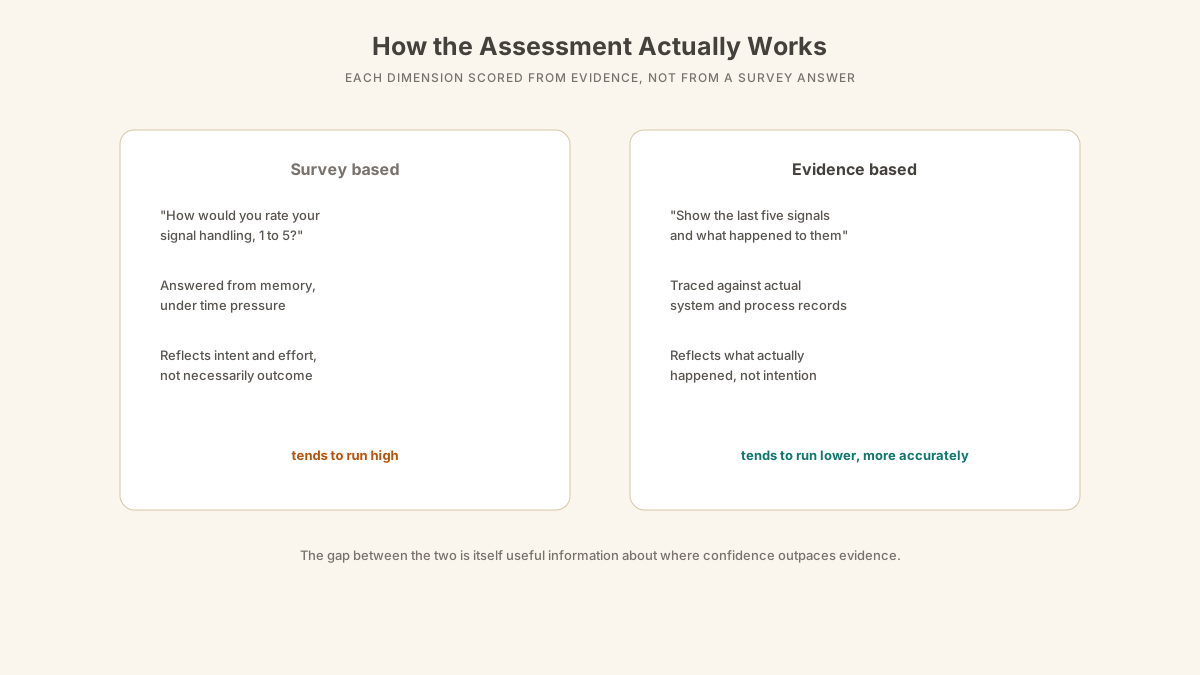
Rather than asking how well does your organization handle signal, the framework asks for the last five specific signals the organization actually received, and traces what happened to each one: was it detected promptly, scored consistently, routed to an owner, acted on within a reasonable window, and did the outcome feed back into how future signals of that type get handled. This is a considerably more demanding question to answer, since it requires pulling real examples rather than offering a general impression, and that added difficulty is precisely what makes the resulting answer more reliable.
This tracing exercise is applied to each of the five dimensions in turn, using a similar structure adapted to what that dimension actually measures. For signal, the trace follows detection through to routing. For scoring, the trace checks whether similar signals received consistent priority, or whether scoring varied unpredictably depending on who happened to review it. For action, the trace checks whether the response actually matched what the scoring recommended, or whether execution drifted from what was decided. For feedback, the trace checks whether the outcome of that action informed anything downstream, or whether it was recorded and then effectively forgotten. For ownership, the trace checks whether a specific person was accountable for the signal at each stage, or whether accountability was diffuse enough that no one specific person could be identified as responsible for what happened.
This evidence based approach mirrors the same asserted, sourced, validated tiering described in the companion piece on GTM readiness, applied here specifically to organizational self-perception rather than to a single strategic claim. A maturity claim supported only by a survey response is asserted. A maturity claim supported by one traced example is sourced. A maturity claim supported by a consistent pattern across several independently traced examples is validated, and only validated claims should meaningfully move a dimension's score, for exactly the same reasons described in that companion piece regarding strategic evidence more broadly.
| Evidence type | What it actually shows | Weight in the assessment |
|---|---|---|
| Self-rated survey response | How the team feels about its own performance | Context only, not scored directly |
| A single traced example | One specific instance of the process working or not | Partial, suggestive but not conclusive |
| A pattern across several traced examples | Consistent evidence of how the process actually performs | Full weight toward the dimension score |
The Progression Roadmap: Specific Gaps, Not Generic Advice
A maturity score on its own, however accurately measured, is not particularly useful without a clear answer to the next question: what specifically needs to change to move up a level. Most maturity frameworks stop at the score. This framework treats the roadmap as equally important.
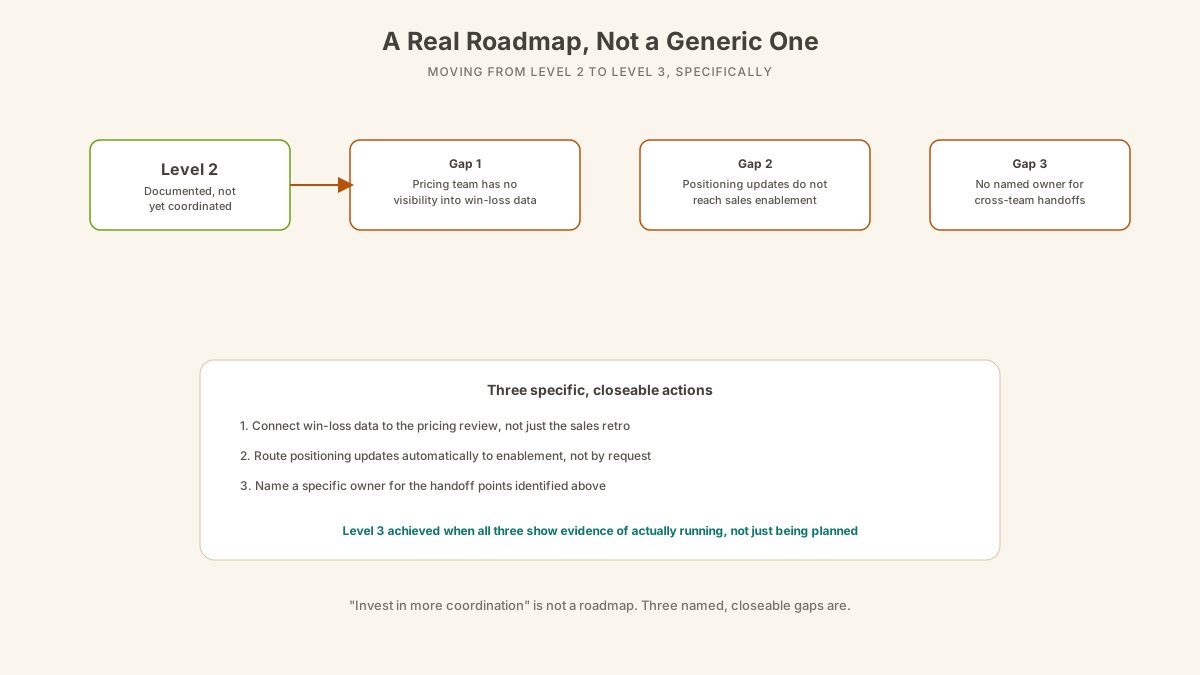
Consider an organization assessed at Level 2, documented but not yet coordinated, using the same evidence based tracing described above. Rather than offering a generic recommendation to improve cross-functional coordination, the framework identifies the specific, traceable gaps the evidence surfaced: the pricing team has no visibility into win-loss data that would inform pricing decisions, positioning updates do not reach sales enablement without someone manually remembering to forward them, and no specific person owns the handoff points where information needs to move between functions. Each of these gaps is specific enough to be closed and specific enough to verify once it has been.
This specificity is what actually distinguishes a genuine roadmap from a restatement of the level definition. Telling a Level 2 organization it needs to become more coordinated to reach Level 3 restates the goal without identifying the path. Telling that same organization that connecting win-loss data to the pricing review, routing positioning updates automatically rather than by request, and naming an explicit owner for the identified handoff points are the three specific changes required to reach Level 3 gives the organization something it can actually act on and later verify against the same evidence based tracing that identified the gap in the first place.
The value of this specificity compounds over successive assessment cycles. An organization that closes the three gaps identified in one cycle, and is reassessed using the same evidence based tracing, either sees those specific gaps confirmed closed, in which case the organization has genuine, verifiable evidence of progress, or discovers that a gap believed closed was not actually closed as thoroughly as assumed, which is itself valuable information a generic, restated recommendation would never have surfaced. Neither outcome is possible with a roadmap that only restates the destination without naming the specific, checkable steps required to reach it.
It is also worth noting that the roadmap identified through this process is specific to the organization being assessed, not a generic template applied uniformly regardless of what the evidence actually revealed. Two different Level 2 organizations, assessed using the same methodology, will typically surface different specific gaps, since the particular way coordination breaks down varies by organization even when the overall maturity level happens to be the same. This is precisely why the evidence based tracing matters more than the level label itself: the label tells you roughly where you stand, the traced gaps tell you specifically what to do next.
Common Mistakes in Maturity Assessment
Beyond the self-rating bias described earlier, a handful of other specific mistakes recur often enough in how organizations approach maturity assessment to name directly.
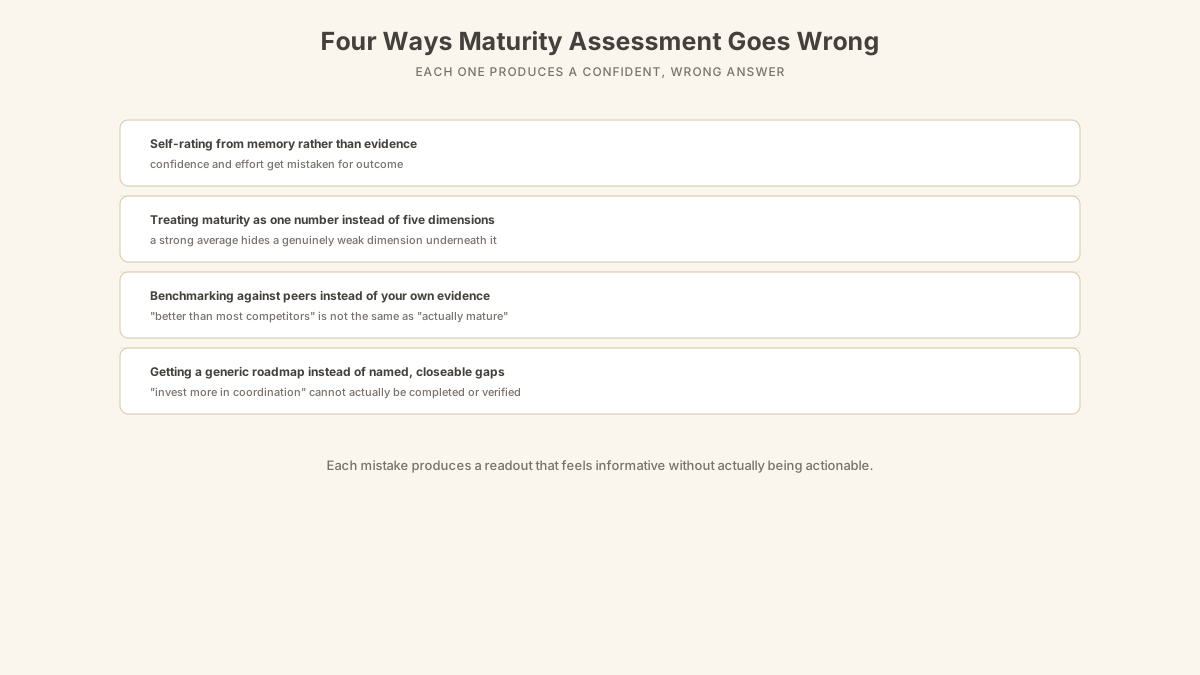
Self-rating from memory rather than evidence has already been covered in detail, and it remains the single most common source of an inflated maturity picture.
Treating maturity as a single number rather than five distinct dimensions obscures exactly the information a genuine assessment should surface, since an organization with strong signal handling and genuinely weak ownership clarity is not adequately described by an averaged score that lands somewhere comfortably in the middle. This mistake is particularly costly because it tends to direct improvement effort toward the dimension the organization already understands well, since that is the dimension leadership naturally gravitates toward discussing, rather than the genuinely weak dimension the average was quietly masking.
Benchmarking against peers or competitors rather than against your own evidence substitutes a relative, comparative question for the actual question that matters, since being ahead of a competitor whose own coordination is genuinely poor says little about whether an organization's own processes actually work well in absolute terms. This mistake is especially common in industries where a category-wide reputation for poor GTM coordination has become normalized, since a company operating only modestly better than a genuinely weak peer group can mistake that relative advantage for a much stronger absolute position than the evidence would actually support.
Receiving a generic roadmap rather than named, closeable gaps leaves an organization with a restated goal instead of an actionable plan, which is precisely the failure the specific, evidence traced roadmap described in this piece is built to avoid. This mistake is often not the fault of the organization being assessed, but of an assessment process, whether run internally or by an outside consultant, that stops at the level label without doing the harder, more specific work of tracing exactly which gaps produced that label.
| Mistake | What it produces | What the framework does instead |
|---|---|---|
| Self-rating from memory | A score inflated by confidence and effort | Traces specific, recent examples instead |
| A single averaged score | A weak dimension hidden inside a comfortable average | Scores five dimensions independently |
| Benchmarking against peers | A relative comparison, not an absolute assessment | Scores against the organization's own evidence |
| A generic roadmap | A restated goal with no specific path | Names specific, closeable gaps and verifies them later |
Objections and Counterarguments
"Tracing specific signals through the full chain is considerably more time consuming than a survey, and not every organization has time for that level of rigor." This is a fair practical concern. The response is that the framework does not require tracing every signal, a representative sample, typically five to ten recent, specific examples per dimension, is usually sufficient to reveal whether the pattern is consistent or not, without requiring exhaustive coverage of every instance. This is a meaningfully larger time investment than a five minute survey, but it is considerably smaller than the cost of acting on an inflated maturity picture that turns out not to reflect reality once real decisions get built on top of it. Organizations that have run both processes typically describe the evidence based version as taking a few hours to a day per dimension, spread across the people who can actually pull the relevant examples, which is a modest cost relative to the decisions a maturity assessment is often used to justify.
"An evidence based assessment still depends on which specific examples get chosen to trace, which introduces its own source of bias." This is a legitimate methodological concern. The framework addresses it by specifying that examples should be selected before the tracing begins, ideally by someone other than the person whose performance is being assessed, and drawn from a genuinely representative time window rather than cherry picked for being unusually strong or unusually weak. This does not eliminate selection bias entirely, but it meaningfully reduces the specific risk of a team unconsciously selecting its best examples to trace. A useful additional safeguard is selecting examples using a simple, mechanical rule, the five most recent signals of a given type, for instance, rather than a rule that leaves room for judgment about which examples seem most representative.
"A lower than expected maturity score, delivered to leadership, risks demoralizing a team that has genuinely been working hard." This is worth taking seriously as a real organizational risk, distinct from the technical accuracy of the assessment itself. The framing that tends to work best treats a lower evidence based score not as a judgment of the team's effort, which the assessment does not actually measure, but as a specific, useful diagnostic that makes the next steps clearer than a vaguer, more comfortable self-rating would have. A team told specifically which three gaps stand between them and the next level is, in most cases, better positioned than a team told only that its self-rated 3.8 average suggests things are basically fine. Leadership framing this correctly, as a diagnostic rather than a verdict, does considerably more to determine how a team receives a lower score than the number itself.
"This methodology assumes an organization has enough traceable records to actually reconstruct what happened to past signals, which not every organization has." This is a genuine limitation worth acknowledging directly. An organization with poor record keeping around how signals were actually handled will find the tracing exercise itself harder, and in some cases the inability to reconstruct a clear trace is itself diagnostic, revealing that the organization's processes are less traceable and less auditable than a survey based self-assessment would ever surface. In these cases, the first practical step toward a genuine maturity assessment is often improving basic record keeping around how signals get handled, which is itself a meaningful, closeable early gap regardless of what level the organization eventually turns out to be at.
How This Fits With the Broader Maturity Model
The companion piece on the GTM Maturity Model, published elsewhere in this content series, defines what each of the five levels actually means and describes the dimensions, signal, scoring, action, feedback, and ownership, that those levels span. That piece is the right place to start for understanding what Level 3 coordination actually looks like in practice, or how a platform like Elevate is built to support the higher end of that model architecturally.
This piece assumes that foundation and focuses specifically on the methodology question the broader model does not fully address: given those five levels and five dimensions, how does an organization actually find out where it stands, and what does it do next. The two pieces are meant to be read together, the Maturity Model as the map of the territory, this framework as the specific instrument used to figure out where on that map an organization currently sits, and the specific route from its current position to the next meaningful point on it.
What This Means for GTM Teams
Replace or supplement your next maturity survey with a small, representative sample of traced examples. A handful of specific, recent signals traced through the full chain, detection through outcome and feedback, will surface a more reliable picture than a broader survey, even one with more respondents. Start with the dimension leadership currently feels most confident about, since that is often where the largest gap between perception and evidence turns out to be hiding, precisely because high confidence tends to suppress the impulse to check.
Score the five dimensions independently and resist the instinct to average them into a single number. As described throughout this piece, an averaged score reliably hides the specific, weakest dimension an organization most needs to address, and reporting dimensions separately, even when the resulting picture is less tidy, is more useful than a smoother but less informative summary. When presenting results to leadership, resist the temptation to lead with an overall average even if one stakeholder specifically asks for it, and instead present the five dimensions side by side so the actual pattern, not a flattened summary of it, is what drives the conversation.
Demand a specific, closeable roadmap rather than accepting a restated goal. If a maturity assessment concludes with a recommendation to improve coordination or invest in better tooling without naming the specific gaps that produced the current score, ask for those specifics directly, since a roadmap without them is not meaningfully more actionable than the level definition it is supposed to build on. A useful test is asking whether each recommended action could be marked done or not done by someone checking evidence six weeks later. If the action is too vague to pass that test, it is not yet specific enough to function as a real roadmap item.
Revisit the assessment periodically using the same evidence based method, not a fresh survey each time. Comparing this quarter's traced examples against last quarter's, using the same methodology, produces a genuine before and after picture. Comparing this quarter's survey average against last quarter's survey average mostly measures how confident the team happens to feel at two different points in time, which is a considerably less reliable signal of actual progress than a consistent, evidence based comparison across the same specific dimensions and, where possible, the same specific gaps identified in the prior roadmap.
Frequently Asked Questions
How is this different from the GTM Maturity Model covered elsewhere in this content series? The Maturity Model defines the five levels and the dimensions they span. This framework addresses the separate, practical question of how to actually assess which level an organization is at, using evidence rather than self-report, and how to turn that assessment into a specific roadmap rather than a general recommendation.
How often should a maturity assessment be repeated? Roughly every two to three quarters is a reasonable cadence for most organizations, frequent enough to track genuine progress against a specific roadmap without repeating the exercise so often that the underlying evidence has not had time to meaningfully change between assessments.
Can a small team with limited resources realistically run an evidence based assessment? Yes, since the framework does not require exhaustive tracing, a handful of representative examples per dimension is usually sufficient, and a small team often has an easier time gathering those specific examples than a larger, more distributed organization would.
What should happen if the evidence based assessment and the team's self-rating differ significantly? The gap itself is useful information, often more useful than either number alone. A large gap specifically suggests that confidence and actual outcomes have diverged, which is worth understanding on its own terms rather than simply resolving in favor of whichever number is more comfortable to report upward.
Does a higher maturity score always mean a better outcome for the business? Not automatically, and this connects to a point covered in the companion GTM Readiness Framework: an organization can have strong ongoing maturity while a specific initiative still launches without adequate readiness, since maturity and readiness answer different questions. Maturity describes the standing quality of an organization's ongoing operation. It does not, on its own, guarantee that any specific initiative built on top of that operation has been adequately validated before launch.
Who should actually run the evidence based tracing, and should it be done internally or by an outside party? Either can work, provided the person or team running the tracing has genuine access to the underlying records and is not the same person whose performance is directly being assessed. An internal RevOps or GTM operations function is often well positioned to run this exercise, since they typically have the cross-functional visibility needed to pull examples from multiple teams, though a fresh, outside perspective can be valuable specifically for catching blind spots an internal team might not think to question.
What is the single most common finding once organizations switch from self-rated to evidence based maturity assessment? The most consistent finding across organizations that make this switch is a specific gap in the feedback dimension, evidence showing that outcomes from past signals rarely make their way back into how future, similar signals get handled. This dimension is disproportionately likely to be self-rated higher than the evidence supports, since a team can feel like it is learning and improving over time without any specific, traceable mechanism that actually closes that loop.
Conclusion
The gap between a self-rated 3.8 and an evidence based Level 2 is not a story about a dishonest team. It is what happens, reliably and predictably, whenever maturity gets measured by asking people how they feel about their own performance rather than by tracing what specific, recent examples actually show. The Elevate GTM Maturity Framework addresses this by replacing opinion with evidence, scoring five dimensions independently rather than averaging them into a single comfortable number, and turning the resulting assessment into a specific, closeable roadmap rather than a restated goal dressed up as a recommendation.
None of this makes maturity assessment effortless, and a representative, evidence based trace takes real time to do properly. What it offers in exchange is a maturity picture an organization can actually trust and act on, and a roadmap specific enough to verify, later, using the same method that identified the gap in the first place. That verification loop, assess with evidence, close a specific gap, reassess with the same evidence based method, is what turns a maturity framework from a one-time diagnostic into something an organization can actually use to track real progress over time.
The revenue operations leader from this piece's opening example ultimately used the evidence based trace, not the original survey, as the basis for the following quarter's investment priorities, specifically funding the three gaps the tracing had surfaced rather than a general initiative to improve coordination. The following assessment cycle, using the same tracing methodology, confirmed all three gaps closed and surfaced two new, smaller ones further along the chain, a genuinely useful, specific picture of progress that a repeated survey, measuring confidence rather than evidence, would have been considerably less likely to produce with the same clarity.
Contents
Related Frameworks
GTM Frameworks
Explore frameworks for assessing, structuring, aligning, and evolving go-to-market.
View Framework Library →