
Elevate Unified GTM Framework
Most GTM strategy is fourteen separate documents written by fourteen different people on fourteen different schedules. The Unified GTM Framework treats it as one connected system instead, built from evidence gathered broadly and reasoned into a single, coherent strategy.
Published 2026-07-31
Walk into most B2B companies and ask to see the GTM strategy, and you will not get one document. You will get a market research deck from a consultant engagement two years ago, a positioning one-pager the founding team wrote before the last funding round, a pricing spreadsheet maintained by finance, a messaging guide marketing updated for the last campaign, and a sales enablement folder nobody has fully read. Each of these was written by a different person, at a different time, often without much visibility into what the others said. None of them contradict each other on purpose. They drift apart anyway, because nothing ever forced them to stay consistent with each other in the first place.
This is the ordinary, unremarkable state of GTM strategy at most companies, not a sign of dysfunction but a predictable consequence of how strategy typically gets built: piece by piece, by different people, at different times, with no shared source of truth underneath any of it. The Elevate Unified GTM Framework is built around a different premise, that go to market strategy across market research, positioning, pricing, messaging, acquisition, channels, launch, enablement, customer success, and every other discipline in between, should be treated as one connected system, generated from a shared base of evidence and reasoned into a single, internally consistent strategy, rather than assembled after the fact from documents that were never talking to each other.
This piece defines the framework precisely: what unification actually means beyond a vague aspiration, how evidence gets gathered and reasoned into strategy at the scale a genuine synthesis requires, and why this approach produces a meaningfully different and more defensible kind of strategy than the fragmented, document by document process most companies still rely on.
This is the first in a series of thirty framework pieces this content series will publish, covering the specific methodologies underlying how Elevate approaches strategy, intelligence, product marketing, sales, operations, and AI-native GTM execution. The Unified GTM Framework sits at the top of that set deliberately, since it describes the overarching architectural principle, evidence gathered broadly, reasoned into coherent, cross-disciplinary strategy, that the more specific frameworks published afterward each apply to a narrower part of the same underlying problem.
What Fragmentation Actually Costs
Before defining what unification looks like, it is worth being specific about the cost of the fragmented default, since that cost is usually invisible until someone goes looking for it directly.
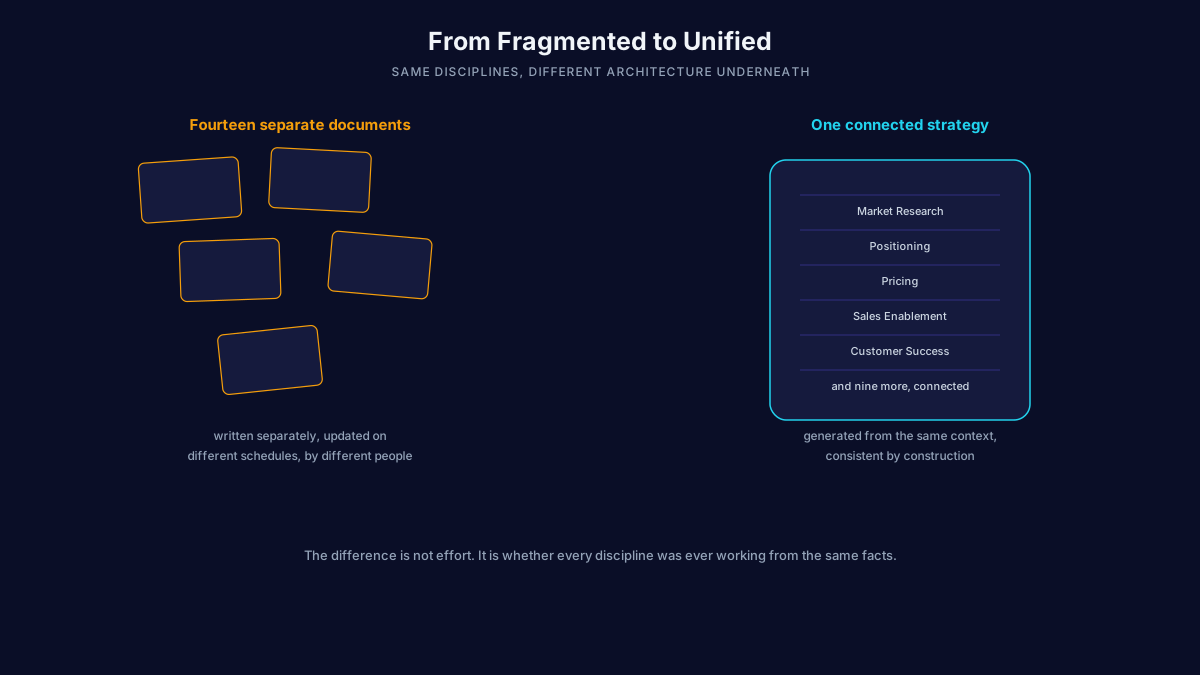
When positioning, messaging, and pricing are each written independently, small inconsistencies accumulate that nobody notices until a specific, costly moment exposes them: a sales rep pitching a differentiator the positioning team quietly abandoned two quarters ago, a pricing page that implies a different ICP than the one marketing is actually targeting, an enablement deck that references a competitive landscape that has since shifted. None of these gaps exist because anyone made an error. They exist because each discipline's output was produced in isolation, by someone with only partial visibility into what the other disciplines currently believe to be true.
The deeper cost is that this fragmentation makes genuine strategic coherence structurally difficult to achieve, not just occasionally missed. Even a highly competent team, doing careful work in each individual discipline, cannot fully compensate for the fact that positioning was finalized in March, pricing was revised in May, and messaging was refreshed in July, each based on whatever the person doing that work understood to be current at the time. Coherence requires more than competence in each piece. It requires every piece being built from the same underlying facts at the same time, which a document by document process does not naturally produce.
This is worth distinguishing clearly from a simpler, more commonly discussed problem: teams not talking to each other enough. Better communication between teams genuinely helps, and no framework should be read as an argument against it. But even excellent, frequent communication between a positioning owner and a pricing owner does not solve the underlying architectural issue if each is still working from their own separately assembled understanding of the market, refreshed on their own schedule, using their own selection of sources. Communication can catch some inconsistencies after they appear. It does not prevent them from being generated in the first place, which is the specific gap this framework is built to close.
What Unification Actually Means
The Unified GTM Framework treats this differently: rather than assembling strategy from independently produced documents, every discipline is generated from the same underlying evidence base and reasoned through the same strategic logic, so that positioning, messaging, pricing, and every other output are consistent with each other by construction, not by later reconciliation.
This is worth stating even more precisely, since the word unified gets used loosely across the industry to mean almost anything from a shared brand template to a single vendor relationship. In this framework specifically, unification means three concrete things happening together. First, every one of the fourteen disciplines described below draws from the same underlying evidence gathering process, rather than each discipline's owner independently deciding which sources to consult. Second, that evidence is processed into the same pattern layer before any discipline specific reasoning begins, so that market research and pricing strategy are reasoning over the same synthesized understanding of the market, not two separately assembled pictures that happen to be produced by the same overall system. Third, the reasoning process for each discipline is applied consistently, using the same underlying strategic logic adapted to that discipline's specific questions, rather than fourteen unrelated reasoning processes that happen to share a brand name.
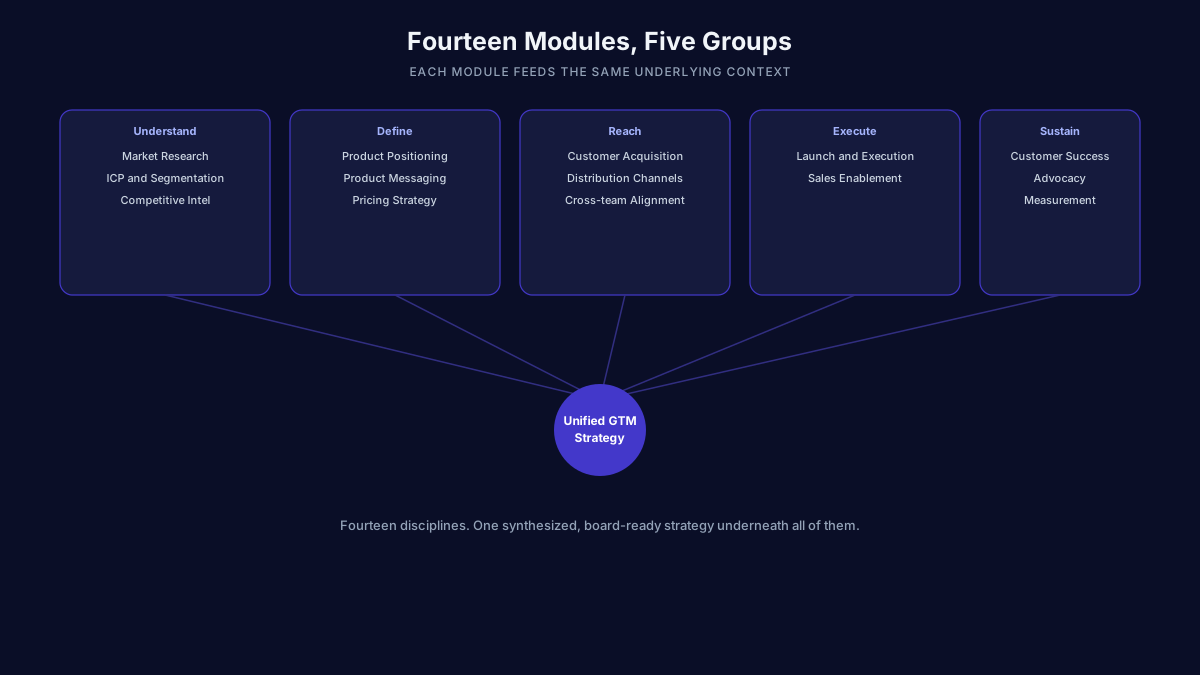
This spans fourteen distinct disciplines, organized into five functional groups. The Understand group covers market research, ICP and segmentation, and competitive intelligence, building the foundational picture of the market, the customer, and the competitive landscape. The Define group covers product positioning, messaging, and pricing strategy, translating that foundational understanding into how the company presents and prices what it sells. The Reach group covers customer acquisition, distribution channel strategy, and cross-functional alignment, determining how the company actually reaches its market and keeps its own teams working from the same plan. The Execute group covers launch and execution planning and sales enablement, turning strategy into structured, actionable work. And the Sustain group covers customer success, customer advocacy, and measurement and optimization, closing the loop on what happens after a customer is acquired and what that experience should teach the earlier stages of the strategy.
Grouping the fourteen disciplines this way is not purely organizational convenience. Each group represents a distinct kind of question a GTM motion needs answered, understanding reality, defining a response to it, reaching the market with that response, executing it operationally, and sustaining and learning from what happens afterward, and the groups themselves form a rough sequence that mirrors how strategy actually needs to build on itself. Positioning cannot be reasoned about soundly without an accurate market and competitive picture underneath it. Sales enablement cannot be built well without positioning and messaging already defined. Customer success signal is most valuable when it feeds back into acquisition and positioning rather than sitting isolated as a post-sale concern. The five groups make this dependency structure explicit rather than leaving it implicit and easy to overlook.
| Group | Disciplines covered | Core question it answers |
|---|---|---|
| Understand | Market research, ICP and segmentation, competitive intelligence | What is actually true about the market right now |
| Define | Positioning, messaging, pricing strategy | How should the company present and price what it sells |
| Reach | Customer acquisition, distribution channels, cross-team alignment | How does the company actually reach its market |
| Execute | Launch and execution, sales enablement | How does strategy become structured, actionable work |
| Sustain | Customer success, advocacy, measurement and optimization | What happens after acquisition, and what does it teach |
It is worth noting explicitly that the Sustain group's position at the end of this sequence does not mean it is the least important, or that it only matters once the earlier groups are complete. The measurement and optimization discipline specifically is designed to feed its findings back into the Understand group, closing what this content series has described elsewhere as a genuine loop rather than a one-directional pipeline. A customer success insight about which segments actually retain and expand well is exactly the kind of evidence that should inform, and in this framework does inform, how the ICP and segmentation module reasons about the ideal customer profile going forward, which is what keeps a unified strategy current rather than accurate only at the moment it was first produced.
The defining architectural claim of this framework is not that all fourteen disciplines exist, most companies already have some version of each. It is that they are generated from a shared context rather than fourteen separate starting points, which is what actually produces the consistency a fragmented process cannot reliably achieve, regardless of how skilled the individual people working on each piece happen to be.
From Evidence to Strategy: How the Framework Actually Works
Producing a genuinely unified strategy this way requires a specific process, not just a stated intention to be more coordinated. The framework runs through three distinct stages for every discipline it covers.
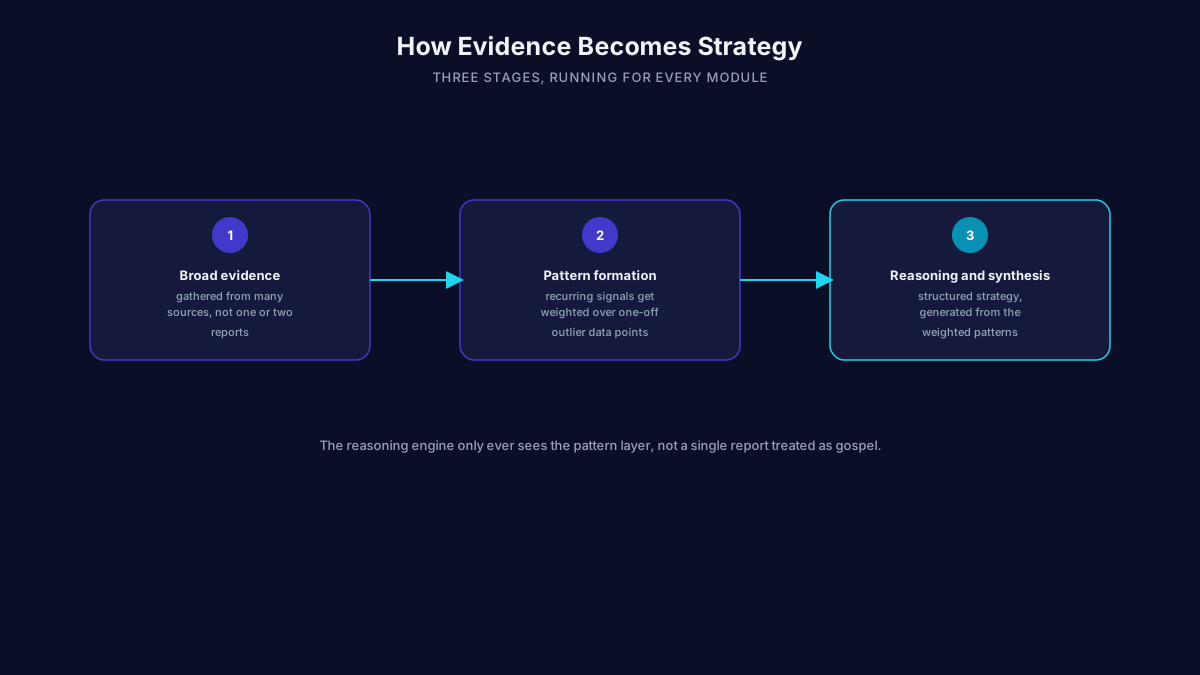
Broad evidence gathering. Rather than working from one or two reports, the framework draws on a wide base of evidence relevant to each discipline, market data, competitive signal, customer and industry context, and related inputs, gathered broadly rather than narrowly. This matters because a strategy built from a single source inherits that source's specific blind spots and biases without any way to catch them, a risk covered in more detail below. The breadth of this gathering step is deliberately calibrated to the discipline in question, competitive intelligence draws differently than pricing strategy does, but the underlying principle, breadth before synthesis, applies consistently across all fourteen.
Pattern formation. Rather than treating every individual data point as equally reliable, the framework specifically looks for what recurs consistently across multiple, independent pieces of evidence, weighting patterns that show up repeatedly more heavily than a single outlier data point, however specific or confident that single point might sound. This is the step that distinguishes genuine synthesis from simply summarizing whatever the most recent or most prominent source happened to say. A claim that appears in only one source, however authoritative that source seems, is treated differently than a claim that shows up independently across several genuinely different sources, since the latter is considerably more likely to reflect something real about the underlying market rather than one source's particular framing or error.
Reasoning and synthesis. The weighted patterns from the previous stage become the actual input to a structured reasoning process, built on a large language model functioning specifically as a reasoning and synthesis engine, which is directed through a defined strategic framework to produce a structured, board-ready output for each discipline. The model is never simply asked to describe what one source said. It is reasoning over a synthesized pattern layer, which is a meaningfully different and more defensible task than summarizing or paraphrasing a single input. This stage is also where discipline specific structure gets applied, ensuring a competitive intelligence output and a pricing strategy output, while reasoning from the same underlying evidence, are each organized and presented in the way that specific discipline actually requires.
This three stage process runs consistently across every one of the fourteen disciplines described earlier, which is precisely what allows the resulting outputs to stay coherent with each other. Since the market research module and the pricing module are both reasoning over the same underlying evidence base and the same patterns, their outputs describe the same market, the same competitive landscape, and the same customer, rather than each discipline working from its own separately assembled and potentially inconsistent picture of the world. This is the specific mechanism, not just a stated design goal, that produces the consistency described throughout this piece, and it is worth distinguishing from a simpler, more common approach where an AI system is asked to generate several documents that merely share a similar tone or template without actually sharing an underlying evidence base.
Why the Evidence Base Matters More Than the Reasoning Step
It is worth being direct about a specific, common failure mode in how AI generated strategy content gets produced elsewhere in the market, since understanding this failure mode is what actually motivates the pattern intelligence approach at the center of this framework.
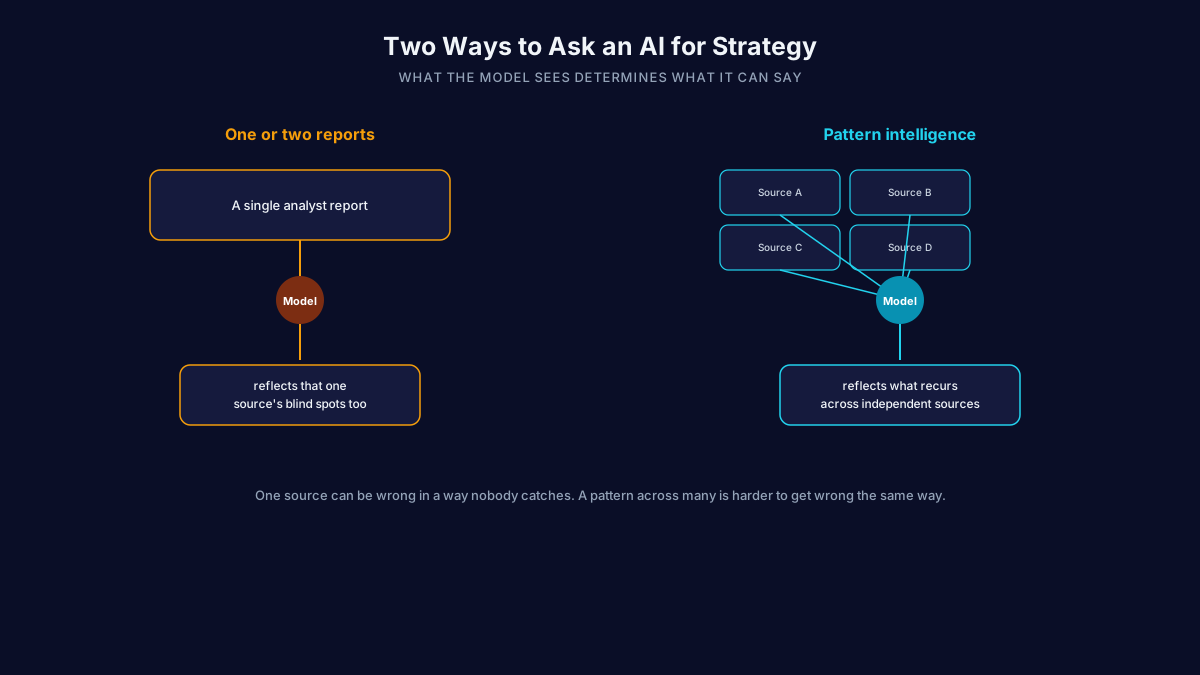
A reasoning engine, however capable, can only reason as well as the evidence it is given allows. Asked to produce a competitive analysis from a single, outdated industry report, even the most sophisticated reasoning process will confidently produce a competitive analysis built on that report's specific, potentially stale picture of the landscape, because the model has no way to know the report is unrepresentative unless it has something to compare it against. This is not a flaw specific to any one model, it is a structural limitation of reasoning over narrow, unverified input, and it is the primary reason the Unified GTM Framework treats evidence gathering as a distinct, deliberately broad first stage, rather than trusting a single source and reasoning directly from it.
This limitation is easy to underestimate because a confidently written, well formatted output does not visibly signal how narrow its underlying evidence was. A strategy document built from one source and a strategy document built from a genuinely broad, cross-validated evidence base can look equally polished and equally confident on the page, and the difference between them only becomes apparent when someone checks the underlying claims against independent reality, often well after the strategy has already shaped real decisions. This is precisely the gap pattern intelligence is built to close before it ever reaches that stage.
Pattern intelligence, gathering evidence broadly and specifically looking for what recurs across independent sources rather than trusting any single one, is a direct, structural response to this limitation. A pattern that shows up consistently across several genuinely independent sources is considerably more likely to reflect something real about the market than a specific, confident claim from any single source, and building the reasoning stage to work primarily from that pattern layer, rather than from any one input directly, is what allows the resulting strategy to be more resistant to the specific kind of error a narrower process is vulnerable to.
This does not eliminate the need for human judgment in reviewing the resulting strategy, a point covered in more detail in the objections section below. It does mean the starting point for that human review is a synthesis built to be more broadly grounded than what a single analyst working from one or two sources, however skilled, could reasonably produce within a comparable amount of time. A human strategist reviewing a pattern based synthesis is reviewing and refining a well evidenced starting point, which is a meaningfully more productive use of their judgment than starting from a blank page or from a single source's necessarily narrower view.
Objections and Counterarguments
"An AI reasoning engine synthesizing strategy from patterns still needs human oversight, and treating it as authoritative on its own is risky." This is correct, and it is worth stating plainly rather than glossing over. The Unified GTM Framework is built to produce a strong, broadly evidenced starting point for a strategy, not a final, unreviewed answer a team should implement without applying its own judgment. The value of the pattern intelligence approach described in this piece is that it raises the floor of that starting point considerably above what a single narrow source could produce, not that it removes the need for a person with direct business context to review, challenge, and where appropriate override the resulting recommendations. Any team adopting this framework should build an explicit review step into how the resulting strategy gets used, the same discipline this content series has recommended elsewhere for any AI generated recommendation feeding into consequential business decisions.
"Unifying fourteen disciplines into one system sounds like it would produce generic, one-size-fits-all output rather than genuinely tailored strategy." This is a reasonable concern about any systematized approach to strategy, and the response is that unification refers to the underlying evidence and reasoning process being shared and consistent, not to the outputs themselves being generic. Each discipline's output is still generated specifically for the particular company, product, market, and context provided as input, the unification is in ensuring those fourteen tailored outputs remain consistent with each other, not in flattening them into a single generic template. Two companies in the same category, with different products, different stages, and different competitive positions, will receive genuinely different, specifically tailored outputs from the same underlying framework, precisely because the evidence gathering and reasoning process is applied fresh to each company's specific inputs rather than reusing a fixed, generic answer.
"Pattern intelligence across many sources still depends on the quality and diversity of those sources, which the framework cannot fully control." This is a fair and important limitation to acknowledge directly. A pattern intelligence approach is only as strong as the breadth and independence of the evidence base it draws from, and a category or market with genuinely thin, low quality, or highly correlated available evidence will produce a correspondingly less confident synthesis than one with a rich, diverse evidence base. This is a real constraint, and it is a reason to weight confidence in any specific output partly based on how much genuine, independent evidence was actually available for that particular market or question, rather than assuming uniform reliability across every output the framework produces. A well designed synthesis process should be expected to reflect this uncertainty honestly rather than presenting a thinly evidenced conclusion with the same confidence as a well supported one.
"A framework this broad, covering fourteen disciplines at once, risks producing shallow coverage of each rather than genuine depth in any of them." This is a legitimate tension in any framework attempting broad coverage, and it is addressed specifically by treating each of the fourteen disciplines as its own dedicated module, with its own structured reasoning process tailored to that discipline's specific questions and outputs, rather than treating unification as a reason to compress fourteen distinct disciplines into a single shallow pass. Breadth of coverage and depth within each individual discipline are treated as separate design goals, both pursued deliberately, rather than trading one off against the other by default. The shared evidence base described throughout this piece is what unifies these fourteen modules, not a shared shallow treatment of each one.
How This Differs From Asking a General AI Assistant for Strategy
It is worth addressing a natural question directly: since large language models are now widely accessible, why does the specific architecture described in this piece matter, rather than simply asking a general purpose AI assistant to produce a GTM strategy directly.
A general purpose AI assistant, asked directly for a competitive analysis or a pricing strategy, will produce a fluent, plausible sounding answer drawing on whatever general knowledge the underlying model already has, typically without any deliberate process for gathering current, market-specific evidence beyond what a person manually provides in the prompt. This can be genuinely useful as a starting point for brainstorming or as a sounding board for an idea a person already has in mind. It is a fundamentally different process than the one described throughout this piece, which deliberately gathers broad, current evidence specific to a company's actual market before any reasoning begins, and which applies that same evidence base consistently across fourteen interconnected disciplines rather than treating each request as an isolated, one-off question with no relationship to the others.
The practical difference shows up specifically in consistency and currency. A person asking a general assistant for positioning guidance on Monday and pricing guidance on Wednesday has no guarantee the two conversations drew on the same underlying facts about the market, since each request is typically treated independently unless the person manually carries context between them. The unified process described in this piece is built specifically to avoid this gap, ensuring that whatever the positioning module concludes about the competitive landscape is the same understanding the pricing module is reasoning from, because both draw from the same evidence gathering and pattern formation process rather than from independent, potentially inconsistent conversations.
What This Means for GTM Teams
Treat strategic consistency as an architecture problem, not a communication problem. Most organizations respond to strategy fragmentation by adding more meetings, more shared documents, or more explicit handoff processes between teams. These responses can help at the margins, but they do not address the underlying cause, that each discipline's strategy was generated from its own separate starting point. Addressing that underlying cause requires changing how strategy gets produced, not just how often the people producing it talk to each other afterward. A team that has tried adding more cross-functional syncs without seeing the underlying inconsistency actually resolve is usually experiencing exactly this limitation, since better communication about two independently produced strategies is still a conversation about two independently produced strategies, not a fix for why they diverged in the first place.
Audit your own current strategy for the specific inconsistencies fragmentation tends to produce. Compare your current positioning document against your current pricing page, and your current messaging guide against what your sales enablement content actually says about the competitive landscape. Specific, concrete inconsistencies found through this exercise are usually more persuasive, internally, than an abstract argument about the value of unification. This audit is also a useful, low cost way to gauge how much value a more unified approach would likely deliver for your specific organization, since a company that finds several genuine, costly inconsistencies through this exercise has more to gain from unification than one that finds its existing documents are already, through some combination of luck and diligence, reasonably well aligned.
Weight confidence in any AI generated strategic output based on the evidence process behind it, not just the polish of the output. A fluent, well formatted strategy document can be produced from a narrow, unverified evidence base just as easily as from a broad, carefully synthesized one, and the two are not equally trustworthy despite potentially looking similar on the page. Asking specifically how broadly a given output's underlying evidence was gathered, and whether it reflects a pattern across independent sources or a single input, is a more reliable way to calibrate trust than the output's surface quality alone. This is the same discipline this content series has recommended elsewhere when evaluating any vendor's claims about AI capability, applied specifically to the question of strategic content generation.
Keep a human explicitly in the loop for the judgment calls a synthesis process cannot make on its own. Consistent with the broader argument made throughout this content series regarding AI-native GTM operation, a unified strategy synthesis is at its most valuable as a well evidenced starting point a person with direct business context reviews, challenges, and refines, not as a final answer implemented without that review. The specific judgment calls most worth reserving for a person are the ones this content series has described elsewhere as rare, expensive, and hard to reverse, a major repositioning decision, a fundamental pricing model change, a decision to exit or double down on a specific segment, rather than the more routine, frequent, and reversible parts of a GTM motion where a well evidenced synthesis can reasonably carry more of the initial weight.
Frequently Asked Questions
Does the Unified GTM Framework replace the need for a human strategist? No. It changes what a strategist spends time on, shifting from manually researching and drafting each of fourteen separate documents from scratch toward reviewing, challenging, and refining a broadly evidenced synthesis, which is a different and generally higher leverage use of a skilled strategist's time and judgment.
How is pattern intelligence different from simply asking an AI model to summarize a report? Summarizing a report reflects that one report's specific view, including its blind spots and biases, without any way to catch them. Pattern intelligence specifically gathers evidence broadly and looks for what recurs across multiple independent sources before reasoning proceeds, which is a meaningfully different and more defensible process than working from a single input directly.
Can this framework work well for a company in a very niche or under-documented market? The framework's reliability depends partly on how much genuine, independent evidence exists for a given market, and a niche category with limited available evidence will produce a correspondingly less confidently synthesized output than a well documented one. This is a real, honest limitation worth factoring into how much weight to place on any specific output, not a flaw unique to this particular framework.
Why fourteen disciplines specifically, rather than a smaller or larger number? Fourteen reflects a reasonably complete map of the distinct disciplines a GTM motion typically spans, from initial market understanding through post-sale advocacy and measurement, without becoming so granular that adjacent disciplines lose meaningful distinction from each other. The specific count is less important than the underlying principle, that whatever disciplines a company's GTM motion actually spans should be reasoned from the same shared evidence rather than built as separate, disconnected efforts.
Is this framework only useful for building an initial strategy, or does it apply to keeping strategy current over time? Both, and the ongoing use case is arguably the more valuable one. Because every discipline draws from the same evidence and reasoning process, revisiting that process as market conditions change produces an updated strategy that stays consistent across all fourteen disciplines simultaneously, rather than requiring someone to separately notice and update each individual document as circumstances shift, a gap this content series has described elsewhere as one of the most common and costly failure modes in traditional, document based strategy.
How does this framework handle disagreement between what different sources say about the same question? Genuine disagreement across sources is itself a meaningful signal, and the pattern formation stage described earlier in this piece is specifically designed to surface that disagreement rather than silently resolving it in favor of whichever source happened to be consulted first or most recently. Where evidence genuinely conflicts rather than converging on a clear pattern, a well built synthesis process should reflect that uncertainty explicitly, which is itself more useful information for a human reviewer than a falsely confident answer that papers over a real disagreement in the underlying evidence.
Does using an AI reasoning engine for this process introduce risks that a fully human-run strategy process would not have? Any process, human or AI-assisted, carries some risk of error, and the specific risks differ rather than one approach being strictly safer than the other. A fully manual process risks the specific blind spots and inconsistencies described throughout this piece, arising naturally from fragmented, independently produced work. An AI-assisted synthesis process risks a different kind of error, over-trusting a fluent, confident sounding output without adequate human review, which is precisely why this framework treats human oversight as a required part of the process rather than an optional safeguard, not because the underlying evidence gathering and reasoning process is unreliable, but because any strategic output, however well produced, benefits from a person with direct business context applying their own judgment before it shapes real decisions.
Conclusion
Most GTM strategy fragments not because any individual team does careless work, but because the underlying process, fourteen separate documents produced by different people at different times, has no mechanism for keeping those documents consistent with each other as circumstances change. The Elevate Unified GTM Framework addresses this directly, by treating strategy as one connected system built from a shared, broadly gathered evidence base rather than fourteen separate starting points reconciled after the fact, if they get reconciled at all.
The specific mechanism, gathering evidence broadly rather than narrowly, forming patterns from what recurs across independent sources, and reasoning from that pattern layer into structured, discipline-specific output, is what allows this unification to hold up under scrutiny rather than simply asserting coherence without the underlying process to actually produce it. This does not remove the need for human judgment in reviewing and refining the result, and it is not a claim that broader evidence gathering eliminates every limitation a synthesis process can have, particularly in genuinely under-documented markets. It is a claim that strategy built this way starts from a stronger, more broadly evidenced, more internally consistent foundation than the fragmented, document by document default most organizations still rely on, and that the resulting foundation is worth the more deliberate, more architecturally intentional process required to actually produce it.
This piece is the first of thirty framework pieces this content series will publish, and the architectural principle described here, evidence gathered broadly, formed into patterns, and reasoned into coherent, cross-disciplinary output, recurs throughout the frameworks that follow, each applying the same underlying discipline to a narrower, more specific part of the broader GTM problem. Readers who want to go deeper into any single discipline described in this piece, market intelligence, competitive intelligence, positioning, pricing, sales enablement, and the rest, will find a dedicated framework covering that specific discipline elsewhere in this series, built on the same foundation this piece has laid out. The unifying idea across all of them remains the same: strategy is stronger when it is built as one connected system from broad, well evidenced patterns, than when it is assembled, piece by piece, from whatever any single document happened to say at the time it was written.
Contents
Related Frameworks
GTM Frameworks
Explore frameworks for assessing, structuring, aligning, and evolving go-to-market.
View Framework Library →