
Elevate GTM Strategy Framework
Most GTM strategy documents have the right sections. Few are built in the right order. The Elevate GTM Strategy Framework treats sequence as seriously as content, since a positioning decision made before the ICP is validated tends to fail for a reason nobody traces back to its actual cause.
Published 2026-07-31
A company entering a new market started, reasonably enough, with the parts of the plan that felt most urgent: which channel to run paid acquisition through, and what price to put on the offer. Both decisions got made within the first two weeks, both looked sound on paper, and both got quietly reworked six weeks later, once the team finally sat down to define the ideal customer profile properly and discovered it looked meaningfully different from who the channel and pricing decisions had assumed. Nothing about the original channel or pricing work was careless. It was simply made before the decision it actually depended on had been validated, which meant it had to be redone once that earlier decision finally caught up.
This is a sequencing failure, not a content failure, and it is worth treating as its own distinct category of mistake, because it is common, expensive, and almost entirely avoidable. Most GTM strategy frameworks focus on what a strategy should contain, market analysis, ICP, positioning, pricing, channel, execution plan. Far fewer focus on what order those pieces need to be decided in, and how much downstream cost accumulates when that order gets violated, even when every individual piece is eventually done well. The Elevate GTM Strategy Framework treats sequence as a first class concern, not an afterthought, defining the specific dependency chain a sound GTM strategy needs to follow and the cost that accrues when a later decision gets made before the earlier one it depends on has actually been settled.
This piece is the third in a series of thirty framework pieces this content series is publishing, following the Unified GTM Framework and the GTM Readiness Framework covered elsewhere. Where the Unified Framework addresses how disciplines stay consistent with each other and the Readiness Framework addresses whether a given claim has strong enough evidence behind it, this piece addresses a third, distinct question: whether decisions are being made in the right order relative to each other, regardless of how well evidenced or how internally consistent any individual decision happens to be.
Content Is Not the Same Problem as Sequence
It is worth being precise about the distinction this framework addresses, since it is easy to conflate with more familiar concerns about strategy quality.
A content problem is when a specific piece of strategy, the ICP, the positioning, the pricing model, is poorly reasoned or thinly evidenced. This is a real and common problem, and it is the specific concern addressed by the evidence standard covered in the companion piece on GTM readiness, which distinguishes an asserted claim from a validated one. A sequence problem is different: even a well reasoned, well evidenced piece of content can still cause real damage if it was produced before the decision it logically depends on had been settled. A brilliantly researched channel strategy, built before the ICP was actually clear, is still built on an assumption about who the channel needs to reach, and no amount of quality in the channel research itself corrects for that assumption being wrong.
This framework is specifically about the second problem. It assumes, largely, that a team is capable of doing good work on any individual piece of a GTM strategy, and focuses on the separate, often overlooked question of whether that good work happened in an order that let each piece actually build on a validated version of what came before it, rather than on an assumption that later work has to quietly correct once the earlier piece is finally settled.
These two problems compound each other in a way that makes them easy to confuse in practice. A team that violates sequence, building pricing before positioning is validated, often also produces weaker content as a direct result, since the pricing work has nothing solid to reason from and ends up filling the gap with its own assumption about value, an assumption that then needs its own separate validation the original sequence would have already provided. Distinguishing which problem is actually present, weak content or wrong order, or both simultaneously, is itself a useful diagnostic step before deciding how to fix a strategy that is not holding up.
The Seven Step Decision Sequence
The framework defines seven sequential decisions, each one requiring a validated answer to the decision before it, rather than treating all seven as parallel work streams that simply need to converge by a deadline.
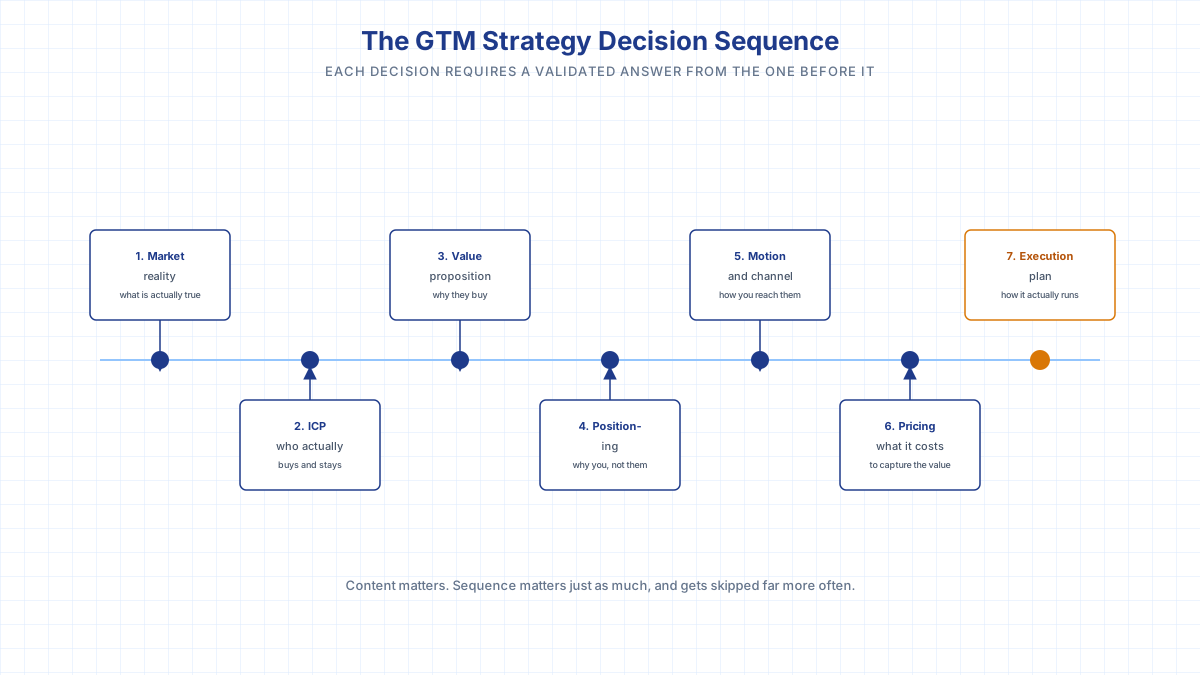
Market reality comes first: what is actually true about the market being entered right now, independent of assumption or extrapolation from an adjacent market. This step is deceptively easy to shortcut, since a team entering a market adjacent to one it already understands well often assumes the new market behaves similarly, without actually validating that assumption against evidence specific to the new market itself.
Customer definition, the ICP, comes second, and it depends directly on market reality, since a customer profile defined without an accurate picture of the market is built on an incomplete foundation. An ICP produced without a validated market picture underneath it tends to reflect who the team hopes the customer is, rather than who the market evidence actually suggests it is.
Value proposition comes third, defining why the defined customer actually buys, which depends on knowing who that customer is with enough specificity to reason about their actual priorities. A value proposition written for a vaguely defined customer tends to default toward generic, broadly applicable claims, since specificity in a value proposition requires specificity in the customer definition it is responding to.
Positioning comes fourth, defining why a buyer chooses this company over the alternatives available to them, which depends on a value proposition already being clear, since positioning is fundamentally a comparative claim built on top of a value proposition, not a replacement for one. Positioning without a settled value proposition underneath it tends to default to comparing surface features against competitors, rather than making a genuine, differentiated claim about value.
Motion and channel comes fifth, determining how the company actually reaches the defined customer with the now validated positioning, which depends on knowing both who the customer is and what the company is telling them. A channel decision made before positioning is settled risks optimizing for a message that has not yet been finalized, wasting spend on creative and targeting that will need to change once positioning catches up.
Pricing comes sixth, determining what the offer costs relative to the value it delivers, which depends on positioning being settled, since price is fundamentally a claim about value, and that claim only holds up if the underlying value story has already been validated. This is the step where sequence violations most visibly surface as the "too expensive" objection described in more detail later in this piece.
Execution planning comes seventh and last, turning the now validated strategy into a structured, actionable plan, which depends on every decision before it, since a plan for executing an unsettled strategy is a plan for executing something likely to change. A detailed execution plan built before the underlying motion is genuinely settled represents real, often substantial planning effort that has to be redone once the actual motion becomes clear.
| Step | Decision | Depends directly on |
|---|---|---|
| 1 | Market reality | Nothing prior, this is the foundation |
| 2 | Customer definition (ICP) | An accurate picture of market reality |
| 3 | Value proposition | A specific, validated customer definition |
| 4 | Positioning | A clear, settled value proposition |
| 5 | Motion and channel | A validated customer and settled positioning |
| 6 | Pricing | Settled positioning to justify the value claim |
| 7 | Execution plan | Every decision above it being settled |
Why Skipping a Step Costs More Than It Saves
The specific danger of an out of order sequence is that the resulting problem rarely shows up where the actual mistake happened. It shows up several steps downstream, disguised as a different kind of problem entirely.
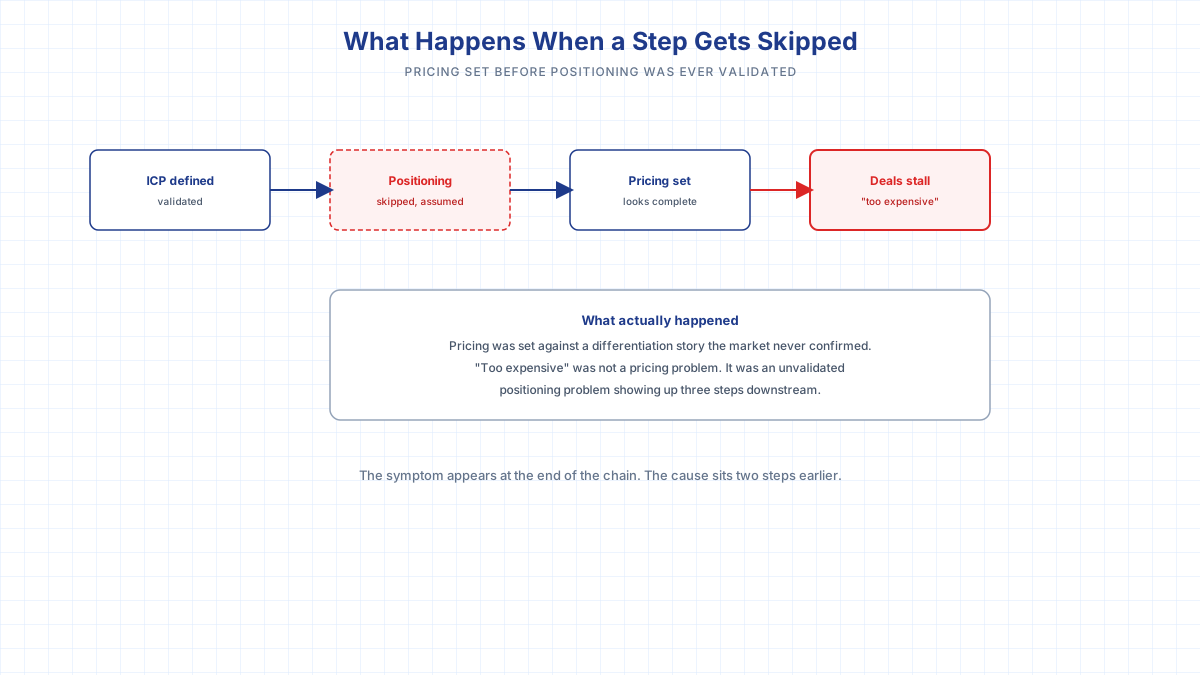
Consider a pricing decision made before positioning had actually been tested against the market. The pricing itself might be calculated carefully, benchmarked against competitors, modeled against unit economics. None of that careful work addresses the actual gap: the value story the pricing depends on to feel justified was never validated, only assumed. When deals later stall with buyers citing price as an objection, the natural response is to treat it as a pricing problem, discounting, repackaging, adjusting tiers. The actual cause, several steps upstream, is that positioning was never confirmed to land the way the team assumed it would, which means the price feels unjustified not because the number is wrong but because the value story underneath it was never actually settled.
This pattern, a downstream symptom masking an upstream sequencing failure, is what makes sequence violations so costly to diagnose and correct. A team experiencing deals stalling on price will very reasonably start by examining pricing, since that is where the symptom appears, and considerable time can be spent iterating on pricing specifically before anyone traces the problem back to an earlier, skipped validation step. The cost is not just the rework itself, it is the time spent investigating the wrong layer of the problem before the actual cause becomes clear.
This diagnostic cost compounds in organizations where different teams own different steps in the sequence. A pricing team investigating a stalled deal has no natural visibility into whether the positioning team's work was ever actually validated, and without an explicit, shared record of which steps in the sequence carry genuine validated evidence versus which carry only an assumption, the pricing team has little choice but to treat the symptom as belonging to their own layer, since that is the only layer they have full visibility into. This is one of the more concrete, practical reasons the sequence enforcement described later in this piece needs to be structural rather than left to informal, cross-team communication.
Five Ordering Mistakes That Recur
Across many GTM strategy processes, a small number of specific sequence violations show up again and again, each one putting a later decision ahead of the prerequisite it actually depends on.
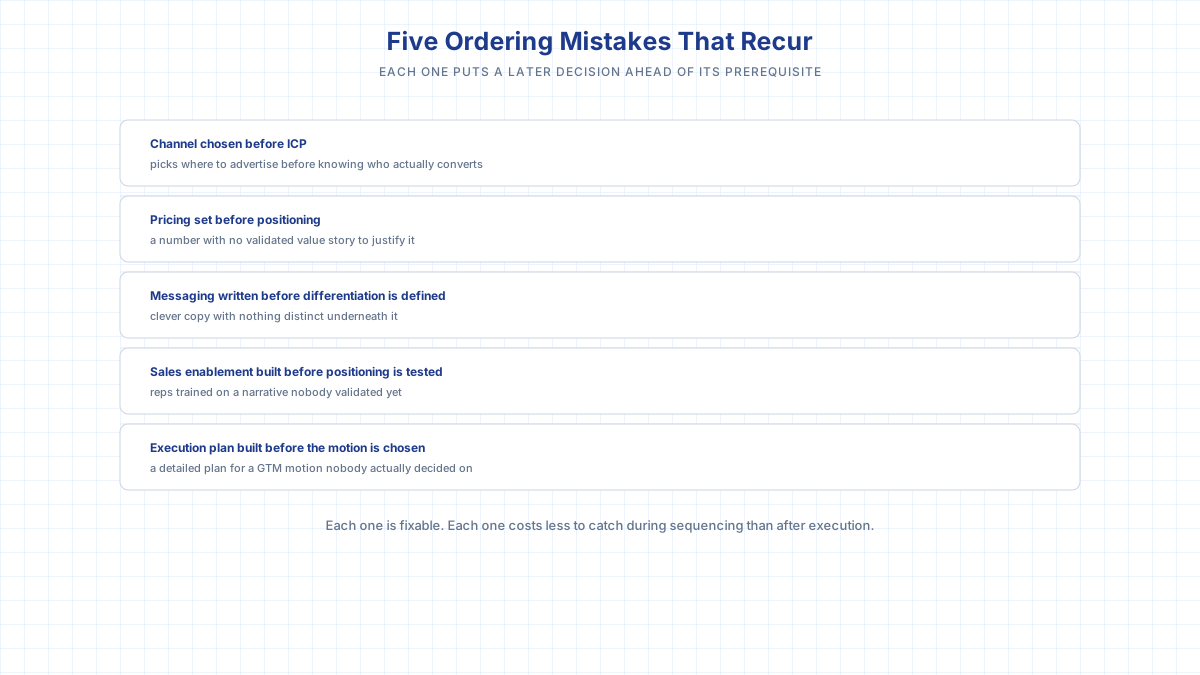
Channel gets chosen before the ICP is genuinely clear, often because channel decisions feel urgent and concrete, easy to act on quickly, while ICP definition can feel more abstract and easier to defer. Pricing gets set before positioning is validated, frequently because pricing has its own external pressures, a board expectation, a competitor's public pricing, that create urgency independent of whether the underlying value story has actually been tested. Messaging gets written before differentiation is genuinely defined, producing copy that reads well but does not actually communicate anything distinct, since there was no settled differentiation for the messaging to express. Sales enablement gets built before positioning is tested against real buyer conversations, training a team to defend a narrative that has not yet proven it holds up under real objections. And execution plans get built in detail before the underlying motion has actually been chosen, producing a well organized plan for the wrong thing.
| Mistake | Why it happens | Where the symptom shows up |
|---|---|---|
| Channel before ICP | Channel decisions feel urgent and concrete | Poor targeting efficiency, high acquisition cost |
| Pricing before positioning | External pressure to set a number quickly | Deals stalling, discounting pressure |
| Messaging before differentiation | Copy feels like visible progress | Messaging that reads well but converts poorly |
| Enablement before tested positioning | Enablement has its own deadline pressure | Reps struggling against real objections |
| Execution plan before motion is chosen | Planning feels like the responsible next step | A detailed plan that has to be substantially reworked |
How the Framework Enforces Sequence, Not Just Recommends It
A sequence that depends entirely on a team remembering to follow it, without any structural enforcement, tends to erode under the same deadline pressure that causes these violations in the first place. The framework addresses this by making each step's dependency explicit and structurally required, not just documented as a best practice.
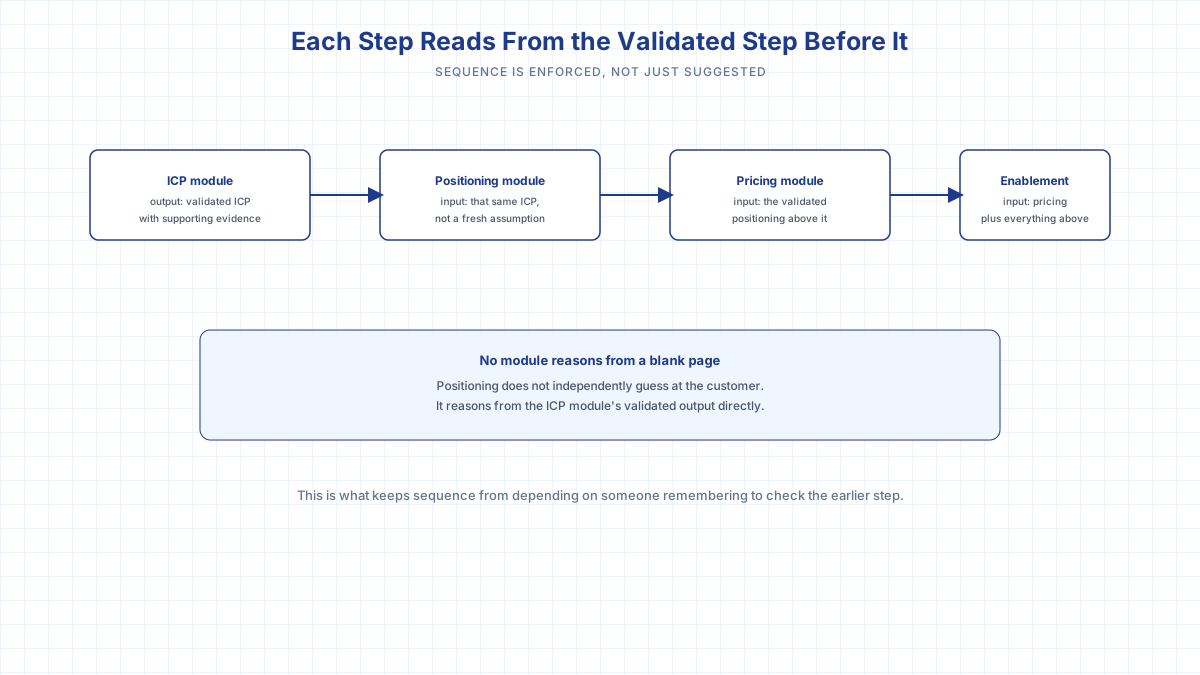
Concretely, this means the positioning stage of the process does not independently guess at who the customer is. It reasons directly from the validated ICP output that came before it, using that specific, already evidenced customer definition rather than re-deriving its own assumption about the customer from scratch. The pricing stage, similarly, does not set a number in isolation, it reasons from the validated positioning that preceded it, using the specific value claims that positioning already established rather than starting a fresh, disconnected pricing exercise. This is the same underlying architectural principle described in the companion piece on the Unified GTM Framework, that every discipline should reason from a shared, consistent evidence base rather than an independently assembled one, applied here specifically to enforcing that the base each step reasons from is not just shared, but sequenced correctly, with each step depending explicitly on the validated output of the step before it.
This structural enforcement is what keeps sequence from depending entirely on organizational discipline and good intentions, both of which reliably erode under the deadline pressure that causes sequence violations in the first place. A team under pressure to hit a launch date will, understandably, look for ways to parallelize work that feels sequential, and a framework that only recommends the right order without structurally requiring it will predictably get overridden exactly when it matters most.
This structural approach also produces a useful, practical side benefit beyond simply preventing violations: it makes the dependency chain visible and auditable after the fact. A team investigating why a launch underperformed can trace, step by step, which decisions were built on genuinely validated inputs and which were built on an earlier step that had not yet been settled, rather than reconstructing that history from memory or scattered meeting notes. This audit trail is often as valuable as the upfront prevention, since it turns a launch postmortem into a specific, evidence based diagnosis rather than a general, difficult to act on sense that something in the process did not work as well as hoped.
A Case in Two Sequences
It is useful to see this concretely, comparing how the same underlying market entry played out under two different sequences.
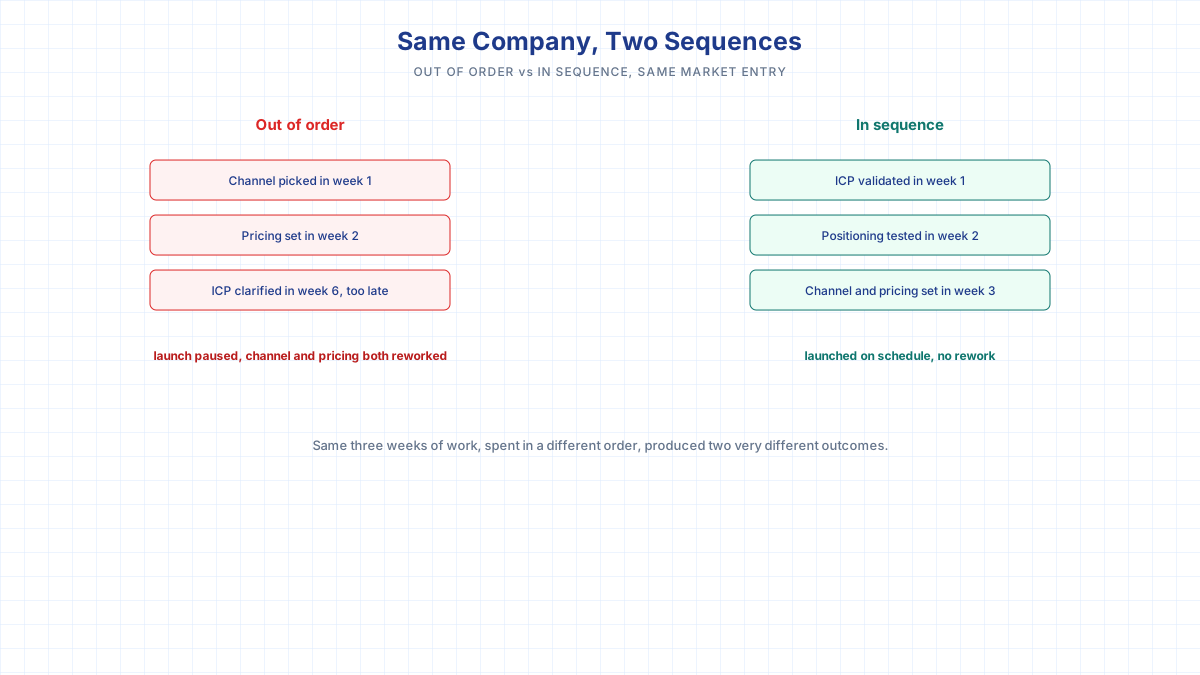
Run out of order, a company picked its acquisition channel in the first week and set pricing in the second, both reasonable sounding decisions made quickly to maintain momentum. ICP clarity did not actually arrive until week six, at which point it became clear the customer converting well did not match the assumption the channel and pricing decisions had been built around. Both had to be reworked, and the launch was delayed to accommodate that rework, well past what the original timeline had planned for.
Run in sequence, the same company validated its ICP in week one, tested positioning against that validated ICP in week two, and only then set channel and pricing in week three, once both had a settled foundation to build from. The total amount of work across both scenarios was similar. The order in which that work happened was not, and the in-sequence version launched on schedule, without the specific rework the out of order version required.
Objections and Counterarguments
"Real GTM work is rarely this linear, and teams often need to work on several pieces in parallel to hit realistic timelines." This is a fair practical concern, and the framework does not require strict serial execution with zero overlap. What it requires is that a later decision not be finalized and committed to before the earlier decision it depends on has been validated, even if preliminary work on both happens concurrently. A team can begin drafting channel options while ICP validation is still in progress, provided the channel decision is not locked in until the ICP output is actually settled. The distinction that matters is between preparatory work happening in parallel and a dependent decision being finalized out of order. In practice, this means a team can be doing genuinely useful, exploratory work on several steps at once, the discipline the framework asks for is specifically about the moment of commitment, not the moment of first draft.
"Some GTM motions genuinely need to start from a pricing or channel constraint, working backward from there rather than following this sequence forward." This is a legitimate exception worth acknowledging directly. A company with a hard external pricing constraint, a regulatory price cap or an existing market price point it must compete within, is reasonably working within a genuine constraint rather than making a premature decision, and the framework's sequence should be understood as the default ordering for decisions that are genuinely open, not a rule that overrides a real, externally imposed constraint. In this case, the constraint itself becomes an input to the earlier steps, informing which customers and value propositions are viable within it, rather than the sequence being abandoned entirely.
"This framework adds rigidity to a process that benefits from iteration and willingness to revisit earlier decisions as new information arrives." The framework does not argue against revisiting earlier decisions when genuinely new information arrives, that is a different and healthy kind of adjustment, distinct from the specific failure mode this piece addresses, which is finalizing a later decision before the earlier one was ever validated in the first place. A team that validates ICP, moves forward, and later revises that ICP based on real post-launch evidence is doing exactly what a good iterative process should do. A team that never validated ICP at all before finalizing channel and pricing decisions built on top of it is doing something different and considerably riskier.
"Enforcing this sequence structurally, rather than just recommending it, risks slowing down teams in a way that costs more than the rework it prevents." This is worth taking seriously as a genuine tradeoff rather than dismissing. The response is that the specific delay introduced by validating one step before committing to the next is typically measured in days, while the rework cost of a sequence violation, as described earlier in this piece, is typically measured in weeks and often includes real, hard costs like discarded creative work, retrained sales teams, and delayed revenue. The tradeoff is not symmetric, and in most cases the modest delay of respecting sequence is considerably cheaper than the rework required to correct a violation once its downstream symptom finally surfaces.
What This Means for GTM Teams
Map your own current or planned GTM initiative against the seven step sequence explicitly. For each step, identify whether it has actually been validated, in the evidence sense described in the companion readiness framework, or whether it is still an assumption being carried forward because an earlier deadline required a decision before the real answer was ready. This mapping alone often reveals sequence violations a team had not previously recognized as connected to a specific downstream problem they were already experiencing.
When a downstream symptom appears, trace it back through the sequence before assuming the fix belongs at the layer where the symptom showed up. As described earlier in this piece, a pricing objection is not always a pricing problem, a channel underperformance is not always a channel problem. Before iterating on the layer where a symptom appears, check whether an earlier, upstream step in the sequence was actually settled before the current layer was built on top of it.
Distinguish preparatory parallel work from premature finalization. Teams do not need to fully serialize every piece of GTM work to respect this framework. What matters is ensuring a decision is not locked in and built upon until the decision it depends on has actually been validated, which allows meaningful parallel preparation without the specific risk this framework addresses.
Build sequence checks into whatever process or tooling governs how your GTM strategy actually gets produced. A sequence that depends purely on individual discipline to maintain, without any structural support, will erode under the same deadline pressure that causes violations in the first place. Whether through a formal gate, a required sign-off, or a system that structurally requires an earlier step's output before a later step can proceed, some mechanism beyond good intentions is usually necessary to keep sequence intact under real organizational pressure.
Frequently Asked Questions
Is this framework the same as the GTM Readiness Framework covered elsewhere in this content series? No, though the two are closely related and designed to work together. The Readiness Framework addresses whether a specific claim has strong enough evidence behind it to be trusted. The Strategy Framework addresses whether decisions are being made in the right order relative to each other. A team can have a well validated, high readiness decision that was still made in the wrong sequence, built before an earlier, prerequisite decision was settled.
What happens if a later step reveals that an earlier step needs to change? This is a legitimate, healthy part of a well run process, distinct from the sequence violation this framework addresses. If positioning work genuinely surfaces new evidence that the original ICP was incomplete, the correct response is revisiting and updating the ICP, then re-validating downstream steps built on it, not treating the sequence as broken. The framework's concern is with decisions finalized before validation ever happened, not with legitimate revision based on new evidence discovered later.
Can this sequence be compressed for a smaller, faster moving team? Yes, and compression of timeline is different from violation of order. A small team can move through all seven steps in days rather than weeks, provided each step still receives a genuine validation check before the next one builds on it. The framework's concern is with order, not pace, and a fast team that respects the sequence is in a fundamentally different position than a fast team that skips steps to save time.
How does this framework apply to an existing product doing a repositioning rather than a brand new launch? The same sequence applies, though several early steps may already have a validated starting point to build from rather than starting from scratch. A repositioning effort should still explicitly check whether the market reality and customer definition underlying the new positioning have themselves been validated recently, rather than assuming they remain accurate simply because they were correct at some point in the past.
What is the fastest way to tell whether a current strategy problem is a sequence issue? Trace the specific symptom backward through the seven steps, checking at each one whether the step was genuinely validated before the step above it was finalized. If the trace reveals a step that was assumed rather than validated, with a later, dependent step already committed to and built upon, that is a strong signal the current problem is a sequence issue rather than, or in addition to, a content quality issue at the layer where the symptom actually appeared.
Conclusion
Sequence is an easy thing to overlook in GTM strategy, because content quality is what most reviews, templates, and frameworks focus on, and a document with all the right sections present can look complete regardless of what order those sections were actually decided in. The specific cost of ignoring sequence, a downstream symptom that gets misdiagnosed and iterated on at the wrong layer, while the actual upstream cause goes unaddressed, is real, common, and usually more expensive than the modest discipline required to avoid it in the first place.
The Elevate GTM Strategy Framework treats the seven step decision sequence, market reality, customer definition, value proposition, positioning, motion and channel, pricing, and execution planning, as a dependency chain, each step requiring a validated answer to the step before it, not a checklist of sections that can be completed in whatever order feels most urgent under deadline pressure. This does not mean rigid, fully serial execution with no parallel work, and it does not mean earlier decisions can never be revisited as genuinely new evidence emerges. It means a later, more visible decision should not be finalized and built upon before the earlier, less visible decision it actually depends on has been genuinely settled, which is the specific discipline most GTM strategy processes, focused heavily on content and less on order, still tend to skip.
The company from this piece's opening example ultimately relaunched successfully, once the ICP work that should have come first was actually done properly and the channel and pricing decisions were rebuilt on top of it. The six week delay and the specific rework it required were avoidable costs, not an inevitable part of entering a new market, and they trace back to a single, identifiable cause: two decisions made before the one they depended on had been settled. That is the specific failure this framework exists to prevent, not by demanding more work, but by insisting the same work happen in an order that lets each piece actually build on something solid rather than something assumed.
Contents
Related Frameworks
GTM Frameworks
Explore frameworks for assessing, structuring, aligning, and evolving go-to-market.
View Framework Library →