
By the Elevate GTM Solutions Team · Updated November 10, 2026 · 21 min read
GTM Platform vs ABM Platform: What Each Does, and How to Choose
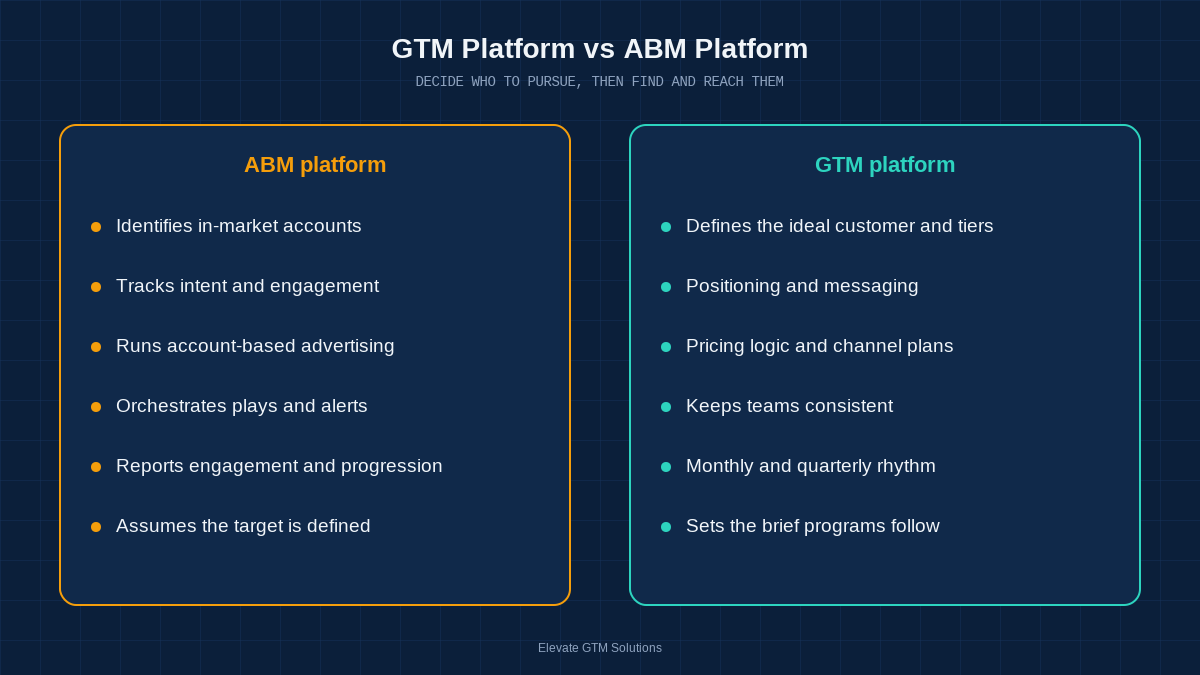
Account-based marketing platforms and GTM platforms are often shortlisted together, because both promise to help a company go after the right customers more deliberately. They solve different problems. An ABM platform helps you find the accounts that are in market, reach them with coordinated campaigns and advertising and measure engagement. A GTM platform helps you decide which kinds of accounts you should target in the first place, how to position against the alternatives they consider, what to say and how to keep that strategy consistent across teams.
Buying one to do the other's job is a common and expensive mistake. An ABM platform will tell you which accounts are showing interest, but not whether they are the accounts you should be winning. A GTM platform will help you define who you should be winning, but it does not buy the advertising or detect the intent. This guide compares them honestly: what each does, where they meet, how to decide, how they work together and how to run an evaluation. Elevate GTM Solutions makes a GTM strategy platform, so we say plainly when an ABM platform is the better answer. Descriptions of vendors reflect their public statements and your site's own comparison pages as of November 2026, and they change often. Confirm details before you buy.
GTM Platform vs ABM Platform: What Is the Difference?
An ABM platform, such as Demandbase or 6sense, identifies in-market accounts, tracks intent and engagement, and runs account-based advertising and orchestration. A GTM platform, such as Elevate GTM Solutions, builds and maintains the strategy that tells those programs who to target and what to say: ideal customer, segments, positioning, messaging, pricing logic and priorities, consistent across teams. ABM platforms execute and measure account programs. GTM platforms decide and align. Many B2B companies with an account-based motion use both, in that order.
Which should I buy first? If you cannot describe your ideal customer and message consistently, a GTM platform. If you know them and need to find and reach accounts at scale, an ABM platform.
Does one replace the other? No. They sit at different layers.
The two categories side by side
| ABM platform | GTM platform | |
|---|---|---|
| Core question | Which accounts are in market, and how do we reach them? | Which accounts should we want, and what do we say? |
| Main users | Demand generation, ABM and revenue marketing, sales development | Product marketing, strategy, marketing leaders, founders, RevOps |
| Main objects | Accounts, contacts, intent signals, campaigns, advertising audiences | Customer definition, segments, positioning, messaging, pricing logic, plans |
| Data | Intent, engagement, firmographic and contact data | Your context and evidence, structured |
| Typical output | Target account lists, signals, ads, orchestrated plays, engagement reports | A strategy others use, kept consistent |
| Timescale | Daily and weekly | Monthly and quarterly, updated when conditions change |
| AI role | Signal detection, scoring, agents that act on accounts | Structuring evidence, drafting strategy, keeping outputs consistent |
| Assumes | You know whom to target and what to say | You will test the draft with customers and decide |
| Failure mode | Efficient pursuit of the wrong accounts | A strategy nobody uses or keeps current |
What ABM platforms do
Account-based marketing is the practice of treating target accounts as markets of their own, with coordinated outreach across marketing and sales. ABM platforms support that work. They differ in scope, so check what each vendor includes.
| Capability | What it does |
|---|---|
| Account identification | Matches site visitors and signals to accounts |
| Intent data | Tracks research and engagement that suggests an account is in market |
| Account scoring and tiering | Ranks accounts by fit and intent |
| Advertising | Runs targeted ads to account audiences, in some platforms through an owned advertising engine |
| Orchestration | Coordinates plays across email, ads, web and sales alerts |
| Sales alerts | Notifies sellers when accounts show signals |
| Buying group mapping | Helps find the people involved at an account |
| Reporting | Shows engagement, pipeline influence and account progression |
| AI agents | Automate parts of analysis, campaign optimization and outreach, depending on the vendor |
Demandbase describes itself as an AI-powered GTM intelligence platform that combines account intelligence, B2B advertising, sales intelligence and AI agents, and has grown through acquisition, including the purchase of Engagio in 2020. 6sense is an account intelligence and intent platform for revenue teams. Terminus merged into DemandScience in 2024 and now sits within DemandScience's account-based offering. Our comparison pages, Elevate vs Demandbase and Elevate vs 6sense, cover specific vendors.
What GTM platforms do
A GTM platform operates at the strategy layer. Elevate GTM Solutions describes itself as an AI-native GTM operating system. From the market, industry, product and segment context you provide, it builds connected outputs across 15 modules, including ICP and segmentation, competitive intelligence, account-based marketing planning, positioning, messaging, pricing, channels, launch and execution, and measurement. It supports workflows, weekly plans, task ownership and a recurring review rhythm, and lets teams compare strategies side by side.
It does not detect intent, identify anonymous visitors, run advertising or send outreach. Its account-based marketing module supports planning: which accounts to prioritize, how to tier them and what each tier needs. The execution of those plans is done in other tools.
Where the two meet
| Strategy decision | How it shows up in an ABM platform |
|---|---|
| Ideal customer and exclusions | Target account criteria, lists and suppression |
| Segment priorities | Which account sets get programs first and how budget is divided |
| Account tiers and what each gets | The 1:1, 1:few and 1:many structure and the plays for each |
| Buying roles and personas | Contacts targeted and persona-specific content |
| Messaging pillars and proof | Ad copy, email themes and landing pages |
| Forbidden claims | Approval rules for creative |
| Qualification criteria | Handoff rules to sales |
| Channel plan | Mix of advertising, email, events and direct outreach |
| Feedback from the ABM platform | Where it goes in strategy |
|---|---|
| Engagement by segment and message | Messaging and positioning review |
| Accounts that progressed or stalled | Segment priority and qualification review |
| Intent patterns among wins | Evidence for the ICP |
| Cost and pipeline by tier | Budget and tiering decisions |
When the loop works, the ABM platform spends effort where the strategy says it should, and results improve the strategy. When it does not, the platform optimizes toward whatever is easiest to measure.
Account tiering in plain terms
Many ABM programs organize accounts into tiers with different levels of effort. The labels vary, and the idea is consistent.
| Tier | Description | Typical effort |
|---|---|---|
| One to one | A small number of strategic accounts, each treated as a market of one | Custom research, tailored content, executive involvement |
| One to few | Clusters of similar accounts | Shared themes with some customization |
| One to many | A larger set sharing a profile | Scaled programs with programmatic personalization |
Deciding which accounts belong in which tier is a strategy decision informed by fit, potential value and evidence of fit. An ABM platform helps run the plays. Our guide to ICP scoring covers rating fit.
Choosing target accounts: a worked example
This is an invented illustration of how strategy turns into an account list.
Step 1: start from the strategy. The ideal customer is a national logistics operator with a complex scheduling problem. Exclusions are regional carriers and companies that run their own scheduling software.
Step 2: build the universe. The team lists all companies that match basic firmographic criteria: industry, region and a size band. This gives about two thousand accounts.
Step 3: score for fit. Using the scoring approach in our ICP scoring framework, the team scores each account on industry, size, current method, trigger, buying group access and integration needs.
Step 4: tier.
| Tier | Criteria | Count | Treatment |
|---|---|---|---|
| One to one | Top fit, high potential value, an executive relationship possible | 25 | Custom research, executive outreach, tailored content |
| One to few | High fit in three clusters by sub-industry | 150 | Cluster themes, shared content with variations, coordinated sales and marketing plays |
| One to many | Moderate fit | 800 | Programmatic advertising and email, signal-based alerts |
| Watch | Lower fit | 1,025 | No active programs, monitor for triggers |
Step 5: use intent for timing. Intent signals decide which accounts within each tier to contact first, not which accounts belong in a tier.
Step 6: review quarterly. Accounts move between tiers when fit changes or when new evidence appears.
The result is a list that reflects the strategy, with the ABM platform used to detect timing and run plays.
Plays by tier
| Tier | Example plays |
|---|---|
| One to one | An executive briefing request, a personalized research note about the account's situation, a customer reference introduction, a tailored proposal outline |
| One to few | A themed webinar or roundtable, a cluster case study, coordinated outreach by an assigned seller and marketer |
| One to many | Account-targeted advertising with a specific message, triggered emails on engagement, alerts to sellers when signals appear |
| Watch | Brand content, community presence and passive monitoring |
Plays should carry approved messaging with proof, and they should end with a clear next step. Document each play: its goal, audience, content, owner, timing and measures.
Buying group basics
Account-based programs reach people, not accounts. Identify the roles involved.
| Role | Typical concern | What helps |
|---|---|---|
| Champion | Solving a daily problem | A clear way to try and share the product internally |
| Economic buyer | Cost and return | A business case with honest evidence |
| Technical evaluator | Integration and security | Documentation and a straightforward evaluation path |
| End users | Usability | A hands-on experience |
| Procurement or legal | Terms and risk | Clear contracts and references |
| Executive sponsor | Strategic fit | A short, credible story |
Buying groups vary by company. Learn from your wins who was actually involved, and ask in early conversations. Our guide to the win-loss analysis framework shows how.
Measuring ABM programs
| Measure | Why it matters | Caution |
|---|---|---|
| Coverage of target accounts with the right contacts | Shows reach | Contacts must be accurate |
| Engagement from target accounts | Shows interest | Interest is not intent to buy |
| Meetings or conversations with target accounts | Shows progress | Quality matters |
| Account progression through stages | Shows movement | Define stages clearly |
| Pipeline created from target accounts, by tier | Shows commercial impact | Attribution is imperfect |
| Win rate and cycle by tier | Shows whether tiers predict outcomes | Show counts |
| Cost per engaged account and per opportunity, by tier | Shows efficiency | Include media, data and people |
| Sales follow-up speed | Shows alignment | Define response time |
Compare tiers with each other, and compare account-based programs with your non-account-based baseline. Be cautious about claiming that a platform caused changes in win rate.
Sales and marketing alignment for ABM
ABM fails when marketing runs programs that sales ignores.
| Element | Practice |
|---|---|
| Shared account list | Agreed by sales and marketing, with named owners |
| Tier definitions | Written, with criteria and treatment |
| Play ownership | A named marketer and seller for each one-to-one and one-to-few account |
| Response times | Agreed time to respond to signals and engagement |
| Weekly sync | A short meeting on target accounts' progress |
| Monthly review | Results by tier, learning and changes |
| Feedback | Sellers record what they hear and what works |
| Definitions | One definition of engaged, qualified and accepted |
Data and account-matching problems to expect
| Problem | What happens | What to do |
|---|---|---|
| Wrong or duplicate accounts | Signals attributed to the wrong company | Clean the CRM and set matching rules |
| Parent and subsidiary confusion | Activity split across entities | Choose the level you sell at |
| Missing contacts | Plays cannot reach the buying group | Add contact discovery to the process |
| Stale data | Messages reach people who left | Refresh on a schedule |
| Anonymous traffic | Signals cannot be attributed | Accept limits and do not over-interpret |
| Inconsistent industry codes | Tiers and lists are inconsistent | Use one classification |
How to think about budget
Account-based programs involve platform fees, media, data and people. Plan them together.
| Question | Why it matters |
|---|---|
| How much is the platform fee, and what is included? | Quotes vary and may omit media and data |
| How much media will we run, and for which tiers? | Media is often the largest variable cost |
| Which data sources are required? | Intent and contact data may cost extra |
| Who will run the plays? | People are a cost even if not in the budget |
| What is the expected payback, and how will we measure it? | Set expectations before you spend |
| What is the cost of one-to-one accounts per account? | Custom effort is expensive, so keep the top tier small |
Start with a pilot on one segment and one or two tiers, with a defined measurement plan and review date.
Terms used in this guide
| Term | Meaning |
|---|---|
| ABM | Account-based marketing |
| ICP | Ideal customer profile |
| Intent data | Signals that an account is researching topics related to your category |
| Tiering | Grouping accounts by the effort they deserve |
| Play | A defined set of actions for an account or tier |
| Orchestration | Coordinating actions across channels and teams |
| Buying group | The people involved in a purchase decision |
| Account match | Linking a visitor, contact or signal to the correct company |
When you need an ABM platform first
- Your ideal customer and message are proven.
- Your market is defined by a list of accounts, with high deal values.
- You need to know which accounts are researching your category.
- You want to coordinate advertising and sales outreach to the same accounts.
- You have the people and process to act on signals.
When you need a GTM platform first
- Different leaders describe the ideal customer differently.
- Programs reach the wrong accounts or say inconsistent things.
- You are launching, repositioning or entering a market.
- You have several products, segments or regions needing consistent strategy.
- You cannot say which accounts deserve one-to-one attention and why.
When you need both
Companies with a mature account-based motion often reach this point. A pattern that works:
- Decide ideal customer, segments, tiers and message in the strategy layer.
- Configure the ABM platform from them: target accounts, tiers, personas, creative themes.
- Run programs with review rules.
- Feed engagement and pipeline results back monthly.
- Update strategy and configuration together.
How to evaluate each
An ABM platform
| Test | What to do | What to look for |
|---|---|---|
| Account match | Give the vendor your target list and ask for matches | Match rate and quality |
| Signals | Ask how intent is built and how often it is wrong in your segment | Explainable signals |
| Orchestration | Build a play for one tier | Ease and control |
| Advertising | Understand what is included and what costs extra | Transparency |
| Integration | Connect your CRM | Fields, direction and conflicts |
| Reporting | Pull results by tier and message | Whether you can cut the data |
| Controls | Check approvals, limits and logs for AI actions | Safety |
| Cost | Estimate over three years at your scale | Total cost |
A GTM platform
| Test | What to do | What to look for |
|---|---|---|
| Specificity | Enter real context and evidence | Outputs that name your customers and alternatives |
| Change handling | Change the target segment | What updates and what you must fix |
| Tiering support | Ask how it supports account prioritization | Clarity of criteria |
| Review | Have sales and marketing read the output | What they say is wrong or missing |
| Handoff | Produce messaging and a customer profile | Match with the strategy |
| Integration | Check supported actions with your CRM | Automatic versus manual |
| Cost | Compare plans with your scope | Total including team time |
Cost shapes
| Element | ABM platform | GTM platform |
|---|---|---|
| License | Annual contracts, often quote-based, scaling with accounts, contacts or data | By scopes and users, with published plans for some vendors |
| Advertising | Media spend may be separate from the platform fee | Not applicable |
| Data | Intent and contact data may be bundled or add-on | Your own inputs |
| Implementation | Integrations, account lists, play design, training | Inputs, review and owners |
| Internal time | Campaign operations and sales follow-up | Updating inputs and reviewing outputs |
For reference, Elevate GTM Solutions publishes Enable at USD 499 per month and Growth at USD 1,499 per month, billed annually, with custom Scale pricing and a free first strategy build. ABM pricing is usually quote-based, so ask each vendor for a written quote at your scale.
Mistakes to avoid
| Mistake | What happens | Fix |
|---|---|---|
| Buying an ABM platform to define your market | Efficient pursuit of the wrong accounts | Settle ICP and tiers first |
| Treating intent as fit | High-intent poor-fit accounts consume time | Score fit separately |
| Skipping sales alignment | Alerts go unused | Agree plays and response times |
| Over-tiering | Too many one-to-one accounts | Keep the top tier small |
| Measuring impressions | Activity looks like progress | Track progression and pipeline by tier |
| Generic creative | Wasted spend | Use specific messaging with proof |
| Ignoring data quality | Wrong accounts and contacts | Test match and accuracy |
| No feedback loop | Strategy stales | Monthly review with results |
A hypothetical example
This is an illustration, not a real company.
A company selling to large logistics operators bought an ABM platform and loaded a list of two thousand target accounts built from firmographic filters. The platform surfaced high engagement from a set of mid-sized regional carriers, and marketing spent heavily on them. Sales said the carriers rarely bought. A review showed that the company's best customers were national operators with a specific scheduling problem, and that the target list had been built before anyone defined that.
The company paused new spending and ran a strategy process. It defined the national operators as the priority segment, wrote messaging from buyer interviews, set up three tiers with criteria and defined what each tier would receive. It then rebuilt its target list in the ABM platform, added exclusions for regional carriers, gave the top tier custom research and moved the middle tier to shared themes. Intent signals were used for timing within the tiers, not for choosing them.
After two quarters, engagement came from fewer accounts, progression through the pipeline improved among the national operators and the monthly review showed which messages resonated by tier. The ABM platform had not failed. It had been pointed at the wrong list.
A ninety-day plan for a first account-based program
Days 1 to 15: decide. Write the ideal customer, exclusions and tier criteria. Name a sales owner and a marketing owner. Agree definitions of engaged, qualified and accepted. Choose one segment for the pilot.
Days 16 to 30: build the list. Create the universe, score fit, assign tiers and review the top tier with sellers. Check account and contact data on a sample.
Days 31 to 45: prepare plays. Write the plays for each tier, with messaging pillars, proof and forbidden claims. Prepare content for the one-to-few clusters. Set up alerts and response times.
Days 46 to 75: run. Launch plays for the top two tiers. Hold a weekly sync. Record what sellers hear. Monitor engagement and progression by tier.
Days 76 to 90: review. Compare engagement, meetings and progression with your baseline. Read buyer feedback. Decide which plays to extend, change or stop, and whether to add a tier.
Keep the pilot small enough that sellers can follow up on every signal. A small program well executed teaches more than a broad one ignored.
Questions for ABM vendors about data and AI
| Topic | Question |
|---|---|
| Data sources | Where do intent and contact data come from, and how fresh is it? |
| Accuracy | How do you measure and report accuracy for accounts like ours? |
| Matching | How are visitors and signals matched to accounts, and what is the error rate? |
| Signals | Which signals drive scores, and can I see why an account scored as it did? |
| AI agents | What actions can agents take without approval? How are they logged? |
| Advertising | What is included, what media costs extra and how is spend reported? |
| Privacy | How do you handle consent and regional rules? |
| Integration | Which CRM fields sync, and how are conflicts handled? |
| Exit | How do I export account lists, history and audiences? |
| Contract | What happens to pricing at renewal, and what if products are merged or retired? |
Ask for written answers, and keep them with the contract.
Creative and messaging for account-based programs
Messages for named accounts can be more specific than general campaigns, and specificity must be accurate.
| Guideline | Practice |
|---|---|
| Lead with the problem | Name a situation the account probably faces, drawn from evidence about similar customers |
| Prove it | Use evidence you may cite, such as a customer story with permission |
| Do not over-personalize | Messages that show unsettling knowledge of a company reduce trust |
| Keep claims consistent | Use approved pillars and avoid forbidden claims |
| Respect the buying group | Tailor by role without saying contradictory things |
| Offer a useful next step | An invitation, a resource or a short conversation |
| Keep it short | Busy people respond to specific, brief messages |
| Check facts | Verify any account-specific detail before sending |
AI tools can draft account-specific messages quickly. Require a source for any statement about an account, and have a person approve messages to top-tier accounts.
Final thoughts
ABM platforms and GTM platforms answer different questions, and the order matters. Decide who you want and what you will say, then use an ABM platform to find the moment and the reach, then feed what you learn back into the decision. Keep the top tier small, measure by tier and read the results with sales. The most expensive account-based programs are the ones that reach the wrong accounts efficiently, and the most effective ones reach a short, well-chosen list with something worth saying.
An ABM reporting pack
| Report | Question it answers | Cadence |
|---|---|---|
| Target account coverage | Do we have the right contacts at the accounts that matter? | Monthly |
| Engagement by tier and theme | Which messages resonate with which tiers? | Weekly |
| Account progression | Which accounts moved forward or stalled? | Weekly |
| Meetings and opportunities by tier | Are plays producing conversations? | Weekly and monthly |
| Pipeline and win rate by tier | Do tiers predict outcomes? | Quarterly |
| Cost by tier | Where is spend working? | Quarterly |
| Sales follow-up | Are signals acted on quickly? | Weekly |
| Data quality | Are matches and contacts accurate? | Monthly |
Publish definitions with each report, and note sample sizes beside rates.
Questions teams ask about ABM
"How many accounts should be one to one?" Few enough that each can receive real, custom effort. For many teams that means tens, not hundreds.
"Can we run ABM without a platform?" Yes, for a small list. A spreadsheet, a CRM and disciplined plays can work. Platforms help with scale, signals and advertising.
"How long before ABM shows results?" Account-based cycles are often long. Watch engagement and progression early and pipeline later.
"What if sales ignores the alerts?" Agree response times, make alerts specific and review which signals led to conversations. Drop signals that never do.
"Is intent data reliable?" It is evidence of research, not a promise of purchase. Test its relationship with your own outcomes before relying on it.
"How do we avoid spamming target accounts?" Coordinate across teams, cap frequency per account and keep messages relevant.
Working with an agency on ABM
If you use an agency to run programs, set expectations in writing.
| Topic | Agree |
|---|---|
| Scope | Which tiers, channels and deliverables are included |
| Strategy ownership | Who owns the ICP, tiers and message, which should remain with you |
| Access | Which systems the agency can use and how data is protected |
| Measures | The outcomes you will review, with definitions |
| Reviews | Monthly results and quarterly resets |
| Documentation | Plays, creative and learnings delivered to you |
| Exit | How work product and audiences transfer if you stop |
Hand the agency a tested brief. They will execute whatever target and message you provide.
Scenarios and directions
| Situation | Direction to explore |
|---|---|
| A company with a short list of large target accounts | Strategy and tiering first, then a small ABM program with a light platform or none |
| A company with a large addressable market and a defined ICP | An ABM platform for signals and advertising, once fit is scored |
| A company where marketing and sales disagree on target accounts | Settle criteria and tiers before any platform decision |
| A company with several products and regions | A strategy layer with scopes, and regional ABM programs that follow shared tiers |
| A company that bought an ABM platform and is not seeing results | Check the target list, the message and sales follow-up before changing platforms |
| A company testing ABM for the first time | A ninety-day pilot on one segment and two tiers |
A short checklist before you sign an ABM contract
- You can describe the ideal customer and exclusions in writing.
- Sales and marketing have agreed target account criteria and tiers.
- You have tested account match and data accuracy on a sample.
- You know what is included in the quote and what is extra, including media and data.
- You have named owners for plays on each tier.
- You have agreed response times for signals.
- You understand how AI agents act and how they are logged.
- You have reviewed consent and privacy for your regions with advisers.
- You know how to export data and audiences if you leave.
- You have set a pilot scope, measures and a review date.
What to do this week
Write the criteria for your top fifty accounts and ask sales and marketing to rate five accounts against them separately. Compare their ratings. If they disagree, settle the criteria before choosing platforms. If they agree and you need signals and reach, evaluate ABM platforms with your own account list.
In plain language
ABM platforms help you find in-market accounts and reach them. GTM platforms help you decide which accounts you should want and what you should say. If you buy the first without the second, you will reach the wrong accounts efficiently. If you build the second and never buy the first, you may have a good list and no signals. For most account-based teams the right order is: define the ideal customer and tiers from evidence, build the list, use the ABM platform for timing, reach and measurement, and bring results back into a monthly review. Keep the top tier small, use specific messages with proof, and agree with sales how signals will be handled.
Key takeaways
- ABM platforms find and reach in-market accounts. GTM platforms decide who to target and what to say.
- They sit at different layers, and companies with account-based motions often need both, in order.
- Score fit separately from intent, and decide tiers and plays from evidence.
- Evaluate each with your own data, and check controls on AI actions.
- Ask ABM vendors for written quotes at your scale, including media and data.
Where Elevate GTM Solutions fits
Elevate GTM Solutions is an AI-native GTM operating system for B2B companies. Its ICP and segmentation module and its account-based marketing module help define the ideal customer, segments, exclusions, tiers and what each tier needs, and its positioning and messaging modules turn those into pillars with proof. It supports workflows, weekly plans and a recurring review rhythm, and lets teams compare strategies side by side. It does not detect intent, run advertising or send outreach, so account-based teams pair it with an ABM platform. It connects to HubSpot, Salesforce, LinkedIn, Notion and Claude for supported actions.
For related reading, see Elevate vs Demandbase, Elevate vs 6sense, ICP Scoring Framework and Account-Based Marketing. See the pricing page, or request a demo.
Frequently Asked Questions
What is the difference between a GTM platform and an ABM platform?
An ABM platform identifies in-market accounts, tracks intent and runs account-based advertising and orchestration. A GTM platform builds and maintains the strategy those programs follow: ideal customer, segments, positioning, messaging, pricing logic and priorities.
Do I need both?
Companies with a mature account-based motion often do. Decide the ideal customer, tiers and message in the strategy layer, configure the ABM platform from them and feed results back.
Which should I buy first?
If you cannot describe the ideal customer and message consistently, a GTM platform. If you know them and need signals and reach, an ABM platform.
Can an ABM platform define my ICP?
It can reveal patterns in engagement, but it follows the target criteria you give it. Intent shows interest, not fit, so define fit from your own wins and losses.
Can a GTM platform run account-based advertising?
No. A GTM platform does not detect intent or run advertising. It plans which accounts to prioritize and what each tier needs.
What is account tiering?
Organizing accounts into groups with different effort, commonly one to one, one to few and one to many, based on fit and potential value.
How should I evaluate an ABM platform?
Test account match against your own list, ask how intent is built and how often it is wrong, build a play for one tier, check integrations and controls and get a written quote at your scale.
What happened to Terminus?
Terminus merged into DemandScience in November 2024 and now sits within DemandScience's account-based offering.
How much do ABM platforms cost?
Pricing is usually quote-based and varies with accounts, contacts, data and advertising, so ask each vendor for a written quote at your scale.
How do the two work together?
Strategy decisions set targets, tiers, personas and creative themes in the ABM platform. Engagement and pipeline results return to the monthly review to update the strategy.
Does Elevate GTM Solutions replace Demandbase or 6sense?
No. It covers strategy and planning and connects to other tools for supported actions. Account intelligence and advertising are done in ABM platforms.
How do I choose target accounts for ABM?
Start from the ideal customer and exclusions, build the universe, score for fit, assign tiers, use intent only for timing within tiers and review quarterly.
What plays work for each ABM tier?
One-to-one accounts get custom research and executive outreach. One-to-few clusters get themed content and coordinated plays. One-to-many accounts get programmatic advertising and triggered email.
How should ABM be measured?
By coverage, engagement, meetings, progression, pipeline by tier, win rate and cycle by tier and cost per engaged account, with counts and caution about attribution.
What should an ABM budget include?
The platform fee, media, data, the people who run plays and a pilot plan with a measurement and review date.
Contents