
By the Elevate GTM Solutions Team · Updated November 10, 2026 · 22 min read
ICP Scoring Framework: How to Score Accounts Against Your Ideal Customer Profile
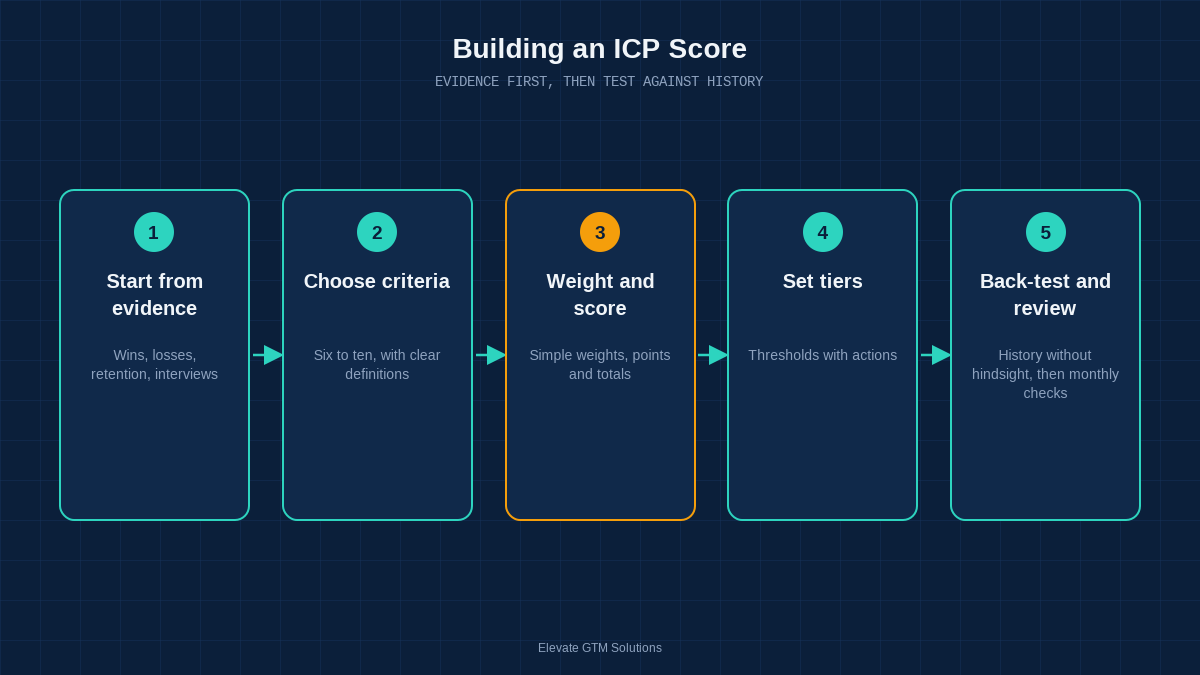
An ideal customer profile is a description. A score turns that description into a decision. Without one, teams argue about whether a particular account is "a good fit" and answer by instinct, so the same account is a priority for one seller and a waste of time for another. With one, you can rank accounts, route them, decide how much effort each deserves and learn which assumptions about your customer are wrong.
An ICP score is not magic, and it can mislead if built carelessly. This guide gives you a practical framework: how to choose criteria from evidence, how to weight them, how to define tiers, how to test the model against real wins and losses, where the data comes from, how to maintain it and how to avoid common traps. It uses a worked example with invented numbers to show the arithmetic. Elevate GTM Solutions makes a GTM strategy platform that produces an ICP and segment definition, which is the input to scoring, so we have an interest. The method works in a spreadsheet or any CRM. Nothing here guarantees a result, and every business will adapt it.
What Is an ICP Scoring Framework?
An ICP scoring framework is a structured way to rate how closely an account matches your ideal customer profile. You choose fit criteria from evidence about who buys and succeeds (such as industry, size, situation, technology and buying group), give each a weight, score accounts, set tier thresholds, test the model against past wins and losses and review it regularly. The result is a ranked list that guides targeting, routing and effort. It measures fit. It does not by itself measure buying intent or timing, which is usually scored separately.
Is ICP scoring the same as lead scoring? Not quite. ICP scoring rates the fit of an account. Lead scoring often adds behavior and engagement.
Do I need software? No. A spreadsheet works for a few hundred accounts.
Fit versus intent
| Dimension | Question | Source |
|---|---|---|
| Fit | Is this the kind of company we serve best? | ICP definition and evidence |
| Intent or engagement | Is this account showing interest now? | Behavior, signals and conversations |
| Timing | Is there a trigger that makes this a good moment? | Events and signals |
Teams that score only engagement send active but poor-fit accounts to sellers. Teams that score only fit have a good list and no sense of timing. A common approach uses fit to decide who is worth pursuing, and intent and timing to decide who to contact first.
| Fit | Intent | Interpretation | Typical action |
|---|---|---|---|
| High | High | Ready now | Prioritize for sellers |
| High | Low | Right company, not yet interested | Nurture and watch for triggers |
| Low | High | Interested but a poor match | Politely redirect or deprioritize |
| Low | Low | Not relevant | Suppress |
Step 1: start from evidence, not opinion
An ICP score should reflect who actually buys and succeeds.
| Source | What to extract |
|---|---|
| Closed-won deals | Attributes common to wins, especially quick, large or retained ones |
| Closed-lost deals | Attributes common to poor-fit losses |
| Customer retention and expansion | Who stays and grows |
| Buyer interviews | Triggers, situations and buying roles |
| Support and onboarding history | Who struggles |
| Sales feedback | Patterns sellers notice |
Aim for at least a few dozen outcomes if you can. With fewer, treat the model as a set of hypotheses and add weight to qualitative evidence. Our guide to the win-loss analysis framework covers how to gather buyer evidence.
Step 2: choose criteria
Choose criteria that you can observe for target accounts, that matter to success and that do not duplicate each other.
| Category | Examples | Notes |
|---|---|---|
| Firmographic | Industry, company size, region, growth stage | Usually easy to find |
| Technographic | Tools they use, systems you integrate with | Needs a data source or research |
| Situational | A recent trigger such as a launch, a leadership change or funding | Often the strongest predictors |
| Operational | How they work today, for example scheduling in spreadsheets | Often from interviews |
| Buying group | Presence of a champion role and a budget owner | Often from conversations |
| Risk or exclusion | Needs you cannot serve, or customers you have not retained | Useful as disqualifiers |
Keep the list short, usually six to ten criteria. A long list adds noise and makes the model hard to explain.
Step 3: define scoring levels
For each criterion, define what counts as strong, partial or poor fit, and write it clearly.
| Criterion | Strong fit (3 points) | Partial fit (1 point) | Poor fit (0 points) |
|---|---|---|---|
| Industry | Field services or logistics | Adjacent services | Other |
| Size | Ten to eighty technicians | Eighty-one to two hundred | Below ten or above two hundred |
| Current method | Spreadsheets or phone | A basic tool they dislike | A mature competing tool |
| Trigger | Recent missed jobs or a growth spurt | General interest | None |
| Buying group | Owner involved and a daily user identified | One of the two | Neither |
| Data and integration needs | Light | Moderate | Heavy |
Write definitions that two different people would apply the same way. Test this by having two people score the same ten accounts and compare.
Step 4: assign weights
Not all criteria matter equally. Weight them by their relationship to outcomes.
| Criterion | Weight | Reason |
|---|---|---|
| Industry | 2 | Consistently linked to wins |
| Size | 2 | Strongly linked to success and retention |
| Current method | 3 | Strongest sign of the problem |
| Trigger | 2 | Predicts timing |
| Buying group | 1 | Helps, harder to know early |
| Data and integration needs | 2 | Heavy needs predicted losses |
Choose weights from your evidence, with judgment where evidence is thin. Avoid false precision: weights of 1, 2 and 3 are usually enough.
Step 5: calculate the score
Multiply each criterion's points by its weight and add them. With the weights above, the maximum is 3 times (2 plus 2 plus 3 plus 2 plus 1 plus 2), which is 36.
A worked example, with invented numbers
| Account | Industry | Size | Method | Trigger | Buying group | Data needs | Score |
|---|---|---|---|---|---|---|---|
| Account A | 3 x 2 = 6 | 3 x 2 = 6 | 3 x 3 = 9 | 3 x 2 = 6 | 3 x 1 = 3 | 3 x 2 = 6 | 36 |
| Account B | 3 x 2 = 6 | 1 x 2 = 2 | 3 x 3 = 9 | 0 | 1 x 1 = 1 | 3 x 2 = 6 | 24 |
| Account C | 1 x 2 = 2 | 3 x 2 = 6 | 1 x 3 = 3 | 1 x 2 = 2 | 0 | 1 x 2 = 2 | 15 |
| Account D | 0 | 0 | 0 | 0 | 0 | 0 | 0 |
Account A scores the maximum. Account B fits the industry and the problem but is larger than the sweet spot and has no trigger. Account C is a weak match across the board. Account D matches nothing.
Step 6: set tiers and thresholds
Tiers turn scores into actions.
| Tier | Score range (of 36) | Meaning | Typical action |
|---|---|---|---|
| A | 28 to 36 | Strong fit | Priority outreach, tailored messaging, seller attention |
| B | 18 to 27 | Reasonable fit | Standard outreach or nurture, watch for triggers |
| C | 9 to 17 | Weak fit | Low-touch or self-serve, no active outreach |
| Exclude | Below 9, or any disqualifier | Not a fit | Suppress |
Set thresholds by looking at where past wins and losses fall, then adjust. Include disqualifiers that override the score, such as a requirement you cannot serve.
Step 7: test the model against history
A score is only useful if it predicts outcomes. Back-test it.
| Test | Method | What good looks like |
|---|---|---|
| Score past wins and losses | Apply the model to closed deals, scoring from information available at the time | Wins score higher than losses on average |
| Win rate by tier | Compute win rate for deals in each tier | Higher tiers win more often |
| Retention by tier | Compare retention or expansion by tier | Higher tiers retain better |
| Cycle length by tier | Compare sales cycle by tier | Higher tiers close faster or at higher value |
| Misses | Look at high scorers that lost and low scorers that won | Patterns suggest missing criteria |
| Consistency | Have two people score a sample | Scores agree within a small margin |
Be careful of hindsight. Score using what you knew before the deal, not what you learned during it. Treat small samples with caution, and show counts beside rates.
Reading the back-test, with invented numbers
| Tier | Deals closed | Won | Win rate |
|---|---|---|---|
| A | 18 | 11 | 61 percent |
| B | 30 | 9 | 30 percent |
| C | 22 | 2 | 9 percent |
| Exclude | 10 | 0 | 0 percent |
This pattern, with win rate falling as tier falls, suggests the model has some predictive value. If tiers B and C had similar rates, the criteria or weights would need work.
Step 8: gather the data
| Criterion type | Typical sources | Cautions |
|---|---|---|
| Firmographic | CRM, data providers, public information | Accuracy varies by region and size |
| Technographic | Data providers, website analysis, interviews | Often incomplete |
| Situational | News, hiring signals, conversations | Needs a process to capture |
| Operational | Discovery calls, forms | Needs good questions |
| Buying group | Conversations and contact roles | Often unknown at first |
Where data is missing, score the criterion as unknown, not as poor, and use a rule for unknowns, such as a neutral point value or a flag. Test accuracy with a sample you know well.
Step 9: use the score
| Use | How the score helps |
|---|---|
| Targeting | Build lists from tier A and B accounts |
| Routing | Send tier A accounts to your best-fit sellers |
| Account tiering | Decide how much effort each account deserves |
| Messaging | Tailor messages to tier A characteristics |
| Suppression | Exclude accounts that are clearly poor fits |
| Forecasting | Weight pipeline by the tier of the account |
| Marketing programs | Focus spend on tiers with better outcomes |
| Strategy review | Check whether wins match the intended ICP |
Account tiering, which decides how much effort each account deserves, is a natural next step.
Maintaining the model
| Cadence | Activity |
|---|---|
| Monthly | Review exceptions: high scorers that lost and low scorers that won |
| Quarterly | Re-run the back-test, review weights and thresholds and check data quality |
| After major changes | Re-check after a repositioning, a new product or a change in market |
| Annually | Review the criteria list and remove those that no longer help |
Keep a change log with dates and reasons so you can see how the model evolved.
A spreadsheet template
A simple workbook is enough to start.
| Tab | Columns |
|---|---|
| Criteria | Criterion, category, definition of strong, partial and poor, weight, data source, owner |
| Accounts | Account name, each criterion's points, weighted subtotals, total score, tier, disqualifier flag, notes |
| Back-test | Deal, outcome, score at first call, tier, notes on what was known then |
| Exceptions | Account, score, outcome, why the model missed, proposed change |
| Change log | Date, change, reason, decided by |
Use formulas for totals and tier assignment so that changing a weight or threshold updates everything. Lock the criteria tab to prevent accidental edits, and keep one current version.
A calibration session
Scoring models fail when people interpret criteria differently. Hold a short session before you roll it out.
- Choose ten accounts that cover strong, weak and borderline cases.
- Score them separately. Each person scores without discussion.
- Compare. List criteria where scores differed by more than one level.
- Discuss the definitions. Rewrite any criterion that two people read differently.
- Re-score. Check that scores now agree.
- Record examples. Keep a one-line example for each level of each criterion.
Repeat the session when you add criteria or onboard new scorers.
Edge cases
| Case | How to handle |
|---|---|
| Strategic accounts | Allow an override with a recorded reason, reviewed quarterly, so exceptions do not erode the model |
| Existing customers | Score them for expansion potential with different criteria, or exclude them from new-business scoring |
| Partners and resellers | Use a separate profile and score |
| Very small accounts | Decide whether a self-serve path suits them, and score accordingly |
| Subsidiaries and parents | Choose the level at which you sell, and score that entity consistently |
| Newly formed companies | Treat missing history as unknown and watch for triggers |
| Accounts that moved | Rescore when attributes change |
| Accounts with conflicting data | Use the most reliable source, note the conflict and verify when it matters |
Scoring for different motions
| Motion | Adjustments |
|---|---|
| Sales-led, enterprise | Emphasize buying group, integration needs, security requirements and deal size potential |
| Product-led | Add behavior within the product, such as activation steps and team growth, as a separate intent score |
| Partner-led | Score the partner's fit and the joint customer overlap |
| Account-based marketing | Score for tiering, then layer intent signals for timing |
| Land and expand | Add expansion potential, such as the number of teams that could use the product |
The same logic of evidence, weights and back-testing applies. Only the criteria change.
Intent and timing signals to pair with fit
Fit tells you who is worth pursuing. These signals help decide when.
| Signal type | Examples | Caution |
|---|---|---|
| Behavioral | Repeat visits to key pages, product usage, content engagement | Interest is not always buying intent |
| Event-based | Hiring for a relevant role, a leadership change, funding, a launch | Verify relevance |
| Conversational | A reply, a question about pricing, a request for a demo | Strongest when specific |
| Contextual | A renewal date for a competing tool, public statements about priorities | Often found through research |
| Community | Participation in relevant discussions | Interpret carefully |
Score intent on a separate scale, and combine it with fit as in the table earlier, so that a high-intent, low-fit account does not take a seller's time.
Communicating the score to sellers
A score that sellers distrust will be ignored.
- Explain the criteria in plain language and show examples.
- Show the back-test results with counts.
- Allow sellers to flag accounts the model misjudges, and review flags monthly.
- Show the score alongside the reasons, not just a number.
- Credit sellers when their feedback changes the model.
- Avoid using the score to judge individual sellers.
Terms used in this guide
| Term | Meaning |
|---|---|
| ICP | Ideal customer profile |
| Fit | How closely an account matches the ICP |
| Intent | Signs that an account is interested now |
| Tier | A grouping of accounts by score, with an associated action |
| Disqualifier | A condition that excludes an account regardless of score |
| Back-test | Applying a model to past outcomes to check whether it would have predicted them |
| Proxy | A criterion that stands in for something else and may have side effects |
| Calibration | Aligning how people apply criteria |
Example criteria for three kinds of business
The criteria below are invented illustrations. Build yours from your own evidence.
A scheduling platform for field-service firms
| Criterion | Strong fit |
|---|---|
| Industry | Field services such as HVAC, electrical or plumbing |
| Size | Ten to eighty technicians |
| Current method | Spreadsheets and phone calls |
| Trigger | Recent missed appointments or rapid hiring |
| Buying group | Owner involved, dispatcher identified |
| Exclusions | Needs deep invoicing, below ten technicians |
A security and compliance platform for mid-sized software companies
| Criterion | Strong fit |
|---|---|
| Industry | Software companies selling to regulated customers |
| Size | Fifty to five hundred employees |
| Situation | Preparing for a first major customer security review |
| Current method | Manual evidence collection |
| Trigger | A deal waiting on a security questionnaire |
| Buying group | Security lead, engineering manager and a finance approver |
| Exclusions | Already using a mature compliance platform |
A data analytics tool for operations teams in distribution
| Criterion | Strong fit |
|---|---|
| Industry | Distribution and wholesale |
| Size | Two hundred to two thousand employees |
| Current method | Reports assembled in spreadsheets from several systems |
| Trigger | A new warehouse, a system change or a margin squeeze |
| Buying group | Operations leader, finance partner, an IT contact |
| Exclusions | Heavy custom integration requirements |
Notice how each includes a situational trigger and an operational method, which often predict fit better than industry and size alone.
Testing criteria: simple checks before you commit
You do not need advanced statistics to learn whether a criterion helps.
| Check | How | What it tells you |
|---|---|---|
| Split test on history | Compare win rates for deals with and without the criterion | Whether it separates outcomes |
| Remove one criterion | Recompute tiers without it and compare back-test results | Whether it adds value |
| Interaction look | Check whether a criterion matters only in combination with another | Whether weights should change |
| Seller review | Ask sellers whether the criterion matches their experience | A reality check |
| Sample size check | Count deals behind each comparison | Whether to trust it |
If a criterion does not help in any check, remove it. A simpler model is easier to explain and maintain.
When you have very little data
Early companies may have only a handful of wins. A qualitative scorecard can still help.
| Step | Practice |
|---|---|
| Use interviews | Base criteria on what customers say about their situation and trigger |
| Mark confidence | Label each criterion as strong, medium or weak evidence |
| Keep it short | Four to six criteria |
| Use broad tiers | Strong fit, possible fit, poor fit |
| Learn quickly | Revisit after every ten new conversations or deals |
| Avoid precision | Do not compute fine scores from thin evidence |
A simple three-level judgment, applied consistently and revisited often, beats a precise model built on guesses.
Governance for the model
| Question | Practice |
|---|---|
| Who owns the model? | A named person, usually in revenue operations or product marketing |
| Who can change it? | The owner, with input from sales and marketing, recorded in the change log |
| Where does it live? | One place, with a link from the CRM and tools |
| How are changes communicated? | A short note to sellers and marketers, with the reason |
| How are versions handled? | Archive old versions, and record when each applied |
| How is data quality checked? | A monthly check of the fields the score depends on |
| How are disputes resolved? | A flag process, reviewed monthly |
Final thoughts
An ICP score is a simple tool with a large effect when it is built from evidence and used consistently. It lets a team stop arguing about whether an account is a good fit and start learning from the cases where the answer was wrong. Keep it short, explain it plainly, test it against history without hindsight and revise it regularly. Treat it as a hypothesis about your customer that gets better each quarter.
A quarterly scoring review
Sixty minutes with revenue operations, sales, marketing and product marketing.
| Time | Topic |
|---|---|
| 0 to 10 minutes | Review the back-test with new deals added, with counts |
| 10 to 25 minutes | Review exceptions: high scorers that lost and low scorers that won |
| 25 to 40 minutes | Review data quality for the fields the score uses |
| 40 to 50 minutes | Decide changes to criteria, weights or thresholds |
| 50 to 60 minutes | Assign owners and update the change log |
Share a short summary with sellers and marketers the same week.
Questions teams ask about ICP scoring
"Is a score too mechanical for relationship selling?" It guides where to spend effort. It does not replace judgment, and allowing flagged exceptions keeps both.
"How do we handle a customer who scores low but is great?" Treat it as information. Look for what the model missed, and add or adjust a criterion if the pattern repeats.
"Should marketing and sales use the same score?" Yes, for fit. Teams can use different intent signals for timing.
"How often will the score change a seller's behavior?" Only if sellers trust it and it is easy to use. Put it where they work and show examples.
"Can we score contacts as well as accounts?" Yes, with separate criteria for role and seniority, but keep the account-level fit score as the base.
"What if our data is poor?" Start with the criteria you can verify, improve data on the rest and mark unknowns clearly.
Quick reference
| Question | Short answer |
|---|---|
| How many criteria? | Six to ten |
| How are weights set? | From evidence, simple values such as one to three |
| How are tiers set? | From where past wins and losses fall, then adjusted |
| How is the model tested? | Back-test on past deals using information known at the time |
| How often is it reviewed? | Monthly for exceptions, quarterly for the model |
| What if data is missing? | Mark unknown and apply a rule, do not treat it as poor |
Where AI helps and where it does not
| Task | How AI helps | Caution |
|---|---|---|
| Extracting attributes from deal notes | Summarizes patterns | Check against the source |
| Proposing criteria | Suggests candidates from your evidence | Decide yourself, and avoid proxy criteria that cause unfair exclusion |
| Enrichment | Fills missing fields | Errors spread, so sample |
| Running back-tests | Speeds calculation | Verify the method and the data |
| Predictive models | Finds patterns in larger datasets | Need enough data, and can be hard to explain |
| Drafting criteria definitions | Provides a first pass | Test with two scorers |
For small datasets, a simple, explainable scorecard usually beats a complex model, because teams can understand and trust it.
Fairness and caution
Scoring decides where effort goes, and criteria can have side effects. Review criteria for proxies that could unfairly exclude groups, for example in contexts involving individuals. In business-to-business scoring, consider whether rules unintentionally exclude whole regions or company types for reasons unrelated to fit. Be transparent about how scores are used, and allow sellers to flag accounts the model misjudges.
Common mistakes
| Mistake | What happens | Fix |
|---|---|---|
| Building from opinion | A model that reflects assumptions | Use wins, losses and interviews |
| Too many criteria | Noise and confusion | Six to ten |
| Overprecise weights | False confidence | Use simple weights |
| Mixing fit and intent | Hard to interpret | Score separately |
| Not back-testing | No evidence it works | Test on history |
| Hindsight scoring | Inflated accuracy | Use information available at the time |
| Treating unknown as poor | Good accounts penalized | Use a rule for unknowns |
| Never updating | The model decays | Review monthly and quarterly |
| No override | Sellers distrust it | Allow flagged exceptions |
| Using the score as the strategy | Fit without positioning | Pair with messaging and motion |
A hypothetical example
This is an illustration, not a real company.
A company selling scheduling software to field-service firms had an ICP that said "service businesses with fifty to two hundred employees." Sellers worked any account that fit, and win rates were uneven. The head of revenue operations pulled the last sixty closed deals and looked at what the wins shared. Most wins were field-service firms with ten to eighty technicians who scheduled in spreadsheets, and the biggest losses were larger firms that needed deep invoicing.
She built a six-criterion scorecard with weights, scored the sixty deals using only information known at the first call and back-tested it. Tier A deals won at more than twice the rate of tier B. She added a disqualifier for firms needing deep invoicing, set thresholds and shared the scorecard with sellers for comment. Two sellers pointed out that trigger events were often visible before a first call, which led to a new criterion.
The team used the score to build lists, route tier A accounts to its two strongest sellers and suppress the excluded group. After a quarter, it re-ran the back-test with new deals and adjusted one weight. The score did not choose the strategy. It made the strategy visible in daily decisions.
A scorecard to judge the model itself
| Criterion | Question | Score |
|---|---|---|
| Evidence | Is each criterion linked to outcomes in our data or interviews? | |
| Clarity | Do two people score the same account the same way? | |
| Predictive value | Does win rate fall as tier falls, with counts? | |
| Usefulness | Do sellers use tiers to decide where to spend time? | |
| Maintenance | Is there an owner, a review rhythm and a change log? | |
| Fairness | Have we checked for criteria that exclude accounts for the wrong reasons? |
A model that scores low on evidence or clarity needs revision before it spreads.
A second hypothetical
This is another invented illustration.
A security software company scored accounts only by employee count and industry. Sellers chased large accounts, and win rates were low. A review of wins showed that most customers had a particular trigger: they had a major customer's security questionnaire waiting. The team added a trigger criterion and a "current method" criterion, and then found it could see triggers by monitoring a few public signals and asking one discovery question.
With the revised scorecard, tier A accounts were smaller than before but had a trigger and a champion. Win rates in tier A rose, cycles shortened and sellers spent less time on large accounts that were not ready. The company had not found a new market. It had described its existing one more precisely.
Rolling out the score in thirty days
Week 1. Choose the criteria and definitions from the evidence. Calibrate with a small group.
Week 2. Score a sample of past deals and back-test. Adjust weights and thresholds.
Week 3. Score the active target list. Review the top tier with sellers and collect objections.
Week 4. Put tiers into the CRM, adjust routing and lists, train sellers and marketers and schedule the first monthly exception review.
Keep the first version simple. A plain scorecard that people use is better than a clever model they ignore.
What to do this week
Pull your last thirty closed deals. List the attributes of the ten best wins and ten worst losses. Draft six criteria with strong, partial and poor definitions, and score twenty past deals with only the information known at the first call. Compare scores for wins and losses.
In plain language
An ICP score is a way of making your description of the ideal customer usable. Choose a handful of criteria that your wins and losses actually support, define strong, partial and poor fit in words two people can apply the same way, give simple weights and map totals to tiers with clear actions. Test it on past deals using only what you knew at the time, and look hard at the misses. Keep fit separate from intent and timing, so a high-interest but poor-fit account does not take a seller's day. Review it monthly for exceptions and quarterly for the model, and treat it as a hypothesis about your customer that improves with each round of evidence.
Key takeaways
- An ICP score turns a description of your ideal customer into a ranked decision.
- Build it from evidence: closed-won, closed-lost, retention and buyer interviews.
- Use six to ten criteria with clear definitions, simple weights and tiers with actions.
- Score fit separately from intent and timing.
- Back-test against history without hindsight, and review regularly.
- Prefer an explainable scorecard to a complex model when data is limited.
Where Elevate GTM Solutions fits
Elevate GTM Solutions is an AI-native GTM operating system for B2B companies. Its ICP and segmentation module helps define the ideal customer, segments and exclusions, and its competitive intelligence, positioning and messaging modules build on them, which gives scoring a clear starting point. It lets teams compare strategies for different segments side by side and supports workflows and a recurring review rhythm for updating criteria. It does not supply account data or run scoring in your CRM, and it connects to HubSpot, Salesforce, LinkedIn, Notion and Claude for supported actions, so check what is supported before relying on a connection. A free first strategy build is available, and published plans, billed annually, are Enable at USD 499 per month and Growth at USD 1,499 per month, with custom Scale pricing.
For related reading, see What is ICP?, GTM Planning Template and What Is Elevate GTM Solutions?. See the pricing page, or request a demo.
Frequently Asked Questions
What is an ICP scoring framework?
A structured way to rate how closely an account matches your ideal customer profile, using criteria chosen from evidence, weights, scoring levels, tier thresholds, back-testing and regular review.
How do you score accounts against an ICP?
Choose six to ten observable criteria, define strong, partial and poor fit for each, assign simple weights, multiply points by weights and add them, then map totals to tiers with actions.
What criteria should an ICP score include?
Firmographic, technographic, situational, operational and buying group criteria, plus disqualifiers. Choose those linked to wins and retention in your own data.
How is ICP scoring different from lead scoring?
ICP scoring rates account fit. Lead scoring often adds engagement and behavior. Keep them separate so you can see fit and intent distinctly.
How do I validate an ICP score?
Score past wins and losses using only information available at the time, then check that win rate, retention and cycle length improve with higher tiers, and review the misses.
How many criteria should I use?
Usually six to ten. More adds noise and makes the model hard to explain.
What should I do when data is missing?
Score the criterion as unknown and apply a rule, such as a neutral value or a flag, instead of treating it as poor. Test data accuracy on a sample you know.
Should I use AI or a predictive model?
For small datasets, a simple scorecard is usually better because people can understand and trust it. AI can help extract attributes and enrich data, with sampling for errors.
How often should I update the score?
Review exceptions monthly, re-run the back-test and review weights quarterly and re-check after repositioning, a new product or a market change.
How do I use the score?
For targeting, routing, account tiering, messaging, suppression, forecasting weights and focusing marketing programs.
What are the most common mistakes?
Building from opinion, too many criteria, mixing fit and intent, not back-testing, hindsight scoring, treating unknown as poor and never updating.
How do I calibrate a scoring model with a team?
Choose ten varied accounts, have each person score them separately, compare differences, rewrite criteria that were read differently, re-score and record an example for each level.
How should I handle strategic accounts the model scores low?
Allow an override with a recorded reason, review overrides quarterly and use them to find missing criteria.
Should existing customers be scored the same way?
Usually not. Score them for expansion potential with different criteria, or exclude them from new-business scoring.
How do I combine fit and intent?
Score them separately, then use fit to decide who is worth pursuing and intent and timing to decide who to contact first.
Contents