
By the Elevate GTM Solutions Team · Updated November 10, 2026 · 21 min read
Win-Loss Analysis Framework: How to Learn Why You Win and Lose Deals, and Use It to Fix Your GTM
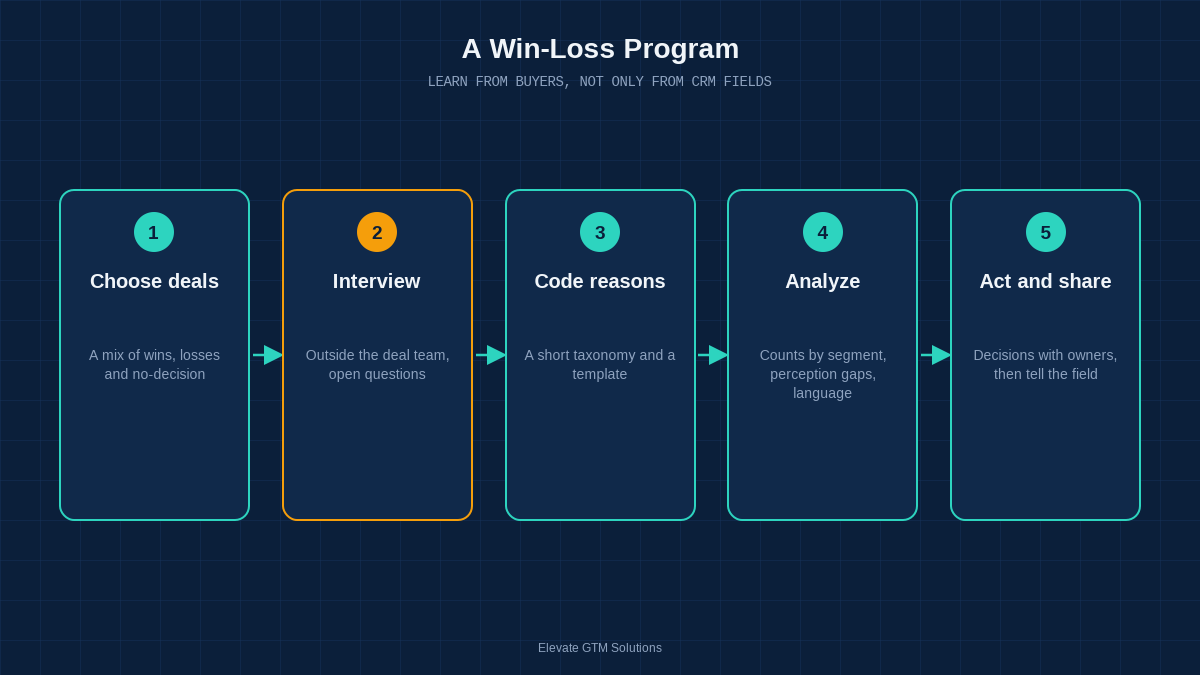
Ask a sales team why a deal was lost and you will hear a short list: price, timing, a competitor with more features, no decision. Ask the buyer a month later and you often hear something different. The buyer did not understand what made the product different, nobody explained the cost of the problem, or a trusted peer recommended another vendor. Win-loss analysis is the discipline of asking, recording and learning from what buyers actually say, so that positioning, messaging, pricing, qualification and product decisions rest on evidence instead of anecdote.
This guide gives a framework you can run with a spreadsheet and a few hours a week. It explains what to study, whom to interview and how many, how to run conversations that produce honest answers, how to code and analyze them, how to turn findings into changes in strategy, how to keep the program running and how to use AI without distorting the evidence. Elevate GTM Solutions makes a GTM strategy platform whose review cycle depends on this kind of evidence, so we have an interest. The method works with any tools. Nothing here promises a particular improvement, and results depend on what you do with what you learn.
What Is Win-Loss Analysis?
Win-loss analysis is a structured way of learning why you win and lose deals by interviewing buyers (and reviewing deal records), coding the reasons, counting patterns by segment and turning findings into decisions about targeting, positioning, messaging, pricing, qualification and product. It is most reliable when it includes buyer interviews conducted by someone outside the selling team, covers wins, losses and no-decision outcomes and is repeated on a rhythm. It complements CRM data, which records what happened but rarely why.
How many interviews do I need? A useful program can start with ten to fifteen a quarter and grow, with attention to coverage across segments.
Who should interview buyers? Someone who was not on the deal, ideally outside the sales team, so buyers feel free to be candid.
Why CRM loss reasons are not enough
| Source | What it tells you | Limits |
|---|---|---|
| CRM loss reason field | A category chosen by the seller | Sellers choose the easiest option, and the real reason is often missing |
| Seller notes | Context from the seller's view | Subject to hindsight and defensiveness |
| Call recordings | What was said | Shows behavior, not the buyer's private reasoning |
| Buyer interviews | The buyer's own account of how they decided | Memory fades, so interview soon after the decision |
| Product usage data | What buyers did in a trial | Does not show why |
Combine sources. Buyer interviews add the layer that other sources cannot provide.
What to study
| Outcome | Why study it | Typical questions |
|---|---|---|
| Wins | Learn what to repeat and what buyers valued | What convinced you, and what almost stopped you? |
| Losses to a competitor | Learn how buyers compared | What did the winner do better in your eyes? |
| Losses to no decision | Learn what blocked action | What would have needed to change to act? |
| Stalled deals | Find friction | What happened after the last conversation? |
| Churned customers | Find promises that were not kept | What did you expect, and what happened? |
| Customers who expanded | Learn what deepens value | What led you to buy more? |
Many teams study only losses. Wins are equally informative, because they show which claims actually persuade.
Whom to interview, and how many
| Decision | Guidance |
|---|---|
| Sample | Include a mix of segments, deal sizes, competitors and outcomes. Avoid only the extremes |
| Number | Start with ten to fifteen a quarter. Add more as the program matures and as segments multiply |
| Roles | Speak to the champion, the economic buyer and, where possible, a skeptic |
| Timing | Within a few weeks of the decision, while memory is fresh |
| Interviewer | Someone outside the deal team, trained to listen |
| Recording | With permission, record or take careful notes |
| Incentives | Offer a small, permitted token of thanks where appropriate, and never tie it to a particular answer |
| Consent | Explain how the information will be used and keep identities confidential if promised |
Response rates are often low. Ask politely, make it easy to schedule and be open that you are learning, not selling.
Running a good interview
A thirty-minute conversation is enough. Be curious and neutral.
Opening
Explain why you are asking, who will see the answers and that you are not selling. Ask permission to record.
Questions that work
| Theme | Example questions |
|---|---|
| Trigger | What was going on that made this a priority? When did you start looking? |
| Process | Who was involved? How did you gather options? How long did it take? |
| Alternatives | What did you consider, including doing nothing? How did you hear about them? |
| Criteria | What mattered most when you compared options? Did it change along the way? |
| Experience | What was it like working with each vendor? What stood out? |
| Differences | How did you see the differences between us and the others? |
| Doubts | What nearly stopped you from choosing us, or from choosing the winner? |
| Decision | What tipped the decision? Who had the final say? |
| Price | How did price figure in the decision? How did you think about value? |
| Advice | What should we do differently? |
Techniques
- Ask about what happened, not about what they would do.
- Use silence. People fill gaps with useful detail.
- Follow up on specifics: "Can you tell me about that moment?"
- Avoid defending or explaining. If the buyer misunderstood something, record the misunderstanding.
- Thank them and share what you can about how you will use the feedback.
What to avoid
Leading questions, pitching, arguing, and asking the seller who worked the deal to run the call.
Recording and coding
Use a consistent template so that interviews can be compared.
| Field | What to record |
|---|---|
| Deal and segment | Company type, size, industry, region, product |
| Outcome | Won, lost to a competitor, lost to no decision, stalled, churned |
| Competitors | Named alternatives, including non-obvious ones |
| Buying group | Roles involved |
| Trigger | The event that started the search |
| Criteria | Main decision criteria, in the buyer's words |
| Reasons | Primary and secondary reasons for the outcome |
| Quotes | Two or three exact phrases |
| Perceptions | What the buyer believed about us that was accurate or inaccurate |
| Suggestions | What the buyer said we could do differently |
| Interviewer notes | Tone, uncertainty and anything surprising |
A reasons taxonomy
A short, stable list lets you count. Keep it to eight to twelve categories, and allow free-text detail.
| Category | Examples |
|---|---|
| Fit | The product did not match the buyer's situation |
| Capability | A needed feature or integration was missing |
| Value | The buyer did not see enough value for the cost |
| Price | The price or structure was a barrier |
| Trust | Concerns about the vendor's size, references or risk |
| Process | The buying experience was slow, confusing or poorly handled |
| Positioning | The buyer did not understand how we differ |
| Champion | The internal advocate left or lacked influence |
| Timing | Priorities changed or budgets moved |
| Competitor | Another vendor was preferred, with the reason noted |
| Status quo | The buyer kept their current approach |
Code each interview with a primary reason and up to two secondary ones. Two people coding a sample independently will show you whether the categories are clear.
Analyzing the results
| Analysis | Method | What it reveals |
|---|---|---|
| Reasons by outcome | Count primary reasons for wins and losses | The main drivers |
| Reasons by segment | Cut by segment, size and industry | Where problems concentrate |
| Competitor patterns | Reasons when each competitor won | How buyers see rivals |
| Perception gaps | Compare what buyers believed with what is true | Messaging and proof gaps |
| Language | Collect phrases buyers use | Better messaging |
| Process friction | Where the buying experience slowed | Sales and onboarding improvements |
| Trend | Compare quarter to quarter | Whether changes help |
| Win and loss pairs | Compare similar wins and losses | What differs |
Always show counts beside percentages. Small samples can mislead, so treat patterns as hypotheses to test, not facts.
Turning findings into decisions
| Finding | Possible action | Owner |
|---|---|---|
| Buyers misunderstand how we differ | Rewrite positioning and messaging, add proof | Product marketing |
| A segment loses repeatedly for the same reason | Reconsider the ideal customer or add exclusions | Strategy owner |
| Price is cited with weak value perception | Revisit packaging and the value story | Pricing owner |
| Missing capability appears often among strong-fit buyers | Share with product, with counts and quotes | Product |
| The buying process frustrates buyers | Change handoffs, response times or materials | Sales operations |
| Champions leave or lack authority | Add multi-threading and buying group steps to the playbook | Sales leadership |
| Competitor X wins on a specific point | Update the competitive playbook with honest guidance | Product marketing |
| Customers churn after unmet expectations | Adjust messaging and onboarding | Customer success |
Close the loop. Share a summary with the field, say what changed and credit what came from interviews. Teams contribute more when they see an effect.
A cadence that keeps it alive
| When | Activity |
|---|---|
| Continuously | Schedule interviews within weeks of decisions |
| Monthly | Review new interviews, update counts and bring findings to the strategy review |
| Quarterly | Analyze patterns, segment cuts and perception gaps, then decide changes |
| Annually | Review the question guide, taxonomy and sampling plan |
Name an owner, because without one the program stops when the team is busy.
Using AI in win-loss analysis
| Task | How AI helps | Caution |
|---|---|---|
| Transcribing interviews | Saves time | Check names and technical terms |
| Summarizing and coding | Fast first pass | Sample against the transcript, and keep humans in charge of the taxonomy |
| Finding quotes | Surfaces candidate phrases | Verify the context |
| Clustering themes | Suggests groupings | Treat as hypotheses |
| Drafting reports | Saves writing time | Check that numbers match your counts |
| Preparing interview guides | Proposes questions | Edit for neutrality |
Do not give an assistant data you are not permitted to share, such as confidential buyer details, outside approved tools. Ask it to separate what buyers said from what it inferred. Our guide to building a GTM strategy with AI covers the method.
Privacy and consent
Buyer interviews involve personal and commercial information. Be clear about:
- Why you are asking and how the answers will be used.
- Who will see identifiable information.
- Whether the conversation is recorded and how recordings are stored.
- How long you keep the data.
- Any regional rules on recording and personal data, which you should review with your legal advisers.
Honor promises of confidentiality, and anonymize quotes in internal reports unless the buyer agrees otherwise.
Common mistakes
| Mistake | What happens | Fix |
|---|---|---|
| Letting the seller interview the buyer | Polite, shallow answers | Use someone outside the deal |
| Studying only losses | Missing what persuades | Include wins |
| Relying on CRM reasons alone | Easy answers hide real ones | Add interviews |
| Too many categories | Counts become meaningless | Eight to twelve |
| Overreacting to a few interviews | Strategy swings on anecdotes | Show counts, look for patterns |
| No follow-through | Interviews feel like a waste | Share findings and changes |
| Interviewing months later | Memory fades | Within a few weeks |
| Confusing buyer opinions with facts | Acting on misperceptions as if true | Record perceptions and test them |
| No owner | The program lapses | Name one and set a cadence |
An interview guide with probes
Probes are follow-up questions that turn a general answer into a story.
| Opening question | Probes to follow with |
|---|---|
| "What was going on that made this a priority?" | "When did you first notice it?" "What was the moment you decided to act?" |
| "How did you find options?" | "Who suggested them?" "What did you read or ask?" |
| "What mattered most when comparing?" | "Did that change?" "What would have changed your mind?" |
| "What was it like working with us?" | "What stood out?" "What was frustrating?" |
| "How did you see the difference between us and the others?" | "Where did that impression come from?" "Was anything unclear?" |
| "What nearly stopped you?" | "Who raised it?" "How was it handled?" |
| "What tipped the decision?" | "Who had the final say?" "Was there a moment it became clear?" |
| "How did price figure in?" | "Compared with what?" "What would a fair price have looked like to you?" |
| "What should we do differently?" | "If you were in our seat, what would you change first?" |
Example wording matters. "Tell me about the last time" invites a story. "Would you say price was an issue?" invites a yes.
Three coded interviews, invented
These are illustrations to show the coding method, not real data.
| Field | Interview A | Interview B | Interview C |
|---|---|---|---|
| Outcome | Won | Lost to a competitor | Lost to no decision |
| Segment | Field service, 25 technicians | Field service, 40 technicians | Retail, 12 staff |
| Competitors | Spreadsheet, larger suite | Larger suite | None |
| Trigger | A missed job caused a complaint | Renewal of an existing tool | Owner changed priorities |
| Buying group | Owner, dispatcher | Operations manager, finance | Owner only |
| Primary reason | Positioning (understood the fast start) | Capability (needed invoicing) | Timing |
| Secondary reasons | Champion (the owner joined a walkthrough) | Trust (wanted a larger vendor) | Value (unclear payoff) |
| Perception gap | None | Believed we lacked integrations we have | Believed implementation took months |
| Quote | "They showed me I could be live in a week" | "I assumed you could not connect to our accounting tool" | "It did not seem urgent enough" |
| Suggestion | Keep the owner walkthrough | Show integrations earlier | Share an example of the first week |
With a dozen of these, you can count: how often positioning was primary in wins, how often a perception gap appeared in losses and which segment lost for timing. The quotes become messaging and enablement material.
A perception gap, worked through
Interview B shows a common pattern: the buyer believed the company lacked an integration that it actually has. The finding has several implications.
| Question | Answer |
|---|---|
| Is the perception accurate? | No, so this is a communication problem, not a product gap |
| Where could the belief have come from? | An old website page, a competitor's claim or a seller's omission |
| How often does it appear? | Check the other interviews and call recordings |
| What should change? | Put integrations earlier in the demo, add them to the one-page profile and correct any old page |
| How will we know it worked? | The perception stops appearing in interviews, and the objection falls in call notes |
Not every gap is a messaging fix. Where the perception is accurate, the finding goes to product with counts and quotes.
Win-loss and the CRM
A good CRM setup makes win-loss analysis easier and gives interviews context.
| Design choice | Practice |
|---|---|
| Loss reason field | A short list matching your taxonomy, required at close |
| Competitor field | Required when the reason is a competitor, and includes non-obvious alternatives |
| Note field | One sentence in the buyer's words |
| Interview flag | A field showing whether the deal has been interviewed, and a link to notes |
| Segment field | Assigned consistently so results can be cut |
| Buying group roles | Contact roles recorded on deals |
| Stage history | Dates for stage changes to spot friction |
Reconcile seller-reported reasons with interview findings each quarter. The gap is often the most instructive finding in the whole program.
A reporting template
| Section | Content |
|---|---|
| Coverage | Interviews completed by outcome and segment, with counts |
| Reasons | Primary reasons for wins and losses, with counts |
| Segment cuts | Where problems or strengths concentrate |
| Competitor view | How buyers describe each named alternative |
| Perception gaps | Beliefs that were inaccurate, with how often they appeared |
| Language | Ten phrases buyers used, with context |
| Process friction | Where the buying experience slowed |
| Decisions | Changes made, owners and dates |
| Caveats | Sample size, bias risks and what to test |
Share it with sales, marketing, product and customer success, and discuss it in the monthly strategy review.
A thirty-day plan to start
Week 1. List the last twenty closed deals with segment and outcome. Choose eight to interview, including wins and losses. Agree who will interview. Draft the guide, template and reasons list.
Week 2. Send invitations, schedule the first calls and set up a shared folder for notes. Run the first two interviews and adjust the guide.
Week 3. Complete the remaining interviews. Code each within two days.
Week 4. Analyze: counts by outcome and segment, perception gaps and quotes. Draft the report. Hold a session with sales and marketing to agree three changes and owners.
After the first month, move to a regular cadence and keep adding interviews.
Win-loss for different sales motions
The framework flexes with how you sell.
| Motion | What changes |
|---|---|
| Enterprise, long cycle | Interview several roles, allow longer gaps between decision and interview, and study stalled deals |
| Mid-market | Interview the champion and the economic buyer, and aim for more interviews per quarter |
| Product-led | Combine usage data with short interviews of converters and non-converters |
| Partner-led | Include the partner in the study and ask what they would change |
| Low-touch or transactional | Use short surveys with a few open questions, plus occasional calls |
| Renewals and expansion | Interview customers at renewal about value and alternatives considered |
Whatever the motion, ask open questions about what happened and code the answers consistently.
Dealing with bias
| Bias | How it shows up | Mitigation |
|---|---|---|
| Politeness | Buyers soften criticism | Use a neutral interviewer and ask for specific moments |
| Recency | Buyers recall the last thing | Interview soon and probe earlier steps |
| Rationalization | Buyers explain decisions after the fact | Ask what happened, not why they think they chose |
| Selection | Only friendly buyers agree to talk | Invite widely and note who declined |
| Interviewer influence | The interviewer's questions steer answers | Use a guide and review recordings |
| Confirmation | The team hears what it expects | Code with two people and review disagreements |
| Small samples | A few vivid stories dominate | Show counts and wait for patterns |
State the biases in your report. Honesty about limits builds trust in the findings.
Questions teams ask about win-loss
"Buyers will not talk to us." Offer short calls, make scheduling easy, explain that you are learning and consider a neutral third party. Accept a modest response rate and note who responded.
"We are too small for this." A small company can do six interviews a quarter. The sample is small and the value is high because each conversation is a large share of your market evidence.
"Sales distrusts the findings." Involve sellers in choosing which deals to study, share quotes, show counts and credit the team when changes come from their feedback.
"What if the findings contradict the strategy?" Treat that as the program working. Review the evidence, test the contradiction and update the strategy if it holds.
"How do we avoid overreacting?" Wait for patterns across several interviews, test changes cheaply and track results by segment.
"Who owns it?" A named person, often in product marketing or revenue operations, with a sponsor in sales leadership.
Digging into specific topics
Some themes deserve their own questions.
Pricing
| Question | Why |
|---|---|
| "How did you think about the cost compared with the problem?" | Reveals value perception |
| "What did you expect it to cost before you spoke to us?" | Reveals reference points |
| "Was the structure of the price clear?" | Reveals confusion about packaging |
| "Who else needed to approve the spend?" | Reveals hidden stakeholders |
| "Was there a moment when the price changed how you saw us?" | Reveals triggers |
Competitors
| Question | Why |
|---|---|
| "What did you like about the vendor you chose, or the others you saw?" | Reveals strengths you may underrate |
| "How would you describe each vendor to a colleague?" | Reveals positioning as buyers hold it |
| "Where did you hear about them?" | Reveals channels |
| "What would have made you choose differently?" | Reveals the decisive factor |
Trust and risk
| Question | Why |
|---|---|
| "What worried you about choosing us?" | Reveals concerns about size, references or risk |
| "What evidence did you look for?" | Reveals the proof buyers want |
| "Whom did you ask for opinions?" | Reveals influence networks |
| "What would have made you feel safer?" | Reveals what to prepare |
An invitation and consent script
A short, honest invitation raises response rates.
"Hello [name], thank you for considering [Company] recently. I am [name] from [team], and I am not part of the sales team. We are learning how buyers make decisions like yours, and your view would help us improve. Could we talk for thirty minutes about how you approached the decision? Your answers will be used internally to improve our product and the way we work. [State confidentiality: for example, we will share themes with our team and will not attribute comments to you by name.] With your permission, I would like to record the call for note-taking only. You can decline any question or stop at any time."
At the start of the call, repeat the purpose, the confidentiality terms and the request to record, and note the answer. Follow your regional rules on recording and personal data, and check them with your legal advisers.
A sample one-page findings brief
This brief uses invented findings to show the format.
| Section | Entry |
|---|---|
| Coverage | Twelve interviews: six wins, four losses to a larger suite, two no-decision |
| Headline | The decisive factor in wins was the owner seeing a short walkthrough. In losses, buyers misunderstood integrations and the owner was absent from the evaluation |
| Counts | Five of six wins included an owner walkthrough. Three of four competitor losses cited an inaccurate belief about integrations |
| Segments | Field-service firms of twenty to forty technicians won most often. Small retail did not fit |
| Language | "Live in a week", "my dispatcher actually uses it", "I find out when the customer calls" |
| Changes agreed | Add an owner walkthrough step. Move integrations earlier in the demo. Update the customer profile with the language above. Add "who signs off" to qualification questions |
| Owners and dates | Product marketing, sales leadership, sales operations, each with a date |
| Caveats | Twelve interviews is a small sample. Re-run next quarter |
One page is enough. Attach detail for those who want it.
A starter kit
Gather these before your first interview.
| Item | Purpose |
|---|---|
| List of deals to study | A balanced mix of outcomes and segments |
| Interview guide | Questions and probes |
| Invitation and consent script | Honest, short and clear |
| Notes template | Consistent fields |
| Reasons taxonomy | Eight to twelve categories |
| Coding sheet | Counts by outcome and segment |
| Report template | One page, with caveats |
| Owner and sponsor | Named people |
| Calendar | Interviews, monthly review and quarterly analysis |
| Storage plan | Where recordings and notes live and for how long |
A sample first-quarter schedule
| Week | Activity |
|---|---|
| 1 | Choose deals, finalize guide and consent script |
| 2 | Send invitations and run the first two interviews |
| 3 to 4 | Run four more interviews and code each within two days |
| 5 | Review the first six together, adjust the guide and taxonomy |
| 6 to 8 | Run six more interviews |
| 9 | Analyze counts, segments and perception gaps |
| 10 | Draft the one-page brief and meet sales, marketing, product and customer success |
| 11 | Agree three changes and owners |
| 12 | Start tracking whether the changes affect the reasons buyers give, and plan the next quarter |
Treat the first quarter as learning about the method as well as about buyers. Expect to refine the guide and the categories after the first handful of interviews, and keep a note of changes so that comparisons over time remain fair.
Setting expectations with the team
Tell the team at the start what the program is and is not. It is a way to learn from buyers, not a way to grade sellers. Findings will be shared as themes and counts. Individual deals will not be used to criticize people. Sellers will be asked to help choose which deals to study and to suggest questions. Changes that come from interviews will be announced, with credit. This framing improves cooperation and makes honest findings easier to accept.
A hypothetical example
This is an illustration, not a real company.
A company selling software to field-service firms recorded "price" as the reason for most losses. A product marketer arranged twelve buyer interviews over a quarter, six wins and six losses, conducted by a colleague from customer success. In the losses, price came up in every conversation, yet in only two did it decide the outcome. In four, buyers said they did not understand how the product differed from a larger suite, and in three, the owner had not been included in the evaluation, so the dispatcher's enthusiasm never reached the decision maker.
The wins showed a different pattern: in five of six, the owner had been part of a walkthrough, and buyers repeated a phrase about "starting in days." The team rewrote its positioning around that language, added an owner walkthrough to the sales process as a step before proposals and adjusted the qualification questions to ask who signs off. Over the following two quarters, it tracked the proportion of deals with an owner walkthrough and the win rate in that group.
The CRM field had said "price." The buyers had said something more useful, and the team changed its process because of it.
What to do this week
List the last twenty closed deals and note which segments and outcomes they cover. Choose six to interview, a mix of wins and losses, and ask someone outside the deal teams to run the calls. Draft the interview guide, the template and the reasons list. Schedule the first three conversations.
In plain language
The CRM tells you what happened. Buyers can tell you why. Interview a mix of wins, losses and no-decision outcomes soon after the decision, using someone outside the deal team and open questions about what happened. Record each conversation in the same template, code the reasons with a short list and count patterns by segment. Look for perception gaps, the beliefs that were wrong, and for the language buyers use. Turn each finding into a decision with an owner, such as a new message, a different qualification question, a pricing change or a product request, and tell the team what changed. Run it every quarter, and treat the first few rounds as learning about the method too.
Key takeaways
- Win-loss analysis learns why you win and lose from buyers, not only from CRM fields.
- Include wins, losses, no-decision outcomes and churn, and interview soon after the decision.
- Use someone outside the deal team, a neutral guide and a consistent template and reasons taxonomy.
- Show counts, cut by segment and treat patterns as hypotheses.
- Turn findings into specific changes in positioning, messaging, qualification, pricing and product feedback, and share what changed.
- Run it on a rhythm with a named owner, and respect privacy and consent.
Where Elevate GTM Solutions fits
Elevate GTM Solutions is an AI-native GTM operating system for B2B companies. Win and loss evidence is one of the most valuable inputs to its strategy outputs, including ICP and segmentation, competitive intelligence, positioning and messaging, and its monthly review rhythm is built to bring such evidence in and update decisions. It does not run interviews for you or replace the conversations themselves. It connects to HubSpot, Salesforce, LinkedIn, Notion and Claude for supported actions. A free first strategy build is available, and published plans, billed annually, are Enable at USD 499 per month and Growth at USD 1,499 per month, with custom Scale pricing.
For related reading, see What Is Elevate GTM Solutions?, GTM Metrics and KPIs, What Is a GTM Playbook? and Competitive Intelligence. See the pricing page, or request a demo.
Frequently Asked Questions
What is win-loss analysis?
A structured way of learning why you win and lose deals by interviewing buyers and reviewing deal records, coding the reasons, counting patterns by segment and turning findings into decisions about targeting, positioning, messaging, pricing, qualification and product.
How many win-loss interviews do I need?
A useful program can start with ten to fifteen a quarter, covering a mix of segments, outcomes and competitors, and grow over time.
Who should conduct win-loss interviews?
Someone who was not on the deal, ideally outside the sales team, so buyers feel free to be candid.
When should I interview the buyer?
Within a few weeks of the decision, while memory is fresh.
What questions should I ask?
Ask about the trigger, process, alternatives, criteria, experience, differences, doubts, the decision and price, using open questions about what happened.
Should I study wins as well as losses?
Yes. Wins show which claims and experiences actually persuade, and they help you repeat what works.
How do I code the reasons?
Use a short taxonomy of eight to twelve categories, such as fit, capability, value, price, trust, process, positioning, champion, timing, competitor and status quo, with a primary reason and up to two secondary ones for each interview.
Why are CRM loss reasons unreliable?
Sellers often choose the easiest category, and the real reason is frequently missing. Buyer interviews add the buyer's own account.
Can AI help with win-loss analysis?
AI can transcribe, summarize, cluster themes and draft reports. People should sample outputs against transcripts, own the taxonomy and avoid sharing data outside approved tools.
How do I turn findings into action?
Map each finding to a decision and an owner: positioning and messaging, ideal customer and exclusions, pricing and packaging, product feedback, sales process, competitive guidance or onboarding, then share what changed.
How often should I run win-loss analysis?
Continuously schedule interviews, review monthly, analyze patterns quarterly and refresh the guide and taxonomy annually.
What privacy issues should I consider?
Explain how answers will be used, who will see them, how recordings are stored, how long data is kept and any regional rules, review with legal advisers and honor confidentiality promises.