
By the Elevate GTM Solutions Team · Updated November 10, 2026 · 21 min read
What Is a GTM Playbook? Components, Types, Examples, and How to Build One
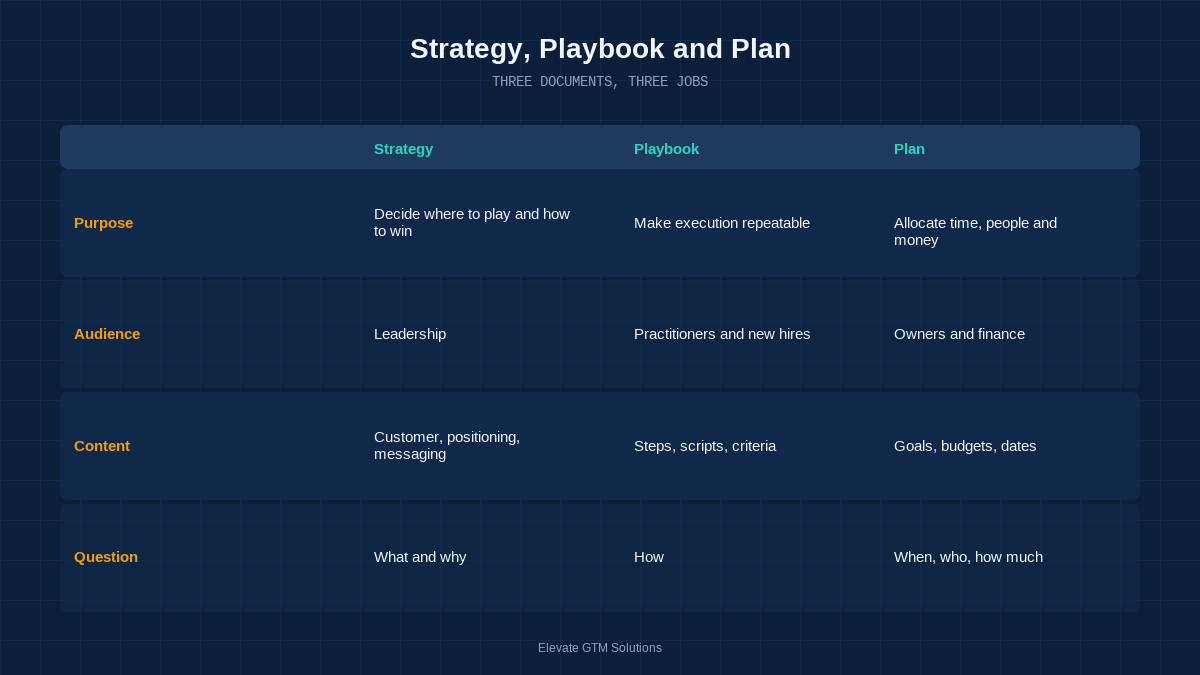
A go-to-market strategy says what you will do and why. A go-to-market playbook says how, in enough detail that someone who was not in the room can do it. The first is a set of decisions. The second is those decisions turned into repeatable practice: who to call, what to say, how to qualify, what to do when a buyer objects, who owns each step and how to tell whether it worked.
Companies often use the two words interchangeably, and that causes problems. A team with a strategy and no playbook has agreement at the top and improvisation everywhere else. A team with a playbook and no strategy has a polished routine aimed at an unexamined target. This guide defines a GTM playbook, separates it from a strategy and a plan, lists what goes into one, describes common types, shows how to build and maintain one and explains how AI can help without taking over. Elevate GTM Solutions makes a GTM strategy platform whose outputs feed playbooks, so we have an interest. The method here works with any tools, including documents. Nothing in it guarantees results, and every company will adapt it.
What Is a GTM Playbook?
A GTM playbook is a documented, repeatable guide to executing a go-to-market strategy. It translates strategic decisions (ideal customer, positioning, messaging, pricing logic, channels and priorities) into practical steps: who to target, what to say, how to qualify and handle objections, who does what, which tools and assets to use and which measures show whether it is working. A playbook is more specific than a strategy and more durable than a plan, and it is meant to be used daily and revised from evidence.
Is a playbook the same as a strategy? No. The strategy decides. The playbook explains how to carry out the decision.
Who uses a playbook? Sellers, marketers, customer success staff, partners and new hires, each with their own section.
Strategy, playbook and plan: three different documents
| Strategy | Playbook | Plan | |
|---|---|---|---|
| Purpose | Decide where to play and how to win | Make execution repeatable and consistent | Allocate time, people and money to goals |
| Time horizon | Months to years, revisited quarterly | Durable, revised as evidence arrives | A quarter or a year |
| Audience | Leadership | Practitioners and new hires | Owners and finance |
| Content | Customer, positioning, messaging, pricing logic, channels | Steps, scripts, criteria, templates, roles | Goals, budgets, dates, owners |
| Question answered | What and why | How | When, who and how much |
| Failure mode | Never reaches the field | Used mechanically on the wrong target | Hits dates and misses goals |
Build them in that order. A playbook is only as good as the strategy it carries.
What goes into a GTM playbook
A playbook is modular. Include the sections your motion needs.
| Section | What it contains | Source |
|---|---|---|
| Ideal customer and exclusions | A profile and who is not a fit | Strategy |
| Buying group and personas | Roles, concerns and what each cares about | Strategy and interviews |
| Positioning | The statement and the alternatives it is set against | Strategy |
| Messaging | Pillars, proof, talk tracks and forbidden claims | Strategy |
| Qualification | Criteria and questions that decide whether to pursue | Win and loss evidence |
| Sales or customer process | Stages, entry and exit criteria, owners | Operations |
| Discovery guide | Questions that surface the problem and the buying group | Interviews and calls |
| Objection handling | The common objections with honest responses | Calls and lost deals |
| Competitive guidance | How each alternative positions and how to respond | Competitive framing |
| Pricing guidance | What may be said about price and what discounts require approval | Pricing logic |
| Channels and campaigns | Where and how you reach the audience | Channel plan |
| Assets and templates | Decks, emails, one-pagers, proposals | Marketing and enablement |
| Handoffs | How leads and customers move between roles | Operations |
| Metrics | The measures that show progress | Strategy and operations |
| Tools | Systems used, with how to use them | Operations |
| Roles | Who owns what | Leadership |
| Review rhythm | When the playbook is updated | Strategy owner |
Do not write everything at once. Start with the sections that cause the most inconsistency.
Types of GTM playbooks
| Type | Used by | Typical contents |
|---|---|---|
| Sales playbook | Sellers and sales managers | Ideal customer, qualification, discovery, objections, proposal guidance |
| Outbound playbook | SDRs and founders | Target lists, sequences, personas, approved claims, escalation |
| Marketing playbook | Marketers | Segments, pillars, channel plans, campaign briefs, measures |
| Launch playbook | Product, marketing, sales | Readiness checklist, timeline, roles, communication plan |
| Customer success playbook | Customer success | Onboarding steps, health signals, expansion plays, renewal process |
| Partner playbook | Partner managers and partners | Who the ideal partner is, joint messaging, referral process |
| Competitive playbook | Sellers and product marketing | How each alternative positions, honest strengths, responses |
| Expansion or new-market playbook | Regional teams | Segment evidence, local adaptation rules, entry plan |
Companies often start with one or two and add more as the need appears.
How to build one: eight steps
Step 1: start from the strategy
If the customer definition, positioning and messaging are not settled, settle them first. A playbook built on disputed decisions captures the dispute. Our guides on building a GTM strategy without a consultant and with AI cover this.
Step 2: choose the first playbook
Pick the audience with the most inconsistent practice: for example, new sellers who each improvise discovery calls. One playbook, written well, beats five written poorly.
Step 3: gather what works
Collect examples from your best practitioners: recordings of strong calls, emails that earned replies, proposals that won, objection responses that landed. Interview them. Ask why they do what they do.
Step 4: write the draft
Keep it short. Use headings, tables and checklists. Write for someone busy. Include examples, not only rules.
Step 5: test with practitioners
Give the draft to three people who will use it. Ask what is unclear, missing or wrong. Watch someone use it on a real task.
Step 6: publish where work happens
Put it where the audience already works: the CRM, the shared workspace or the enablement tool. A playbook that lives in a folder nobody opens is a document, not a playbook.
Step 7: train and practice
Walk through it. Role-play the discovery questions and the objection responses. Give new hires a short path through it in their first week.
Step 8: review and update
Set a monthly review. Bring wins, losses, buyer language and competitor changes. Update the playbook and note what changed, so people can see it is alive.
A sales discovery guide, as an example of detail
A good playbook section is specific. Here is an illustrative discovery guide, with invented content.
| Part | Content |
|---|---|
| Goal of the call | Understand the situation, the problem's cost and who else is involved |
| Open | "Tell me what prompted you to look at this now" |
| Situation questions | How do you schedule technicians today? What tools are involved? |
| Problem questions | What happens when an appointment is missed? How often? What did the last one cost? |
| Impact questions | Who hears about it? What does it mean for renewals? |
| Buying group questions | Who else will care? Who signs off? |
| Alternatives | What have you tried, and what did you decide against? |
| Qualification | Fits the profile, named a problem, has authority or access to it, within the target size |
| What not to do | Pitch features before the problem is clear; claim anything on the forbidden list |
| Next step | A specific, mutually agreed step with a date |
| After the call | Log the problem in the CRM field, in the buyer's words |
Someone new could use this on their second day.
An objection handling section, as an example
| Objection | What is behind it | Honest response | Proof to use |
|---|---|---|---|
| "We use spreadsheets and it works" | Familiarity and cost | Acknowledge that it works until it does not, ask about the last miss | A customer story you may cite |
| "This is too expensive" | Unclear value or budget | Ask about the cost of the problem and compare with the alternatives | A measured example, labeled with its basis |
| "We will build it ourselves" | Control or cost | Discuss maintenance and opportunity cost, offer to compare | A comparison you can support |
| "We need a feature you lack" | A real gap or a preference | Be direct about what is not covered and when it matters | The roadmap, only as far as it is committed |
| "Now is not the time" | Priority or timing | Ask what would change that and agree a follow-up | None needed |
Never invent responses to objections you cannot answer. If the honest answer is that you are not the right fit, say so.
A sales playbook, section by section
This illustration uses invented details for a company selling scheduling software to field-service firms. Use it as a pattern.
Ideal customer profile
| Attribute | Entry |
|---|---|
| Industry | Field-service businesses such as HVAC, electrical and plumbing |
| Size | Ten to eighty technicians |
| Situation | Scheduling by spreadsheet and phone, with missed appointments |
| Not a fit | Firms below ten technicians, firms needing deep invoicing |
| Buying group | Owner or general manager, dispatcher, sometimes an office manager |
| Typical trigger | A visible failure, such as a complaint from a key customer |
Stages with entry and exit criteria
| Stage | Entry criterion | Exit criterion | Owner |
|---|---|---|---|
| Qualified conversation | Fits the profile and has named a scheduling problem | Problem and impact recorded in the CRM | Seller |
| Evaluation | A scheduled walkthrough with the dispatcher and owner | Both have seen the product and named a decision date | Seller |
| Pilot | Agreed scope and success measure | Pilot results reviewed with the owner | Seller and customer success |
| Proposal | Pilot succeeded or evaluation complete | Written proposal sent | Seller |
| Decision | Proposal reviewed | Signed or reasons for loss recorded | Seller |
Qualification questions
- How many technicians do you schedule, and how?
- What happens when an appointment is missed, and how often?
- Who decides, and who else will be affected?
- What have you tried?
- When do you want this solved?
What the seller records
A field that captures the problem in the buyer's own words, the alternatives named, the number of technicians, the decision date and the reason for any loss, chosen from a short list.
What the seller does not do
Quote prices before the problem is clear, claim anything on the forbidden list or promise features that are not committed.
A launch playbook skeleton
| Section | Content |
|---|---|
| Purpose and tier | The launch's goal and whether it is tier one, two or three |
| Owner and roles | Launch owner, product, marketing, sales, customer success, finance, executive sponsor |
| Customer and positioning | From the strategy: who it is for, the problem and the claim |
| Messaging and proof | Pillars, proof and forbidden claims |
| Timeline | Dated steps working backward from release, with dependencies |
| Readiness checklist | Customer, positioning, messaging, pricing, assets, enablement, channels, support, measurement and risks |
| Communication plan | Who hears what, when and from whom |
| Release decision | The go, narrow or hold criteria and the decision owner |
| Early signals | What to watch in the first weeks and who watches |
| Review | Thirty- and ninety-day reviews and a retrospective template |
A customer success playbook skeleton
| Section | Content |
|---|---|
| Customer types | Segments with different onboarding needs |
| Onboarding | Milestones, owners and target timing for first value |
| Health signals | The indicators that show a customer is thriving or at risk, and who reviews them |
| Plays | What to do for each signal: a check-in, a training session, an executive call |
| Expansion | Triggers and approach for additional use cases or seats |
| Renewal | The timeline and steps before the renewal date |
| Advocacy | How to ask for references and reviews respectfully |
| Escalation | Who handles problems, and how quickly |
| Feedback to strategy | How customer insight reaches product and strategy owners |
A competitive playbook entry
For each alternative a buyer may consider, one page.
| Field | Entry |
|---|---|
| Alternative | Name and category |
| How buyers describe it | In their words, from calls |
| What it does well | An honest summary |
| Where we differ | Specific differences that matter to our customer |
| When to recommend it instead | Cases where we are not the best fit |
| Questions to ask the buyer | To uncover whether the difference matters |
| Proof | Evidence we may cite |
| What not to say | Claims we cannot support or comparisons we should avoid |
| Last reviewed | Date and owner |
Including when to recommend the alternative builds credibility, and it protects against wasted effort on poor-fit deals.
Governing a playbook
| Question | Practice |
|---|---|
| Who owns it? | A named person for each playbook, with the strategy owner reviewing consistency |
| Where does it live? | One place, linked from the tools sellers and marketers use daily |
| How are changes made? | Proposed, reviewed and noted with a short change log |
| Who can see it? | Everyone who uses it, with sensitive sections restricted where needed |
| How are old versions handled? | Archived, not circulating |
| How often is it reviewed? | Monthly for fast-changing sections, quarterly for the rest |
| What triggers an off-cycle update? | A new competitor, a pricing change, a repositioning or a pattern in losses |
A first-week path for new hires
| Day | Activity |
|---|---|
| 1 | Read the one-page strategy and the customer profile |
| 2 | Listen to five recorded calls or read five winning emails, with the playbook open |
| 3 | Read the discovery guide and objection section, then role-play with a manager |
| 4 | Shadow a real conversation and write what you noticed |
| 5 | Run a supervised conversation or draft a message for review, and note questions about the playbook |
Ask new hires to list what was unclear. Their questions are the best test of the playbook.
Playbooks and AI assistants
If you give an AI assistant your playbook, it can help in several ways: answering practitioners' questions about it, drafting messages that follow its claims and forbidden list, preparing call briefs from the discovery guide and flagging when a draft conflicts with it. This works only if the playbook is specific and current, which is another reason to keep it short, owned and reviewed.
Measuring whether a playbook works
| Measure | What it tells you |
|---|---|
| Time for a new seller to run a good discovery call | Whether the playbook teaches |
| Consistency of message across calls, emails and site | Whether people use it |
| Qualification accuracy | Whether the criteria predict wins |
| Conversion by stage | Whether the process helps |
| Win rate by segment | Whether the strategy and the playbook agree |
| Feedback from practitioners | Whether it is useful and current |
| Time to update after a change | Whether it is alive |
Compare with a baseline taken before you introduced the playbook, and be careful about claiming it caused improvements without evidence.
Where AI helps and where it does not
| Task | How AI helps | What you must do |
|---|---|---|
| Summarizing calls and emails that worked | Structure and patterns | Check a sample against the source |
| Drafting sections from strategy outputs | A first draft | Add examples and remove unsupported claims |
| Role-play practice | Generates scenarios | Have humans give feedback |
| Keeping versions consistent | Flags conflicting statements | Decide which is right |
| Updating after changes | Proposes edits | Review each change |
AI does not know which practices work in your market unless you give it evidence. It can make a weak playbook look polished.
Mistakes to avoid
| Mistake | What happens | Fix |
|---|---|---|
| Writing a playbook before a strategy | Captures disagreement | Settle strategy first |
| Writing for compliance, not use | Nobody opens it | Keep it short and practical |
| Copying another company's playbook | Wrong fit | Build from your wins and losses |
| One giant document | Overwhelms users | Modular sections by audience |
| No owner | It goes stale | Name an owner and a review date |
| No training | New hires ignore it | Practice and onboarding |
| No feedback path | It does not learn | A monthly review with practitioners |
| Claims without proof | Credibility erodes | Approved proof and forbidden claims |
A hypothetical example
This is an illustration, not a real company.
A company of sixty people had a clear strategy and three new sellers who each ran discovery differently. Win rates varied widely. The head of sales and the head of product marketing decided to write a sales playbook. They listened to ten recorded calls from their strongest seller and noticed three habits: she asked what prompted the search, she asked what the last failure cost and she agreed a specific next step with a date.
They wrote a six-page playbook around those habits: a customer profile, three message pillars with proof, a discovery guide, five objection responses and qualification criteria. Three sellers tested it for two weeks and said two questions felt awkward, which the team reworded. They put the playbook in the CRM, ran a role-play session and set a monthly review.
Within two quarters, the new sellers' calls were more consistent, and the team could see which objection responses worked. The playbook did not make the sellers better by itself. It made good practice repeatable.
How playbooks differ by motion
The core sections are similar, and the emphasis changes with how you sell.
An outbound playbook
| Section | Emphasis |
|---|---|
| Target list rules | Filters, exclusions and how lists are built and refreshed |
| Personas | Titles, concerns and the problem in their words |
| Sequences | Themes, number of steps, timing and stopping rules |
| Claims | Approved proof and forbidden claims |
| Replies | Templates for common responses and escalation triggers |
| Hygiene | Suppression lists, opt-out handling and sending limits |
| Review | Weekly sample reading and monthly results by segment and theme |
A product-led playbook
| Section | Emphasis |
|---|---|
| Activation | The first actions that predict a user will succeed |
| Onboarding | In-product guidance and emails tied to behavior |
| Upgrade triggers | Signals that suggest a user is ready for a paid plan |
| Sales assist | When and how a seller joins a self-serve account |
| Support | How common questions are answered and escalated |
| Measures | Activation, conversion, retention and expansion by segment |
A partner playbook
| Section | Emphasis |
|---|---|
| Ideal partner | The kind of company that serves your customer and benefits from working with you |
| Joint message | One description of the shared value, with approved proof |
| Referral process | How introductions are made, tracked and acknowledged |
| Enablement | What partners need to know and how they learn it |
| Conflicts | How overlaps with direct sales are handled |
| Review | Shared results, feedback and a regular meeting |
A style guide for writing playbooks
How a playbook is written decides whether it is read.
| Principle | In practice |
|---|---|
| Write for the busiest reader | Headings, tables and short paragraphs |
| Prefer examples to rules | Show a good question next to the rule |
| Use customers' words | Quote phrases from calls, with permission |
| Be honest | Include when not to pursue a deal |
| Make it findable | Consistent names and one location |
| Date it | Show last reviewed and by whom |
| Keep it modular | Each section useful alone |
| Avoid jargon | Plain language that a new hire understands |
A playbook audit checklist
Run this each quarter.
- Does every section trace to a current strategy decision?
- Is each section owned by a named person?
- Was each section reviewed in the last quarter?
- Do the examples reflect recent calls and deals?
- Are forbidden claims and approved proof up to date?
- Do practitioners use it? Ask five of them.
- Does it appear in onboarding?
- Are old versions archived?
- Have losses and objections from the last quarter been reflected?
- Is there a record of what changed and why?
A section that fails three or more questions should be rewritten or retired.
Playbooks, enablement and training
Playbooks, enablement platforms and training programs overlap, and it helps to know which does what.
| Element | Role |
|---|---|
| Playbook | The content: how to carry out the strategy |
| Enablement platform | The delivery: where content lives, is found and is measured |
| Training | The practice: role-play, coaching and feedback |
| Coaching | Individual improvement using real calls |
| Strategy | The decisions the playbook carries |
A playbook without delivery is hard to find. A platform without good content is a library of noise. Training without a playbook is improvisation. Treat them as a system, and start with the playbook.
Final thoughts
A GTM playbook is a small, practical document that makes a strategy usable. It does not need to be long or beautiful. It needs to be specific, honest, current and used. Build it from your best practitioners and your real calls, test it with the people who will use it, publish it where they work and review it monthly with evidence. The test of a playbook is simple: can someone new do a good job in their second week because of it? If yes, you have a playbook. If not, you have a document.
Questions from sales leaders and marketers
"Will a playbook make sellers robotic?" A good playbook standardizes the claims, the qualification criteria and the questions worth asking. It leaves room for style and judgment. Teams often find their best sellers contribute most, because their habits become the playbook.
"How do I get busy people to read it?" Make it short, put it in their daily tools, base it on their own best calls and include a first-week path. Ask them what is unclear and fix it.
"Who writes it?" A pair works well: a practitioner who does the work and someone who writes clearly, with the strategy owner checking that it reflects decisions.
"How detailed should scripts be?" Provide example phrases and questions, not word-for-word scripts, except where compliance requires exact wording.
"What if the strategy changes?" Update the affected sections first, note the change and tell people. A change log helps trust.
"How do I handle regions?" Decide what must be consistent, such as claims and qualification, and what may be adapted, such as examples and proof points. Record exceptions.
A simple dashboard for a playbook
| Measure | Why |
|---|---|
| Time for a new hire to run a good first call | Shows whether it teaches |
| Share of calls that follow the discovery guide | Shows adoption |
| Message consistency across site, deck and emails | Shows alignment |
| Qualification accuracy | Shows whether criteria predict wins |
| Conversion by stage and segment | Shows where deals stall |
| Practitioner satisfaction | Shows usefulness |
| Days since last review | Shows freshness |
Review monthly with the strategy owner and the practitioners who use it.
Terms used in this guide
| Term | Meaning |
|---|---|
| GTM strategy | Decisions about customer, positioning, messaging, pricing logic and channels |
| GTM playbook | A documented guide to executing the strategy repeatably |
| Plan | An allocation of time, people and money to goals |
| Qualification | Criteria deciding whether to pursue a lead or deal |
| Discovery | A conversation to understand the buyer's situation and problem |
| Objection | A reason a buyer hesitates |
| Persona | A description of a buying role and its concerns |
| Enablement | Content, training and coaching that equip practitioners |
Writing your first playbook section in a day
If you want a quick start, choose one section and follow this sequence.
Morning. Listen to five recordings of your best performer, or read five emails or proposals that worked. Write down three habits you notice, and a sentence about why each works.
Midday. Draft the section in one page: the goal of the activity, the questions or steps, an example of each, and what not to do. Use the customer's words where you can.
Afternoon. Show it to two practitioners. Ask them to try it on a real task or a recent example and tell you where it fails. Fix the two biggest problems.
End of day. Publish it where people work, tell them where it is and put a review date in the calendar.
One good page used by the team is worth more than a long document nobody reads, and it is the best way to find out what the rest of the playbook should cover.
A short list of warning signs
- People ask where the playbook is, which means it is hard to find.
- Two people describe the same step differently, which means it is unclear.
- New hires do not mention it, which means onboarding skips it.
- The playbook has not changed in six months, which means it is not being reviewed.
- The best performer says they do something different, which means you have not captured what works.
A quick reference
| Question | Short answer |
|---|---|
| What does a playbook carry? | A strategy's decisions turned into repeatable practice |
| What makes it good? | Specific, short, honest, current and used |
| Where should it live? | In the tools people already use daily |
| Who owns it? | A named person per playbook, with the strategy owner checking consistency |
| How often should it change? | Whenever evidence says so, with a monthly review |
| How do you know it works? | New hires reach good practice faster, messages are consistent and win rates by segment make sense |
What to do this week
Choose the audience whose practice is most inconsistent. Listen to five calls or read five emails from your best performer. Write down three habits you hear. Draft a one-page version of the section that would help most, and show it to two people who will use it.
In plain language
A GTM playbook is what you write down so that good practice does not depend on who happens to be in the room. It takes the decisions in your strategy and turns them into questions to ask, claims to make, criteria to apply and steps to follow. The best ones are short, specific and built from your own best calls and wins. They live where people work, they have owners and they change when evidence says so. If a new hire can do a good job in their second week because of it, it is working. If nobody opens it, it is just a document, and the fix is usually to shorten it, test it with users and put it where the work happens.
Key takeaways
- A GTM playbook turns strategic decisions into repeatable practice that people can use.
- It is different from a strategy, which decides, and a plan, which allocates time and money.
- Build it from your strategy and your best practitioners, test it with users and publish it where work happens.
- Keep it short, modular and full of examples.
- Train people to use it and review it monthly with evidence.
- Use AI to structure and draft, and your own calls and wins for what works.
Where Elevate GTM Solutions fits
Elevate GTM Solutions is an AI-native GTM operating system for B2B companies. Its outputs are the raw material for playbooks: customer profile, positioning, messaging pillars with proof, competitive framing, qualification criteria and launch and execution plans, across 15 modules. It supports workflows, weekly plans and a recurring review rhythm, and lets teams compare versions side by side. It does not write your playbook for you or replace the practitioners whose experience fills it. Published plans, billed annually, are Enable at USD 499 per month and Growth at USD 1,499 per month, with custom Scale pricing and a free first strategy build.
For related reading, see What Is Elevate GTM Solutions?, GTM Strategy Handoff, Sales Enablement and What Is GTM Execution?. See the pricing page, or request a demo.
Frequently Asked Questions
What is a GTM playbook?
A documented, repeatable guide to executing a go-to-market strategy. It turns decisions about the ideal customer, positioning, messaging, pricing logic and channels into practical steps, scripts, criteria, roles and measures that people can use daily.
What is the difference between a GTM strategy and a GTM playbook?
The strategy decides where to play and how to win. The playbook explains how to carry out those decisions in enough detail that someone new can do it.
What is the difference between a GTM playbook and a GTM plan?
A plan allocates time, people and money to goals over a period. A playbook describes repeatable practice and is revised from evidence.
What should a GTM playbook include?
Ideal customer and exclusions, buying group and personas, positioning, messaging and proof, qualification, process stages, discovery questions, objection handling, competitive guidance, pricing guidance, channels, assets, handoffs, metrics, tools, roles and a review rhythm.
What types of GTM playbooks are there?
Sales, outbound, marketing, launch, customer success, partner, competitive and expansion or new-market playbooks.
How do I build a GTM playbook?
Start from the strategy, choose the first audience, gather what works from your best practitioners, write a short draft, test it with users, publish it where work happens, train people and review it monthly.
How long should a playbook be?
As short as it can be while still usable. Many teams start with a few pages for one audience and add modules as needed.
How do I know if a playbook works?
Track how fast new people reach good practice, consistency of messaging, qualification accuracy, conversion by stage and win rate by segment, compared with a baseline.
Can AI write a GTM playbook?
AI can structure examples, draft sections from your strategy and flag inconsistencies. It does not know what works in your market without your evidence, so people must supply and check the content.
Who should own the playbook?
Usually the leader of the function it serves, with the strategy owner ensuring it matches current decisions and practitioners giving feedback.
How often should a playbook be updated?
Review monthly using wins, losses, buyer language and competitor changes, and update when the strategy changes.
What does a sales playbook look like in practice?
A short document with the ideal customer profile, stages with entry and exit criteria, qualification questions, a discovery guide, objection responses, competitive notes, forbidden claims and what the seller records in the CRM.
What is in a launch playbook?
Purpose and tier, roles, customer and positioning, messaging and proof, a dated timeline, a readiness checklist, a communication plan, release decision criteria, early signals and review dates.
How do I make a playbook useful to new hires?
Keep it short, include examples, put it where they work, give them a first-week path with role-play and ask what was unclear so you can improve it.
Should a competitive playbook say when not to compete?
Yes. Stating when to recommend an alternative builds credibility and prevents wasted effort on poor-fit deals.