
By the Elevate GTM Solutions Team · Updated November 10, 2026 · 12 min read
How to Build a GTM Strategy With AI, Step by Step
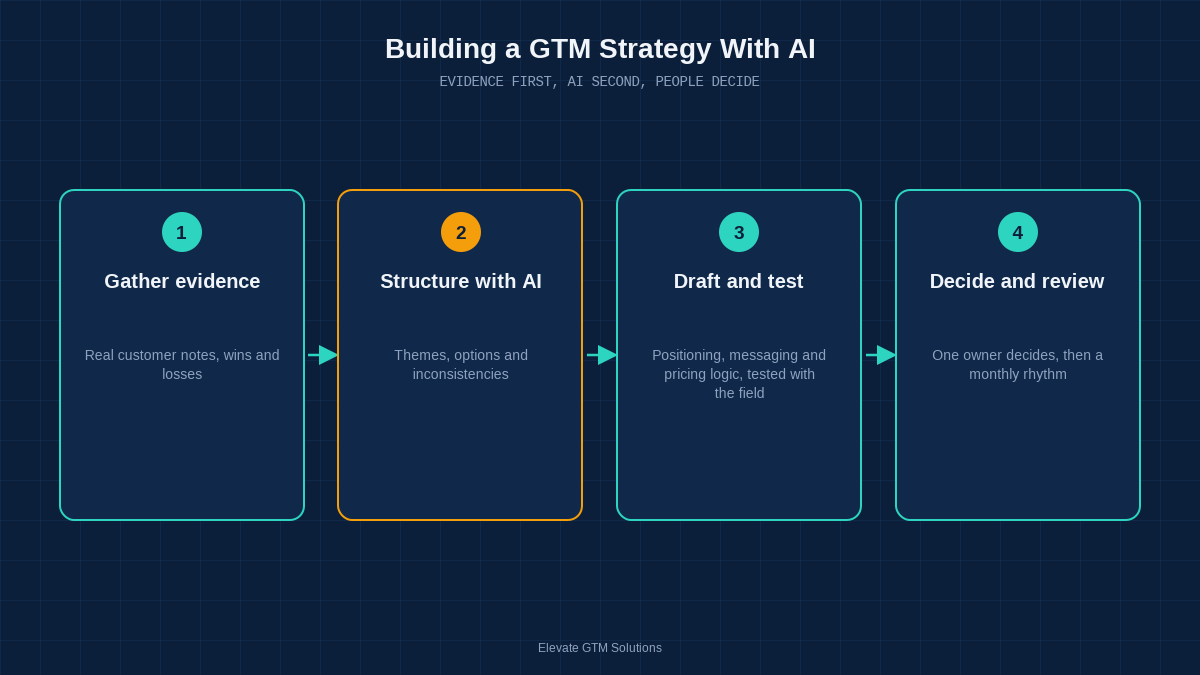
You can build a go-to-market strategy faster with AI, and many teams now do. The risk is that "faster" produces a polished, generic document that describes any company in your category. The teams that get real value use AI for the parts it does well, structuring evidence and drafting options, and keep people responsible for the parts it does badly: choosing, testing against customers and committing.
This guide gives you a step-by-step method. It shows where AI helps at each step, what to review before moving on, and example prompts you can adapt. It works with a general AI assistant or with a purpose-built platform. Elevate GTM Solutions makes a platform for this work, so we explain where a platform helps and where a general assistant is enough. The method does not depend on any product.
How Do You Build a GTM Strategy Faster With AI?
Build it in eight steps: gather real evidence, structure it into themes, define the customer, choose positioning, write messaging with proof, set pricing logic, choose channels and a launch plan, then test with sellers and customers and set a review rhythm. Use AI to structure evidence, draft options and keep outputs consistent. Do not use it to invent evidence or to make the final choices. Every AI draft should pass a review gate against real customer evidence before you move on.
How long does it take? A first version can take days instead of weeks. Testing with customers is what takes the time, and it should.
What is the biggest risk? Generic output built from thin inputs, accepted without checking.
Where AI helps and where it hurts
| Task | AI helps | Watch for |
|---|---|---|
| Summarizing interviews and notes | A lot | Missing nuance, invented quotes |
| Grouping evidence into themes | A lot | False patterns from small samples |
| Drafting customer definitions and positioning options | A lot | Generic answers |
| Drafting messaging variants | A lot | Claims without proof |
| Spotting inconsistencies | Some | Confident but wrong flags |
| Estimating market size or pricing | Little | Made-up numbers |
| Choosing the segment | None | Leaders must decide |
| Knowing what customers think | None unless you supply it | Assumptions presented as facts |
Two published studies are useful context. In a field study of 5,172 customer-support agents published in the Quarterly Journal of Economics, access to an AI assistant raised issues resolved per hour by about 15 percent on average, with larger gains for less experienced workers. In a Harvard Business School field experiment with 758 consultants, AI helped on tasks inside its capability and reduced performance on a task outside it. The lesson is to know which of your tasks are which, and to check.
The eight steps
Step 1: Gather real evidence before you open any AI tool
AI cannot create evidence. Collect what you have:
- Closed-won and closed-lost deals with reasons.
- Customer interviews or call notes, including a few lost deals.
- Pipeline data by segment.
- Competitor pages, pricing and reviews.
- Existing messaging and sales material.
If you have fewer than a handful of customer conversations, run some first. Eight to twelve is a reasonable target for a first pass. Everything after this step depends on the quality of this one.
Review gate: can you point to three customer quotes for each major claim you expect to make?
Step 2: Structure the evidence
This is where AI saves the most time. Paste in anonymized notes and ask it to group them. Example prompts:
- "Here are notes from eight customer interviews. Group the main reasons each customer chose us, list the three most common objections, and quote the exact phrases customers used. Mark anything you inferred."
- "From these win and loss reasons, summarize what separates the deals we win from the ones we lose. List what you cannot tell from this data."
Ask it to mark inferences and to list what it cannot tell. Then check a sample of its themes against the original notes.
Review gate: do the themes match what you remember, and can you trace each to the source notes?
Step 3: Define the customer
Ask for options, not answers:
- "Based on these themes, propose three candidate ideal customer definitions. For each, list the evidence for it, the evidence against it and what we would need to learn to be confident."
Pick one as a working hypothesis. Decide who is explicitly not a fit. A definition that excludes some companies is more useful than one that includes all.
Review gate: could two people look at a list of real companies and agree which fit?
Step 4: Choose positioning
Positioning states the category you compete in, how you differ from the alternatives buyers actually consider, and why that matters.
- "Given this customer definition and these competitor descriptions, draft three positioning statements. For each, name the alternative the buyer would otherwise use and the proof we can show."
Include doing nothing and spreadsheets as alternatives where relevant.
Review gate: can a seller repeat the positioning in their own words after one reading?
Step 5: Write messaging with proof
- "Draft a core narrative and three message pillars for this positioning. For each pillar, list the proof we have, and flag any claim we cannot support."
Remove or label claims without proof. Create short variants for the roles in the buying group, such as the person who feels the problem, the budget owner and the technical reviewer.
Review gate: does every pillar have evidence you could show a skeptical buyer?
Step 6: Set pricing logic
AI can structure options. It cannot know willingness to pay.
- "List the value metrics that could apply to this product, with the pros and cons of each, and list the buyer evidence we would need to choose between them."
Use buyer conversations and tests to decide. Treat any price an AI suggests as a hypothesis, never a fact.
Review gate: is the price tied to something customers said they value?
Step 7: Choose channels and plan the launch
- "Given this customer and where they research and decide, suggest two to four channels with a success measure each. List the assumptions each channel depends on."
Name an owner and a date for each initiative. Choose few channels you can run well.
Review gate: does each channel have an owner, a goal and a way to tell whether it worked?
Step 8: Test, decide and set a rhythm
Share the draft with sellers, customer success and a few customers. Ask what rings true and what is wrong. Run small tests where you can. Then hold a decision meeting with one named owner, record what you decided and why, and set a monthly review and a quarterly reset.
Review gate: is there a written decision record with a review date?
An assumption log keeps AI honest
For every important claim, record:
| Claim | Source | Status | Test | Owner |
|---|---|---|---|---|
| Mid-sized companies convert fastest | Eight of the last twelve wins | Supported | Review next quarter | Sales lead |
| Buyers value speed of setup | Two interviews | Untested | Ask in six calls | Product marketing |
| Price is a barrier for small teams | One lost deal | Weak | Test a smaller plan | Sales lead |
An AI draft with no entry in this log is a guess.
A prompt hygiene checklist
- Give the assistant your evidence instead of asking it to recall facts about your market.
- Ask it to separate what the source says from what it infers.
- Ask for options and counterarguments, not a single answer.
- Do one step at a time and review before the next.
- Keep sensitive customer data out of tools your company has not approved.
- Save the prompts and outputs with the decision record.
- Never publish a statistic from an AI answer without a primary source.
When a platform helps more than a chat assistant
A general assistant is flexible, and it forgets context between sessions, holds no shared record and does not keep outputs connected. A purpose-built GTM platform stores your inputs once, generates connected outputs and updates them when you change an assumption. For one person doing a one-off exercise, an assistant may be enough. For a team maintaining strategy across products or segments, a platform's structure matters more. Our guides to GTM platform vs GTM consultant and building a strategy without a consultant go deeper.
Mistakes to avoid
Skipping Step 1. AI polishes whatever you give it. Thin evidence yields polished mush.
Accepting the first draft. Ask for alternatives and the strongest case against each.
Letting AI choose. Leaders choose. AI drafts options.
Treating output as validation. A well-formatted answer is not tested.
No owner. An unowned strategy goes stale.
Never updating. Put the review rhythm in the calendar.
A hypothetical example
This is an illustration, not a real company.
A founder of a B2B software company wanted a go-to-market strategy in a week. She spent two days pulling together twelve months of wins and losses and arranged six customer calls. She then used an AI assistant to summarize the calls, group reasons and draft three customer definitions with evidence for and against each.
The strongest definition surprised her: mid-sized logistics firms, not the broad "operations teams" she had assumed. She drafted positioning and messaging with the assistant, removed two claims that had no proof, and tested the message on three more calls. Sellers rejected one phrase as jargon, which she replaced with a customer's own words.
In week two, she set pricing options, chose two channels, and held a decision session with her head of sales. The whole process took about nine working days, most of it on evidence and testing. The AI saved time on structuring and drafting. It did not supply the insight. The calls did.
Weak and strong prompts, side by side
Small changes in how you ask produce very different results.
| Weak prompt | Why it fails | Stronger version |
|---|---|---|
| "Write a GTM strategy for my software company." | No evidence, so the answer is generic | "Here are twelve months of win and loss reasons and notes from eight calls. Draft three candidate customer definitions with evidence for and against each." |
| "What is the best price for my product?" | Invites an invented number | "List value metrics that could apply, with pros and cons, and the buyer evidence we would need to choose." |
| "Write our messaging." | No positioning to anchor it | "Using this positioning and these competitor descriptions, draft a core narrative and three pillars, each with the proof we have, and flag unsupported claims." |
| "Who are my competitors?" | Relies on the model's memory | "Here are the websites and pricing pages of the five alternatives our buyers named. Summarize how each positions itself and where we differ." |
What a good output looks like at each step
These examples are illustrative.
After Step 2 (themes): "Customers who bought in under 30 days mentioned a single deadline (7 of 8). Objections: integration effort (5), price (3). Inferred: urgency may matter more than features. Cannot tell: whether this holds for larger accounts."
After Step 3 (customer): "Candidate A: mid-sized logistics firms. For: six of eight wins. Against: two losses to a spreadsheet approach. Need to learn: size threshold."
After Step 5 (messaging): "Pillar: setup in days, not months. Proof: three customer quotes, one internal measurement. Unsupported: 'industry-leading accuracy', remove."
Notice that good outputs separate evidence, inference and unknowns. If an output does not, ask for that structure.
Roles in an AI-assisted strategy process
| Role | Job |
|---|---|
| Decision owner | Chooses and signs off |
| Evidence owner | Runs the customer conversations and brings the data |
| Drafter | Works with AI to structure and draft |
| Reviewers | Sellers and customer success who test claims |
| Record keeper | Maintains the assumption log and decision record |
In a small team one person may hold several roles. Make sure the decision owner and the reviewers are different people.
Troubleshooting
The draft sounds generic. Add specifics: customer phrases, the exact alternative buyers used, concrete outcomes. Remove any sentence that could describe a competitor.
The AI cites numbers you cannot find. Delete them. Replace them with figures from a source you have read.
Different runs give different answers. Treat variation as a signal that the inputs are thin. Add evidence, then compare.
Sellers reject the output. Ask what they would say differently, and update the inputs with their words.
The strategy goes stale. Check the monthly review is happening and that win and loss reasons feed it.
A full worked example, step by step
This example is a hypothetical illustration with invented details, written to show what the inputs, prompts and outputs can look like at each step. It is not a description of a real company.
The company. A sixty-person software company sells scheduling software to businesses that run field teams. It has one product, around two hundred customers and a founder who wants a clearer strategy before hiring two more sellers.
Day 1 to 2: gather evidence (Step 1)
The head of product marketing exports twelve months of closed deals: forty-one wins and twenty-six losses, each with the reason recorded by the seller. She adds notes from the last nine customer calls, three lost-deal conversations she arranges, the pricing pages and descriptions of four alternatives buyers named, and the current sales deck.
She also lists what she cannot answer from this material: whether larger accounts behave differently, and why some buyers choose a spreadsheet instead.
Day 3: structure the evidence (Step 2)
She gives an AI assistant the anonymized call notes and the win and loss reasons with this instruction:
"These are notes from twelve conversations with customers and prospects. For each, list the situation that triggered the purchase, what they considered, why they chose or rejected us, and who was involved. Then group the findings into themes, give the number of conversations behind each theme and mark anything you inferred. Finish with the questions the notes cannot answer."
A sample of the result (invented):
- Trigger: a missed customer appointment caused by a scheduling error (seven of twelve).
- Considered: spreadsheets (nine), a larger field-service suite (four), a competitor (three).
- Chosen because: setup in days (six), simple mobile use for technicians (five).
- Lost because: needed deep invoicing features (four), price versus spreadsheets (three).
- Inferred: smaller firms switch after a visible failure, not after comparing features.
- Cannot answer: what happens at companies with more than two hundred technicians.
She checks five themes against the original notes and corrects one miscount.
Day 4: define the customer (Step 3)
"From these themes, propose three candidate ideal customer definitions. For each, give the evidence for it and against it, the size of the group in our wins and losses, and what we would need to learn to be confident."
The assistant offers: small and mid-sized field-service firms of ten to eighty technicians; larger firms with complex invoicing; and facilities teams in mid-sized property companies. The first has the most wins and the fewest losses. The second has the highest deal values and the most losses. The third has little evidence.
She and the founder choose the first as the working definition, and write who is excluded: firms needing deep invoicing and firms below ten technicians.
Day 5: choose positioning (Step 4)
"Given this customer definition and these descriptions of the four alternatives, draft three positioning statements. For each, name the alternative the buyer would otherwise use, and list the proof we can show."
The strongest option positions the product against spreadsheets and a heavyweight suite: scheduling that a team can start using in days and technicians can use on a phone. She notes that the claim "days" is supported by six customers, and that "mobile simplicity" has quotes from five.
Day 6: write messaging (Step 5)
"Draft a core narrative and three message pillars for this positioning. For each pillar, list the evidence we have, and flag any claim we cannot support. Write one variant for the owner who feels the cost of missed appointments, and one for the dispatcher who uses the tool daily."
One draft pillar says "the most accurate scheduling on the market." The assistant flags it as unsupported. She removes it.
Day 7: pricing logic and channels (Steps 6 and 7)
The assistant lists three possible value metrics: per technician, per job and per location, with pros and cons. She chooses to test per technician in conversations because buyers described their pain in technicians. For channels, she picks two: direct outreach to small field-service firms, and a partnership with a payments provider that serves the same customers, flagged as an assumption to test.
Day 8: test with the field (Step 8, part one)
Sellers read the draft and raise two objections: the positioning ignores buyers who want invoicing, and the phrase "scheduling intelligence" confuses people. She changes the text to a customer's own words and adds a sentence on what the product does not cover. She also holds two more buyer calls to test the per-technician price.
Day 9: decide and set the rhythm (Step 8, part two)
The founder, head of sales and head of product marketing meet for ninety minutes. They approve the customer definition, positioning and three pillars. They record what they did not decide: the partnership channel stays a test. They name owners and put a monthly review in the calendar.
What the AI did: structured notes, drafted options, flagged unsupported claims. What people did: collected the evidence, checked the themes, chose, tested and decided.
A prompt library, step by step
Adapt these to your own inputs. Replace the bracketed descriptions with your own material.
| Step | Prompt to adapt |
|---|---|
| Evidence | "Summarize each of these [number] conversations into trigger, alternatives, reasons for choosing or rejecting, and who was involved. Quote exact phrases." |
| Themes | "Group these summaries into themes with counts. Mark inferences. List what the notes cannot tell us." |
| Customer | "Propose three candidate ideal customer definitions with evidence for and against and what we would need to learn." |
| Exclusions | "Based on our losses, list the types of company we should not target, with the evidence." |
| Positioning | "Draft three positioning statements against [the alternatives buyers named]. For each, list the proof we have." |
| Messaging | "Draft a core narrative and three pillars. Flag unsupported claims. Write variants for [roles]." |
| Objections | "List the five strongest objections a skeptical buyer would raise to this positioning and the best honest response to each." |
| Pricing | "List value metrics that could apply, with pros and cons, and the buyer evidence we would need." |
| Channels | "Suggest two to four channels for [customer] with a success measure and the assumption behind each." |
| Consistency | "Compare these three documents and list any statements that conflict." |
| Test plan | "For each assumption in this log, propose the cheapest way to test it in two weeks." |
Two prompts deserve emphasis. The objections prompt makes the assistant argue against your draft, which surfaces weak points early. The consistency prompt is a cheap way to catch drift between documents.
A scoring rubric for AI drafts
Before accepting a draft, score it from one to five on each line and fix anything below three.
| Criterion | Question | Score |
|---|---|---|
| Evidence | Can I trace each major claim to a source I have read? | |
| Specificity | Could this describe a competitor? If yes, it is too generic | |
| Honesty | Are unsupported claims flagged or removed? | |
| Usability | Could a seller use it tomorrow? | |
| Consistency | Does it agree with the other documents? | |
| Testability | Do we know how to check the riskiest claim? | |
| Ownership | Is there a named person to approve it? |
A draft that scores low on specificity is the commonest failure. The fix is to add customer words, named alternatives and concrete examples.
Turning the strategy into a plan
A strategy that stays in a document changes nothing. Convert it.
- List the five to eight decisions and the actions each implies.
- Assign one owner and one date to each action.
- Create the handoff material: a one-page customer profile, the message pillars, objection responses, qualification questions.
- Set the measures: leading indicators such as qualified conversations, and lagging ones such as win rate by segment.
- Schedule the rhythm: a weekly check-in during the first month, then monthly, with a quarterly reset.
- Record the assumptions and the dates by which you will test them.
If you use a platform, many of these outputs come from the same source as the strategy, which reduces drift. Otherwise, keep a single folder of current documents and archive older versions.
Privacy and data handling when using AI
Customer notes can contain personal and commercially sensitive information. Before you paste anything into an AI tool:
- Check your company's policy on approved tools.
- Remove names, contact details and anything not needed.
- Confirm whether the tool uses your inputs to train models and whether you can opt out.
- Keep customer quotes you intend to publish separate, and get permission.
- Record which tool and version produced which draft.
- Review regional rules on personal data with your legal advisers.
A good working habit is to anonymize first, then structure, then reinsert customer language only in the final documents where you have permission to use it.
Applying the method in different situations
The eight steps stay the same. What changes is where to spend your effort.
| Situation | Spend most effort on | Watch for |
|---|---|---|
| A new product for existing customers | Positioning against what customers use today, and pricing | Assuming current customers want the new thing |
| A new product for a new segment | Evidence about the segment through new conversations | Reusing old messaging that does not fit |
| Entering a new region | Local competitors, buying habits, regulation, price | Translating instead of adapting |
| Repositioning an existing product | Proof for the new claim and consistency across materials | Changing the website but not sales material |
| A strategy refresh | Win and loss evidence from the last quarter | Updating wording without updating decisions |
| An enterprise with several units | Decision rights and what is global versus local | Producing many strategies that conflict |
In every case, Step 1 and Step 8, evidence and testing, determine the quality of the result.
Common AI mistakes in GTM work, and how to catch them
| Mistake | Example | How to catch it |
|---|---|---|
| Invented statistic | "Most buyers in your market prefer X" with no source | Ask for the source and check it, then delete if absent |
| Plausible but wrong competitor detail | A feature the competitor does not have | Check the competitor's own pages |
| Generic benefit | "Save time and increase efficiency" | Ask what exactly changes and for whom, in a customer's words |
| Over-broad customer | "Any company that wants to grow" | Ask for exclusions and the evidence |
| False consensus | Treats one customer's opinion as a trend | Ask for counts behind every theme |
| Confident pricing advice | A specific price with no buyer evidence | Treat as a hypothesis and test |
| Inconsistency across documents | Positioning and messaging that conflict | Run a consistency check prompt |
| Borrowed language | Phrases that sound like a competitor's site | Compare against competitors' wording |
A good habit is to read the output once as a skeptical buyer and once as a seller who must say it aloud.
A sign-off workflow for AI-assisted strategy
When several people contribute, define who signs off on what, so speed does not erode quality.
| Stage | Who checks | What they check | Pass condition |
|---|---|---|---|
| Evidence summary | Evidence owner | Themes match the source notes | Sample of five themes verified |
| Customer definition | Sales and customer success | The definition matches real wins and losses | Two sellers agree on a list of real accounts |
| Positioning | Product marketing lead and a seller | A seller can state it; alternatives are named | Repeat test passed |
| Messaging | Marketing and sales | Every claim has proof | No unsupported claim remains |
| Pricing logic | Finance and sales | Tied to buyer evidence | Evidence recorded |
| Channels and plan | GTM leader | Owners, dates, measures set | Plan signed by each owner |
| Final strategy | Decision owner | Reasoning and assumptions recorded | Decision record and review date written |
Keep the record of who signed off and when. If a result later turns out wrong, the record shows which assumption failed, which is how the strategy improves.
Two rules keep the workflow light. Reviewers see only what they are qualified to check. And a draft that fails a check goes back to the previous stage, with the reason written down.
Handing the strategy to a new team member
A good strategy survives a change of people. When someone new joins, give them a short path.
- Read the one-page strategy. Customer, exclusions, positioning, three pillars, price logic and channels.
- Read the decision record. What was decided, by whom, and why.
- Read the assumption log. What is believed, what is proven and what is being tested.
- Listen to five customer calls. Hear the language behind the strategy.
- Sit in on a monthly review. See how the strategy changes.
- Write what is unclear. The questions of a newcomer often expose gaps.
If this takes more than a day, the documents are too long or too scattered.
Key takeaways
- Build the strategy in eight steps and put a review gate after each one.
- Gather real customer evidence before opening any AI tool. AI cannot create evidence.
- Use AI to structure evidence and draft options. Leaders choose, and customers test.
- Ask AI to separate what sources say from what it infers, and to list what it cannot tell.
- Keep an assumption log and a decision record, and set a monthly review.
- Delete any statistic or claim you cannot trace to a source.
What to do this week
Gather the evidence you already hold: twelve months of win and loss reasons and any call notes. Book five customer or lost-deal conversations. Run Step 2 on the notes with an assistant and check five themes against the source. Start an assumption log with three entries. That small start gives you a real basis for every later step and shows quickly how much AI helps with your own material.
Where Elevate GTM Solutions fits
Elevate GTM Solutions is an AI-native GTM operating system. It follows a similar flow: you provide market, industry, product and segment context, it builds structured outputs across 15 connected modules, and you review, revise and compare versions. It adds workflows, weekly execution plans and a recurring review rhythm. It does not replace customer conversations or the decision owner. Published plans are Enable at USD 499 per month and Growth at USD 1,499 per month, billed annually, and a free first strategy build is available.
For related reading, see How to Build a GTM Strategy Without a Consultant, What Is Elevate GTM Solutions?, What Is a GTM Strategy? and Unified GTM Strategy. See the pricing page, or request a demo.
Frequently Asked Questions
How do you build a GTM strategy with AI?
Gather real customer evidence, use AI to structure it into themes, define the customer, choose positioning, write messaging with proof, set pricing logic, choose channels and a launch plan, then test with sellers and customers and set a review rhythm. Review every AI draft against evidence before moving on.
Can AI create a go-to-market strategy for me?
AI can draft strategy outputs quickly from inputs you supply. It cannot create customer evidence or make the final choices, so treat its output as a draft to test.
How long does it take to build a GTM strategy with AI?
A first version can take days instead of weeks, as long as you already have or can quickly gather customer evidence. Testing with customers and sellers takes the most time.
What should I give AI to get a good GTM strategy?
Your own evidence: win and loss reasons, customer interview notes, pipeline data by segment, competitor material and existing messaging. Ask it to separate what the sources say from what it infers.
What are the risks of using AI for GTM strategy?
Generic output from thin inputs, invented statistics, claims without proof, and false confidence. Use review gates, an assumption log and a named decision owner.
Is a GTM platform better than ChatGPT for strategy?
A general assistant is flexible but does not keep a shared, connected record. A purpose-built platform stores inputs and keeps outputs consistent across products and segments. For a one-off personal exercise an assistant may be enough.
Where should I not use AI in GTM strategy?
For choosing the target segment, estimating willingness to pay without buyer evidence, and anything that requires knowing what customers think but was not in your inputs.
How do I keep an AI-built strategy current?
Update the inputs as evidence changes, review what shifts in the outputs, and hold a monthly review and a quarterly reset with a written decision record.
Does Elevate GTM Solutions use AI to build the strategy?
Yes. It builds structured strategy outputs across its modules from the context you provide, and you review, revise and compare versions. It does not replace customer conversations or a decision owner.
What is a good first prompt for building a GTM strategy with AI?
Give the assistant your own evidence and ask it to group findings into themes with counts, mark anything it inferred and list what the evidence cannot answer. Avoid asking it to write a strategy from nothing.
How do I stop AI from inventing facts in my strategy?
Supply the sources, ask it to separate what the sources say from what it infers, delete any statistic without a primary source, and check a sample of its claims against the original notes.
How do I make an AI-built GTM strategy specific to my company?
Add customer phrases, the named alternatives buyers use, concrete examples and proof points, and remove any sentence that could describe a competitor.
How do I test an AI-drafted strategy?
Share it with sellers and customer success, run a few more buyer conversations, test the riskiest assumptions in the cheapest way available and record results in an assumption log.
Is it safe to paste customer data into AI tools?
Only if your company's policy allows the tool. Anonymize first, check whether inputs are used for training, and review regional data rules with your legal advisers.