
By the Elevate GTM Solutions Team · Updated November 10, 2026 · 14 min read
What Is Elevate GTM Solutions? Product, Modules, Pricing, and Who It Is For
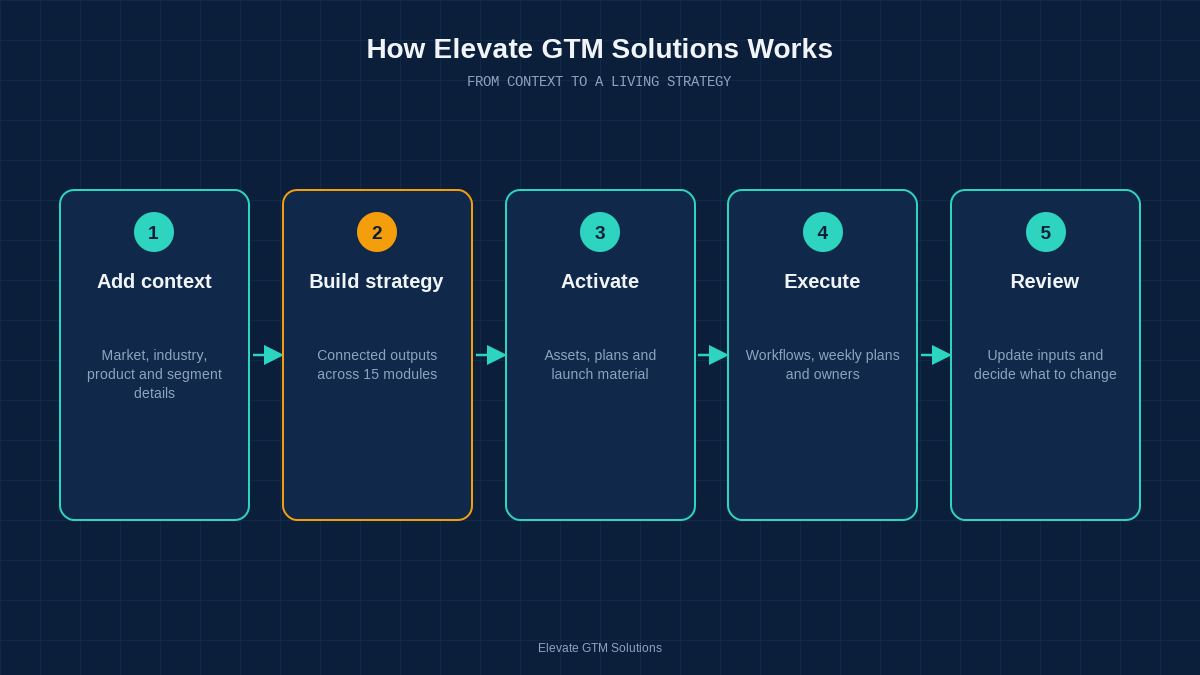
Search for "Elevate" and you will find government contractors, growth agencies, public affairs firms and software labs. Search for "GTM" and you may get Google Tag Manager. This page exists to settle both. Elevate GTM Solutions is a software company and platform for go-to-market strategy, and in this name "GTM" means go-to-market, not Google Tag Manager.
This guide states plainly what the platform is, what it is not, who it suits, what it contains, how it is priced and where it fits next to the tools you already use. Everything here comes from the Elevate GTM Solutions website and its published plans. Where a claim is the company's own and has not been independently verified, we say so, and we suggest how to test it.
What Is Elevate GTM Solutions?
Elevate GTM Solutions is an AI-native GTM operating system and platform for B2B companies. You give it your market, industry, product and segment context, and it builds a structured go-to-market strategy across 15 connected modules, including market research, ICP and segmentation, competitive intelligence, positioning, messaging, pricing, customer acquisition, channels, launch execution and measurement. It then helps teams turn that strategy into workflows and a recurring review rhythm, so the strategy can be updated as markets change.
Is it a consulting firm? No. The pricing page states that Elevate is a product. The company also offers advisory and guided programs, sold separately.
Is it a CRM? No. It does not replace a customer database. It connects to CRMs for supported actions.
What Elevate GTM Solutions does in plain terms
Most companies make go-to-market decisions in slide decks, spreadsheets and meetings. The decisions are about who to sell to, how to position the product, what to say, what to charge, which channels to use and how to launch. They are usually made once, then drift out of date.
Elevate GTM Solutions replaces that scattered process with one connected system.
- You enter context. Your market, industry, product and segment details, plus signals and triggers that define the motion.
- The platform builds structured outputs. A unified GTM strategy and the outputs of each module, such as a customer profile, positioning, messaging, pricing logic and channel plans.
- Teams turn outputs into work. Structured workflows, weekly execution plans, task ownership and tracking.
- The strategy stays current. You update inputs as conditions change, review what shifts and decide what to act on. The platform calls this a continuous operating cycle.
The company's own summary of the benefit is "no decks, no rework, no starting over." Read that as a design goal. Whether it holds for your team depends on the quality of your inputs and on who owns the system.
What it is not
Being clear about limits makes the description more useful.
| It is not | Why that matters |
|---|---|
| A consulting firm | The platform is software. Advisory and guided programs exist, but they are separate offers |
| A CRM or customer database | Customer records and pipeline live in your CRM. Elevate connects to it for supported actions |
| A contact data provider | It does not supply prospect lists or verified emails |
| A sales engagement tool | It does not run outreach sequences or dial |
| A guarantee of results | Its outputs are structured drafts that people should test against real customers |
| Google Tag Manager | Here GTM means go-to-market |
| Any other company called Elevate | Check the domain: elevategtmsolutions.com |
Who it is for
The platform page describes organizations that need to build, align and keep adapting GTM strategy without months of planning or static decks. The roles and situations it names are:
- Product marketing, strategy, RevOps and growth teams.
- Organizations operating across changing markets.
- Multi-region, multi-segment and multi-product environments.
- Teams that need continuous alignment between strategy and execution.
The home page speaks of enterprises, the metadata speaks of B2B teams, and published pricing starts at a level that smaller companies can consider. A fair reading is B2B companies of different sizes, with the strongest fit where several products, segments or regions need a consistent strategy. If you are unsure, the free strategy build described below is a low-cost way to test the fit.
How the platform is organized
The website describes six connected areas, each with its own page.
| Area | What it covers |
|---|---|
| GTM Context | Structured inputs: market, segment and product context, plus triggers and signals |
| GTM Intelligence | Industry, segment, buyer and competitive context to inform decisions |
| GTM Strategy | ICP, positioning and segmentation, channel and workflow planning, aligned strategy across teams |
| GTM Activation | Turning strategy into assets and plans for sales, marketing and launches |
| GTM Execution | Structured workflows, weekly execution plans, task ownership and tracking |
| GTM Analytics | Measuring performance and feeding results back into the next cycle |
Recurring priorities and the execution cadence run through a feature the site calls Elevate Pulse, also referred to as GTM Pulse on the platform page.
The 15 modules
Each module works on its own and together. According to the site, they are built on a proprietary 15-module GTM methodology.
| Module | Question it helps answer |
|---|---|
| Unified GTM Strategy | How do all the decisions fit together? |
| Market Research | What does the market look like and where is the opportunity? |
| ICP and Segmentation | Who is the ideal customer and which segments come first? |
| Competitive Intelligence | How do alternatives position themselves and where do we differ? |
| Account-Based Marketing | Which accounts to target and how to approach them |
| Product Positioning | How should we be understood against alternatives? |
| Product Messaging | What do we say, to whom and with what proof? |
| Pricing Strategy | What does the price signal and how should it be packaged? |
| Customer Acquisition | Which motions and campaigns bring in customers? |
| Distribution Channel Strategy | Which paths to market fit the product? |
| Marketing Alignment | How do teams stay aligned on one plan? |
| Launch and Execute | How do we turn the plan into a launch and a cadence? |
| Measure and Optimize | What is working and what should change? |
| Sales Enablement | What do sellers need to carry the strategy? |
| Customer Success | How do we onboard, retain and expand customers? |
| Customer Advocacy | How do we turn happy customers into references and advocates? |
That is the unified strategy plus 15 modules.
What you get at the end
The outputs are structured documents and views you can review and share:
- A unified GTM strategy that connects the module outputs.
- Module outputs such as an ICP, positioning narratives, messaging frameworks and pricing logic.
- Executive dashboards and a GTM report.
- Workflows and weekly execution plans tied to the strategy.
- Versions you can compare, for example strategies by region, vertical or segment, side by side.
- Exports, including PDF sharing on the entry plan.
The home page states that a full GTM strategy can be built in about five minutes. That is the company's claim. A sensible test is to enter a real product and segment, then judge the draft's specificity and accuracy with the people who sell it.
Common use cases
The site names six, each with a page.
| Use case | What the platform is used for |
|---|---|
| Launch a new product | A structured strategy and execution plan from real context, with teams aligned before launch |
| Enter a new market | Demand, segment and competitive context before expanding |
| Expand an existing product | New segments, use cases and regions |
| Fix GTM performance | Finding gaps between strategy and execution |
| Improve win rates | Aligning messaging, positioning and execution |
| Align cross-functional teams | One shared GTM model across marketing, sales, product and RevOps |
Integrations
The integrations page lists the supported directions, not automatic synchronization of every object.
| Tool | Direction |
|---|---|
| Claude | Push and pull selected outputs and supported context |
| HubSpot CRM | Push supported GTM work and pull available business data |
| Salesforce | Connect supported destination actions with available inputs |
| LinkedIn for Business | Send supported assets and import available data |
| Notion | Push selected outputs |
| Pull supported data | |
| YouTube | Pull supported data |
Before you rely on any connection, ask which exact actions and data it supports for your account.
Pricing and plans
Published plans, billed annually:
| Plan | Price | What it covers |
|---|---|---|
| Enable | USD 499 per month | One GTM scope, one revision cycle |
| Growth | USD 1,499 per month | Up to three users and three scopes, up to two revisions per scope |
| Scale | Custom, annual | Unlimited scopes and advanced intelligence |
A scope is a product, market or segment. The company also offers a free first strategy build through its free trial page, and guided programs with advisors, priced separately. Check the pricing page for current terms, since plans can change. If you see a different price on a third-party listing, the pricing page is the source of record.
Guided programs, advisory and partners
For teams that want help alongside the software, Elevate GTM Solutions offers:
- Guided GTM: the platform plus advisor support to develop and activate a strategy.
- GTM Advisory: short, focused engagements on specific problems such as positioning, pricing and expansion, described as fast and focused instead of long-term consulting.
- A self-serve GTM Strategy Framework: templates, prompts and examples.
- An advisor network and a partner program: for specialists who work with the platform.
What the evidence shows so far
The case studies page describes three engagements, all anonymized: a technology services company in India that used the full platform to build and evaluate its strategy, an AI risk and compliance company in Canada that built a unified strategy for internal review, and an AI animation technology company in the United States, served through a partner. They describe how the platform was used and what was produced. They do not report performance figures.
That is honest, and it is also a limit. If outcome data matters to your decision, ask for named references or measurable results, and run a pilot on your own product.
The founder's story on the Our Story page adds context: the platform grew out of about twenty years of product marketing experience and the observation that a GTM strategy starts going out of date the day it is finished.
What a first build looks like
The free first strategy build is the quickest way to see the platform. The steps below describe the flow in general terms. Screens and field names can change, so treat this as orientation, not a manual.
- Describe the business. Company, market and industry, then the product and the segment you want to plan for.
- Add the context that makes it yours. Who buys, what alternatives they use, how you price, what you already know from wins and losses. The more specific this is, the more specific the output.
- Generate the unified strategy and module outputs. The platform produces connected outputs across the modules, including a customer profile, positioning, messaging, pricing logic and channel plans.
- Review with the people who know the customers. Ask sellers and customer success staff what rings true, what sounds generic and what is missing.
- Revise and compare. Change an assumption, regenerate, and compare versions, for example one segment against another.
- Turn outputs into work. Use workflows and weekly execution plans to assign owners and dates.
- Review on a rhythm. Bring fresh evidence monthly or quarterly and update inputs.
A good first test is to choose a product your team knows very well. That way the people reviewing the draft can judge its accuracy quickly, and any gaps point to inputs you can improve.
How different roles use it
| Role | Typical use |
|---|---|
| Founder or head of a small company | Get a structured first strategy and a shared language for the team without a long consulting engagement |
| Product marketing | Build and maintain positioning, messaging and competitive framing from one set of inputs |
| Head of strategy or GTM | Compare strategies by segment or region and keep them consistent |
| RevOps | Connect strategy to workflows, ownership and measurement |
| Sales leadership | Review the customer profile and messaging that sellers will carry |
| Marketing leadership | Align channel and acquisition plans with the agreed strategy |
| Agency or advisor | Use the platform to structure client work, through the partner and advisor programs |
Elevate GTM Solutions compared with doing it manually
Many teams manage go-to-market in documents and spreadsheets, and for a single product that can be enough. The platform is aimed at the point where that stops working.
| Situation | Documents and spreadsheets | Elevate GTM Solutions |
|---|---|---|
| One product, one segment, one owner | Often sufficient | Possibly more than you need |
| Several products or segments | Versions drift apart | Shared inputs and comparable outputs |
| Strategy changes often | Each update is manual rework | Update inputs and review what shifts |
| Many contributors | Hard to know the current version | One workspace |
| Need for traceability | Reasons live in people's heads | Outputs tied to inputs |
The comparison is not that software is always better. It is that the cost of keeping documents consistent grows with the number of products, segments and people, and a system helps most when that cost is high.
Terms used on this page
| Term | Meaning |
|---|---|
| GTM | Go-to-market: how a company reaches and wins customers |
| GTM operating system | A connected system for the decisions, plans and measurement behind go-to-market |
| AI-native | Built with AI as part of how outputs are produced, not added on afterward |
| Scope | A product, market or segment that a plan covers |
| ICP | Ideal customer profile |
| Module | One of the connected areas, such as positioning or pricing |
| Elevate Pulse | The recurring priorities and review rhythm, also called GTM Pulse |
The 15 modules in more detail
The module list tells you what exists. This section describes what each one is for, what it needs from you and what you can expect back. Output formats and screens may change, so treat the descriptions as orientation and confirm specifics in a demo.
Unified GTM Strategy
The module that connects the others. It brings the outputs of the individual modules into one strategy so that the customer definition, positioning, messaging, pricing logic and channel plans agree with each other. Its practical value is consistency: change the target segment and the unified view shows what else should change. It needs the inputs the other modules use and produces a single strategic framework and report your team can review.
Market Research
Helps you describe the market you are entering or serving: its shape, the demand signals, the segments within it and where the opportunity sits. It needs your market and industry context and any evidence you already hold. It produces a structured view of the market that the later modules build on. It does not replace primary research with customers, and it is only as current as the context you give it.
ICP and Segmentation
Turns what you know about who buys into a defined ideal customer profile and a set of segments, with a view on which to prioritize. It works best when you supply win and loss reasons, customer attributes and examples of your best accounts. The output is a customer definition, segment priorities and the reasoning behind them. The test of a good output is whether two people can use it to agree which companies fit.
Competitive Intelligence
Frames the alternatives a buyer considers and where you differ. It needs the names of the competitors your buyers actually mention, including non-obvious ones such as spreadsheets or doing nothing. The output is a competitive framing you can use in positioning and in sales conversations. It is a structured analysis, not a live feed of competitor changes, so keep tracking tools if that is your need.
Account-Based Marketing
Supports planning an account-based approach: which accounts to prioritize, how to tier them and what each tier needs. It uses the customer definition and segment priorities. The output is a plan for account focus. It does not supply account data or run advertising, which is the job of account intelligence and advertising platforms.
Product Positioning
Produces positioning options: the category you compete in, the differentiation, and the value you claim for each segment. It needs the customer definition and the competitive framing. The output is a set of positioning statements with the reasoning, ready for review. Treat them as options to test with buyers.
Product Messaging
Builds the language that expresses the positioning: a core narrative, message pillars, proof points and role-specific variants. It needs the positioning and any proof you hold, such as customer quotes and measurements. The output is a messaging framework your team can use consistently. Claims without proof should be removed or labeled as untested.
Pricing Strategy
Structures pricing decisions: what customers value, which value metric to use, how to package and what the price signals. It needs your cost and customer context and any buyer reactions to price. The output is pricing logic and packaging options. It cannot know willingness to pay, which comes from buyer conversations and tests.
Customer Acquisition
Plans how you will bring in customers: motions, campaigns and growth experiments suited to your segment and price point. It uses the customer definition, positioning and channels. The output is an acquisition plan with priorities. Execution happens in your own marketing and sales tools.
Distribution Channel Strategy
Helps choose the paths to market: direct, self-serve, partner, marketplace and others, with the trade-offs for each. It needs your price, buyer behavior and resources. The output is a channel recommendation and plan. A few channels run well beat many run badly.
Marketing Alignment
Keeps marketing, sales and product working from the same plan. It uses the strategy outputs to produce shared definitions, priorities and ownership. The output is an alignment framework and cadence. It works only if people use it, so assign an owner.
Launch and Execute
Turns the strategy into a launch and an execution rhythm: owners, dates, weekly plans and tracking. It uses the strategy and channel plans. The output is a launch plan and structured workflows. Detailed project management often stays in a dedicated tool.
Measure and Optimize
Defines what success looks like and how results feed back into the strategy. It uses the goals and plan. The output is a measurement framework and a review cycle. It depends on the data you can bring in, so check which sources connect to your account.
Sales Enablement
Derives what sellers need from the strategy: customer profile, talk tracks, competitive notes and qualification guidance. It uses positioning, messaging and competitive framing. The output is enablement inputs and drafts. A governed content library and training program usually live in a dedicated enablement platform.
Customer Success
Plans how to onboard, retain and expand customers in line with what was promised in sales. It uses the customer definition and messaging. The output is a success framework: onboarding milestones, health signals and expansion plays. Day-to-day customer success tooling remains separate.
Customer Advocacy
Plans how to turn satisfied customers into references, reviews and advocates. It uses the customer base and the messaging. The output is an advocacy plan. It does not manufacture testimonials, and it depends on customers who are willing to speak.
Where it sits among the tools you already use
Understanding the difference from familiar categories avoids a common mistake: buying something that does a different job.
| If you use today | What it does well | What Elevate GTM Solutions adds | What you still need |
|---|---|---|---|
| A CRM (HubSpot, Salesforce) | Records customers, deals and activity | A structured strategy for what the CRM should be used to execute | The CRM itself |
| Account intelligence or ABM (Demandbase, 6sense) | Finds in-market accounts and runs account programs | The customer definition and messaging those programs run on | The intelligence platform |
| Outbound and data tools (Clay, Apollo, Artisan, Outreach) | Research, sequencing and follow-up | The target, message and priorities they should follow | The outbound tool |
| A general AI assistant | Flexible drafting and brainstorming | A stored, connected, shared record that updates | The assistant for exploration |
| Consultants | Judgment, facilitation, outside view | A reusable system for the structured work | Advisors for decisions that need an outside voice |
| Documents and spreadsheets | Flexibility and low cost | Consistency across products and people | Documents for ad hoc work |
The common thread is that Elevate GTM Solutions sits above execution tools and keeps what they are told consistent. It does not try to replace them.
A worked example of a first strategy build
This is an illustration, not a real customer.
A product marketing manager at a software company with two products asked her team to settle the target for the newer one. She entered the market and industry, described the product, listed the segment she believed in and added what she knew: eight recent wins, three losses and the alternatives buyers mentioned.
The first output proposed a customer definition, competitive framing, positioning options and messaging pillars. She read it with a seller and a customer success manager. Two things were wrong. The draft assumed larger accounts than the team won, and one message pillar leaned on a claim the team could not prove. She corrected the inputs, regenerated the outputs and compared the two versions side by side.
She then ran the same exercise for the second segment and compared. The team chose the first segment, recorded the reasons and used the weekly plan to assign owners for the launch tasks. The process took her a few working days of review and conversation. The platform did the structuring and drafting. The decision, and the evidence behind it, came from people.
Your first thirty days
- Days 1 to 3: choose the scope. One product and one segment. Name the person who will approve changes.
- Days 4 to 7: gather inputs. Win and loss reasons, customer notes, competitor names, current messaging, pricing and any known constraints.
- Days 8 to 12: build and review. Generate outputs, read them with sellers and customer success, and list what is wrong or generic.
- Days 13 to 18: correct and compare. Improve the inputs, regenerate, and compare versions.
- Days 19 to 24: test with buyers. Share the positioning and messaging with a few customers or prospects and note reactions.
- Days 25 to 30: decide and start the rhythm. Hold a decision meeting, record the decisions, set owners and dates, and put the first monthly review in the calendar.
Data, security and ownership questions
Ask these before entering sensitive information.
| Question | Why it matters |
|---|---|
| Who owns the inputs and the outputs? | You should be able to keep and reuse your work |
| Where is data stored and who can access it? | Company policy and customer commitments |
| Is my data used to train models? | Confidentiality |
| How do I export everything? | Avoids lock-in |
| What logs and version history exist? | Traceability |
| How are integrations authorized and revoked? | Access control |
| What happens to my data if I cancel? | Deletion and retention |
Review the answers with your security and legal advisers, and confirm them against current terms.
Common misunderstandings about Elevate GTM Solutions
"It is a consulting company." It is a software product. The company also sells advisory and guided programs separately, which is where the confusion comes from.
"It replaces the CRM." It does not hold customer records. It connects to CRMs for supported actions.
"It generates leads." It does not supply contacts or run outreach. It helps decide who to target and what to say.
"The output is the strategy." The output is a structured draft. The strategy is what your team decides after testing it with customers.
"It only suits large enterprises." The home page speaks to enterprises, but published plans start at a level smaller companies can consider, and a free first build is available.
"It is the same as other companies called Elevate." The name is shared by unrelated businesses. The domain is elevategtmsolutions.com.
"It means Google Tag Manager." In this name GTM means go-to-market.
Key takeaways
- Elevate GTM Solutions is an AI-native GTM operating system and platform for B2B companies. In its name, GTM means go-to-market.
- It builds structured go-to-market strategy across 15 connected modules plus a unified strategy, from the market, product and segment context you provide.
- It is software, not a consulting firm, a CRM, a contact database or an outreach tool. Advisory and guided programs are sold separately.
- Published plans, billed annually, are Enable at USD 499 per month and Growth at USD 1,499 per month, with custom Scale pricing and a free first strategy build.
- Integrations list HubSpot, Salesforce, LinkedIn, Notion, Claude, Instagram and YouTube, each with specific supported directions.
- Case studies are anonymized and describe use, not performance figures, so ask for references or run a pilot.
- Output quality depends on specific inputs, a named owner and testing against real customers.
Honest considerations before you buy
- Output quality depends on inputs. Specific, honest context produces useful drafts. Vague inputs produce generic ones, with any AI-based tool.
- It needs an owner. Someone should approve changes and bring fresh evidence. Otherwise the strategy goes stale like any document.
- It does not replace customer conversations. Interviews and win and loss reviews remain the best evidence.
- It is not an execution engine for outreach or advertising. Use dedicated tools for that.
- Some claims are the company's own. Test speed and coverage claims with your own inputs.
Questions to ask in a demo
- Can I enter my own product and segment and see the output live?
- What changes in the strategy if I change the target segment?
- How are outputs traced back to my inputs?
- What can I export, and who owns the outputs?
- Which exact actions work with my CRM?
- What is included at each plan, and what costs extra?
- What do you not do?
- Can I speak to a customer who uses it?
How it compares with other tools
Elevate GTM Solutions sits at the strategy and planning layer. Other tools carry out or measure the motion.
- Against CRMs: see GTM Platform vs CRM and Elevate vs HubSpot.
- Against account intelligence and ABM platforms: see Elevate vs Demandbase and Elevate vs 6sense.
- Against consulting: see GTM Platform vs GTM Consultant.
- For choosing between platform types: see How to Choose a GTM Platform.
Getting started
- Read the platform overview and the GTM operating system guide.
- Try the free strategy build on the free trial page with a real product.
- Review the output with the people who sell and support the product.
- Request a demo if you want a walkthrough with your own scenario.
Frequently Asked Questions
What is Elevate GTM Solutions?
Elevate GTM Solutions is an AI-native GTM operating system and platform for B2B companies. It builds structured go-to-market strategies across 15 connected modules from your market, product and segment context, and helps teams turn them into workflows and keep them current.
What does GTM stand for in Elevate GTM Solutions?
GTM stands for go-to-market. It does not mean Google Tag Manager, and the company is not related to other businesses that use the name Elevate.
Is Elevate GTM Solutions a consulting firm or software?
It is software. The pricing page states that it is a product and not a consulting service. The company also offers guided programs and advisory engagements, which are sold separately.
How much does Elevate GTM Solutions cost?
Published plans, billed annually, are Enable at USD 499 per month and Growth at USD 1,499 per month, with custom annual pricing for Scale. A free first strategy build is available, and guided programs are priced separately. Check the pricing page for current terms.
Who is Elevate GTM Solutions for?
B2B companies, especially product marketing, strategy, RevOps and growth teams working across several products, segments or regions that need their strategy and execution aligned and updated continuously.
Does Elevate GTM Solutions replace a CRM?
No. A CRM holds customer records and pipeline. Elevate connects to CRMs such as HubSpot and Salesforce for supported actions and available data.
What are the 15 modules?
They cover market research, ICP and segmentation, competitive intelligence, account-based marketing, positioning, messaging, pricing, customer acquisition, distribution channels, marketing alignment, launch and execution, measurement and optimization, sales enablement, customer success and customer advocacy, plus a unified strategy that connects them.
Which tools does Elevate GTM Solutions integrate with?
The integrations page lists Claude, HubSpot CRM, Salesforce, LinkedIn for Business, Notion, Instagram and YouTube, with supported directions for each. These are not automatic synchronization of every object, so confirm the exact actions for your account.
How long does it take to build a strategy?
The company states that a full GTM strategy can be built in about five minutes. Treat that as a claim to test with your own product, and plan time for your team to review and refine the output.
How do I try it?
Use the free strategy build on the free trial page, or request a demo to see the platform with your own scenario.
Is Elevate GTM Solutions suitable for small companies?
It can be. Published plans start at USD 499 per month, billed annually, and a free first strategy build is available. The strongest fit is where several products, segments or regions need a consistent strategy, but a smaller company with one product can use it to structure a first strategy.
How is Elevate GTM Solutions different from a CRM?
A CRM records customers, deals and activity. Elevate GTM Solutions helps decide the strategy those records are used to execute: who to target, how to position, what to say and what to charge. It connects to CRMs such as HubSpot and Salesforce for supported actions.
Can Elevate GTM Solutions replace a consultant?
It can cover much of the structured, repeatable work, such as drafting and updating customer definitions, positioning and messaging. It does not replace independent judgment, customer interviews or facilitation. The company also offers advisory and guided programs for teams that want outside help.
What do I need to provide to get good output?
Specific context: your market and industry, the product, the segment, win and loss reasons, competitor names and current messaging. Vague inputs produce generic outputs with any AI-based tool.
Can I compare strategies for different segments?
Yes. The platform supports comparing versions, for example strategies for different segments or regions side by side, so a team can see where they differ and why.