What Is an AI-Native GTM Operating System? How It Works
What is an AI-native GTM operating system? Learn how AI connects GTM context, intelligence, strategy, activation, execution, and analytics into one continuous system.
Published 2026-07-31
An AI-native GTM operating system is a single, connected system that runs the full go-to-market motion: understanding the market, defining strategy, activating that strategy into workflows, executing the work, and measuring what happened, all against the same shared context. It replaces the model most companies still run on, which is a CRM, a handful of point tools, and one person whose real job, whether or not it appears in their title, is carrying context from one of those tools to the next by hand.
That handoff is the distinction that matters. Most tools with an AI feature added somewhere improve a single step. An operating system is built so that no step sits orphaned from the others.
In one sentence: An AI-native GTM operating system connects context, intelligence, strategy, activation, execution, and analytics so GTM decisions do not have to be manually translated from one tool or team to another.
This piece works through what that means in practice. It covers why the tool stack model wears down over time, what the six layers of a complete GTM motion actually do, how to tell "AI-native" from "AI-enabled" without reading a single marketing page, where people still belong in the loop, and how to begin without trying to rebuild everything at once. It is long on purpose. The category is young enough that its vocabulary is still loose, and loose vocabulary is exactly how a company ends up buying the stack it already had with a new label on the front.
The core idea: A GTM operating system is not simply a collection of AI features. It is a connected system in which context informs decisions, decisions become execution, and execution changes the context used for the next decision.
Why the Tool Stack Model Breaks
Walk into almost any B2B software company and ask where the ideal customer profile lives. You will get a slide deck, a Notion page, or, if the person is being honest, "mostly in Sarah's head, but there's a deck." Ask where the competitive research lives and you will hear about a shared drive folder that was neatly organized in the first week of the quarter and hasn't been opened since. Ask where the forecast lives and someone will tell you, with a slightly tired expression, that RevOps rebuilds a spreadsheet every Monday.
None of this is negligent. Each piece was a sensible answer to a real need at the moment it was adopted. The CRM tracks pipeline. The research tool covers the market. The messaging doc keeps the team roughly aligned on what to say. The spreadsheet makes the forecast legible to the people who need to see it. Taken one at a time, they all do their jobs.
The trouble sits in the gaps between them.
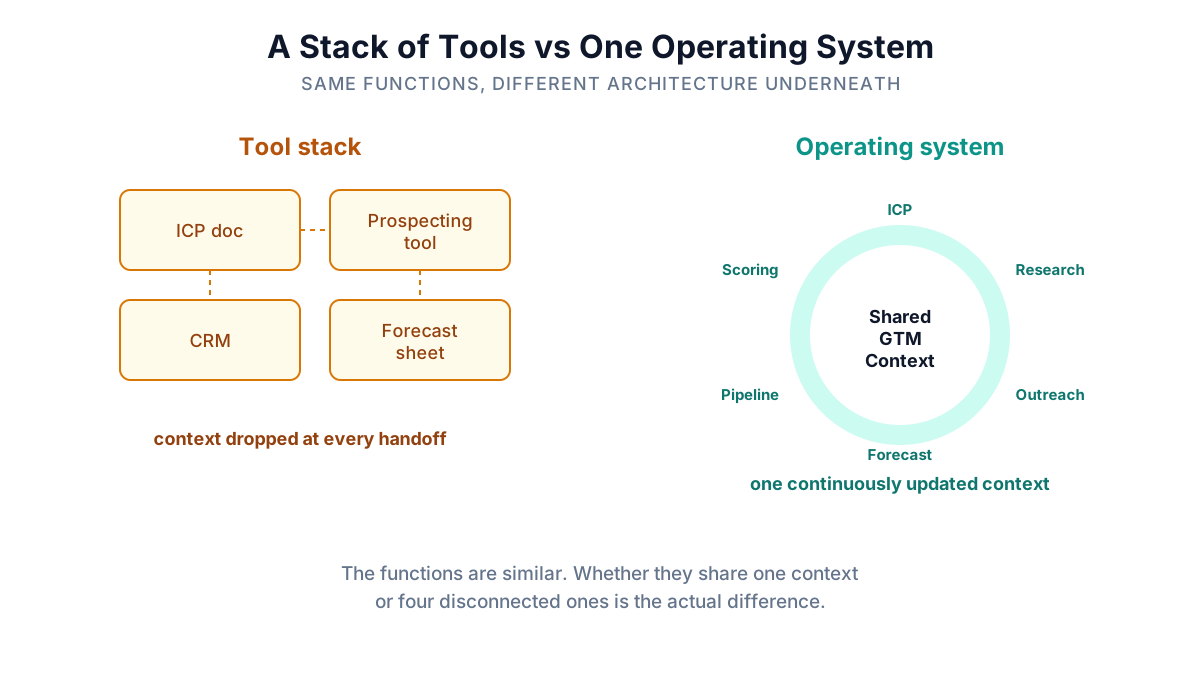
Every gap between two tools gets filled by a person. Somebody reads the research and decides what matters. Somebody translates the positioning into a sequence. Somebody exports a list, cleans it, and loads it into another system. Somebody reconciles the number in the CRM with the number that ended up in the board deck. Each of those people is copying and reinterpreting, and each copy is a small chance for something to be dropped or quietly reworded on the way through.
So the account insight that would have made an email land never reaches the email. The reason a deal was disqualified never reaches the definition of who gets targeted next. The objection that came up in six calls last month is known to the six reps who heard it and to nobody else.
What makes this so durable is that it never announces itself. There is no error message and no missed deadline. Each stage simply performs a little worse than it should, and those small losses compound in a way that is very hard to trace back to any single cause. That is why companies tolerate the arrangement for years, far longer than they would put up with a problem that made noise.
The human integration layer
Engineers have a name for the code that moves data between systems: the integration layer. In most GTM stacks, the integration layer is a human being. It might be a RevOps lead, a sales operations analyst, a marketing manager with a talent for spreadsheets, or a founder who never quite handed the job off. Whoever it is, a large share of their week goes to moving information from where it was produced to where it is needed, and to translating it a little on the way.
This costs more than it appears to, and the cost hides well. It doesn't show up as a line item. It shows up as a smart person spending Tuesday afternoon on formatting. It also creates a single point of failure. When that person takes two weeks off, or leaves, the connective tissue of the whole motion goes with them, and the company discovers how much of its GTM lived in one person's habits.
A small illustration
Here is a hypothetical, but it will sound familiar. A rep is on a late-stage call with a prospect who ultimately chooses a competitor. The stated reason is a specific integration gap. The rep logs the deal as "Closed Lost, Competitor" and moves on to the next call, because that is what the CRM has a field for.
A quarter later, marketing revises the messaging. The people doing it have never seen that call and have no reason to open a closed-lost record. Sixty days after that, the team is still targeting accounts that depend on the missing integration, still positioning against that competitor in the same way, and still losing the same deals for the same reason.
Nobody made a mistake here. Every person did their job. The information simply had nowhere to go, because the stack was designed to store what happened and never to route what it meant.
Why adding another tool doesn't help
The instinctive fix is to buy something for each gap. It rarely works, because each new tool adds another boundary, and boundaries are where the loss happens. Point-to-point integrations move fields, not meaning. A sync can copy "Closed Lost, Competitor" from one system to another with perfect fidelity, and the meaning still fails to arrive, because the meaning was never in the field to begin with.
How the Stack Got This Way
It helps to see how these stacks came to look the way they do, because nobody designed them. They accumulated.
The CRM came first, and it was built to be a system of record. Its job is to answer questions about the past and the present: who owns this account, what stage is this deal in, when did we last speak. That is a valuable job, and it is still the right job for a CRM to have.
Then came the point tools. Enrichment, sequencing, intent data, conversation intelligence, forecasting, each aimed at one motion and each easy to buy, because each solved a visible problem for one team with one budget owner. No single purchase looked like a bad decision. The stack grew the way a house grows when every year someone adds a room without looking at the plans.
Then came automation, which added rules. If a lead does this, do that. Automation is excellent at repetition, and it is the reason a small team can send thousands of emails a week. Its limitation is that a rule can only do what it was told, against the world as it looked on the day it was written. Automation has no way to notice that the world changed.
What is different now is that models can read, summarize, weigh, and draft at a level that used to require a person. That matters because reading, synthesizing, and deciding what is relevant is precisely the work that people have been doing in the gaps. For the first time, it is realistic to hand that work to something that runs continuously.
Which leaves a choice. A company can attach that capability to each existing tool separately, in which case it gets a slightly smarter version of the same disconnected stack. Or it can rebuild the connective layer itself around that capability, in which case it gets something that behaves differently in kind. The second option is what "operating system" is meant to describe.
The Six Layers, Running as One Loop
A complete GTM motion is not one thing. It is six connected layers, and most of the value of an operating system comes from how tightly those layers stay connected, not from how sophisticated any single layer is in isolation.
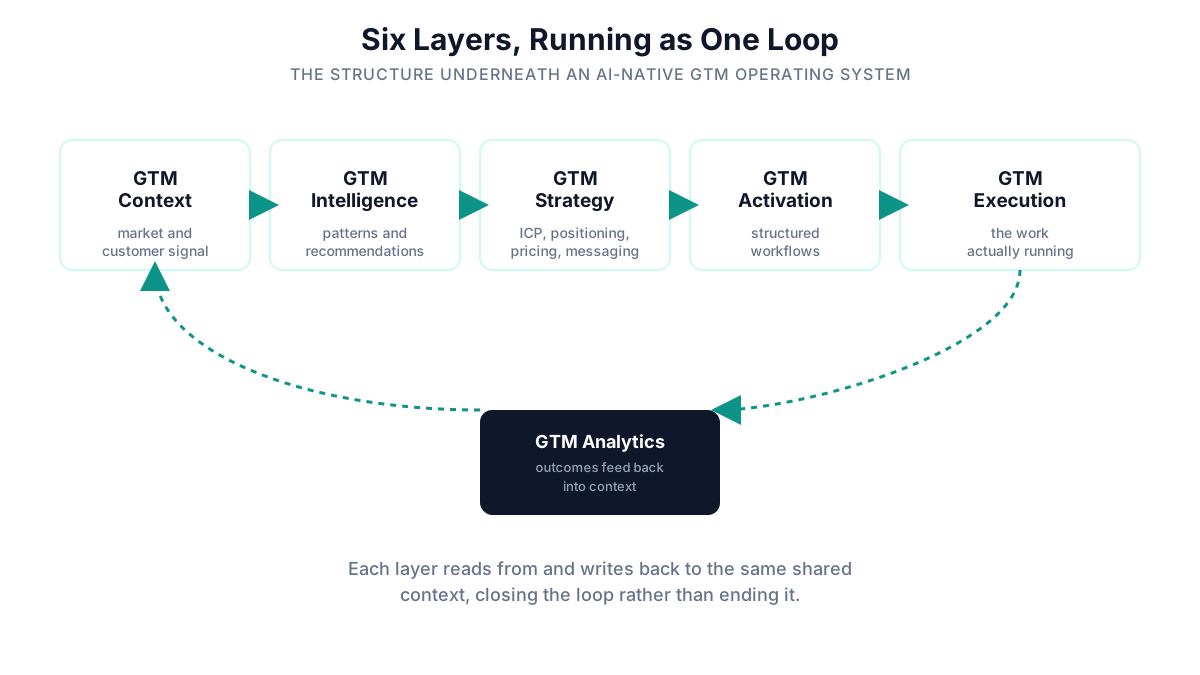
The six layers at a glance
01 — GTM Context
The shared, continuously updated picture of the market, customer, and competitive landscape.
02 — GTM Intelligence
Patterns and recommendations synthesized from that context.
03 — GTM Strategy
ICP, positioning, messaging, and pricing defined from intelligence.
04 — GTM Activation
Strategy turned into structured, executable workflows.
05 — GTM Execution
The work actually running across channels and cadence.
06 — GTM Analytics
Outcomes fed back into context, closing the loop.
The important part is the loop. The six layers are useful individually, but the operating-system behavior comes from what happens when each layer can read from and contribute back to the same shared context.
Each layer deserves a closer look, because the details are where the idea either holds together or turns into a slogan.
GTM Context
Context is the shared, continuously updated picture of the market, the customer, and the competitive landscape. It includes the obvious things, such as who the potential buyers are and what they look like on paper. It also includes what customers say and do, how competitors position and price themselves, and the company's own history: which deals were won, which were lost, and for what reasons.
Two words in that description carry most of the weight. The first is "shared." Context that lives in one team's tools is just that team's notes. The second is "continuously." A market picture refreshed once a year is a report, and reports go stale the day after they are published.
The form matters too. Context stored as a folder of PDFs can be read by a person but cannot be queried by another layer. Context stored as structured, connected data can be used by everything downstream without anyone re-reading it. Every other layer inherits its quality from this one, so this is where the investment pays back most often.
GTM Intelligence
Intelligence turns context into patterns and recommendations. Which segments close faster. Which events tend to come before a purchase. Which objections cluster around which roles. Where a particular competitor keeps winning and what the winning accounts have in common.
Every company already does some version of this. It happens when someone reads a few things, forms a view, and puts it in a deck. The trouble is that the result depends on who did the reading, what else was on their plate that week, and which sources they happened to open. Two analysts given the same question will often return two different answers, and neither can fully explain why.
Moving this into a dedicated layer makes the synthesis repeatable. It also makes it inspectable, which matters more than it sounds. A recommendation that arrives with the evidence behind it can be checked, challenged, and corrected. A recommendation that arrives as a confident paragraph cannot.
GTM Strategy
Strategy is where the ideal customer profile, positioning, messaging, and pricing get defined, drawing on what intelligence found rather than on whoever last held the pen on the last version of the deck.
This is the layer most stacks handle worst, mostly because strategy has always lived in documents. A positioning document is written once, circulated, and then slowly drifts away from the reality it was meant to describe, while everything built from it carries on as if nothing changed.
In an operating system, strategy is a set of structured decisions that other layers read directly. If the definition of the ideal customer changes, scoring and targeting change with it, without anyone having to remember to update six other places. Strategy is also the layer where human review matters most, for reasons covered later in this piece.
GTM Activation
Activation is the layer most companies don't have a name for, and it is the one that most stacks lack entirely.
Between "we decided to sell to mid-market fintech with this message" and "an email went out" there is a surprising amount of work. Which accounts count. Which contacts at those accounts. Which channel, in what order, with what cadence. What triggers a follow-up. What happens when someone replies, and what happens when they don't.
In most companies that work is done by hand, by whoever runs operations, in a long afternoon. It decays quickly, since every strategic adjustment means someone has to redo a piece of it. Activation as a layer turns those decisions into structured workflows that can be adjusted when the strategy is adjusted, rather than rebuilt.
GTM Execution
Execution is the work actually running, in the channels and at the cadence that activation defined. Research, outreach, follow-up, scheduling, logging, reporting.
This is where existing tools are strongest, and it is where the AI-enabled products tend to concentrate. What separates execution inside an operating system is that it doesn't operate independently of everything else. It draws on the same context as the layers above it, and it reports what happened in a form the system can learn from, rather than as a log that a person has to read and interpret later.
GTM Analytics
Analytics closes the loop. What happened during execution feeds back into context, so the next cycle begins from evidence.
That is different from a dashboard. Dashboards are for people to look at, and they have their place. The point of this layer is that outcomes change what the system believes. If reply rates in one segment come in well below expectation, that should alter the intelligence layer's read of where to focus, which should alter strategy, which should alter activation. Without the loop, each function keeps its own version of events. Sales believes one thing about why deals stall, marketing believes another, and the two versions never meet.
Where stacks hold up and where they don't
Most GTM stacks cover context and execution reasonably well, since those are the two layers a CRM and a sequencing tool were built for. Strategy, activation, and the feedback loop back into context are where most stacks quietly fall apart, held together by whoever remembers to update the deck this quarter.
It also explains why "loop" is the right word and "pipeline" is the wrong one. A pipeline runs in one direction and ends. A loop keeps going, and each pass through it starts from a better position than the last.
What Makes It "Native" Rather Than "Enabled"
Almost every GTM tool sold today claims some AI capability, and the label alone tells a buyer very little. The distinction that counts is architectural. It has nothing to do with a feature checklist.
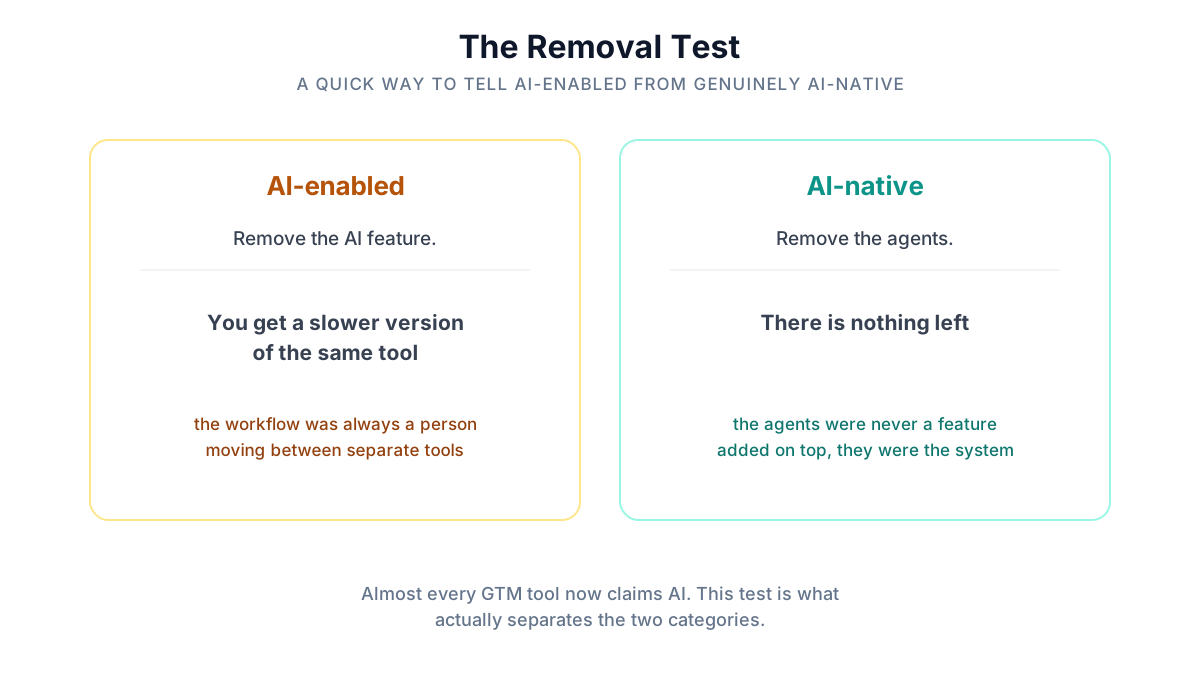
AI-enabled means a traditional tool with intelligence added at the edges. A CRM that now summarizes a call. A sequencer that now rewrites a subject line. These are real improvements, and some are very good. The underlying workflow, though, is unchanged: a person still moves between separate systems, and the AI helps with one small step along the way.
AI-native means the connective tissue itself is the intelligence layer. The ideal customer profile is not a document that a person writes and a model occasionally reads. It is a structured, shared object that every other layer queries directly. Scoring reads it, messaging reads it, and channel selection reads it. When it changes, they all see the change.
The removal test
There is a practical way to tell the two apart. Take the AI feature out of an AI-enabled tool, and what remains is a slower version of the same tool. It still stores contacts, still sends sequences, still shows a pipeline. Nothing structural has been lost.
Do the same to something that is truly AI-native and there is nothing functional left, because that layer was never a feature bolted onto the system. It was the system. The agents were doing the research, holding the context, carrying decisions from one stage to the next. Take them away and the parts no longer connect.
Questions worth asking any vendor
Vendors are usually happy to describe themselves in the most flattering terms available, so the useful move is to ask questions that are hard to answer with a slogan.
- If the AI features were switched off tomorrow, what would still work, and what would stop?
- Where does the ideal customer profile live, and can other parts of the product query it directly, or does someone have to paste it in?
- When a deal is lost, where does the reason go, and what changes as a result?
- What happens between a strategic decision and the first message that goes out? Who or what does that work?
- Which actions run without approval, which require it, and who decided the line?
A good answer to these will be specific and a little unglamorous. A vague or inspirational one usually means the architecture underneath is a stack with a nicer front door.
A note on fairness
None of this means AI-enabled tools are bad. A strong point solution can outperform one layer of a broader system at a narrow task, and plenty of companies will be well served by a handful of good tools and a disciplined operator. The argument here concerns how the pieces connect. It makes no claim that a connected system beats a great specialist at that specialist's own job.
Autonomous Does Not Mean Unsupervised
Any GTM system that claims to run without human oversight should raise a flag before it inspires confidence. The workable model draws an explicit line between what runs continuously and what waits for a person.
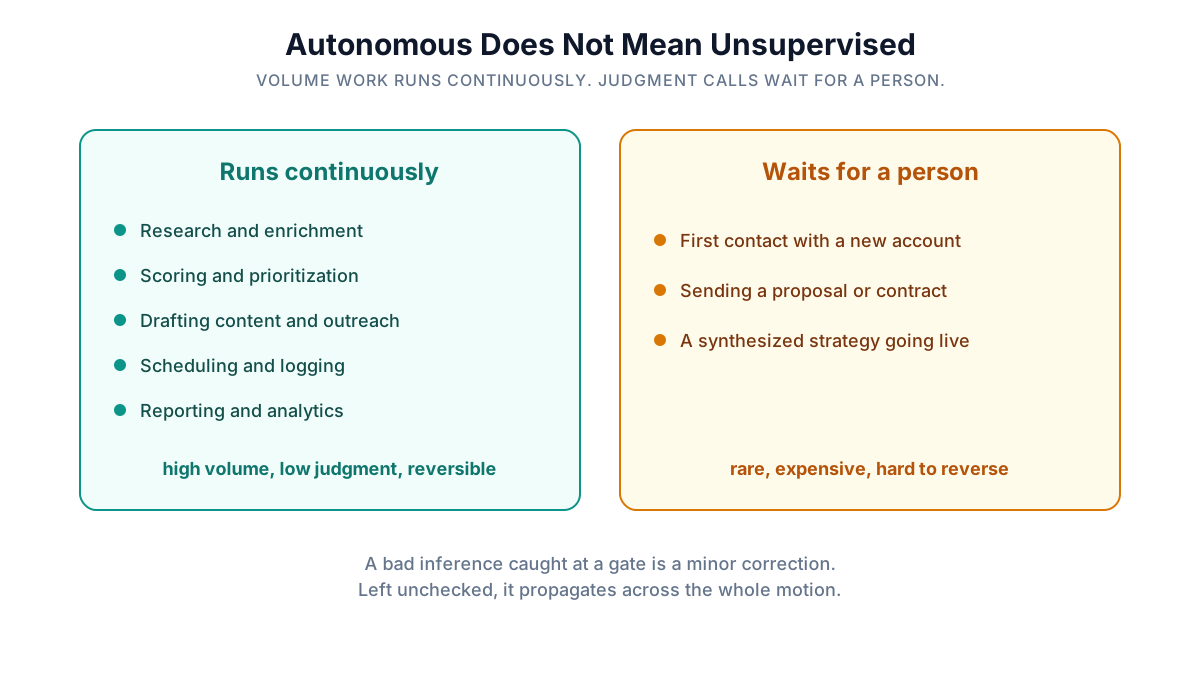
Research, scoring, drafting, scheduling, logging, and reporting are volume problems. They are repetitive, they are tedious at scale, and an error in any one instance is small and easy to correct. A well-built system runs all of them continuously and doesn't need a person to trigger each one.
Deciding whether to pursue an account, what a proposal actually promises, and what goes into a signed contract are judgment problems. They stay with a person because the cost of being wrong is high and the decision is hard to unwind.
How to decide where the gates go
In practice, four questions sort most decisions into one bucket or the other.
How reversible is it? A draft that never leaves the system costs nothing to discard. A message already sitting in a prospect's inbox cannot be recalled.
What does a mistake cost? A mis-scored lead wastes a few minutes. A misjudged promise in a proposal can cost a quarter's margin on a deal.
Who sees it? Internal work has room for error. Anything customer-facing carries the company's name and reputation with it.
Does it involve a relationship or a commitment? Anything touching trust, negotiation, or legal terms belongs to a person, since those are exactly the places where nuance decides the outcome.
Work that scores low on all four can run freely. Work that scores high on any of them should wait for approval.
The strategy layer gets a gate too
The same logic applies to strategy itself. A synthesized recommendation should be reviewed by a person before it becomes the version every other layer is working from. The reason is propagation. An unreviewed error in a single email is one bad email. An unreviewed error at the strategy layer doesn't stay contained. It flows into scoring, into messaging, into every activation and execution decision built on top of it, and by the time anyone notices, a large amount of work has been done against a wrong premise.
Gates only work if they are real
Two failure modes are worth naming. The first is the gate that exists on paper only. If the reviewer can't see the evidence behind a recommendation, or if rejecting it takes more effort than approving it, the review becomes a formality. A person who clicks approve on everything is not a control.
The second is the opposite mistake: so many approvals that people stop reading them. A system that asks for sign-off on every small action trains its users to click through, and then the one approval that mattered gets the same half-second of attention as the rest. Approvals should be rare enough that each one carries weight.
It is also reasonable for the line to move over time. A team might begin with approvals on a wide range of actions and loosen them deliberately as the system builds a track record. What shouldn't happen is drift, where the gates quietly erode because nobody was watching. Changes to what runs without approval should be a decision someone made on purpose.
What Actually Changes Once It's One System
Three things shift when the six layers run as a connected loop instead of six separate initiatives.
Context stops leaking. The reason a deal was disqualified reaches the definition of who gets targeted next, automatically, instead of sitting in a rep's memory until somebody happens to ask. Revisit the earlier hypothetical: in a connected system, the integration gap behind a lost deal becomes evidence. It informs the intelligence layer, which surfaces the pattern, which prompts a decision about targeting or positioning. The loss still happened, but it starts to pay for itself.
Consistency stops depending on effort. The hundredth account gets the same depth of research as the first, because it is a process running the same way every time. It is no longer a favor a motivated person did once and never repeated. Anyone who has watched account research quality vary with the time of the quarter, or with who was assigned, will recognize how much this changes.
People move up the stack. Hours that used to go toward reading through scattered tabs and manually reconciling three different pipeline numbers go toward the decisions that needed judgment all along.
What this looks like by role
The effect is not the same for everyone. The common shift is from moving and reconciling information toward defining, reviewing, and deciding.
The effect isn't the same for everyone, and it is worth being concrete about it.
For revenue operations, the shift is from maintaining plumbing to owning definitions. The question stops being "why don't these two numbers match" and becomes "is our definition of a qualified account still right." That is a more interesting job, and a more valuable one.
For sellers, it is mostly about preparation and follow-through. The research that used to be skipped when the calendar was full is already done, and the notes that used to disappear into a CRM field go somewhere they can be used.
For marketers, it means messaging that can be checked against what is happening in deals, rather than against internal opinion. That takes some of the guesswork out of a discipline that runs on a lot of it.
Where These Efforts Go Wrong
Adopting an operating system is not automatically a success, and the ways it goes wrong are fairly consistent.
Buying a relabeled stack. The most common failure is purchasing a set of point tools under a single brand, with a shared login and a unified dashboard, and calling it a system. The removal test and the vendor questions above are the defense against this. If context still has to be carried by hand between modules, the integration layer is still a person.
Automating a vague definition faster. A system can execute a fuzzy ideal customer profile at enormous speed, and that is worse than doing it slowly. If the company hasn't decided who it is selling to, the system will produce a great deal of activity aimed at the wrong people. Speed magnifies whatever it is pointed at.
Granting autonomy before earning trust. Turning everything on at once, with no approval gates, is a good way to find out what the system gets wrong in front of customers. Trust should be built the way it is with a new hire, with more review early and more latitude as evidence accumulates.
Having no owner. A system that spans strategy, activation, execution, and analytics touches every function, which means it belongs to no function by default. Somebody needs to be accountable for the shared definitions, and for deciding when they change. Without that, the shared source of truth becomes another place where things go out of date.
Measuring activity instead of outcomes. More emails sent, more accounts researched, and more meetings booked are easy to count and easy to celebrate. They are also easy to inflate. The measures that matter are the ones further down the funnel, and the analytics layer is only useful if the team is willing to let it say that something isn't working.
Where to Actually Start
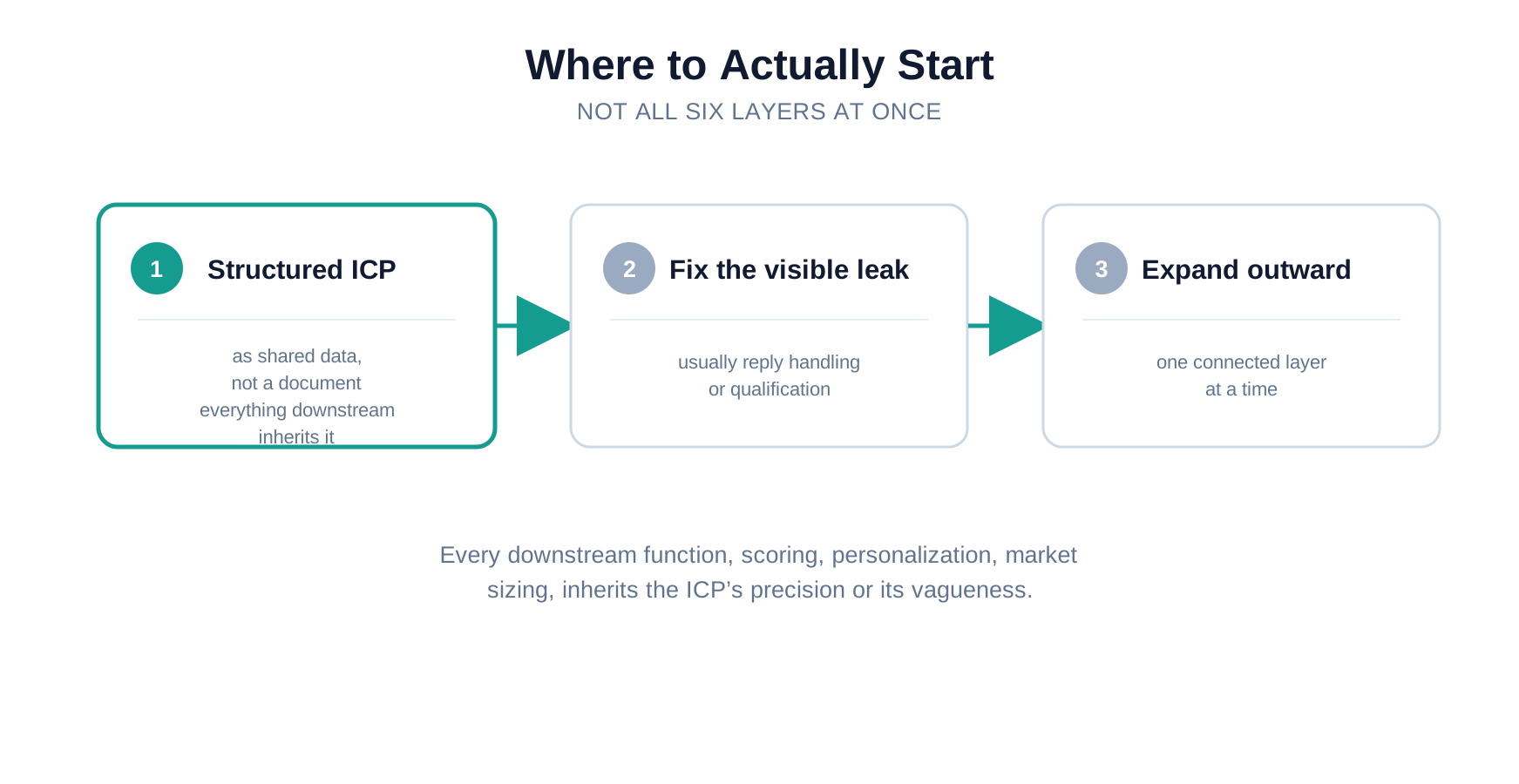
Nobody builds all six layers on day one, and trying to is usually how these initiatives stall before they produce anything usable.
Begin with a structured ICP
Start with a structured ideal customer profile, defined as shared data that every downstream function can query, not as a slide deck a person has to interpret.
Every other layer, whether scoring, positioning, messaging, or channel selection, inherits its precision or its vagueness directly from this starting point. That makes it the single highest-leverage place to get things right first, and it is far cheaper to fix here than to discover the problem several layers later.
What does "structured" mean? Here is an illustrative example of the shape it might take. The specifics will differ for every company, and the fields are invented for the sake of the example.
Example: a structured ICP
Mid-Market Fintech
| Dimension | Example |
|---|---|
| Company size | 200–1,000 employees |
| Regions | North America · UK |
| Qualifying signals | Recent funding round · Hiring for compliance roles |
| Disqualifiers | No dedicated engineering team · Contract length under 12 months |
| Buying committee | Head of Operations · CFO · Security Lead |
| Evidence | Closed-won analysis · Last four quarters |
| Last reviewed | July 15, 2026 |
| Owner | Revenue Operations |
The important point is not the specific fields. It is that the ICP is represented as structured, reusable context rather than as a slide that another person has to interpret.
Under the hood: what this could look like as structured data
icp:
  name: mid-market-fintech
  firmographics:
    employee_range: 200-1000
    regions: [north-america, uk]
  qualifying_signals:
    - recent funding round
    - hiring for compliance roles
  disqualifiers:
    - no dedicated engineering team
    - contract length under 12 months only
  buying_committee: [head-of-operations, cfo, security-lead]
  evidence:
    source: closed-won analysis, last four quarters
  last_reviewed: 2026-07-15
  owner: revenue-operations
The individual fields matter less than three properties of the whole. It is written in a form other layers can read directly, so nobody has to translate it. It states what disqualifies an account as well as what qualifies one, which is where a lot of wasted effort hides. And it carries its own evidence, a review date, and an owner, which are the things that keep a definition from quietly going stale.
Then fix the most visible leak
From there, pick whichever stage currently has the most visible and most frequently discussed leak. In many companies that turns out to be reply handling or qualification, the places where good leads most often stall or get dropped without anyone deciding to drop them.
Choosing the loudest problem is an easy argument to win, because everyone involved already agrees the problem exists. A fix at that stage, connected to the ICP, produces evidence that flows back into the system. That is the first turn of the loop, and it persuades better than any diagram.
Expand one layer at a time
Once a single connected slice is working, extend outward, one layer at a time, always keeping what has been built connected to the shared context. The order will depend on where each company's pain is greatest. What matters is that every addition is wired to the same source of truth, since a layer added without that connection is just one more tool in the stack.
A useful check at every step: can the new piece read from and write back to the shared context without a person in between? If the answer is no, the loop hasn't closed yet.
Frequently Asked Questions
Is an AI-native GTM operating system the same as a CRM? No. A CRM is a system of record. It stores what happened. An operating system is a system of action. It decides and executes what happens next. It typically syncs with the CRM rather than replacing it outright, and the CRM remains the place where the official record of accounts, contacts, and deals lives.
How is this different from marketing or sales automation? Automation typically covers one motion, such as sequencing outreach or triggering a workflow, within a single stage, and it follows rules someone wrote in advance. An operating system covers the full lifecycle from context through analytics, with every stage sharing the same underlying data. It can also adjust as that data changes, where a rule-based workflow keeps doing what it was told.
Does this replace the people currently doing GTM work? It replaces the research-and-reconciliation portion of the work, not the judgment. The approval gates described earlier keep a person on the decisions where relationship and judgment determine the outcome. In practice, the job shifts toward defining, reviewing, and deciding, and away from gathering and copying.
What is the first thing worth implementing? A structured ICP. It is the input every other layer inherits from, and getting it right first is considerably cheaper than discovering, several layers downstream, that scoring and messaging were both built on a vague or outdated definition of who the company is selling to.
Does a company need to replace its entire existing stack to adopt this? Not necessarily. Many operating systems connect to and sit above existing tools rather than requiring a full replacement, provided there is a genuine shared source of truth those tools can reference, instead of each one holding its own disconnected fragment of the picture.
How long does it take to see results? It varies too much between companies to quote honestly. What is reliable is the shape. Starting with one structured definition and one connected slice produces something you can evaluate quickly, whereas attempting a full rollout tends to postpone the first useful result indefinitely. The narrower the first scope, the sooner the evidence arrives.
Who should own it? Someone who sits close to the definitions and has the standing to change them, which in many companies means revenue operations or a GTM lead with cross-functional reach. The specific title matters less than the fact that a named person is accountable for the shared context. A system with no owner slowly reverts to being a collection of tools.
Where Elevate Fits
The framework above is intentionally broader than any one vendor. The useful question is whether a platform actually behaves this way when you look underneath the marketing language.
Elevate GTM Solutions is built as exactly this kind of system: an AI-native GTM platform and GTM operating system that connects GTM Context, Intelligence, Strategy, Activation, Execution, and Analytics into one continuously running loop, rather than a set of features layered onto a CRM built for a different job.
Its evidence base is gathered broadly across many sources rather than one or two reports. Its reasoning runs through a structured synthesis process rather than a single unreviewed model call. And the same human review discipline described above, in which a synthesized strategy gets reviewed before it becomes the version every other layer runs against, is built into how it operates from the start, not added as an afterthought once something has already gone wrong.
None of this makes the underlying category any less early. What separates a real operating system from a relabeled tool stack is still the test this piece opened with: does removing the intelligence layer leave a slower version of the same product, or does it leave nothing at all? That test applies to Elevate exactly as it applies to any other platform claiming this category, and it is the question worth asking before taking any vendor's description of itself, including this one, at face value.