
AI GTM Platform for B2B SaaS
B2B SaaS runs two GTM motions at once, product-led signal and sales-led execution, on top of a product that ships changes weekly. Here is why generic GTM software struggles with that specific rhythm, and what an AI GTM platform needs to do differently for SaaS.
Published 2026-07-31
A VP of growth at a Series C SaaS company describes the same recurring pattern every quarter: the product team ships a meaningful new capability, competitors notice and reposition within weeks, the company's own messaging and battlecards lag two or three months behind, and by the time sales enablement catches up, the market has already moved again. None of this is a failure of any individual team. Product is shipping on schedule. Sales is executing the plays it has. The problem is that the GTM motion itself, the strategy, positioning, and priorities underneath those plays, updates on a slower cycle than the product and the market around it.
This is a specifically B2B SaaS problem, more acute here than in most other categories of business, because B2B SaaS combines a handful of pressures that rarely all show up together elsewhere: a product that changes continuously rather than on a multi-year cycle, a GTM motion that usually blends product-led signal with sales-led execution rather than relying on just one, a competitive landscape where a rival can copy a feature and reposition around it within a single sprint, and a revenue model where expansion and retention matter as much as new logo acquisition. This piece looks specifically at why generic GTM software, built for a slower, more linear kind of business, struggles with this rhythm, and what an AI GTM platform needs to do differently to actually fit how B2B SaaS companies operate.
This is not a claim that B2B SaaS is harder to sell than other categories in some general sense. It is a more specific claim about pacing: the rate at which the underlying facts a GTM motion depends on, who the best customer is, what the strongest competitive angle is, what the product actually does today, changes faster in B2B SaaS than in most adjacent categories, and a GTM system built around a slower cadence of change will systematically lag behind a market moving at this pace, regardless of how skilled the team operating it is.
Why B2B SaaS GTM Is a Different Problem
Most GTM software, and most GTM thinking more broadly, was built around an implicit assumption: a company sells a relatively stable product into a relatively stable market, and periodic strategy reviews are frequent enough to keep pace with how quickly things actually change. B2B SaaS breaks that assumption in several specific, compounding ways.
The product itself changes continuously. A SaaS company shipping meaningful product updates weekly or biweekly is not unusual, and each of those updates can shift who the ideal customer actually is, what the strongest competitive angle looks like, and which messaging still accurately describes what the product does. A positioning document written at the start of a quarter can be measurably out of date by the time that quarter ends, not because anyone did anything wrong, but because the product it describes has changed underneath it. This is a meaningfully faster rate of underlying change than most B2B categories selling physical goods or longer cycle services experience, where the core product offering itself typically holds steady for much longer stretches between meaningful updates.
The GTM motion itself is usually hybrid, not singular. Most B2B SaaS companies run some combination of product-led growth, where usage and trial behavior generate signal and qualify accounts, and sales-led execution, where a team runs a more traditional, multi-touch process for larger accounts. These two motions generate genuinely different kinds of signal, in-app usage and feature adoption on one side, deal activity and stakeholder engagement on the other, and few GTM tools were built from the outset to unify both into a single, coherent picture of an account. A tool built primarily around one motion often treats the other as an afterthought, which becomes a real limitation for the many SaaS companies running both simultaneously, sometimes for the same product across different customer segments.
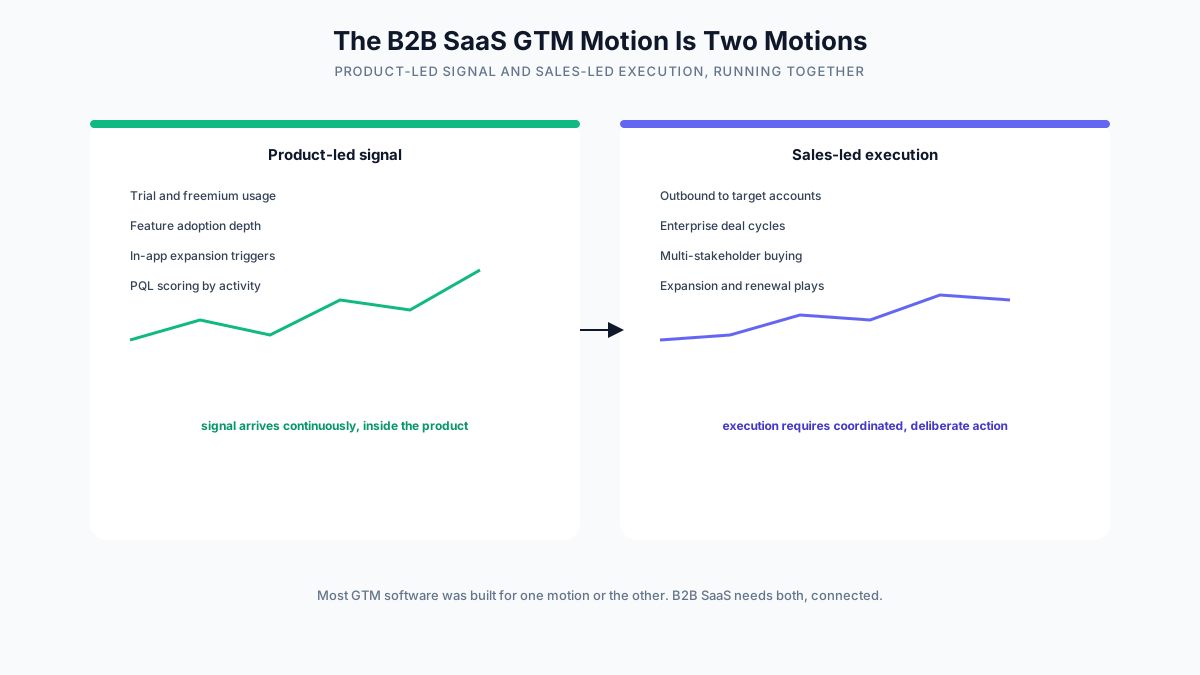
Competitive dynamics move unusually fast. Because software features can be copied and shipped quickly, and because SaaS categories tend to be crowded with well funded competitors, a positioning advantage can erode within weeks of a competitor's product update or repositioning, far faster than the quarterly review cycle most companies still use to revisit their own messaging. A feature that differentiated a product meaningfully in January can be table stakes across the entire competitive set by March, and a GTM motion still messaging around that now-commoditized differentiator is not just missing an opportunity, it is actively presenting a weaker case than the facts on the ground would support.
And the revenue model itself weights expansion and retention as heavily as new acquisition. Net revenue retention is a headline metric for most B2B SaaS companies specifically because a subscription model makes the ongoing health of existing accounts as financially significant as closing new ones, which means a GTM motion that only optimizes for new logo acquisition is optimizing for less than half of what actually determines the business's growth trajectory. A dollar of expansion revenue from an existing account is, in most SaaS unit economics, considerably cheaper to generate than a dollar of new logo revenue, which makes underinvestment in expansion and retention signal a particularly costly blind spot relative to how much attention it typically receives compared to acquisition.
Where the Cracks Show Up First
These structural pressures do not stay abstract. They show up as specific, measurable metrics quietly drifting in the wrong direction, often before anyone connects the drift back to its actual cause.
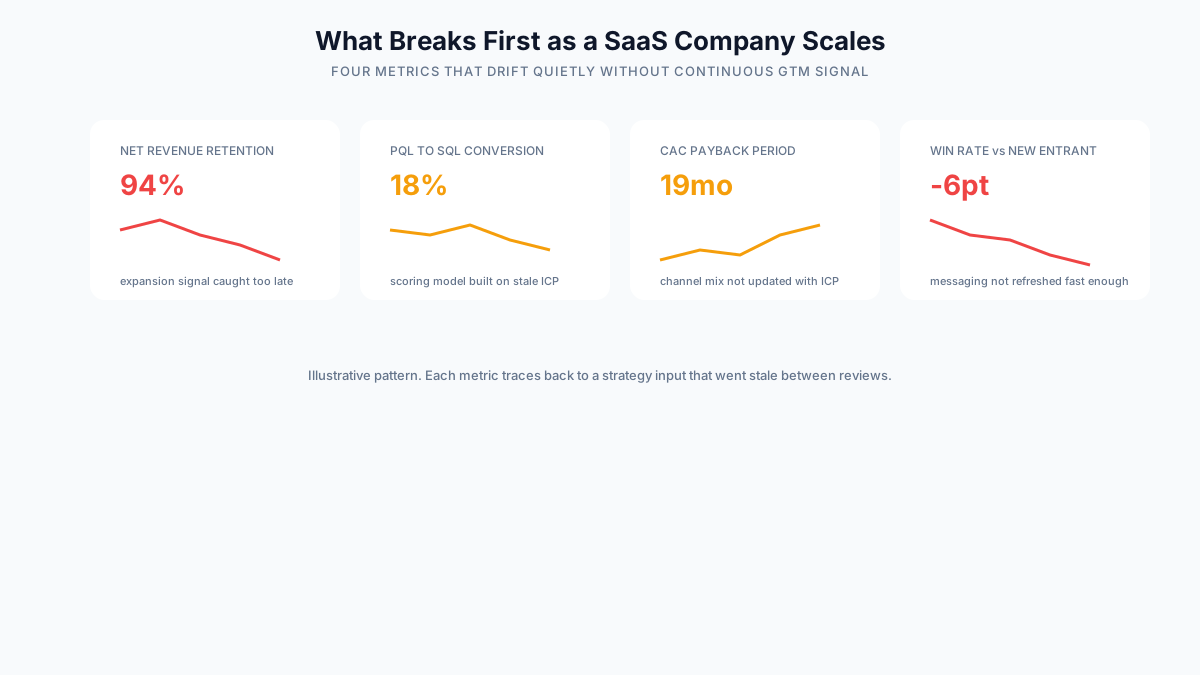
Net revenue retention erodes when expansion signal, a customer's usage pattern indicating readiness for a higher tier, does not reach the right person in time to act on it, a gap this content series has described elsewhere as one of the more costly and least visible forms of strategic drift. This kind of erosion is particularly insidious because it happens gradually, a handful of missed expansion opportunities and slightly higher churn each quarter, none individually alarming, until the cumulative effect shows up as a clearly declining trend that takes real effort to reverse.
PQL to SQL conversion declines when the scoring model qualifying product usage as sales ready is still built around an ICP that no longer matches who is actually converting, a common consequence of the ICP drift problem covered in more depth elsewhere in this series. In a hybrid motion specifically, this often shows up as a widening gap between which accounts the product-led scoring model flags as qualified and which accounts the sales team's own experience suggests are actually worth pursuing, a disagreement that erodes trust in the scoring system itself over time.
CAC payback lengthens when channel mix and spend allocation are not kept current against which channels are actually converting the current, real ICP rather than the one defined at the start of the year. Because paid acquisition channels in particular can shift in cost and performance quickly, sometimes due to factors entirely outside a company's control like a platform's algorithm change, a static channel allocation set once per quarter is especially vulnerable to this specific kind of drift in a fast moving digital category like B2B SaaS.
And competitive win rate slips when messaging has not been refreshed fast enough to address a new entrant's repositioning, exactly the kind of drift a quarterly review cycle catches too slowly in a market moving at SaaS speed. This is often the most visible and most painful symptom on this list, since a lost deal attributed to a competitor's fresher positioning is a specific, discussable event in a way that gradual retention erosion or lengthening payback periods are not, which sometimes means it gets disproportionate attention relative to the other three metrics even though all four typically share the same underlying cause.
Each of these metrics is a lagging indicator. By the time a leadership team notices the number moving in a dashboard, the underlying strategic drift that caused it has usually been compounding for weeks or months already, which is precisely the gap a continuously updated GTM motion is built to close before it shows up as a damaged metric in the first place.
What an AI GTM Platform Needs to Do Differently for SaaS
Given these specific pressures, an AI GTM platform built for B2B SaaS needs to prioritize a few capabilities that matter less in slower moving categories.
Multi-motion ICP tracking. Because B2B SaaS typically runs both product-led and sales-led motions, an effective platform needs to track ICP and account scoring separately for each, since the profile of an account converting well through a self-serve trial can differ meaningfully from the profile converting best through an enterprise sales process, and collapsing both into a single scoring model tends to produce worse recommendations for both motions than tracking them separately would. A platform that genuinely supports this distinction can also surface a valuable, less obvious insight over time: whether a given account or segment is better served by one motion or the other, which is itself a strategic decision most companies currently make through intuition rather than through systematic, ongoing evidence.
Continuous competitive intelligence. Given how quickly SaaS competitors can reposition around a shipped feature, a platform that only refreshes competitive intelligence on a quarterly cadence is structurally too slow for this category. Continuous ingestion of competitor pricing pages, release notes, and public messaging, feeding directly into positioning and sales enablement updates, is considerably more valuable in SaaS specifically than in categories where competitive dynamics shift more slowly. This capability matters most precisely at the moments it is hardest to remember to check manually, immediately after a competitor's product launch or a funding announcement that changes their go to market posture.
Expansion and renewal signal, not just acquisition signal. Given how much of SaaS growth comes from net revenue retention, a platform focused only on new logo acquisition signal is missing roughly half of what actually drives the business. Genuine capability here means synthesizing usage, support, and engagement signal continuously enough to flag expansion readiness or churn risk while there is still time to act on it, not simply reporting a churn event after it has already happened, which is closer to a post-mortem than an actionable signal.
Pricing and packaging that keeps pace with product changes. As a SaaS product adds tiers, features move between plans, or usage based pricing components get introduced, pricing strategy guidance needs to stay current with those changes rather than describing a packaging structure the product team has already moved past. A pricing page that undersells recently shipped value, or a packaging structure that creates confusing overlap between tiers, both quietly cost revenue in ways that rarely get traced back to their actual cause, a pricing strategy function that fell out of sync with an evolving product.
Sales enablement generated from current context, not a quarterly refresh. Given how quickly both product and competitive context change in SaaS, sales enablement content that goes stale between scheduled refreshes actively works against a sales team, since reps repeating outdated claims or missing a recent competitive development lose credibility with increasingly well informed buyers, particularly buyers who may themselves have used an AI research tool to check a claim before the call even started, a dynamic covered in more detail elsewhere in this content series regarding agent mediated buyer research.
| Capability | Why it matters more in B2B SaaS specifically |
|---|---|
| Multi-motion ICP tracking | PLG and sales-led motions convert genuinely different profiles |
| Continuous competitive intelligence | Competitors reposition around shipped features within weeks |
| Expansion and renewal signal | Net revenue retention is as important as new acquisition |
| Pricing and packaging alignment | Tiers and packaging shift as the product itself evolves |
| Continuously current sales enablement | Stale claims cost credibility with informed SaaS buyers |
The SaaS Flywheel Needs the Same Loop
The classic SaaS growth flywheel, acquisition, activation, expansion, renewal, and advocacy, is itself a description of a continuous loop, and it is worth noticing how directly it maps onto the Continuous GTM Loop framework this content series has described elsewhere.
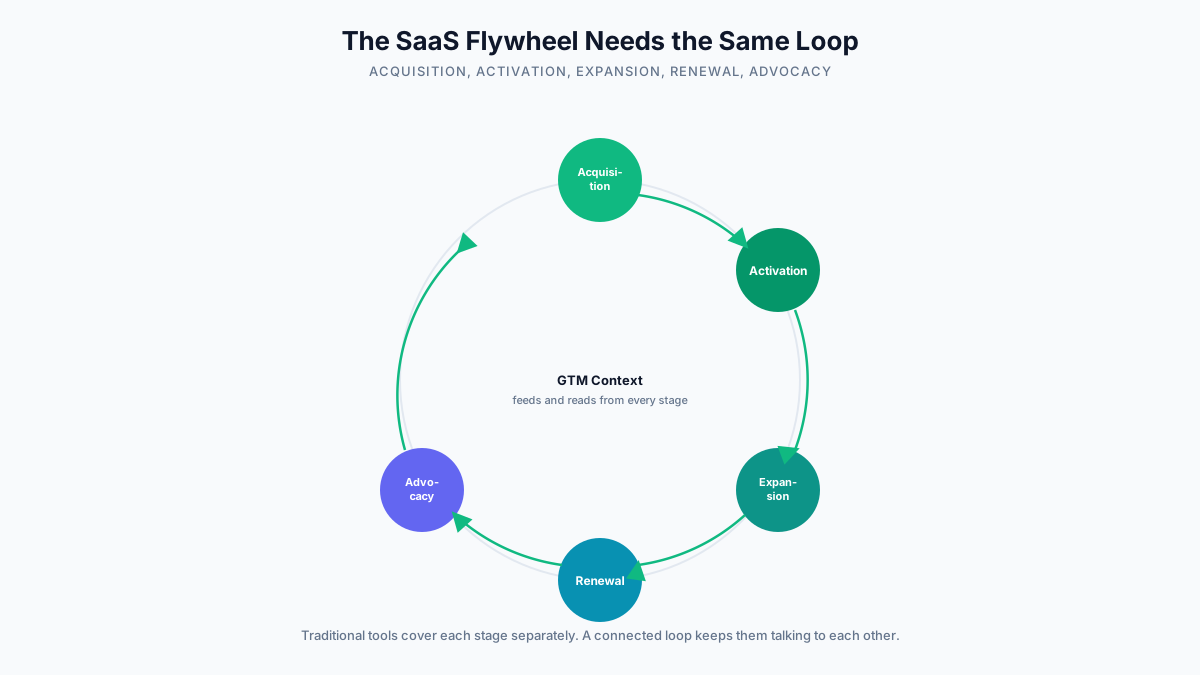
Most GTM tooling covers each flywheel stage with a separate, disconnected tool: an acquisition focused marketing platform, a product analytics tool for activation, a customer success platform for renewal, an advocacy or reference management tool for the final stage. Each of these tools can be genuinely strong within its own stage, and the gap this piece has described throughout shows up specifically in the connections between them, an activation insight that never reaches the team responsible for expansion, a renewal risk signal that never informs how the next cohort gets acquired and onboarded.
This fragmentation compounds specifically because the SaaS flywheel is meant to be a loop, not a line, each stage's output is supposed to inform the next cohort's journey through the earlier stages, which is precisely the same architectural principle this content series has argued elsewhere defines a genuine GTM operating system. A flywheel run through five disconnected tools is, in practice, five separate lines rather than one connected loop, regardless of how the underlying strategy documents describe it, and the resulting friction shows up exactly where this piece has already identified the cracks: retention insight never reaching acquisition targeting, activation friction never informing what gets promised during the sales process that led to it.
A genuine AI GTM platform for SaaS closes these connections by keeping a single, shared GTM context underneath every stage of the flywheel, so that what is learned at renewal automatically informs acquisition targeting, rather than requiring a person to notice the pattern and manually carry it from one team's tool to another's. This is a meaningfully different and more demanding architectural requirement than simply offering strong point capability at each individual stage, and it is the specific gap most fragmented, best-of-breed SaaS GTM stacks never fully close, however strong any single tool within that stack happens to be.
Which Features Matter Most for SaaS Specifically
Not every feature area covered elsewhere in this content series carries equal weight for a B2B SaaS buyer specifically. Illustrative patterns in how SaaS GTM teams prioritize these capabilities show a clear ordering, and the ordering itself is instructive, since it reflects which pressures SaaS teams have found, through direct experience, to be most consequential when left unaddressed.
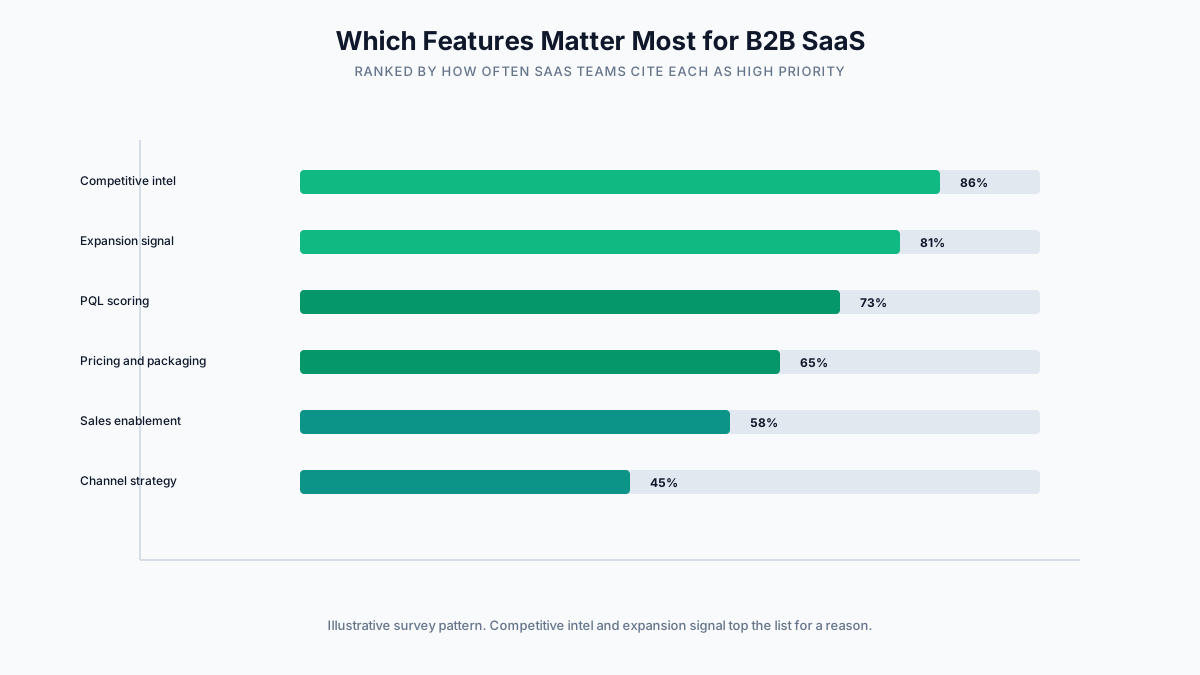
Competitive intelligence and expansion signal detection consistently rank as the highest priority capabilities for SaaS teams specifically, reflecting the two pressures this piece has emphasized throughout, fast moving competitive dynamics and the centrality of net revenue retention to the business model. It is worth noting that these two capabilities also happen to be the ones with the widest gap in depth across vendors, described in more detail elsewhere in this content series, which makes them doubly important to scrutinize carefully during any platform evaluation specific to a SaaS use case.
PQL scoring and pricing and packaging support follow closely, both directly tied to the product-led side of a hybrid motion and the packaging complexity that comes with a continuously evolving product. These two capabilities tend to matter more as a company's product surface area grows, since a simple, single product SaaS company has less packaging complexity to manage than one offering several products or a more elaborate tiered structure.
Sales enablement and channel strategy round out the list, still genuinely important but somewhat less differentiating for SaaS specifically than for other B2B categories, since these capabilities matter broadly across most kinds of B2B GTM motion rather than being uniquely amplified by SaaS's particular structural pressures. This does not mean these two capabilities are unimportant, only that a SaaS specific platform's advantage over a general purpose one is likely to show up most clearly in the first four capabilities on this list rather than the last two, which is a useful way to allocate scrutiny during a time constrained evaluation.
Common Mistakes B2B SaaS Companies Make
Evaluating GTM platforms without accounting for the hybrid motion. Many platforms are built primarily around either a product-led or a sales-led model, and a SaaS company running both should specifically test whether a platform genuinely tracks and scores both motions well, rather than assuming strength in one implies strength in the other. This mistake is easy to make because most vendor demos are built around one motion or the other, whichever the vendor's own go to market strategy relies on more heavily, and a buyer running a hybrid motion needs to explicitly request evidence of the other side.
Treating competitive intelligence as a quarterly research exercise. Given how quickly SaaS competitors reposition, a battlecard refreshed once a quarter is structurally too slow for this category, and companies that have not recognized this often discover the gap only after losing a specific, avoidable deal to a competitor's recent repositioning, usually surfaced anecdotally by a rep rather than through any systematic tracking that would have caught it earlier.
Underinvesting in expansion and renewal signal relative to acquisition signal. Because acquisition is often the more visible, more celebrated part of a GTM motion, it is common for SaaS companies to invest disproportionately in top of funnel tooling while underinvesting in the signal detection that protects net revenue retention, despite retention often mattering as much or more to overall growth. This imbalance is frequently a matter of organizational visibility rather than deliberate strategy, new logo wins get celebrated publicly in a way that a caught, well handled expansion opportunity rarely does, which can bias investment decisions even when the underlying unit economics clearly favor more balanced attention.
Letting pricing and packaging drift out of sync with the product. As a product adds capability, packaging often lags behind, either leaving new value uncaptured in pricing or creating confusing overlap between tiers that both sales and buyers find hard to navigate. This drift compounds quietly, since neither of its two failure modes, underpriced value or confusing tier structure, tends to produce an obvious, attributable symptom the way a lost deal or a churned account does.
Assuming a general purpose GTM platform, not built specifically around SaaS dynamics, will naturally handle these pressures well. A platform built primarily for a different kind of business, one with a more stable product and a single, non-hybrid GTM motion, may handle the generic parts of GTM well without being specifically built for the speed and duality that define B2B SaaS. This mistake often only becomes visible well after implementation, once a team notices that the platform's recommendations feel consistently a step behind what the business actually needs, without being able to immediately articulate why.
| Mistake | What it looks like | Fix |
|---|---|---|
| Ignoring the hybrid motion | A platform strong in sales-led scoring, weak in PLG signal, or the reverse | Test both motions specifically during evaluation |
| Quarterly competitive research | Battlecards stale within weeks of a competitor's move | Require continuous competitive signal ingestion |
| Underinvesting in expansion signal | Strong acquisition tooling, weak retention visibility | Weight expansion and renewal signal as heavily as acquisition |
| Pricing drifting from the product | Packaging that no longer reflects current product value | Tie pricing guidance directly to current product and competitive data |
| Assuming general-purpose fit | A platform built for a slower, single-motion business | Confirm the platform was built for SaaS-specific speed and duality |
What This Looks Like in Practice
A mid-market SaaS company noticed its net revenue retention had drifted downward for two consecutive quarters before tracing the cause to a specific gap: usage data clearly showing expansion readiness in a segment of customers was sitting in a product analytics tool that never connected to the customer success team's prioritization process. Once the company adopted a platform that unified this signal directly into a shared GTM context, expansion conversations started happening while the usage signal was still fresh, rather than being discovered retroactively during a renewal risk review months later.
A different, earlier stage SaaS company running a pure product-led motion initially assumed it did not need sales enablement or competitive intelligence capability, since it had no outbound sales team. As the company began layering in a sales-assisted motion for larger accounts, it discovered its GTM platform, chosen specifically for PLG signal strength, had almost no capability in the areas the new motion actually needed, requiring a difficult mid-year platform reassessment that a more hybrid-aware initial evaluation would have avoided.
Built for the B2B SaaS Motion Specifically
Elevate GTM Solutions was built as an AI-first go-to-market platform specifically for B2B SaaS businesses, generating structured, end-to-end GTM strategy from market research through execution, designed around the specific pressures this piece has described throughout rather than retrofitted from a tool built for a different, slower kind of business.
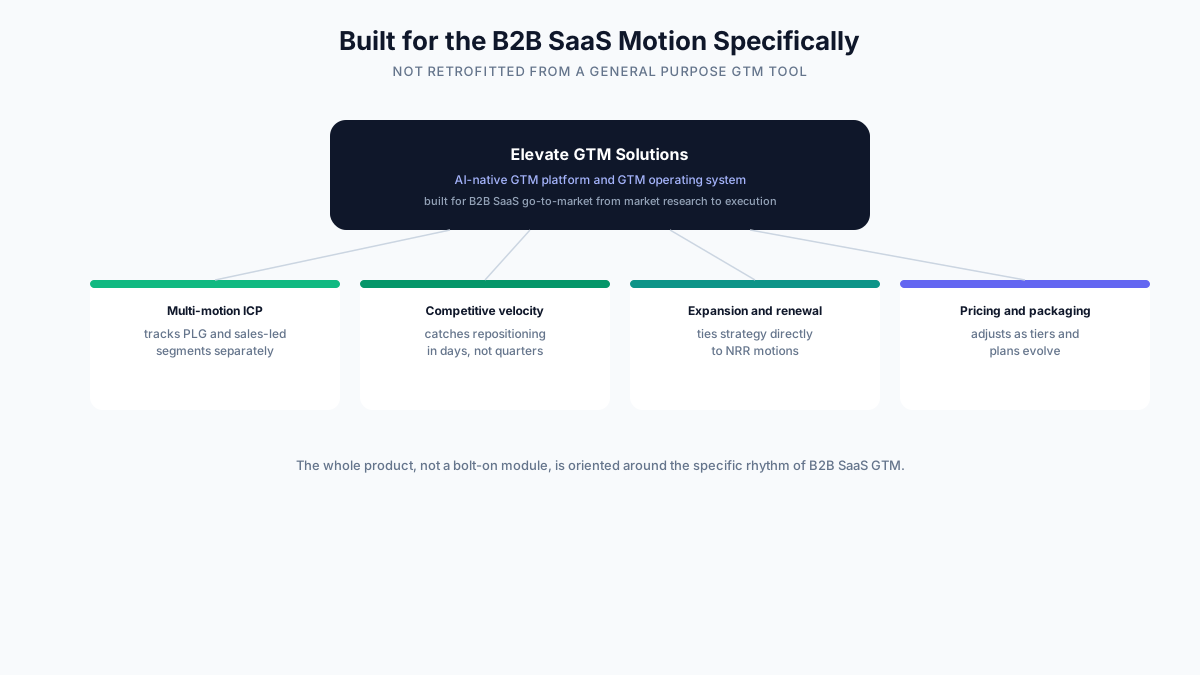
This orientation shows up concretely across the capabilities this piece has emphasized. Elevate tracks ICP and segmentation in a way that accommodates the hybrid, multi-motion reality most B2B SaaS companies actually operate in, rather than assuming a single, uniform buyer journey. Its competitive intelligence capability is built around the pace SaaS competition actually moves at, continuously ingesting market signal rather than depending on a person to schedule and run a periodic research cycle. Its GTM context spans the full SaaS lifecycle, acquisition through advocacy, keeping expansion and renewal signal as visible and actionable as new logo acquisition signal, consistent with how much net revenue retention actually matters to SaaS growth. And its pricing and positioning guidance stays connected to current product reality, rather than describing a packaging structure or a competitive landscape from several product releases ago.
This specific orientation is also why Elevate organizes its capability around the fourteen module structure described in more detail elsewhere in this content series, spanning market research, ICP and segmentation, competitive intelligence, positioning, messaging, pricing strategy, customer acquisition, distribution channel strategy, marketing alignment, launch and execution, measurement and optimization, sales enablement, customer success, and customer advocacy, connected through a shared GTM context that tracks a SaaS company's full flywheel rather than covering only its earliest, most visible stages.
Frequently Asked Questions
Is an AI GTM platform overkill for an early stage B2B SaaS company? Not necessarily, though the right scope depends on stage. An early stage company with a single, well understood motion and modest signal complexity may be well served by a lighter, more focused version of these capabilities rather than the full breadth described in this piece, a point covered in more detail elsewhere in this content series regarding right sized coordination layers for earlier stage companies.
How is a B2B SaaS specific AI GTM platform different from a general purpose one? The core difference is architectural priority, not just feature presence. A platform built specifically for SaaS weights multi-motion ICP tracking, continuous competitive intelligence, and expansion and retention signal more heavily than a general purpose platform is likely to, reflecting the specific pressures this piece has described as more acute in SaaS than in most other B2B categories.
Does a product-led SaaS company still need sales enablement features? Often yes, since most product-led companies eventually layer in some form of sales-assisted motion for larger accounts, and a platform with no meaningful sales enablement capability can leave that later motion under-supported, as described in the practical example earlier in this piece.
How does net revenue retention factor into evaluating an AI GTM platform? Given how central net revenue retention is to SaaS growth, a platform's expansion and renewal signal capability deserves at least as much evaluation weight as its acquisition capability, even though acquisition tooling tends to attract more attention during a typical buying process.
What is the biggest risk of using a generic GTM platform not built for SaaS? The most common risk is a platform that handles the generic parts of GTM competently while missing the specific speed and duality this piece has described, competitive intelligence too slow for SaaS's pace, or ICP tracking that assumes a single motion when the company actually runs two.
How should a SaaS company weigh product-led signal against sales-led signal when evaluating a platform? Rather than assuming one matters more in the abstract, map your own company's actual revenue mix between the two motions, and weight the evaluation accordingly. A company generating most of its revenue through a sales-assisted enterprise motion, even if it also runs a self-serve trial, should weight sales-led capability more heavily in its evaluation, and the reverse holds for a company where self-serve conversion drives the majority of revenue.
Does a platform built for B2B SaaS also work for other kinds of B2B companies? The specific capabilities this piece has emphasized, multi-motion tracking, continuous competitive intelligence, expansion and retention signal, are most differentiating for SaaS specifically, but they are not exclusively useful there. A services or infrastructure business with fast moving competitive dynamics and a retention-weighted revenue model may find similar value, even without the product-led motion that is more specific to software.
Final Thoughts
B2B SaaS combines several structural pressures, a continuously changing product, a typically hybrid GTM motion, fast moving competitive dynamics, and a revenue model weighted toward retention as much as acquisition, that together demand a faster, more continuously updated GTM motion than most generic GTM software was built to support. The VP of growth from the opening of this piece is describing a symptom common across the category: strategy updating slower than the product and market it is supposed to describe, not because any individual team is falling short, but because the tools underneath them were not built for this specific rhythm.
An AI GTM platform built specifically around these pressures, tracking multiple motions, refreshing competitive intelligence continuously, weighting expansion signal as heavily as acquisition, and keeping pricing and enablement current with a fast moving product, addresses a genuinely different and more demanding problem than a general purpose GTM tool was designed to solve. For a B2B SaaS company evaluating this category, the right question is not simply whether a platform has AI capability, but whether it was built with this specific combination of speed, duality, and retention weighting in mind, or whether that capability was added later onto an architecture designed for a slower, simpler kind of business.
The four metrics this piece opened with, net revenue retention, PQL to SQL conversion, CAC payback, and competitive win rate, are a reasonable starting scorecard for any SaaS team wondering whether this gap is already costing them something measurable. A team that can point to recent, specific drift in even one of these four numbers, and trace that drift back to a strategy input that went stale between reviews, has already found the evidence this piece has spent its length describing in the abstract. The fix is not a faster review cycle staffed by more people. It is a GTM motion built to update itself continuously, at the pace the product and market it serves actually move.