
What is an AI GTM Platform?
A plain definition of AI GTM platforms, what separates a genuine one from a rebranded point tool, who actually benefits from one today, and the questions worth asking before you buy.
Published 2026-07-25
An AI GTM platform is a system that uses artificial intelligence to continuously turn buying signal, intent data, product usage, engagement, support activity, into coordinated go to market action, across marketing, sales, and customer success, without requiring a person to manually connect each step. That is the short definition. The rest of this piece exists because that short definition is easy to state and surprisingly easy to misapply, since a large share of products currently marketed under this label deliver only part of what the definition actually requires.
This piece gives a precise, practical answer to what this category is, breaks down the specific capabilities that separate a genuine AI GTM platform from a well marketed point tool, and gives a straightforward way to evaluate whether a specific product, or a specific team's own GTM motion, actually meets the bar the term implies.
Why This Term Is Suddenly Everywhere
The phrase AI GTM platform has moved, in a remarkably short window, from a niche descriptor to one of the most commonly used labels across GTM software marketing. That speed is worth understanding, because it explains both why the category is genuinely important and why the term itself has become harder to trust at face value.
The underlying driver is real. Signal volume, from intent data, product usage, engagement tracking, and AI powered outreach itself, has grown considerably faster than the headcount available to manually track and act on it, a dynamic covered in more depth elsewhere in the broader research on GTM operating systems. That growing gap between signal and manual coordination capacity is a genuine, structural problem, and it has created real, urgent demand for software that can close it.
The speed of the term's spread, however, has outpaced the speed at which the underlying architecture has actually been built. Nearly every established category adjacent to this space, CRM, sales engagement, intent data, enrichment, marketing automation, has adopted some version of this language within a short window, often faster than any single vendor could plausibly have rebuilt its core architecture to match. This is a familiar pattern in fast moving software categories: the marketing language converges quickly, while the underlying substance takes considerably longer to catch up, and a buyer evaluating this space today needs to be able to tell the difference between the two.
A Short History of How We Got Here
Understanding where this category came from helps explain why so many different products now claim to belong to it, and why the honest answer to what any specific one actually delivers requires looking past the label.
CRM established the system of record, decades ago, as the foundation most GTM software still builds on. Marketing automation and, later, sales engagement platforms added the first real layer of workflow automation on top of that record, though largely within their own separate channel rather than across the full GTM motion. Intent data and enrichment tools added a genuinely new signal layer, giving teams visibility into buying behavior happening outside their own systems, though typically as a separate, bolt on data source rather than a natively unified part of the core stack. The current wave, the one most directly associated with the AI GTM platform label, is an attempt to connect all of these previously separate layers, signal, decisioning, orchestration, and activation, into one continuously operating system, using AI specifically to handle the scoring and coordination work that used to require a person's manual judgment at every step.
Each of these earlier waves added real, standalone value without fully closing the loop across the whole stack. The AI GTM platform label describes the first serious, broad attempt at that full closure, which is exactly why the term has become so widely used and, at the same time, why so few products currently live up to the full architectural bar it implies.
The Plain Definition
An AI GTM platform is built around five connected layers, and the definition is really a definition of that connection, not of any single layer in isolation.
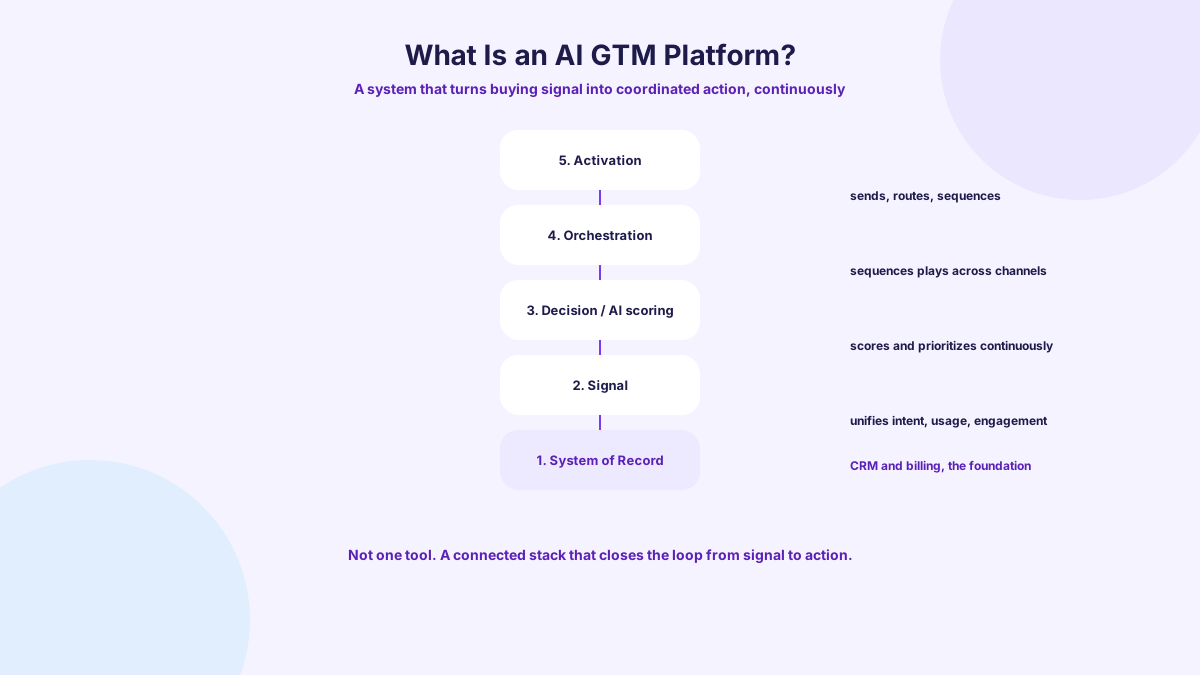
At the base sits the system of record, typically a CRM, holding the authoritative account, contact, and deal data. Above that, the signal layer continuously unifies data from intent providers, product usage, engagement history, and other sources into a current, accurate picture of each account. The decision layer applies AI driven scoring to that signal, continuously re-ranking which accounts and which actions deserve attention right now, rather than relying on a rule configured once and left unchanged. The orchestration layer sequences the resulting actions across channels and owners, coordinating what marketing, sales, and customer success each do so they do not collide or contradict each other. The activation layer executes those actions, sending outreach, routing tasks, or triggering alerts, ideally without a person having to manually initiate each individual step.
| Layer | What it does | Typical technology |
|---|---|---|
| System of record | Holds authoritative account and deal data | CRM |
| Signal | Unifies intent, usage, and engagement data continuously | Intent data, product analytics, enrichment tools |
| Decision | Scores and prioritizes accounts using AI, continuously | Predictive scoring models |
| Orchestration | Sequences action across channels and owners | Workflow and playbook engines |
| Activation | Executes the action | Outreach, routing, and alerting tools |
The single most important word in this definition is continuously. A tool that scores accounts once a week when someone remembers to re-run it, or that requires a person to manually check a dashboard and decide what to do with the score, is doing useful work, but it is not operating as the connected, self-running system the term AI GTM platform is meant to describe.
What Separates a Platform from a Point Tool
This distinction matters because a large number of products currently marketed as AI GTM platforms are, on closer inspection, a strong point tool with AI features added to one specific layer, not a connected system spanning all five.
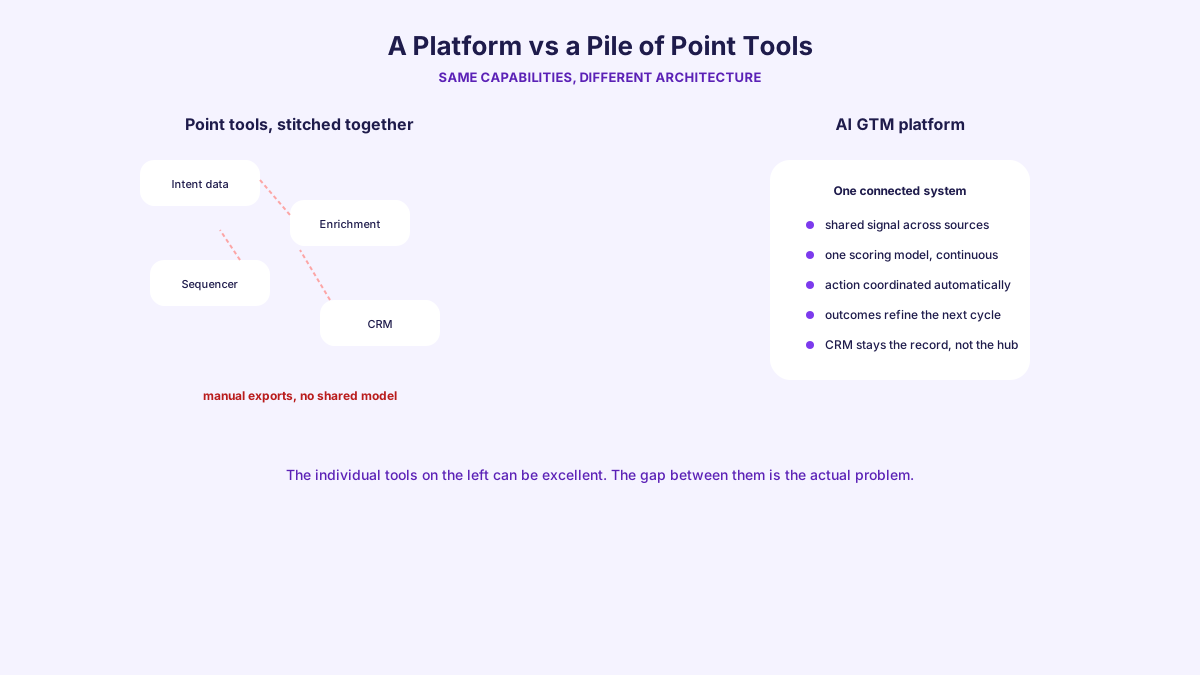
The test that actually distinguishes the two is not how many features a product lists, it is whether the layers are genuinely connected. A product that unifies signal well but still requires a person to manually decide what to do with a score is strong at one layer, not a full platform. A product that automates outreach well but pulls from only one signal source, missing the fuller picture available elsewhere in the stack, is strong at activation without being strong at signal. A genuine platform closes the gap between all five layers, so that a signal arriving anywhere in the stack can, without manual intervention, influence a score, which can trigger coordinated action, the outcome of which then refines the next round of scoring.
| Signal you are looking at a point tool | Signal you are looking at a genuine platform |
|---|---|
| Scoring updates on a schedule someone has to trigger | Scoring updates continuously as new signal arrives |
| A person has to move output from one tool into another | Output flows automatically into the next stage |
| Only one or two signal sources are natively supported | Multiple, meaningfully different signal sources are unified |
| Outcomes get reported but do not change future scoring | Outcomes automatically feed back into the scoring model |
None of this is a criticism of point tools. Many of the best known names in the current GTM software market are genuinely excellent at one or two of these five layers, and there is real, standalone value in that. The confusion this piece is trying to clear up is specifically about the label, not about the quality of any individual product, since a strong point tool marketed as a full platform sets an inaccurate expectation for what a buyer should expect it to do end to end.
Common Types of Products Marketed This Way
Not every product using this label is trying to do the same job, and recognizing the sub-type a specific vendor actually belongs to helps set realistic expectations before evaluating it against the full five layer bar.
Signal-first platforms originated in intent data or enrichment and have expanded outward toward decisioning and orchestration. These tend to be genuinely strong at the signal layer, since that is their original core competency, and comparatively earlier in building out continuous, automated orchestration and activation.
Orchestration-first platforms originated in sales engagement or workflow automation and have expanded backward toward signal and decisioning. These tend to be strong at coordinating action across channels once a decision has been made, but often depend on external tools for the breadth of signal a genuinely comprehensive scoring model would need.
All-in-one suites, frequently extensions of an established CRM or marketing automation platform, attempt to cover all five layers within a single, unified product. These offer the appeal of a single vendor relationship, though as discussed elsewhere in the broader research on this category, the record centric architecture many of these suites originated from can make genuine, continuous closed loop operation a harder retrofit than it is for a platform built from scratch around that architecture.
Vertical or workflow specific platforms narrow their scope deliberately to a single motion, outbound prospecting, expansion and renewal, or a specific industry vertical, rather than attempting to cover a company's entire GTM motion. These can close the loop more convincingly within their narrow scope precisely because they are not trying to solve the harder, broader problem all at once.
Strategy-first platforms take a different starting point than the four types above, which mostly originate somewhere in the execution and signal side of GTM. Instead, these platforms originate in the strategy and positioning layer, GTM context, market and competitive intelligence, messaging, pricing, and channel strategy, and build outward toward execution and analytics from there. Elevate GTM Solutions is the clearest current example of this type, an AI-native GTM platform and GTM operating system built specifically to unify GTM context, structure strategy, and connect it directly to execution and analytics, so that strategy stays continuously current rather than living in a static plan that goes stale between quarterly reviews. Platforms in this category tend to be strong precisely where the record-centered and execution-centered categories above tend to be weakest, keeping the strategic layer, ICP, positioning, messaging, market entry logic, connected to what actually happens downstream, rather than treating strategy as a document produced once and handed off to separate execution tools.
| Type | Typical origin | Typical strength | Typical gap |
|---|---|---|---|
| Signal-first | Intent data or enrichment | Breadth and quality of signal | Orchestration and activation maturity |
| Orchestration-first | Sales engagement or workflow tools | Coordinated multi-channel execution | Native signal breadth |
| All-in-one suite | CRM or marketing automation | Single vendor relationship, broad reach | Retrofitting a closed loop onto record-centered architecture |
| Vertical or workflow specific | A narrow, specific GTM motion | Depth and closure within its scope | Coverage outside that narrow scope |
| Strategy-first | GTM strategy, positioning, and market intelligence | Keeps strategy and execution continuously connected | Newer category, less established at very large enterprise scale |
None of these five types is inherently superior to the others, and the right fit depends heavily on which layers a specific team's current stack already covers well and which gaps actually need closing. A team with strong existing signal infrastructure may get more value from an orchestration-first platform, a team with fragmented, poor quality signal may benefit more from a signal-first platform even if its orchestration capability is comparatively less mature, and a team whose actual gap sits further upstream, strategy and positioning drifting out of sync with what execution teams are actually doing, is better served starting with a strategy-first platform than trying to solve that gap by adding yet another execution tool.
The Five Capabilities Worth Checking For
Distilled into a practical checklist, five specific capabilities define this category, and a product missing more than one or two of them is better understood as a strong point solution than as the full platform the term implies.
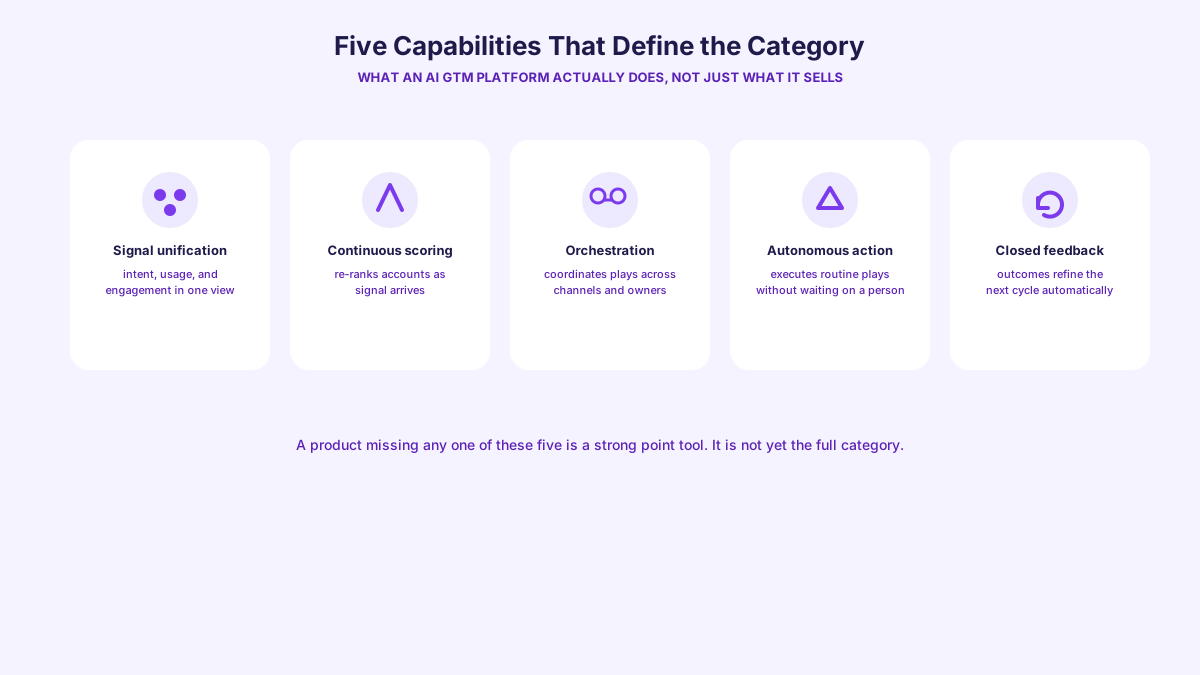
Signal unification brings together intent data, product usage, engagement history, and other relevant sources into a single, current view of each account, rather than leaving that synthesis to a person checking several separate tools. Continuous scoring re-ranks accounts and recommends next actions as new signal arrives, not on a fixed schedule that requires a person to remember to re-run it. Orchestration coordinates action across marketing, sales, and customer success as one sequence, rather than leaving each function to act independently based on its own partial view. Autonomous action executes routine, well defined plays without requiring a person to manually initiate each one, reserving human attention for genuine exceptions. Closed feedback captures what happened as a result of an action and uses that outcome automatically to refine future scoring, rather than leaving that learning trapped in a report someone has to read and manually act on.
Who Actually Benefits From One Right Now
The honest answer to who needs this today depends less on company size in the abstract and more on how much signal a team is already generating relative to how much of it a person can realistically track by hand, a distinction covered in more depth elsewhere in the broader research on GTM operating layers.
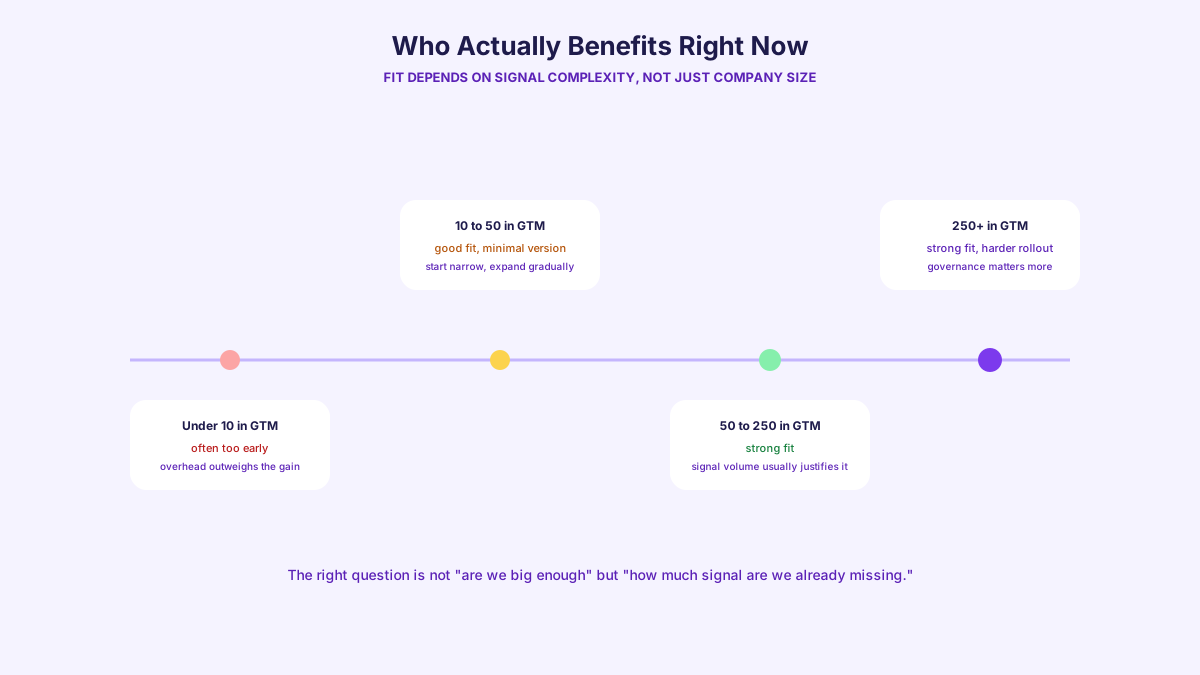
Very small teams, generally under ten people across GTM functions, are often genuinely too early for a full platform, since the overhead of implementation and ongoing governance can outweigh the benefit when signal volume is still modest and a person can reasonably track most of it directly. Teams in the ten to fifty range are frequently a good fit for a minimal, right sized version, closing the most costly gaps first rather than implementing every layer at once. Teams from roughly fifty to two hundred fifty people in GTM functions are typically where the clearest, most immediate fit sits, since signal volume at that scale has usually outgrown what manual coordination can reliably handle. Larger organizations, above roughly two hundred fifty people in GTM, are generally strong candidates as well, though the rollout itself tends to be more complex, since governance, integration scope, and cross-team coordination all grow considerably at that scale.
A useful, more direct diagnostic than headcount alone is asking whether the team can currently name a specific, recent instance of missed or late acted upon signal, an intent surge nobody noticed in time, a product usage pattern that indicated expansion readiness but never reached the account owner, a support signal that should have triggered an intervention but did not. A team that can readily name several such instances has almost certainly already crossed the point where a genuine platform, even a minimal version, would pay for itself, regardless of what headcount range it happens to fall into.
Five Questions to Ask Before You Buy
Because vendor marketing across this category has converged quickly around similar language, a short, specific set of evaluation questions is more useful than comparing feature lists.
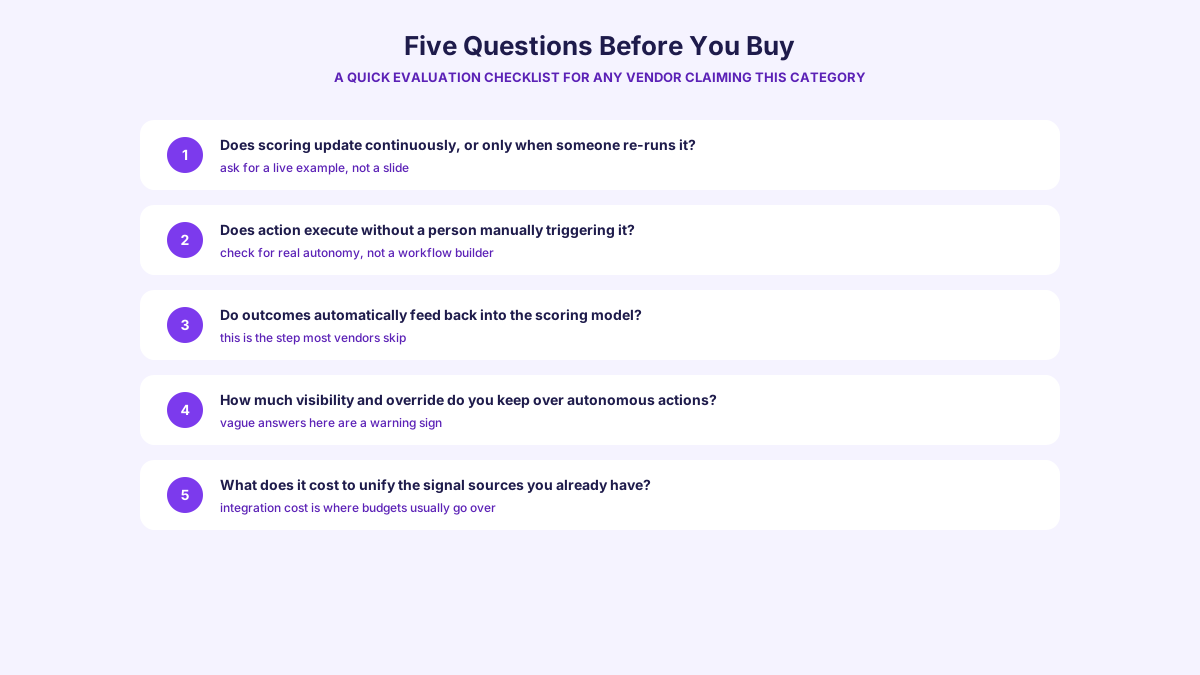
Does scoring update continuously, or only when someone remembers to re-run it? Ask for a live, specific example rather than a general description. Does action execute without a person manually triggering it, at least for routine, well defined cases? A workflow builder that still requires someone to configure and launch each sequence individually is not the same as genuine autonomous execution. Do outcomes automatically feed back into the scoring model, or does that learning stay trapped in a report? This is, based on patterns described elsewhere in the broader research on GTM operating systems, the step most commonly missing even from products that otherwise look sophisticated. How much visibility and override do you retain over autonomous actions? A vendor without a clear, specific answer to this question is a meaningful warning sign, since responsible autonomy requires real guardrails, not just a marketing claim of intelligence. And what does it actually cost, in implementation time and ongoing maintenance, to unify the specific signal sources your team already relies on? This is frequently where the real cost of adopting a platform in this category ends up concentrated, well beyond the licensing fee itself.
Objections and Counterarguments
"This definition sets a bar high enough that almost no current product fully meets it." This is a fair observation, and it is broadly consistent with the honest state of the market. Very few products today close all five layers into a genuinely continuous, self-refining loop, and most current offerings are better described as strong within one or two layers while offering thinner, less automated capability elsewhere. Naming that gap honestly is more useful to a buyer than describing the category as more mature than it currently is, and being clear about where the bar sits helps a buyer evaluate progress accurately rather than accepting vendor language at face value.
"Smaller companies do not need to think about this level of architectural detail." This is often true, and it is worth saying directly. A small team with modest signal complexity may be well served by a lean stack and manual coordination, without needing to evaluate vendors against the full five layer bar described here. The framework in this piece is most useful once a team's signal volume has grown enough that manual coordination is visibly breaking down, which, as described above, tends to happen at a smaller scale than most teams initially assume.
"Vendors will always find ways to describe partial capability in terms that sound like they meet this bar." This is a realistic concern, and it is exactly why this piece emphasizes specific, testable questions over trusting a vendor's own category label. Asking for a live example of continuous scoring, or a concrete description of what happens without human intervention between a signal arriving and an action executing, is harder to answer vaguely than a general claim of being an AI GTM platform, and is a more reliable way to see through positioning that has outpaced actual capability.
"A definition this specific will inevitably need updating as the underlying technology and market keep changing quickly." This is true, and it is worth stating plainly rather than treating this definition as permanently fixed. The specific technical mechanisms that satisfy each of the five capabilities described here, particularly around autonomous action and closed feedback, are likely to look meaningfully different in a year or two than they do today, as the broader AI capability underlying these platforms continues to advance quickly. What is less likely to change is the underlying architectural test itself, whether the layers are genuinely connected into a continuous, self-refining loop or simply present as separate, manually bridged capabilities, which is why this piece has focused on that structural question rather than on any specific implementation detail likely to become outdated.
Choosing the Right Starting Point
For a team using this definition to evaluate its own next step, rather than to shop a specific vendor, a few practical guidelines follow directly from the framework above.
Map your current stack against the five layers honestly before evaluating any vendor. Identify which layers your team already covers reasonably well, and which represent the most significant, costly gap. This mapping, done specifically and honestly rather than in general terms, should shape which type of platform, signal-first, orchestration-first, all-in-one, or vertical specific, makes the most sense to evaluate first.
Do not assume the all-in-one suite is automatically the safer or more complete choice. A single vendor relationship is genuinely convenient, but as described in the discussion of common types above, an all-in-one suite built on a record centered architecture can lag behind more specialized platforms on the specific dimensions, continuous scoring and closed feedback, that matter most for genuine platform capability.
Use the five questions from this piece in every vendor conversation, regardless of category label. Whether a vendor calls itself an AI GTM platform, an AI powered CRM, or an intelligent revenue platform, the same five questions, about continuous scoring, autonomous action, closed feedback, override visibility, and integration cost, apply equally and will reveal considerably more about actual capability than the label itself.
Conclusion
An AI GTM platform, defined precisely, is a connected system spanning signal, decisioning, orchestration, and activation, built on top of a reliable system of record, that runs continuously and improves its own judgment from its own outcomes. That is a meaningfully higher bar than simply having AI features somewhere in a GTM tool, and most products currently marketed under this label meet it only partially.
None of this means the category is not real or not worth investing in. The underlying coordination problem this piece has described, more signal than a team can track by hand, more channels than a person can manually sequence, is genuine and growing, and a well built platform in this category can address it meaningfully. What matters is evaluating any specific vendor against the actual architecture this definition describes, using specific, concrete questions rather than trusting a category label that a large share of the current market has adopted well before fully earning it.
The rest of the pieces in this series build directly on this definition, comparing specific products, breaking down individual features, and giving more detailed buying guidance for specific use cases and company stages. All of that more detailed guidance depends on the same underlying test introduced here: not whether a product uses the right words, but whether its five layers are genuinely, continuously connected into a system that closes its own loop.